Division IX (include assigned division number from I to X)
ANALYSIS OF TEMPERATURE AND INTERNAL PRESSURE LOADING
EFFECT ON PSC CONTAINMENT STRUCTURE WITH UNBONDED
TENDON
Yangsu Kwon1, and Kwang-Ho Joo2
1 Ph. D., Site & Structural Engineering Group, KHNP CRI, Korea
2 Principal Research Engineer, Site & Structural Engineering Group, KHNP CRI, Korea
ABSTRACT
Because the high temperature changes the material properties including mechanical and thermal properties used in nuclear power plant structures, the global behavior of containments subjected to the internal pressure under elevated temperature, such as LOCA or any severe accident in containments, is different from that subjected to the internal pressure only. This paper conducts the nonlinear finite element analyses of PSC containment structures, and the effect of the consideration on the temperature effect has been concluded because severe accident usually accompanies internal high pressure together with a high temperature increase. It has been try to find the behavior of the unbonded tendon considering tension stiffening effect of concrete and bond-slip effect between tendon and concrete for high temperature condition also. This paper, accordingly, the three-dimensional full-model were developed based on the 1/4 scale PCCV test by Sadia Lab and compare results from numerical and experiment data for verification. And then three-dimensional analyses for the same structure have been performed by considering internal pressure and temperature loadings for some levels. From the results of parametric study, varying load cases, tendon type and strength. Through the difference in the structural behavior of containment structures according to the addition of temperature loading, the elevated temperature effect on the concrete, tendon and interaction between concrete and tendons of containment structure has been emphasized.
INTRODUCTION
One of the major structures in a nuclear power plant (NPP) is a massive containment structure which surrounds the nuclear power furnace and related components. Such a containment structure has a thick walled prestressed concrete (PSC) cylindrical shell with a spherical dome, whose design has been strictly guided by related design codes, and an exact prediction of its ultimate resisting capacity under extreme design loads is also essential in design procedure because it serves as a final barrier to prevent the dissemination of radioactive materials in any case of accident.
NUMERICAL ANALYSIS
Finite Element Model : 1/4 PCCV
As shown in Fig. 1 which represents the overall geometry of a 1/4 PCCV tested by Hesshimer et al.(2003), the containment is composed of a circular base slab, an upright cylinder with two buttresses to accommodate the anchorages for the prestressing tendons being located symmetrically around the wall and a hemispherical dome. The overall height is 16.4m, and the radius of the cylinder is 5.3m. The cylinder’s wall thickness is 0.32m, reducing to 0.275m in the dome after a short transition region. The bottom of the cylinder is joined to a base that is 3.5m thick.. The design pressure for the example structure is 0.39MPa, and details of the geometry and dimensions of the containment are provided in reference (Hessheimer et al., 2003; Dameron et al., 2003)
Equipment hatches and penetrations on the containment are considered for more exact evaluation of structural behavior induced from non-symmetric configuration of structure. 84,658 three-dimensional solid elements (named C3D10R element in ABAQUS) are based in the numerical modeling of the containment from the dome to the foundation, and the passive reinforcements embedded in concrete matrix are considered by using the layered steel model. In advance, the liner plate is considered by the membrane element (named M3D4R in ABAQUS) and 9000 elements are used. On the other hand, the internal tendons are described by the truss element (named T3D2 in ABAQUS) maintaining the placing space.
To describe the tensioning sequence in the tendon, sequential loading steps of self-weight, post-tensioning and internal pressure are considered, and the prestressing losses caused by the friction and anchorage slip are taken into account on the basis of the values measured from the Sandia National Laboratories 1:4 scale PCCV experiment (Hessheimer et al., 2003).
3500 2450 2525 5775 ø14400 ø10750 ø11400 ø1540 4675 5125 E/H M/S F/W F/W M/S E/H A/L 0⁰ 180⁰ 270⁰ 135⁰
Plan View Through Cylinder
Figure 1. Configuration of 1/4 scale PCCV (Hessheimer et al.,2003)
Table 1: Material properties used in 1/4 PCCV
Structure Concrete Rebar Liner Tendon
1/4 PCCV
25700
c
E = MPa
'
53.4
c
f = MPa
2.21
cr
f = MPa
190
s
E = GPa
480
y
f = MPa
620
u
f = MPa
190
liner
E = GPa
, 380
liner y
f = MPa
, 480MPa liner u f = seven-wire strand ( 2 339 p
A = mm ) 1900
pu
Material Model
For modelling the behavior of material used in containment structure, the stress-strain relation should be defied. Concrete stress can be determined by substituting only the mechanical strain component into stress-strain relationship. In describing the uniaxial stress-strain behavior of concrete, many empirical formulas have been proposed, and the consideration of the effect by elevated temperature is not exceptional. In this paper, the stress-strain relationship proposed by Lie and Lin (1985) is used because it is effectively describing the thermal characteristics of concrete ascertained by experiment.
In case of steel, since both mechanical properties of the Young’s modulus and the yield strength are degraded with high temperature, the definition of the stress-strain relation of steel according to the elevated temperature is necessary to reflect the degradation of the material properties. The stress-strain relationship of the steel reinforcement in EN1992-1-2 is used in this paper because a material model introduced in EN1992-1-2 (2004) represents the flexible stress-strain relationship which can effectively include the at creep effect in the elevated temperature.
Unbonded Tendon Model
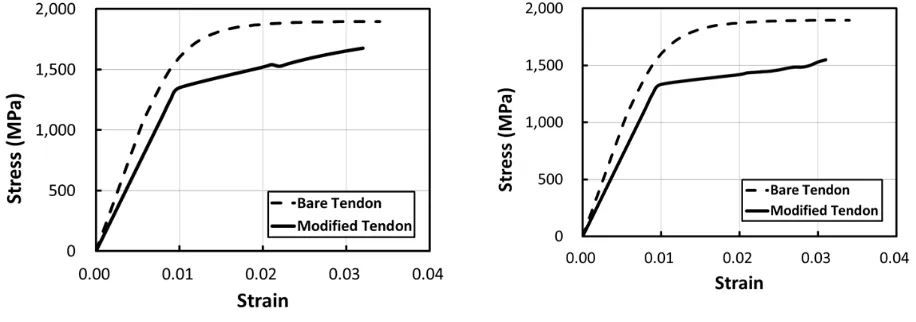
Fig. 2 shows the average stress-strain relations of prestressing tendon modified by considering the tension stiffening and bond-slip effects according to the numerical algorithm introduced in this paper. Especially the relation corresponding to the un-bonded internal tendon is constructed through the iteration procedure adopted to take into account the slip effect along the length. In Fig. 2, it can be found that there is a slight difference in the average stress-strain relations between hoop tendon and meridional tendon, and larger slip effect can be expected at the meridional tendon. More details related to the iteration procedure for the un-bonded internal tendons can be found elsewhere (Kwak and Kim, 2006).
(a) Hoop tendon (b) Meridional tendon
Figure 2. Modified stress-strain relationships of prestressing tendon
Definition of Severe Accident Loading
(ISP-48, 2005). More details related to the description of each loading cases can be found elsewhere (ISP-(ISP-48, 2005; Hessheimer, 2006).
Before application of thermal loading to the same structure of a 1/4 PCCV 3D-model, the heat transfer analysis was conducted to evaluate the distribution of temperature across the section and to determine the corresponding material properties of concrete and steel depending on the changed temperature.
(a) Case 1 Saturated Station Condition (b) Case 2 Station Blackout Scenario Figure 3. Pseudo-Pressure/Temperature Time Histories (ISP-48, 2005)
Numerical Analysis Results
A commercial program of ABAQUS was used in the heat transfer analysis, and the finite element with temperature degrees of freedom only (Dassault Systems, 2007) was used. In advance, the base material properties of containment were obtained from the reports of NUREG-6809(Dameron et al., 2003) and NUREG-6810(Hessheimer et al., 2003) which describe the material properties of 1/4 PCCV used in the experiment. Thermal bonding conditions were imposed at the outer surface of the PCCV cylinder and dome wall consisting of free convention with air of a temperature 25⁰C.
As shown in these figures, both analytical results of considering and ignoring the change in material properties with temperature do not represent the remarkable difference for both temperature time histories. It means that the change in material properties with temperature does not affect to the temperature distribution itself and has a minor effect.
(a) Temperature Distribution for Case 1 Loading (b) Temperature Distribution for Case 2 Loading Figure 4. Temperature Distribution across the Wall under the Maximum Temperature
of considering (w/ degradation in Figs. 5 and 6) and ignoring (w/o degradation in Figs. 5 and 6) the change in the material properties at the elevated temperature were conducted while applying the temperature loading simultaneously with pressure loading, and the following results were also obtained: (1) more remarkable difference in the ultimate resisting capacities between considering and ignoring the change in the material properties with temperature was occurred at Case 1 loading history; (2) Case 2 loading history developed larger deformations through the whole structure because of relatively higher maximum temperature which accompanies not only an increase of the temperature loading but also a larger decrease of the structural stiffness across the depth of wall and dome; but (3) the additional consideration of the temperature loading changes neither the failure mode nor the critical location where the structural failure starts (see Table. 2).
(a) Mid-Height of Cylindrical Wall (b) ) Dome Apex
Figure 5. Pressure – Displacement Curve of Case 1 Scenario
(a) Mid-Height of Cylindrical Wall (b) ) Dome Apex
Figure 6. Pressure – Displacement Curve of Case 2 Scenario
Table 2: Ultimate Pressure (Load) and Failure Mechanism
Case
Crack Occurring
(MPa)
Yield of Liner Plate
(MPa)
Ultimate Pressure (MPa)
Failure Mechanism
CONCLUSION
In this paper, three-dimensional non-linear analyses considering internal pressure and temperature loadings were conducted to evaluate the severe accident in NPP containments. To take into account the tension stiffening and the bond-slip effects developed at the interface of two adjacent materials of concrete and tendon, a modified stress-strain relation of tendon has been proposed on the basis of the constitutive materials of concrete and steel, and as such they can effectively be used in modelling a large three-dimensional PSC structures. The finite element modelling of PCCV has been verified through a comparison of experimental results and numerical results for the 1/4 PCCV which was tested under internal pressure loading condition. From the numerical analyses considering the additional nonlinear effect induced from the elevated temperature, furthermore, the following conclusions were obtained: (1) due to the degradation of mechanical properties of which elastic modulus and strength, its ultimate strength have been down up to 15%; (2) in addition to temperature effect to PCCV, the duration of high temperature also affects to the non-linear behavior of structure as one of major influencing factors; and (3) comparing the analysis results, the structural behavior can be largely affected by high temperature and its duration. Therefore, ignorance of the temperature effect may cause about 10 to 20% overestimation to the ultimate capacity of PCCV. It means that the temperature loading as well as the change in the material properties with temperature must be taken into consideration to exactly predict the nonlinear behavior of PCCV up to reach the ultimate loading condition.
REFERENCES
Dameron, R.A., Hansen, B.E., Parker, D.R., Rashid, Y.R., Hessheimer, M., Costello, J.F. (2003), Posttest Analysis of the NUPEC/NRC 1:4 Scale Prestressed Concrete Containment Vessel Model, NUREG/CR-6809, SAND2003-0839P, ANA-01-0330. San Diego, CA: ANATECH Corporation, Albuquerque, NM: Sandia National Laboratories.
Dassault Systemes Simulia Corp. (2010), Abaqus User's Manual, Version 6.10, Rhode Island, USA. Eurocode 2 (2004), Design of Concrete Structures. Part 1–2: General Rules-Structural Fire Design, EN
1992-1-2, Commission of European Communities, Brussels.
Hessheimer, M. F., and Dameron, R. A. (2006), Containment Integrity Research at Sandia National Laboratories, Division of Fuel, Engineering and Radiological Research, Office of Nuclear Regulatory Research, US Nuclear Regulatory Commission.
Hessheimer, M. F., Shibata, S., and Costello, J. F. (2002), Results of Overpressurization Test of a 1: 4-Scale Prestressed Concrete Containment Vessel Model, The ASME Foundation, Inc., Three Park Avenue, New York, NY 10016-5990 (United States).
Kwak, H. G., and Kim, J. H. (2006), “Numerical Models for Prestressing Tendons in Containment Structures”, Nuclear Engineering and Design, 236(10), 1061-1080.