IMPACTS OF ROAD NETWORK CONNECTIVITY ON QUALITY OF IN ABUJA CITY
NUHU HONNEY TINI
A thesis submitted in fulfilment of the requirements for the award of the degree of Doctor of Philosophy (Transportation Planning)
Choose an item.
Faculty of Built Environment and Surveying Universiti Teknologi Malaysia
iii DEDICATION
iv
ACKNOWLEDGEMENT
To God Almighty be the glory; who marvellously helped me and made this work a success.
Words cannot sufficiently express my appreciation for the persistent guidance and care of my Supervisor, Assoc. Prof. Dr. Muhammad Zaly Shah, all through this research work. The support and contribution in all facets from Dr. Zahid Sultan and Dr. Mehdi Moeinadinni is also exceedingly acknowledged.
My enormous thanks goes to Nigerian Government for TETFUND sponsorship, and to Adamawa State University, Mubi for study leave.
I appreciate the support of my colleagues who in spite of tight research schedule sacrificed their precious time to train me in software applications. I specifically express my indebtedness to Dr. Hassan Adulaziz, Surveyor Anthony Tumba, Dr. Iraj Karimi, and Dr. Solomon Oluyinka.
The affections, prayers, and patience of my wife, Rita and children, Jehu, Jemimah, Jabin and Julia will keep on lingering in my heart for ever. Thanks for understanding and forbearing the many nights I was away.
v ABSTRACT
vi ABSTRAK
vii
TABLE OF CONTENTS
TITLE PAGE
DECLARATION ii
DEDICATION iii
ACKNOWLEDGEMENT iv
ABSTRACT v
ABSTRAK vi
TABLE OF CONTENTS vii
LIST OF TABLES xv
LIST OF FIGURES xvii
LIST OF ABBREVIATIONS xx
LIST OF SYMBOLS xxii
LIST OF APPENDICES xxiii
CHAPTER 1 INTRODUCTION 1
1.1 Research Background 1
1.2 Research Problem Statement 4
1.3 Research Aim 6
1.4 Research Objectives 6
1.5 Research Questions 6
1.6 Scope of the Study 7
1.7 Research Limitations 8
1.8 Significance of the Research 8
1.9 Structure of Thesis 9
CHAPTER 2 LITERATURE REVIEW 13
2.1 Introduction 13
viii
2.2.3 Economic Opportunity Model 14 2.2.4 Foundational Development Model 15
2.2.5 The Connection Model 15
2.3 Research Conceptual Framework 16
2.4 Research Gap 18
2.5 Urban Morphology and Form 22
2.5.1 Typology of Urban Form 23
2.5.2 Typology of Transportation Networks 25
2.6 Evolution of Road Network 27
2.6.1 Simple Theory of Networks 28 2.6.2 Economic Models of Networks 30
2.6.2.1 Random Models 30
2.6.2.2 Strategic Interaction Models 30
2.6.3 Science of Networks 31
2.7 Trends in Urban Road Transport Network
Dynamics 33
2.8 Road Network Connectivity 36
2.8.1 Concept of Road Connectivity 36 2.8.2 Components of Road Network Connectivity 38
2.8.2.1 Route Options 39
2.8.2.2 Transport Efficiency 40 2.8.2.3 Network Reliability 42
2.8.2.4 Traffic Flow 43
2.9 Societal Benefit and Cost of Road Network
Connectivity 44
2.10 Structural Measures of Road Network Connectivity 49
2.10.1 Network Density 52
2.10.2 Beta Index 53
2.10.3 Cyclomatic Number 53
2.10.4 Alpha Index 54
2.10.5 Gamma Index 54
ix
2.10.7 Aggregate Transportation Score 55 2.10.8 Significance of Graph Theory in Transport
Analysis 56
2.11 Quality of Life 57
2.11.1 Definition of Quality of Life 57 2.11.2 Quality of Life Concept 58 2.11.2.1 Preference Satisfaction 58 2.11.2.2 Flourishing Well-being 59 2.11.2.3 Objective Well-being 59 2.11.2.4 Subjective Well-being 60 2.11.3 Need for Assessment of Subjective Quality of Life 61 2.12 Transportation Network and Quality of Life 62 2.13 Existing Studies on Road Network Connectivity
and Societal Quality of Life 63
2.14 Road Network Connectivity Quality of Life
Indicators 68
2.14.1 Emotional Travel Safety 69
2.14.2 Social Interaction 70
2.14.3 Economic Well-Being 72
2.14.4 Travel Comfort 73
2.14.5 Personal Accessibility 74
2.14.5.1 Infrastructure-based Accessibility
measure 74
2.14.5.2 Location-based Accessibility
measure 75
2.14.5.3 Network Impedance Accessibility 75 2.14.5.4 Personal Mobility 76
2.15 Chapter Summary 77
CHAPTER 3 EXISTING SITUATION, TRANSPORTATION
NETWORK AND POLICY IN ABUJA CITY 79
3.1 Introduction 79
3.2 Physical Setting 79
x
3.2.2 Topography 81
3.3 Population 81
3.4 Historical Background 82
3.5 Urban Form of Abuja City 82
3.6 Land Use Pattern 84
3.6.1 Residential Areas 85
3.6.1.1 Asokoro District 85
3.6.1.2 The City Centre 86
3.6.1.3 Garki District 88
3.6.1.4 Guzape District 88
3.6.1.5 Maitama District 89
3.6.1.6 Wuse District 90
3.6.1.7 Utako District 91
3.6.1.8 Jabi District 91
3.6.1.9 Gwarimpa District 92 3.6.1.10 Lokogoma District 93
3.6.1.11 Kafe District 94
3.6.2 Commercial Areas 94
3.6.3 Industrial Areas 97
3.6.4 Recreational Areas 97
3.7 Urban Development and Transport Policy in
Abuja City 101
3.7.1 Accessibility 102
3.7.2 Transport System Integration 102
3.7.3 Traffic Management 102
3.7.4 Non-Motorized Transportation 103 3.7.5 Environmental Protection 103
3.8 Transportation Network 103
3.8.1 Air Transport 104
3.8.2 Rail Transport Network 104
xi
3.8.3.2 Urban Road Transportation 109
3.9 Chapter Summary 112
CHAPTER 4 RESEARCH METHODOLOGY 113
4.1 Introduction 113
4.2 Research Strategy 113
4.3 Method of Study 114
4.3.1 Types and Sources of Data 115
4.3.1.1 Types of Data 116
4.3.1.2 Sources of Data 116
4.3.2 Analytical Tools and Software 118 4.4 Population and Sampling Strategy 119
4.4.1 Sampling Unit 120
4.4.2 Population Sample Size 122
4.4.3 Population Sampling Procedure 124
4.5 Data Analytical Techniques 127
4.5.1 Road Network Spatial Analysis 127 4.5.1.1 Representation of Road Network
Configuration 127 4.5.1.2 Analysis of Road Network
Structural Topology 128
4.5.2 Questionnaire Survey 130
4.5.2.1 Questionnaire Development 130 4.5.2.2 Questionnaire Scaling
Technique 131
4.5.2.3 Pilot Survey 132
4.5.2.4 Questionnaire Administration 132
4.6 Questionnaire Analysis 133
4.7 Data Examination 134
4.7.1 Missing Data 135
4.7.2 Test of Normality 135
4.7.3 Outliers 136
xii
4.7.5 Sample Suitability Test 137 4.7.6 Exploratory Factor Analysis 137
4.8 Confirmatory Factor Analysis 138
4.8.1 Validity Test 140
4.8.1.1 Face Validity 140
4.8.1.2 Content Validity 141 4.8.1.3 Construct Validity 141
4.9 Statistical Test Analysis 144
4.9.1 Descriptive Statistics 144
4.9.2 Weighted Average Score (WAS) 145 4.9.3 One-way Analysis of Variance (ANOVA) 146
4.10 Chapter Summary 147
CHAPTER 5 DATA ANALYSIS AND DISCUSSION 149
5.1 Introduction 149
5.2 Demographic Profile of Respondents 150 5.2.1 Gender 150
5.2.2 Age Distribution 151
5.2.3 Educational Attainment 151
5.2.4 Employment Status 152
5.2.5 Monthly Income 153
5.2.6 Duration of Residence 154
5.2.7 Travel Mode 155
5.2.8 Vehicle Ownership 156
5.2.9 Daily Distance Travel 157
5.2.10 Daily Travel Expenses 158
5.3 Research Question 1: What is the spatial pattern of road network connectivity in Abuja city? 159 5.3.1 Road Network Spatial and Attribute Data 160
5.3.1.1 Curvilinear Grid Network
Pattern 161
xiii
5.3.1.3 Rectilinear Grid Network
Pattern 163
5.3.1.4 Hybrid Grid Network Pattern 164 5.3.1.5 Broken Gridiron Network
Pattern 165
5.3.2 Road Network Connectivity 171 5.3.2.1 Proportion of Edges per Vertex 171 5.3.2.2 Network Circuitry 172 5.3.2.3 Network Cyclomatic Number 173 5.3.2.4 Proportion of Routes 175 5.3.2.5 Network Routes Length 176 5.3.2.6 Aggregate Transportation Score
(ATS) 178
5.4 Research Question 2: What are the Components of Road Connectivity and Quality of Life Indicators? 181 5.4.1 Preliminary Analysis of Road Connectivity
Components and Quality of Life Indicators 182 5.4.1.1 Reliability Test 183 5.4.1.2 Sample Suitability 185 5.4.2 Exploratory Factor Analysis 185 5.5 Research Question 3: To what extent does road
network connectivity components influence quality
of life in Abuja city? 189
5.5.1 Estimate of Measurement Model of QOL Variables 189
5.5.2 Pooled Confirmatory Factor Analysis
(PCFA) of Quality of Life Perception 192
5.5.3 Model Modification 193
5.5.4 Model Fit Enhancement 195
5.5.5 Second Order Structural Model CFA for Quality of Life Perception 201 5.5.6 Structural CFA Model for Road Connectivity
Components and Quality of Life
Perception 205
xiv
5.7 Discussion 215
CHAPTER 6 CONCLUSION AND RECOMMENDATIONS 219
6.1 Introduction 219
6.2 Research Summary 219
6.2.1 Research Question 1: What is the spatial pattern of road network connectivity in
Abuja city? 220
6.2.2 Research Question 2: What are the components of road connectivity and quality of life indicators? 220 6.2.3 Research Question 3: To what extent does
the components of road connectivity
components influence quality of life? 221 6.2.4 Is there any similarity in quality of life
between districts with different levels of
road connectivity? 221
6.3 Summary of Findings 222
6.4 Theoretical and Policy Implications 223
6.5 Practical Implications 225
6.6 Contribution of Road Connectivity Quality of
Life Model 226
6.7 Limitations and Suggestions for Further Research 228
6.8 Recommendations 229
xv
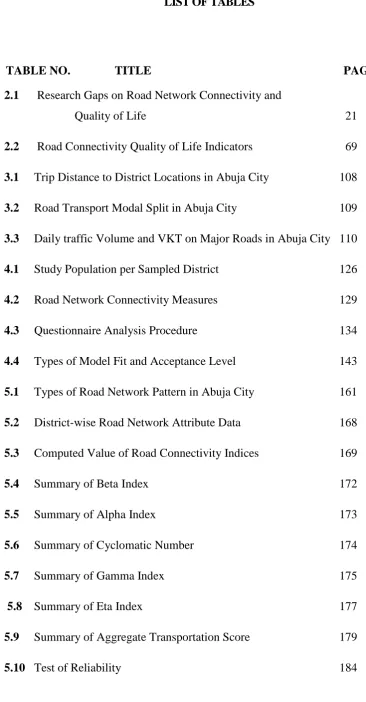
LIST OF TABLES
TABLE NO. TITLE PAGE
2.1 Research Gaps on Road Network Connectivity and
Quality of Life 21
2.2 Road Connectivity Quality of Life Indicators 69 3.1 Trip Distance to District Locations in Abuja City 108 3.2 Road Transport Modal Split in Abuja City 109 3.3 Daily traffic Volume and VKT on Major Roads in Abuja City 110 4.1 Study Population per Sampled District 126 4.2 Road Network Connectivity Measures 129
4.3 Questionnaire Analysis Procedure 134
4.4 Types of Model Fit and Acceptance Level 143 5.1 Types of Road Network Pattern in Abuja City 161 5.2 District-wise Road Network Attribute Data 168 5.3 Computed Value of Road Connectivity Indices 169
5.4 Summary of Beta Index 172
5.5 Summary of Alpha Index 173
5.6 Summary of Cyclomatic Number 174
5.7 Summary of Gamma Index 175
5.8 Summary of Eta Index 177
5.9 Summary of Aggregate Transportation Score 179
xvi
5.11 KMO and Bartlett's Test 185
5.12 Exploratory Factor Analysis 187
5.13 Summary Connectivity Components & QOL Indicators 188 5.14 Modification Indices of Correlated Pair of Items 193 5.15 Statistics of Enhanced Model CFA for Quality of Life
Perception 198
5.16 Discriminant Validity of Quality of Life Perception 200 5.17 Statistics of Second Order CFA for Quality of Life Perception 203 5.18 Statistics of CFA Model for Road Connectivity and QOL
Perception 207
5.19 Discriminant Validity of Road Connectivity and Quality of
Life Perception 209
5.20 District-wise Quality of Life Perception (Weighted Average
Score) 207
5.21 Variable Descriptive Statistics 213
5.22 Result of Analysis of Variance (ANOVA) 214
5.23 Result of Post Hoc Tests 214
xvii
LIST OF FIGURES
FIGURE NO. TITLE PAGE
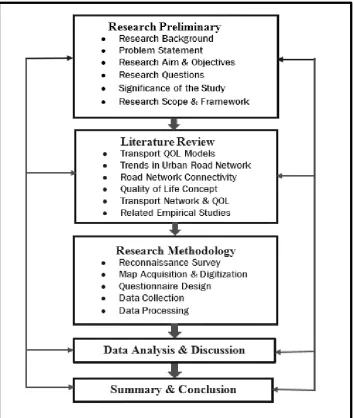
1.1 Research Design 11
2.1 Road Connectivity Quality of Life Conceptual Framework 18 2.2 Summary of Studies, Gap and Analysis Domains 22
2.3 Morphological Urban Forms 24
2.4 Fundamental Transportation Network 25
2.5 Road Network Nodes and Links (Nykamp, 2017) 28
2.6 Stages of Road Network Development 29
2.7 Scale-Free Road Network (Fonseca et al., 2007) 32 2.8 Ribbon Housing Development (Istock, 2017) 36 2.9 Spatial Patten of Road Connectivity (Aaustin, 2015) 38 3.1 Location of Abuja FCT in Nigeria 80
3.2 Location of Abuja City in the FCT 80
3.3 Demarcation of the 40 Districts within Abuja Municipality 80 3.4 Urban Form of Abuja City. Source: https://imgcop.com 84
3.5 Land Use Map of Abuja Municipality 85
3.6 Housing Layout in Asokoro District with Walkway Street 86 3.7 National Christian Church Abuja. Source 87
3.8 National Mosque Abuja 87
3.9 Central Bank of Nigeria Sited in Garki District, Abuja 88
xviii
3.11 Maitama Residential District with Street Parkway 90
3.12 Wuse Residential Zone Sky View 91
3.13 Jabi Lake Estate 92
3.14 Classic House in Gwarimpa District, Abuja 93
3.15 Wuse Central market, Abuja 95
3.16 Garki International Mark, Abuja 96
3.17 Millenium Park Maitama, Abuja 98
3.18 Villa Park and Garden, Abuja 99
3.19 Art and Craft Village, Abuja 100 3.20 Nigerian Traditional Mask and Necklace 100
3.21 Abuja Metro Light Rail 105
3.22 Abuja City Road Network Sky View 106
3.23 Road Network Pattern in Abuja City 107
4.1 Flowchart of Data Collection and Analysis Procedure 115 4.2 Base Maps Used Extraction of Road Network 118 4.3 Case Study Districts for Questionnaire Administration 122
5.1 Data Analysis Flowchart 149
5.2 Respondents' Gender 150
5.3 Respondents' Age Distribution 151
5.4 Respondents' Educational Attainment 152
5.5 Respondent's Employment Status 153
5.6 Respondents' Monthly Income 154
xix
5.8 Respondents' Travel Mode 155
5.9 Respondents' Vehicle Ownership 157
5.10 Daily Distance Travelled by Respondents 158
5.11 Respondents' Daily Travel Expenses 159
5.12 Road Network Structure in Abuja City 160
5.13 Curvilinear Grid Pattern in Bonkoro District 162
5.14 Irregular Grid Pattern in Maitama District 163 5.15 Rectilinear Grid Pattern in Institution and Research Area 164
5.16 Hybrid Grid Pattern in Industrial Area 2 165 5.17 Broken Gridiron Pattern in Central Business District 166 5.18 Distribution of Road Network Pattern in Abuja City 167
5.19 Spatial Distribution of Road Connectivity in Abuja City 180
5.20 Normal Distribution of Response Cases 182
5.21 Estimate of QOL Pooled CFA Measurement Model 190 5.22 Initial Result of QOL Pooled Confirmatory Factor Analysis 192
5.23 Re-Specified QOL Model Fit Indexes after Correlating Items 194 5.24 Final Enhanced QOL Model CFA Fit Indices
After Deleting Item e17 (SAFE5) 196 5.25 Second Order Structural Model CFA of Quality of Life 202
5.26 Structural CFA Model for Road Connectivity Components
and Quality of Life Perception 206
xx
LIST OF ABBREVIATIONS
ACEA - Association des Constructeurs Europeen AEPB - Abuja Environmental Protection Board AGIS - Abuja Geographic Information Studies AMOS - Analysis of Moments Structure
ArcGIS - Aeronautical Reconnaissance Coverage Geographic Information System
BRT - Bus Rapid Transit CBD - Central Business District CFA - Confirmatory Factor Analysis CFI - Comparative Fit Index
CMIN - Chi Square
EFA - Exploratory Factor Analysis
EU - European Union
EUR - Euro
FCDA - Federal Capital Development Authority FCT - Federal Capital Territory
FHA - Federal Housing Authority
FRF - French Franc
GDP - Gross Domestic Product
GIS - Geographic Information System
GOT - Goodness of Fit
GT - Guarantee Trust Bank
KM - Kilo Meter
KMO - Kaiser Meyer Olkin
ND - Network Density
NGO - Non-Governmental Organization
NFI - Normed Fit Index
NO - Nitric Oxide
xxi
PDR - People’s Democratic Republic QOL - Quality of Life
R2 - Squared Multiple Correlation
RMSEA - Root Mean Square of Approximation SEM - Structural Equation Modelling
SINTEF - The Foundation for Industrial and Scientific Research SPSS - Statistical Package for Social Science
TDM - Transportation Demand Management TLI - Tusker-Lewis Index
TOD - Transit-oriented Development UBA - United Bank of Africa
USA - United States of America
VEPI - Voter Education and Publicity Inec VMT - Vehicle Miles Travelled
xxii
LIST OF SYMBOLS
𝛼 - Alpha Index
𝛽 - Beta Index
𝜂 - Eta Index
∞ - Infinity
𝜇 - Cyclomatic Number
xxiii
LIST OF APPENDICES
APPENDIX TITLE PAGE
Appendix A List of Publications 271
Appendix B Research Questionnaire 272
Appendix C Normality Test 279 Appendix D Quality of Life Weighted Average Score 280
1 CHAPTER 1
INTRODUCTION
1.1 Research Background
Transportation is a process that satisfies human mobility demand by providing access to diverse activities in the society. The social and economic activities of human kind centre on transportation (Harriet et al., 2013 and Coffin, 2009). This is a means by which people physically access social capital, either in form of associations and community groups or simply to maintain linkages with extended family members. Activities such as social, cultural or economic interaction involve diverse functions comprising ‘production, consumption and distribution’ occur at locations served by various modes of transportation (Rodrigue et al., 2013).
Road as a mode of transportation serves as a conduit linking places, regions, and economy together; facilitating movement of people, goods and services (Venter et al., 2016, and Niazi, 2017). Road plays a central role in economic development and enhancement of social transaction. Thus contributes to productivity in other economic sectors, foster prosperity and support the foundation upon which economic strength of a place, region or nation rest (Patarasuk and Binford, 2012, and Papoutsis, 2013). This in turn has tremendous influence on societal well-being.
Network is a group of path nodes joined together by sets of linkages (Newman, 2010). It is also known as a framework of functional relations shaping the pattern of a territory (Borruso, 2003). Hence road network has a fundamental structure defined by layout, arrangement and connectivity of individual network elements and their intersections (Parthasarathi, 2011).
2
time and optimal path’ (Jayasinghe and Munasinghe, 2013). Connectivity in order words refers to linking many places so as to create interconnections which yields web-like network (Levinson, 2012). Bashir et al. (2012) aver that connectivity expresses the degree to which network permits direct movement between its various vertices or nodes. Thus road connectivity is critical for the success of other urban sectors. The advantages of road network connectivity are far ahead of accessibility and mobility in the city. But encompasses safer roads, reduced traffic congestion, and cost saving (Lehigh-Valley-Planning-Commission, 2011).
Road network connectivity influence pattern of urban growth and location of socio-economic activities, environmental aesthetics, employment and residential areas in the city. It as well affects commuters’ choice of destination and accessibility (Huang and Levinson, 2012, Waddell, 2011, and Bogale, 2012). Also, Rodrigue et al. (2013) posits that connectivity does not only favour economic development but also determine the spatial organization in terms of locations, relations and accessibility. In a city setting where roads are the predominant means of mobility; land-use and roads are intertwined. Consequently, road networks are solely relied upon to access different activities such as businesses, educational institutions, employment opportunities, cultural and recreational centres. Shahi (2014) rightly observes that ‘road network is the basic foundation of other development initiatives which ensures overall social, cultural and economic empowerment of communities’.
3
Road transport network is paramount to advancement of social and economic development in urban areas. In due course, investigations are directed towards understanding the link between transportation and economy, environment, social relationships and the people, and in turn their causal effect on societal well-being. Nevertheless, the social impact of transportation network has not been sufficiently explored particularly in developing country cities (Tiwari and Arora, 2012). It is equally acknowledged that the influence of transport network on urban lifestyle is scarcely investigated (Mohamed et al., 2013).
Existing investigations on road transport network impact on societal living quality mostly dwell on objective attributes while subjective quality of life is scarcely examined. For instance, preceding studies (Oluseyi, 2006, Özbil et al., 2008, Rifaat et al., 2012, Bornasal, 2012, Schneider, 2013, Parida, 2014) tried to describe the link between road network and societal well-being. However, their analysis and emphasis concentrate on selective individual indicators of objective (external attributes like air quality, noise, local economy, crime, traffic crash, social interactions) of well-being. Such individual objective variables neither indicate thorough and adequate measures nor provide sufficient information on societal quality of life.
The statistical framework employed is another major defect in analytical process. Most of the preceding studies presented only descriptive statistics or used simple bivariate tests of correlation, while some proposed theoretic models without empirical assessment. Thus results of such investigation cannot adequately relate the causal effect of road network on living quality. This makes judgements difficult, which result to indefinite and disputed conclusions about the causality between transport network and societal well-being (Reardon and Abdallah, 2013).
4
Such limited capture of quality of life attributes in analysis, inadequate statistical approach, and undefined predictive model pose some difficulties to professionals and the society at large. Specifically, it constrains transport planners and engineers from gaining adequate insight to how their activities (policy and plan) influence the lifestyle of urban dwellers. It as well restricts policy-makers from comprehending the success of road investment in achieving the desired transport demand. It also makes the performance of urban road network in ensuring cultural, economic, social and overall urban development to remain unclearly defined.
The desire for more empirical approaches required in order to facilitate better insight to the rapport between societal well-being and transportation network stimulated interest in this present research. The motive is to introduce a firm and multi-dimensional (multiple interactive factor) model for empirical evaluation of road connectivity causal impact on quality of life. The model would help planners, engineers and decision-makers to better understand how road transportation system affect the well-being of urban dwellers. Thus the outcome of this research could facilitate future road planning, design, decision and implementation, without which sustainable transportation system and overall growth cannot be achieved in the city.
1.2 Research Problem Statement
5
Generally, improvement of living quality has become a spectacular issue in cities. Thus, because it is one of the most essential dimensions for sustaining urban development (El-Din, et al., 2013). In realizing this objective, Jiménez-Espada and Gonzalez-Escobar (2016) have established that optimization of road transport network is one of the main ways to attain urban quality of life. Unfortunately, the causal impact of transportation system on societal well-being is not yet well established (Schneider, 2013 and Venables, 2014). Such predicament is prompted by limited capture of quality of life attributes in analysis, inadequate statistical analytical approach, and undefined predictive model for assessment (Carse, 2010, and Schneider, 2013).
These challenges and the rising need for better approach arouse interest in the present research to develop a more suitable and reliable technique for assessment of road network connectivity causal impact on societal quality of life in the context of Abuja city. The intention is to introduce a model with multidimensional analytical approach and diverse variables of transport related quality of life. Such involves modelling spatial connectivity of road network, ascertaining the components of road connectivity and quality of life indicators, and determining the implication of road connectivity on societal quality of life. Then lastly compare the quality of life between the districts with different road connectivity levels.
6 1.3 Research Aim
The main aim of this research is to extend the understanding of road network effect on societal quality living using multidimensional quantitative analytical approach. This will be achieved by investigating road network connectivity, and by determining the theoretical effect of connectivity components on quality of life via structural equation modelling. Such a dynamic approach can facilitate future planning and designing of roads, which in turn could offer sustainable transportation system, better quality of life and overall growth in the city.
1.4 Research Objectives
The specific objectives to be achieved in this study are to:
(a) Analyze the spatial pattern of road network connectivity in Abuja city.
(b) Examine the connectivity components and quality of life indicators suitable for assessing impact of road network,
(c) Determine the influence of road connectivity components on quality of life, (d) Compare quality of life between the districts with different levels of road
network connectivity.
1.5 Research Questions
The following are questions to enable the research achieve its objectives:
(a) What is the spatial pattern of road network connectivity in Abuja city?
(b) What are the connectivity components and quality of life indicators suitable for assessing impact of road network?
7
(d) Is there any similarity in quality of life between the districts with different levels of road connectivity?
1.6 Scope of the Study
This research is mainly a cross sectional analysis of road connectivity influence on quality of life in Abuja municipality. The aspects looked into were spatial structure of road connectivity, components of road connectivity and quality of life indicators. Forty planning districts were designated as unit of road network analysis. The structural analysis is confined to road network connection pattern in the study area. Alpha index, beta index, gamma index, cyclomatic number, eta index, and aggregate transportation score were used to determine the road connection pattern. The analysis did not involve complex network analysis such as betweenness, heterogeneity, and homogeneity. All categories of road comprising expressway, arterial, sub-arterial, secondary and local roads within the metropolitan area were unanimously represented as primal graph for analysis.
Social implication of road network in this research is restricted to the performance of road connectivity components and quality of life indicators. Four social components of road network connectivity were examined. These comprised route options, traffic flow, network reliability and transport efficiency. Six transport-related quality of life indicators were surveyed. These encompassed personal accessibility, personal mobility, economic well-being, travel comfort, travel safety, social interaction. The selection of few social components and quality of life indicators is for convenience, easy variable management, interpretation and result implementation.
8 1.7 Research Limitations
This research will delineate connectivity of road network so as to know the pattern and properties of roads within Abuja municipality. Thereby provides adequate information to planners, engineers, administrators and the general public on the physical configuration and efficiency of road network in the city. This is vital for future decision on planning and development of roads. This investigation does not involve complex network analysis such as betweenness, heterogeneity, and homogeneity.
The study also ascertains the performance of road connectivity components and as well determines road users’ life satisfaction with the road connectivity. This outcome will reveal to planners and engineers the impact of their activities on the lifestyle of city dwellers. The finding will also enable administrators to ascertain the ability of road investment in achieving the desired goal of improving standard of living of the urbanites.
Furthermore, the study shall verify and compare quality of life between the districts with different levels of road connectivity. Such understanding is essential for planning decision which could ensure cultural, economic, social equity and environmental sustainability at regional and the entire city levels.
1.8 Significance of the Research
The rational for this study was to develop a multidimensional analytical model which shall serve as a guide for transport planners and policy makers in assessing the impact of road connectivity on societal living quality. Thus the important and beneficial achievements of the research include the following:
9
inhabitants in choosing favourable location to reside either in the low, the moderate or the highly road connected districts.
Result of this research shall aid planning authority in detecting and finding solution to the problems associated with physical road network in Abuja city.
Findings of this study will also assist planning authority and administrators to know the performance of road connectivity in promoting societal liveability and quality of life.
In view of the rising requirement for approaches to assess transport impact on societal well-being. The active model introduced in this research will be useful for transport planners and researchers as a significant and flexible technique for evaluating the influence of road network on societal living quality. The study shall as well serve a future reference for researchers on urban transportation and human society.
Finally, the outcome of this work will provide planners and policy- makers with adequate information on the factors to be noted in designing an integral approach for planning quality and aesthetic urban environment with sustainable road network that would enhance cultural, social and economic well-being of the urbanites.
1.9 Structure of Thesis
This research is organized in six sections systematically outlined as follows: Chapter 1 captures background of the study, research problem, research questions, aim and objectives, scope and limitation of the study, and research significance. Generally, it describes the concept and content of this research work.
10
quality of life concept, its relationship with transportation network, quality of life indicators, and the related existing studies.
Chapter 3 describes the physical and social characteristics of the study area. Additionally, it gives hint about urban form and land use pattern of the city. The existing transportation policy and transport network of Abuja city are other issues captured in this section.
Chapter 4 presents the materials and methods used in achieving objectives of the study. It explains the types of data collected, data acquisition and processing methods. It further covers road network analysis, population sampling strategy, questionnaire administration, statistical test and structural equation modelling procedures.
Chapter 5 consists of the data analysis and results discussion. The collected data were analysed and interpreted based on the research objectives as follows: analysis of spatial pattern of road network connectivity, components of road connectivity and quality of life indicators, impact of road connectivity on quality of life, and comparison of quality of life between different road connectivity districts.
11
231 REFERENCES
AAM, (2012, August 30). Road Transportation – A History and How We Use it Today. American Auto Move News Paper. Retrieved on April 12, 2015 from
http://www.americanautomove.com.
Aaustin, (2015, September 16). AARP: Livable Communities Solutions Forum. ULI Minnesota News. Retrieved on June 15th, 2017 from https://minnesota.uli.org.
Abdel-Aty, M., Pande, A., Das, A. & Knibbe, W. (2008). Assessing Safety on Dutch Freeways with Data from Infrastructure-based Intelligent Transportation Systems. Transportation Research Record: Journal of the Transportation Research Board, 153-161.
Abreha (2007). Analysing Public Transport Performance Using Efficiency Measures and Spatial Analysis; The Case of Adis Ababa, Ethiopia. https://webapps.itc.utwente.nl/librarywww/papers_2007/msc/upla/abreha.pdf. Abubakar, I. R. (2014). Abuja City Profile. Cities, 41, 81-91.
Abuja, (2012). Abuja Word Document. Retrieved from
https://wwejohncenaonlinebooks.files.wordpress.com /2012/02/abuja-word.docx.
Abujacity.com (2017, April 10). Abuja City and Beyond. Retreived on May 20, 2017 from Abuja City Communication. http://abujacity.com.
ACEA, (2005). Tax Guide. European Automobile Manufactures' Association (ACEA). Retrevieved on January 18th, 2015 from http://www.acea.be/.
Adams, M. A., Ryan, S., Kerr, J., Sallis, J. F., Patrick, K., Frank, L. D. & Norman, G. J. (2009). Validation of the Neighborhood Environment Walkability Scale (NEWS) Items Using Geographic Information Systems. Journal of Physical Activity and Health, 6, S113-S123.
232
Adolphe, L. (2001). A Simplified Model of Urban Morphology: Application of An Analysis of the Environmental Performance of Cities. Environment and Planning B 2001 Journals. sagepub.com
Affenzeller, J. (2017). ERTRAC: The European Road Transport Research Advisory Council. In Automated Driving 2017 (pp. 607-610). Springer, Cham.
Alba, C. A., & Beimborn, E. (2005). Analysis of the Effects of Local Street Connectivity on Arterial Traffic. In Transportation Research Board Annual Meeting.
Albemarle (Producer). (2015, November 5th, 2017). Neighborhood Model Design Approch for Principle. Retrieved from https://www.albemarle.org.
Allen, M. (2017). The SAGE Encyclopedia of Communication Research Methods (Vol. 2, pp. 957-960) Thousand Oaks, California: Sage Publications.
Andalucia, J. E. A. (2000). Socio-Economic Benefits of the A92 Motorway in Spain. In IRF (2007) The Socio-Economic Benefits of Roads in Europe. November 2007 IRF Research Report. http://www.aecarretera.com.
Anderson, D. R., Sweeney, D. J., Williams, T. A., Camm, J. D. & Cochran, J. J. (2014). Statistics for Business & Economics, Revised Edition (11th ed.) South Western
Cengage, LearningTM.
Anderson, W. P., Kanaroglou, P. S., & Miller, E. J. (1996). Urban Form, Energy and the Environment: A Review of Issues, Evidence and Policy. Urban Studies, 33(1), 7-35.
Andrews, F. M. & Withey, S. B. (2012). Social Indicators of Well-being: Americans' Perceptions of Life Quality. Springer Science & Business Media, eBook, P82.
Apparicio, P., Seguin, A.-M. & Naud, D. (2008). The Quality of the Urban Environment Around Public Housing Buildings in Montréal: An Objective Approach-based on GIS and Multivariate Statistical Analysis. Social Indicators Research, 86, 355-380.
Arasu, A., Cherniack, M., Galvez, E., Maier, D., Maskey, A. S., Ryvkina, E., ... & Tibbetts, R. (2004, August). Linear Road: A Stream Data Management Benchmark. In Proceedings of the Thirtieth International Conference on Very Large Data Bases-Volume 30 (pp. 480-491). VLDB Endowment.
233
Residential Developments on Levels of Crime and Anti-social Behaviour.
University of Huddersfield, Huddersfield. (Unpublished) http://eprints.hud.ac.uk/id/eprint/13592/1/Briefing.
Arnold Jr, C. L., & Gibbons, C. J. (1996). Impervious Surface Coverage: The Emergence of a Key Environmental Indicator. Journal of the American Planning Association, 62(2), 243-258.
Arian, M., Campbell, M. J., Cooper, C. L., & Lancaster, G. A. (2010). What is a Pilot or Feasibility Study? A Review of Current Practice and Editorrial Policy. BMC Medical Research Methodology, 10(1), 67.
Artimy, M. M., Robertson, W. & Phillips, W. J. (2004). Connectivity in Inter-vehicle Ad-hoc Networks. Electrical and Computer Engineering, 2004. Canadian Conference on, 2004. IEEE, 293-298.
Asher & Novosad, 2018). Rural Roads and Local Economic Development. World
Bank Policy Research Working Paper 8466.
https://openknowledge.worldbank.org/bitstream/handle/10986/29895/WPS84 66.pdf?sequence=1.
Attane, M., Jose, P. & Aniceto, Z. (2009). ERF’s Position on the Socio-economic Benefits of Roads to Society. European Union Road Federation (ERF)
Publications. Retrieved on January 18, 2015 from http://www.irfnet.eu
Auge, M. (2008). Non-Places: An Introduction to Supermodernity, 1995 Trans. John Howe, London and New York: Verso.
Auld, C. J. & Case, A. J. (1997). Social Exchange Processes in Leisure and Non-leisure Settings: A Review and Exploratory Investigation. Journal of Leisure Research, 29, 183.
Ayachi, F., Dorey, J. & Guastavino, C. (2015). Identifying Factors of Bicycle Comfort: An Online Survey with Enthusiast Cyclists. Applied Ergonomics, 46, 124-136. Baileson, J. N., Shum, M. S. & Uttal, D. H. (1998). Road Climbing: Principles Governing Asymmetric Route Choices on Maps. Journal of Environmental Psychology, 18, 251-264.
Banister, D. (2002). Transport Policy and the Environment. London: Routledge. Banister, D. (2008). The Sustainable Mobility Paradigm. Transport Policy, 15, 73-80. Bannister, D. & Berechman, Y. (2001). Transport Investment and the Promotion of
234
Bannister, D. & Bowling, A. (2004). Quality of Life for the Elderly: The Transport Dimension. Transport policy, 11, 105-115.
Barabasi, A.-L. (2002). Linked: The New Science of Networks. Cambridge: MA, Perseus Publication.
Bashir, A., Yelwa, S. A. & Mariya, L. (2012). Spatio-Temporal Analysis of Roads Connectivity and Accessibility Pattern: A Case Study of North-Eastern Nigeria. Pakistan Journal of Social Sciences 9, 79-88.
Bartlett, R (2013). GTA-303 Road Classification - Some Current Examples. Series 3- Discussion Papers. Global Transport Atlas. Retrieved on October 23rd, 2018 from https://www.researchgate.net/publication/236522667.
Bawa-Cavia, A. (2010). Sensing the Urban. Using Location-based Social Network Data in Urban Analysis. 1st Workshop on Pervasive Urban Applications (PURBA) San Francisco.
Beatty, P. C. & Willis, G. B. (2007). Research Synthesis: The Practice of Cognitive Interviewing. Public Opinion Quarterly, 71, 287-311.
Bedogni, L., Gramaglia, M., Vesco, A., Fiore, M., Harri, J. & Ferrero, F. (2015). The Bologna Ringway Dataset: Improving Road Network Conversion in SUMO and Validating Urban Mobility Via Navigation Services. IEEE Transactions on Vehicular Technology, 64, 5464-5476.
Bell, M. G. & Iida, Y. (1997). Transportation Network Analysis. https://books.google.com.my.
Bentler, P. M. (1990). Comparative Fit Indexes in Structural Models. Psychological Bulletin, 107, 238.
Bentler, P. M. & Bonett, D. G. (1980). Significance Tests and Goodness of Fit in the Analysis of Covariance Structures. Psychological Bulletin, 88, 588.
Berdica, K. (2002). An Introduction to Road Vulnerability: What Has Been Done, Is Done and Should be Done. Transport Policy, 9, 117-127.
Bergstad, C. J., Gamble, A., Hagman, O., Polk, M., Garling, T., Ettema, D., Friman, ¨ M., Olsson, L.E., (2011a). Influences of Affect Associated with Routine
Out-of-Home Activities on Subjective Well-Being. Applied Research in Quality of Life, 1–14.
235
Berrigan, D., Pickle, L. W. & Dill, J. (2010). Associations Between Street Connectivity and Active Transportation. International Journal of Health Geographics, 9, 20.
Beuran, M., Gachassin, M. G., Raballand, G. (2013). Are There Myths on Road Impact and Transport in Sub-Saharan Africa?. HAL Id: halshs-00830006. Retrieved
on October 22nd, 2018 from https://halshs.archives-ouvertes.fr/halshs/. Bhat, C. R. (2000). Development of an Urban Accessibility Index: Literature Review,
Center for Transportation Research. University of Texas at Austin.
Bhattacherjee, A. (2012). Social Science Research: Principles, Methods, and Practices. Blaikie, N. (2003). Analyzing Quantitative Data: From Description to Explanation.
Sage Publications.
Blair, N., Hine, J., & Bukhari, S. M. A. (2013). Analysing the Impact of Network Change on Transport Disadvantage: a GIS-based Case Study of Belfast. Journal of Transport Geography, 31, 192-200.
Bogale, Y. A. (2012). Evaluating Transport Network Structure: A Casa Study in Addis Ababa, Ehiopia. Master Degree M.Sc Thesis, University of Twente,The
Neitherlands.
Bollen, K. A. (1989). A New Incremental Fit Index for General Structural Equation Models. Sociological Methods & Research, 17, 303-316.
Boonekamp, T. & Burghouwt, G. (2017). Measuring Connectivity in the Air Freight Industry. Journal of Air Transport Management, 61, 81-94.
Bornasal, F. B. (2012). Transportation Network Connectivity. Facilities Encouraging Walkability, and Crime.
Borruso, G. (2003). Network Density and the Delineation of Urban Areas. Journal of Transaction in GIS Vol. 7,, 177-199.
Bovy, P. H. (2009). On Modelling Route Choice Sets in Transportation Networks: A Synthesis. Transport Reviews, 29, 43-68.
Bovy, P. H. & Bradley, M. A. (1985). Route Choice Analyzed with Stated-Preference Approaches.
Bowen, P., Rose, R. & Pilkington, A. (2017). Mixed Methods-Theory and Practice. Sequential, Explanatory Approach. International Journal of Quantitative and Qualitative Research Methods, 5, 10-27.
236
Zealand (Breakout Presentation). Journal of Transport & Health. 2017 Dec 31;7:S47-8.
Brereton, F., Clinch, J. P. & Ferreira, S. (2008). Happiness, Geography and the Environment. Ecological Economics, 65, 386-396.
Brrown, O. (2015). Sharing Cars: The Future of Road Transport. Solution Online Journal 6, 25-29.
Browne, M. W. & Cudeck, R. (1993). Alternative Ways of Assessing Model Fit. Sage Focus Editions, 154, 136-136.
Bryceson, D., Davis, A., Ahmed, F. & Bradbury, T. (2004). Framework for the Inclusion of Social Benefits in Transport Planning: Final Report. Transport Research Laboratory, Crowthorne.
Bullmore, E. & Sporns, O. (2009). Complex Brain Networks: Graph Theoretical Analysis of Structural and Functional Systems. Nature Reviews. Neuroscience, 10, 186.
Burckhardt, L. & Ritter, M. (2006). Warum Ist Landschaft Schön. Die Spaziergangswissenschaft. Berlin.
Caltrans (2006). Performance Measures for Rural Transportation Systems GUIDEBOOK.
Campbell, A., Converse, P. E. & Rodgers, W. L. (1976). The Quality of American Life: Perceptions, Evaluations, and Satisfactions. Russell, Sage Foundation.
Carruthers, R. E. A. E. (2009). Improving Connectivity: Investing in Transport Infrastructure in Sub-Saharan Africa. AICD (Africa Infrastructure Country
Diagnostic).Washington DC: World Bank Publication.
Carse, A. T. (2010). Development of an Alternative Transport Appraisal Technique: the Transport Quality of Life Model. Doctoral Dissertation, University of Glasgow.
Carse, A. T. (2011). Assessment of Transport Quality of Life as an Alternative Transport Appraisal Technique. Journal of Transport Geography, 19, 1037-1045.
237
Chandra, S. & Quadrifolio, L. (2013). A New Street Connectivity Indicator to Predict Performance for Feeder Transit Services. Transportation Research Part C: Emerging Technologies, 30, 67-80.
Chang, M. T. (2012). Final Project Network Analysis of Urban Street Patterns. In: 1.204 (ed.).
Chen, A., Yang, H., Lo, H. K. & Tang, W. H. (1999). A Capacity-related Reliability for Transportation Networks. Journal of Advanced Transportation, 33, 183-200.
Chen, A., Yang, H., Lo, H. K. & Tang, W. H. (2002). Capacity Reliability of a Road Network: An Assessment Methodology and Numerical Results. Transportation Research Part B: Methodological, 36, 225-252.
Chen, Y. (2016). Investigating the Influences of Tree Coverage and Road Network Density on Property Crime: A Case Study in the City of Vancouver. British Columbia, Canada. University of Waterloo.
Cheng, L. & Panichpapiboon, S. (2012). Effects of Intervehicle Spacing Distributions on Connectivity of VANET: A Case Study from Measured Highway Traffic. IEEE Communications Magazine, 50, 90-97.
Choi, M. & Lee, H.-Y. (1995). Traffic Flow and 1/f Fluctuations. Physical Review E, 52, 5979.
Chong, E. E., Nazim, A. & Ahmad, S. B. (2014). A Comparison Between Individual Confirmatory Factor Analysis and Pooled Confirmatory Factor Analysis: An Analysis of Library Service Quality: A Case Study at a Public University in Terengganu. International Journal of Engineering Science and Innovative Technology, 3, 110-116.
Chou, J.-S. & Yang, J.-G. (2013). Evolutionary Optimization of Model Specification Searches Between Project Management Knowledge and Construction Engineering Performance. Expert Systems with Applications, 40, 4414-4426. Christian, H., et al,. (2015). The Influence of the Neighbuorhood Physical
Environment on Early Child Health and Development: A Review and Call for Research. Health & Place, 33, pp.25-36.
238
Clement, S., Vogiatzis, N., Daniel, M., Wilson, S. & Clegg, R. (2000). Road Networks of the Future: Can Data Networks Help? 28th Australasian Transport Research Forum, 2000.
Coffin, A. W. (2009). Road Network Development and Landscape Dynamics in the Santa Fe River Watershed, North-Central Florida, 1975 to 2005. Doctoral Dissertation, University of Florida.
Cohen, J. (1988). Statistical Power Analysis for the Behavioral Sciences . Hilsdale. NJ: Lawrence Earlbaum Associates, 20-26.
Collins (2018). English Dictionary. Webster's New World College Dictionary, Online. Cooper, D. R., & Schindler, P. S. (2011). Business Research Methods. New York. Mc
Graw-Hill Higher Education.
Cornelia, Butler Flora., Jan, L. Flora., Stephen, P., & Gasteyer, Chartres Refresh 8 (1989, Spring). Road Transport and Economic Growth in the 18th Century. Printed by William Sessions Limited. York, England, The Ebor Press.
Costanza, R., Fisher, B., Ali, S., Beer, C., Bond, L., Boumans, R., Danigelis, N. L., Dickson, J., Elliott, C. & Farley, J. (2007). Quality of life: An Approach Integrating Opportunities, Human Needs, and Subjective Well-being. Ecological Economics, 61, 267-276.
Costanza, R., Fisher, B., Ali, S., Beer, C., Bond, L., Boumans, R., Danigelis, N. L., Dickson, J., Elliott, C. & Farley, J. (2008). An Integrative Approach to Quality of Life Measurement, Research, and Policy. SAPI EN. S. Surveys and
Perspectives Integrating Environment and Society.
Coubergs, C., Struyven, K., Vanthournout, G. & Engels, N. (2017). Measuring Teachers’ Perceptions about Differentiated Instruction: The DI-Quest Instrument and Model. Studies in Educational Evaluation, 53, 41-54.
Creswell, J. W. (2013). Research Design: Qualitative, Quantitative, and Mixed Methods Approaches. Sage Publications.
Creswell, J. W. & Poth, C. N. (2017). Qualitative Inquiry and Research Design: Choosing Among Five Approaches. Sage Publications.
Crucitti, P., Latora, V. & Porta, S. (2006). Centrality Measures in Spatial Networks of Urban Streets. Physical Review E, 73, 036125.
239
CTAA (2012). Employment Transportation Fundamentals.
Cummins & Gullone (2000). Why We Should Not Use 5-Point Likert Scales: The case for subjective quality of life measurement. Proceedings, Second International Conference on Quality of Life in Cities (pp.74-93). Singapore: National University of Singapore.
Currie, G. & Delbosc, A. (2010). Modelling the Social and Psychological Impacts of Transport Disadvantage. Transportation, 37, 953-966.
Daganzo, C. F. (2010). Structure of Competitive Transit Networks. Transportation Research Part B: Methodological 44, 434–446.
Darvish, M., Yasaei, M. & Saeedi, A. (2009). Application of the Graph Theory and Matrix Methods to Contractor Ranking. International Journal of Project Management, 27, 610-619.
Das, D. (2008). Urban Quality of Life: A Case Study of Guwahati. Social Indicators Research, 88, 297-310.
Davies, T. & Johnson, S. D. (2015). Examining the Relationship Between Road Structure and Burglary Risk Via Quantitative Network Analysis. Journal of Quantitative Criminology, 31, 481-507.
Dawan, P. (2000). Geography of Abuja-Federal Capital Territory. Minna, Famous Asaaly Press.
Dawes (2007). Do Data Characteristics Change According to the Number of Scale Points Used? An Experiment Using 5-Point, 7-Point and 10-Point Scales. International Journal of Market Research, Vol. 50 Issue 1.
De-Groot, J. & Steg, L. (2006). Impact of Transport Pricing on Quality of Life, Acceptability, and Intentions to Reduce Car Use: An Exploratory Study in Five European Countries. Journal of Transport Geography, 14, 463-470.
De Klerk L. A. (1980). Op Zoek Naar De Ideale Stad (In Search of the Ideal City). Van Loghum Slaterus, Deventer.
Delbosc, A., & Currie, G. (2011b). The Spatial Tontext of Transport Disadvantage, Social Exclusion and Well-being. Journal of Transport Geography, 19(6), 1130-1137.
240
Delbosc, A. (2012). The Role of Well-being in Transport Policy. Transport Policy, 23, 25-33.
Deluka-Tibljas, A., Karleusa, B. & Dragicevic, N. (2013). Review of Multicriteria-Analysis Methods Application in Decision-making about Transport Infrastructure. Gradevinar, 65, 619-631.
Deng, L. & Yuen, A. H. (2011). Towards a Framework for Educational Affordances of Blogs. Computers & Education, 56, 441-451.
Desai, S. & Peerbhay, K. (2016). Assessing the Conditions of Rural Road Networks in South Africa Using Visual Observations and Field-based Manual Measurements: A Case Study of Four Rural Communities in Kwa-Zulu Natal. Review of Social Sciences, 1, 42-55.
Devellis, R. F. (2016). Scale Development: Theory and Applications. Sage Publications.
Devi, S. & Neetha, T. (2017). Machine Learning-based Traffic Congestion Prediction in a IoT-based Smart City.
Diener, E., Emmons, R. A., Larsen, R. J. & Griffin, S. (1985). The Satisfaction with Life Scale. Journal of Personality Assessment, 49, 71-75.
Diener, E. & Lucas, R. E. (1999). 11 Personality and Subjective Well-being. Well-being: Foundations of Hedonic Psychology.
Diener, E. & Suh, E. (1997). Measuring Quality of Life: Economic, Social, and Subjective Indicators. Social Indicators Research, 40, 189-216.
Directorate, D. S., Statistics, I. M. F. B. O., Statistics, I. L. O. B. O. & Committee, C. O. I. S. S. 2002. Measuring the Non-observed Economy: A Handbook. Lippincott Williams & Wilkins.
Dixon, W. J. & Tukey, J. W. (1968). Approximate Behavior of the Distribution of Winsorized t (Trimming/Winsorization 2). Technometrics, 10, 83-98.
Dixon, W. J. & Yuen, K. K. (1974). Trimming and Winsorization: A Review. Statistische Hefte, 15, 157-170.
Doi, K., Kii, M. & Nakanishi, H. (2008). An Integrated Evaluation Method of Accessibility, Quality of Life, and Social Interaction. Environment and Planning B: Planning and Design, 35, 1098-1116.
Dolan, P., Peasgood, T. & White, M. (2006). Review of Research on the Influences on Personal Well-being and Application to Policy Making. London, DEFRA.
241
uk/science/project_data/DocumentLibrary/SD12005/SD12005_4017_FRP. pdf.
Dolma, S. (2010). The Central Role of the Unit of Analysis Concept in Research Design. Istanbul University Journal of the School of Business, 39, 169-174. Donovan, S., & Munro, I. (2013). Impact of Urban Form on Transport and Economic
Outcomes. NZ Transport Agency Research Report 513. pp74.
Dorosh, P., Wang, H. G., You, L. & Schmidt, E. (2012). Road Connectivity, Population, and Crop Production in Sub‐Saharan Africa. Agricultural Economics, 43, 89-103.
Dratva, J., Zemp, E., Dietrich, D. F., Bridevaux, P.-O., Rochat, T., Schindler, C. & Gerbase, M. W. (2010). Impact of Road Traffic Noise Annoyance on Health-related Quality of Life: Results from a Population-based Study. Quality of Life Research, 19, 37-46.
Drost, E. A. (2011). Validity and Reliability in Social Science Research. Education Research and Perspectives, 38, 105.
Dubois, D. & Prade, H. (1992). Putting Rough Sets and Fuzzy Sets Together. Intelligent Decision Support. Springer.
Dugundji, E., Paez, A. & Arentze, T. (2008). Social Networks, Choices, Mobility, and Travel. UK: London, England, Sage Publication.
Dutta, B. & Jackson, M. O. (2001). On the Formation of Networks and Groups: Draft Forthcoming in the Models of the Strategic Formation of Networks and Groups. Heidelberg: Springer Verlag.
Eddington, R. (2006). The Eddington Transport Study-The Case for Action-Sir. Rod Eddington's Advice to Government-December 2006.
Ejifor, C. (2013). Blooming Night Markets in Abuja. Entertaimant Naij.com, 2013. Ekstrom, A. & Williamson, M. (1971). Transportation and Urbanization. Urban and
Regional Planning, No. 3, PP. 37-46.
El-Din, H.S., Shalaby, A., Farouh, H.E. & Elariane, S.A. (2013). Principles of Urban Quality of Life for a Neighborhood. HBRC Journal, 9(1), pp.86-92.
EL-Geneidy, A. M., Leninson, D. M. & Country, H. (2006). Access to Destinations: Development of Accessibility Measures. Citeseer.
242
Erath, A., Lochl, M. & Axhausen, K. (2009). Graph-Theoretical Analysis of the Swiss Road and Railway Networks over Time. Networks and Spatial Economics 9, 379–400.
ESCAP (2009). Enhancing the Policy Impact of Transport Investment Analysis (E/ESCAP/FAMT/SG O/3). Background Paper for the Forum of Asian Ministers of Transport, ESCAP, Bangkok. Retrieved on June 29th, 2017 from
www.unescap.org/ttdw/FAMT/FAMT1/Documents/English/FAMT_SG O_3E.pdf.
Estlander, K., (2015).Assessment of Welfare Impacts in Transport System Planning. Thesis for the Degree of Doctor of Science in Technology, Aalto University. Evans, A. N. (2013). Using Basic Statistics in the Behavioral and Social Sciences.
Sage Publications.
Ewing, R. & Cervero, R. (2010). Travel and the Built Environment: A Meta-analysis. Journal of the American Planning Association, 76, 265-294.
Farinmade, A. Soyinka, O. Siu, K.W. (2018). Assessing the Effect of Urban Informal Economic Activity on the Quality of the Built Environment for Sustainable Urban Development in Lagos, Nigeria. Sustainable Cities and Society. 2018 Aug 1;41:13-21.
FCDA, (1979). The Master Plan for Abuja the New Federal Capital of Nigeria. In: Authority, F. C. D. A. F. C. T. (ed.). Lagos, Government Printing Office. FCTTS, (2010). Federal Capital Territory - Transport Secretariat White Papaer on
Land Transport Policy. In SECRETARIAT, F. C. T. (ed.). Abuja: Adam Smith International.
Femi, S. A. G. (2012). Characterization of Current Transportation Challenges in the Federal Capital Territory, Nigeria. Journal of Sustainable Development, 5(12), 117.
Feng, C.-M. & Hsieh, C.-H. (2009). Implications of Transport Diversity for Quality of Life. Journal of Urban Planning and Development, 135, 13-18.
Feng, J. (2016). Mobility and Quality of Life of the Elderly in Urban China: The Role of Household Structure. Mobility, Sociability and Well-being of Urban Living. Springer.
243
Fonseca, A., Flintsch, G. W., Garvin, M. J., Sotelino, E. D. & Barkhi, R. (2007). Contemporary Network Theory: Concepts and Implications for Transportation Infrastructure Management. Transportation Research Board, 86th Annual Meeting, 2007.
Forkenbrock, D. J. (1990). Putting Transportation and Economic Development into Perspective. Transportation and Economic Development. Transportation and Economic Development, 1990s November 5-8, 1989 1990 Williamsburg,
Virginia, USA.
Forkenbrock, D. J. (2004). Transportation Policy Strategies for Iowa to Advance the Quality of Life.
Forkenbrock, D. J., Benshoff, S. & Weisbrod, G. E. (2001). Assessing the Social and Economic Effects of Transportation Projects. Transportation Research Board. Forsyth, A., Oakes, J. M., Lee, B. & Schmitz, K. H. (2009). The Built Environment, Walking, and Physical Activity: Is the Environment more Important to Some People than Others? Transportation Research Part D: Transport and Environment, 14, 42-49.
Francesca, C., Ana, L.-N., Jerome, M. & Frits, T. (2011). Help Wanted? Providing and Paying for Long-term Care. Health Policy Studies, OECD Publishing.
Frank, L. & Kavage, S. (2009). A National Plan for Physical Activity: the Enabling Role of the Built Environment. Journal of Physical Activity and Health. Frank, L. D. (2000). Land Use and Transportation Interaction: Implications on Public
Health and Quality of Life. Journal of Planning Education and Research, 20, 6-22.
Frank, L. D., Sallis, J. F., Saelens, B. E., Leary, L., Cain, K., Conway, T. L. & Hess, P. M. (2010). The Development of a Walkability Index: Application to the Neighborhood Quality of Life Study. British Journal of Sports Medicine, 44, 924-933.
Fresno (2014). Urban Form, Land Use, and Design. General Plan. Retrived on Octorber 28th, 2018 from https://www.fresno.gov/darm/wp-content/uploads/sites/10/2016/11/GP3Urban Form.pdf.
244
Gao, M., Ahern, J. & Koshland, C. P. (2016). Perceived Built Environment and Health-related Quality of Life in Four Types of Neighborhoods in Xi’an, China. Health & Place, 39, 110-115.
Garcke, S. E. (1939). Comfort in Travel Section I: By Road. Proceedings of the Institution of Automobile Engineers, 33, 663-671.
Garrison, W. L. (1960). Connectivity of the Interstate Highway System. Papers in Regional Science, 6, 121-137.
Garrison, W. L. & Marble, D. F. (1961). The Structure of Transportation Networks. Evanston, IL: Transportation Center at Northwestern University.
Gauthier, H. L. (1966). Highway Development and Urban Growth in Sao Paulo, Brazil: A Network Analysis. Ph.D. Thesis, Institute: Northwestern University.
Retrieved from elibrary.ru.
George, E. I. & Mcculloch, R. E. (1993). Variable Selection Via Gibbs Sampling. Journal of the American Statistical Association, 88, 881-889.
Gerard De Jong, R., Leeds, I., Daly, A., Europe, R., Pieters, M. & De Jong, G. (2005). The Logsum as an Evaluation Measure: Review of the Literature and New Results. Paper Presented at the 45th Congress of the European Regional Science Association, 2005. 27.
Geurs, K., Wee, V. B., Annema, J. & Banister, D. (2013). Accessibility: Perspectives, Measures and Applications. The Transport System and Transport Policy: An Introduction. Edward Elgar, 207-226.
Geurs, K. T., Van Wee, B. & Rietveld, P. (2006). Accessibility Appraisal of Integrated Land-use—Transport Strategies: Methodology and Case Study for the Netherlands Randstad Area. Environment and Planning B: Planning and Design, 33, 639-660.
Ghorveh, G. M. (2017). Does Street Quality Affect Transit Users' Route Choice? Giacomin, D. J. & Levinson, D. M. (2015). Road Network Circuity in Metropolitan
Areas. Environment and Planning B: Planning and Design, 42, 1040-1053. Girling, C., & Kellett, R. (2005). Skinny Streets and Green Neighborhoods: Design
for Environment and Community. Island Press.
245
Giusti, C., Lee, C., Lord, D. & Wieters, M. (2008). Transportation Infrastructure and Quality of Life for Disadvantage Populations: A Pilot Study of El Cenizo Colonia in Texas. Research Report SWUTC/08/167162e1. http://swutc. tamu. edu/publications/technicalreports/167162-1. pdf (Accessed 10.11. 09).
GlobalSecurity (2016, December 12th, 2016). Urban Environment. Retrieved from www.globalsecurity.org/militaarty/library/arm.
Goetzke, F., Gerike, R., Paez, A. & Dugundji, E. (2015). Social Interactions in Transportation: Analyzing Groups and Spatial Networks. Transportation, 42, 723-731.
Gorter, C., Nijkamp, P. & Vork, R. (2000). Analysis of Travellers' Satisfaction with Transport Chains. Transportation Planning and Technology, 23, 237-258. Granovetter, M. (1983). The Strength of Weak Ties: A Network Theory Revisited.
Sociological Theory, 1, 201-233.
Gucuyener, A. (2014). Transportation and Development Corridors. Retrieved on January 29th, 20114 from Hazar/strateji Eastitusu
GUK (2015). The Weighted Scoring Method.: Finance Resources and Templates for Economic Appraisal Guidance. Retrieved on August 15th, 2017 from. Nibusinessinfo.co.uk.
Gupta, J., Pouw, N. R. & Ros-Tonen, M. A. (2015). Towards an Elaborated Theory of Inclusive Development. The European Journal of Development Research, 27, 541-559.
Gutierrez, J., Monzon, A. & Pinero, J. (1998). Accessibility, Network Efficiency, and Transport Infrastructure Planning. Environment and Planning A, 30, 1337-1350.
Hagerty, M. R., Cummins, R. A., Ferriss, A. L., Land, K., Michalos, A. C., Peterson, M., Sharpe, A., Sirgy, J. & Vogel, J. (2001). Quality of Life Indexes for National Policy: Review and Agenda for Research. Social Indicators Research, 55, 1-96.
Haggett, P. & Chorley, R. J. (1969). Network Analysis in Geography. London, Edward Arnold London.
Hair, J. F. (2007). Research Methods for Business. Retrieved from Digitalcommons. www.http.//kennesaw.edu.
246
Hair, J. F., Ringle, C. M. & Sarstedt, M. (2011). PLS-SEM: Indeed a Silver Bullet. Journal of Marketing theory and Practice, 19, 139-152.
Hair, J. F., Sarstedt, M., Ringle, C. M. & Mena, J. A. (2012). An Assessment of the Use of Partial Least Squares Structural Equation Modeling in Marketing Research. Journal of the Academy of Marketing Science, 40, 414-433.
Hajrasouliha, A. & Yin, L. (2014). The Impact of Street Network Connectivity on Pedestrian Volume. Urban Studies Journal Limited.
Handy, S. L. (1996). Understanding the Link between Urban Form and Nonwork Travel Behaviour. Journal of Planning Education and Research, 15(3), 183-198.
Handy, S., Paterson, R. G. & Butler, K. (2003). Planning for Street Connectivity: Getting from Here to There (No. PAS Report No.515). trid.trb.org.
Handy, S., Tal, G. B. & G, D. M. (2010). Draft Policy Brief on the Impacts of Network Connectivity Based on a Review of the Empirical Literature. Air Resources
Board. Retrieved on November 22nd, 2017 from
www.arb.ca.gov/cc/sb375/policies/connectivity/netconnectivity_brief.pd. Hankey, S., Lindsey, G. & Marshall, J. D. (2017). Population-level Exposure to
Particulate Air Pollution During Active Travel: Planning for Low-Exposure, Health-Promoting Cities. Environmental Health Perspectives, 125, 527. Hansen, W. G. (1959). How Accessibility Shapes Land Use. Journal of the American
Institute of Planners, 25, 73-76.
Hanson, S. (2010). Gender and Mobility: New Approaches for Informing Sustainability. Gender, Place & Culture, 17, 5-23.
Hanson, S. & Huff, J. (1986). Classification Issues in the Analysis of Complex Travel Behavior. Transportation, 13, 271-293.
Haringercorestrategy (2010). Environmental Factors: JSNA Environmental Section (Transport, Fuel Poverty, Green and Open Space, CO2 Emission and Fluvial Flood). Haringey.
Harriet, T., Poku, K. & Emmanuel, A. K. (2013). An Assessment of Traffic Congestion and Its Effect on Productivity in Urban Ghana. International Journal of Business and Social Science, 4, 225-234.