Group Based Neural Collaborative Filtering for
E-Learning Recommender System
K. Venkatachalapathy, V. Vijayalakshmi
Abstract:: E-Learning is playing the vital role in the educational sector. Data mining techniques are statistical technique using that we can extract the useful information. Applying the data mining algorithms in the education data is known as Educational Data Mining. There are many applications of EDM for the betterment of the students or learners world. One of the important applications is Recommender system using that learners can able to get the books or materials based on their preferences. In this paper, we proposed the Group based Neural Collaborative Filtering to provide the materials based on the students levels (Beginner, Intermediate and Master) and to the corresponding groups. That is recommendation is not only based on the level of student and also in between the groups.
Index Terms: E-Learning, Educational Data Mining, Groupization, Neural Collaborative Filtering, Recommender System.
—————————— ——————————
1, INTRODUCTION
With the improvement of artificial intelligence innovation, progressively increasing intellectual items are being connected in day by day life and give accommodation to individuals in different viewpoints. The intelligent recommendation function of personalized proposal frameworks can successfully give clients with profitable data from gigantic Internet information; along these lines, it is generally utilized in many system stages, for example, music, motion picture, shopping, and E-Learning. The Recommender System (RS) is a technique and tool that encourages individuals to accomplish content on the premise of their wish and along these lines spares a great deal of time [1]. Numerous sites, such as Netflix [2], Amazon [3], and other social organizations, have embraced recommender frameworks. E-learning recommender frameworks can give proposals for valuable and relevant online educational materials to students utilizing e-learning [4]. There are two types of recommender systems namely, content based RS [5], collaborative filtering RS [6]. Content based RS purely rely on the user-item rating matrix whereas collaborative filtering RS depends on features of the content. Both the methods concentrate only on the user and items details, it don‘t consider the contextual information of learning materials. Exact proposal of learning contents requires consolidation of student's contextual data to improve personalization and exactness of recommendations. Contextual information, for example, learning objectives and level of knowledge should be considered in making recommendations to the student. A student whose knowledge point level is beginner at the present setting may have various inclinations for learning materials when the knowledge level of the same student converts into intermediate in the future. Matrix Factorization was mostly used collaborative filtering so far. Then the utilization of DNN (Deep Neural Network) was emerged in the recommender system concepts.
2
L
ITERATURER
EVIEWK. Miyahara et al. [7], implemented recommender system using Bayesian model with user based CF, item based CF and combination of Item-User. Among these methods Item-User combination produced better performance on movie dataset. B. Sarwar et al. [8] used SVD (Singular Value Decomposition) to dimensionality reduction for recommender system, which yielded better result than traditional collaborative filtering methods. B. Sarwar et al. [9], produced item based collaborative filtering and compared with item based filtering (K-Nearest Neighbor). Their approach gave good result and quality comparing to the user based collaborative filtering. S. Vucetic and Z. Obradovic [10] developed collaborative filtering based on regression with ratings of active user for items, which achieves high accuracy. R. Salakhutdinov et al. [11] developed collaborative filtering based on Restricted Boltzmann Machines (RBM) and applied on the Netflix dataset. The error rate of RBM is (6% over) slightly high than SVD models. A. Mnih and R. R. Salakhutdinov [12], presented the PMF (Probabilistic Matrix Factorization) model and used in Netflix dataset. The error rate of PMF is (7% over) slightly high than RBM models. Y. Koren et al. [13], generated recommender system based on Matrix Factorization Technique (MFT). The two important areas of collaborative filtering are latent factor and neighborhood methods. It is example latent factor technique. The strength of MFT is which allows explicit feedback like user score, thumbs up and down called as rating and also implicit feedback such as history, search patterns, and also mouse movements. K. Yu et al. [14], developed nonparametric matrix factorization methods and applied on EachMovie and Netflix dataset. Nonparametric matrix factorization produced more accurate predictions than the traditional low-rank matrix factorization methods of latent factors such as singular value decomposition and probabilistic principal component analysis. K. Georgiev and P. Nakov [15], created Restricted Boltzmann Machines Collaborative Filtering (RBM-CF) with non-IID Framework by expanding the correlation between user and item ratings. A. van den Oord et al. [16] predicted the music audio latent factors using the deep Convolutional Neural Networks. It produces better result than traditional technique with bag-of-words illustration of audio signals. X. Wang and Y. Wang [17] extended the above work and also outperformed by using probabilistic graphical model and deep belief network for hybrid content based music recommendation system. H. Wang et al. [18] suggested a ————————————————
K. Venkatachalapathy is Professor in Computer and Information Sciences, Annamalai University, INDIA.
1556 progressive Bayesian model using deep learning model to get
content characteristics and a conventional CF model to tackle rating data. As should be obvious, these techniques dependent on deep learning methods pretty much make recommendations by learning the content features of things, for example, content of text also, the range of music. These strategies are not pertinent when we can't get the content of things. Liu et al. [19], proposed an algorithm known as Domain-sensitive Recommendation (DsRec) for predicting the rating of user-item subgroups with three components such as matrix factorization, bi-clustering model and the regression regularization. He et al. [20], proposed a novel framework for recommendation in light of deep learning. In their technique, items and users are represented to through one-hot encoding of their ID; clearly, this strategy just utilizes the ID data during the preparation period of the model, which makes a lot of earlier data incapable to be utilized. Accordingly, the effectiveness of feature learning is difficult to ensure. Zhang Libo, et al. [21], combined the collaborative filtering with deep learning algorithm with two parts. First is quadric polynomial regression model was utilized for feature representation method. Second is predicting the rate of scores. At last, three datasets were compared with the proposed method which produced better outcome effectively. Yu Liu et al. [22] developed a new deep hybrid recommender system by combining Auto-encoder and Neural Collaborative filtering (DHA-RS) for predicting the preferences from the user-item features.
2.1 Recommendation Model
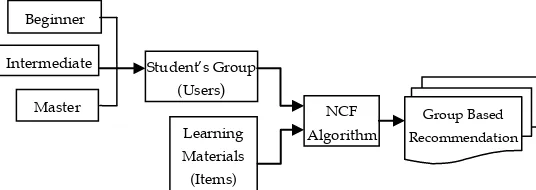
The proposed approach combines the Neural Collaborative Filtering (NCF) and Groupization technique for E-Learning resources based on the levels of learners.
Fig. 1.Recommendation model of proposed approach
The students are predicted based on three levels such as Beginner, Intermediate and Master. Similar students from a single group having the similar capability and provide the almost similar ratings to the learning materials. This information (User group and items rating) are feed as input to
the Neural Collaborative Filtering algorithm. The group based recommendation provided to the user groups as output.
2.2 Group Based Neural Collaborative Filtering
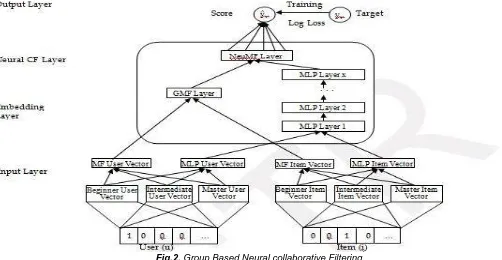
In 2017, Neural Collaborative Filtering introduced for recommender system concept. It makes use of the non-linearity, complexity and flexibility to construct the system for recommendation. The architecture of the Group Based Neural Collaborative Filtering is shown in Fig. 2. The user and item values are one-hot encoded in the input layer. Then these values are mapped with the embedding layers (here three groups of users and items). Neural Collaborative Filtering layer is in between the input and output layer and it contains the Multilayer Perception (MLP) layers and Generalized Matrix Factorization (GMF) and form the NeuMF (Neural Matrix Factorization) layer. The output layer finally produces the score. Matrix Factorization is one of the best methods for recommendation. Let us consider user latent vector is pu and item latent vector is qi for the user and item respectively. The following equation is for GMF layer.
ŷ = a (h (p ⨀q)) (1)
In this equation 1, aout means activation function and h means the edge weight. NCF uses sigmoid function. GMF layer produce the element wise product value and MLP layers produce values based on ReLU function, then finally the output ŷ is produced by concatenating the two layers output. The following equation is for combining GMF and MLP.
ŷ =σ(h a(p ⊙ q + W [pq] + b)) (2) To provide more flexibility the two models such as GMF and MLP are fused.
3
FEATURE
REPRESENTATION
METHODS
There are many feature representation methods. The n users and m items are represented as user-item matrix Rn×m. The index Rij denotes ith user to the jth item. Rij value is 0 if the record is not available. The latent feature matrix of users are ∈ R , ith user‘s feature is the ith row of vector Ui and a denote dimension of user feature. The latent feature matrix of items is V ∈ R , jth item‘s feature is the jth row of vector Vj and b denote dimension of item feature.
3.1 Singular Value Decomposition
The Singular Value Decomposition (SVD) algorithm is sort of the most renowned matrix factorization algorithms. This algorithm divides the matrix into 3 matrices, so that we can able to get the features of users and items. The expression is R = U. S. V the R matrix consists of eigen values of diagonal
Output Layer
Beginner
Intermediate
Master
Student’s Group (Users)
NCF Algorithm
Group Based Recommendation Learning
Fig.2. Group Based Neural collaborative Filtering
element. U is the user matrix and V is the item matrix. S is the diagonal matrix, S ∈ Rn×m. This method performs low when the data size is larger because of computing eigen values.
3.2 ID as Features
He et al. [23] proposed NCF, which is one of the feature representation methods. In this method ID is unique of user or item. First One-hot encoding method used to decode ID value the two other neural network models to train and get the features Ui and Vj for user and item respectively.
Ui=NeuralNetwork(OneHot(i)) and
Vj=NeuralNetwork(OneHot(j)).
Fig. 3. Feature Representation of NCF
OneHot(i) denotes one hot method to decode the user ID and OneHot(j) represents one hot method to decode the item ID value.
3.3 Probabilistic Matrix Factorization
Mnih and Salakhutdinov [24] proposed the Probabilistic Matrix Factorization (PMF). This algorithm uses the product of latent feature of user and latent feature of item to calculate the rating score. The loss function is
L= ∑ δ ||R − UV ||2F+ ||U||2F+ ||V||2F (3)
Here, λ1 and λ2 are L2 regular parameters, δ is 0 when the value Rij=0 otherwise, δ is 1. This algorithm perfectly deals with the missing value problems. Algorithm 1 clearly describes the steps for feature representation. We used gradient descent method and set the learning rate to η.Algorithm 1 Algorithm for Feature Representation ModelNeed: User-item rating matrix R; UserMatrix U, ItemMatrix V; WeightMatrix W;
Variables: n, m, a, b, η;
1: Initialize the values z, p, q, i, j; 2: repeat
3: Calculate ∆ =δ (Ȓ − R ); 4: Update z = z −η ∑ ∆ ; 5: for each user u=1 to n do
6: Update p = P −η ∑ ∆ ;
7: Update U = U −η∑ (∆ ∑ W V ); 8: end for
9: for each item v=1 to m do
10: Update q = q −η ∑ ∆ ;
11: Update V = V −η∑ (∆ ∑ W U ); 12: end for
13: Update W = W −η∑ (∆ U V ); 14: until
User – Item Rating Matrix
OneHot(j) OneHot(i)
Vj NeuralNetwork
1558
4
DATASET
One of the dataset from MovieLens website is MovieLens-1M dataset. It comprises 1,000,209 records of rating from 6,040 users for 3,952 movies. The details of the dataset are in Table I.
Table I. Details of Dataset. MovieLens-1M
Number of Users 6,040
Number of Items 3,952
Number of ratings 1,000,209 Number of rating per user 165.6 Number of rating per item 253.09
Rating Sparsity 95.81%
5
EXPERIMENTAL
RESULT
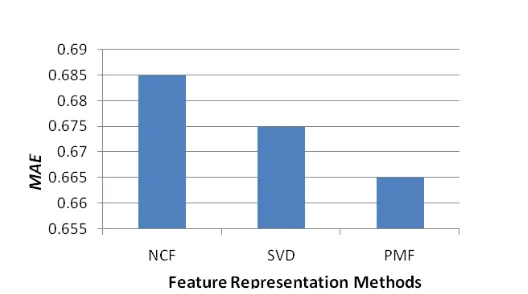
We implemented our proposed model using python with the help of keras and Tensorflow libraries. According to the feature representation model the PMF method produced the better result among other methods and shown in fig. 4. The lower value denotes high performance.
Fig. 4. Results of Feature Representation Methods
The evaluation metrics we used are MEA (Mean Absolute Error). Our proposed model Neural Collaborative filtering combined with the PMF feature representation technique leads to better accuracy. There are three levels of students (Beginner, Intermediate and Master) participated to examine. The collection of books or materials is available for this kind of different level of students. The recommended books obtained to the students of corresponding groups. The test has been conducted before recommending books and after the recommendation. The student‘s performance is far better when the books are recommended to the different groups of students based on their knowledge level with the help of our proposed system.
CONCLUSION
The E-Learning applications are widely used for education purpose. The needed material has to provide for needed students in the correct time to improve the performance. The deep learning model is implemented with the PMF feature representation method and group based NCF technique. This combination gave the good result to produce the recommended books to the group of students which are in the same group.
R
EFERENCES[1] J. W. Lu, Y. Guo, Z. Q. Mi, and Y. Yang, Trust-enhanced matrix factorization using PageRank for recommender system, in Proc. 2017 Int. Conf. Computer, Information and Telecommunication Systems, Dalian, China, 2017, pp. 123–127.
[2] J. A. Konstan, B. N. Miller, D. Maltz, J. L. Herlocker, L. R. Gordon, and J. Riedl, ―Grouplens: Applying collaborative filtering to Usenet news,‖ Commun. ACM, vol. 40, no. 3, pp. 77–87, 1997.
[3] G. Linden, B. Smith, and J. York, ―Amazon.com recommendations: Item-to-item collaborative filtering,‖ IEEE Internet Comput., vol. 7, no. 1, pp. 76–80, 2003.
[4] Ricci F, Rokach L, Shapira B (2011) ―Introduction to recommender systems handbook.‖ In: Ricci F et al (eds) Recommender systems handbook, vol 54. Springer. US, Boston, MA, pp 1–35
[5] M. J. Pazzani and D. Billsus, ―Content-based recommendation systems,‖ in The Adaptive Web. Berlin, Germany: Springer, 2007, pp. 325-341.
[6] X. Su and T. M. Khoshgoftaar, ―A survey of collaborative filtering techniques‖ Adv. Artif. Intell., vol. 2009, Aug. 2009, Art. no. 421425.
[7] K. Miyahara and M. J. Pazzani, ``Collaborative ltering with the sim-ple Bayesian classier,'' in Proc. Topics Artif. Intell. (PRICAI), 2000, pp. 679-689.
[8] B. Sarwar, G. Karypis, J. Konstan, and J. Riedl, ``Application of dimensionality reduction in recommender systemA case study,'' Dept. Comput. Sci. Eng. Univ. Minnesota, Minneapolis, MN, USA, Tech. Rep. TR-00-043, 2000.
[9] B. Sarwar, G. Karypis, J. Konstan, and J. Riedl, ``Item-based collaborative filtering recommendation algorithms,'' inProc. 10th Int. Conf. World Wide Web, 2001, pp. 285-295.
[10]S. Vucetic and Z. Obradovic, ``Collaborative ltering using a regression-based approach,''Knowl. Inf. Syst., vol. 7, no. 1, pp. 1-22, 2005.
[11]R. Salakhutdinov, A. Mnih, and G. Hinton, ``Restricted Boltzmann machines for collaborative ltering,'' inProc. 24th Int. Conf. Mach. Learn., 2007, pp. 791-798.
[12]A. Mnih and R. R. Salakhutdinov, ``Probabilistic matrix factorization,'' in Proc. Adv. Neural Inf. Process. Syst., 2008, pp. 1257-1264.
[13]Y. Koren, R. Bell, and C. Volinsky, ``Matrix factorization techniques for recommender systems,''Computer, vol. 42, no. 8, pp. 30-37, 2009.
[14]K. Yu, S. Zhu, J. Lafferty, and Y. Gong, ``Fast nonparametric matrix factorization for large-scale collaborative ltering,'' in Proc. 32nd Int. ACM SIGIR Conf. Res. Develop. Inf. Retr., 2009, pp. 211-218.
[15]K. Georgiev and P. Nakov, ``A non-IID framework for collaborative filtering with restricted boltzmann machines,'' in Proc. Int. Conf. Mach. Learn., 2013, pp. 1148-1156.
[16]A. van den Oord, S. Dieleman, and B. Schrauwen, ``Deep content-based music recommendation,'' inProc. Adv. Neural Inf. Process. Syst., 2013, pp. 2643-2651.
[17]X. Wang and Y. Wang, ``Improving content-based and hybrid music recommendation using deep learning,'' inProc. 22nd ACM Int. Conf. Multimedia, 2014, pp. 627-636.
[18]H. Wang, N. Wang, and D.-Y. Yeung, ``Collaborative deep learning for recommender systems,'' in Proc. 21th ACM SIGKDD Int. Conf. Knowl. Discovery Data Mining, 2015, pp. 1235-1244.
Trans. Knowl. Data Eng., vol. 28, no. 4, pp. 939950, Apr. 2016. [20]X. He, L. Liao, H. Zhang, L. Nie, X. Hu, and T.-S. Chua, ``Neural
collaborative ltering,'' inProc. 26th Int. Conf. World Wide Web, 2017, pp. 173-182
[21]Zhang, Libo, Tiejian Luo, Fei Zhang, and Yanjun Wu. "A recommendation model based on deep neural network." IEEE Access 6 (2018): 9454-9463.
[22]Liu, Yu, Shuai Wang, M. Shahrukh Khan, and Jieyu He. "A novel deep hybrid recommender system based on auto-encoder with neural collaborative filtering." Big Data Mining and Analytics 1,
no. 3 (2018): 211-221.
[23]X. He, L. Liao, H. Zhang, L. Nie, X. Hu, and T.-S. Chua, ‗‗Neural collaborative filtering,‘‘ in Proc. 26th Int. Conf. World Wide Web, 2017, pp. 173–182.