Exploring the factors of Perceived Risks of Online Shopping
Ms. Urvashi, Research Scholar,
M.M. Institute of Management, Maharishi Markandeshwar University, Mullana
Abstract
Consumers’ perceived risk has been considered as a fundamental concern of decision making process during online shopping. For the purpose of this study, perceived risk is defined as the potential for loss in pursuing a desired outcome from online shopping. Perceived risk is one of the big hurdles in online shopping. Measuring this aspect & finding the details of it & implementing the ways to reduce it will increase online shopping The study aimed to know the demographic profile of the respondents and also examine the factors of perceived risks (financial risk, time risk, source risk, psychological risk, and performance risk) affecting online shopping behaviour of consumers. A sample size of 120 has been taken and data was collected through Questionnaires from various online shopping users that includes professionals, students, business man etc. The results of the study will further be used by the researchers and practitioners for conducting future studies in the similar area.
Keywords: Perceived Risk, Online Shopping, financial risk, performance risk, psychological risk , source risk, time risk,
Introduction:
Perceived risk is defined as “the nature and amount of uncertainty perceived by consumers in completing particular purchase decision.” As online shopping is becoming more prevalent, it is important to understand consumer online purchasing behavior. While the influencing factors are important to understanding consumer behavior, hindering factors are also vital to understanding such behavior. Therefore, the importance of identifying and analyzing factors that could hinder consumers' willingness to make an online purchase is imperative. This study aims to examine the effect of perceived risk factors (i.e. perceived performance risk, financial risk, time-loss risk, psychological risk and source risk) on consumers' online.
Types of Perceived Risk Perceived Financial risk
Perceived financial risk is defined as concern over any financial loss that might be incurred because of online shopping. There may be financial loss due to hidden costs, maintenance costs or lack of warranty in case of fault .Also there may be possibility that the product will not be worth the financial price and might be available cheaper.
Perceived Performance risk
Perceived product risk is defined as concern over the functionality of the communication channel i.e. Internet . Product ordered with specific color and quality as displayed on the web sites may not match with the delivered product.
Perceived Time Risk
Time risk is defined as concern over the amount of time required to receive the product. This risk involves the waiting time for the product or any time lost due to technological difficulty encountered in browsing through the web site or time lost in returning or exchanging the product.
Perceived Psychological risk
Perceived psychological reflects concern about the psychological discomfort and tension that may arise because of online shopping. Apart from feeling uncomfortable and experiencing unnecessary tension while online shopping, customers may also have the feeling of too much socially isolated.
Perceived Source risk
Source risk involves concerns about the difficulty in ascertaining the reliability and expertise, reputation, trustworthiness and believability of some online companies.
Review of Literature:
Syarafina Ibrahim, Norazah Mohd Suki and Amran(2014) conducted a study on “ Structural relationships between perceived risk and consumers unwillingness to buy home appliances online with moderation of online consumer reviews”. The aim of the study is to examine the effect of perceived risk factors (i.e. perceived performance risk, financial risk, time-loss risk, psychological risk and source risk) on consumers' unwillingness to buy home appliances online. The primary data was collected through self-administered questionnaires distributed among 150 respondents. The data was analyzed using structural equation modeling. The results revealed that perceived performance risk influences consumers' likelihood of not buying home appliances online, as the consumers are themselves unable to touch, see and hear the product. Online consumer reviews have also been found to moderate this relationship. The study provided important practical contributions that allow retailers and internet marketers to understand consumers' perceptions and behaviors regarding consumer risk perception and to determine which type of risk is most important to address in order to increase the consumers' likelihood of buying home appliances online.
Bo Dai, Sandra Forsythe, Wi-Suk Kwon (2014) conducted a study on “ The impact of online shopping experience on risk perceptions and online purchase intentions: Does product category matter?” The purpose of this study was to examine the influence of online shopping experience on perception of specific types of risks associated with online shopping and how each type of risk perceptions influences online purchase intentions. An online survey was used to assess participants’ online shopping experience, three types of risk perceptions, and online purchase intentions for non-digital (e.g. a denim jacket) and digital products (e.g. MP3 files). A self-administered Web-based questionnaire was developed to measure participants’ (1) online purchase experience, (2) perceptions of the three types of risks associated with online purchasing, (3) online purchase intention in the next six months, and (4) demographic characteristics. The data was collected by a self administered questionnaire from 2500 college students. A conceptual model was proposed to illustrate the relationships between online shopping experience and perceptions of product, financial, and privacy risks associated with online shopping, and how both experience and risk perceptions impact online purchase intentions The results indicated that online shopping experience is a strong positive predictor of online shoppers’ purchase intentions for the two product categories (i.e. non-digital and digital products) examined.
Emad Y. Masoud (2013) conducted a study on “The Effect of Perceived Risk on Online Shopping in Jordan”. The study aimed to examine the effect of perceived risks (financial risk, product risk, time risk, delivery risk, and information security risk) on online shopping behavior in Jordan. To investigate the hypotheses of the research, data was collected from online shopping users with a sample size of 395 online shoppers among consumers who previously purchased online and mainly from the main popular online stores in Jordan. The methodology was done using SPSS 17 and Amos 18. The study revealed that financial risk, product risk, delivery risk, and information security risk negatively affect online shopping behavior. The results also showed that the other two dimensions, perceived time risk, and perceived social risk have no effect on online shopping. The study has an important managerial implication; it provides marketers with the importance of consumers risk perception in order to adopt adequate risk-reduction strategies in the internet shopping environment.
Vinay Kumar, Sumit Mishra (2012) conducted a research on “A Study of the attitude towards Online Shopping: A conceptual model regarding intention formation, the role of perceived risks.” The objective of the study was to study different types of attitude towards online shopping that exists from the relationship between perceived risks and perceived benefits. Consumer changed intention framing process: The role of perceived risks (the proposed Model) was framed to achieve the objective. The results of the study show that attitudes towards risk and benefit of using online shopping create conflict for the consumers and it creates a negative intention towards online shopping among the consumers.
Research Methodology:
Objective of the study:
1. To study the demographic profile of the consumer shopping online
2. To explore the influence of various factors of perceived risks on online shopping behavior of consumers.
Research Design and Framework
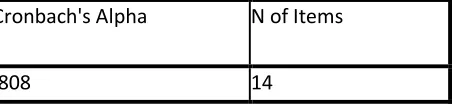
This study focused on the influence of perceived risk on consumers online purchase behavior. The current research is descriptive in nature. Data was collected by questionnaire from 130 respondents from Haryana and after shifting out the invalid ones, 120 questionnaires were used for the study. The first part of questionnaire included questions about demographic profile of respondents like age, education, income, gender, marital status and the second part of questionnaire comprised of 14 questions regarding factors of perceived risk. These items were measured on a five-point Likert scale ranging from 1 (strongly disagree) to 5 (strongly agree) Basic statistical tools and Factor Analysis with the help of SPSS version 20.0 have been used in this study for analyzing the Primary data. Reliability and Validity were used to assess the internal consistency and content validity of the instrument. Cronbach Alpha was used to assess the internal consistency. KMO and Bartlett’s test of Sphericity have been undertaken in this study which helps to determine whether the sample was adequate to consider the data as normally distributed, and thus highlighted whether the factor analysis is appropriate or not. Factor analysis helps us to determine the interdependence amongst the various factors. The Bartlett's Test of Sphericity was tested through Chi-Square in order to determine whether the null hypothesis will be accepted or rejected.
Hypothesis:-
Data Analysis & Interpretation
Table 4.1:Demographic Characteristics:
Variable Frequency Percentage
Gender: Male Female 66 54 55 45 Age: 18-28 years 29-38 years 39-48 years Above 49 years
57 35 21 7 47.5 29.2 17.5 5.8 Education level: Primary Secondary UG PG Above PG 00 02 40 50 28 0 1.7 33.4 41.2 23.3 Income (Rs.) :
Less than 10,000 10,000-30,000 30,000-60,000 60,000-1,00,000 Above 1,00,000 20 32 48 15 5 16.7 26.7 40 12.5 4.2 Marital Status: Single Married 51 69 42.5 57.5
The table 4.1 revealed that from the sample which we have collected, 55% were males and remaining 45% were females. As far as the age of the respondents are concerned 57% were between 18-28 years followed by 29-38 years with 35%. If we consider the educational qualifications, 23.3% respondents were postgraduates and above, 41.2% of respondents were postgraduates, 33.4 % were undergraduates and only 07% were having secondary qualification. As far as their monthly income was concerned 48% were earning between 30,000-60,000 rupees followed by 32% with an income of 10,000-30000 Rupees per month. 51% of respondents were single while 69% were married.
Reliability Analysis:
Table 4.2: Reliability Statistics
Cronbach's Alpha N of Items
.808 14
Factor Analysis
In order to determine the factors influencing the online purchase of products in Haryana, factor analysis was undertaken with the help of SPSS version 20.0 and the following interpretations were concluded
Table 4.3: KMO and Bartlett's Test
Kaiser-Meyer-Olkin Measure of Sampling Adequacy. .749
Bartlett's Test of Sphericity
Approx. Chi-Square 376.938
df 91
Sig. .000
According to the KMO and Bartlett's Test table, the Kaiser-Meyer-Olkin Measure of Sampling Adequacy value is 0.749 which is greater than 0.50. This indicates that the sample was adequate to consider the data as normally distributed, and the KMO test is highly significant. The Bartlett's Test of Sphericity was tested through Chi-Square which is found to have a value of 376.938 which is significant at 0% level of significance, i.e., p<0.05. So we see that there are low chances of obtaining the required results if the null hypothesis was true. Hence we reject the null hypothesis (H0) and accept the alternative hypothesis (H1).
Table 4.4:Total Variance Explained
Component Initial Eigenvalues Extraction Sums of Squared Loadings
Rotation Sums of Squared Loadings
Total % of Variance
Cumulative %
Total % of
Variance
Cumulative %
Total % of
Variance
Cumulative %
1 3.869 27.639 27.639 3.869 27.639 27.639 2.753 19.665 19.665
2 1.536 10.973 38.613 1.536 10.973 38.613 1.801 12.867 32.532
3 1.267 9.047 47.659 1.267 9.047 47.659 1.714 12.240 44.772
4 1.160 8.284 55.944 1.160 8.284 55.944 1.342 9.587 54.359
5 1.042 7.444 63.388 1.042 7.444 63.388 1.264 9.029 63.388
6 .856 6.112 69.500
7 .762 5.446 74.946
8 .706 5.044 79.990
9 .659 4.707 84.696
10 .573 4.095 88.791
11 .452 3.230 92.021
12 .416 2.969 94.990
13 .391 2.796 97.786
14 .310 2.214 100.000
Table 4.5: Rotated Component Matrixa
Component
1 2 3 4 5
It is difficult to feel, try and/or experience the product prior to purchase during online shopping
.748 .120 .132 -.108 .200
It is difficult to determine the characteristics of the products such as quality, size, colour, and style by just looking at pictures on the web
.743 .038 .150 .022 -.075
I am concerned that the product delivered may not be exactly as it appeared when displayed on the computer screen.
.545 .499 -.003 .064 .053
It is not safe to give my credit card number when I order online.
.120 .695 .078 .279 -.055
I am concerned about the ultimate price of the on-line product because there might be hidden costs.
.454 .483 .298 -.036 -.235
I am concerned that my financial records might not be adequately protected if I shop online.
.129 .498 .144 .420 .282
It is difficult to determine the reliability and expertise of some online companies
.228 .203 .572 -.087 .025
I am concerned about the trustworthiness of some online companies.
.104 .131 .438 .115 -.090
It is difficult to determine the reputation of some online companies.
.004 .117 .424 .101 -.336
The thought of online shopping makes me feel uncomfortable. -.061 .013 .037 .771 .029
Online shopping will lead to too much social isolation .111 .145 .168 .737 -.011
The thought of online shopping causes me to experience unnecessary tension.
.085 .290 .144 .662 .429
I am afraid that products purchased from online vendors will not be delivered on time.
.198 -.032 .97 .063 .897
I would have to spend a lot of time if I want to return online purchased products.
Extraction Method: Principal Component Analysis. Rotation Method: Varimax with Kaiser Normalization.
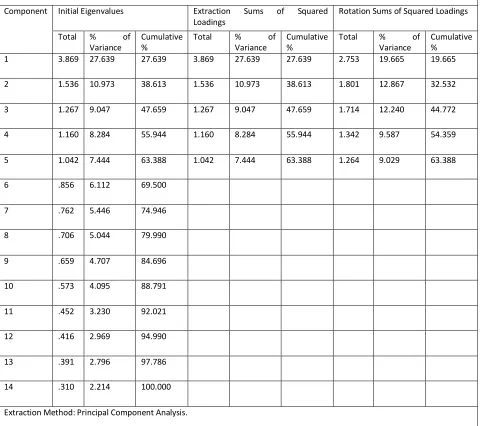
The initial factor solution was obtained using principal component analysis (PCA) and varimax rotation. The rotation converged in 07 iterations identifying the five principle components with Eigen value of at least 1.By employing the method, five factors were identified in this study. Factor analysis demonstrated five factors cumulatively accounting for 63.388 % of variation in all the items. Table 4.4 represents the rotated components matrix of items loading on each of the eight factors. The squared factor loading is the percent of variance in that item explained by the factor. Factor analysis is used to examine dominant factors that influenced consumer attitude toward online shopping. With regard to result reported in Table 4.4, the most important dominant factor of online shopping orientation is performance risk which can be grouped under component 1; financial risk can be grouped under component 2; source risk can be grouped under component 3 ; psychological risk can be grouped under component 4, time loss risk can be grouped under component 5. As presented in Table 4.5, factor 1explains 27.639% of the variance, 10.973% of the variance, factor 3 explains 9.047% of the variance, factor 4 explains 8.284% of the variance, factor 5 explains 7.444% of the variance.
Findings
The results show that demographic factors do affect the online shopping behaviour of consumers. The results support the findings in the previous studies that males tend to become more online shoppers..It has also been proved that people in the age group of 18-28 years do more online shopping, the respondents with PG qualification are more online shoppers. As far as their monthly income was concerned 48% were earning between 30,000-60,000 rupees followed by 32% with an income of 10,000-30000 rupees per month. Maximum online shoppers were married as they find less time because of family commitments. The study also highlighted the factors that restrain the consumers to buy the goods online. Perceived Performance risk was determined to be the most significant risk dimension that affects consumers' online shopping behavior, surpassing the other components of perceived risk such as financial risk, source risk, psychological risk and time risk. These findings also provide practical implications for online retailers. By better understanding the relationships among previous online shopping experience, types of risk perceptions, e-marketers may be able to take more appropriate actions to make shopping online a less risky experience
Conclusion:
References
Emad Y. Masoud (2013), “The Effect of Perceived Risk on Online Shopping in Jordan”, European Journal of Business and Management, Vol.5, No.6, pp.76-87.
Silvina Santana, Sandra Loureiro(2010), Assessing benefits and risks of online shopping in Spain and Scotland”, Vol. 15, No.2 , pp.161-172.
Bo Dai, Sandra Forsythe, Wi-Suk Kwon (2014), “ The impact of online shopping experience on risk perceptions and online purchase intentions: does product category matter?”, Journal of Electronic Commerce Research, Vol.15, No.1, pp.13-24.
Dowling, G.R., and Staelin, R. (1994), “A Model of Perceived Risk and Intended Risk-handling Activity,” Journal of Consumer Research, 21(1), 119-134.
Lu, H. P., C. L. Hsu, and H. Y. Hsu (2005), “An Empirical Study of the Effect of Perceived Risk upon Intention to Use Online Applications”, Information Management & Computer Security, Vol. 13, No. 2/3: 106-120, 2005.
Horrigan, J. B (2009), “Online Shopping: Convenient But Risky”, available at http://pewresearch.org/pubs/733/online-shopping (accessed 15 February, 2009).
Horton, R. L (1984), “The Structure of Perceived Risk: Some Further Progress”, Academy of Marketing Science, Vol. 4, No. 4: 694-716, 1984.
Ahasanul, H., Ali, K., & Shameem, A. M. (2009). Factors determinate customer shopping behavior
through Internet: The Malaysian case. Australian Journal of Basic and Applied Sciences, 3(4), 3452–3463.
Akram, M. S. (2008). How perceived risk affects online purchase intention: Consumer's perspective. Unpublished doctoral dissertation, Universite Paul Cézanne, France.
Ali, H. A., Farhad, G., & Nooshin, G. T. (2010). A study of the role of perceived risk and user characteristics in Internet purchase intention. World Academy of Science, 66, 43–47.
Al-Mowalad, A., & Lennora, P. (2012). Factors that influence Saudi consumers behavior to make online purchase. Paper presented at the International Conference on Management, Behavioral Sciences and Economics Issues.
Atchariyachanvanich, K., & Okada, H. (2007). How consumer lifestyle affect purchasing behavior: Evidence from Internet shopping in Japan. Journal of Entrepreneurship Research, 2(2), 63–78.
Bailey, A. A. (2005). Consumer awareness and use of product review websites. Journal of Interactive Marketing, 6(1), 1–16.
Benedicktus, R. L., Brady, M. K., Darke, P. R., & Voorhees, C. M. (2010). trustworthiness to online consumers: Reactions to consensus, physical store presence, Jour, brand familiarity, and generalized suspicion. Journal of Retailing, 86(4), 322–335.
Journal of Retailing, 86(4),322-335
Lu, H. P., C. L. Hsu, and H. Y. Hsu, “An Empirical Study of the Effect of Perceived Risk upon Intention to Use Online Applications”, Information Management & Computer Security, Vol. 13, No. 2/3: 106-120, 2005.
Bauer, R.A (1967), “Consumer Behavior as Risk taking,” in Risk Taking and Information Handling in Consumer Behavior, edited by D. Cox, Harvard University Press, Cambridge, Mass
Cristiane Salome Ribeiro Costa, Rafael Lucian (2014), “Structural Equations Modeling, Perceived Risk and Flow State on E-Commerce”, iBusiness, Published online in Scientific Research, No.6, pp.38-43