A Study of retention variables influencing employee attrition for IT-units:
with special reference to - Pune City.
Yogita Gupta1, Dr. Ajay Kumar2, Dr. Seemarani3
1
Assistant Professor, SIBAR, Pune- 411048 2Director, JSPM‟s JICA,
Pune-411033,
3Visiting faculty, Tilak Maharashtra Vidyapeeth, Pune.
ABSTRACT
In this era of globalization employees are blessed with good opportunities. There are many factors which influence retention and it is required to understand employee expectations. Employee Retention is a process in which the employees are encouraged to be with the organization for the maximum time. To support business optimally, need is to retain existing talented employees who have the essential knowledge, expertise and competencies to do the work. The IT industries are facing the critical challenges of recruiting and retaining the best talents. The retention problem is highly persisted in IT industry. The objective of this paper is to find out the factors which influence employee turnover and reasons for turnover in IT-units. The study is done in selected IT-units in the Pune with the post exit employees. The twelve retention variables have been used for the study. The results showed that some of the retention variables are highly influencing attrition. One gets the trends of attrition in IT-units in Pune and accordingly, HRD can design its retention strategies as suggested in this study.
Key Words: - HR Practice, IT Industry, Attrition, Employee Retention, retention variables.
I-INTRODUCTION
The evolution of HRM (Human Resource Management) can be traced back to the HR movement in the ancient period. Since last 100 odd years, the techniques and study of human behaviour at work has become formal and structured with certain basic practices established as core. Individual business has been designed, implemented and practiced according to business need and their goal. Every organization has its own culture and it is the blue print of its features, its people, its success and its failure. Today, HRM is the key section of an organisation and its role is to develop strategies time to time in rapidly changing global business environment to retain their existing talent employees so that the set organisation goals are achieved. The Information technology (IT) has been in news for many reasons, mainly for generating revenue, high profit and well-paid market. The IT industry in India has gained a brand identity as a knowledge economy due to its IT and ITES sector. The sector has increased its contribution to India's GDP from 6.1% in 2009-10 to 6.4% in 2010-11, 7.5% in 2011-12 and has grown 19% during 2012-13, NASSCOM (2013). A lot of small and big industries have come into the market, and therefore a major segment of youngsters have selected their profession in IT sector. When so many IT industries are available, employees have an option of changeover their job very frequently. Before switching the job employees consider some factors, some of which are: working hours, good working conditions, challenging projects, perks, decent salary package, career growth, salary package, support form pears, support for higher education. The minute they feel, they are being underutilized, they start searching the job which leads to turnover. To avoid such situation, IT units have to give attention on retention.
The retention of high performing employees has become more challenging for managers as this category of employees frequently move from one job to another as they are being attracted by more than one organization at a time Michael O. Samuel and Crispen Chipunza (2009). However the reason for employee turnover varies from one Organization to the other and from one person to another as they are not getting what they expect from the Organization (Ongori, 2007). Mobley (1982) and Dickter, Roznowski and Harrison (1996) also called for more research and theory pertaining to how the turnover process occurs overtime. Turnover of the employees in the IT units leads management to many problems. Retention of the employees reduces the cost of the product, increase productivity and condense brain drain of the particular unit. A high rate of turnover affect the organization in many ways like lead to loss of more expenses, loss of company knowledge, interruption of customer service, as well as the goodwill.
The turnover can be Involuntary, Voluntary, Desirable and Undesirable. The most common reasons for leaving a job are „poor salary and benefits’, A lack of training and development opportunities, Dissatisfaction with
management, Not getting along with colleagues, The journey to work, Lack of work/life balance.
retain the skilled and knowledgeable employees. The various tools are used by HRD for employee retention which are employee reward program, career development program; performance based bonus, employee referral plan, loyalty bonus, employee recreation, Gifts at some occasions, accountability, making the managers effective and easily accessible, surveys etc. This research paper is a line of study on the key retention factors influence in IT units has been investigated.
Pune – IT Industries has been the home for majority of the software development companies and organizations both of Indian origin and firms formed as the IT wings of leading multi-national companies. During the last two decades Pune has grown into a destination for both the IT sector entrepreneurs and the young engineers and professionals wanting to make a career in the IT industry. But it is also a fact that the industry has been facing the problem of high rates of employee attrition due to the sudden growth of the industry and simultaneous scarcity of the qualified manpower in the changing environment and technology. This rate has varied from year to year and from IT-unit to IT-IT-unit and place to place.
Numerous studies have been conducted on employee retention so far. The exponential growth of IT sector in India in the last few decades have prompted the Organization to focus on employee centred employment relationship to hold back the employees. A considerable amount of literature has been published on retention so far. Review of literature of the related studies gave an insight about the subject matter and also helped in analyzing the existing gap that could be taken up for further research. The problem of employee retention has hit all category of employee equally. Although several studies are done on the topic in different industry but the issue is still disturbing.
II - REVIEW OF LITERATURE
The main purpose of retention is to prevent the loss of competent employees from the organization as this could have adverse effect on productivity and service delivery. However, retention of high performing employees has become more challenging for managers as this category of employees frequently move from one job to another as they are being attracted by more than one organization at a time Michael O. Samuel and Crispen Chipunza (2009).
Retention is a voluntary move by an organization to create an environment which engages employees for long term (Chaminade, 2007). However the reason for employee turnover varies from one Organization to the other and from person to person as they are not getting what they expect from the Organization (Ongori, 2007). Mobley (1982) and Dickter, Roznowski and Harrison (1996) also called for more research and theory pertaining to how the turnover process occurs over time.
Arnold and Feldman (1982) devised that turnover intention can be influenced by many factors such as job satisfaction, age, tenure of the job, organization commitment, perception of job security and intention to switch a job (Lee et al., 2010). Furthermore, Mobley et al., (1979) presented some other factors which indicated employee‟s turnover intention and that are “promotion opportunities”, “centrality of work value” and “peer group interaction”. Lee et al., (2010) derived the factors which influence the turnover intention of the employees i.e. organizational culture (enterprise style, leadership style), job stress (work load, work atmosphere, interaction between upper management and employees), work characteristics (working hours, work attributes, work interest), promotion (promotional opportunities, repositioning, fair allocation), salary and compensation (compensation, employee benefits, reward system, retirement system) and quality of work life (work environment, work atmosphere, interaction with colleagues), (Arnold and Feldman, 1982; Mobley, 1982; Mobley et al., 1979).
Hamermesh (2001) is of the view that job satisfaction is basically the perception of an employee which is an outcome of all the aspects of his/her job. Furthermore, he discussed that it also depends on the similar job opportunities the employee may have outside the organization as that comparison between his/her job and other similar jobs determines the satisfaction level. Purani and Sahadev (2008) divides job satisfaction into five basic components i.e. the satisfaction with overall HR polices, satisfaction with the compensation, satisfaction with the supervisor‟s behavior and attitude, satisfaction with the extent of task clarity and the satisfaction with the career growth opportunities in the organization. Pergamit and Veum (1989) in their study found a close and positive correlation between promotions and job satisfaction and which in turn, helps in retaining employees. Locke (1976) defined job satisfaction as” a pleasurable or positive emotional state resulting from the appraisal of one‟s job or job experience. Davis et al., (1985) stated that job satisfaction is a combination of positive and negative feelings that workers have towards their work.
The talented employees are required for maintaining a competitive advantage and employees want career growth opportunities to develop and rise in their career ladder. Research by Meyer et al, (2003) has shown internal career development of employees is often the best predictor of an employee's effective commitment. Many practitioners and scholars within human resource development (HRD) field have claimed that the utmost crucial aspect of the practices is career development (McLagan, 1989; Weinberger, 1998; Swanson & Holton, 2001). However, this area of studies has been given little attention (Upton, Egan & Lynham, 2003). With the intense competition in the 21 century, many organisations have realised that in order for them to stay in the competition they have to improve their employees and enhance their career development (Boudreaux, 2001);
Work-life balance is increasingly important for engagement and affects retention. Hyman et al., (2003) in their empirical research in the UK found that interventions of work demands into personal life (e.g. working during the week-end) resulted into heightened stress and emotional exhaustion among the employees.
Performance reviews help the company as well as the employees. They help the employees get a feedback of their past performance, it helps them understand as to where in the organisation hierarchy they stand- their strengths and weakness which can be worked upon further for efficiency. In case of employees who possess very high potential a performance appraisal for them is more important than pay hike or increase in benefits as it helps in enhancing further motivation and commitment. At the same time the immediate supervisor should make sure that how will they go about doing the appraisal-the way feedback has to be given plays a very important role in an employee‟s decision to stay. Thus, not only monetary benefits but rewards and recognition, performance appraisals, effective leadership style, professional development practices, managerial support and social activities-work ethics. Therefore the above few pointers determine the employee‟s intention to leave the organisation. Companies like Ingersol Rand Limited have developed a 360 degree online performance appraisal tool to manage the evaluation and opinion process and also provide consultative advice on coaching and mentoring. According to the survey conducted by them with company heads being interviewed such as the TATAS, Hyundai Motors, Reliance industries, Infosys, etc. it was revealed that employees need to be given that “extra” which motivates them to stay(Jonathan P. Doh, 2011).Now coming to the personal life of the employees, employees are looking for alternatives because of their collective desire to improve
Employee retention is essential to have a competitive advantage in today‟s date. Providing emotional support and work life balance to employees helps organizations in low turnover (Osman M. Karatepe 2013). The role of work life balance has a direct relation in employee‟s decision to stay or leave the organization.
III- STATEMENT OF PROBLEM
A significant difference has been established between what employers assumed the key causes of turnover and actual reasons employees gave for leaving. Turnover of the employees in the IT units are high because most of the talents are youngster and Information Technology are changing very fast and employees does not wants to become absolute in this domain. In small span of time employee get higher position, responsibility and other status in IT as compare to other industries.
The exit interviews are an ideal way to recording and analysing the factors that have led staff to leave the organisation. The success of exit interview depends on employee‟s willingness to give full and honest feedback. The common observations are that staffs are uncomfortable giving honest feedback because of various reasons that are- the interview may be carried out by a line manager/colleague but departures do not feel comfortable to indicate past working relationship with them / the interview was carried out by a senior director which was quit intimidating/ the interview is carried out by HR department and staff can think that his feedback could affect his future references. The best way to gain staff buy-in is to ensure that, the process is implemented by someone who is seen as impartial and a method by which the employee is given the opportunity to speak freely about their opinions.
It has been observed that there is a great demand for skilled IT professionals within India and abroad, which has resulted in technocrats leaving the Organization in search of greener pastures.
IV-OBJECTIVES
Handling the employee retention issues has got a serious attention at all level of management in IT industries. The retention in IT industry is vibrant, due to fast changes in Information Technology and industries are engaged in different technology, accordingly there is a shortage of skill human resources.
issues(X12) were considered for the study. The 12 retention variables further classified with two or more composite variables are listed in table-1.
The research objectives of this study are:
To find the retention variables influencing attritions and rank the composite variables under each influenced retention variable.
To helps the HR Managers of IT-Units to design specific retention strategies to control employee attrition effectively.
Table-1: Retention variables with their composite variables
Retention variables
Composite variables
X1 1-Salary 2-Fringe benefits 3-Insurance 4-Rewards and incentives
X2 1-Availability of better roles, 2-Initiatives/Responsibilities, 3-Opportunities of higher studies, 4-Job expectation v/s reality, 5-Promotion Policy
X3 1-Availability of flexible working hour, 2-Availability of work from home, 3-Availability of job sharing, 4-Availability of compensatory off for working on off days, 5-Work pressure X4 1-Proper utilization of skills, 2-Proper HR Policies, 3-Co-operation among co-worker,
4-Transparency in communication, 5-Challenging job task
X5 1-Well organized working environment, 2-Resource to perform job effectively, 3-Hierarchy in management
X6 1- Support by team members to perform role effective, 2-Work in team is appreciated and recognized, 3-Task being properly allocated among team member, 4-Innovation of doing things are appreciated by team members, 5-Team is effectively managed by team leader X7 1-Delegating the work effectiveness, 2-Treatment by management, 3-Monthly plans
developed, 4-Listening of grievance, 5-Feedback loop
X8 1-Staff development programme held to add value to the skill, 2-Ability to perform assigned jobs, 3-Organization gives new opportunities
X9 1-Take responsibility to put extra effort when necessary, 2-Committed to the goals of the organization
X10 1-Performance appraisal System adequately done, 2-360° feedback
X11 1-The employees involved in managerial decision making, 2-Management keeps department informed about happening‟s in the organization, 3-Receive a proper induction while joining X12 1- Gender discrimination, 2-Behaviour of co-worker, 3-Behaviour of Management
V- HYPOTHESIS
Based on the objectives the hypothesis set for study of retention in IT-units:
H1: There is a relation between retention variables that are positively related to employee decision to stay with
the organization.
Hypothesis -a to l: Each retention variable is a set of two and more composite variables that are significantly differing for attrition or retention.
a) H1: There is difference in the importance of employees attach to the various composite variables of
compensation schemes.
b) H1: There is difference in the importance of employees attach to the various composite variables of
career growth.
c) H1: There is difference in the importance of employees attach to the various composite variables of
work-life-balance.
d) H1: There is difference in the importance of employees attach to the various composite variables of job
e) H1: There is difference in the importance of employees attach to the various composite variables of
Environment.
f) H1: There is difference in the importance of employees attach to the various composite variables of
Team Work.
g) H1: There is difference in the importance of employees attach to the various composite variables of
Management Effectiveness.
h) H1: There is difference in the importance of employees attach to the various composite variables of
Competency.
i) H1: There is difference in the importance of employees attach to the various composite variables of
Commitment.
j) H1: There is difference in the importance of employees attach to the various composite variables of
Appraisal system.
k) H1: There is difference in the importance of employees attach to the various composite variables of
Involvement.
l) H1: There is difference in the importance of employees attach to the various composite variables of
Gender Issues.
VI- RESEARCH METHODOLOGY
Research Design: The conceptual model of the research is based on the literatures review and the theoretical framework of the hypothesis consider. The structured Questionnaire directive approach has been considered. The Questionnaire is divided in two sections that are Background Information and Research Questions to test reasons for job changed. Descriptive Analysis (Mean & %), and Non-Parametric–Tests are used. Cochran Q-Test to find most and least influencing retention variables and Friedman chi square for the significant test, Wilcoxon signed –rank test, Skewness test and Kurtosis tests are used for ranking the composite variables under each retention variables.
Sample size: Sampling population and area taken, is segregated in and around Pune (Hingiwadi IT park, Magarpatta, Koregoan, Rajiv Gandhi IT park PCMC). Sample Frame is IT-units (MNC, big and small units) listed under Pune Maratha Chambers of Commerce and Industries and Agriculture (MCCIA) have been considered. Out of around 402 IT-units in MCCIA, 42 IT-units taken for the study. The total approximate populations were 6000 employees in these 402 IT-Units. The sampling technique used for study is simple random sampling and 600 employees were approached for data collection.
Respondent type: The IT employee, who has left the organization at least once, is considered for the study. The respondent can be male or female, any age group and any designation with 1 year and onwards experiences.
Pilot study: In this study, 30 employees from six IT-units (Capgemini, Tech Mahindra, Cognizant, Infosys, Sementac and Syntel) have been approached with the condition that they have switched their job at least once. The questionnaire were distributed to the employees who were willing to help researcher in pilot study considering that within 7 to 8 days they will read & and return the questionnaire with suggestions. Out of 30 respondents, 25 had responded effectively for the completion of pilot study and 5 respondents did not responded due to various reasons, so the response rate was 83.33%.
Primary Data: During main study, a few of the IT-units were not ready to corporate, some of them were closed down, because of which data were collected from 36 units only as considered 42 units during the sample size consideration. In order to achieve a similar or better response rate, that of the pilot survey was, the 600 respondents were invited to participate in the main survey and 576 respondents response were found valid. The response rate was 96% for the main study. Two types of scale were used. Likert 5 point scale (1-Very low influenced, 2- Low influenced, 3- Moderate influenced, 4- Highly influenced, 5- Very highly influenced) for composite variables and dichotomous scale (1= Yes and 2 = No) for retention variables.
VII - DATA ANALYSIS AND RESULTS
Respondents and their Demographics: Other than age group and gender there were more three survey questions which were related to profile of the employees, including Industries worked in- MNC or National, current designation of respondent (Junior Level, Middle level and Higher Level), their years of experiences (1-5years, 6-10years, 10-15years, 16+ years) at the time of questionnaire filled. The respondents of the age were group as 21 to 25years, 26 to 30 years, 31 to 35 years and 36 + years. The number of job changed by a respondent are classified as 1-time, 2-times, 3-times, 4-times and 5+ times All this demographic information are tabulated in the Table- 2.
Table- 2: Survey respondent by demographics (n =576).
Aspects/variables Category Frequency Percentage
Respondent from 36 IT-units
National 14 38.88%
MNC 22 61.11%
Gender
Male 374 64.93%
Female 202 35.07%
Respondent Designation/ Employee position level
Junior Level 307 53.30%
Middle Level 224 38.89%
Higher Level 45 7.81%
Years of Experience at the time of the survey
1yr-5yrs 374 64.93%
6yrs-10yrs 173 30.03%
10yrs-15yrs 17 02.95%
16yrs and above 12 02.08%
Age group
21 to 25 198 34.37 %
26 to 30 190 32.98 %
31 to 35 98 17.01%
36 + 90 16.62 %
Number of Job changed 1 time 267 46.35%
2 times 145 25.17%
3 times 90 15.62%
4 times 52 09.02%
5 times and above 22 03.81%
According to the Table-2, indicated that the data was collected from 36 IT-units, out of which 22 (61.11%) were Multinational and 14(38.88%) were in National. The Male respondents were 374 out of 576 (64.93%) and female respondents were 202 (35.07 %). The respondent‟s position levels were junior, middle and higher. The junior level employees were 307(53.30%), middle level employees were 224 (38.89%) and higher level employees were 45 (7.81%).
In the 576 responses, 1-5years experiences were 374(64.93%), 6-10years experiences were 173(30.03%), 10-15years experiences were 17(02.95%), and 16+years experiences were 12(02.08%). The respondent of age 21 to 25 years were 198 (34.37%), 26 to 30 years were 190 (32.98%), 31 to 35 years were 98 (17.01%) and 36+ years were 90 (16.62%). Numbers of job changed by the respondents were 1 time- 267 (46.35%), 2 times- 145 (25.17%), 3 times- 90 (15.62%), 4 times- 52 (09.02%) and 5+ times- 22 (03.81%) respondents were.
Testing of the Hypothesis:
H
1:
There is a relation between retention variables that are positively related toemployee decision to stay with the organization.
result is tabulated in table-3. Further, Friedman chi-square test and Wilcoxon Signed Ranks test are also applied to find most influencing retention variables.
Table -3: Cochran’s Q test statistics
Where in, N= number of respondent, Df - degrees of freedom, Asymp. Sig. = asymmetry of the probability distribution i.e P value.
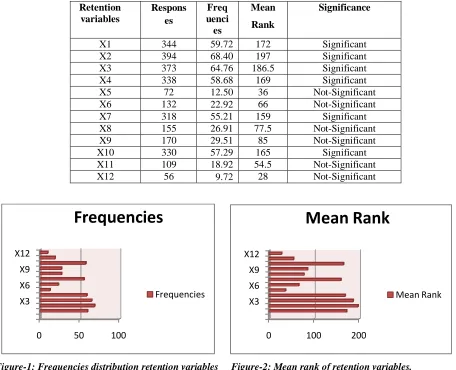
Observation: From the Table-2, theCochran's Q (11) =1409.519, P value = 0.000, N=571. Since the P value (0.000) is less than level of significance (0.05). Hence, there is some significance value in the importance of employees attach to the various retention variables and their ranks are presented in the table-3.
Table-4: Frequencies distribution, Mean Rank and test results on retention variables.
Retention variables
Respons es
Freq uenci es
Mean
Rank
Significance
X1 344 59.72 172 Significant
X2 394 68.40 197 Significant
X3 373 64.76 186.5 Significant
X4 338 58.68 169 Significant
X5 72 12.50 36 Not-Significant
X6 132 22.92 66 Not-Significant
X7 318 55.21 159 Significant
X8 155 26.91 77.5 Not-Significant
X9 170 29.51 85 Not-Significant
X10 330 57.29 165 Significant
X11 109 18.92 54.5 Not-Significant
X12 56 9.72 28 Not-Significant
Figure-1: Frequencies distribution retention variables Figure-2: Mean rank of retention variables.
By table-4 and figure-2 & 3 it can be observed that there are six retention variables mostly influencing retention that are - career growth, work life balance, compensation, Job satisfaction appraisal system and management effectiveness.
0 50 100
X3 X6 X9 X12
Frequencies
Frequencies
0 100 200
X3 X6 X9 X12
Mean Rank
Mean Rank
Test Statistics
N Cochran's Q Df Asymp. Sig.
Hypothesis (a to l) testing and analysis:
The retention variables are composed of 2 and more composite variable as per table-1. The Friedman chi-square test and Wilcoxon Signed Ranks Test has been used to test is there any difference in the importance of employees attach to the various composite variable on the retention variables and the results are tabulated in the table-5 & 6. The Skewness, Kurtosis and Mean Rank testing tools are used to test the hypothesis and presented in the Table- 7 to 18.
Table-5: Friedman chi-square test on retention variables with Level of Significance: = 0.05)
Table-6: Wilcoxon Signed Ranks Test with Level
of Significance: = 0.05a) S
kewness, Kurtosis and Mean Rank on most influencing retention variables.
Table-7: Skewness, Kurtosis and Mean Rank on the Composite Variable of Compensation Scheme.
Retention variable
Composite Variable
Mean SD Skewness Kurtosis Mean
Rank
Influence
Compens ation Scheme
Salary 2.97 1.1 -0.162 (Curve is centre
Skewed Curve)
- 0.639 (Curve is Short & Spread)
2.41 Moderate influence Fringe
benefits
3.0 1.2 0.255 (Curve is centre Skewed Curve)
-0.764 (Curve is Short & Spread)
2.59 Moderate influence Insurance 2.82 1.2 0.013 (Curve is in right
Skewed Curve)
- 0.950 (Curve is Short & Spread)
2.41 Low
influence Reward and
incentives
3.09
1.1 -0.196 (Curve is right Skewed Curve),
-0.628 (Curve is Short & Spread)
2.59 Low
influence
There is a significance value in the importance of employees attach to the various factors of compensation scheme. Alternative hypothesis is retained.
As per table-7 the mean rank for „Fringe benefits‟ and „Rewards & Incentives‟ = 2.59 and these composite variables are Moderate influencing. The „Salary‟ and „Insurance‟ mean rank = 2.41 and these composite variables are Low influencing. Based on mean rank table it can be observed that the most influencing sub factors defined under Compensation retention variable is Fringe benefits, rewards & incentives with same weight followed by Salary and Insurance composite variable is on 2nd rank with equal importance.
Table-8: Skewness, Kurtosis and Mean Rank on the Composite Variable of Career Growth.
Retention variable
Composite Variable
Mean SD Skewness Kurtosis Mean
Rank Influence Career Growth Availability of better jobs
3.07 1.1 -0.261(Curve is centre Skewed Curve)
- 0.588 (Curve is Short & Spread)
2.99 Moderate influence Initiatives/
Responsibilities
3.11 1.1 -0.121 (Curve is centre Skewed Curve)
-1.048 (Curve is Short & Spread)
3.03 Influencing
Opportunities for higher studies
2.96 1.3 0.013 (Curve is in centre Skewed Curve)
- 0.950 (Curve is Short & Spread)
3.15 Influencing
Job expectation v/s reality
2.99 1.2 -0.194 (Curve is centre Skewed Curve)
-0.809 (Curve is short & Spread)
2.87 Moderate influence Promotion policy 3.01 1.2 -0.285 (Curve is
centre Skewed Curve)
-0.865 (Curve is Short & Spread)
2.96 Moderate influence Retention
variables
N
Chi-square
Df Asymp.
Sig.
X1 575 21.900 3 .000
X2 398 8.840 4 .065
X3 576 13.711 4 .008
X4 575 5.371 4 .251
X5 576 2.601 2 .272
X6 132 7.849 4 .097
X7 573 1.045 4 .903
X8 576 1.171 2 .557
X11 574 33.857 2 .000
X12 574 33.857 2 .000
Retention variables
Z Asymp. Sig.
(2-tailed)
X9 -.610b .542
There is a significance value in the importance of employees attach to the various factors of career growth. Alternative hypothesis is retained.
As per table-8 the mean rank for „Opportunities of higher studies‟ = 3.15 and „Initiatives/ responsibilities‟= 3.03 and these composite variable are Influencing. „Availability of better roles‟ = 2.99, „Promotion policy‟ = 2.96 and „Job expectation v/s reality‟ = 2.87 and these composite variable are Moderate influencing. Based on mean rank table it can be concluded that the top two career growth factors, influencing attrition are Opportunities of higher studies and Initiatives/Responsibilities, followed by availability of better roles, promotion policy and job expectation v/s reality.
Table-9: Skewness, Kurtosis and Mean Rank on the Composite Variable of work life balance.
Retention variable
Composite Variable Mean SD Skewness Kurtosis Mean
Rank
Influence
Work life balance
Availability of flexible working hours
2.1 1.2 -0.261(Curve is centre Skewed Curve)
- 0.588 (Curve is Short & Spread)
2.98 Moderate influence Availability of work
from home
2.93 1.2 -0.165 (Curve is centre Skewed Curve)
-1.013 (Curve is Short & Spread)
3.05 Influencing
Availability of job sharing
2.90 1.2 0.144 (Curve is in centre Skewed Curve)
- 0.958 (Curve is Short & Spread)
2.96 Moderate influence Availability of
compensatory-off for working on off days
2.83 1.2 -0.063 (Curve is centre Skewed Curve)
-0.919 (Curve is short & Spread)
2.90 Moderate influence
Work pressure 3.05 1.2 -0.222 (Curve is
centre Skewed Curve)
-0.887 (Curve is Short & Spread)
3.11 Influencing
There is a significance value in the importance of employees attach to the various factors of work-life-balance.
Alternative hypothesis is retained.
As per table-9 the mean rank for „Work pressure‟= 3.11, „Availability of work from home‟ = 3.05 and these composite variable are Influencing. „Availability of flexible working‟ = 2.98, „Availability of job sharing‟ = 2.96, „Availability of compensatory-off for working on off days‟ = 2.90 and these composite variable are Moderate influencing. Based on mean rank table it can be concluded that the top two of Work-life-balance factors, influencing attrition are Work pressure and Availability of work from home, followed by Availability of flexible working hours, Availability of job sharing Availability of compensatory off for working on off days.
Table-10: Skewness, Kurtosis and Mean Rank on the Composite Variable of Job satisfaction. Retention
variable
Composite Variable Mean SD Skewness Kurtosis Mean
Rank
Influence
Job Satisfaction
Proper utilisation of skills
2.83 1.2 -0.063(Curve is centre
Skewed Curve)
- 0.919 (Curve is Short & Spread)
3.1740 Influencing
Proper HR policy 3.08 1.14 -0.412 (Curve is centre
Skewed Curve)
-0.601(Curve is Short & Spread)
3.0796 Influencing
Co-operation among co-workers
3.08 1.1 -0.272 (Curve is in
centre Skewed Curve)
- 0.745 (Curve is Short & Spread)
3.0826 Influencing
Transparency in communication
3.06 1.13
4
-0.251 (Curve is centre Skewed Curve)
-0.647 (Curve is short & Spread)
3.0590 Influencing
Challenging job task 3.05 1.2 -0.222 (Curve is centre
Skewed Curve)
-0.887 (Curve is Short & Spread)
3.0501 Influencing
There is a significance value in the importance of employees attach to the various factors of job satisfaction.
Alternative hypothesis is retained.
Table-11: Skewness, Kurtosis and Mean Rank on the Composite Variable of appraisal system.
Retention variable
Composite Variable Mean SD Skewness Kurtosis Mean
Rank
Influence
Appraisal System
Performance appraisal system adequately done
2.63 1.43 -0.324(Curve is centre Skewed Curve)
- 0.81 (Curve is Short & Spread)
2.6307 Moderate influence
360° feedback 2.59 1.43 -0.412 (Curve is centre
Skewed Curve)
-0.601(Curve is Short & Spread)
2.5876 Moderate influence There is a significance value in the importance of employees attach to the various factors of appraisal system.
Alternative hypothesis is retained.
As per table-11 the mean rank for „Performance appraisal system‟ =2.63 and „3600 feedback‟ =2.5 these composite variables are Moderate influencing. Based on mean rank table it can be concluded that all composite variables of Appraisal System is low influencing Performance appraisal system adequately done and 360° feedback.
Table-12: Skewness, Kurtosis and Mean Rank on the Composite Variable of Management effectiveness.
Retention variable
Composite Variable
Mean SD Skewness Kurtosis Mean
Rank Influence Managem ent Effectiven ess Delegating the work effectiveness
3.13 1.11 -0.328(Curve is centre Skewed Curve)
- 0.488 (Curve is Short & Spread)
3.1289 Influencing
Treatment by management
3.02 1.65 -0.412 (Curve is centre Skewed Curve)
-0.601(Curve is Short & Spread)
3.0189 Influencing
Monthly plans developed
2.86 1.28 Skewness = 1.28 (Curve is right Skewed Curve)
-1.09 (Curve is Short & Spread)
2.8616 Moderate influence Listening of
grievance
3.04 1.13 -0.206 (Curve is centre Skewed Curve)
-0.702 (Curve is Short & Spread)
3.0440 Influencing
Feedback loop 2.94 1.18 -0.206 (Curve is centre Skewed Curve)
-0.702 (Curve is Short & Spread)
2.9434 Moderate influence There is a significance value in the importance of employees attach to the various variables of management effectiveness. Alternative hypothesis is retained.
As per table-12 the mean rank for „Delegating the work effectiveness‟ =3.12, „Treatment by management‟ = 3.0 and „listening of grievances has a mean of 3.0, these composite variables are Influencing. „Feedback loop‟ has a mean of 2.9 and „Monthly plans developed‟ = 2.86 these composite variables are Moderate influencing. Based on mean rank table it can be concluded that all composite variables of Management Effectiveness influencing are Delegating the work effectiveness, Treatment by management and Listening of grievance and Moderate influencing are Monthly plans developed and Feedback loop.
b) Skewness, Kurtosis and Mean Rank on least influencing retention variables.
Though these variables are least influencing retention variables which are below mean value but, the composite variables of these retention variables are influencing on some employee segments.
Table-13: Skewness, Kurtosis and Mean Rank on the Composite Variable of Team works.
Retention variable
Composite Variable Mean SD Skewness Kurtosis Mean
Rank
Influence
Team Work
Support by team members
3.14 1.18 -0.296(Curve is centre Skewed Curve)
- 0.741(Curve is Short & Spread)
3.27 Influencing
Work in team is appreciated and recognized
2.93 1.23 -0.115 (Curve is centre Skewed Curve)
-0.953(Curve is Short & Spread)
3.01 Influencing
Task being properly allocated
2.89 1.23 1.23 (Curve is right Skewed Curve)
-1.00 (Curve is Short & Spread)
2.89 Moderate influence Innovation of doing
things are
appreciated by team members
2.86 1.21 -0.117 (Curve is centre Skewed Curve)
-1.077 (Curve is Short & Spread)
3.04 Influencing
Team is effectively managed by team members
2.64 1.22 -0.211 (Curve is right Skewed Curve)
-1.029 (Curve is Short & Spread)
There is no significance value in the importance of employees attach to the various factors of team work-Null hypothesis is retained.
As per table- 13 the mean rank for „Support by team members‟ =3.27, „Innovation of doing things are appreciated by team members‟= 3.04 and „Work in team is appreciated and recognised‟ =3.01 these composite variable is Influencing. ‘Task being properly allocated among team members‟ =2.89 and „Team is effectively managed by team leader‟ = 2.79 and these composite variable is Moderate influencing. Based on mean rank table it can be concluded that all composite variables of Team Work are Support by team members, Work in team is appreciated and recognized influencing and Innovation of doing things are appreciated by team members are Influencing and Moderate influencing are Task being properly allocated and Team is effectively managed by team members.
Table-14: Skewness, Kurtosis and Mean Rank on the Composite Variable of Environment.
Retentio n variable
Composite Variable
Mean SD Skewness Kurtosis Mean
Rank
Influence
Environ ment
Well organizing working environment
2.32 1.37 0.830(Curve is centre Skewed Curve)
0.572 (Curve is Short & Spread)
3.1289 Influencing
Recourses to perform job effectively
2.33 1.29 0.412 (Curve is centre Skewed Curve)
0.601(Curve is Short & Spread)
3.0189 Influencing
Hierarchy in Management
2.05 1.18 1.28 (Curve is right Skewed Curve)
0.09 (Curve is Short & Spread)
2.8616 Moderate influence
There is a significance value in the importance of employees attach to the various factors of management effectiveness.
Alternative hypothesis is retained.
As per table- 14 the mean rank for „Well organizes working environment‟ =2.3 and „Resource to perform job effectively‟ =2.3 these composite variable is Influencing and „Hierarchy in management‟ =2.05 this composite variable is Moderate Influencing. Based on mean rank table it can be concluded that composite variables of Management Effectiveness are Well organizing working environment is Influencing, Recourses to perform job effectively is Influencing and Hierarchy in Management is Moderate influencing.
Table-15: Skewness, Kurtosis and Mean Rank on the Composite Variable of competency.
Retention variable
Composite Variable
Mean SD Skewness Kurtosis Mean
Rank
Influence
Competen cy
Staff development programme held to add value to the skills
3.03 1.18 -0.276(Curve is centre Skewed Curve)
- 0.753(Curve is Short & Spread)
3.03 18
Influencing
Ability to perform assigned jobs
3.08 1.13 -0.138(Curve is centre Skewed Curve)
-0.939(Curve is Short & Spread)
3.08 28
Influencing
Organization gives new opportunities
2.85 1.28 -0.056 (Curve is centre Skewed Curve)
-1.09 (Curve is Short & Spread)
2.85 35
Moderate influence
There is a no significance value in the importance of employees attach to the various factors of Competency. Null hypothesis is retained.
Table-16: Skewness, Kurtosis and Mean Rank on the Composite Variable of Commitment.
Retention variable
Composite Variable
Mean SD Skewness Kurtosis Mean
Rank
Influence
Commitm ent
Take responsibility to put extra efforts when necessary
3.16 1.16 -0.393(Curve is centre Skewed Curve)
- 0.682 (Curve is Short & Spread)
3.1637 Influencing
Committed to the goals of the organization
3.11 1.23 -0.056 (Curve is centre Skewed Curve)
-1.095(Curve is Short & Spread)
3.1053 Influencing
There is no significance value in the importance of employees attach to the various variable of commitment.
Null hypothesis is retained.
As per table- 16, the mean rank for „Take responsibility to put extra effort when necessary‟ = 3.1 and
„Committed to the goals of the organization‟ =3.1 these composite variables are Influencing. Based on mean rank table it can be concluded that all composite variables of Commitment influencing Take responsibility to put extra efforts when necessary and Committed to the goals of the organization.
Table-17: Skewness, Kurtosis and Mean Rank on the Composite Variable of Involvement.
Retenti on variable
Composite Variable Mean SD Skewness Kurtosis Mean
Rank
Influence
Involve ment
The employees involved in managerial decision making
1.25 1.11 1.079 (Curve is right Skewed Curve)
0.090 (Curve is Short & Spread)
2.00 Low influence
Management keeps
department informed about happening‟s in the
organization
2.16 1.29 0.412 (Curve is right Skewed Curve)
0.601(Curve is Short & Spread)
2.03 Low influence
Receive a proper induction while joining
1.88 1.11 1.35 (Curve is right Skewed Curve)
1.15 (Curve is Short & Spread)
1.96 Low influence
There is a no significance value in the importance of employees attach to the various factors of job involvement. Null hypothesis is retained.
As per table-17, the mean rank for „Management keeps department informed about happenings in the organization‟ = 2.03, „The employees involved in managerial decision making‟ =2.00 and „Receive a proper induction while joining‟ =1.96 these composite variables are Influencing. Based on mean rank table it can be concluded that all composite variables of Involvement, The employees involved in managerial decision making, Management keeps department informed about happening‟s in the organization, Receive a proper induction while joining all are Low influencing.
Table-18: Skewness, Kurtosis and Mean Rank on the Composite Variable of Gender issues.
Retention variable
Composite Variable
Mean SD Skewness Kurtosis Mean
Rank
Influence
Gender issues
Gender
discrimination 2.54
1.37 0.42 (Curve is centre Skewed Curve)
-1.10(Curve is Short & Spread)
2.00 Low
influence Behaviour of
co-worker 2.54
1.36 0.56(Curve is centre Skewed Curve)
-0.912(Curve is Short & Spread)
2.00 Low
influence Behaviour of
Management 2.3
1.26 Skewness = 0.79(Curve is right Skewed Curve)
-0.30 (Curve is Short & Spread)
1.85 Low
influence
There is no significance value in the importance of employees attach to the various factors of gender issues.
Null hypothesis is retained.
concluded that all composite variables, Gender discrimination, Behaviour of co-worker and Behaviour of Management of Gender issues are low influencing.
VIII-FINDINGS
In this study it is understood that, there are six retention variables influence for employee leaving, are Career growth, Work-life-balance, Compensation, Job satisfaction, Appraisal system and Management Effectiveness in IT-units. Gender issues, Environment, Involvement, Team work, Competency and Commitment the remaining six retention variables, least influencing. Further analysis on the most influencing retention variables which are composed of composite variables gives micro level insight and factors which influence turnover, which are as follows:
a) In case of Career growth- Opportunities of higher studies is the main reason for turnover followed with Initiatives/Responsibilities, Availability of better roles, Promotion Policy, andJob expectation v/s reality.
b) Analysis of Work-life-balance’s composite variables indicates that-Work pressure and Availability of flexible working hour are the major influencing factor followed by Availability of job sharing, Availability of compensatory-off for working on off days and Availability of work from home.
c) Compensation is the third main reason affecting the retention in which—Salary and Fringe benefits appeal for leaving the job in IT-units followed by Insurance and Rewards/incentives.
d) Various studies show that Job satisfaction is very important retention variable in all types of industries, which also influence in IT-units. The composite factor of job satisfaction- Proper utilization of skills, Co-operation among co-worker, Proper HR Policies, Transparency in communication and Challenging job task are equally influenced for retention.
e) Knowledgeable and skilled employees are very keen for their appraisal. The Appraisal system is the fifth retention variable found in this study which is composed of- Performance appraisal System and 360° feedback, which are moderately influencing.
f) IT job performer require high concentration to obtain zero defects in product, so employee must be away from mind disturbing environments, therefore Management Effectiveness strategy must be powerful on Delegating the work effectively, Good treatment by management, Listening and solving the grievances quickly, Feedback and Monthly plans should be taken seriously.
IX-SUGGESTIONS AND RECOMMENDATIONS
HRD of IT units should view attrition as a serious problem and should take measures to control it by designing good retention policy and strategies. HRD should conduct exit interview periodically, engagement and culture surveys to understand the changing expectations of the critical workforce from time to time and take all this inputs to have a holistic understanding of the variable influencing retention of employees. One should design and develop employee specific retention strategies to control attrition.
One of the retention strategies could be providing Flexible benefits where employees have options to choose benefits, which are more beneficial for them.
Should provide stress free work environment for the employees, so that people are enjoying their work, make work and work place cheerful and fun-filled as possible.
Employees must feel rewarded, recognized and appreciated. Giving periodical raise in salary or position will help to retain employees.
One should have the option for career growth in terms of higher education. They must get challenging responsibility as per capability. Encourage & groom employees to take up higher positions and openings. If they don‟t get opportunity for growth within the organization, they will look elsewhere for it.
Work-life balance initiatives are important. Innovative and practical employee policies pertaining to flexible working hours and schemes, granting compassionate and urgency leave, providing healthcare for self, family and dependants, etc. are important for most of the employees because most of the time they are engaged for high performance assignments. Need base Work-life balance policies would have a positive impact on retaining skilled employees, as well as attracting high-caliber recruits.
X- CONCLUSION
knowledge, interruption of customer service, as well as the goodwill get effected. The various studies on employee attrition and retention reveal that the rate of attrition at times increases wildly leading to serious concern for employee retention.
The exponential growth of IT sector in India in the last few decades have prompted the Organization to focus on employee centred employment relationship to hold back the employees. In fact, this study is not a full length survey of the IT industry on the subject, instead a study of IT-units are in and around Pune city. But the employee attrition and retention have been quite a challenge for IT-units and HRD should focus on Career growth, work-life-balance, compensation, job satisfaction, appraisal system and Management Effectiveness retention factors.
In this era of globalization employees are blessed with good opportunities. As soon as they feel dissatisfied with the current employer or with the job, they switch over. If an employee resigns, then good amount of time is lost in hiring a new employee and then training him/her and this goes to the loss of the company directly which many a times goes unnoticed. Tools for employee retention are employee reward program, career development program; performance based bonus, employee referral plan, loyalty bonus, employee recreation, gifts at some occasions, accountability, making the managers effective and easily accessible, surveys etc.
Effective human resource management must be practiced at both strategic and day-to-day levels because the HR strategy should evolve from a transactional support role to partnering in the organizations business strategy. The IT units need to apply monetary retention strategies tools such as- performance linked incentives, rewards, increment in salary. The non-monetary retention strategies tools is to be design as per the requirements such as- job enrichment, on bench- specialization to generalization, other location preference, past track career program(lower level), training/coaching, work hours flexibility, quarterly contest, hi-potential program, fun at work, one on one connect, regular round table discussions between employees and their respective Managers.
The outcome of the study is expected to help the HR Managers of IT-units in minimising the attrition rate by developing effective retention strategies specific to their unit.
REFERENCES:
1. Abelson, M., B. Baysinger (1984), “Optimal and dysfunctional turnover: Toward an organizational level model,” Academy of Management Review, Vol. 9 No.2, pp. 331–341.
2. Arnold, H.J. and Feldman, D.C., (1982), “A multivariate analysis of the determinants of job turnover,” Journal of Applied Psychology, Vol. 67, No.3, pp. 350-360.
3. Chaminade B (2007) A retention checklist: how do you rate? www.humanresourcesmagazine.co.au. Accessed, 28 November, 2007.
4. Crispen Chipunza (2009) Employee retention and turnover: Using motivational variables as a panacea, African Journal of Business Management Vol.3 (8), pp. 410-415 ISSN 1993-8233
5. Davies, D., Taylor,R., Savery, C (2001). “The role of appraisal, remuneration and training in improving staff relations in the Western Australian accommodation industry: A comparative study”. Journal of European Training, 25 (6/7). 366-373.
6. Dickter, D.N., Roznowski, M. and Harrison, D.A., (1996), “Temporal tempering: An event history analysis of the process of voluntary turnover,” Journal of Applied Psychology, Vol.81, pp.707–716.
7. Hamermesh, D. S. (2001). The changing distribution of job satisfaction. The Journal of Human Resources, 36(1), 1- 30.
8. Hyman, J. and Summers, J. (2004), “Lacking balance? Work-life employment practices in the modern economy”, Personnel Review, Vol. 33, pp. 418-29.
9. Janet Cheng Lian Chew B.Com. (Hons) (Murdoch University on “The Influence of Human Resource Management Practices on the Retention of Core Employees of Australian Organisations: An Empirical Study” 10. J. Sadri, S.Sadri and N.Nayak book on Human Resource Management, published by Jaico Publishing House, 2009
edition.
11. Jonathan P. Doh, Richard R. Smith, Stephen A.Stumpf, Walter G Tymon Jr.," Pride and professionals: retaining talent in emerging economies." Journal of business strategy, VOL. 32 NO. 5 2011, pp. 35-42
12. Lee, T., Chen, S., & Wang, S. (2010). The relationship between spiritual management and determinants of turnover intention. European Business Review, 22(1), 102-116.
14. Meyer, John, Laryssa Topolnytsky, Henryk Krajewski and Ian Gellatly (2003). Best Practices: Employee Retention. Toronto: Tomson-Carswell.
15. Milkovich GM, Newman JM (2004). Compensation (8th ed.). Burr Ridge, IL: Irwin McGraw-Hill.
16. Ministry of Information Technology (1999a): Information Technology Action Plan. Part I – Software. New Delhi. 17. Mobley, W.H., Griffeth, R.W., Hand, H.H. and Meglino, B.M., (1979), “Review and conceptual analysis of the
employee turnover process,” Psychological Bulletin, Vol. 86, pp. 493-522.
18. Moncraz, E., Zhao, J., and Kay, C. (2009). An exploratory study on US lodging properties‟, organizational practices and employee turnover and retention. International Journal of Contemporary Hospitality Management, 21 (4). 437-458.
19. Nasscom. (2009). Retrieved on August 20, 2009, from http://www.nasscom.org/Nasscom/templates/ NormalPage.aspx/id/56966
20. Ongori.H.(2007);” A Review of the Literature on Employee Attrition, African Journal of Business Management,” pp.049-054. z
21. Osman M. Karatepe. (2013), "High-performance work practices, work social support and their effects on job embeddedness and turnover intentions". International Journal of Contemporary Hospitality Management Vol. 25 No. 6, 2013 pp. 903-921
22. P.Jyothi and D.N. Venkatesh book on “Human Resource Management, published by Oxford University Press, 2010 edition.
23. Pergamit, M. R. and Veum, J. R. (1999), “What is a promotion?” Industrial and Labor Relations Review, Vol. 52 No. 4, pp. 581-601
24. Purani, K., & Sahadev, S. (2008). The moderating role of industrial experience in the job satisfaction, intention to leave relationship: an empirical study among salesmen in India. Journal of Business & Industrial Marketing, 23(7), 475-485.