1
What are the principles that govern life?
by
Jaime Gómez-Márquez
Department of Biochemistry and Molecular Biology,
Faculty of Biology - CIBUS, University of Santiago de Compostela,
15782 Santiago de Compostela, Galicia, Spain
e-mail: [email protected]
ABSTRACT
We know that living matter must behave in accordance with the universal laws of physics and chemistry. However, these laws are insufficient to explain the specific characteristics of the vital phenomenon and, therefore, we need new principles, intrinsic to biology, which are the basis for developing a theoretical framework for understanding life. Here I propose what I call the seven commandments of life (the Vital Order, the Principle of Inexorability, the Central Dogma, the Tyranny of Time, the Evolutionary Imperative, the Conservative Rule, the Cooperating Thrust) as a set of principles that help us explain the vital phenomenon from an evolutionary perspective. In a metaphorical way, we can consider life like an endless race in which living beings are the runners, who are changing as the race goes on (the evolutionary process), and the commandments the rules.
Introduction
In the last two centuries there has been enormous scientific progress in the understanding of biological processes. Currently, Biology is entering a new phase focused on the analysis of immense amounts of information that allow us to address the study of complex systems such as the genomes or the brain, or even reveal the mystery of the origin of life. However, despite such huge amount of information and the new methodological and analytical tools, we still need to elaborate a conceptual framework to answer the fundamental questions about the nature of life.
Physics and chemistry have laws and theories to explain the universe but biology does not. The reductionist perspective that the laws of physics and chemistry are sufficient to explain everything that happens in living organisms does not, however, provide a satisfactory explanation of vital phenomenon. Through the last centuries, biologists, physicists and philosophers have tried to formulate the universal principles that govern life. In 1944, E. Schrödinger in his book What is life? wrote: “Living matter, while not eluding the laws of physics and chemistry as established up to date, is likely to involve other laws of physics hitherto unknown, which however, once they have been revealed, will form just as integral a part of science as the former” (Schrödinger 1944). The biochemist N. Lane in his book The Vital Question states that there is a black hole at the heart of biology because we do not know why life is the way it is and we do not know that because we still do no have the conceptual tools to understand life as a whole (Lane 2015).Physicist P. Davis in The 5th Miracle also reflects on the meaning of life and concludes "True progress with the mystery of biogenesis will be made, I believe, not through exotic chemistry, but from something conceptually new” (Davis 1999). Science philosopher C. Cleland in her book "The Search for a Universal Theory of Life" offers an accurate analysis of the challenges of formulating a universal theory of life (Cleland 2019). In this direction, to explain the phenomenon of life, in addition to the universal laws of science, it seems clear that we need a specific biological conceptual framework.
The Commandments
statement (Cockell 2017). But the question is whether those laws are sufficient to explain the vital phenomenon. It is at this point that discrepancies can exist between scientists or philosophers.
The best example of a theory in Biology is undoubtedly the theory of evolution of Ch. Darwin (Darwin 1859). Despite the success of his theory, Darwin never formalized it in mathematical terms; he was aware of this formal gap that could weaken his brilliant theory of evolution (Shou et al. 2015). What was revolutionary in this case was the concept of evolution applied to living beings even though it lacked mathematical support. Many years after this brilliant idea, another great scientist, F. Crick, enunciated the central dogma of molecular biology (Crick 1970) and thus laid the foundations of modern biology. All that came next was to develop and complete the central dogma.
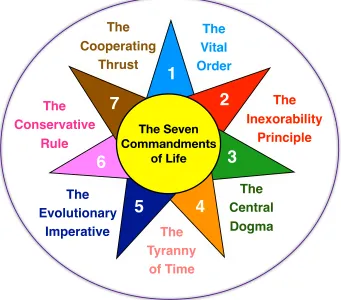
Here, I propose what I call the seven commandments of life (outlined in figure 1) as a set of principles that may help us to understand the vital phenomenon and the evolution of organisms in nature. I do not dare to call them laws because they were not obtained from the standpoint of mathematics, they are the fruit of my reflections as a biologist, my experience as a researcher in molecular biology and a teacher in biochemistry, as well as the fundamental contributions of other scientists and philosophers.
The Vital Order
Nobel Prize winner A. Szent-György wrote about the mystery of life: “My own scientific career was a descent from higher to lower dimension, led by a desire to understand life. I went from animals to cells, from cells to bacteria, from bacteria to molecules ..… On my way life ran out between my fingers” (Szent-György 1972). This beautiful metaphor illustrates very well the first commandment, because when order was lost in the transit of bacteria to molecules, life disappeared and we could not see life any longer, we could only see the molecular components of a living thing.
them down (we disorder them) in a test tube, life disappears and no new cells will be produced although all cellular components were present.
This commandment is closely related to the second law of thermodynamics, but it has its own path as a biological principle. The relationship between life and entropy was recognized by L. Boltzmann in 1886: “The general struggle for existence of living beings is therefore not a fight ... for energy ... Rather, it is a struggle for entropy ...” (Broda 1983). We know that living beings do not violate the second law because they keep their entropy low by increasing the disorder in the environment causing a net increase in entropy (Nelson 2004). To keep this low entropy and to perform biological work, living systems need an external energy source. Certainly, the strategy to obtain energy to keep the entropy low was one of the main conditioners of evolution.
Isolated systems spontaneously evolve towards thermodynamic equilibrium, the state with maximum entropy. However, living organisms are open systems and life is a far-from-equilibrium thermodynamic process (Pascal, Pross and Sutherland 2013); if a living being reaches equilibrium with its surroundings, then the quality of life disappears. Living organisms face changes every moment of their life and require constant energy input to maintain their highly ordered state. In this vital process the only thing that remains unaltered is the vital order and the non-equilibrium state; if the vital order is lost then the whole biosystem goes to an irreversibly state that we call death. Reproduction is the victory of life over entropy because it generates new vital order. Once an organism is born, it begins a race against the arrow of time and finally succumbs to the second law of thermodynamics at death. In the struggle of which Boltzmann spoke there are two winners: life, because reproduction generates a new vital order, and entropy because the activity of living beings and the decomposition of living matter after death produces an increase in the entropy of the universe.
The Inexorability Principle
genomes), not because there was a predestination to have eyes. In the history of life, this commandment together with the evolutionary imperative (natural selection and other evolutionary forces) was very important in the configuration of nature.
Is the Inexorability Principle related to the “Intelligent Design” (Dembski 1998). The answer is no because nature is neither the consequence of an intelligent designer nor a prior design of what nature is supposed to be; what we observe is the result of millions of years of evolution driven by the laws of nature. On the other hand, is the Inexorability Principle related to Causal Determinism? If we define determinism as “the world is governed by (or is under the sway of) determinism if and only if, given a specified way things are at a time t, the way things go thereafter is fixed as a matter of natural law” (Hoefer 2016), the answer would be no because in the evolutionary process both determinism and contingency (chance) play a role in the evolutionary process. An example that illustrates very well this point is related to the evolution of echinoids (Erwin 2006). Thus, all echinoids (sea urchins, sand dollars, etc.) are descended from one or two species that survived the great End-Permian mass extinction. As it happened, this one group had two columns of plates in the test. Consequently all the descendants also have these two rows of interambulacral plates, while in Permian species the number of rows of such plates varied from one to eight. As D. Erwin says “one can argue that the group with two plates was somehow better adapted, or that they simply survived by chance. In truth, either possibility is equally likely” (Erwin 2006). From my point of view, the condition of having plates represents the vital determinism (the inexorability principle) but whether they have 1, 2 or n plates is contingency.
evolution in nature such as the evolution of complex eyes in vertebrates, cephalopods and arthropods, the echolocation system in whales and birds, the evolution of woody stem in seed plants, horsetails and trees, the silk producing ability of spiders, silk worms, silk moths and weaver ants, wings, etc. (McGhee 2019). Interestingly, it was found that increases in the haemoglobin-oxygen binding affinity occurred in different alpine species (convergent evolution), but the molecular changes underlying in the haemoglobin molecule were variable and unpredictable revealing that convergent adaptive traits can also arise from different genetic changes (Natarajan et al. 2016). As Conway Morris said “life will inevitably evolve towards an optimum body plan” (Conway Morris 2005).
S. J. Gould asked what would happen if we “replay the tape of life” (Gould 1989). My answer to this question is that life would be very similar to what we know (fossils and extant creatures) providing the environmental conditions were about the same: for vision, living beings would develop eyes, to fly, wings, or to harness the energy of the sun, photosynthesis. In other words, organisms evolving under similar ecological conditions often evolve similar traits. There are many studies that reinforce this idea of repeatability of evolution. For instance, there is the case of cichlid fishes in lake Malawi and lake Tanganika who developed strikingly similar body shapes (Brakefield 2006), or the three distantly related lineages of snakes that have convergently evolved resistance to tetrodoxin found in their prey via the same amino acid substitution in the Na+/K+ ATPases (Feldman, Brodie and Pfrender 2012).
An important corollary of this commandment is that if there is life elsewhere in the universe it should be very similar to what we know on Earth and the hypothetical differences between the Earth living forms and the “space creatures” could be attributed to a different evolutionary stage or to specific environmental conditions.
The Central Dogma
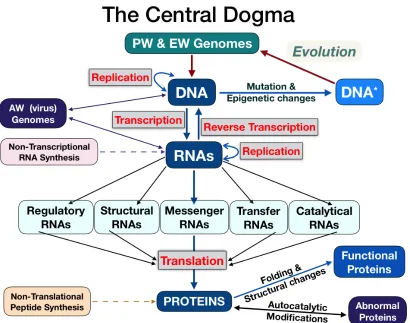
The third commandment is the Central Dogma (figure 2) and it represents the flow of genetic information. It states that genetic information flows from nucleic acids to proteins. This commandment is obviously based on the central dogma of molecular biology first formulated by F. Crick (Crick 1970). The universality of the dogma and its conservation throughout evolution is the best proof of its importance in the history of life.
and Williamson 2005). The functional diversity of RNA, specially its catalytic capacities, supports the existence of a prebiotic “RNA world” (Gilbert 1986).Moreover, two new enzymes should be incorporated to the dogma: polynucleotide phosphorylase (Cameron, Matz and De Lay 2018) because, besides another functions, it catalyzes the non-transcriptional RNA synthesis, and the non-ribosomal peptide synthetases (Reimer et al. 2019) because they are responsible of the non-translational peptide synthesis.
The Tyranny of Time
The fourth commandment is the Tyranny of Time and it says that there is a submission of life to time. Time determines life but life cannot change time because time is usually not made up of, or dependent on, anything else. Time is so important that almost every vital process has its own time and all living organisms show a behaviour that indicates awareness of time (Tuisku, Pernu and Annila 2009). For example, cell cycle always occurs in a precise space-time sequence and to achieve this precision, thousands of molecules must unconsciously cooperate to pass each phase of the cycle in time to division (this is another example of the inexorability principle).
As physics show us there is a close relationship between entropy and time and the flow of time is inherent in the second law of thermodynamics. A. Eddington coined the phrase “arrow of time” to illustrate the directionality in time which means that as time progress entropy increases (Price 1996). Life is order and time plays against this order because of the arrow of time. Therefore, life needs free energy to struggle against entropy (it cannot fight against time) and to maintain the vital order.
Time leads to disorder but it is necessary to reach order. This is what I call the “Paradox of Time” and it can be formulated as follows: “what time makes possible, time makes impossible”. It is easily conceivable that in the origin of life it was necessary a long time to generate the prebiotic soup (time make it possible) but the formation of the first cell had to be instantaneous otherwise disorder would triumph (time would make it impossible). Each new living being has to fight against the arrow of time, without knowing that because the tyranny of time it will always loose this battle. The only way of overcoming the tyranny of time is to reproduce and set the life timer to cero.
The Evolutionary Imperative
theory of Biology (Futuyma and Kirkpatrick 2017). This idea is perfectly summed up in the phrase of T. Dobzhansky: “Nothing in biology makes sense except in the light of evolution” (Dobzhansky 1973).
There are four classical evolutionary forces: natural selection, genetic drift, mutation and migration (Futuyma and Kirkpatrick 2017). Natural selection is defined as the process of adaptation of an organism to its environment by means of selectively reproducing changes in its genotype; it is like a pressure that causes populations of organisms to change over time. Genetic drift and migration are random processes in which chance plays a role in deciding which gene variants survive. Mutations are changes in the genetic material and when they are advantageous they are selected, fixed and passed to the next generations. The need to evolve is embodied in the genomes whose changes are the source of variability for the evolutionary forces to act. Nevertheless, I think that these evolutionary forces are not enough to understand the evolutionary process because, at most, they can explain how complex systems evolve but they do not provide an explanation of why organisms are the way they are, and not some other way. In this sense, I want to put forward a recomposition of the evolutionary forces by adding to the classical ones the vital determinism (understood as the consequence of the inexorability principle) as well as the interactions between the biotic (acellular, prokaryotic and eukaryotic) and abiotic worlds (manuscript in preparation).
spiny, adapted to arid conditions); although they belong to separate families, their morphologies have evolved similarly and independently in response to similar environmental challenges (Álvarez-Cárdenas et al. 2013).
Genome modifications (duplications, transposition, point mutations, insertions, deletions, chromosomal translocations and inversions, exon shuffling, genome reduction, epigenetic changes, horizontal gene transfer and recombination) are the source of variability necessary for the evolution of species. Moreover, random events (mutations, genetic drift, migration) generate genetic variability by chance. J. Monod in his book Chance and Necessity (Monod 1971) supports that life is only the result of natural processes by "pure chance". This is only partially true because chance or contingency play an important role in evolution but vital determinism and non-random processes, such as recombination or epigenetic changes, also contribute to genomic changes. A proof of this was the recent report showing that there is coordination between stochastic and deterministic specification in the neurodevelopment of Drosophila visual system (Courgeon and Desplan 2019).
All species that make up the ecosystems are, directly or indirectly, interconnected to each other and with their environment. The interactions amongst the three natural worlds (acellular, prokaryotic and eukaryotic) with their environment were basic in evolution. We can see many kinds of interplay between worlds such as cooperative interactions such as symbiosis, infections and disease, horizontal gene transfer, etc. (Mittelbach and McGill 2019). What happens to one species ends up affecting others. The ensemble of worlds maintains the dynamic equilibrium in the ecosystem that simultaneously has the plasticity to evolve.
The Conservative Rule
solution for every biological challenge. The joint action of these commandments created the beauty and perfection that we can observe in nature.
The Cooperating Thrust
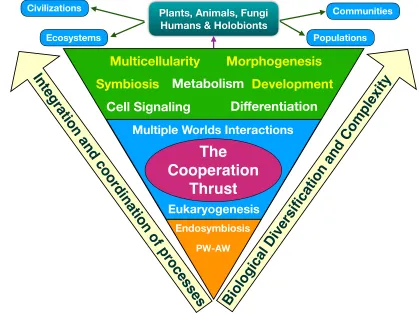
The seventh commandment is about the need for cooperation as a survival strategy. There is cooperation everywhere in nature from the molecular level to symbiotic and social interactions, and in the past, it was involved in two of the most important transformations on the history of life: eukaryogenesis and multicellularity (figure 3).
Symbiosis defined as any of several living arrangements between members of two different speciesis presently recognized as one of the main forces shaping life in our planet (Archibald 2014). It is a reflection of different cooperation ways, an example of permanent interactions between species from the three worlds. I want to highlight three examples that represent distinct faces of symbiosis. The first one is endosymbiosis, which was crucial in the origin of eukaryotic cells. In fact, we can consider eukaryotes as symbiotic mergers forged via cooperative interactions by progressive physical integration and endosymbiotic gene transfer (López-García, Eme and Moreira, 2017). The second example is mutualism. The pea aphid, Acyrthosiphon pisum, has several species of bacteria (Buchnera, Rickettsiella and Hamiltonella) that live in its cells (Moran et al. 2005).These insects rely on Buchnera to provide nutrients, on Rickettsiella for color changing of the aphid, and on Hamiltonella to defend the insect against wasp infection with the help of a lysogenic phage (Oliver et al. 2009). So there is a multiple cooperation to feed and protect the aphid from wasps and to provide a home for the bacteria that keep the phage rented. The third example is the holobiont. Holobionts are multicellular organisms that have co-evolved with complex consortia of viruses, bacteria, fungi and parasites, known collectively as the microbiota (Belkaid and Hand 2014). Changes in the composition of microbiota can influence metabolism, digestion, immunity, neuronal activity and behavior, and also they are associated with multiple diseases (Chu et al. 2019). This tight host-microbiota cooperative relationship challenges the concept of individuality by a conception congruent with symbiotic associations as the evolutionary unit (Gilbert, Sapp and Tauber 2012).
organisms was not a “difficult problem” in evolution and that multicellular complexity may evolve more readily that previously thought (Furusawa and Kaneko 2002). Once the first multicellular organisms began to exist, two new cellular processes had to emerge quickly, otherwise the group of cells would be just a colony: the genetic control of development (growth and morphogenesis) to ensure the continuity of multicellular life, and the process of cell differentiation that gave rise to tissues and organs. Furthermore, the increase in the complexity of multicellular organisms provoked the appearance of coordination mechanisms to ensure cooperation amongst all the cells, tissues and organs. The cooperative thrust, the inexorability principle, the evolutionary imperative and the conservative rule were acting together in the generation of multicellular life.
Concluding remarks: the endless race
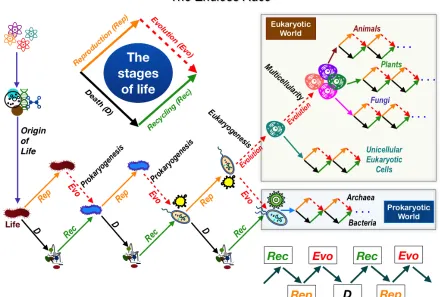
Life must struggle against the second law of thermodynamics, against the tyranny of time. The living beings always loose this battle against entropy and time: there is no immortality and death is the end of the tyranny of time, the victory of entropy. However, there is a paradox: if all organisms had to die, life would disappear, and we know that this does not happen; on the contrary, since life emerged on Earth, millions of years ago, it began an endless succession of new living forms that we recognize as the evolution. Reproduction and evolution are responsible for the victory of life over entropy and time.
second, fifth, sixth and seventh commandments are playing an essential role. Death is necessary for the survival of future generations. But death also gives way to life through the recycling of organic and inorganic matter that is generated when a living being dies. Recycling feeds the creation of new life. The four stages of life are involved in an endless race of biological events towards an unsettled arrival. Life is like an endless relay race in which living beings are the runners, who change as the race goes on, and the commandments are the rules.
Declarations
No funding supported this work. There are no conflicts or competing interests.
Acknowledgments
I want to thank the professor González Caamaño for his comments during the elaboration of this manuscript. This work is dedicated to my granddaughters Abril and Vera.
References
Alexander DE (2015) On the wing: insects, pterosaurs, birds, bats and the evolution of animal flight. Oxford University Press, Oxford
Alvarado-Cárdenas LO, Martínez-Meyer E, Feria T P, Eguiarte LE, Hernández HM, Midgley G, Olson ME (2013) To converge or not to converge in environmental space: testing for similar environments between analogous succulent plants of North America and Africa, Ann Bot 111:1125-1138
Archibald J (2014). One plus one equals one: symbiosis and the evolution of complex life. Oxford University Press, Oxford
Belkaid Y, Hand T (2014) Role of the microbiota in immunity and inflammation. Cell 157:121-141 Brakefield P (2006) Evo-devo and constraints on selection. Trends Ecol Evol 21:362-368
Broda E (1983) Ludwig Boltzmann-Man-Physicist-Philosopher. Ox Bow Press, Woodbridge Cameron T, Matz LM, De Lay NR (2018) Polynucleotide phosphorylase: Not merely an RNase but
a pivotal post-transcriptional regulator. PLoS Genetics 14: e1007654
Chu C, Murdock, MH, Jing D, Won TH et al. (2019) The microbiota regulate neuronal function and fear extinction learning. Nature574:543-548
Cleland CE (2019) The Quest for a Universal Theory of Life. Cambridge University Press, Cambridge
Cockwell CS (2017) The laws of life. Physics Today 70:42-48
Conway Morris S (2005) Life’s solution: inevitable humans in a lonely universe. Cambridge
Courgeon M, Desplan C (2019). Coordination between stochastic and deterministic specification in the Drosophila visual system. Science 366:eaay6727
Crick F (1970) Central dogma of molecular biology. Nature 227:561-563
Davies P (1999) The fifth miracle: the search for the origin and meaning of life. Simon & Schuster, New York
Darwin Ch (1859) On the Origin of Species by means of natural selection, or the preservation of favoured races in the struggle for life. John Murray, London.
Dawkins R (2009) The Greatest Show on Earth: The Evidence for Evolution. Transworld Publishers, Ealing
Dembski WA (1998) The Design Inference: eliminating chance through small probabilities. Cambridge University Press, Cambridge
Dobzhansky T (1973) Nothing in Biology makes sense except in the light of Evolution. Am Biol Teach 35:125-129
Erwin DH (2006) Evolutionary contingency. Current Biology 16:825-826
Fedor MJ, Williamson JR (2005) The catalytic diversity of RNAs. Nat Rev Mol Cell Biol 6:399- 412
Feldman CR, Brodie ED, Pfrender ME (2012) Constraint shapes convergence in tetrodoxin-resistant sodium chanels of snakes. PNAS USA 109:4556-4561
Furusawa C, Kaneko K (2002) Origin of multicelular organisms as an inevitable consequence of dynamical systems. Anat Rec 268:327-342
Futuyma, DJ, Kirkpatrick M (2017) Evolution. Oxford University Press, London Gottdenker P (1979) Francesco Redi and the fly experiments. B Hist Med 53:575-592 Gilbert W (1986) Origin of Life: The RNA world. Nature 319:618
Gilbert SF, Sapp J, Tauber AI (2012) A symbiotic view of life: we have never been individuals. Q Rev Biol 87:325-341
Gould SJ (1989) Wonderful Life: The Burguess Shale and the Nature of History. W.W. Norton and Company, New York
Hoefer C (2016) Causal Determinism, Stanford Encyclopedia of Philosophy. Stanford University, Stanford
Keller MA, Zylstra A, Castro C, Turchyn AV, Griffin J, Ralser M (2016) Conditional iron and pH- dependent activity of a non-enzymatic glycolysis and pentose phosphate pathway. Sci Adv 2:e1501235
Lane N (2015) The Vital Question. Profile Books, London
33
Massimi M, Breitenbach A (2017) Kant and the Laws of Nature. Cambridge University Press, Cambridge
McGhee GR (2019) Convergent Evolution on Earth. MIT Press, Cambridge
Mittelbach, G., & McGill, B. (2019). Community Ecology. London: Oxford University Press. Monod J (1971) Chance and Necessity: An Essay on the Natural Philosophy of Modern Biology.
Alfred A. Knopf, New York
Moran NA, Degnan PH, Santos SR, Dunbar HE, Ochman H (2005) The players of mutualistic symbiosis: insects, bacteria, viruses, and virulence genes. PNAS USA 102:16919-16926 Muchowska K, Varma S, Moran J (2019) Synthesis and breakdown of universal metabolic
precursors promoted by iron. Nature 569:104-107
Natarajan C, Hoffmann FG, Weber RE, Fago A, Witt CC, Stortz JF (2016) Predictable convergence in haemoglobin function has unpredictable molecular underpinnings. Science 354:336-339.
Nelson P (2004) Biological Physics, Energy, Information, Life. W.H. Freeman and Company, New York
Niklas KJ, Newman SA (2013) The origins of multicelular organisms. Evol Dev 15:41-52
Oliver KM, Degnan PH, Hunter MS, Moran NA (2009) Bacteriophages encode factors required for protection in a symbiotic mutualism. Science 325:992-994
Pascal R, Pross A, Sutherland JD (2013) Towards an evolutionary theory of the origin of life based on kinetics and thermodynamics. Open Biol 3:130156
Price H (1996) Time’s arrow and Archimedes’ Point. Oxford University Press, London
Reimer JM, Eivaskhani M, Harb I, Guarné A, Weigt M, Schemeing TM (2019) Structures of a dimodular nonribosomal peptide synthetase reveal conformational Flexibility. Science 366:eaaw4388
Schrödinger E (1944) What is life? Cambridge University Press, Cambridge
Shou W, Bergstrom CT, Chakraborty AK, Skinner FK (2015) Theory, models and biology. eLIFE 4:e07158.
Szent-György A (1972) The Living State. Academic Press, New York
Tuisku P, Pernu TK, Annila A (2009) In the light of time. P Roy Soc A 465:1173-1198
Figure captions
Fig 1 The Seven Commandments of Life. The commandments are metaphorically represented as a sun with seven rays that help to better understand the vital phenomenon.
Fig. 2 The Central Dogma. This scheme is a variation of the original version by F. Crick (Crick, 1970). The genetic material of prokaryotes and eukaryotes is DNA whereas in viruses is either DNA or RNA. DNA can mutate and undergo epigenetic changes and this altered DNA is the target for evolution. RNAs play a central role in the flow of genetic information because link DNA (information) with proteins (cellular actions). Noteworthy, all different kinds of RNAs are involved in translation. RNA and proteins can be synthesized by transcription and translation, respectively, and also by a non-transcriptional and non-translational mechanisms. Proteins undergo folding and post-translational modifications to become a functional protein. Some proteins have the capability of autocatalytic modifications.
Fig. 3 The Cooperating Thrust. Since life on earth originated, the cooperative impulse has played an essential role in two fundamental evolutionary processes: eukaryogenesis by endosymbiosis and the generation of multicellular organisms, which involved biological diversification (generation of plants, animals, fungi), an increase in the complexity of organisms (tissues and organs) and the emergence of mechanisms for the integration and coordination of biological processes involved in development, morphogenesis, cell signalling, etc. Symbiosis gave rise to new forms of survival and in some cases such close symbiotic relationships were established that they led to the emergence of holobionts as an evolutionary unit. The multicellular eukaryotic organisms were organized in populations, communities, ecosystems and the Homo sapiens, due to the development of the brain, gave origin to the civilizations.
Figure 1
LIFE
The Seven Commandments
of Life
1
2
3
4
5
6
7
The Vital Order
The Inexorability
Principle
The Central Dogma
The Tyranny
of Time The
Evolutionary Imperative
The Conservative
Rule
The Cooperating
Figure 3
In
te
gr
ati
on
a
nd
c
oo
rd
in
ati
on
o
f p
ro
ce
ss
es
B
io
lo
gi
ca
l D
iv
er
si
fic
ati
on
a
nd
C
om
pl
ex
ity
Differentiation
Multicellularity
Populations Ecosystems
Civilizations Plants, Animals, Fungi Communities Humans & Holobionts
Endosymbiosis
The
Cooperation
Thrust
PW-AW
Multiple Worlds Interactions