Privacy of Email Ecosystems
⋆Pyrros Chaidos1, Olga Fourtounelli1, Aggelos Kiayias2,3, and Thomas Zacharias2 1
National and Kapodistrian University of Athens, Greece
{pchaidos,folga}@di.uoa.gr 2
The University of Edinburgh, UK
{akiayias,tzachari}@inf.ed.ac.uk 3
IOHK, UK
Abstract. Email communication is amongst the most prominent online activities, and as such, can put sensitive information at risk. It is thus of high importance that internet email applications are designed in a privacy-aware manner and analyzed under a rigorous threat model. The Snowden revelations (2013) suggest that such a model should feature a
global adversary, in light of the observational tools available. Furthermore,
the fact that protecting metadata can be of equal importance as protecting the communication context implies that end-to-end encryption may be necessary, but it is not sufficient.
With this in mind, we utilize the Universal Composability framework [Canetti, 2001] to introduce an expressive cryptographic model for email “ecosystems” that can formally and precisely capture various well-known privacy notions (unobservability, anonymity, unlinkability, etc.), by pa-rameterizing the amount of leakage an ideal-world adversary (simulator) obtains from the email functionality.
Equipped with our framework, we present and analyze the security of two email constructions that follow different directions in terms of the efficiency vs. privacy tradeoff. The first one achieves optimal security (only the online/offline mode of the users is leaked), but it is mainly of theoretical interest; the second one is based on parallel mixing [Golle and Juels, 2004] and is more practical, while it achieves anonymity with respect to users that have similar amount of sending and receiving activity.
1
Introduction
During the last decade, internet users increasingly engage in interactions that put their sensitive information at risk. Social media, banking, mail, and e-government, are prominent cases where personal data are collected and processed in the web. To protect people’s personal data, it is important that applications
⋆
intended for communication of such information over the internet are designed in a privacy-aware manner and analyzed under a rigorous threat model.
The recent revelations by Snowden (2013) on massive surveillance of citizens’ internet interactions, confirmed researchers’ views that current technology is sufficient to provide adversaries with the tools to monitor the entire network. This was a turning point in that, henceforth, treating internet security and privacy in a threat model that considers aglobal adversary seems not only desirable, but imperative for the design of state-of-the-art cryptographic protocols.
As far as standard security is concerned, i.e., hiding the context between communicating internet users, there have been significant advancements on the aforementioned matter, mainly to due to wide deployment of end-to-end (E2E) encryption tools, even for some of the world’s most popular applications, such as WhatsApp, Viber, Facebook Messenger and Skype (over Signal). However, it is well understood that E2E encryption is not enough to protect the users’ metadata (e.g. users’ identities and location, or the communication time), that often can be of equal importance. The protection of metadata is studied in the context of
anonymous communications, that were introduced by the seminal works of Chaum with the concept of nets [11], followed by DC-nets a few years later [9]. A mix-net is a message transmission system that aims to decouple the relation of senders to receivers by using intermediate servers to re-encrypt and re-order messages. The operation of mix-nets relies on messages from A to B making intermediate stops in mix servers, with appropriate delay times so that multiple messages “meet” at each server. The server re-encrypts messages before forwarding them, thus breaking the link between incoming and outgoing messages. We will analyse a mix-based system in Sect. 6 and contrast its overhead to the more expensive broadcast solution in Sect. 5. Nowadays, the most scalable solutions of anonymous communications in the real-world rely ononion-routing [34], and mostly on the Tor anonymous browser [17]. Although very efficient and a major step forward for privacy-preserving technologies, it has been pointed out (e.g., [22, 33, 35]) that onion-routing can provide anonymity only against adversaries with local views with respect to the (three) relay routing nodes, whereas a global observer can easily derive the addresses of two entities that communicate over onion-routing applications. Towards the goal of communication anonymity against a global adversary [2, 10, 12–14, 25–27, 30, 36], various schemes have been proposed, and several recent ones achieving reasonable latency [1, 10, 26, 27, 30, 36].
Modeling privacy for email ecosystems. In this work, we focus on the study of privacy (as expressed via several anonymity-style notions cf. [28]) for email ecosystems. The reason why we choose to focus on the email case is threefold:
1.Email is one of the most important aspects of internet communication, as email traffic is estimated to be in the order of∼1011 messages per day, while there are approximately 2.5 billion accounts worldwide 4.
4
2.The actual network infrastructure of an email ecosystem has some special features that encourage a separate study from the general case of private messag-ing. Namely, the users dynamically register, go online/offline, and communicate, in a client-friendly environment and the management of the protocol execution is mainly handled by their service providers (SPs) that manage their inboxes. In turn, the client interface allows the user to log in/log out and while online, submit send and fetch requests to their SP. Moreover, adding a subsystem of mix-nodes which, in principle, are functionally different than the clients and the SPs, stratifies the observational power of the global adversary into three layers (i) the client↔SP channels, (ii) the SP↔mix-node channels, and (iii) the channels within the mix-node system. Under this real-world setting, exploring the feasibility and the trade off between efficiency and privacy for anonymous email routing poses restrictions on the expected secrecy, that would not be present in a generic peer-to-peer setting (e.g. users jointly engaging in an MPC execution).
3.To the best of our knowledge, there is no prior work on general modeling of email privacy in a computational model, that captures protocol flow under a com-position of individual email messaging executions. TheUniversal Composability (UC) framework [6] is the ideal tool for such a modeling.
Contributions. Our contributions are as follows:
1. In Section 3, we introduce a framework for the formal study of email ecosystems in the ideal world paradigm of the UC model [6]. The real-world entities involved in our framework comprise the set of clients, the of SPs and the subsystem of mix-nodes; all entities are synchronized via a global clock
functionality𝒢clock and communicate over anauthenticated channel functionality with bounded message delay 𝛥net, denoted byℱauth𝛥net. In the ideal-world, anemail
privacy functionality ℱLeak,𝛥net
priv manages email traffic among dummy parties that forward their inputs. The functionality is parameterized by 𝛥net and a
leakage function Leak, defined over the history transcript, that formally expresses the underlying privacy notion the studied email ecosystem should satisfy. To illustrate the expressibility of our framework, in Section 4, we show how to formally capture intuitively well understood privacy notions by properly defining the leakage function. In particular, we express and study the relation of notions of anonymity, unlinkability, unobservability and pseudonymity defined in [28], as well as E2E encryption, and a notion we callweak anonymity that, although a relaxed version of standard anonymity (still stronger than E2E encryption), provides reasonable privacy guarantees given the setting.
3. In Sections 6 and 7 we analyze a construction similar to the classical parallel mix of Golle and Juels [19], to illustrate the expressiveness of our model in a more practice-oriented protocol. We focus on the UC simulation in Section 6, and in Section 7, we use H˚astad’s matrix shuffle to model the permutation’s distribution. This in turn makes our analysis relevant to Atom [26], a state of the art anonymity system using similar permutation strategies. At the same time, as we only assume an adversary that is a global passive observer, Atom’s techniques to mitigate corruptions are complementary, even if orthogonal, to our work.
2
Background
2.1 Notation
We use 𝜆 as the security parameter and write negl(𝜆) to denote that some function𝑓(·) is negligible in𝜆. We write [𝑛] to denote the set{1, . . . , 𝑛} andJ·K to denote a multiset. By𝑋 ≈𝜖𝑌, we denote that the random variable ensembles {𝑋𝜆}𝜆∈N,{𝑌𝜆}𝜆∈Nare computationally indistinguishable with error𝜖(·), i.e., for
every probabilistic polynomial time (PPT) algorithm𝒜, it holds that
⃒
⃒Pr[𝑤←𝑋𝜆:𝒜(𝑤) = 1]−Pr[𝑤←𝑌𝜆:𝒜(𝑤) = 1]< 𝜖(𝜆) ⃒ ⃒.
We simply write𝑋 ≈𝑌 when the error 𝜖isnegl(𝜆). The notation𝑥←$ 𝑆 stands for𝑥being sampled from the set𝑆 uniformly ar random.
2.2 IND-CPA security of public-key encryption schemes
In our constructions, we utilize public-key encryption (PKE). We require that a PKE schemePKE= (KeyGen,Enc,Dec) satisfies the property ofmultiple challenge
IND-CPA (m-IND-CPA) security, which is equivalent to standard IND-CPA
security (up to negligible error). We recall that m-IND-CPA with error 𝜖(𝜆) dictates that any adversary ℬ that (a) obtains the public key, and (b) sends (polynomially many) challenge queries of the form (𝑀0, 𝑀1) to the challenger receiving encryption of𝑀𝑏, where𝑏 is the random bit of the challenger, can not guess𝑏 with more than 1/2 +𝜖(𝜆) probability.
2.3 Related Work
Early works treating anonymity followed the intuitive definition of Pfitzmann and Hansen (formerly Kh¨ontopp) [28], originally [29], as “the state of not being identifiable within a set of subjects”, and aimed to augment it by quantifying the degree of non-identifiability. One of the first efforts in that direction (predating [29]) was the concept of “𝑘-anonymity” by Samarati and Sweeney [31], that (in the context of databases) attempts to identify an individual produce at least𝑘
candidates.
In [16,32], anonymity is quantified by measuring the probability that a message
set of candidates, but also their relative probabilities. This definition improved upon the “folklore” metric of only measuring the size of the subject set, even if the probability distribution on that set was highly non-uniform –e.g. [24].
The seminal work of Dwork [18] on Differential Privacy, while originating in the realm of databases, highlights and formalizes the strength of combining different pieces of seemingly respecting information to arrive at a privacy-impacting conclusion. Influenced in part by Differential Privacy, AnoA [3] is a game-based privacy analysis framework that is flexible enough to model various privacy concepts.Their approach is based on games between a challenger and an adversary who has control of the execution of the game, apart from a challenge message representing the scenarios the adversary is trying to distinguish.
In a different direction, the Universal Composability (UC) framework, [6] models security as a simulation not against an adversary, but a malicious envi-ronment, given strong control over the inputs of each party as well as a complete view of the system. This rigorous approach produces strong and composable security guarantees but is quite demanding in that the simulation must operate with the bare minimum of data (i.e. what we assume the protocol leaks). This precision in both simulation and leakage is a key motivation of this work.
On the other hand, state of the art anonymous communication solutions such as Loopix [30] which aims for high performance while maintaining strong anonymity properties, as well as unobservability, are analyzed under a weaker ad-versary. Moreover, Atom [26] is engineered to provide statistical indistinguishable shuffling with strong safeguards against malicious servers, but lacks formal proofs. In our work, we analyze a construction that shares a similar design (namely H˚astad’s matrix shuffle), so that we are able to offer a suggested𝑇 value (i.e mix length) as a side contribution in Section 7. A key difference between Loopix and Atom is that Loopix uses a free routing approach (i.e a message’s path is determined by its sender) as opposed to allowing mix nodes to route messages. The first approach is more agreeable with high-efficiency solution aiming for a practical level of resilience against active adversaries while the second approach is easier to reason about but requires a passive adversary or measures such as NIZKs or trap messages to ensure correct behavior.
Camenish and Lysyanskaya [5] offer a treatment of onion routing in the Universal Composability model. The defining characteristic of onion routing, is that routing is entirely determined by the initial sender and is not influenced by the intervening nodes. As such, their analysis focuses on defining security with regards to the encryption, padding, structuring and layering of onions rather than the routing strategy itself. This is orthogonal to our approach: we focus on evaluating the anonymity of different mixing strategies under what we view as realistic requirements about the message encapsulation.
In the work of Alexopouloset al. [1], anonymity is studied in the concept of messaging via a stand-alone simulation-based model. Even though formally treated, anonymity in [1] is defined under a framework that is weaker than UC.
3
A UC framework for the privacy of email ecosystems
In this section, we present our UC framework for email privacy. As in standard UC approach, privacy will be defined via the inability of an environment 𝒵, that schedules the execution and provides the inputs, to distinguish between (i) a real-world execution of an email ecosystem Ein the presence of a (global passive) adversary 𝒜 and (ii) an ideal-world execution handled by an email privacy functionality interacting with a PPT simulator Sim. More specifically, we adjust our definitions to theglobal UC setting [7], by incorporating a global clock functionality (cf. [4, 23]) that facilitates synchronicity and is accessed by all parties, including the environment.
3.1 Entities and protocols of an email ecosystem
The entities that are involved in a private email “ecosystem”Eare the following:
– Theservice providers (SPs)SP1, . . . ,SP𝑁 that register users and are respon-sible for mailbox management and email transfer.
– Theclients 𝐶1, . . . , 𝐶𝑛 that wish to exchange email messages and are regis-tered to the SPs. For simplicity, we assume that each client is linked with only one SP that manages her mailbox. We write𝐶ℓ@SP𝑖 to denote that𝐶ℓ is registered toSP𝑖, where registration is done dynamically. We define the setC𝑖:=
{︀
𝐶ℓ ⃒
⃒𝐶ℓ@SP𝑖 }︀
of all clients whose mailboxes SP𝑖 is managing. – Themix nodesubsystemMXthat consists of the mix nodesMX1, . . . ,MX𝑚
and is the core of the anonymous email routing mechanism.
An email ecosystemEhas the two following phases:
Initialization is a setup phase where all SPs and mix nodes generate any
possible private and public data, and commune their public data to a subset of the ecosystem’s entities.
Executionis a phase that comprises executions of the following protocols:
– TheREGISTERprotocol between client𝐶𝑠and her service providerSP𝑖. For simplicity, we assume that registration can be done only once.
– The SEND protocol between client 𝐶𝑠 and her service provider SP𝑖. In particular,𝐶𝑠that wishes to send a message𝑀to some client address𝐶𝑟@SP𝑗 authenticates toSP𝑖and provides her with an encoding Encode(𝑀, 𝐶𝑟@SP𝑗) of (𝑀, 𝐶𝑟@SP𝑗) (that may not necessarily include information about the sender). At the end of the protocol,Encode(𝑀, 𝐶𝑟@SP𝑗) is at the outbox of
𝐶𝑠@SP𝑖 managed bySP𝑖.
– TheRECEIVEprotocol between client𝐶𝑟and her service providerSP𝑗, where
𝐶𝑟 can retrieve the messages from the inbox of𝐶𝑟@SP𝑗 via fetch requests.
Remark 1. In this work, we consider email solutions that follow the realistic client-side approach, where the client-side operations are relatively simple and do not include complex interaction with the other entities for the execution of heavy cryptographic primitives (e.g. pairwise secure MPC). As we will explain shortly, the client-friendly approach poses some limitations on the privacy level that the email ecosystem can achieve.
3.2 A global clock functionality
In our setting, the protocol flow within the email ecosystemEadvances intime slots, that could refer to any suitable time unit (e.g. ms). The entities of Eare synchronized via aglobal clock functionality 𝒢clock that interacts with a set of partiesP, a set of functionalitiesF, the UC environment𝒵 and the adversary𝒜. In the spirit of [4, 23], the functionality𝒢clock, presented in Fig. 1, advances when all entities inPandFdeclare completion of their activity within the current time slot, whereas all entities have read access to it.
The global clock functionality𝒢clock(P,F).
The functionality initializes the global clock variable as Cl ←0 and the set of advanced parties as𝐿adv← ∅.
– Upon receiving (sid,Advance Clock, 𝑃) fromℱ ∈For𝑃∈P, if𝑃 /∈𝐿adv,
then it adds 𝑃 to𝐿adv and sends the message (sid,Advance Ack, 𝑃) toℱ
or𝑃, repsectively, and notifies𝒜by forwarding (sid,Advance Clock, 𝑃). If
𝐿adv=P, then it updates asCl←Cl+ 1 and resets𝐿adv← ∅.
– Upon receiving (sid,Read Clock) from𝑋 ∈P∪F∪ {𝒵,𝒜}, then it sends
(sid,Read Clock,Cl) to𝑋.
Fig. 1.The global clock functionality𝒢clock(P,F) interacting with the environment𝒵
and the adversary𝒜.
3.3 A UC definition of e-mail privacy
Let Ad be the set of all valid email addresses linking the set of clients C = {𝐶1, . . . , 𝐶𝑛} and with their corresponding providers inSP={SP1, . . . ,SP𝑁}, i.e.Ad:=∪𝑖∈[𝑁]C𝑖. We denote byPthe unionC∪SP∪MX.
leakage string𝑧. Here,𝑧could be⊥indicating no leakage to the adversary. This leakage may depend on the entry indexed byptras well as on entries recorded previously (i.e. prior thanptr).
We require that during a time slot, the environment sends a message for every party, even when the party is idle (inactive) for this slot, so that the clock can be advanced as described in Fig. 1.
The ideal world execution. In the ideal world, the protocol execution is managed by the email privacy functionality ℱLeak,𝛥net
priv (P), parameterized by the message delivery delay bound𝛥net and the leakage functionLeak(·,·), with access to 𝒢clock. The functionalityℱLeak,𝛥net
priv (P) consists of theInitialization, Execution, andClock advancementphases, that informally are run as follows:
– At the Initialization phase, all the SPs in SP and mix nodes in MX provideℱLeak,𝛥net
priv (P) with an initialization notification via public delayed output. The functionality proceeds to theExecutionphase when all SPs and mix nodes are initialized. Note that in the ideal world, the SPs and the mix nodes remain idle afterInitialization(besides messages intended for 𝒢clock), as privacy-preserving email routing is done by ℱLeak,𝛥net
priv (P). Their presence in the ideal setting is for consistency in terms of UC interface.
– At theExecutionphase,ℱLeak,𝛥net
priv (P) manages the email traffic, as sched-uled per time slot by the environment. During this phase, the clients may (dynamically) provide ℱLeak,𝛥net
priv (P) with registration, log in, log out, send or fetch requests. Upon receiving a request, ℱLeak,𝛥net
priv (P) updates the history by adding the request as a new entry associated with a unique pointer ptr, in a ‘pending’ mode. Then, it notifies the simulatorSimby attaching the corresponding leakage. The execution of a pending request which record is indexed by a pointer ptr is completed whenℱLeak,𝛥net
priv (P) receives anAllow Execmessage paired withptrfromSim.
Within a time slot 𝑇, each client may perform only one action that also implies a time advancement request to𝒢clock. In order for the clock to advance all the other parties that performed no action (i.e., the SPs, the mix nodes and the clients that remained idle during𝑇), send an explicit time advancement request toℱLeak,𝛥net
priv (P). Besides, any party may submit clock reading requests arbitrarily. All the messages that are intended for𝒢clock are forwarded to it byℱ
Leak,𝛥net priv (P). – At theClock advancementphase, all parties have already submitted time advancement requests during time slot 𝑇, so ℱLeak,𝛥net
priv (P) takes the necessary final steps before proceeding to 𝑇+ 1. In particular,ℱLeak,𝛥net
priv (P) completes the execution of all send and fetch requests that have been delayed for𝛥net steps (bySim). This suggests that in the ideal-world, the delay in message delivery is upper bounded by𝛥net. Finally,ℱprivLeak,𝛥net(P) informsSimof the leakage derived from the aforementioned executions, advances its local time by 1 and reenters theExecutionphase for time slot𝑇+ 1.
Formally, the email privacy functionalityℱLeak,𝛥net
Initializationon status ‘init’.
– ℱLeak,𝛥net
priv (P) sets its status to ‘init’. It initializes the set of valid addresses Ad, the set of active entities𝐿act, the set of clock-advanced entities𝐿adv, the
history list𝐻, and the set of leaked entries𝐿leak as empty.
– Upon receiving (sid,Init) from a party𝑃∈SP∪MX, if𝐿act(SP∪MX, then it sends the message (sid,Init, 𝑃) toSim.
– Upon receiving (sid,Allow Init, 𝑃) from Sim, if 𝑃 ∈ (SP∪MX)∖𝐿act, then it adds𝑃 to𝐿act. If𝐿act=SP∪MX, then it sends (sid,ready) toSim. – Upon receiving (sid,Execute) from Sim, it sends (sid,Read Clock) to
𝒢clock.
– Upon receiving (sid,Read Clock,Cl) from𝒢clock, it sets its clock asCland its status to ‘execute’, and sends the message (sid,start,Cl) toSim.
Executionon status ‘execute’.
Registration:
– Upon receiving(︀
sid,Register,@SP𝑖)︀from𝐶ℓ, if for every𝑗 ∈[𝑁] :𝐶ℓ@SP𝑗∈/
Adand𝐶ℓ∈/𝐿adv, then
1. It sends the message (sid,Advance Clock, 𝐶ℓ) to𝒢clock.
2. Upon receiving (sid,Advance Ack, 𝐶ℓ) from𝒢clock, it adds𝐶ℓ to𝐿adv and the entry(︀
ptr,(︀
sid,Cl,Register, 𝐶ℓ@SP𝑖)︀,‘pending’)︀to𝐻.
3. It sends the message(︀
sid,ptr,Leak(ptr, 𝐻))︀
to Sim.
4. Upon receiving(︀sid,Allow Exec,ptr)︀fromSim, ifptrrefers to an entry of the form(︀
ptr,(︀
sid,Cl,Register, 𝐶ℓ@SP𝑖)︀,‘pending’)︀, then
(a) It adds𝐶ℓ@SP𝑖 to Adand𝐿act, and initializes a list Inbox[𝐶ℓ@SP𝑖] as empty.
(b) It updates the entry as(︀ ptr,(︀
sid,Cl′,Register, 𝐶ℓ@SP𝑖
)︀
,‘(registered,Cl)’)︀ . (c) It sends the message(︀
sid,ptr,Leak(ptr, 𝐻))︀
toSim.
Log in:
– Upon receiving(︀
sid,Active,@SP𝑖
)︀
from𝐶ℓ, if𝐶ℓ@SP𝑖∈Adand𝐶ℓ∈/ 𝐿adv, 1. It sends the message (sid,Advance Clock, 𝐶ℓ) to𝒢clock.
2. Upon receiving (sid,Advance Ack, 𝐶ℓ) from𝒢clock, it adds𝐶ℓ to𝐿adv and the entry(︀ptr,(︀sid,Cl,Active, 𝐶ℓ@SP𝑖
)︀
,‘pending’)︀to𝐻. 3. It sends the message(︀sid,ptr,Leak(ptr, 𝐻))︀to Sim.
4. Upon receiving(︀
sid,Allow Exec,ptr)︀
fromSim, ifptrrefers to an entry of the form(︀
ptr,(︀
sid,Cl′,Active, 𝐶ℓ@SP𝑖
)︀
,‘pending’)︀ , then (a) If𝐶ℓ@SP𝑖∈/𝐿act, then it adds𝐶ℓ@SP𝑖 to𝐿act.
(b) It updates the entry as(︀ ptr,(︀
sid,Cl′,Active, 𝐶ℓ@SP𝑖)︀,‘(logged in,Cl)’)︀. (c) It sends the message(︀
sid,ptr,Leak(ptr, 𝐻))︀
toSim.
Log out:
– Upon receiving(︀sid,Inactive,@SP𝑖 )︀
from 𝐶ℓ, if𝐶ℓ@SP𝑖 ∈Adand𝐶ℓ ∈/
𝐿adv, then
1. It sends the message (sid,Advance Clock, 𝐶ℓ) to𝒢clock.
2. Upon receiving (sid,Advance Ack, 𝐶ℓ) from𝒢clock, it adds𝐶ℓ to𝐿adv and the entry(︀
ptr,(︀
3. It sends the message(︀
sid,ptr,Leak(ptr, 𝐻))︀
to Sim. 4. Upon receiving(︀
sid,Allow Exec,ptr)︀
fromSim, ifptrrefers to an entry of the form(︀
ptr,(︀
sid,Cl′,Inactive, 𝐶ℓ@SP𝑖)︀,‘pending’)︀, then
(a) If𝐶ℓ@SP𝑖∈𝐿act, then it deletes𝐶ℓ@SP𝑖 from𝐿act. (b) It updates the entry as(︀
ptr,(︀
sid,Cl′,Inactive, 𝐶ℓ@SP𝑖)︀,‘(logged out,Cl)’)︀. (c) It sends the message(︀
sid,ptr,Leak(ptr, 𝐻))︀
toSim.
Send:
– Upon receiving(︀
sid,Send,⟨𝐶𝑠@SP𝑖, 𝑀, 𝐶𝑟@SP𝑗⟩)︀from𝐶𝑠, if𝐶𝑠@SP𝑖, 𝐶𝑟@SP𝑗 ∈ Adand𝐶𝑠∈𝐿act∖𝐿adv, then
1. It sends the message (sid,Advance Clock, 𝐶𝑠) to𝒢clock.
2. Upon receiving (sid,Advance Ack, 𝐶𝑠) from 𝒢clock, it adds 𝐶𝑠 in𝐿adv and the entry(︀ptr,(︀sid,Cl,Send,⟨𝐶𝑠@SP𝑖, 𝑀, 𝐶𝑟@SP𝑗⟩
)︀
,‘pending’)︀to𝐻. 3. It sends the message(︀
sid,ptr,Leak(ptr, 𝐻))︀
to Sim. 4. Upon receiving(︀
sid,Allow Exec,ptr)︀
fromSim, ifptrrefers to an entry (︀
sid,Cl′,Send,⟨𝐶𝑠@SP𝑖, 𝑀, 𝐶𝑟@SP𝑗⟩ )︀
with status ‘pending’, then (a) It adds(︀
sid,Cl′,Send,⟨𝐶𝑠@SP𝑖, 𝑀, 𝐶𝑟@SP𝑗⟩)︀toInbox[𝐶𝑟@SP𝑗]. (b) It updates as(︀ptr,(︀sid,Cl′,Send,⟨𝐶𝑠@SP𝑖, 𝑀, 𝐶𝑟@SP𝑗⟩
)︀
,‘(sent,Cl)’)︀. (c) It sends the message(︀
sid,ptr,Leak(ptr, 𝐻))︀
toSim.
Fetch:
– Upon receiving(︀Fetch,sid, 𝐶𝑟@SP𝑗 )︀
from𝐶𝑟, if 𝐶𝑟@SP𝑗 ∈Adand𝐶𝑟∈
𝐿act∖𝐿adv, then
1. It sends the message (sid,Advance Clock, 𝐶𝑟) to 𝒢clock.
2. Upon receiving (sid,Advance Ack, 𝐶𝑟) from𝒢clock, it adds 𝐶𝑠 in𝐿adv and the entry(︀
ptr,(︀
sid,Cl,Fetch, 𝐶𝑟@SP𝑗
)︀
,‘pending’)︀ to 𝐻. 3. It sends the message(︀
sid,ptr,Leak(ptr, 𝐻))︀
to Sim. 4. Upon receiving(︀
sid,Allow Exec,ptr)︀
fromSim, ifptrrefers to an entry of the form(︀
sid,Cl′,Fetch, 𝐶𝑟@SP𝑗)︀with status ‘pending’, then
(a) It sends the message (sid,Inbox[𝐶𝑟@SP𝑗]) to 𝐶𝑟. (b) It updates the entry as(︀
ptr,(︀
sid,Cl′,Fetch, 𝐶𝑟@SP𝑗
)︀
,‘(fetched,Cl)’)︀ . (c) It resetsInbox[𝐶𝑟@SP𝑗] as empty.
(d) It sends the message(︀
sid,ptr,Leak(ptr, 𝐻))︀
toSim.
Clock reading:
– Upon receiving(︀
sid,Read Clock)︀
from a party𝑃 ∈P, then 1. It sends the message(︀
sid,Read Clock)︀
to𝒢clock. 2. On receiving (︀
sid,Read Clock,Cl)︀
from 𝒢clock it adds (︀
ptr,(︀ sid,Cl,
Read Clock, 𝑃)︀)︀to𝐻, sending(︀sid,Read Clock,Cl)︀to𝑃.
3. It sends the message(︀sid,ptr,Leak(ptr, 𝐻))︀to Sim.
Clock advance:
– Upon receiving(︀sid,Advance Clock)︀from a party𝑃∈P∖𝐿adv, then 1. It sends the message (sid,Advance Clock, 𝑃) to𝒢clock.
2. Upon receiving (sid,Advance Ack, 𝑃) from𝒢clock, it adds𝑃 in𝐿advand (︀
ptr,(︀
sid,Cl,Advance Clock, 𝑃)︀)︀
to𝐻. 3. It sends the message(︀
sid,ptr,Leak(ptr, 𝐻))︀
to Sim.
Clock advancementon status ‘advance’.
– Upon setting its status to ‘advance’: 1. For every history entry of the form(︀
sid,Cl′,Send,⟨𝐶𝑠@SP𝑖, 𝑀, 𝐶𝑟@SP𝑗⟩)︀ with status ‘pending’ such that Cl−Cl′ = 𝛥net, it adds this entry to Inbox[𝐶𝑟@SP𝑗] and updates the entry’s status to ‘(sent,Cl)’.
2. For every history entry of the form(︀
sid,Cl′,Fetch, 𝐶𝑟@SP𝑗)︀with status
‘pending’ such thatCl−Cl′=𝛥net, it sends the message (sid,Inbox[𝐶𝑟@SP𝑗]) to 𝐶𝑟, resets the list Inbox[𝐶𝑟@SP𝑗] as input and updates the entry’s status to ‘(fetched,Cl)’.
3. It sends the message(︀
sid,ptr,Leak(ptr, 𝐻))︀
to Sim. 4. It finalizes execution for the current slot as follows:
(a) It advances its time byCl←Cl+ 1.
(b) It adds(︀ptr,(︀sid,Clock Advanced)︀)︀to𝐻.
(c) It reverts its status to ‘execute’ and resets𝐿adv to empty. (d) It sends the message (sid,Clock Advanced) toSim.
We denote by EXECℱ Leak,𝛥net priv
Sim,𝒵,𝒢clock[P](𝜆), the output of the environment𝒵 in an ideal-world execution ofℱLeak,𝛥net
priv (P) under the presence ofSim.
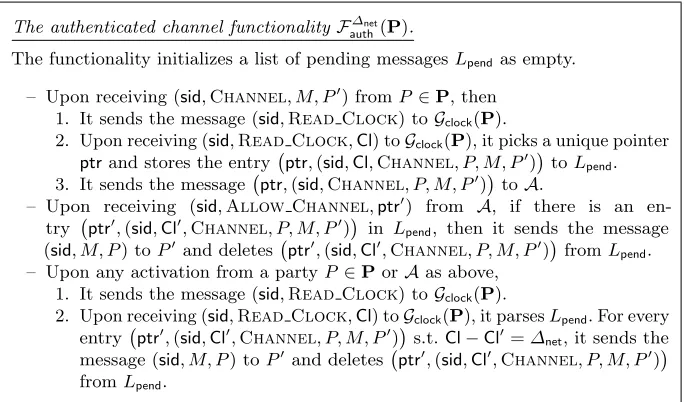
The authenticated channel functionalityℱ𝛥net
auth(P).
The functionality initializes a list of pending messages𝐿pend as empty.
– Upon receiving (sid,Channel, 𝑀, 𝑃′) from𝑃∈P, then 1. It sends the message (sid,Read Clock) to𝒢clock(P).
2. Upon receiving (sid,Read Clock,Cl) to𝒢clock(P), it picks a unique pointer ptrand stores the entry(︀
ptr,(sid,Cl,Channel, 𝑃, 𝑀, 𝑃′))︀
to𝐿pend.
3. It sends the message(︀
ptr,(sid,Channel, 𝑃, 𝑀, 𝑃′))︀
to𝒜.
– Upon receiving (sid,Allow Channel,ptr′) from 𝒜, if there is an en-try (︀
ptr′,(sid,Cl′,Channel, 𝑃, 𝑀, 𝑃′))︀
in 𝐿pend, then it sends the message
(sid, 𝑀, 𝑃) to𝑃′ and deletes(︀
ptr′,(sid,Cl′,Channel, 𝑃, 𝑀, 𝑃′))︀
from𝐿pend.
– Upon any activation from a party𝑃 ∈Por𝒜as above, 1. It sends the message (sid,Read Clock) to𝒢clock(P).
2. Upon receiving (sid,Read Clock,Cl) to𝒢clock(P), it parses𝐿pend. For every
entry(︀
ptr′,(sid,Cl′,Channel, 𝑃, 𝑀, 𝑃′))︀
s.t.Cl−Cl′=𝛥net, it sends the
message (sid, 𝑀, 𝑃) to𝑃′ and deletes(︀
ptr′,(sid,Cl′,Channel, 𝑃, 𝑀, 𝑃′))︀ from𝐿pend.
Fig. 2.The authenticated channel functionalityℱ𝛥net
auth(P) interacting with the
adver-sary𝒜.
The(︀
𝒢clock,ℱ𝛥net auth )︀
guidelines and the environment’s instructions. The message delivery is executed via the functionalityℱ𝛥net
auth(P) described in Fig. 2 that captures the notion of an authenticated channel, upon which a maximum delivery delay 𝛥net can be imposed. Clock advancement is done via calls to𝒢clock, which interacts with all entities andℱ𝛥net
auth .
We denote by EXECE𝒢clock,ℱ
𝛥net auth
𝒜,𝒵,𝒢clock [P](𝜆) the output of the environment𝒵 in an execution ofE𝒢clock,ℱauth𝛥net under the presence of𝒜.
The UC definition of a private email ecosystem is provided below.
Definition 1 (UC Email Privacy). Let𝛥net, 𝜖be non-negative values. Let E
be an email ecosystem with client setC=𝐶1, . . . , 𝐶𝑛, service provider setSP= SP1, . . . ,SP𝑁 and mix node setMX=MX1, . . . ,MX𝑚. LetP:=C∪SP∪MX.
We say that E𝒢clock,ℱauth𝛥net achieves statistical (resp. computational)𝜖-privacy with respect to leakage (Leak) and message delay𝛥net, if for every unbounded (resp.
PPT) global passive adversary 𝒜, there is a PPT simulator Simsuch that for every PPT environment𝒵, it holds that
EXECℱ Leak,𝛥net priv
Sim,𝒵,𝒢clock[P](𝜆)≈𝜖EXEC
E𝒢clock,ℱauth𝛥net
𝒜,𝒵,𝒢clock [P](𝜆).
4
Formalizing privacy notions via types of leakage
functions
In [28], Pfitzmann and Hansen provide definitions for anonymity, unlinkability, unobservability and pseudonymity. Even though outside the context of a formal framework, the definitions in this seminal work have served as a reference point by researchers for the understanding of privacy notions. In this section, we formally express the said (yet not only these) notions by carefully specifying a corresponding leakage function.
Basic leakage sets. Below, we define some useful sets that will enable the succinct description of the various leakage functions that we will introduce. In our formalization, leakage will derive from the history entries that are in a ‘pending’ mode. This is due to technical reasons, as the ideal-world simulator Sim (cf. Section 3.3) must be aware of the actions to be taken by the email privacy functionalityℱLeak,𝛥net
priv (P)beforeallowing their execution, so that it can simulate the real-world run in an indistinguishable manner. In the following, the symbol* denotes a wildcard, andptr′ ≤ptr denotes that entry indexed with pointerptr′ was added earlier than the entry with pointerptr.
– Theactive address set for 𝐻 by pointerptr:
Actptr[𝐻] =:{︁𝐶ℓ@SP𝑖 ⃒ ⃒ ⃒∃ptr
′ ≤ptr:[︁[︀(︀ ptr′,(︀
sid,*,Active, 𝐶ℓ@SP𝑖)︀,‘pending’)︀∈𝐻]︀∨
∨[︀(︀ ptr′,(︀
sid,*,Register, 𝐶ℓ@SP𝑖)︀,‘pending’)︀∈𝐻]︀
]︁ ∧
∧[︁∀ptr′′:ptr′ ≤ptr′′≤ptr⇒(︀
ptr′′,(︀sid,*,Inactive, 𝐶ℓ@SP𝑖
)︀
Note.To simplify the notation and terminology that follows, we consider as active all the addresses that are in a pending registration status.
– Thesender set for 𝐻 by pointer ptr:
Sptr[𝐻] := {︁
𝐶𝑠@SP𝑖 ⃒ ⃒ ⃒∃ptr
′≤ptr:(︀ ptr′,(︀
sid,*,Send,⟨𝐶𝑠@SP𝑖,*,*⟩ )︀
,‘pending’)︀ ∈𝐻}︁.
– The sender multiset for 𝐻 by pointer ptr, denoted by JSptrK[𝐻], is defined
analogously. The difference withSptr[𝐻] is that the cardinality of the pending
Sendmessages provided by𝐶𝑠@SP𝑖 is attached.
– Themessage-sender set for 𝐻 by pointer ptr:
MSptr[𝐻] :={︁(𝑀, 𝐶𝑠@SP𝑖) ⃒ ⃒ ⃒∃ptr
′≤ptr:
(︀
ptr′,(︀sid,*,Send,⟨𝐶𝑠@SP𝑖, 𝑀,*⟩ )︀
,‘pending’)︀∈𝐻}︁.
– Therecipient set for 𝐻 by pointerptr:
Rptr[𝐻] :={︁𝐶𝑟@SP𝑗 ⃒ ⃒ ⃒∃ptr
′ ≤ptr:
(︀ ptr′,(︀
sid,*,Send,⟨*,*, 𝐶𝑟@SP𝑗⟩)︀,‘pending’)︀∈𝐻 }︁
.
– Therecipient multiset for 𝐻 at time slot𝑇, denoted byJRptrK[𝐻], is defined analogously. The difference withRptr[𝐻] is that the cardinality of the pending
Sendmessages intended for𝐶𝑟@SP𝑗 is attached. – Themessage-recipient set for 𝐻 by pointerptr:
MRptr[𝐻] :={︁(𝑀, 𝐶𝑟@SP𝑗)⃒⃒ ⃒∃ptr
′≤ptr:
(︀
ptr′,(︀sid,*,Send,⟨*, 𝑀, 𝐶𝑟@SP𝑗⟩ )︀
,‘pending’)︀∈𝐻}︁.
– Theset of fetching clients for 𝐻 by pointer ptr
Fptr[𝐻] := {︁
𝐶𝑟@SP𝑗 ⃒ ⃒ ⃒∃ptr
′≤ptr:(︀ ptr,(︀
sid,*,Fetch, 𝐶𝑟@SP𝑗
)︀
,‘pending’)︀}︁
.
Unobservability. Unobservability is the state where “the messages are not discernible from random noise”. Here, we focuse on the case of(complete) sender and receiver unobservability, that we will refer to as unobservability for brevity. In this case, the sender and recipient unobservability sets match the set of all online clients, and within these complete unobservability sets, it is neither noticeable if a client sends, nor if it receives as message. Hence, in our setting, unobservability is achieved if only the “client activity bit” is leaked. As a result, we can define theunobservability leakage function Leakunob as the active address set:
Remark 2 (Unobservability as a golden standard for email privacy).In our UC formalization of e-mail ecosystems, we consider a dynamic scenario where the clients register, go online/offline and make custom fetch requests, which is consistent with the real-world dynamics of email communication. It is easy to see that in such a setting the clients’ online/offline status may be leaked to a global observer. E.g., the environment may provide send requests to offline clients and notify the global adversary that provided the said requests, so that the latter can check the activity of those clients. Hence, in our framework, unobservability as defined in Eq. (1), sets a “golden standard” for optimal privacy. In Section 5, we show that this golden standard is feasible in principle. Namely, we describe a theoretical construction with quadratic communication complexity and we prove it achieves unobservability. As a result, that construction sets one extreme point in the privacy vs. efficiency trade off for the client-server email infrastructure, the other being a simple and fast network with no security enhancements. Clearly, the challenge of every email construction is to balance the said trade off between these two extreme points.
We conclude our remark noting that a higher level privacy (e.g., no leakage at all) could be possible if we considered an alternative setting where the email addresses are a priori given, the clients are always online and mail delivery is via continuous push by the SPs. However, we believe that such a setting is restrictive for formally capturing what is an email ecosystem in general.
Anonymity. According to [28],anonymity “is the state of being not identifiable within a set of subjects, the anonymity set”. In the email scenario, a sender (resp. recipient) should be anonymous within the set of potential senders (resp. recipients), i.e. thesender (resp.recipient)anonymity set. In addition, anonymity sets may change over time, which in our framework is done via global clock advancement and per slot. We recall from the discussion in Remark 2 that in our setting, the anonymity sets are restricted within the set of online users.
We define the predicateEnd(·,·) over the pointers and history transcripts to denote that a pointer ptrrefers to the last history entry before the functionality enters the Clock advancement phase in order to finalize execution for the running time slot. By the above, we define the anonymity leakage function, Leakanon, as follows:
Leakanon(ptr, 𝐻) := {︂ (︀
Sptr[𝐻],Rptr[𝐻],Actptr[𝐻] )︀
, ifEnd(ptr, 𝐻) = 1 Actptr[𝐻], otherwise
(2)
Unlinkability.Unlinkability of items of interest (e.g. subjects, messages, etc.) means that “the ability of the attacker to relate these items does not increase by observing the system”. In [28] several anonymity variants are defined in terms of unlinkability. Below, we propose a formalization of a selection of the said notions5.
5 In the proceedings version of this work [8], the terms of sender-side/recipient-side
– Sender anonymity: a particular message can not be linked to any sender and to a particular sender, no message is linkable. We define the sender anonymity leakage function Leaks.anon as
Leaks.anon(ptr, 𝐻) := {︂ (︀
Sptr[𝐻],MRptr[𝐻],Actptr[𝐻])︀, ifEnd(ptr, 𝐻) = 1 Actptr[𝐻], otherwise
(3)
Sender anonymity is a useful notion to capture the level of privacy desired in an e-voting process. Namely, all voters (senders) provide their votes (messages) in an encrypted form to a single known recipient server, playing the role of the ballot box. During tally, the ballot box opens so that the votes are counted, yet the link between the vote and the voter is should be broken so that privacy is preserved.
– Recipient anonymity:a particular message can not be linked to any recipient and to a particular recipient, no message is linkable. We define therecipient anonymity leakage function Leakr.anon as
Leakr.anon(ptr, 𝐻) := {︂ (︀
MSptr[𝐻],Rptr[𝐻],Actptr[𝐻])︀, ifEnd(ptr, 𝐻) = 1
Actptr[𝐻], otherwise (4)
As an interesting example for the direction of recipient-anonymity, suppose that an individual wishes to make several donations amongst a number of known charities. Recipient-anonymity ensures that even if the sender wishes to disclose the amounts, this is done without necessarily disclosing which the charity received which amount.
Pseudonymity.According to [28] “being pseudonymous is the state of using a pseudonym as ID”. To capture pseudonymity, we may slightly abuse nota-tion and consider leakage as a randomized funcnota-tion (or program). Namely, the functionality initially chooses a random permutation 𝜋over the set of clients C, and the pseudonym of each client𝐶ℓ is𝜋(𝐶ℓ)∈[𝑛]. We denote by𝜋[𝐻] the “pseudonymized history” w.r.t. to 𝜋, i.e. in every entry of𝐻 we replace 𝐶ℓ by
𝜋(𝐶ℓ). We define thepseudonymity leakage function as follows:
Leakpseudon(ptr, 𝐻) :=𝜋[𝐻], where 𝜋 $ ←{︀
𝑓 ⃒⃒𝑓 :C−→[𝑛] }︀
. (5)
Besides anonymity, unlinkability, unobservability and pseudonymity defined in [28], other meaningful notions of privacy can be formally expressed in our framework. We present two such notions below.
the recipient anonymity set still is leaked “per slot”. Theweak anonymity leakage function,Leakw.anon, is defined via the sender and recipient multisets as follows:
Leakw.anon(ptr, 𝐻) := {︂ (︀
JSptrK[𝐻],JRptrK[𝐻],Fptr[𝐻],Actptr[𝐻]
)︀
, ifEnd(ptr, 𝐻) = 1 (︀
JSptrK[𝐻],Fptr[𝐻],Actptr[𝐻]
)︀
, otherwise
(6)
Remark 3. Even though not a very strong privacy notion, weak anonymity sup-ports a reasonable level of privacy for email realizations that aim at a manageable overhead and practical use. Indeed, observe that if we can not tolerate to blow up the ecosystem’s complexity by requiring some form of cover traffic (which is a plausible requirement in practical scenarios), then a global adversary monitoring the client-SP channel can easily infer the number of sent/received messages over this channel. Moreover, one may informally argue that in case the email users do not vary significantly in terms of their sending and fetching activity (or at least they can be grouped into large enough sets of similar activity), weak anonymity and standard anonymity are not far. In Section 6, we present an efficient weakly anonymous email construction based on parallel mixing [19, 20].
End-to-end encryption.The standard notion of end-to-end encryption, now applied in many internet applications (e.g., Signal, WhatsApp, Viber, Facebook Messenger, Skype), suggests context hiding of𝑀 in the communication of the end users (up to the message length|𝑀|), in our case the sender and the recipient. Hence, we define the end-to-end leakage function Leake2e as shown below.
Leake2e:=(︁Actptr[𝐻],{︁(𝐶𝑠@SP𝑖,|𝑀|, 𝐶𝑟@SP𝑗) ⃒ ⃒ ⃒∃ptr
′≤ptr:
(︀
ptr′,(︀sid,*,Send,⟨𝐶𝑠@SP𝑖, 𝑀, 𝐶𝑟@SP𝑗⟩ )︀
,‘pending’)︀∈𝐻}︁)︁.
(7)
Relation between privacy notions.Observe that the relation between two privacy notions can be deduced via their corresponding leakage functions. Namely, if for every (ptr, 𝐻) a PPT adversary given the output of leakage function Leak1(ptr, 𝐻) can derive the output of some other leakage functionsLeak2(ptr, 𝐻), thenLeak2(·,·) refers to a stronger notion of privacy thanLeak1(·,·). In Fig. 3, given the definitions ofLeakunob,Leakanon,Leaks.anon/Leakr.anon,Leakw.anon,Leake2e above we relate the respective notions in an intuitively consistent way.
Unobservability =⇒ Anonymity =⇒Sender/Recipient anonymity
⇓
Weak anonymity =⇒E2E encryption
Remark 4. We observe that pseudonymity can not be compared to any of the notions in Fig. 3. Indeed, even for the stronger notion of unobservability, having the set of active addresses is not enough information to derive the pseudonyms. Conversely, having the entire email activity pseudonymized, is not enough infor-mation to derive the active clients’ real identities. In addition, we can combine pseudonymity with some other privacy notion and result in a new ‘pseudonymized’ version of the latter (e.g. pseudonymous unobservability/anonymity/etc.). It is easy to see that the new notions can also be expressed via suitable (randomized) leakage functions, by applying a random permutation on the clients’ identities and then define leakage as in the original corresponding leakage function, up to this
permutation. E.g., for𝜋←$ {︀
𝑓 ⃒⃒𝑓 :C−→C }︀
, “pseudonymized unobservability” could be expressed via the leakage function
Leakps.unob(ptr, 𝐻) := {︁
𝜋(𝐶ℓ)@SP𝑖 ⃒
⃒𝐶ℓ@SP𝑖∈Actptr[𝐻] }︁
.
Remark 5. As our E2E leakage does not cover fetch information, strictly speaking the implication from Weak anonymity to E2E encryption only holds if the fetch behavior is either known in advance (e.g. because of the system specification) or irrelevant. One could also opt to add the additional leakage to the E2E definition, but we believe there is little practical value in doing so.
5
An email ecosystem with optimal privacy
We present an email ecosystem, denoted by Ecomp, that achieves privacy at an optimal level at the cost of high (quadratic) communication complexity. Specifically, in each time slot all SPs in Ecomp communicate with complete
connectivity and always pad the right amount of dummy traffic, so that the
activity of their registered clients is unobservable by a third party, leaking nothing more than that they are online (logged in). In addition, end-to-end communication between the clients is done via encryption layers by utilizing a public key encryption schemePKE= (KeyGen,Enc,Dec). The encryption layers are structured according to the network route
Sender−→ Sender’s SP−→ Receiver’s SP −→Receiver
To support unobservability, the online clients who do not send an actual message during some round provide their SPs with a dummy ciphertext.
Even though certainly impractical,Ecomp sets a “golden standard” of privacy according to the discussion in Remark 2 that efficient constructions refer to in order to balance the privacy vs. efficiency trade off.
we denote the encryption of𝑀 under𝑃’s public key, and (b) all computations require one time slot6:
The phases ofEcomp are as follows:
Initialization:
– On input(︀sid,Init)︀, a service providerSP𝑖 that is not yet initialized, runs KeyGen(1𝜆) to generate a private and a public key pair (skSP𝑖,pkSP𝑖). Then, it
initializes its list of setup entities, denoted by𝐿SP𝑖
setup, as the pair (pkSP𝑖,SP𝑖),
implying that at firstSP𝑖is only aware of itself. In addition,SP𝑖 initializes its list of valid addresses, denoted byAdSP𝑖, as empty. Finally, it broadcasts the message(︀
sid,Channel,(setup,pkSP𝑖),SP𝑗) toℱauth𝛥net(P) for every𝑗∈[𝑁]∖{𝑖}, so that all other SPs receive its public key.
– Upon receiving(︀
sid,(setup,pkSP
𝑗,SP𝑗
)︀
fromℱ𝛥net
auth(P),SP𝑖adds (︀
(pkSP
𝑗,SP𝑗)
)︀
to𝐿SP𝑖
setup. When𝐿 SP𝑖
setup contains all SPs, theSP𝑖 sets its status to ‘execute’, and only then it processes messages of theExecutionphase described below.
Execution:
Registration:
– On input(︀
sid,Register,@SP𝑖
)︀
, if𝐶ℓ is not registered to any SP and has not yet sent a message (sid,Advance Clock, 𝐶ℓ), then:
1.𝐶ℓsends the message (sid,Advance Clock, 𝐶ℓ) to𝒢clock.
2.Upon receiving (sid,Advance Ack, 𝐶ℓ) from𝒢clock,𝐶ℓrunsKeyGen(1𝜆) to generate a private and a public key pair (skℓ,pkℓ). It also initializes her list of setup entities,𝐿ℓ
setupas the pair (pkℓ, 𝐶ℓ), and her list of valid addresses,Adℓ as empty. Then, she sends the message(︀
sid,Channel,(register,pkℓ),SP𝑖)︀to
ℱ𝛥net auth(P).
3. Upon receiving (︀sid,(register,pkℓ), 𝐶ℓ )︀
from ℱ𝛥net
auth(P), SP𝑖 checks that (𝐶ℓ,·)∈/ 𝐿setupSP𝑖 and thatpkℓis a valid public key, and if so, then it adds (pkℓ, 𝐶ℓ)
to𝐿SP𝑖
setup and𝐶ℓ@SP𝑖 to AdSP𝑖. Next, it updates other SPs and its
regis-tered clients by broadcasting the message(︀
sid,Channel,(setup,pk𝐶
ℓ, 𝐶ℓ), 𝑃)
to ℱ𝛥net
auth(P) for every 𝑃 ∈ (SP∖ {SP𝑖})∪C𝑖. It also sends the message (︀
sid,Channel,(setup,{pk𝑃, 𝑃}𝑃∈𝐿SP𝑖
setup
,AdSP𝑖), 𝐶ℓ), updating𝐶ℓwith all the
valid public keys and addresses it knows so far. Finally, it initializes the inbox Inbox[𝐶ℓ@SP𝑖] of𝐶ℓ.
4.Upon receiving(︀
sid,(setup,pkℓ, 𝐶ℓ),SP𝑖 )︀
from ℱ𝛥net
auth(P),SP𝑗 checks that (𝐶ℓ,·)∈/ 𝐿
SP𝑗
setupand thatpkℓis a valid public key, and if so, then it, then it adds (pkℓ, 𝐶ℓ) to𝐿
SP𝑗
setupand𝐶ℓ@SP𝑖toAdSP𝑗. It also adds it adds𝐶ℓto its set of
ac-tive users, denoted by𝐿SP𝑖
act and initialized as empty. Next, it updates its regis-tered clients by broadcasting the message(︀
sid,Channel,(setup,pk𝐶
ℓ, 𝐶ℓ), 𝐶)
toℱ𝛥net
auth(P) for every𝐶∈C𝑗.
6 As it will become clear by the ecosystem’s description, the above simplifications do
5.Upon receiving(︀
sid,(setup,{pk𝑃, 𝑃}𝑃
∈𝐿SP𝑖
setup
,AdSP𝑖),SP𝑖
)︀
fromℱ𝛥net auth(P), the client𝐶ℓ, newly registered toSP𝑖, checks that all public keys are valid. If the check is successful, then𝐶ℓ adds{pk𝑃, 𝑃}𝑃∈𝐿SP𝑖
setup to𝐿𝑖
setup and sets Adℓ←AdSP𝑖. Thus, from this point,𝐶ℓ is aware of the public information
of all SPs and all registered clients up to now. In addition, it sets its status as logged in toSP𝑖.
6.Upon receiving(︀
sid,(setup,pk𝐶𝑡,SP𝑗),SP𝑖) fromℱ𝛥net
auth(P), client𝐶ℓ(now already registered toSP𝑖) checks the validity ofpk𝐶𝑡, and if so, then she adds (pk𝑡, 𝐶𝑡) to 𝐿ℓsetupand𝐶𝑡@SP𝑗 toAdℓ.
Log in:
– On input(︀
sid,Active,@SP𝑖
)︀
, if 𝐶ℓ is not logged in, 𝐶ℓ@SP𝑖 is her valid address, and has not yet sent a message (sid,Advance Clock, 𝐶ℓ), then:
1.𝐶ℓsends the message (sid,Advance Clock, 𝐶ℓ) to𝒢clock.
2.Upon receiving (sid,Advance Ack, 𝐶ℓ) from𝒢clock,𝐶ℓ “logs in” by send-ing(︀
sid,Channel,Enc[SP𝑖](Active),SP𝑖
)︀
toℱ𝛥net auth(P). 3.Upon receiving(︀sid,Enc[SP𝑖](Active), 𝐶ℓ
)︀
fromℱ𝛥net
auth(P),SP𝑖decrypts as (︀
sid,Active, 𝐶ℓ
)︀
and checks that𝐶ℓ@SP𝑖∈AdSP𝑖. If so, then it adds 𝐶ℓ to 𝐿SP𝑖
act.
Log out:
– On input(︀
sid,Inactive,@SP𝑖
)︀
, if𝐶ℓis logged in,𝐶ℓ@SP𝑖is her valid address, and has not yet sent a message (sid,Advance Clock, 𝐶ℓ), then:
1.𝐶ℓsends the message (sid,Advance Clock, 𝐶ℓ) to𝒢clock.
2. Upon receiving (sid,Advance Ack, 𝐶ℓ) from 𝒢clock, 𝐶ℓ “logs out” by sending(︀sid,Channel,Enc[SP𝑖](Inactive),SP𝑖
)︀
toℱ𝛥net auth(P). 3.Upon receiving (︀
sid,Enc[SP𝑖](Inactive), 𝐶ℓ
)︀
fromℱ𝛥net
auth(P),SP𝑖 decrypts as(︀
sid,Inactive, 𝐶ℓ
)︀
and checks that𝐶ℓ@SP𝑖∈AdSP𝑖. If so, then it removes 𝐶ℓ from𝐿SPact𝑖.
Send:
– On input (︀
sid,Send,⟨𝐶𝑠@SP𝑖, 𝑀, 𝐶𝑟@SP𝑗⟩ )︀
, if𝐶𝑠 is logged in toSP𝑖 and has not yet sent a message (sid,Advance Clock, 𝐶𝑠), then:
1.𝐶𝑠sends the message (sid,Advance Clock, 𝐶𝑠) to𝒢clock.
2.Upon receiving (sid,Advance Ack, 𝐶𝑠) from𝒢clock,𝐶𝑠 encrypts the mes-sage𝑀 into layers and providesℱ𝛥net
auth(P) with the layered encryption
(︀
sid,Channel,Enc[SP𝑖]
(︀ Enc[SP𝑗]
(︀
𝐶𝑟@SP𝑗,Enc[𝐶𝑟](𝑀)
)︀)︀
,SP𝑖)︀
3.Upon receiving(︀
sid,Enc[SP𝑖]
(︀ Enc[SP𝑗]
(︀
𝐶𝑟@SP𝑗,Enc[𝐶𝑟](𝑀)
)︀)︀
, 𝐶𝑠)︀fromℱauth𝛥net(P), SP𝑖 checks that 𝐶𝑠@SP𝑖∈AdSP𝑖. If so, then it decrypts the first layer with
skSP𝑖and adds(︀
sid, 𝐶𝑠@SP𝑖,Enc[SP𝑗]
(︀
𝐶𝑟@SP𝑗,Enc[𝐶𝑟](𝑀)
)︀)︀
to its set of mes-sages pending to be sent, denoted by𝐿SP𝑖
send and initialized as empty.
Fetch:
– On input (︀
sid,Fetch, 𝐶𝑟@SP𝑗
)︀
, if𝐶𝑟 is logged in toSP𝑗 and has not yet sent a message (sid,Advance Clock, 𝐶𝑟):
2.Upon receiving (sid,Advance Ack, 𝐶𝑟) from𝒢clock,𝐶𝑟sends the message (︀
sid,Channel,Enc[SP𝑗](Fetch),SP𝑗
)︀
toℱ𝛥net auth(P). 3.Upon receiving(︀
sid,Enc[SP𝑗](Fetch), 𝐶𝑟
)︀
fromℱ𝛥net
auth(P),𝐶𝑟checks that
𝐶𝑟@SP𝑗 ∈AdSP𝑗. If so, then she decrypts and adds Inbox[𝐶𝑟@SP𝑗] to her
set of inboxes which messages are pending to be pushed, denoted by𝐿SP𝑗
push. 4.Upon receiving (sid, 𝐸𝑟,1, . . . , 𝐸𝑟,𝑛,SP𝑗) fromℱauth𝛥net(P) (see below), if𝐶𝑟 is registered toSP𝑗 and has sent a
(︀
sid,Fetch, 𝐶𝑟@SP𝑗
)︀
request, then she decrypts all ciphertexts and stores the ones that are not dummy, i.e. they correspond to actual mail messages with her as recipient. Otherwise, she discards (sid, 𝐸𝑟,1, . . . , 𝐸𝑟,𝑛,SP𝑗).
Clock reading:
– On input (︀sid,Read Clock), the entity 𝑃 ∈ C∪SP sends the message (︀
sid,Read Clock) to 𝒢clock. Upon receiving
(︀
sid,Read Clock,Cl) from
𝒢clock,𝑃 storesClas its local time.
Clock advance (for clients):
– On input(︀
sid,Advance Clock), if the client𝐶ℓ is logged in toSP𝑖 and has
not yet sent a message (sid,Advance Clock,SP𝑖), then she executes the following steps:
1.𝐶ℓsends the message (sid,Advance Clock, 𝐶ℓ) to𝒢clock.
2. Upon receiving (sid,Advance Ack, 𝐶ℓ) from 𝒢clock, then she sends a dummy message(︀sid,Enc[SP𝑖](null)
)︀
toSP𝑖 via ℱauth𝛥net(P) (in turn, SP𝑖 will discard the receivednullupon decryption).
Clock advance (for SPs):
– On input(︀
sid,Advance Clock), ifSP𝑖 has not yet sent a message
(sid,Advance Clock,SP𝑖), then it executes the following steps:
1.SP𝑖 sends the message (sid,Advance Clock,SP𝑖) to𝒢clock.
2. Upon receiving (sid,Advance Ack,SP𝑖) from 𝒢clock, for every address
𝐶𝑠@SP𝑖∈AdSP𝑖:
∙ If there is a message (︀sid, 𝐶𝑠@SP𝑖,Enc[SP𝑗]
(︀
𝐶𝑟@SP𝑗,Enc[𝐶𝑟](𝑀)
)︀)︀ in
𝐿SP𝑖
send, thenSP𝑖broadcasts (︀
sid,Enc[SP𝑗]
(︀
𝐶𝑟@SP𝑗,Enc[𝐶𝑟](𝑀)
)︀)︀
to all SPs viaℱ𝛥net
auth(P), and removes the message from𝐿 SP𝑖
send.
∙ If there is no such message for𝐶𝑠@SP𝑖but𝐶𝑠∈𝐿𝑖act, thenSP𝑖broadcasts a dummy message(︀
sid,Enc[SP𝑖]
(︀ null)︀)︀
under its own key. 3.Upon receiving a message(︀sid,𝐸,˜ SP𝑖
)︀
fromℱ𝛥net
auth(P),SP𝑗 checks whether ˜
𝐸 is a ciphertext under its public key that decrypts as a pair of a valid address𝐶𝑟@SP𝑗 along with an (encrypted) message𝐸. If so, then it adds𝐸 toInbox[𝐶𝑟@SP𝑗].
4.When𝐿SP𝑗
fin,k contains all SPs, then for every address𝐶𝑟@SP𝑗: ∙ IfInbox[𝐶𝑟@SP𝑗]∈𝐿SP𝑗
push, thenSP𝑗 forwards all messages𝐸𝑟,1, . . . 𝐸𝑟,𝑛𝑟
inInbox[𝐶𝑟@SP𝑗] to𝐶𝑟along with𝑛−𝑛𝑟dummy ciphertexts under𝐶𝑟’s public key, emptiesInbox[𝐶𝑟@SP𝑗] and removes it from𝐿
SP𝑗
push. ∙ If Inbox[𝐶𝑟@SP𝑗] ∈/ 𝐿SP𝑗
push but 𝐶𝑟 ∈𝐿 SP𝑗
Thus, in any case, if 𝐶𝑟 is active, then SP𝑗 sends a message of the form (sid, 𝐸𝑟,1, . . . , 𝐸𝑟,𝑛) to𝐶𝑟viaℱauth𝛥net(P).
Privacy ofEcomp. To prove the privacy ofEcomp, we require that the underlying public key encryption schemePKE= (KeyGen,Enc,Dec) satisfies m-IND-CPA, as specified in Section 2.2. In the following theorem, we prove thatEcomp only leaks the “activity bit” of the clients formally expressed by the leakage function Leakunob(·,·) defined in Eq. (1).
Theorem 1. Let Ecomp with clients C = {𝐶1, . . . , 𝐶𝑛} and service providers SP=SP1, . . . ,SP𝑁 be implemented over the PKE schemePKE= (KeyGen,Enc,Dec)
that achieves m-IND-CPA security with error𝜖(𝜆). Then,E𝒢clock,ℱauth𝛥net
comp achieves
computational2(𝑛+𝑁)𝜖(𝜆)-privacy for message delay𝛥net with respect to the
unobservability leakage function defined below
Leakunob(ptr, 𝐻) :=Actptr[𝐻].
Proof. Let𝒜be a global passive PPT adversary againstE𝒢clock,ℱ
𝛥net auth
comp . We begin by constructing a simulatorSimfor𝒜as shown below.
Constructing a simulator for 𝒜.The ideal adversarySimfor𝒜that for any environment𝒵, simulates an execution ofEcomp as follows:
Simulating interaction between𝒵 and𝒜.
– Upon receiving a message(︀ sid, 𝑀)︀
from𝒵, it forwards(︀ sid, 𝑀)︀
to𝒜playing the role of a simulated environment.
– Upon receiving a message(︀ sid, 𝑀)︀
from 𝒜intended for the environment, it forwards(︀
sid, 𝑀)︀ to𝒵.
Achieving synchronicity.
– Upon receiving any message from ℱLeakunob,𝛥net
priv (P), Simsends the message (︀
sid,Read Clock)︀ to 𝒢clock. Upon receiving (︀sid,Read Clock,Cl)︀ from
𝒢clock, it storesClas the global time of the real-world simulation. This way, Simsimulates an execution where the simulated entities are synchronized with respective actual ones in the ideal-world.
Simulating real-world message delivery.
– Upon receiving a leakage message of the form(︀
sid,(ptr, 𝑀))︀
(possibly𝑀 =⊥)
fromℱLeakunob,𝛥net
priv (P),Simknows that this message refers to some command (register/active/inactive/send/fetch) that in the real-world protocol is realized via communication between a client and her SP. Since in the simulationSim also plays the role ofℱ𝛥net
auth(P) in the eyes of𝒜, it must be consistent with the bounded delays (up to𝛥net) that𝒜imposes on message communication. To achieve this consistency,Simkeeps record of the simulated message ˜𝑀
that sends to the simulatedℱ𝛥net
the message delivery of ˜𝑀 is allowed, either by𝒜 or automatically when
𝛥net delay has passed, Sim sends the message (︀
sid,Allow Exec,ptr)︀
to ℱLeakunob,𝛥net
priv (P).
Simulating Initialization.
– Upon receiving(︀sid,Init,SP𝑖 )︀
fromℱLeakunob,𝛥net
priv (P), it runsGen(1
𝜆) on behalf
of SP𝑖 to generate a pair of a private and a public key pair (skSP𝑖,pkSP𝑖).
Then, it broadcasts the message(︀sid,Channel,(setup,pkSP𝑖),SP𝑗) to every 𝑗∈[𝑁]∖ {𝑖}, also simulating the role ofℱ𝛥net
auth(P). Observe that since 𝒜is global and passive, the execution will always initiate upon𝒵’s request. Then, Simsends the message (sid,Allow Init,SP𝑖) toℱLeakunob,𝛥net
priv (P). – Upon receiving(︀
sid,ready)︀
fromℱLeakunob,𝛥net
priv (P), if all simulated SPs have ini-tialized by generating and broadcasting their keys, then it sends(︀sid,Execute)︀
toℱLeakunob,𝛥net
priv (P). Otherwise, it aborts simulation.
Simulating Execution.
Whenever the environment sends a register/active/inactive/send/fetch/clock advance command to a dummy party 𝑃 that forwards it to ℱLeakunob,𝛥net
priv (P), Simobtains (i) an (sid,Advance Clock, 𝑃) notification from𝒢clock, and (ii) the leakage of the form(︀sid,ptr,Actptr[𝐻])︀fromℱLeakunob,𝛥net
priv (P). Namely,Simobtains the sequence of clock advances and the transcript of activations/deactivations. We describe how using this information,Simsimulates execution:
– Upon receiving (sid,Advance Clock, 𝐶ℓ) and(︀
sid,ptr,Actptr[𝐻])︀ , then: ∙ Playing the role of the global clock,Simsends a simulated notification
(sid,Advance Clock, 𝐶ℓ) to 𝒜.
∙ If 𝐶ℓ@SP𝑖 is in Actptr[𝐻] and (︀sid,ptr,Actptr[𝐻])︀is the first entry that
𝐶ℓ@SP𝑖 is activated, then Sim deduces that this refers to a registra-tion command (Recall that for simplicity we included the pending reg-istration commands in the set of active addresses). In this case, Sim runs the registration protocol between 𝐶ℓ and SP𝑖 exactly as in the description ofEcomp, except that it replaces the ciphertext contents with ‘null’ messages. Whenℱ𝛥net
auth delivers the message,Simsends the message (︀
sid,Allow Exec,ptr)︀toℱLeakunob,𝛥net
priv (P).
∙ If𝐶ℓ@SP𝑖is inActptr[𝐻] and is registered but not yet logged in, thenSim deduces that this refers to an active or a clock advance command. In either of these cases,Simsimulates execution by sending a dummy ciphertext (︀
sid,Channel,Enc[SP𝑖](null),SP𝑖
)︀
to the simulated ℱ𝛥net
auth. When ℱ 𝛥net auth delivers the message,Simsends the message(︀
sid,Allow Exec,ptr)︀
to ℱLeakunob,𝛥net
priv (P).
∙ If𝐶ℓ@SP𝑖 is inActptr[𝐻] and is registered and already logged in, then Simdeduces that this refers to either a inactive, send, fetch or a clock advance command. In either of these cases,Simsimulates execution by sending a dummy ciphertext(︀
sid,Channel,Enc[SP𝑖](null),SP𝑖
)︀
∙ If𝐶ℓ@SP𝑖 is not inActptr[𝐻], thenSimdeduces that𝐶ℓ@SP𝑖 is inactive and takes no further action.
– Upon receiving (sid,Advance Clock,SP𝑖) and(︀sid,ptr,Actptr[𝐻])︀:
∙ Playing the role of the global clock,Simsends a simulated notification
(sid,Advance Clock,SP𝑖) to𝒜.
∙ For every address𝐶𝑠@SP𝑖∈AdSP𝑖, it broadcasts a dummy message
(︀
sid,Channel,Enc[SP𝑖](null),SP𝑖
)︀
to all other SPs. Then, it sends the
message(︀sid,Allow Exec,ptr)︀to ℱLeakunob,𝛥net priv (P).
Reducing privacy to m-IND-CPA security.We prove the privacy ofE𝒢clock,ℱauth𝛥net comp via a reduction to the m-IND-CPA security with error𝜖of the underlying pub-lic key encryption schemePKE= (KeyGen,Enc,Dec), which is assumed in the theorem’s statement. Our reduction works as follows: Let 𝒜 be a real-world adversary and𝒵 be an environment. First, we order the clients and servers as parties𝑃1, . . . , 𝑃𝑛+𝑁. Then, we construct a sequence of “hybrid” m-IND-CPA adversariesℬ1, . . . ,ℬ𝑛+𝑁, where ℬ𝑗* executes the following steps:
1. It receives a public key pkfrom the m-IND-CPA challenger.
2. It generates the parties𝑃1, . . . , 𝑃𝑛+𝑁and simulates an execution ofE𝒢clock,ℱ
𝛥net auth comp conducted by 𝒵 and under the presence of 𝒜, also playing the role of 𝒢clock,ℱ𝛥net
auth. The simulation differs from an actual execution as shown below: (a) Upon initialization of a party𝑃𝑗: if𝑃𝑗̸=𝑃𝑗*, thenℬ𝑗*honestly generates
a fresh key pair (sk𝑗,pk𝑗). If𝑃𝑗=𝑃𝑗*, then it sets pk𝑗*:=pk.
(b) When a party𝑃𝑖must send an encrypted message 𝑀 under the public key of𝑃𝑗 (note it may be the case that𝑃𝑖=𝑃𝑗) viaℱauth𝛥net:
– If𝑗 < 𝑗*, thenℬ𝑗* sends an encryption of𝑀 underpk𝑗.
– If𝑗=𝑗*, then it sends a challenge pair (𝑀0, 𝑀1) := (null, 𝑀) to the m-IND-CPA challenger. Upon receiving a ciphertext Enc[𝑃𝑗*](𝑀𝑏),
where 𝑏 is the m-IND-CPA challenge bit, it sends Enc[𝑃𝑗*](𝑀𝑏) to 𝑃𝑗*.
– If𝑗 > 𝑗*, then it sends an encryption ofnullunderpk𝑗.
(c) Since𝒜is passive, all parties are honest, thusℬ𝑗* is completely aware of
the plaintext-ciphertext correspondence. Therefore, when𝑃𝑖 encrypts 𝑀 under𝑃𝑗’s public key to a ciphertextEnc[𝑃𝑗](𝑀),ℬ𝑗* proceeds as if𝑃𝑗
had indeed decrypted this ciphertext to𝑀. 3. It returns the output of𝒵.
Given the description ofℬ𝑗*,𝑗*= 1, . . . , 𝑛+𝑁, we make the following
observa-tions:
– The limit case𝑗*= 1: if𝑏= 0, thenℬ1replaces all real-world communication with encryptions of ‘null’, exactly asSim does in its simulation. Thus, we have that
Pr[︀
ℬ1= 1|𝑏= 0]︀= EXEC
ℱLeakunob,𝛥net priv
– The hybrid step: for every 1≤𝑗*< 𝑛+𝑁, the adversaries ℬ𝑗* andℬ𝑗*+1
have the same behavior regarding the parties𝑃𝑗, where𝑗 ̸=𝑗*, 𝑗*+ 1. In addition, if the m-IND-CPA challenge bit𝑏 is 1, thenℬ𝑗* (i) respects the
encryptions of𝑃𝑗* (hence, of every𝑃𝑗, for𝑗≤𝑗*) and (ii) replaces withnull any plaintext intended for𝑃𝑗, for𝑗≥𝑗*+ 1. Observe that this is exactly the behavior ofℬ𝑗*+1, if𝑏= 0. Therefore, it holds that
Pr[︀ℬ𝑗*= 1|𝑏= 1]︀= Pr[︀ℬ𝑗*+1= 1|𝑏= 0]︀. (9)
– The limit case𝑗*=𝑛+𝑁: if𝑏= 1, then ℬ𝑛+𝑁 executes real-world commu-nication respecting the environments’ instructions and inputs. Thus, we have that
Pr[︀ℬ𝑛+𝑁 = 1|𝑏= 1 ]︀
= EXECE𝒢clock,ℱ
𝛥net auth
𝒜,𝒵,𝒢clock [P](𝜆). (10) Consequently, by Eq. (8) and the m-IND-CPA security ofPKE, we have that for every 𝑗*∈[𝑛+𝑁], it holds that
⃒ ⃒ ⃒Pr
[︀
ℬ𝑗*= 1|𝑏= 1]︀−Pr[︀ℬ𝑗*= 1|𝑏= 0]︀
⃒ ⃒ ⃒=
= ⃒ ⃒ ⃒Pr
[︀
ℬ𝑗*= 1|𝑏= 1]︀−(︀1−Pr[︀ℬ𝑗*= 0|𝑏= 0]︀)
⃒ ⃒ ⃒≤
≤⃒⃒ ⃒2·Pr
[︀
(ℬ𝑗*= 1)∧(𝑏= 1)]︀+ 2·Pr[︀(ℬ𝑗*= 0)∧(𝑏= 0)]︀−1
⃒ ⃒ ⃒=
=⃒⃒ ⃒2·Pr
[︀
ℬ𝑗*(1𝜆) breaksPKE]︀−1
⃒ ⃒ ⃒≤
⃒ ⃒ ⃒2·
(︀
1/2 +𝜖(𝜆))︀ −1⃒⃒
⃒= 2𝜖(𝜆).
(11)
Finally, by Eq. (8), (9),(10), and (11), we get that
⃒ ⃒ ⃒EXEC
ℱLeakunob,𝛥net priv
Sim,𝒵,𝒢clock [P](𝜆)−EXEC
E𝒢clock,ℱ
𝛥net auth
𝒜,𝒵,𝒢clock [P](𝜆) ⃒ ⃒
⃒≤2(𝑛+𝑁)𝜖(𝜆)
which completes the proof. ⊓⊔
6
A parallel mix email ecosystem with
𝑡
strata
We will now describe a design to be used for routing messages between various clients, based on parallel mixing [19, 20]. A parallel mix is a design that borrows characteristics from stratified mixes i.e mixes where servers are grouped in sets calledstrata, and routing is restricted so that each stratum except the first only receives messages from the previous one and each stratum except the last only forwards messages to the next (the first and last strata operate as the entry and exit points respectively). In parallel mixing routing is determined by the servers themselves in the interest of symmetry and predictability in performance and security. All 𝑡 strata consist of 𝜎 nodes each. We use MX𝑖,𝑗 to indicate the 𝑗-th server in stratum 𝑖, and let MX = {MX𝑖,𝑗|𝑖 ≤ 𝑡, 𝑗 ≤ 𝜎}. We use P=(︀
C∪SP∪MX)︀
to denote the set of all involved parties. We use a set of assumptions similar to those of section 5, specifically: (a) all communication is executed viaℱ𝛥net