SAGE Open
October-December 2015: 1 –14 © The Author(s) 2015 DOI: 10.1177/2158244015612877 sgo.sagepub.com
Creative Commons CC-BY: This article is distributed under the terms of the Creative Commons Attribution 3.0 License (http://www.creativecommons.org/licenses/by/3.0/) which permits any use, reproduction and distribution of
Article
Introduction and Background
Adults of working age typically have busy lives involving employment, mortgage repayments, study, life partnership, family, raising children, and sporting or community activi-ties. In Australia, 30% of all strokes occur in those below 65 years of age (National Stroke Foundation [NSF], 2013a), and U.S. research found it to be approximately 45% (Wolf, Baum, & Connor, 2009). Stroke incidents in younger adult-hood are increasing, with mild to moderate stroke the most prevalent (Tellier & Rochette, 2009; Wolf et al., 2009), fre-quently resulting in lifelong consequences (Maaijwee, Rutten-Jacobs, Schaapsmeerders, van Dijk, & de Leeuw, 2014; Rutten-Jacobs et al., 2013). Survivors who experience stroke of mild to moderate severity are typically discharged home quickly (Mold, Wolfe, & McKevitt, 2006), with only minimal referral for rehabilitation follow-up or support to meet specific needs in recovery (Baum et al., 2008; Tellier & Rochette, 2009). The same unmet needs involving work, financial support, marital or relationship support, social and leisure activities have persisted for more than a decade (Kersten, Low, Ashburn, George, & McLellan, 2002; Low, Kersten, Ashburn, George, & McLellan, 2003; NSF, 2013b; Teasell, McRae, & Finestone, 2000), with psychosocial sup-ports particularly neglected (Maaijwee et al., 2014). Stroke
impairment, physical and/or cognitive, intensifies survivor vulnerability in the context of everyday challenges and envi-ronments (Palmcrantz, Widén Holmqvist, & Sommerfeld, 2012).
Particular vulnerabilities of younger, higher functioning stroke survivors (those aged 18-65 years who resume employment, independent parenting, and/or substantial responsibilities post-stroke) have received some recognition in international literature in recent years. Being “vulnerable” is defined by the online Oxford Dictionaries (2014) as, “1) Exposed to the possibility of being attacked or harmed, either physically or emotionally . . . 2) (Of a person) in need of special care, support, or protection because of age, disability, or risk of abuse or neglect.” A heightened awareness of vul-nerability has been identified by stroke survivors in recovery
612877SGOXXX10.1177/2158244015612877SAGE OpenWolfenden and Grace research-article2015
1La Trobe University, Melbourne, Australia
2The Florey Institute of Neuroscience and Mental Health, Melbourne,
Australia
3Victoria University, Melbourne, Australia Corresponding Author:
Barbara Wolfenden, The Florey Institute of Neuroscience and Mental Health, Melbourne Brain Centre—Austin Campus, 245 Burgundy Road, Heidelberg, Victoria 3084, Australia.
Email: [email protected]
Vulnerability and Post-Stroke Experiences
of Working-Age Survivors During
Recovery
Barbara Wolfenden
1,2and Marty Grace
3Abstract
Survivors who experience stroke of mild to moderate severity are typically discharged home quickly, with only minimal referral for rehabilitation follow-up or support to meet specific needs in recovery. Particular vulnerabilities of younger, higher functioning stroke survivors have received some recognition in international literature in recent years. This article reports on findings of a small Australian qualitative study focusing on recovery and return to work experiences of young higher functioning female stroke survivors, in particular exploring experiences of post-stroke vulnerability from participants’ own perspectives. Our research adds depth and nuance to this developing area of interest and research. Our findings include survivors’ reflections on the consequences of delayed diagnosis, the impacts of empowering and disempowering interactions with health care professionals, a general lack of access to psychosocial rehabilitation, and frustrations of financial hardship. Implications for health professionals, service systems, and income support provision are discussed, along with directions for future research.
Keywords
2 SAGE Open
(Alaszewski, Alaszewski, Potter, & Penhale, 2007), relating to work resumption, well-being, and administrative systems (Trygged, 2012). Experiences of vulnerability in young sur-vivors may impact on their ability to manage challenges in stroke recovery:
The long term effects of a coping process can involve greater vulnerability and exhaustion as if something had been lost or used up. This side of the coping process ought to be taken into account in the rehabilitation process and the construction of intervention programmes, even for individuals with mild stroke. (Carlsson, Moller, & Blomstrand, 2009, p. 780)
Survivors of mild stroke, or those who may be higher functioning, are sometimes deemed “recovered” despite last-ing invisible impairments, which are poorly understood in social, community, and work contexts (Alaszewski et al., 2007; Edwards et al., 2006; Maaijwee et al., 2014). Invisible impairments occur in executive function, concentration, memory, fatigue, anxiety, depression and/or emotions, pain, and sexual dysfunction (Maaijwee et al., 2014; Radman et al., 2012; Teasdale & Engberg, 2005). Obvious physical impairment is given attention, but frequently invisible psy-chosocial and cognitive impairment, also requiring neurore-habilitation, is less well recognized in survivors of mild to moderate stroke (Roding, Lindstrom, Malm, & Ohman, 2003; Tellier & Rochette, 2009), particularly younger adult survivors (Maaijwee et al., 2014). Stone (2005) identified one possibility for misconception here; young stroke survi-vors who may be visibly physically able, but cognitively impaired, are not easily categorized by society as abled or disabled. Another reason may involve a lack of sensitivity reported for some common assessment tools used to detect cognitive and psychosocial impairment in survivors of mild stroke (Palmcrantz et al., 2012; Wolf, Barbee, & White, 2011). Maaijwee et al. (2014) reviewed the prognosis of young stroke involving both neurological and psychosocial outcomes. They advise screening young stroke survivors thoroughly for invisible impairments to better direct inter-vention. Eriksson, Baum, Wolf, and Connor (2013) recom-mend follow-up assessment of participation during community reintegration. They call for occupational thera-pists to develop interventions to address participation needs for stroke survivors, particularly those deemed not to require medical-model rehabilitation.
Banks and Pearson (2004) reported young stroke survi-vors’ intimate relationships being vulnerable to breakdown. Martinsen, Kirkevold, and Sveen (2012) found that non-established, single, or young stroke survivors in parenting roles are most vulnerable. An audit of stroke rehabilitation reported less than one third of stroke survivors with recog-nized mood impairments on hospital admission received treatment before discharge (NSF, 2014). Maaijwee et al. (2014) found that young stroke survivors with depression had a 7% increased risk of suicide, and a 6% to 15% risk of
suicidal ideation during acute and longer term chronic phases of stroke.
Stroke rehabilitation programs have traditionally been developed in response to the needs of retirement-aged indi-viduals (Wolf et al., 2009; Wolf, Brey, Baum, & Connor, 2012). Younger adult survivors are at a different life-stage, with different roles informing their desired recovery goals (Maaijwee et al., 2014; Wolf et al., 2011). Equity of access to appropriate rehabilitation to meet recovery needs for all stroke survivors remains an issue (Maaijwee et al., 2014; NSF, 2012) with variations in stroke support recognized (Maaijwee et al., 2014; Mold et al., 2006; NSF, 2010). Systemic constraints have been reported (Hart, 2001; Mold, McKevitt, & Wolfe, 2003). Rehabilitation guidelines provide for support services during transition back to home and com-munity involvement (Lindsay, Furie, Davis, Donnan, & Norrving, 2014; NSF, 2010), yet younger stroke survivors have higher unmet needs (Andrew et al., 2014), and may not receive optimal care following stroke (Mold et al., 2006).
Stroke rehabilitation is defined as,
A proactive, person-centred and goal-oriented process that should begin the first day after stroke. Its aim is to improve function and/or prevent deterioration of function, and to bring about the highest possible level of independence—physically, psychologically, socially and financially. (NSF, 2010, p. 30)
Sumathipala, Radcliffe, Sadler, Wolfe, and McKevitt (2012) found not only services, systems, and policies involved but also attitudes of others and personal factors including psychological resources, life experience, social and financial positions to all affect the extent of need experi-enced after stroke.
Wolfenden and Grace 3
Prompt stroke diagnosis and workplace characteristics each contribute toward a young survivor’s capacity to return to employment. Rapid diagnosis is prioritized in the Global
Stroke Bill of Rights (WSO, 2014). From the moment stroke
commences, survivors are vulnerable, and how they are treated, or not, during acute stroke can influence post-stroke outcomes. Consumer consultation identified misdiagnosis and/or delays in diagnosis as issues (NSF, 2012). This is par-ticularly pertinent to younger stroke survivors within the context of employment obligations. Without stroke diagnosis and intervention certifying sick leave, the survivor may be obliged to attend work with stroke-related psychosocial or cognitive needs unsupported (O’Brien & Wolf, 2010). These can lead to misunderstanding and difficulties (Alaszewski et al., 2007; Hartke, Trierweiler, & Bode, 2011), including reports of bullying (Ellingsen & Aas, 2009). Employment may be unsustainable in work environments perceived to be “inconsistent, unsafe” (Gustafsson & Turpin, 2012, p. 105), and which threaten the preservation of an individual’s “men-tal health” during stroke recovery (Gustafsson & Turpin, 2012, p. 103). Similarly, some young stroke survivors reported experiencing marginalization at work. This left them in a difficult financial situation, and emotionally dis-tressed. Some were forced to leave work, whereas others struggled to meet work expectations (Martinsen, Kirkevold, Bronken, & Kvigne, 2013). Conversely, employers who maintain salary levels and supportive workplaces contribute to financial security, self-esteem, self-image, confidence, well-being, and life satisfaction in recovery (Hannerz, Pedersen, Poulsen, Humle, & Andersen, 2010; Martinsen et al., 2013).
Control over one’s life, or autonomy, is an important aspect of younger and middle adulthood. Stroke by its nature frequently results in a loss of control, and a certain level of dependence. In a literature meta-summary, Peoples, Satink, and Steultjens (2011) identified “Power and Empowerment” as a key theme in the experience of survivors during stroke rehabilitation. “Power and Empowerment” includes individ-ual and inter-relational aspects. The nature of interactions between stroke survivors and health care professionals can affect the quality of care, with negative interactions compro-mising the dignity and respect experienced by patients (Mold et al., 2003; Peoples et al., 2011). Morris, Oliver, Kroll, Joice, and Williams (2015) recognize the socio-ecological complexity of stroke care and rehabilitation to encompass broader social and environmental considerations. Ideally, the young survivor is empowered throughout his or her recovery, with health care professionals supporting his or her decision making and control in setting and achieving rehabilitation goals (Ellis-Hill, Payne, & Ward, 2008; Jones, Mandy, & Partridge, 2008; Kubina, Dubouloz, Davis, Kessler, & Egan, 2013; Peoples et al., 2011). Nevertheless, in June 2015 the World Stroke Organisation launched the Young Stroke
Initiative to address sector-wide shortcomings and improve
recovery outcomes for this group (WSO, 2015).
This article reports on findings of a small Australian quali-tative study focusing on recovery and return to work experi-ences of young higher functioning stroke survivors, in particular exploring experiences of post-stroke vulnerability from participants’ own perspectives. Our research adds depth and nuance to this developing area of interest and research. Our findings include survivors’ reflections on the conse-quences of delayed diagnosis, the impacts of empowering and disempowering interactions with health care professionals, a general lack of access to psychosocial rehabilitation, and the frustrations of financial hardship. Implications for health pro-fessionals, service systems, and income support provision are discussed, along with directions for future research.
Method
This small qualitative research project was carried out as a bachelor’s of social work with honors project. The first author undertook the fieldwork and data analysis under the academic supervision of the second author. The research aimed to explore the experiences of young higher function-ing stroke survivors in re-establishfunction-ing identity and returnfunction-ing to work. The research questions guiding the study were as follows:
Research Question 1: Do younger stroke survivors
per-ceive a change in identity post-stroke, and if so, what meaning do they give this experience?
Research Question 2: What factors are perceived to have
influenced identity re-establishment?
Research Question 3: What are the experiences of
iden-tity re-establishment and returning to employment for young survivors of stroke?
An unexpected finding in the data was that the participants all spoke in detail about their experiences of vulnerability post-stroke, and a further research question was developed:
Research Question 4: What are young stroke survivors’
experiences of vulnerability post-stroke, what do those experiences mean to them, and what are the implications for service delivery?
This article reports the findings in relation to this fourth question. Findings relating to identity re-establishment are reported in detail elsewhere (Wolfenden & Grace, 2012).
4 SAGE Open
In-depth, semi-structured interviews were carried out with a purposive sample of five volunteers who were recruited by advertising through NSF stroke support networks. Informed consent was obtained prior to data collection. In-depth interviews with five people generated 62,945 words of transcripts, an amount considered appropriate for a qualita-tive honors study. Although the recruitment included no pref-erence in relation to the gender of the participants, all five were women. The interviews were conducted by the first author and lasted 1 to 2 hr, with questions focused on the par-ticipants’ perspectives regarding the impact of their stroke on their identity, their experiences of identity re-establishment, and their experiences with returning to employment. Participants were encouraged to recount stories of their own experiences, to obtain richly meaningful first person accounts (Liamputtong, 2013). Pseudonyms were allocated to each participant to protect their confidentiality. Four of the five interviews were held in participants’ homes, with one held in a private workplace office; all were digitally recorded. The interviews were transcribed, coded and analyzed thematically in accordance with procedures described by Liamputtong (2013). Transcripts were coded into topic areas by the first author, under supervision of the second author. These topics were then grouped into categories and discussed with the sec-ond author until agreement was reached on the list of catego-ries, and where each topic belonged. This collaborative process occurred throughout thematic analysis. Categories were grouped into themes, and it was at this stage that the theme of vulnerability was identified. The interview material that was coded to vulnerability was printed out and was ana-lyzed as a data set by re-reading this material and identifying shared perceptions and meanings that were communicated by the participants. Three distinct sub-themes were identified in the data: “Vulnerability in interactions with health care
pro-fessionals,” “Lack of access to psychosocial rehabilitation,”
and “Financial vulnerability post-stroke.”
As Liamputtong (2013) states, rigor in qualitative research is ensured by the ethics of the choice of research questions and methodology, credibility of the sample selection, reflex-ivity of the researchers, and procedures such as member checking, and peer review of coding and analysis. As a criti-cal interpretivist project, this research is underpinned by a strongly ethical choice of research questions, methodology, and reporting. The intention is to contribute to making life better for a disadvantaged group, in this instance, young stroke survivors. The conduct and reporting of the research seeks to remain true to the stories, perspectives, and interpre-tations of the research participants. The research design included lengthy semi-structured face-to-face interviews conducted by a student researcher with personal experience of stroke. The procedures leading up to the interviews, the manner of the researcher, and the questions asked were all carefully designed to support the participants and encourage them to share their stories, perspectives, and interpretations in relation to the research topic. The rich, detailed data and
the inclusion of quite personal material, as well as the disclo-sures regarding the participants’ experiences of vulnerability attest to the success of the research strategies.
The recruitment strategies and the use of inclusion criteria ensured credibility of the sample, in that the research partici-pants were young higher functioning stroke survivors who had experience of returning to work following stroke. Researcher reflexivity was an important part of the research, encouraged by the academic supervisor with repeated tioning of whether the research questions, interview ques-tions, codes, and themes ensured that the research was designed and carried out to gather the broad range of research participants’ experiences, not just those that resonated with the student researcher, as could have been a risk with her closeness to the research topic. Similarly, member checking, and supervisor review of coding and analysis were utilized to ensure the rigor of the research.
Findings
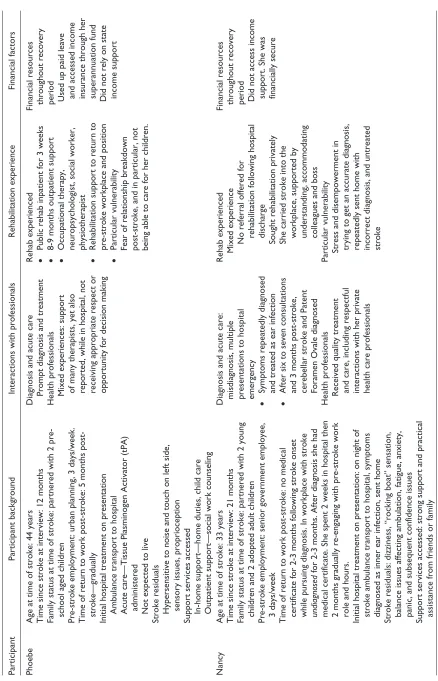
In this section, participants are introduced in table 1, provid-ing basic information on demographics and experiences of vulnerability across sub-themes. This is followed by illustra-tions in the participants’ own words about how they experi-enced vulnerability post-stroke, and details in relation to the three themes that were identified in the data: (a) vulnerability in interactions with health care professionals, (b) lack of access to psychosocial rehabilitation, and (c) financial vul-nerability post-stroke.
Participant Experiences of Vulnerability
Post-Stroke
The participants spoke about post-stroke vulnerability in terms of loss of independence, loss of strength, and loss of income:
I really hated the vulnerability of feeling a bit or being a bit uncertain . . . not feeling strong either emotionally or physically. (Nancy)
It made me really vulnerable because . . . if my husband left me . . . I wasn’t able to work at all and I wasn’t able to care for my children at all. I was completely dependent on another person and I’m a really independent person. (Phoebe)
I never wanted it [income support] for long, just a few months to help us and they said no, I was too healthy for it. (Michelle)
I only had a couple of month’s wages set aside, but that didn’t even last a couple of months. I paid off all my debts and all that sort of thing . . . I’m like, how do people manage who don’t have that [family] support . . . I mean I wasn’t up to fighting any battles or anything like that. (Tracey)
Table 1.
Participant Background Information and Summarized Experiences Indicating Vulnerability.
Participant
Participant background
Interactions with professionals
Rehabilitation experience
Financial factors
Phoebe
Age at time of stroke: 44 years Time since stroke at interview: 12 months Family status at time of stroke: partnered with 2 pre- school aged children Pre-stroke employment: urban planning, 3 days/week. Time of return to work post-stroke: 5 months post- stroke—gradually Initial hospital treatment on presentation Ambulance transport to hospital Acute care—Tissue Plasminogen Activator (tPA) administered Not expected to live
Stroke residuals Hypersensitive to noise and touch on left side,
sensory issues, proprioception
Support services accessed In-home support—home duties, child care Outpatient support—social work counseling Diagnosis and acute care Prompt diagnosis and treatment Health professionals Mixed experiences: support
of many therapists, yet also reported, while in hospital, not receiving appropriate respect or opportunity for decision making Rehab experienced ••
Public rehab inpatient for 3 weeks
••
8-9 months outpatient support
••
Occupational therapy, neuropsychologist, social worker, physiotherapist
••
Rehabilitation support to return to pre-stroke workplace and position
••
Particular vulnerability Fear of relationship breakdown post-stroke, and in particular, not being able to care for her children. Financial resources throughout recovery period Used up paid leave
and accessed income insurance through her superannuation fund Did not rely on state income support
Nancy
Age at time of stroke: 33 years Time since stroke at interview: 21 months Family status at time of stroke: partnered with 2 young children and 2 adopted adult children Pre-stroke employment: senior government employee, 3 days/week Time of return to work post-stroke: no medical certificate for 2-3 months following stroke onset while pursuing diagnosis. In workplace with stroke undiagnosed
for 2-3 months. After diagnosis she had
medical certificate. She spent 2 weeks in hospital then 2 months gradually re-engaging with pre-stroke work role and hours.
Initial hospital treatment on presentation: on night of stroke ambulance transport to hospital, symptoms diagnosed as inner ear infection, sent home Stroke residuals: dizziness, “rocking boat” sensation, balance issues affecting ambulation, fatigue, anxiety, panic, and subsequent confidence issues Support services accessed: strong support and practical assistance from friends or family Diagnosis and acute care: misdiagnosis, multiple presentations to hospital emergency ••
Symptoms repeatedly diagnosed and treated as ear infection
••
After six to seven consultations and 3 months post-stroke, cerebellar stroke and Patent Foramen Ovale diagnosed Health professionals Received quality treatment
and care, including respectful interactions with her private health care professionals Rehab experienced Mixed experience
No referral offered for rehabilitation following hospital discharge Sought rehabilitation privately She carried stroke into the workplace, supported by understanding, accommodating colleagues and boss
Particular vulnerability Stress and disempowerment in
trying to get an accurate diagnosis, repeatedly sent home with incorrect diagnosis, and untreated stroke Financial resources throughout recovery period Did not access income
support. She was financially secure
6
Participant
Participant background
Interactions with professionals
Rehabilitation experience
Financial factors
Michelle
Age at time of stroke: 28 years Time since stroke at interview: 9 years Family status at time of stroke: married, and 19 weeks pregnant Pre-stroke employment: accounts administration, full- time Time of return to work post-stroke: returned to work 6-8 months post-stroke because of financial need, worked 3 hr/week, maternity leave after 2 years, took office temp work 3 days/week until her child started school then worked full-time hours 4-5 days/week. Initial hospital treatment on presentation: presented to emergency department, symptoms diagnosed as pregnancy related, sent home Stroke residuals: sensory issues in the affected hand, fatigue, uneven gait, short-term memory loss, slower information processing, and appearing vague when searching for specific words in communication Support services accessed: ineligible for government income support although both Michelle and her husband were unable to work Diagnosis and acute care Stroke onset misdiagnosed After being sent home, stroke
symptoms 5 hr later, miscarriage followed Admitted on a ward with patients she described as “
really old
”
Health professionals Spent 1 week in acute care and
well cared for Antiphospholipid syndrome blood disorder was diagnosed at this time related to pregnancy Rehab experienced ••
Two months of public outpatient rehabilitation across two facilities
••
Three to four 2-hr sessions weekly
••
Sensory issues, motor skills, walking gait, cognition tasks
••
No psychosocial rehabilitation for stroke or associated miscarriage
••
No rehabilitation support in returning to work after 2 months
••
Supportive employer Particular vulnerability
••
Lack of psychosocial support for stroke and subsequent miscarriage
••
Financial and housing insecurity
Financial resources throughout recovery period •• No access to income support
••
Exacerbated stress during Michelle’s recovery
••
Neither Michelle nor her partner was fit for work
••
Financial situation was dire, impacting on housing security Necessary financial support subsequently sought through family.
Wendi
Age at time of stroke: 39 years Time since stroke at interview: 4 years Family status at time of stroke: married Pre-stroke employment: office management, full-time; also, customer service, part-time Time of return to work post-stroke: approx. 8 months, working two jobs 1. Administration position, supportive supervisor, flexible 20 hr/week. 2. Customer service position, similarly supportive with flexible hours. Initial hospital treatment on presentation: unattended for 36 hr at home beyond stroke onset, ambulance transport to hospital, admitted to stroke acute care, due to vomitus paramedics initial response was to treat for drug overdose—family advised that this was not likely. Stroke residuals: inability to stand for long periods, fatigue, slower information processing, mood fluctuations Support services accessed: Government income support was largely inaccessible. Diagnosis and acute care Prompt diagnosis and treatment
on arriving to hospital.
Health professionals Supportive rehabilitation environment No counseling follow-up referral on discharge Rehab experienced ••
Seven weeks inpatient rehabilitation
••
Physiotherapy for walking, psychological therapy
••
Physiotherapy followed up post- discharge
••
No referral was made for psychosocial support during the transition back to home, family, community, and work Particular vulnerability Consequences resulting from a lack
of referral for psychosocial support following rehabilitation
••
Mood swings and conflict with her mother
••
Marriage breakdown
••
As no referral was offered at point of discharge, she felt undeserving of requesting or accessing assistance Financial resources throughout recovery period: A total of Aus$10.92
provided following income support assessment. Instead, savings account depleted across 7-8 months rehabilitation and recovery, leaving no reserve and necessitating a return to work
(continued)
Table 1.
Participant
Participant background
Interactions with professionals
Rehabilitation experience
Financial factors
Tracey
Age at time of stroke: 34 years Time since stroke at interview: 3 years Family status at time of stroke: single Pre-stroke employment: worked in the hospitality industry, as well as practicing massage and aroma therapy Time of return to work post-stroke: approx. 15 months post-stroke, could not return to previous positions, worked as an integration aide at a local primary school Initial hospital treatment on presentation: reports that allergy to injection administered by doctor caused stroke, admitted directly to local regional hospital for acute care, transferred to metropolitan public rehabilitation hospital Stroke residuals: loss of strength and fine motor skills in dominant hand, severe limp, and fatigue Support services accessed: income support Diagnosis and acute care Prompt due to being in doctor’s clinic at the time of stroke Health professionals Reports that she did not receive appropriate respect or opportunity for decision making while learning to re-establish personal independence Observed similar interactions involving other patients
Rehab experienced •• Six months inpatient public rehabilitation
••
Further 12 months regional outpatient rehabilitation
••
Rehabilitation period included selling her house, giving up massage career, moving to live with parents. Particular vulnerability Financial insecurity Income support repeatedly
cancelled while undertaking rehabilitation As rehabilitation progressed, employment considered while completing rehabilitation. Expectation to work full-time hours unsustainable—income support payments threatened if she attended rehabilitation part-time, and rehabilitation threatened if she attended work full-time as per requirement She transferred to study instead of work to enable completion of rehabilitation Financial resources throughout recovery period At the time of stroke
only had minimal savings, which she used up in paying off all debts and then needed income support. Reported that seeking income support through the relevant agency was the only real obstacle in recovery. Payments cancelled three times while undertaking inpatient rehabilitation—her father had to act as her representative to sort it out. Payments cancelled another “few times” while undertaking outpatient rehabilitation
Note.
The information contained in this table was obtained from participants, not from medical records.
Table 1.
8 SAGE Open
only had a singlet on and there was vomit everywhere. I remember being cold . . . I think that saved me too because it was so cold; then my body sort of went into a bit of survival mode and the blood vessels maybe constricted a bit. (Wendi)
Vulnerability in interactions with health care professionals.
Par-ticipants’ experiences of interaction with health care profes-sionals varied widely. Their first experiences were mostly with paramedics or hospital emergency departments. For two of the participants, their symptoms were not immediately recognized as stroke related. Once the participants were admitted to hospital, their interactions with health profes-sionals took on considerable significance. The quality of these interactions had powerful impacts, inspiring, encourag-ing, and sometimes antagonizing them.
The night I actually had the stroke I was taken to hospital in an ambulance but they said I had an inner ear infection . . . I had this really bad, dizzy spell; incredible head pain. Yeah so they just sort of sent me home . . . so that would have been the October. So I went back to work and I struggled a lot with not feeling well but being hard to pinpoint what was wrong with me. (Nancy)
Nancy carried undiagnosed stroke into the workplace during the 2 to 3 months period prior to receiving an accurate stroke diagnosis. In total, Nancy presented at hospital emergency 7 to 8 times across approximately 2 to 3 months.
I just kept saying I don’t feel right, I feel all wobbly and this boat rocking sensation and stuff like that. So in about January, finally, I went down to [local] Hospital and said to them, if you don’t do something I’m not going to leave until you diagnose properly. Because I know there’s something wrong with me and I’m sick of coming back here. I cried and the doctor was pretty unsympathetic. But I said I’m not going anywhere until you actually look inside my brain. (Nancy)
Michelle was sent home when she initially presented to hospital, only to experience full stroke symptoms several hours later, followed by miscarriage:
The night that I remember going to the hospital they did a few blood tests or the blood pressure test and things like that and just sort of said “Oh, there is nothing we can do . . . Just go home.” I said I had this really bad headache and—they gave me some kind of medication. I think it was just some sort of paracetamol or something like that. It wasn’t anything—and sent me home. (Michelle)
Phoebe and Tracey received prompt diagnosis and treat-ment, as did Wendi, once she arrived at hospital, after lying on the floor waiting to be found for approximately 36 hr. However, Wendi also reported that her initial intervention by the paramedics was almost mistaken as drug overdose:
There was vomit everywhere . . . dad said the ambos thought I had been taking drugs, and he had to tell them that I don’t. (Wendi)
Once in the hospital and/or rehabilitation setting, each participant experienced both positive and challenged interac-tions with health professionals. Phoebe felt well supported overall:
On every level, I was set up to succeed. It was a supported journey . . . I went through phases where I was just really angry . . . and the social worker explained to me that that was a really positive sign of my recovery. (Phoebe)
Wendi’s inpatient rehabilitation experience was poignant, and positive like Phoebe’s:
I couldn’t walk . . . I took my first steps by myself on my 40th birthday which weren’t really steps they were just like this little shuffle thing . . . When I got back [to the ward] . . . the physio had called to say that I’d taken my first steps and they were all standing there clapping . . . yeah and that was good. (Wendi)
Tracey experienced variations in service delivery and described these clearly. She received good, consistent occu-pational therapy throughout rehabilitation and her first phys-iotherapist offered quality service, but moved on due to staff rotation. Tracey described her next physiotherapist,
She would just put me on the treadmill and gossip . . . she blatantly told me, “Okay I don’t know what to do with young stroke victims, I work with the elderly.” (Tracey)
Tracey also expressed frustration at being asked to engage in therapy when she was overly tired:
I think it was largely from the fatigue. I think . . . my first speech therapist at rehab hospital, I think I ended up getting another one, because I got a bit angry with her. I was just so tired and I just wanted to rest . . . like, you know when they read the stories out and you have to tell them the story back and I’m like, “Oh I don’t care.” (Tracey)
Tracey described how difficult it was to disagree with her doctor:
The doctor said, “Yes we expect that she should have moved that [dominant hand] by now so we don’t think that she’ll ever move it.” I just had this knowingness that it wasn’t true. I’m like, “No I just think that I will” . . . Well it’s difficult to tell people, you know, have confidence in yourself to voice your opinion . . . The other thing is they [healthcare professionals] might have been doing this job so much that it is routine, and they forget that they’re dealing with people with feelings, they are just seeing it from a purely medical perspective. (Tracey)
Tracey did regain movement in her hand, but it remained impaired in strength and dexterity.
Wolfenden and Grace 9
By the next day when it came to bathing time . . . when I went to put a panty liner in my underpants it was a bit crooked and I was happy with a bit crooked, and in everyday life I’m happy with a bit crooked. But the nurse decided without any discussion that it needed to be straight and reached down and unpeeled it and put it back in for me. The positive out of that was actually there’s not a nurse in the bathroom with me anymore, that’s it.
Another participant was denied dignity in relation to toilet-ing needs. She explained that one morntoilet-ing each week, all patients were presented to a doctor and head nurse in another room:
They wouldn’t even let me go to the toilet because we had to see the doctor by a certain time, it was like, excuse me I’m still a person. How about a bit of dignity here? Like, let me go to the toilet! . . . But the nurses were like really anxious about getting everyone to the doctor . . . But now they’re pushing me there anyway and I’m like, I, I couldn’t believe this . . . They made sure I went to the toilet . . . After, you know, I had a bit of a hissy fit, but I just thought, unbelievable!
Further to this, she described the environment she experienced:
They would always keep telling me how they were the best rehab hospital and I was thinking, god if you’re the best, heavens, because sometimes I would get really, really angry with things they would say and do . . . I would get furious at the doctor who used to visit us once a week. We would be—she would just sit in a room with like the head nurse and . . . everyone would be brought to this room and you would have to line up and you would be presented to her.
In challenging disrespectful treatment of a fellow patient in her facility, the same participant emphasized how her com-municative efforts were ignored:
They did talk down to a lot of the other people in my room . . . my slurring was so bad . . . they’d just pretend that they didn’t understand me. I’d think, yes you do bloody know what I’m telling you. You can tell in my tone.
Lack of access to psychosocial rehabilitation. Four of the five
participants reported that they received no referral for psy-chosocial support following discharge, although all of them identified psychosocial challenges post-discharge relating to the demands of daily life. The one participant who reported being provided with a social worker’s contact details described it as an after-thought:
As I was walking out the door and then they said, “Maybe we’ll give you the number of a social worker just in case,” were the words they used. (Phoebe)
The participants spoke about their circumstances post-discharge and their need for psychosocial support in relation
to relationships, physical and social well-being, miscarriage, and navigating the health and income support systems:
I sort of went oh I’ve had a stroke. I’ve lost this baby. I didn’t really deal with it . . . Body wise I did because you have to keep moving. But yes. I was never offered any kind of . . . [psychosocial support] . . . They might have said, “How are you feeling?” and I’d say shit . . . didn’t know what was going on and thinking, “What the hell has happened to me?” (Michelle)
Phoebe was the participant who had been given the social worker’s contact details, and she explained the pressures that led to her accessing that support:
Six weeks after I was discharged from hospital . . . we’d gone from being two parents with busy working lives looking after two pre-school age children, were always exhausted and stretched to the limit, to suddenly the dial was turned up to 99. It was like far out; now we’re really in crisis and struggling, and then my husband’s best friend died and the wheels fell off. It stopped functioning . . . [it went from] we’re barely treading water and gasping for air here, to actually we’re broken now.
. . . So we did ultimately end up accessing counselling through the social worker. (Phoebe)
Wendi reported that she and her husband needed psycho-social support with adjusting to life post-stroke, but they did not have access to any assistance:
Yeah see my husband wasn’t—the better I got the more he couldn’t understand how I was feeling because he could just see the physical . . . he just wouldn’t understand that I was really tired and it had to do with the stroke. He couldn’t understand . . . the emotional . . . I’d just start to cry and he’d go “What are you crying for?” . . . he couldn’t understand that I was having a moment. Yeah. My husband moved out. (Wendi)
Nancy sought out rehabilitation support, including psychoso-cial rehabilitation, through her own personal networks:
I did everything. I went to physio, I went to psychologies, I did this work with this personal coach guy. I just wanted to feel confident that I was sort of back where I was. (Nancy)
Michelle was future oriented, determined to re-establish continuity in life, even though she needed to push forward without counseling assistance and self-inform regarding stroke recovery:
I’d push myself and push myself and read things. (Michelle)
Tracey stated that the counseling offered in the hospital was not what she needed:
10 SAGE Open
massage therapist, because I did really enjoy that. I think it took me a while to accept that I wasn’t going back into that industry and that I would have to find something else to do. (Tracey)
Financial vulnerability post-stroke. The impact of stroke on
earning capacity threatened the participants’ identities, spe-cifically their “worker” identity. Three of the five partici-pants became vulnerable to financial hardship and economic insecurity following their stroke, and attempted to access income support, experiencing considerable angst in this pro-cess. Their financial insecurity caused a reduction in atten-dance at rehabilitation sessions and/or a premature return to work. One used all her savings, which would have left her financially desperate had she not sustained her return to work. Two other participants had established finances that they could draw on at this time. Phoebe benefited from income insurance available through her superannuation fund, and Nancy was financially secure. Young adults do not always have income insurance, yet many young stroke survi-vors would benefit from it. Tracey acknowledged,
I had life insurance but no income insurance. I only had a couple of months’ wages set aside, but that didn’t even last a couple of months. (Tracey)
Wendi reported disappointment at not being able to access any income support despite genuine need for less than a year during stroke recovery, and highlighted the inequity involved:
I couldn’t get any allowance which was really annoying . . . all the time the people that abuse the system—and they’ll just get it [income support]—it was really annoying that I had to use all my savings. I couldn’t get any money. $10 I got in total—$10.92 or something . . . October till May I think . . . [not working] like six, seven months. (Wendi)
Michelle and Tracey attempted to persevere with jobseek-ing compliance measures in return for income support. Neither could sustain the requirements and reported that their needs during stroke recovery were not accommodated by the income support system. Tracey explained her situation in needing to reduce work hours while she built stamina:
They read it all [medical documentation and recommendations] and decided that I could still work . . . The psychologist at [the income support agency], I went and saw him and explained it all and he’s like, look it sounds like you’ve got a great attitude, good work ethic . . . you want to do everything that you can to get back to work, and I’m going to recommend this. They ignored him. I’m like, he actually works for you . . . I had to work a certain number of hours per week [stipulated by the income support authority], so he was recommending that that be halved, and they just said, no, you have to work these. So that only lasted a few weeks before I decided I was going to study. (Tracey)
Tracey’s situation was complex. As her recovery pro-gressed, the income support authority insisted that she be available for full-time hours to qualify for unemployment
benefits, despite her fatigue and time required to maintain rehabilitation commitments. She reports that this expectation arose in response to her accepting a temporary 3 weeks inte-gration aide position (with a school holiday rest period in the middle), effectively returning to full-time work too soon. Tracey’s decision to pursue education rather than employ-ment enabled her to receive income support and ensure that she could attend rehabilitation appointments. Tracey expressed concern for those who may not have the capacity to act with the degree of self-determination that she did:
Well I imagine there’s a lot of people that don’t have [advocacy] support. People who, yeah, have disabilities or even intellectual disabilities . . . [the income support authority] is supposed to be there to support them, and it would be difficult for those people to make sure that they’re treated the way that they should be. (Tracey)
Tracey reported a substantial positive attitudinal shift of income support agency staff when she transferred from unemployment allowance, to study allowance in pursuit of her degree.
There [unemployment allowance section of the agency] it’s very accusing . . . you’re a bludger . . . to [the study allowance section] . . . wow, you’re studying that’s great . . . you’re starting to help yourself. (Tracey)
Michelle’s experience was equally constraining. She reports that neither she nor her husband could work due to stroke and epilepsy respectively. They both required medica-tion and approached the income support agency for assis-tance. Michelle was assessed for a disability pension. With no obvious visible sign of stroke, she reported being assessed as ineligible. Like Tracey, she was offered income support involving jobseeking compliance measures. Michelle described these measures as unsustainable in early recovery, as Tracey also experienced. Walking and traveling were exhausting, and cognitive processing including coherent articulation was challenging. Agency staff suggested to Michelle that they sell their mortgaged house, to receive rental assistance. She stated that this was not what they wanted to do especially as they planned a family and viewed their need for assistance as a temporary measure of approxi-mately 6 months. Despite approaching management staff at their local income support agency, Michelle reported that they remained unassisted. Like Wendi, Michelle and her hus-band needed income support for less than a year, and made similar observations regarding issues of equity in accessing this support. Neither Wendi nor Michelle was able to access income support when in genuine need. Michelle described a sense of desperation and injustice resulting from unmet financial need:
Wolfenden and Grace 11
“I ain’t got my fucking dole money” and all this sort of stuff. They were like “Come here and we’ll help you.” Whereas we were two people that couldn’t work because of what had happened and they could do nothing for us. We just went we are better off without them, if we can borrow the money off [husband’s] mum and dad then that’s great. (Michelle)
Michelle generously shared the impact of this experience, compounding her challenges in recovery:
It was a big angst. I’ve got [attendance at the income support agency] on Wednesday . . . just thinking I had to go down there was always . . . in the end we just went, we can’t even deal with them . . . we’ll get on with life without them. Because we got nothing and it was just really always a hurdle to go down there and—nightmare! (Michelle)
Michelle’s “nightmare” sentiment and decision to instead borrow money from extended family resonated on some lev-els with Tracey’s decision to take up study, so that she could change income support stream and have more control over her rehabilitation schedule. Both decisions were made in response to stress resulting directly from interactions with the income support system.
The participants who sought income support but experi-enced barriers to receiving the support they required advo-cated for stroke in younger adults to be appropriately recognized, assessed, and for income support to be made available while receiving stroke rehabilitation and working in recovery toward a sustainable return to work. Michelle contributed,
There has got to be some kind of change or don’t be so tunnel vision with it [assessment for income support]. Look at each different person . . . even to get a [medical expenses subsidies] card, to pay the medication side . . . [without this card] that was all our money sort of gone, with these pills. (Michelle)
Discussion
By definition (Oxford Dictionaries, 2014), vulnerability involves risk of harm either physically or emotionally. Our research highlights post-stroke vulnerabilities, sometimes from the moment of stroke onset, experienced by young stroke survivors who have the capacity to return to employ-ment. Our participants described how disempowering inter-actions with health care professionals, a lack of access to psychosocial rehabilitation, and financial insecurity inter-fered with their recovery. At the same time, they reported the benefits of empowering interactions with health profession-als, access to psychosocial rehabilitation, and also to finan-cial support. These findings support the findings of previous research and further illustrate them from participants’ own subjective accounts. In combination with previous research, our findings suggest that recovery outcomes could be improved for young stroke survivors if their vulnerability is better protected, and psychosocial needs appropriately met.
It seems that working-age people experiencing stroke are still considered atypical, and this has implications particu-larly at the points of diagnosis and hospital discharge. A Consumer Consultation Forum (NSF, 2012) drew attention to the issues of misdiagnosis and delays in diagnosis. Our research documents the damaging personal impacts of delayed diagnosis for people of working age. These stories could be utilized in education for front line health profes-sionals to remind them of the importance of being on the lookout for stroke symptoms in younger patients.
In our research, we found that participants’ interactions with health professionals had considerable impact. At this vulnerable time of their lives, stroke survivors are highly sensitive to the health professionals who are caring for them, and this presents both opportunities to inspire and motivate, as well as risks of discouraging and demoralizing. Peoples et al. (2011) identified empowerment and disempowerment as key themes in stroke survivors’ experiences of rehabilita-tion. Our research suggests that it is important for health pro-fessionals to interact in a way that maximizes stroke survivors’ control over their own life, while providing the support and assistance that they need at a vulnerable time of their lives. This approach clearly requires sensitivity and patience as well as understanding and knowledge.
Hospital discharge is a time when there is an expectation that rehabilitation plans will be in place. Baum (2011) stresses the importance of including rehabilitation for par-ticipation in everyday life. Our research found an almost total lack of attention to participants’ psychosocial rehabili-tation needs, yet they spoke explicitly of their psychosocial needs with regard to relationships, physical and social well-being, miscarriage, returning to employment, and navigating the health and income support systems. Carlsson et al. (2009) draw attention to the long-term effects of exhaustion and greater vulnerability when such needs are not recognized and supported in a timely way. Palmcrantz et al. (2012) and Wolf et al. (2011) suggest that at least part of the problem is the lack of sensitivity of psychosocial assessment tools. Certainly, our research suggests that it would be useful to review discharge practices to ensure that the psychosocial needs of young, higher functioning stroke survivors are ade-quately assessed, and that rehabilitation plans are made, including referral for follow-up social work services.
For all of our participants who experienced financial vul-nerability, trying to access income support was fraught. Essue et al. (2012) called for better access to income support following stroke, and our research supports that call with fur-ther in-depth data regarding the experiences of Australian working-age survivors. One of the issues for our participants was the invisibility of their impairments, as noted by Peoples et al. (2011). The implications for the interface between the health care and income support systems include the need for greater understanding of each other’s requirements.
12 SAGE Open
lives of younger survivors. The importance of completing rehabilitation for recovery outcomes, including future work capacity must be understood in relation to providing indi-vidualized assessment for income support during rehabilita-tion. Return to work plans would be best devised not only by an income support agency where one is involved, but in direct consultation with the individual’s psychosocial reha-bilitation worker(s).
Directions for Future Research
The findings of this small qualitative research project indi-cate a need for further research into experiences of young, higher functioning stroke survivors. Future interdisciplinary research could explore vulnerability and participation out-comes with reference to emerging research in neuroplasti-city. Further research is also warranted examining the impact of ongoing psychosocial support on recovery outcomes beyond hospital discharge, disempowerment, and/or unmet needs post-stroke, and experiences of depression or anxiety. A particularly practical focus for future research would be the health care and income support system interface in appro-priately providing for the recovery needs of working-age stroke survivors.
Limitations
This article is based on findings of a small qualitative study carried out in Victoria, Australia. Although the findings are not generalizable because of the small self-selected sample, the research nevertheless contributes to understandings of the experiences of working-age survivors of mild to moder-ate stroke. The participants were all women, and this means that men’s experiences post-stroke were not represented in the research.
Conclusion
The stories that people share about their experiences have significance beyond the incident that is recounted. Particular experiences stick in people’s minds usually because they had an emotional impact at the time, resonating with an impor-tant theme in that person’s life. Stories of particular incidents may convey meaning by being typical, epitomizing what was happening at the time, or by being exceptional, contrasting with other experiences. In this research, we have gathered together the stories of a small number of people in a way that conveys the meanings of their post-stroke experiences from their own perspectives, and we have interpreted these experi-ences within the context of other research on stroke rehabilita-tion. Participants divulged their rehabilitation and recovery experiences in research interviews, in the hope that their voices may influence improvements in practice. The findings of this research indicate that vulnerability may be reduced and outcomes improved through (a) timely diagnosis, (b) hospital
and community rehabilitation including longer term psycho-social support, (c) better understanding regarding the impact of stroke in the continuing lives of working-age adults, and (d) rapid access to income support for the duration of rehabilitation.
Acknowledgments
Barbara thanks the research participants, also mentors and support-ers: Carolyn Baum, PhD, OTR; Leeanne Carey, PhD, BAppSc (Occ Ther); Jacinta Douglas, PhD (Psych), MSc (Psych), B App Sc (Sp Path); Sue Sloan, MSc (Clin Neuropsych), BAppSc (Occ Ther); and Kim Trezise, DPsych (Clinical), BBNSc (Hons).
Declaration of Conflicting Interests
The author(s) declared no potential conflicts of interest with respect to the research, authorship, and/or publication of this article.
Funding
The author(s) disclosed receipt of the following financial support for the research and/or authorship of this article: Barbara was awarded an Australian National Stroke Foundation Honours Research Grant (no grant number allocated) in 2010 to support this research.
References
Alaszewski, A., Alaszewski, H., Potter, J., & Penhale, B. (2007). Working after a stroke: Survivors’ experiences and perceptions of barriers to and facilitators of the return to paid employment.
Disability and Rehabilitation, 29, 1858-1869.
Andrew, N., Kilkenny, M., Naylor, R., Purvis, T., Lalor, E., Moloczij, N., . . . National Stroke Foundation. (2014). Understanding long-term unmet needs in Australian
survi-vors of stroke. International Journal of Stroke, 9, 106-112.
doi:10.1111/ijs.12325
Banks, P., & Pearson, C. (2004). Parallel lives: Younger stroke
survivors and their partners coping with crisis. Sexual and
Relationship Therapy, 19, 413-429. doi:10.1080/1468199041
2331298009
Baum, C. (2011). The John Stanley Coulter Memorial Lecture— Fulfilling the promise: Supporting participation in daily life.
Archives of Physical Medicine and Rehabilitation, 92,
169-175. doi:10.1016/j.apmr.2010.12.010
Baum, C., Connor, L., Morrison, T., Hahn, M., Dromerick, A., & Edwards, D. (2008). Reliability, validity, and clinical utility of the Executive Function Performance Test: A measure of
executive function in a sample of people with stroke. American
Journal of Occupational Therapy, 62, 446-455.
Carlsson, G., Moller, A., & Blomstrand, C. (2009). Managing an everyday life of uncertainty—A qualitative study of coping in
persons with mild stroke. Disability and Rehabilitation, 31,
773-782. doi:10.1080/09638280802638857
Edwards, D., Hanh, M., Baum, C., Perlmutter, M., Sheedy, C., & Dromerick, A. (2006). Screening patients with stroke reha-bilitation needs: Validation of the post-stroke rehareha-bilitation
guidelines. Neurorehabilitation & Neural Repair, 20, 42-48.
doi:10.1177/1545968305283038
Wolfenden and Grace 13
International Journal of Disability Management Research, 4,
1-11. doi:10.1375/jdmr.4.1.1
Ellis-Hill, C., Payne, S., & Ward, C. (2008). Using stroke to explore the Life Thread Model: An alternative approach to understanding
rehabilitation following an acquired disability. Disability and
Rehabilitation, 30, 150-159. doi:10.1080/09638280701195462
Eriksson, G., Baum, C., Wolf, T., & Connor, L. (2013). Perceived participation after stroke: The influence of activity retention,
reintegration, and perceived recovery. The American Journal
of Occupational Therapy, 67(6), e131-e138. doi:10.5014/
ajot.2013.008292
Essue, B., Hackett, M., Li, Q., Glozier, N., Lindley, R., & Jan, S. (2012). How are household economic circumstances affected after a stroke? The Psychosocial Outcomes In
StrokE (POISE) Study. Stroke, 43, 3110-3113. doi:10.1161/
STROKEAHA.112.666453
Gustafsson, L., & Turpin, M. (2012). Analysis of one stroke
survi-vor’s transition into vocational experiences. Brain Impairment,
13, 99-107. doi:10.1017/BrImp.2012.8
Hannerz, H., Pedersen, B., Poulsen, O., Humle, F., & Andersen, L. (2010). Study protocol to a nationwide prospective cohort study on return to gainful occupation after stroke in Denmark
1996-2006. BMC Public Health, 10. Retrieved from http://
www.biomedcentral.com/1471-2458/10/623
Hart, E. (2001). System induced setbacks in stroke recovery
[Article]. Sociology of Health & Illness, 23, 101-123.
Hartke, R., Trierweiler, R., & Bode, R. (2011). Critical factors related to return to work after stroke: A qualitative study.
Topics in Stroke Rehabilitation, 18, 341-351.
Jones, F., Mandy, A., & Partridge, C. (2008). Reasons for recov-ery after stroke: A perspective based on personal experience.
Disability and Rehabilitation, 30, 507-516.
Kersten, P., Low, J., Ashburn, A., George, S., & McLellan, D. (2002). The unmet needs of young people who have had
a stroke: Results of a national UK survey. Disability and
Rehabilitation, 24, 860-866.
Kubina, L., Dubouloz, C., Davis, C., Kessler, D., & Egan, M. (2013). The process of re-engagement in personally valued
activities during the two years following stroke. Disability
and Rehabilitation, 35, 236-243. doi:10.3109/09638288.2012.
691936
Liamputtong, P. (2013). Qualitative research methods. South
Melbourne, Australia: Oxford University Press.
Lindsay, P., Furie, K., Davis, S., Donnan, G., & Norrving, B. (2014). World Stroke Organization global stroke services
guidelines and action plan. International Journal of Stroke, 9,
4-13. doi:10.1111/ijs.12371
Low, J., Kersten, P., Ashburn, A., George, S., & McLellan, D. (2003). A study to evaluate the met and unmet needs of mem-bers belonging to Young Stroke groups affiliated with the
Stroke Association. Disability and Rehabilitation, 25,
1052-1056.
Maaijwee, N., Rutten-Jacobs, L., Schaapsmeerders, P., van Dijk, E., & de Leeuw, F. (2014). Ischaemic stroke in young adults:
Risk factors and long-term consequences. Nature Reviews
Neurology, 10, 315-325. doi:10.1038/nrneurol.2014.72
Martinsen, R., Kirkevold, M., Bronken, B., & Kvigne, K. (2013). Work-aged stroke survivors’ psychosocial challenges narrated during and after participating in a dialogue-based psychosocial
intervention: A feasibility study. BMC Nursing, 12, Article 22.
Martinsen, R., Kirkevold, M., & Sveen, U. (2012). Younger stroke survivors’ experiences of family life in a long-term perspective: A narrative hermeneutic phenomenological
study. Nursing Research and Practice, 2012, Article 948791.
doi:10.1155/2012/948791
Mold, F., McKevitt, C., & Wolfe, C. (2003). A review and com-mentary of the social factors which influence stroke care:
Issues of inequality in qualitative literature. Health and Social
Care in the Community, 11, 405-415.
Mold, F., Wolfe, C., & McKevitt, C. (2006). Falling through the net
of stroke care. Health and Social Care in the Community, 14,
349-356. doi:10.1111/j.1365-2524.2006.00630.x
Morris, J., Oliver, T., Kroll, T., Joice, S., & Williams, B. (2015). From physical and functional to continuity with pre-stroke self and participation in valued activities: A qualitative exploration of stroke survivors’, carers’ and physiotherapists’ perceptions
of physical activity after stroke. Disability and Rehabilitation,
37, 64-77. doi:10.3109/09638288.2014.907828
National Stroke Foundation. (NSF). (2010). Clinical guidelines for
stroke management 2010. Melbourne, Australia: Author.
National Stroke Foundation. (NSF). (2012). Consumer consultation
2012. Melbourne, Australia: Author.
National Stroke Foundation. (NSF). (2013a). Facts and figures
about stroke. Retrieved from https://strokefoundation.com.au/
about-stroke/facts-and-figures-about-stroke
National Stroke Foundation. (NSF). (2013b). The needs of stroke
survivors in Australia. Melbourne, Australia: Author.
National Stroke Foundation. (NSF). (2014). National Stroke Audit:
Rehabilitation Services Report 2014. Melbourne, Australia:
Author.
O’Brien, A., & Wolf, T. (2010). Determining work outcomes
in mild to moderate stroke survivors. Work, 36, 441-447.
doi:10.3233/wor-2010-1047
Oxford Dictionaries. (2014). Vulnerable. Retrieved from http://
www.oxforddictionaries.com/definition/english/vulnerable Palmcrantz, S., Widén Holmqvist, L., & Sommerfeld, D. (2012).
Long-term health states relevant to young persons with stroke living in the community in southern Stockholm—A study of
self-rated disability and predicting factors. Disability and
Rehabilitation, 34, 817-823. doi:10.3109/09638288.2011.
621507
Peoples, H., Satink, T., & Steultjens, E. (2011). Stroke survivors’ experiences of rehabilitation: A systematic review of
qualita-tive studies. Scandinavian Journal of Occupational Therapy,
18, 163-171.
Radman, N., Staub, F., Aboulafia-Brakha, T., Berney, A., Bogousslavsky, J., & Annoni, J. (2012). Poststroke fatigue
following minor infarcts: A prospective study. Neurology, 79,
1422-1427.
Roding, J., Lindstrom, B., Malm, J., & Ohman, A. (2003). Frustrated and invisible-younger stroke patients’ experiences of the
reha-bilitation process. Disability and Rehabilitation, 25, 867-874.
doi:10.1080/0963828031000122276
Rutten-Jacobs, L., Maaijwee, N., Arntz, R., Schoonderwaldt, H., Dorresteijn, L., van der Vlugt, M., . . .de Leeuw, F. (2013). Long-term risk of recurrent vascular events after young stroke:
The FUTURE study. Annals of Neurology, 74, 592-601.
doi:10.1002/ana.23953
14 SAGE Open
Disability and Rehabilitation, 36, 1911-1917. doi:10.3109/09
638288.2014.882416
Sarantakos, S. (2005). Social research (3rd ed.). New York, NY:
Palgrave Macmillan.
Stone, S. (2005). Reactions to invisible disability: The experiences
of young women survivors of hemorrhagic stroke. Disability
and Rehabilitation, 27, 293-304.
Sumathipala, K., Radcliffe, E., Sadler, E., Wolfe, C., & McKevitt, C. (2012). Identifying the long-term needs of stroke survivors using the international classification of functioning, disability
and health. Chronic Illness, 8, 31-44.
Teasdale, T., & Engberg, A. (2005). Psychosocial consequences of
stroke: A long-term population-based follow-up. Brain Injury,
19, 1049-1058.
Teasell, R., McRae, M., & Finestone, H. (2000). Social issues in the
rehabilitation of younger stroke patients. Archives of Physical
Medicine and Rehabilitation, 81, 205-209.
Tellier, M., & Rochette, A. (2009). Falling through the cracks: A literature review to understand the reality of mild stroke
survi-vors. Topics in Stroke Rehabilitation, 16, 454-462. doi:10.1310/
tsr1606-454
Trygged, S. (2012). Return to work and wellbeing after stroke—
A success story? International Journal of Therapy and
Rehabilitation, 19, 431-438.
Wolf, T., Barbee, A., & White, D. (2011). Executive dysfunction
immediately after mild stroke. OTJR: Occupation, Participation
and Health, 31(1), S23-S29. doi:10.3928/15394492-20101108-05
Wolf, T., Baum, C., & Connor, L. (2009). Changing face of stroke:
Implications for occupational therapy practice. American
Journal of Occupational Therapy, 63, 621-625.
Wolf, T., Brey, J., Baum, C., & Connor, L. (2012). Activity par-ticipation differences between younger and older
individu-als with stroke. Brain Impairment, 13, 16-23. doi:10.1017/
BrImp.2012.1
Wolfenden, B., & Grace, M. (2012). Identity continuity in the
face of biographical disruption: “It’s the same me.” Brain
Impairment, 13, 203-211. doi:10.1017/BrImp.2012.16
World Stroke Organization. (2014). Global stroke bill of rights.
Retrieved from http://www.worldstrokecampaign.org/images/ global_stroke_bill_of_rights/English_GlobalBORights_web.pdf
World Stroke Organization. (2015). Young stroke congress: Bo
norvving defines young stroke. Retrieved from http://wso.
kenes.hosterspace.com/2015/Issue-No-2/Other-News/Young-Stroke-Congress
Author Biographies
Barbara Wolfenden is a post-graduate researcher in young stroke. Her areas of interest include rehabilitation and recovery outcomes necessary for meaningful activity participation in daily life. She also advocates for young stroke survivors to be facilitated in pursu-ing their potential.