
Coexistence and evolution of shapes: mean-field-based interacting boson
model
KosukeNomura1,∗
1Department of Physics, Faculty of Science, University of Zagreb, 10000 Zagreb, Croatia
Abstract. A method of deriving the Hamiltonian of the interacting boson model, that is based on the mi-croscopic framework of the nuclear energy density functional, is presented. The constrained self-consistent mean-field calculation with a given energy density functional provides potential energy surface within the rele-vant collective coordinates, which is subsequently mapped onto the expectation value of the interacting-boson Hamiltonian in the boson condensate state. This procedure completely determines the strength parameters of the IBM, and the diagonalization of the mapped Hamiltonian yields excitation spectra and transition rates for a given nucleus. Two recent applications of the method are discussed, that is, the descriptions of the intruder states in Cadmium isotopes and the octupole correlations in neutron-rich odd-mass Barium isotopes.
1 Introduction
The nuclear shapes and collective excitations have been one of the most prominent and studied themes of nu-clear structure physics. Experiments using radioactive-ion beams allow to study exotic nuclei that exhibit variety of shapes and related excitations, e.g., evolution and coexis-tence of quadrupole deformed shapes, pear-shaped (or oc-tupole) deformation, etc., and necessitate timely system-atic, as well as reliable, theoretical investigations. The interacting boson model (IBM) [1], a model where cor-relatedJ =0+(S) and 2+(D) nucleon pairs are approxi-mated to (sandd) bosons, has been remarkably successful in phenomenological description of low-lying states in nu-clei. On the other hand, microscopic foundation of the IBM, i.e., an attempt to derive the bosonic Hamiltonian from nucleonic degrees of freedom, has been extensively pursued. Conventionally, this has been done within the seniority scheme of the nuclear shell model [2], but this approach has been somewhat limited to nearly spherical nuclei, due to the fact that in deformed systems the se-niority classification breaks down in the presence of non-degenerate shells. In this context, a completely different method of deriving the Hamiltonian of the IBM was de-veloped [3]: the results of the self-consistent mean-field (SCMF) calculation within the framework of the nuclear density functional theory (DFT) are used as a microscopic input to determine the Hamiltonian of the IBM. Since the DFT framework allows for a global mean-field descrip-tion of many nuclear properties over the entire region of the nuclear chart, it has become possible to derive the IBM Hamiltonian for any arbitrary nuclei with a variety of shapes: strongly axially-deformed [4],γ-soft [5], and
octupole [6] shapes, and shape coexistence [7]. This
fa-∗e-mail: [email protected]
cilitates a detailed, computationally feasible, and system-atic prediction of spectroscopy in nuclei, including those far from the stability. Here we describe the basic notions of this method and highlight two of its recent applications: the descriptions of intruder states in even-even Cd isotopes [8], and the onset of octupole deformation in neutron-rich odd-mass Ba isotopes [9].
2 Mean-field derivation of the IBM
The first step is a standard constrained SCMF calculation based on a given relativistic [10] or non-relativistic [11] EDF. In this case, the constraints are on mass quadrupole moments related to the axial deformationβand non-axial
deformation γ in the geometrical collective model [12].
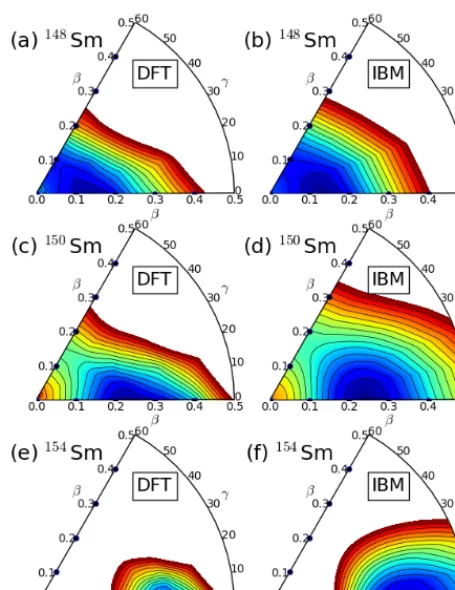
The SCMF calculations are performed to obtain a potential energy surface (PES) for a given set of collective coordi-nates (β, γ). Examples in Fig. 1 show the SCMF PESs for the axially deformed Sm nuclei, which are obtained from the constrained Hartree-Fock+BCS method. The PES for 148Sm exhibits a nearly spherical minimum, typical of the vibrational nucleus. It becomes soft inβandγin150Sm, which is then considered a transitional nucleus. Finally, on the PES for154Sm one sees well defined prolate minimum, indicating that this nucleus is strongly deformed.
Having the SCMF PES for a given deformation (β, γ),
denoted byESCMF(β, γ), for each nucleus, we subsequently map it to the IBM PES, EIBM(β, γ). To be more spe-cific, the IBM Hamiltonian is constructed, i.e., the IBM strengths parameters are determined, so as to reproduce the SCMF surface at each set of (β, γ) as close as possible. We consider the version of the IBM, that distinguishes between neutrons and protons (2) [2]. In the IBM-2, number of neutron (proton) bosons Nν (Nπ) equals
Figure 1.(Color online) The SCMF and mapped IBM PESs for the148,152,154Sm isotopes. The Skyrme-SkM* functional and the
density-dependent zero-range pairing force with strength 1250 MeV fm3 were used. Energy difference between neighbouring
contours is 200 keV.
PES is obtained as the expectation value of a given IBM Hamiltonian in the boson coherent state [13]. The coher-ent state in the IBM-2 is in general defined as the
prod-uct of the neutron λν and proton λπ boson condensates
(Nν!Nπ!)−1/2(λν)Nν(λπ)Nπ|0, whereλ†τ=s†τ+βτcosγτd†τ,0+
βτsinγτ(dτ,†+2+d†τ,−2)/ √
2 (τ=νorπ) and|0is the inert
core, and is parametrized by the deformation parameters
for neutrons and protons, (βν, βπ, γν, γπ), and the Euler
an-glesΩ =(θ1, θ2, θ3) for the relative orientation of the
neu-tron condensate with respect to that of the proton
conden-sate. The (βν, βπ, γν, γπ) deformations could in principle
vary independently but, in realistic cases, introducing all of these variables entails too much complexity. Therefore, and as is usual in the collective model [12], we assume equal deformations of the proton and neutron systems, i.e.,
βν =βπ ≡βBandγν=γπ ≡γB. In addition, the variable
βBin the boson system is proportional toβdeformation in
the collective model, βB = CβwithC being coefficient,
whileγBandγare supposed to be identicalγB =γ. It is
also assumed that the neutron and proton condensates are
aligned, that is,Ω =0. Under these conditions, we equate
the SCMF to the IBM PESs: ESCMF(β, γ) ∼ EIBM(β, γ).
Note that it represents an approximate equality as it is
ful-filled within a limited range of (β, γ) plane, i.e., in the
vicinity of the global minimum. We restrict ourselves to
this range because it is most relevant to the low-energy collective states. On the other hand, one should not try to reproduce the region far from the energy minimum as the topology of the microscopic energy surface around the region is determined by single-nucleon configurations that are, by construction, outside the model space of the IBM consisting of only collective pairs of valence nucleons. For this reason, the IBM PES is, as shown on the right column of Fig. 1, always flat in the region far from the global mini-mum. The topology of the SCMF PES around global min-imum should reflect essential features of fermion many-body systems, such as the Pauli principle, the antisym-metrization, and the underlying nuclear forces. Through
the mapping procedure, these effects are supposed to be
incorporated in the IBM.
The IBM Hamiltonian that embodies the essentials of the underlying nucleonic interactions reads:
ˆ
HB=nˆd+κQˆν·Qˆπ+κLˆ·Lˆ, (1)
where the definitions of each term are found, e.g., in
Refs. [3, 4]. The parameters,κ,χν, andχπ (which
ap-pear in the quadrupole operators ˆQνand ˆQπ), plus the
co-efficient C, are to be fitted to the fermionic PES. Only
the parameterκ should be determined independently of
the other parameters in such a way [4], that a rotational response of nucleonic system, i.e., cranking moment of inertia that is obtained from the SCMF calculation at the equilibrium minimum, be reproduced in the boson system.
Figure 2. (Color online) Experimental and theoretical low-energy levels in Sm isotopes as functions of the neutron number.
Having determined its strength parameters by the above procedure, the resultant IBM Hamiltonian is di-agonalized in the laboratory frame, which provides exci-tation energies and electromagnetic transition rates for a given nucleus. The comparison of the calculated low-lying spectra to the experimental ones in Fig. 2 indicates that the mapped IBM has nicely reproduced the evolution of nuclear structure against the neutron number from nearly spherical vibrational to strongly deformed states.
Figure 1.(Color online) The SCMF and mapped IBM PESs for the148,152,154Sm isotopes. The Skyrme-SkM* functional and the
density-dependent zero-range pairing force with strength 1250 MeV fm3 were used. Energy difference between neighbouring
contours is 200 keV.
PES is obtained as the expectation value of a given IBM Hamiltonian in the boson coherent state [13]. The coher-ent state in the IBM-2 is in general defined as the
prod-uct of the neutron λν and proton λπ boson condensates
(Nν!Nπ!)−1/2(λν)Nν(λπ)Nπ|0, whereλ†τ=s†τ+βτcosγτdτ,†0+
βτsinγτ(dτ,†+2+d†τ,−2)/ √
2 (τ=νorπ) and|0is the inert
core, and is parametrized by the deformation parameters
for neutrons and protons, (βν, βπ, γν, γπ), and the Euler
an-glesΩ =(θ1, θ2, θ3) for the relative orientation of the
neu-tron condensate with respect to that of the proton
conden-sate. The (βν, βπ, γν, γπ) deformations could in principle
vary independently but, in realistic cases, introducing all of these variables entails too much complexity. Therefore, and as is usual in the collective model [12], we assume equal deformations of the proton and neutron systems, i.e.,
βν =βπ ≡βBandγν=γπ ≡γB. In addition, the variable
βBin the boson system is proportional toβdeformation in
the collective model, βB = CβwithC being coefficient,
whileγBandγare supposed to be identicalγB =γ. It is
also assumed that the neutron and proton condensates are
aligned, that is,Ω =0. Under these conditions, we equate
the SCMF to the IBM PESs: ESCMF(β, γ) ∼ EIBM(β, γ).
Note that it represents an approximate equality as it is
ful-filled within a limited range of (β, γ) plane, i.e., in the
vicinity of the global minimum. We restrict ourselves to
this range because it is most relevant to the low-energy collective states. On the other hand, one should not try to reproduce the region far from the energy minimum as the topology of the microscopic energy surface around the region is determined by single-nucleon configurations that are, by construction, outside the model space of the IBM consisting of only collective pairs of valence nucleons. For this reason, the IBM PES is, as shown on the right column of Fig. 1, always flat in the region far from the global mini-mum. The topology of the SCMF PES around global min-imum should reflect essential features of fermion many-body systems, such as the Pauli principle, the antisym-metrization, and the underlying nuclear forces. Through
the mapping procedure, these effects are supposed to be
incorporated in the IBM.
The IBM Hamiltonian that embodies the essentials of the underlying nucleonic interactions reads:
ˆ
HB=nˆd+κQˆν·Qˆπ+κLˆ·Lˆ, (1)
where the definitions of each term are found, e.g., in
Refs. [3, 4]. The parameters,κ,χν, andχπ (which
ap-pear in the quadrupole operators ˆQνand ˆQπ), plus the
co-efficient C, are to be fitted to the fermionic PES. Only
the parameterκ should be determined independently of
the other parameters in such a way [4], that a rotational response of nucleonic system, i.e., cranking moment of inertia that is obtained from the SCMF calculation at the equilibrium minimum, be reproduced in the boson system.
Figure 2. (Color online) Experimental and theoretical low-energy levels in Sm isotopes as functions of the neutron number.
Having determined its strength parameters by the above procedure, the resultant IBM Hamiltonian is di-agonalized in the laboratory frame, which provides exci-tation energies and electromagnetic transition rates for a given nucleus. The comparison of the calculated low-lying spectra to the experimental ones in Fig. 2 indicates that the mapped IBM has nicely reproduced the evolution of nuclear structure against the neutron number from nearly spherical vibrational to strongly deformed states.
3 Structure of even-even Cd isotopes
The even-even Cd isotopes have been traditionally a well-established example for vibrational nuclei. Experimentscarried out more recently, however, identified several
ad-ditional 0+ and 2+ at low energy, and the question as to
whether these states arise from intruder excitation from other major shell has been a long-standing problem. It is then the purpose of Ref. [8] that we addressed this question within the SCMF-IBM calculation that includes intruder configuration in the boson system.
3.1 IBM with configuration mixing
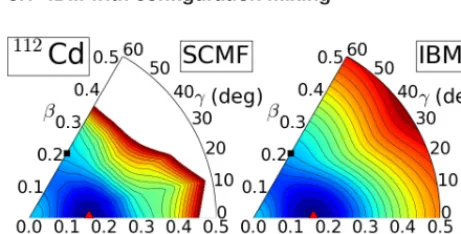
Figure 3. (Color online) Left: The (β, γ) PES for112Cd,
ob-tained from the SCMF calculation using the Skyrme SLy6 EDF with the density-dependent zero-range pairing interaction with the strength 1000 MeV fm3. Right: the corresponding IBM-2
PES. Energy difference between neighbouring contours is 250 keV. The global minimum is indicated by solid triangle, while the local minimum is identified by solid squares.
We draw on the left-hand side in Fig. 3 the (β, γ)
SCMF PES for the112Cd, based on the Skyrme-SLy6 EDF.
For all the considered Cd nuclei, a prolate global
mini-mum is found with moderate axial deformationβ≈0.15.
We also observe on the oblate side (γ≈60◦) a much less
pronounced local minimum betweenβ=0.2 and 0.3.
We then construct from the SCMF result the IBM-2 Hamiltonian that includes configuration mixing. A method to incorporate intruder configuration was pro-posed in Ref. [14], that the different shell-model spaces of 0p−0h, 2p−2h, 4p−4h, . . .excitations be
associ-ated with the corresponding boson spaces comprisingN,
N+2, N +4, . . . bosons, withN being the total boson
numberN = Nπ+Nν, and that the different boson
sub-spaces be subsequently mixed. In most of the configura-tion mixing IBM calculaconfigura-tions, particle-like and hole-like bosons are not distinguished and, as the excitation of a pair
(or boson) increases the boson number by two, the 0p−0h,
2p−2h, etc. configurations differ in boson number by two.
Here we take the doubly-magic nuclei100Sn and132Sn (for
116Cd) as inert cores for the bosons. Also we take into
ac-count up to the 2p−2hintruder excitation of protons across
theZ =50 shell closure. Accordingly,Nπ =1 and 3 for
the normal (i.e., 0p−0h) and intruder (2p−2h)
configu-rations, respectively, while 5≤Nν≤8. The configuration
mixing IBM-2 Hamiltonian is then written as: ˆ
H=Pˆ1Hˆ1Pˆ1+Pˆ3( ˆH3+ ∆) ˆP3+Hˆmix, (2)
where ˆH1( ˆH3) and ˆP1( ˆP3) are the Hamiltonian of and the
projection operator onto the normal and intruder
configu-ration spaces, respectively.∆stands for the energy needed
to promote a proton boson across the shell closure. ˆHmix
in the above equation is the term that is allowed to mix the two configurations.
The coherent state for the configuration mixing IBM is defined as the direct sum of the coherent state for each unperturbed configuration [15]. The bosonic PES is
ob-tained as the lower eigenvalue of the 2×2 coherent-state
matrix. The parameters for the Hamiltonian for each con-figuration are determined by associating the Hamiltonian
with each mean-field minimum, i.e., 0p−0hHamiltonian
for the prolate minimum, and 2p−2hone for the oblate
local minimum, and the energy offset∆and the mixing
strength in ˆHmix are determined so that the energy diff
er-ence between the two mean-field minima and the barrier height for these minima, respectively, are reproduced. On the right-hand side of Fig. 3 we show the mapped IBM-2
PES for112Cd. One notices that the topology of the
corre-sponding SCMF PES in the neighborhood of the minimum is well reproduced by the IBM one.
3.2 Results for the spectroscopic properties
Figure 4 shows the comparison of the predicted and
ex-perimental excitation spectra for108−116Cd. The predicted
energies of the intruder states can be found in those of
the third or higher 0+ states. The SCMF-IBM
calcula-tion does predict the approximately right excitacalcula-tion en-ergies and the dependence on neutron number with the
lowest 0+
3 energy at the mid-shell nucleus114Cd. The
de-scription of the spacing between both 0+states is
overes-timated in108,110Cd, but agrees quite well with experiment
in112−116Cd. However, phenomenological calculations
as-sign for 114Cd the experimental 0+
2 state to the intruder
configuration. Therefore, the energy difference between intruder and normal states is generally overestimated. The predicted normal states are systematically too deformed
as can be seen by the energies of the first 2+, 4+and
espe-cially 6+ states. Experimentally states are observed with
more vibrational energies although there are serious prob-lems with the electric quadrupole transitions.
Phenomeno-logical calculations identified in110−114Cd the 2+
3 state as
the intruder state, while the present calculation yield as
main component the much higher lying 2+
4 state. In
con-trast to the normal states the spacing between the 0+and
2+ intruder states is somewhat large. The description of
the non-yrast states could be improved, e.g., by including higher-order terms in the IBM Hamiltonian.
We have also studied the B(E2) transition rates. The
E2 operator in the consistent-Q formalism [1] has been employed, with the effective charges taken from earlier IBM-2 fitting calculations. In view of the absence of fit-ting the data, there has been good agreement, and
chang-ing trends in the B(E2) values have been well described
[8]. However, we found a few exceptions, mostly
involv-ing the 0+
2, 0+3, 2+2 and 2+3 states as could be expected from
the different nature of these states compared to the phe-nomenological IBM-2 calculations. As an example, the
B(E2; 0+
2 →2+1) are ten times underpredicted in112,114Cd
and ten times overpredicted in116Cd [8]. This confirms
0.0 0.4 0.8 1.2 1.6 2.0 2.4 2.8 3.2
Excitation energy (MeV)
0+ 0+
0+ 2+
2+ 22+
+
(0+)
4+ 4+ 2+
3+ 6+
0+
0+
2+
2+
2+
0+ 3+
4+ 4+ 6+ 2+
108Cd
Expt. IBM
0.0 0.4 0.8 1.2 1.6 2.0 2.4 2.8 3.2
Excitation energy (MeV)
0+
0+
0+ 2+
2+
2+
2+,3+ 3+
4+ 4+
4+ 6+
0+
0+ 2+
2+
2+
0+ 3+
4+ 42+
+ 110Cd
Expt. IBM
0+
4+
(0)3++ 4+ 0+
0.0 0.4 0.8 1.2 1.6 2.0 2.4 2.8 3.2
Excitation energy (MeV)
0+
0+
0+ 2+ 2+
2+ 2+
3+ 4+
4+
4+ 6+
0+
0+ 2+
2+
2+
0+ 3+
4+
2+
112Cd
Expt. IBM
4+
0+ 3+
4+
0+ 2+
0.0 0.4 0.8 1.2 1.6 2.0 2.4 2.8 3.2
Excitation energy (MeV)
0+
0+
0+
2+
2+
2+ 2+
3+ (4)+
4+
4+ 6+
(6)+
0+ 0+ 2+
2+
2+
0+ 3+
4+
4+
2+
114 Cd
Expt. IBM
4+
0+ 2+
3+,44+ 3+
+ 0
+
0+ 2+
0.0 0.4 0.8 1.2 1.6 2.0 2.4 2.8 3.2
Excitation energy (MeV)
0+ 0+
0+
2+ 2+
2+
2+
3+
4+
4+
4+ 6+
0+ 0+
2+
2+
2+
0+ 3+
4+
4+ 2+
2+ 116
Cd
Expt. IBM
4+ 3+
0+
2+ 4+
0+
Figure 4.(Color online) Experimental and predicted excitation spectra for the108−116Cd nuclei. Based on Ref. [8].
normal and intruder states mix, were not satisfactorily de-scribed. Another reason could be that at the SCMF level the prolate minimum, from which the normal states are mainly constructed, was predicted to be too deformed.
Be-sides theB(E2) transitions, an overall reasonable
descrip-tion of the E0 transition rates in the Cd nuclei has also
been obtained (see, Ref. [8]).
4 Octupole correlations in neutron-rich
odd-mass Ba isotopes
Octupole deformation attracts a renowned interest in nu-clear structure, and is also a declared objective of the RIB experiments. In addition, nuclei with octupole deforma-tion are expected to show large electric dipole moment, which would imply the CP violation and thus points to physics beyond the standard model of elementary parti-cles. In Ref. [9] we have extended the SCMF-IBM method to investigated the octupole correlations in neutron-rich
odd-mass Ba isotopes in the mass A ≈ 140 −150
re-gion,where octupole correlation is expected to be most pronounced. In this case, two additional degrees of
free-dom should be introduced to thesd-IBM system: (i)
oc-tupole (f) boson with spin and parityJ =3−; (ii) an
un-paired nucleon (fermion) degree of freedom for describing odd-mass system. For the sake of simplicity, we do not distinguish neutron and proton degrees of freedom, and assume axial symmetry.
4.1 Octupole deformation in even-even nuclei
Figure 5. (Color online) The SCMF (β2, β3) PESs for 142,144,146Ba, obtained with the DD-PC1 functional and a
separa-ble pairing force of finite range. The energy difference between neighbouring contours is 200 keV. Equilibrium minima are iden-tified by open circles. Based on Ref. [9].
Figure 5 depicts the PESs in terms of the
deforma-0.0 0.4 0.8 1.2 1.6 2.0 2.4 2.8 3.2
Excitation energy (MeV)
0+ 0+ 0+ 2+ 2+ 2+ 2+ (0+)
4+ 4+ 2+ 3+ 6+ 0+ 0+ 2+ 2+ 2+ 0+ 3+ 4+ 4+ 6+ 2+ 108Cd Expt. IBM 0.0 0.4 0.8 1.2 1.6 2.0 2.4 2.8 3.2
Excitation energy (MeV)
0+ 0+ 0+ 2+ 2+ 2+
2+,3+ 3+
4+ 4+ 4+ 6+ 0+ 0+ 2+ 2+ 2+ 0+ 3+ 4+ 42+
+ 110Cd
Expt. IBM
0+
4+
(0)3++ 4+ 0+
0.0 0.4 0.8 1.2 1.6 2.0 2.4 2.8 3.2
Excitation energy (MeV)
0+ 0+ 0+ 2+ 2+ 2+ 2+ 3+ 4+ 4+ 4+ 6+ 0+ 0+ 2+ 2+ 2+ 0+ 3+ 4+ 2+ 112Cd Expt. IBM 4+ 0+ 3+ 4+ 0+ 2+ 0.0 0.4 0.8 1.2 1.6 2.0 2.4 2.8 3.2
Excitation energy (MeV)
0+ 0+ 0+ 2+ 2+ 2+ 2+ 3+ (4)+ 4+ 4+ 6+ (6)+ 0+ 0+ 2+ 2+ 2+ 0+ 3+ 4+ 4+ 2+ 114 Cd Expt. IBM 4+ 0+ 2+
3+,44+ 3+
+ 0 + 0+ 2+ 0.0 0.4 0.8 1.2 1.6 2.0 2.4 2.8 3.2
Excitation energy (MeV)
0+ 0+ 0+ 2+ 2+ 2+ 2+ 3+ 4+ 4+ 4+ 6+ 0+ 0+ 2+ 2+ 2+ 0+ 3+ 4+ 4+ 2+ 2+ 116 Cd Expt. IBM 4+ 3+ 0+ 2+ 4+ 0+
Figure 4.(Color online) Experimental and predicted excitation spectra for the108−116Cd nuclei. Based on Ref. [8].
normal and intruder states mix, were not satisfactorily de-scribed. Another reason could be that at the SCMF level the prolate minimum, from which the normal states are mainly constructed, was predicted to be too deformed.
Be-sides theB(E2) transitions, an overall reasonable
descrip-tion of the E0 transition rates in the Cd nuclei has also
been obtained (see, Ref. [8]).
4 Octupole correlations in neutron-rich
odd-mass Ba isotopes
Octupole deformation attracts a renowned interest in nu-clear structure, and is also a declared objective of the RIB experiments. In addition, nuclei with octupole deforma-tion are expected to show large electric dipole moment, which would imply the CP violation and thus points to physics beyond the standard model of elementary parti-cles. In Ref. [9] we have extended the SCMF-IBM method to investigated the octupole correlations in neutron-rich
odd-mass Ba isotopes in the mass A ≈ 140 −150
re-gion,where octupole correlation is expected to be most pronounced. In this case, two additional degrees of
free-dom should be introduced to thesd-IBM system: (i)
oc-tupole (f) boson with spin and parityJ = 3−; (ii) an
un-paired nucleon (fermion) degree of freedom for describing odd-mass system. For the sake of simplicity, we do not distinguish neutron and proton degrees of freedom, and assume axial symmetry.
4.1 Octupole deformation in even-even nuclei
Figure 5. (Color online) The SCMF (β2, β3) PESs for 142,144,146Ba, obtained with the DD-PC1 functional and a
separa-ble pairing force of finite range. The energy difference between neighbouring contours is 200 keV. Equilibrium minima are iden-tified by open circles. Based on Ref. [9].
Figure 5 depicts the PESs in terms of the
axially-symmetric quadrupole β2 and octupole β3
deforma-0.0 0.4 0.8 1.2 1.6 2.0 2.4
Excitation energy (MeV)
2+ 4+ Theory Experiment 144Ba 6+ 8+ 1 -3 -5 -7 -9 -0+ 2+ 4+ 6+ 8+ 0+ 1 -3 -5 -7 -9
-48 48.44+1-3
48+25-34
<106 <139 85.7(2) -1 54.4(2) 71+2 65 64 56 23 35 33 37 27
Figure 6. (Color online) Low-energy positive- and negative-parity spectra of the even-even boson core nuclei142,144,146Ba.
TheB(E2) (numbers along arrows within each band) andB(E3) (inter-band, dashed arrows) values are given in Weisskopf units. Experimental values are taken from Ref. [16].
tions, computed by the constrained relativistic
Hartree-Bogoliubov method [10]. For142Ba the equilibrium
min-imum is found on theβ3 = 0 axis, indicating that it has
a weakly-deformed quadrupole shape. In144,146Ba a
mini-mum with non-zeroβ3deformation (β≈0.1) appears. The
minimum is not very pronounced and is rather soft in the
β3direction, suggesting the occurrence of octupole
vibra-tional states in these nuclei.
The excitation spectra and transition rates for the octupole-deformed nuclei are computed by diagonalizing
the IBM Hamiltonian comprisingJ =0+(s), 2+(d), and
3− (f) boson degrees of freedom, which is determined
from the SCMF (β2, β3) PES. As an example, the
low-energy level scheme for the144Ba isotope is displayed in
Fig. 6. In general, the theoretical predictions are in good agreement with the experimental results [16], not only for
the excitation energies but also for theE2 andE3
transi-tion strengths. We note the very low-lying negative-parity band, which conforms to the results that the corresponding
SCMF PES in Fig. 5 exhibits a rather pronouncedβ3 0
minimum, when compared to the one for142Ba. A rather
large valueB(E3; 3−→0+) is predicted for the144Ba
nu-cleus, but is still considerably smaller than the experimen-tal value [16]. Note, however, the large uncertainty of the latter.
4.2 Particle-boson coupling
In order to compute the spectroscopy of the odd-mass nu-clei, we resort to the method developed in Ref. [17], that is based on the SCMF calculation and the particle-core cou-pling. Here the even-even core is described by the IBM, and the interaction between the odd particle and the even-even boson core is modelled in terms of the interacting boson-fermion model (IBFM) [18]. The Hamiltonian of
the IBFM is composed of the IBM Hamiltonian ˆHB, the
Hamiltonian for a single fermion ˆHF, and the Hamiltonian
ˆ
HBFthat couples fermion and boson spaces:
ˆ
HIBFM=HˆB+HˆF+HˆBF. (3)
The single-fermion Hamiltonian HˆF =
jj(−2j+1)(a†ja˜j)(0), where j is the single-particle
energy for the orbital j. For the sake of simplicity, we
present the form of the Hamiltonian ˆHBFwithinsd-IBFM.
Based on the generalized seniority scheme, the following
three terms of ˆHBFhave been shown to be most essential
to the low-lying spectra in odd-mass nuclei [18]:
Γ0 j j
γj jQˆB·(a†ja˜j)(2) (4)
−2Λ0
j jj
5
2j+1βj jβjj : ((d†a˜j)(
j) (a†
jd˜)(j )
)(0):
(5)
−A0
j
2j+1(a†ja˜j)(0)nˆd. (6)
The first, second and third terms are referred to as the dynamical quadrupole, exchange, and monopole interac-tions, respectively. The quantitiesγj j=(ujuj−vjvj)Qj j andβj j =(ujvj+vjuj)Qj j, are given in terms of the
oc-cupation probabilitiesujandvjfor the orbital j(satisfying
u2
j +v2j = 1) and the matrix element of the quadrupole
operator in the single-particle basisQj j=j||Y(2)||j.Γ0,
Λ0, andA0denote strength parameters. The single-particle
energiesjand occupation numbersv2jare computed fully
microscopically by the SCMF calculation constrained to zero deformation [17]. The three strength parameters of
ˆ
HBF, i.e.,Γ0,Λ0, andA0, are considered free parameters,
and are fitted to reasonably reproduce experimental
low-lying levels in a given nucleus. For thesd f-IBFM system,
we have derived similar formulas to those in Eqs. (4)–(6) from the generalized seniority scheme. More details can be found in Ref. [9].
4.3 Excitation spectra for the odd-mass nucleus
Experimental information is available for the isotope
145Ba, that is enough to compare with the theoretical
pre-diction. Since the corresponding even-even boson core
nucleus 144Ba exhibits an octupole-soft potential at the
SCMF level (cf. Fig. 5), we also expect that octupole cor-relations play an important role in the low-energy spectra of this odd-mass nucleus. In Fig. 7 the calculated
excita-tion spectrum for145Ba is compared to the experimental
bands available in [19]. The bands built on the 3/2−1, 5/2−2,
and 5/2+
1 states are predicted, and it would be interesting
if they can be confirmed by experiments. The lowest two
π = −1 bands in145Ba are built on the 5/2−1 and 7/2−1
states, which are characterized by the coupling of the
un-paired neutron in the 1h9/2single-particle orbital to thesd
boson space. The lowestπ= +1 state 9/2+
1 is described by
the coupling of the 1i13/2orbital tosd-boson states.
The theoretical negative-parity band built on the 15/2−
4 state (calculated at 1167 keV) is dominated by the
cou-pling of the 1i13/2 single-particle orbital to states with
one f-boson. Theoretically the 15/2−
0.0 0.4 0.8 1.2 1.6 2.0 2.4
Excitation energy (MeV)
5/2-1 9/2 -1
Theory Experiment
145Ba
9/2+
19/21
-13/21- 13/2
+11/2(+)
13/2+1 11/2
-17/2 -1
17/2+
17/2+1 21/2+1
25/2+1
9/2+
2 21/2-1
11/21
-5/2+1 13/2+2 15/21
-7/21- 7/2
-9/2
-5/2
-13/2
-15/2
-17/2
-19/2
-21/2
-15/2(+)
21/2+
19/2(+)
25/2+
(23/2+)
9/23 -23/2-1
19/2+1
11/22 -15/2-2
5/2 -2 13/2
-3
9/22 -13/2-2
15/2-4
19/2
-2
17/2-2 (15/2-)
7/2-2 3/21
-19/2(-) 23/2(-)
9/2 -13/2
-17/2
-(21/2-) 23/2+1
15/2+1
11/2+1 7/2+1
9/2+1 19/23
-21/23
-17/2-3
Figure 7. (Color online) Theoretical and experimental [19] en-ergy spectra for the nucleus145Ba. Those theoretical levels that
are suggested to contain onef boson, as well as the experimen-tally suggested octupole bands, are marked as thick lines.
be an octupole state and is located close to the experi-mental 15/2− state found at 1226 keV [19]. Moreover, rather strong E3 transitions from the Jπ = 15/2−
4 band to the corresponding low-lying positive-parity bands are predicted: for instanceB(E3; 15/2−
4 → 9/2+1) = 25 and B(E3; 19/2−
2 → 13/2+1)=31 (in W.u), comparable to the B(E3; 3−
1 → 0+1) value of 23 W.u. in the even-even core nucleus144Ba. To verify model predictions experimental information on theB(E2) andB(E3) values is needed.
5 Summary
I have presented a method of deriving the IBM Hamil-tonian based on the SCMF framework. The constrained SCMF calculation with a given EDF is performed to ob-tain the PES in terms of the relevant collective coordi-nates. The SCMF PES is then mapped onto the expec-tation value of the IBM Hamiltonian in the boson co-herent state. This procedure completely determines the strength parameters of the IBM, and the diagonalization of the mapped IBM Hamiltonian provides excitation spec-tra and spec-transition probabilities. Two recent applications of the method are highlighted, that involve the configu-ration mixing of normal and intruder states, the octupole deformation, and the odd nucleon degree of freedom. As the EDF framework, on which the mapping procedure is built, provides a global and reliable mean-field description of intrinsic properties of nuclei, it has been made possi-ble to determine the IBM Hamiltonian for arbitrary nuclei, starting only from the nucleonic degrees of freedom. This points to a crucial step toward the microscopic foundation of the IBM within a unified theoretical framework. In ad-dition, both theoretical approaches, i.e., IBM and DFT, can
be complementary to each other, in such a way that the lat-ter gives microscopic input with the former, and the former facilitates spectroscopic calculations, which are, from both computational and methodological points of view, highly demanding with the latter approach. On the practical side, contrary to the conventional IBM studies, using the present method we have gained the capability of predicting the spectroscopic properties of nuclei in an accurate, system-atic, and mathematically simple way. This opens up a new possibility to study heavy exotic nuclei that are now under rigorous investigations at RIB facilities around the world.
The results reported here are based on the works with J. Jolie, T. Nikši´c, T. Otsuka, N. Shimizu, and D. Vretenar. This work is financed within the Tenure Track Pilot Programme of the Croa-tian Science Foundation and the École Polytechnique Fédérale de Lausanne and the Project TTP-2018-07-3554 Exotic Nuclear Structure and Dynamics, with funds of the Croatian-Swiss Re-search Programme.
References
[1] F. Iachello, and A. Arima, The interacting bo-son model(Cambridge University Press, Cambridge, 1987)
[2] T. Otsuka, A. Arima, and F. Iachello, Nucl. Phys. A
309, 1 (1978)
[3] K. Nomura, N. Shimizu, and T. Otsuka, Phys. Rev. Lett.101, 142501 (2008)
[4] K. Nomura et al., Phys. Rev. C83, 041302 (2011) [5] K. Nomura, N. Shimizu, D. Vretenar, T. Nikši´c, and
T. Otsuka, Phys. Rev. Lett.108, 132501 (2012) [6] K. Nomura et al., Phys. Rev. C89, 024312 (2014) [7] K. Nomura et al., J. Phys. G43, 024008 (2016) [8] K. Nomura, and J. Jolie, Phys. Rev. C 98, 024303
(2018)
[9] K. Nomura, T. Nikši´c, and D. Vretenar, Phys. Rev. C
97, 024317 (2018).
[10] D. Vretenar et al., Phys. Rep.409, 101 (2005) [11] M. Bender et al., Rev. Mod. Phys.75, 121 (2003) [12] A. Bohr, and B. R. Mottelson, Nuclear Structure
(Benjamin, N.Y., 1975)
[13] J. N. Ginocchio and M. W. Kirson, Nucl. Phys. A
350, 31 (1980).
[14] P. D. Duval and B. R. Barrett, Phys. Lett. B100, 223 (1981).
[15] A. Frank et al., Phys. Rev. C69, 034323 (2004). [16] B. Bucher et al., Phys. Rev. Lett.116, 112503 (2016) [17] K. Nomura et al., Phys. Rev. C93, 054305 (2016). [18] F. Iachello, and P. Van Isacker, The Interacting
Boson-Fermion Model(Cambridge University Press, Cambridge, England, 1991).


![Figure 7. (Color online) Theoretical and experimental [19] en-ergy spectra for the nucleus 145Ba](https://thumb-us.123doks.com/thumbv2/123dok_us/7989322.1325942/6.625.56.287.79.242/figure-color-online-theoretical-experimental-ergy-spectra-nucleus.webp)
