1 INTRODUCTION 1
Efficient Implementation of Password-Based
Authenticated Key Exchange from RLWE and
Post-Quantum TLS
Xinwei Gao
1, Jintai Ding
2, Lin Li
1, Saraswathy RV
2, Jiqiang Liu
1(Corresponding author: Jintai Ding, Lin Li)
Beijing Key Laboratory of Security and Privacy in Intelligent Transportation, Beijing Jiaotong University1
No.3 ShangYuanCun, Haidian District, Beijing, 100044, P.R.China Department of Mathematical Sciences, University of Cincinnati2
French Hall, 2815 Commons Way, Cincinnati, Ohio 45219, United States (Email: [email protected]; [email protected])
(Received Apr. 20, 2012; revised and accepted July 5, 2012)
Abstract
Two post-quantum password-based authenticated key ex-change (PAKE) protocols were proposed at CT-RSA 2017. Following this work, we give much more efficien-t and porefficien-table C++ implemenefficien-taefficien-tion of efficien-these efficien-two tocols. We also choose more compact parameters pro-viding 200-bit security. Compared with original im-plementation, we achieve 21.5x and 18.5x speedup for RLWE-PAK and RLWE-PPK respectively. Compare with quantum-vulnerable J-PAKE protocol, we achieve nearly 8x speedup. We also integrate RLWE-PPK into TLS to construct a post-quantum TLS ciphersuite. This allows simpler key management, mutual authentication and resistant to phishing attack. Benchmark shows that our ciphersuite is indeed practical.
Keywords: Authenticated Key Exchange; Implementa-tion; Post-quantum; RLWE; TLS
1
Introduction
1.1
Key Exchange and Post-Quantum
World
With the groundbreaking work “New Directions in Cryp-tography” from Diffie and Hellman in 1976 [10], the idea of key exchange (KE) and public key cryptography come into reality. Key exchange is a very important crypto-graphic primitive. With properly designed protocols, two or more parties can agree on same session key for message or data encryption using symmetric encryption algorithm-s over adveralgorithm-sary-controlled network. Well known proto-cols including Diffie-Hellman key exchange (DH), elliptic curve DH (ECDH) etc. However, these protocols can-not authenticate user’s identity, i.e., man-in-the-middle
(MITM) attack can compromise the security of communi-cation. Authenticated key exchange (AKE) is a solution to this problem. AKE protocols can negotiate key and authenticate identity of communicating parties simulta-neously. Well studied protocols including HMQV [21], authenticated DH etc. As long as each party has cer-tified public key, two parties can use various explicit or implicit authentication mechanisms to verify the identity of communicating party. The widely-deployed approach is combining unauthenticated key exchange with digital signatures and trusted certificates. This is also known as Public Key Infrastructure (PKI)-based authentication.
[28] and patented protocols like Encrypted Key Exchange (EKE) [7], Simple Password Exponential Key Exchange (SPEKE) [19] etc. Also OpenSSL supports J-PAKE and Firefox Sync service adopted J-PAKE for authentication and key exchange [3]. Some other works related to key exchange include [13], [23], [14] etc.
With the advent of quantum computers during past decades, people have realized the untapped potential from quantum computers and huge threats to current crypto-graphic constructions, especially public key algorithms. Two best-known attacks from quantum computers are Shor’s algorithm [26] and Grover’s algorithm [16]. Shor’s quantum algorithm is widely conjectured to be effective a-gainst all mainstream public-key algorithms that designed based on integer factorization problem, discrete logarithm problem etc., including RSA, Diffie-Hellman and elliptic curve-based ones. If large quantum computer exists, it is believed that most public key algorithms can be bro-ken very efficiently. For Grover’s quantum algorithm, it attacks symmetric encryption algorithms. Result shows thatn-bit key providesn/2-bit security on quantum com-puters. Quantum brute force can be defeated by doubling key size without switching to new algorithms. Larger key size works for symmetric and hash algorithms but curren-t public key algoricurren-thms will be broken regardless of key size. In 2017, D-Wave 2000Q quantum computer break-s the 2000-qubit barrier. Debreak-spite there are controverbreak-siebreak-s around D-Wave on whether they are building truly quan-tum computer or not, they show the potential of building practical and very powerful quantum computers within coming years. In 2015, National Security Agency (N-SA) announced plan to switch to quantum-resistant cryp-tography in near future. At PQCrypto 2016 conference, NIST announced their call for quantum-resistant crypto-graphic algorithms for future and plans for post-quantum cryptography standards. Therefore, it is imperative to build quantum-resistant and efficient algorithms, imple-mentations and gain real-world deployment.
1.2
Contributions
In this paper, we first present a very efficient implemen-tation of two RLWE-based post-quantum password-based authenticated key exchange protocols proposed at CT-RSA 2017 (denoted as PAKE17) [11]. We also choose more compact parameters providing at least 200-bit secu-rity. Our implementation achieve 21.5x and 18.5x per-formance improvement over original implementation of RLWE-PAK and RLWE-PPK protocol respectively. We also compare performance with J-PAKE, which is de-ployed in real-world applications but vulnerable to quan-tum computers. Our implementation is more efficien-t and achieves 8.5x and 7.4x speedup for RLWE-PAK and RLWE-PPK respectively. Benchmark proves that our work is indeed efficient, which is even faster than current widely deployed and quantum-vulnerable PAKE protocol. Our implementation is a portable C++ implementation and does not rely on new instruction set (e.g., AVX2) to
achieve high performance.
Second, we introduce a post-quantum TLS ciphersuit-e and prciphersuit-esciphersuit-ent our proof-of-concciphersuit-ept implciphersuit-emciphersuit-entation. Wciphersuit-e integrate our efficient RLWE-PPK implementation into TLS ciphersuite in a similar way as pre-shared key ci-phersuites. Pre-shared password in RLWE-PPK in this context is a pre-shared key. Advantages of our cipher-suite more convenient key management compared with PKI-based authentication, resistant to phishing attacks and mutual authentication. Benchmark of our implemen-tation shows that our post-quantum TLS ciphersuite is truly practical.
1.3
Organization
We recall necessary background knowledge in section 2. In section 3, we revisit PAKE17 protocol and introduce new parameter choice with security level estimation, much more efficient implementation, comparison with original work and analysis. In section 4, we introduce our post-quantum TLS ciphersuite based on RLWE-PPK, proof-of-concept implementation, performance and discussions. We conclude the paper in section 5.
2
Preliminary
2.1
Post-Quantum Cryptography
Due to Shor’s algorithm, major public key cryptosystem-s nowadaycryptosystem-s (RSA, Diffie-Hellman, ECDH etc.) are no longer secure when large quantum computer is available. Constructions built on these hard problems: integer fac-torization problem, discrete logarithm problem or elliptic-curve discrete logarithm problem can be broken on suf-ficient large quantum computer. Although it is hard to predict the exact time that efficient quantum computers can be built, most scientists believe that they will be built within decades.
Post-quantum cryptography refers to designing and building cryptosystems that can resist attacks from quan-tum computers. Generally, quanquan-tum-resistant cryptosys-tems can be achieved by these approaches: lattice-based, multivariate-based, hash-based, code-based and symmet-ric ciphers with larger key size. In this paper, we focus on lattice-based ones since they have strong provable se-curity, high efficiency, simple structure and much smaller key sizes compared with other approaches. A lattice is a set of points in an n-dimensional space with periodic structure. The latticeL(b1,· · ·, bn) =P
n
3 EFFICIENT PAKE17 IMPLEMENTATION 3
cryptosystem is one of the most promising constructions for post-quantum world.
2.2
Learning with Errors and Ring
Vari-ant
In 2005, Oded Regev showed a problem called Learning with Errors (LWE) [25]. LWE is proven to be as hard as solving several worst-case lattice problems when LWE instances are properly initiated. Regev and Peikert [24] showed both quantum and classical reductions from LWE to standard lattice problems. Properly chosen error term keeps LWE problem very hard to solve. Decision version of LWE is to distinguish truly uniform generated samples from bi =ai·s+ei, where s is secret key, ei is the er-ror term. Typically, s and ei are sampled from discrete Gaussian distribution,aiis uniformly random generated. Search version is to recover secret sgiven multiple LWE samples. If one can solve LWE problem, then underly-ing lattice problem can be solved as well due to reduction theorem. Till now, there are no public known efficient al-gorithms (both on classical and quantum computers) that can solve lattice problems.
Ring Learning with Errors (RLWE) problem [22] is the analogue of LWE in ring setting. The hardness of RLWE can be reduced to hard problems in ideal lattice. Compared with LWE, main attraction of RLWE problem mainly lies on its high efficiency since schemes based on RLWE reduces quadratic overhead in LWE. Solving RL-WE problem can be reduced to finding shortest or closest vectors in ideal lattice. Until now, there are no efficient attacks that especially takes advantage of the ring struc-ture, therefore attacks work for LWE may also work for RLWE.
LWE and RLWE are extremely versatile with available cryptography constructions including encryption, signa-ture, key exchange, identity-based encryption, attribute-based encryption, function encryption, homomorphic en-cryption etc.
3
Efficient PAKE17
Implementa-tion
In this section, we first briefly revisit the password-based authenticated key exchange proposed at CT-RSA 2017 in [11]. Two protocols in PAKE17 can be regarded as RLWE analogues of classical PAK and PPK protocol. Second, we introduce our efficient and portable C++ implementation for both three-pass explicit authenticated key exchange protocol (RLWE-PAK) and two-pass implicit authenti-cated key exchange protocol (RLWE-PPK). We also give more compact parameter choice, analysis of security lev-el, efficient implementation, benchmark and comparisons with original work and J-PAKE protocol.
3.1
Revisit PAKE17
PAKE17 can be categorized to an important line of AKE protocols that takes advantage of human-memorable pass-word to achieve authentication. Since only communicat-ing parties share same password (or equivalents), it can be utilized to construct password-based AKE protocols. To the best of our knowledge, only [20] and PAKE17 pro-vide post-quantum PAKE solutions. [20] can be viewed as a general lattice-based construction but it is based on Common Reference String (CRS). CRS-based protocols are more complex and weaker in security proofs. PAKE17 is based on Random Oracle Model (ROM) and this work gives two RLWE-based PAKE protocols: RLWE-PAK and RLWE-PPK. This work follows the idea and structure of PAK & PPK [9] but they are constructed based on RL-WE key exchange of [12] (denoted as DING12). They also prove the security of both protocols following [3] with new techniques to adapt to RLWE setting. Proof-of-concept implementation shows that two protocols in PAKE17 are efficient. This is the first work that gives practical and provably secure RLWE-based PAKE constructions.
Figure 1 recalls three-pass explicit authenticated pro-tocol RLWE-PAK:
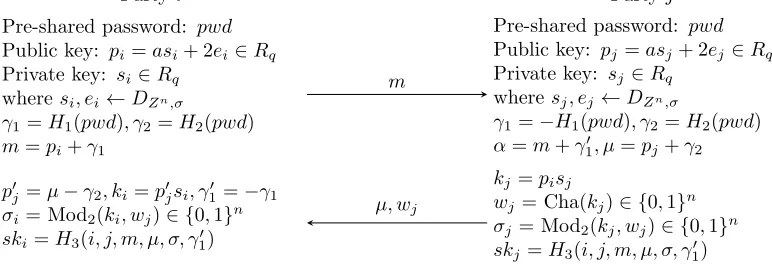
Figure 2 recalls two-pass implicit authenticated proto-col RLWE-PPK:
3.2
New Parameter Choice and Security
Estimation
We first choose new and more compact parameters for PAKE17 considering correctness, security and implemen-tation efficiency. Parameters are given as follows: We choose primeq= 1073479681 (approximately 30 bits). q
can ensure the correctness of PAKE17 by following the-orem 3 in section 3.2 of PAKE17 and it holds q ≡ 1 mod 2nthat can realize NTT efficiently. We also remark that our prime p choice is more compact than original work (modulusq= 232−1 and it is not a prime). n= 1024 and standard deviationσ= 8/√2π≈3.192 are identical to original work.
We also analyze security level of our parameter choice. We use LWE estimator proposed in [6] to get security level of our parameter choice. LWE estimator gives a thorough security estimation for both LWE and RLWE-based cryp-tosystems. It evaluates security level of cryptosystem-s by computing attack complexity of exhaucryptosystem-stive cryptosystem-search, coded Blum-Kalai-Wassermann algorithm (BKW), lattice reduction, decoding, reducing BDD to unique-SVP, stan-dard and dual embedding attacks etc. This estimation ap-proach is considered as one of the most standardized and complete security estimation tool for LWE and RLWE-based cryptosystems. Authors of [6] also suggested it can be used to evaluate RLWE instances since no known at-tacks take advantage of ring structure.
Partyi Party j
Pre-shared password: pwd
Public key: pi=asi+ 2ei∈Rq Private key: si∈Rq
wheresi, ei←DZn,σ γ=H1(pwd), m=pi+γ
Pre-shared password: pwd
Public key: pj =asj+ 2ej ∈Rq Private key: sj ∈Rq
wheresj, ej←DZn,σ γ0=−H
1(pwd)
ki=pjsi, γ0=−γ
σi = Mod2(ki, wj)∈ {0,1}n Abort ifk6=H2(i, j, m, pj, σ, γ0) Elsek0=H3(i, j, m, pj, σ, γ0)
p0
i=m+γ0, kj =p0isj
wj = Cha(kj)∈ {0,1}n
σj= Mod2(kj, wj)∈ {0,1}n
k=H2(i, j, m, pj, σ, γ0)
k00=H3(i, j, m, pj, σ, γ0)
ski=H4(i, j, m, pj, σ, γ0)
Abort ifk06=k00
skj =H4(i, j, m, pj, σ, γ0)
pi
pj, wj, cj
k0
Figure 1: Explicitly authenticated PAKE17 protocol: RLWE-PAK
Partyi Party j
Pre-shared password: pwd
Public key: pi=asi+ 2ei∈Rq Private key: si∈Rq
wheresi, ei←DZn,σ
γ1=H1(pwd), γ2=H2(pwd) m=pi+γ1
Pre-shared password: pwd
Public key: pj =asj+ 2ej ∈Rq Private key: sj ∈Rq
wheresj, ej←DZn,σ
γ1=−H1(pwd), γ2=H2(pwd)
α=m+γ10, µ=pj+γ2
p0j =µ−γ2, ki=p0jsi, γ10 =−γ1 σi = Mod2(ki, wj)∈ {0,1}n
ski=H3(i, j, m, µ, σ, γ10)
kj =pisj
wj = Cha(kj)∈ {0,1}n
σj= Mod2(kj, wj)∈ {0,1}n
skj =H3(i, j, m, µ, σ, γ10) m
µ, wj
Figure 2: Implicitly authenticated PAKE17 protocol: RLWE-PPK
• load(“https://bitbucket.org/malb/lwe-estimator/raw/HEAD/estimator.py”)
• n, alpha, q = 1024, alphaf(8, 1073479681), 1073479681
• set verbose(1)
• = estimate lwe(n, alpha, q, skip=[“arora-gb”])
We remark that our approach is the same as [8]. With above estimation approach, our parameter choice offers at least 200-bit security. Since LWE estimator is constantly updated, our result might slightly different from estima-tion using latest version of LWE estimator script.
3.3
Implementation and Performance
We use NFLlib library [4] to implement RLWE-PAK and RLWE-PPK protocols. NFLlib is a very efficient Number Theoretic Transform (NTT)-based C++ library dedicat-ed to RLWE-basdedicat-ed cryptography implementation. It con-tains various algorithms and programming optimizations for lattice cryptography. NTT, inverse-NTT and sam-pling from discrete Gaussian operations are very efficient.
For fast polynomial multiplication, we adopt NTT and in-verse NTT since our parameterqis chosen to instantiate NTT efficiently. Note that NFLlib provides non-constant time implementation and takes advantage of SSE/AVX2 instruction set to optimize NTT and inverse NTT com-putation.
Our choice for hash function is SHA3-256. We also utilize an extendable-output function (XOF) in our implementation-SHAKE-128. In RLWE-PAK, we have H1 = SHAKE-128(pwd,4096), H2 = SHA3-256(C, S, m, µ, σ, γ0). In RLWE-PPK, we have H1 = SHAKE-128(pwd,4096), H2 = SHAKE-128(SHA3-256(pwd),4096), Hi = SHA3-256(Hi−1) (i = 3,4). We
safely set statistical distance from sampled distribution to discrete Gaussian distribution as 2−128 to preserve high statistical quality and security. More implementa-tion techniques are introduced in secimplementa-tion 3.4. For Cha() and Mod2(), since input is an polynomial inRq, we take each coefficient in the polynomial and compute its corre-sponding value.
64G-3 EFFICIENT PAKE17 IMPLEMENTATION 5
B memory running 64-bit Ubuntu 14.04. Both PAKE17 implementations are compiled by g++ version 4.8.4 with ’-O3 -fomit-frame-pointer -march=native -m64’ options to achieve maximum performance. Note that this CPU does not support AVX2 instruction set, therefore the per-formance of our implementation only benefits from SSE instruction set. Recall that the only difference between our parameter choice and PAKE17 is modulusqsince we choose same dimension n and standard deviation σ for sampling.
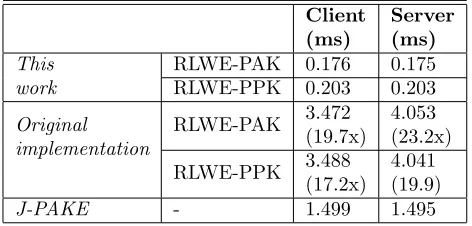
We also compare performance of our implementation with J-PAKE, which is known to be vulnerable to quan-tum computers. J-PAKE implementation we use is lat-er integrated in OpenSSL and is compiled by gcc vlat-ersion 4.8.4 with ’-O3 -fomit-frame-pointer -march=native -m64’ options. All implementation codes only runs on single core and does not utilizes parallel computing mechanism-s. We report average runtime over 10,000 executions of our implementation, original work and J-PAKE in Table 1:
Table 1: Performance of this work, original PAKE17 and J-PAKE implementation
Client (ms)
Server (ms)
This work
RLWE-PAK 0.176 0.175 RLWE-PPK 0.203 0.203
Original implementation
RLWE-PAK 3.472 (19.7x)
4.053 (23.2x)
RLWE-PPK 3.488 (17.2x)
4.041 (19.9)
J-PAKE - 1.499 1.495
Number in parentheses is number of times of corre-sponding runtime for original implementation compared with this work as baseline. Our implementation achieves 21.5x and 18.5x speedup over original implementation for both RLWE-PAK and RLWE-PPK. Compared with J-PAKE, our implementation is 8.5x and 7.4x faster for RLWE-PAKE and RLWE-PPK respectively. This result highlights that our post-quantum PAKE implementation is much more efficient and even much faster than lega-cy PAKE protocol implementation that is vulnerable to quantum computers.
3.4
Discussion
Compared with original PAKE17 implementation, we be-lieve following improvements and optimizations make this work much more efficient:
1) Efficiency from NFLlib library. We use this library to implement major functions related to PAKE17 and this contributes to good performance. NT-T, inverse-NTT and sampling computation costs 0.008ms, 0.010ms, and 0.011ms respectively and they
are 48x, 45.6x and 13.9x faster than original imple-mentation. There are 2 sampling, 2 NTT and 1 in-verse NTT computation operations for RLWE-PAK and RLWE-PPK for both party i and j. NTT and inverse NTT functions take advantage the power of SSE instruction set, therefore it is much more effi-cient. In original work, they use NTL library which is much slower than NFLlib (performance compar-ison of NFLlib and NTL can be found in [4]). In original work, they adopted FFT for polynomial mul-tiplication and implementation of discrete Gaussian sampler is less efficient. NTT, inverse-NTT and sam-pling take up around 25% of total running time in our implementation.
2) We adopt a much smarter hashing strategy combined with efficient hashing implementation. We choose SHA3-256 as hash function and SHAKE-128 as X-OF. These efforts deliver much faster hashing com-putations. In original implementation, when adding hashed value γ = H(pwd) to public key pi (m =
pi+γ), they hash a long and randomly generated number using SHA2-256 for 2561024/32 = 128 rounds. Since SHA2-256 has 256-bit output and each coeffi-cient of polynomial takes up 32-bit, therefore in each SHA2-256 hashing computation round, 256
32 = 8
poly-nomial coefficients are generated. By repeating 128 times, all 1024 coefficients are derived. We use an alternative and more efficient approach to achieve this. Since output of SHAKE family functions can be extended to any desired length, we adopt SHAKE-128 and extend the output to 4096 bytes to ini-tiate 1024 polynomial coefficients. In our efficien-t implemenefficien-taefficien-tion, generaefficien-te γ = H(pwd )=SHAKE-128(pwd,4096) only costs 0.027ms. There is 1 γ
computation and 2 γ computations in RLWE-PAK and RLWE-PPK respectively. In original work, it costs total of 1.578ms and 3.125ms to generate γ
for RLWE-PAK and RLWE-PPK respectively, which take up more than 50% of total running time. Our approach is much faster than original implementation by 58.4x (0.027ms) and 57.9x (0.054ms) for RLWE-PAK and RLWE-PPK respectively. Since γ compu-tation is very costly, our approach has a significant improvement over original implementation. γ com-putation takes up around 20% of total running time in our implementation.
3) We avoid slower multiplication, division and modular operations by make full use of bitwise operations to boost performance. We also make full use of macros and various programming techniques to reduce un-necessary overhead, expensive memory copy opera-tions etc. to improve efficiency. All these approaches also contribute to the efficiency of our implementa-tion.
of new instruction sets (e.g., AVX2) to speedup perfor-mance, therefore our implementation is portable and can run on more outdated devices.
We note that most time-consuming computation of our PAKE17 implementation is hashing six-tuple (i, j, m, µ, σ, γ0) using SHA3-256 since they take up more than 8KB of storage. Hashing this tuple costs more time compared with other operations. It costs 0.077ms which takes up 43.75% and 36.95% of total running time for RLWE-PAK and RLWE-PPK respectively.
We believe that PAKE17 and our implementation are indeed practical for post-quantum world.
4
Post-quantum TLS Ciphersuite
and Implementation
We construct our post-quantum TLS ciphersuite by in-tegrating RLWE-PPK into TLS. It can be regarded as a post-quantum variant of DHE PSK and ECDHE PSK. We build our ciphersuite based on DHE PSK in TLS v1.2 and adapt the notion of password in RLWE-PPK to a key for symmetric encryption which is also pre-shared by two parties (same as definition of PSK in DHE PSK). Advantages of TLS and PAKE are well-inherited and in-tegrated in our ciphersuite, including easier key manage-ment (without PKE-based certificates), mutual authenti-cation, better performance (efficient implementation and no signatures), anti-phishing attack, simplified message flow (inherit from TLS and RLWE-PPK) etc. We intro-duce cryptographic primitive combination of our cipher-suite, implementation based on Botan open source C++ library, benchmarks and discussions.
4.1
Introduction
TLS is designed to ensure secure communications over adversary controlled network, providing secrecy and da-ta integrity between two communicating parties. TLS is consisted with two major components: handshake proto-col and record protoproto-col. In handshake protoproto-col, two par-ties negotiate and establish secure connection. In record protocol, two parties transmit encrypted and authenti-cated data securely. TLS is widely deployed in real world with applications like HTTPS (HTTP over TLS), IMAPS (IMAP over TLS), SMTPS (SMTP over TLS) etc. and it has already comprised more than half of total web traf-fic. It supports various methods for key exchange (Diffie-Hellman and elliptic curve variant, RSA etc.), authen-tication (pre-shared key, RSA, ECDSA etc.), encryption (AES, stream ciphers etc.) and message authentication code (MAC) algorithms. Two parties can agree on a pre-master key using various key exchange algorithms. Other keys are generated through premaster key. For authenti-cation, certificates and signatures are more preferred and widely deployed.
As TLS is so important and we are moving into a post-quantum world, we consider TLS should also
adop-t posadop-t-quanadop-tum crypadop-tographic primiadop-tives. However, ci-phersuites in the latest version of TLS fail to meet the demands since available key exchange and signature al-gorithms can be broken by quantum computers. Recent-ly, a project called “Open Quantum Safety” (OQS) was launched [27]. It provides prototype open-source software implementation which integrate several unauthenticated post-quantum key exchange protocols into TLS. By com-bining post-quantum key exchange and classical signa-tures (RSA, ECDSA etc.), OQS project suggests several post-quantum TLS ciphersuites. Google did experiments on integrating a post-quantum key exchange into Chrome browser in canary channel and few Google domain TL-S servers with ciphersuite called “CECPQ1” [2]. These works show that post-quantum cryptographic primitives are very promising for real-world applications.
4.2
Our Post-Quantum TLS Ciphersuite
Project OQS and Google’s effort are based on adopting u-nauthenticated key exchange protocol with RSA/ECDSA signature to achieve authentication. We want to achieve authentication in a way that discards quantum-insecure signatures. Authenticate two parties using pre-shared key is a very practical and efficient approach as point-ed out in [15]. In TLS v1.2, there are various cipher-suites that supports authentication using pre-shared key (PSK), where PSK is a pre-shared symmetric key for en-cryption and authentication. PSK ciphersuites including standalone PSK, DHE PSK (Diffie-Hellman ephemeral for key exchange+PSK for authentication, ECDHE PSK (elliptic curve DHE+PSK), RSA PSK (RSA for key ex-change+PSK) etc. Advantages for PSK-based cipher-suites including avoid expensive public key computations for authentication (signing and verifying), mutual authen-tication, avoid phishing attacks, simpler key management etc. It can be established with various methods and it is not the focus of this work.
As suggested in [15], integrating PAKE protocols in TLS does not require too much changes in TLS standard-s, therefore we can safely take this approach. To the best of our knowledge, there are no existing works that in-tegrate post-quantum PAKE protocols into TLS. Since RLWE-PPK is a two-pass implicit authenticated key ex-change protocol and it shares very similar structure with Diffie-Hellman, it can be regarded as post-quantum alter-native for pre-shared key ciphersuite in TLS. Analogously, we can replace DHE PSK in standard TLS with RLWE-PPK without modify structure of TLS and message flow significantly. As mentioned before, PSK is a pre-shared symmetric encryption key for authentication, therefore we pre-share key for both parties in our implementation.
REFERENCES 7
quantum computing attacks. We give detailed crypto-graphic primitive combination of our post-quantum TLS ciphersuite:
• Key exchange and authentication: We integrate RLWE-PPK protocol revisited in section 3.1 into TL-S to achieve post-quantum key exchange and tication. This ciphersuite can realize mutual authen-tication in a more convenient way than PKI-based approach, where client may not have user certificate. Parameter choice for RLWE-PPK follow section 3.2.
• Authenticated encryption: We choose AES-256-GCM. It provides confidentiality, integrity and au-thenticity assurances on data.
• Hash function: We choose SHA-384. Our choice fol-lowed the principle proposed by NIST of deprecating SHA-1.
4.3
Implementation and Performance
Our proof-of-concept implementation is based on Botan library. Botan is a C++ library that provides implemen-tations of a variety of cryptographic algorithms and pro-tocols. We integrate our RLWE-PPK implementation in-to Botan library according in-to TLS v1.2 handshake and RLWE-PPK message flow. We also implement test pro-grams that simulate TLS session between client and server using our ciphersuite. Both client and server program are run on localhost. Server listens on port 443 and client communicates with server. We measure runtime from the very beginning of session initiation and stop after hand-shake completes. Test programs run on a PC equipped with a 2.7GHz Intel Core i7-6820HQ processor and 4GB RAM running Ubuntu 14.04 64-bit version. Test pro-grams are compiled by g++ 4.8.4 with optimization flags “-O3 -m64 -fstack-protector” and execute 1,000 times us-ing sus-ingle core. Average runtime over 1,000 executions of our ciphersuite for client and server handshake is 4.83ms and 4.94ms respectively.
Although our PAKE-PPK implementation is very effi-cient, our ciphersuite has larger communication cost. Size of PAKE-PPK key exchange messages from client to serv-er and sserv-ervserv-er to client is 3.75KB and 3.875KB respectively and this is larger than DHE/ECDHE/RSA key exchange messages (around 1-2KB). This might be a disadvantage of our ciphersuite. Also setting up pre-shared materials securely require more works.
5
Conclusion
In this paper, we present a portable and truly efficien-t posefficien-t-quanefficien-tum PAKE implemenefficien-taefficien-tion for RLWE-PAK and RLWE-PPK protocols. We implement these two PAKE protocols in portable C++ style so that our code can run on a variety of devices. We achieve 21.5x and 18.5x performance improvement on both RLWE-PAK and
RLWE-PPK over original implementation. Performance of RLWE-PAK and RLWE-PPK in this work is also 8.5x and 7.4x faster than J-PAKE, which is known to be widely deployed but vulnerable to quantum computers. We al-so integrate RLWE-PPK into TLS as post-quantum TLS ciphersuite. Proof-of-concept implementation based on Botan library shows that our ciphersuite is very practi-cal. Our work shows that post-quantum cryptographic primitives like PAKE17 and real-world post-quantum ap-plications like our post-quantum TLS ciphersuite can be truly efficient.
Acknowledgement
This work is supported by China Scholarship Council, Na-tional Natural Science Foundation of China (Grant No. 61672092) and Fundamental Research Funds for the Cen-tral Universities (Grant No. 2017YJS038). Jintai Ding is partially supported by NSF grant DMS-1565748 and US Air Force grant FA2386-17-1-4067.
References
[1] “Elliptic curve j-pake cipher suites for transport layer security (tls) draft-cragie-tls-ecjpake-00,”.
[2] “Experimenting with post-quantum cryptography,”. [3] “Services/keyexchange,”.
[4] Carlos Aguilar-Melchor, Joris Barrier, Serge Guel-ton, Adrien Guinet, Marc-Olivier Killijian, and Tan-crede Lepoint, “Nfllib: Ntt-based fast lattice li-brary,” inCryptographers Track at the RSA Confer-ence, pp. 341–356. Springer, 2016.
[5] Mikl´os Ajtai, “Generating hard instances of lattice problems,” inProceedings of the twenty-eighth annu-al ACM symposium on Theory of computing, pp. 99– 108. ACM, 1996.
[6] Martin R Albrecht, Rachel Player, and Sam Scott, “On the concrete hardness of learning with errors,”
Journal of Mathematical Cryptology, vol. 9, no. 3, pp. 169–203, 2015.
[7] Steven M Bellovin and Michael J Merritt. “Cryp-tographic protocol for remote authentication,”, Au-gust 8 1995. US Patent 5,440,635.
[8] Joppe W Bos, Craig Costello, Michael Naehrig, and Douglas Stebila, “Post-quantum key exchange for the tls protocol from the ring learning with errors prob-lem,” inSecurity and Privacy (SP), 2015 IEEE Sym-posium on, pp. 553–570. IEEE, 2015.
[9] Victor Boyko, Philip MacKenzie, and Sarvar Pa-tel, “Provably secure password-authenticated key ex-change using diffie-hellman,” inAdvances in Cryptol-ogyEurocrypt 2000, pp. 156–171. Springer, 2000. [10] Whitfield Diffie and Martin Hellman, “New
[11] Jintai Ding, Saed Alsayigh, Jean Lancrenon, RV Saraswathy, and Michael Snook, “Provably se-cure password authenticated key exchange based on rlwe for the post-quantum world,” inCryptographers Track at the RSA Conference, pp. 183–204. Springer, 2017.
[12] Jintai Ding, Xiang Xie, and Xiaodong Lin, “A sim-ple provably secure key exchange scheme based on the learning with errors problem.,” IACR Cryptolo-gy EPrint Archive, vol. 2012, p. 688, 2012.
[13] Mohammad Sadeq Dousti and Rasool Jalili, “For-sakes: A forward-secure authenticated key exchange protocol based on symmetric key-evolving schemes,”
Advances in Mathematics of Communications, vol. 9, no. 4, pp. 471–514, 2015.
[14] Santos Gonzlez, Lloren? Huguet, Consuelo Martnez, and Hugo Villafa?e, “Discrete logarithm like prob-lems and linear recurring sequences,” Advances in Mathematics of Communications, vol. 7, no. 2, p-p. 187–195, 2013.
[15] Phillip H Griffin, “Transport layer secured password-authenticated key exchange,” Information Systems Security Association Journal, vol. 13, no. 6, 2015. [16] Lov K Grover, “A fast quantum mechanical
algorith-m for database search,” inProceedings of the twenty-eighth annual ACM symposium on Theory of com-puting, pp. 212–219. ACM, 1996.
[17] Feng Hao. “J-pake: Password-authenticated key ex-change by juggling,”. tech. rep., 2017.
[18] Dan Harkins, “Secure pre-shared key (psk) authenti-cation for the internet key exchange protocol (ike),” 2012.
[19] David P Jablon. “Cryptographic methods for remote authentication,”, May 1 2001. US Patent 6,226,383. [20] Jonathan Katz and Vinod Vaikuntanathan, “Round-optimal password-based authenticated key ex-change.,” in TCC, vol. 6597, pp. 293–310. Springer, 2011.
[21] Hugo Krawczyk, “Hmqv: A high-performance se-cure diffie-hellman protocol (extended abstract),” in
CRYPTO 2005, p. 546. Springer, 2005.
[22] Vadim Lyubashevsky, Chris Peikert, and Oded Regev, “On ideal lattices and learning with errors over rings,” in Annual International Conference on the Theory and Applications of Cryptographic Tech-niques, pp. 1–23. Springer, 2010.
[23] Giacomo Micheli, “Cryptanalysis of a noncommuta-tive key exchange protocol,”Advances in Mathemat-ics of Communications, vol. 9, no. 2, pp. 247–253, 2015.
[24] Chris Peikert, “Public-key cryptosystems from the worst-case shortest vector problem,” in Proceedings of the forty-first annual ACM symposium on Theory of computing, pp. 333–342. ACM, 2009.
[25] Oded Regev, “On lattices, learning with errors, ran-dom linear codes, and cryptography,”Journal of the ACM (JACM), vol. 56, no. 6, p. 34, 2009.
[26] Peter W Shor, “Algorithms for quantum computa-tion: Discrete logarithms and factoring,” in Founda-tions of Computer Science, 1994 Proceedings., 35th Annual Symposium on, pp. 124–134. Ieee, 1994. [27] Douglas Stebila and Michele Mosca, “Post-quantum
key exchange for the internet and the open quan-tum safe project.,”IACR Cryptology ePrint Archive, vol. 2016, p. 1017, 2016.
[28] Thomas D Wu et al., “The secure remote password protocol.,” inNDSS, vol. 98, pp. 97–111, 1998.
Biography
Xinwei Gaoreceived B.S. degree from Beijing Jiaotong University in 2014. He is a Ph.D. student at Beijing Key Laboratory of Security and Privacy in Intelligent Transportation at Beijing Jiaotong University. He is currently a visiting student at University of Cincinnati with sponsorship from China Scholarship Council. His research interest include post-quantum cryptography and RLWE-based key exchange.
Jintai Ding received Ph.D. degree in Yale in 1995. He is currently a professor of Mathematics at the University of Cincinnati. He was Humboldt fellow and visiting professor at TU Darmstadt in 2006-2007. He received the Zhong Jia Qing Prize from the Chinese math society in 1990. His research interest lies in post-quantum cryptography (PQC). He was a co-chair of the second international workshop on PQC. He and his colleagues invented LWE and RLWE-based key exchange protocols, Rainbow signature, “GUI” HFEV- signature and Simple Matrix encryption.
Lin Lireceived Ph.D. degree from Shandong University in 2007. She is currently an assistant professor at Beijing Key Laboratory of Security and Privacy in Intelligent Transportation at Beijing Jiaotong University. Her current research interests include cryptography and privacy preserving.
Saraswathy RVreceived bachelor degree in mathemat-ics from University of Madras, India in 2006. She worked as a software quality assurance engineer in information technology industry for a few years till 2011 and is now a Ph.D. candidate in mathematics at University of Cincinnati. Her current research interests include lattice based cryptography, Learning with Errors and key exchange using RLWE.