Proof-of-Stake Sidechains
Peter Gaˇzi1, Aggelos Kiayias1,2, and Dionysis Zindros1,3 1
IOHK
2 University of Edinburgh 3
National and Kapodistrian University of Athens
December 18, 2018
Abstract. Sidechains have long been heralded as the key enabler of blockchain scalability and inter-operability. However, no modeling of the concept or a provably secure construction has so far been attempted.
We provide the first formal definition of what a sidechain system is and how assets can be moved between sidechains securely. We put forth a security definition that augments the known transaction ledger properties of persistence and liveness to hold across multiple ledgers and enhance them with a new “firewall” security property which safeguards each blockchain from its sidechains, limiting the impact of an otherwise catastrophic sidechain failure.
We then provide a sidechain construction that is suitable for proof-of-stake (PoS) sidechain systems. As an exemplary concrete instantiation we present our construction for an epoch-based PoS system consistent with Ouroboros (Crypto 2017), the PoS blockchain protocol used in Cardano which is one of the largest pure PoS systems by market capitalisation, and we also comment how the construction can be adapted for other protocols such as Ouroboros Praos (Eurocrypt 2018), Ouroboros Genesis (CCS 2018), Snow White and Algorand. An important feature of our construction ismerged-staking that prevents “goldfinger” attacks against a sidechain that is only carrying a small amount of stake. An important technique for pegging chains that we use in our construction is cross-chain certification which is facilitated by a novel cryptographic primitive we introduce called ad-hoc threshold multisignatures (ATMS) which may be of independent interest. We show how ATMS can be securely instantiated by regular and aggregate digital signatures as well as succinct arguments of knowledge such as STARKs and bulletproofs with varying degrees of storage efficiency.
1
Introduction
Blockchain protocols and their most prominent application so far, cryptocurrencies like Bitcoin [27], have been gaining increasing popularity and acceptance by a wider community. While enjoying wide adoption, there are several fundamental open questions remaining to be resolved that include (i) Interoperability: How can different blockchains interoperate and exchange assets or other data? (ii) Scalability: How can blockchain protocols scale, especially proportionally to the number of participating nodes? (iii) Upgradability: How can a deployed blockchain protocol codebase evolve to support a new functionality, or correct an implementation problem?
The main function of a blockchain protocol is to organise application data into blocks so that a set of nodes that evolves over time can arrive eventually to consensus about the sequence of events that took place. The consensus component can be achieved in a number of ways, the most popular is using proof-of-work [16] (cf. [27,17]), while a promising alternative is to use proof-of-stake (cf. [26,20,5,13]). Application data typically consists oftransactionsindicating some transfer of value as in the case of Bitcoin [27]. The transfer of value can be conditioned on arbitrary predicates calledsmart contracts such as, for example, in Ethereum [11,31]. The conditions used to validate transactions depend on local blockchain events according to the view of each node and they typically cannot be dependent on other blockchain sessions. Being able to perform operations across blockchains, for instance from a main blockchain such as Bitcoin to a “sidechain” that has some enhanced functionality, has been frequently considered a fundamental technology enabler in the blockchain space.4
4
Sidechains, introduced in [1], are a way for multiple blockchains to communicate with each other and have one react to events in the other. Sidechains can exist in two forms. In the first case, they are simply a mechanism for two existingstand-alone blockchainsto communicate, in which case any of the two blockchains can be the sidechain of the other and they are treated as equals. In the second case, the sidechain can be a “child” of an existing blockchain, themainchain, in that its genesis block, the first block of the blockchain, is somehow seeded from the parent blockchain and the child blockchain is meant to depend on the parent blockchain, at least during an initial bootstrapping stage.
A sidechain system can choose to enable certain types of interactions between the participating block-chains. The most basic interaction is the transfer of assets from one blockchain to another. In this application, the nature of the asset transferred is retained in that it is not transformed into a different class of asset (this is in contrast to a related but different concept of atomic swaps). As such, it maintains its value and may also be transferred back. The ability to move assets back and forth between two chains is sometimes referred to as a 2-way peg. Provided the two chains are both secure as individual blockchains, a secure sidechain protocol construction allows this security to be carried on to cross-chain transfers.
A secure sidechain system could be of a great value vis-`a-vis all three of the pressing open questions in blockchain systems mentioned above. Specifically:
Interoperability. There are currently hundreds of cryptocurrencies deployed in production. Transferring assets between different chains requires transacting with intermediaries (such as exchanges). Furthermore, there is no way to securely interface with another blockchain to react to events occurring within it. Enabling sidechains allows blockchains of different nature to communicate, including interfacing with the legacy bank-ing system which can be made available through the use of a private ledger.
Scalability. While sidechains were not originally proposed for scalability purposes, they can be used to off-load the load of a blockchain in terms of transactions processed. As long as 2-way pegs are enabled, a particular sidechain can offer specialization by, e.g., industry, in order to avoid requiring the mainchain to handle all the transactions occurring within a particular economic sector. This provides a straightforward way to “shard” blockchains, cf. [25,21,33].
Upgradability. A child sidechain can be created from a parent mainchain as a means of exploring a new feature, e.g., in the scripting language, or the consensus mechanism without requiring a soft, hard, or velvet fork [19,34]. The sidechain does not need to maintain its own separate currency, as value can be moved between the sidechain and the mainchain at will. If the feature of the sidechain proves to be popular, the mainchain can eventually be abandoned by moving all assets to the sidechain, which can become the new mainchain.
Given the benefits listed above for distributed ledgers, there is a pressing need to address the question of sidechain security and feasibility, which so far, perhaps surprisingly, has not received any proper formal treatment.
Our contributions. First, we formalize the notion of sidechains by proposing a rigorous cryptographic definition, the first one to the best of our knowledge. The definition is abstract enough to be able to capture the security for blockchains based on proof-of-work, proof-of-stake, and other consensus mechanisms.
A critical security feature of a sidechain system that we formalise is the firewall property in which a catastrophic failure in one of the chains, such as a violation of its security assumptions, does not make the other chains vulnerable providing a sense of limited liability.5The firewall property formalises and generalises the concept of a blockchainfirewallwhich was described in high level in [1]. Informally the blockchain firewall
5 To follow the analogy with the term of limited liability in corporate law, a catastrophic sidechain failure is akin
suggests that no more money can ever return from the sidechain than the amount that was moved into it. Our general firewall property allows relying on an arbitrary definition of exactly how assets can correctly be moved back and forth between the two chains, we capture this by a so-called validity language. In case of failure, the firewall ensures that transfers from the sidechain into the mainchain are rejected unless there exists a (not necessarily unique) plausible history of events on the sidechain that could, in case the sidechain was still secure, cause the particular transfers to take place.
Second, we outline a concrete exemplary construction for sidechains for proof-of-stake blockchains. For conciseness our construction is described with respect to a generic PoS blockchain consistent with the Ouroboros protocol [20] that underlies the Cardano blockchain, which is currently one of the largest pure PoS blockchains by market capitalisation,6 nevertheless we also discuss how to modify our construction to operate for Ouroboros Praos [13], Ouroboros Genesis [2], Snow White [6] and Algorand [26].
We prove our construction secure using standard cryptographic assumptions. We show that our construc-tion (i) supports safe cross-chain value transfers when the security assumpconstruc-tions of both chains are satisfied, namely that a majority of honest stake exists in both chains, and (ii) in case of a one-sided failure, maintains the firewall property, thus containing the damage to the chains whose security conditions have been violated. A critical consideration in a sidechain construction is safeguarding a new sidechain in its initial “boot-strapping” stage against a “goldfinger” type of attack [22]. Our construction features a mechanism we call merged-stakingthat allows mainchain stakeholders who have signalled sidechain awareness to create sidechain blocks even without moving stake to the sidechain. In this way, sidechain security can be maintained assum-ing honest stake majority among the entities that have signaled sidechain awareness that, especially in the bootstrapping stage, are expected to be a large superset of the set of stakeholders that maintain assets in the sidechain.
Our techniques can be used to facilitate various forms of 2-way peggings between two chains. As an illustrative example we focus on a parent-child mainchain-sidechain configuration where sidechain nodes follow also the mainchain (what we call direct observation) while mainchain nodes need to be able to receive cryptographically certified signals from the sidechain maintainers, taking advantage of the proof-of-stake nature of the underlying protocol. This is achieved by having mainchain nodes maintain sufficient information about the sidechain that allows them to authenticate a small subset of sidechain stakeholders that is sufficient to reliably represent the view of a stakeholder majority on the sidechain. This piece of information is updated in regular intervals to account for stake shifting on the sidechain. Exploiting this, each withdrawal transaction from the sidechain to the mainchain is signed by this small subset of sidechain stakeholders. To minimise overheads we batch this authentication information and all the withdrawal transactions from the sidechain in a single message that will be prepared once per “epoch.” We will refer to this signaling as cross-chain certification.
In greater detail, adopting some terminology from [20], the sidechain certificate is constructed by obtaining signatures from the set of so-calledslot leaders of the lastΘ(k) slots of the previous epoch, wherek is the security parameter. Subsequently, these signatures will be combined together with all necessary information to convince the mainchain nodes (that do not have access to the sidechain) that the sidechain certificate is valid.
We abstract the notion of this trust transition into a new cryptographic primitive calledad-hoc threshold multisignatures (ATMS)that we implement in three distinct ways. The first one simply concatenates signa-tures of elected slot leaders. While secure, the disadvantage of this implementation is that the size of the sidechain certificate isΘ(k) signatures. An improvement can be achieved by employing multisignatures and Merkle-tree hashing for verification key aggregation; using this we can drop the sidechain-certificate size to
Θ(r) signatures wherer slot leaders do not participate in its generation; in the optimistic case rk and thus this scheme can be a significant improvement in practice. Finally, we show that STARKs and bullet-proofs [4,10] can be used to bring down the size of the certificate to be optimally succinct in the random oracle model. We observe that in the case of an active sidechain (e.g., one that returns assets at least once per epoch) our construction with succinct sidechain certificates has optimal storage requirements in the mainchain.
6
Related work. Sidechains were first proposed as a high level concept in [1]. Notable proposed implemen-tations of the concept are given in [29,23]. In these works, no formal proof of security is provided and their performance is sometimes akin to maintaining the whole blockchain within the sidechain, limiting any po-tential scalability gains. There have been several attempts to create various cross-chain transfer mechanisms including Polkadot [32], Cosmos [9], Blockstream’s Liquid [14] and Interledger [30]. These constructions dif-fer in various aspects from our work including in that they focus on proof-of-work or private (Byzantine) blockchains, require federations, are not decentralized and — in all cases — lack a formal security model and analysis. Threshold multi-signatures were considered before, e.g., [24], without the ad-hoc characteristic we consider here. A related primitive that has been considered as potentially useful for enabling proof-of-work (PoW) sidechains (rather than PoS ones) is a (non-interactive) proof of proof-of-work [18,19]; nevertheless, these works do not give a formal security definition for sidechains, nor provide a complete sidechain con-struction. We reiterate that while we focus on PoS, our definitions and model are fully relevant for the PoW setting as well.
2
Preliminaries
2.1 Our Model
We employ the model from [13], which is in turn based on [20] and [17]. The formalization we use below captures both synchronous and semi-synchronous communication; as well as both semi-adaptive and fully adaptive corruptions.
Protocol Execution. We divide time into discrete units calledslots. Players are equipped with (roughly) synchronized clocks that indicate the current slot: we assume that any clock drift is subsumed in the slot length. Each slot slr is indexed by an integer r ∈ {1,2, . . .}. We consider a UC-style [12] execution of a protocol Π, involving an environment Z, a number of parties Pi, functionalities that these parties can access while running the protocol (such as the DDiffuse used for communication, described below), and an adversary A. All these entities are interactive algorithms. The environment controls the execution by activating parties via inputs it provides to them. The parties, unless corrupted, respond to such activations by following the protocolΠ and invoking the available functionalities as needed.
(Semi-)Adaptive Corruptions. The adversary influences the protocol execution by interacting with the available functionalities, and by corrupting parties. The adversary can only corrupt a partyPi if it is given permission by the environmentZ running the protocol execution (captured as a special message fromZ to
A). Upon receiving permission from the environment, the adversary corrupts Pi after a certain delay of Λ slots, whereΛis a parameter of our model. In particular, ifΛ= 0 we talk aboutfully adaptive corruptionsand the corruption is immediate. The model withΛ >0 is referred to as allowing Λ-semi-adaptive corruptions (as opposed to the static corruptions model, where parties can only be corrupted before the start of the execution). A corrupted partyPi will relinquish its entire state toA; from this point on, the adversary will be activated in place of the partyPi.
(Semi-)Synchronous Communication. We employ the “Delayed Diffuse” functionalityDDiffuse∆ given in [13] to model (semi-)synchronous communication among the parties. It allows each party to diffuse a message once per round, with the guarantee that it will be delivered to all other parties in at most ∆
slots (the delay within this interval is under adversarial control). The adversary can also read and reorder all messages that are in transit, as well as inject new messages. We provide a detailed description of the functionalityDDiffuse∆in Appendix A for completeness.
Clearly, the above model is by itself too strong to allow us to prove any meaningful security guarantees for the executed protocol without further restrictions (as it, for example, does not prevent the adversary from corrupting all the participating parties). Therefore, in what follows, we will consider such additional assumptions, and will only provide security guarantees as long as such assumptions are satisfied. These assumptions will be specific to the protocol in consideration, and will be an explicit part of our statements.7
2.2 Blockchains and Ledgers
Ablockchain (or achain) (denoted e.g.C) is a sequence of blocks where each one is connected to the previous one by containing its hash.
Blockchains (and in general, any sequences) are indexed using bracket notation. C[i] indicates the ith block, starting fromC[0], the genesis block.C[−i] indicates theith block from the end, withC[−1] being the tip of the blockchain. C[i: j] indicates a subsequence, or subchain of the blockchain starting from block i
(inclusive) and ending at blockj (exclusive). Any of these two indices can be negative. Omitting one of the two indexes in the range addressing takes the subsequence to the beginning or the end of the blockchain, respectively. Given blocks A andZ in C, we let C{A: Z} denotes the subchain obtained by only keeping the blocks from A (inclusive) to Z (exclusive). Again any of these two blocks can be omitted to indicate a subchain from the beginning or to the end of the blockchain, respectively. In blockchain protocols, each honest partyPmaintains a currently adopted chain. We denoteCP[t] the chain adopted by partyP at slott. A ledger (denoted in bold-face, e.g.L) is a mechanism for maintaining a sequence of transactions, often stored in the form of a blockchain. In this paper, we slightly abuse the language by lettingL(without further qualifiers) interchangeably refer to the algorithms used to maintain the sequence, and all the views of the participants of the state of these algorithms when being executed. For example, the (existing) ledger Bitcoin consists of the set of all transactions that ever took place in the Bitcoin network, the current UTXO set, as well as the local views of all the participants.
In contrast, we call a ledger state a concrete sequence of transactions tx1,tx2, . . . stored in the stable part of a ledger L, typically as viewed by a particular party. Hence, in every blockchain-based ledger L, every fixed chainCdefines a concrete ledger state by applying the interpretation rules given as a part of the description ofL(for example, the ledger state is obtained from the blockchain by dropping the lastkblocks and serializing the transactions in the remaining blocks). We maintain the typographic convention that a ledger state (e.g.L) always belongs to the bold-face ledger of the same name (e.g.L). We denote byLP[t] the ledger state of a ledger L as viewed by a party P at the beginning of a time slott, and by ˇLP[t] the complete state of the ledger (at time t) including all pending transactions that are not stable yet. For two ledger states (or, more generally, any sequences), we denote bythe prefix relation.
Recall the definitions of persistence and liveness of a robust public transaction ledger given in the most recent version of [17]:
Persistence. For any two honest partiesP1, P2and two time slotst1≤t2, it holdsLP1[t1]LˇP2[t2]. Liveness. If all honest parties in the system attempt to include a transaction then, at any slot t after u
slots (called the liveness parameter), any honest party P, if queried, will report tx∈LP[t].
For a ledger L that satisfies persistence at time t, we denote by L∪[t] (resp. L∩[t]) the sequence of transactions that are seen as included in the ledger byat least one (resp.,all) of the honest parties. Finally,
length(L) denotes the length of the ledgerL, i.e., the number of transactions it contains.
2.3 Underlying Proof-of-Stake Protocols
For conciseness we present our construction on a generic PoS protoocol based on Ouroboros PoS [20]. As we outline in Appendix B, our construction can be easily adapted to other provably secure proof-of-stake protocols: Ouroboros Praos [13], Ouroboros Genesis [2], Snow White [6], and Algorand [26]. While a full
7
understanding of all details of these protocols is not required to follow our work (and cannot be provided in this limited space), an overview of Ouroboros is helpful to follow the main body of the paper. We provide this high-level overview here, and point an interested reader to Appendix B (or the original papers) for details on the other protocols.
Ouroboros. The protocol operates (and was analyzed) in the synchronous model with semi-adaptive cor-ruptions. In each slot, each of the parties can determine whether she qualifies as a so-calledslot leader for this slot. The event of a particular party becoming a slot leader occurs with a probability proportional to the stake controlled by that party and is independent for two different slots. It is determined by a public, de-terministic computation from the stake distribution and so-calledepoch randomness (we will discuss shortly where this randomness comes from) in such a way that for each slot, exactly one leader is elected.
If a party is elected to act as a slot leader for the current slot, she is allowed to create, sign, and broadcast a block (containing transactions that move stake among stakeholders). Parties participating in the protocol are collecting such valid blocks and always update their current state to reflect the longest chain they have seen so far that did not fork from their previous state by too many blocks into the past.
Multiple slots are collected into epochs, each of which contains R ∈ N slots. The security arguments in [20] requireR≥10kfor a security parameterk; we will considerR= 12kas additional 2k slots in each epoch will be useful for our construction. Each epoch is indexed by an indexj∈N. During an epochj, the stake distribution that is used for slot leader election corresponds to the distribution recorded in the ledger up to a particular slot of epochj−1, chosen in a way that guarantees that by the end of epochj−1, there is consensus on the chain up to this slot. (More concretely, this is the latest slot of epochj−1 that appears in the first 4kout of its total Rslots.) Additionally, theepoch randomnessηj for epoch jis derived during the epochj−1 via aguaranteed-output delivery coin tossingprotocol that is executed by the epoch slot leaders, and is available after 10kslots of epochj−1 have passed.
In our treatment, we will refer to the relevant parts of the above-described protocol as follows:
GetDistr(j) returns the stake distribution SDj to be used for epochj, as recorded in the chain up to slot 4kof epochj−1;
GetRandomness(j) returns the randomnessηj for epochj as derived during epochj−1;
ValidateConsensusLevel(C) checks the consensus-level validity of a given chain C: it verifies that all block hashes are correct, signatures are valid and belong to eligible slot leaders;
PickWinningChain(C,C) applies the chain-selection rule: from a set of chains{C} ∪ C it chooses the longest one that does not fork from the current chain Cmore thank blocks in the past;
SlotLeader(U, j, sl,SDj, ηj) determines whether a party U is elected a slot leader for the slotsl of epochj, given stake distributionSDj and randomnessηj.
Moreover, the function EpochIndex (resp. SlotIndex) always returns the index of the current epoch (resp. slot), and the eventNewEpoch (resp.NewSlot) denotes the start of a new epoch (resp. slot). Since we use these functions in a black-box manner, our construction can be readily adapted to PoS protocols with a similar structure that differ in the details of these procedures.
Ouroboros was shown in [20] to achieve both persistence and liveness under the following assumptions: (1) synchronous communication; (2) 2R-semi-adaptive corruptions; (3) majority of stake in the stake distribution for each epoch is always controlled by honest parties during that epoch.
3
Defining Security of Pegged Ledgers
In this section we give the first formal definition of security desiderata for a system of pegged ledgers (popularly often called sidechains). We start by conveying its intuition and then proceed to the formal treatment.
of subprotocols for each of the ledgers.) For eachi∈[n], we denote byAi the security assumption required by Li: For example, Ai may denote that there has never been a majority of hashing power (or stake in a particular asset, on this ledger or elsewhere) under the control of the adversary; that a particular entity (in case of a centralized ledger) was not corrupted; and so on. We assume that allAi aremonotonein the sense that once violated, they cannot become true again. Formally,Ai is a sequence of eventsAi[t] for each time slott that satisfy¬Ai[t]⇒ ¬Ai[t+ 1] for allt.
There is an a priori unlimited number of (types of) assets, each asset representing e.g. a different cryp-tocurrency. For simplicity we assume that assets of the same type are fungible, but our treatment easily covers also non-fungible assets. We will allow specific rules of behavior for each asset (called validity languages), and each asset behaves according to these rules on each of the ledgers where it is present.
We will fix an operatormerge(·) that merges a set of ledger statesL={L1,L2, . . . ,Ln}into a single ledger state denoted bymerge(L). We will discuss concrete instantiations ofmerge(·) later, for now simply assume that some canonical way of merging all ledger states into one is given.
Informally, at any point t during the execution, our security definition only provides guarantees to the subsetS of ledgers that have their security assumptionsAi[t] satisfied (and hence are all considered uncor-rupted). We require that:
- each ledger inS individually maintains both persistence and liveness;
- for each asset A, when looking at the sequence of allA-transactions σ that occurred on the ledgers in
S (sequentialized via themergeoperator), there must exist a hypothetical sequence of A-transactionsτ
that could have happened on the compromised ledgers, such that the merge of σand τ would be valid according to the validity language of A.
We now proceed to formalize the above intuition.
Definition 1 (Assets, syntactically valid transactions). For an asset A, we denote by TA the valid
transaction set ofA, i.e., the set of all syntactically valid transactions involvingA. For a ledger Lwe denote byTLthe set of transactions that can be included intoL. For notational convenience, we defineTA,L,TA∩TL. Let Assets(L)denote the set of all assets that are supported byL. Formally,Assets(L),{A : TA,L6=∅}.
We assume that each transaction pertains to a particular asset and belongs to a particular ledger, i.e., for distinct A16=A2 and L16=L2, we have thatTA1 ∩ TA2 =∅ andTL1∩ TL2 =∅. However, our treatment can be easily generalized to alleviate this restriction.
We now generically characterize the validity of a sequence of transactions involving a particular asset. This is captured individually for each asset via a notion of an asset’s validity language, which is simply a set of words over the alphabet of this asset’s transactions. The asset’s validity language is meant to capture how the asset is mandated to behave in the system. Let ε denote the empty sequence and k represent concatenation.
Definition 2 (Asset validity language).For an assetA, the asset validity language ofAis any language VA⊆ TA∗ that satisfies the following properties:
1. Base.ε∈VA.
2. Monotonicity. For anyw, w0∈ T∗
A we have w6∈VA⇒wkw0 6∈VA.
3. Uniqueness of transactions. Words from VA never contain the same transaction twice: for any
tx∈ TA and anyw1, w2, w3∈ TA∗ we have w1ktxkw2ktxkw36∈VA.
The first condition in the definition above is trivial, the second one mandates the natural property that if a sequence of transactions is invalid, it cannot become valid again by adding further transactions. Finally, the third condition reflects a natural “uniqueness” property of transactions in existing implementations. While not necessary for our treatment, it allows for some simplifications.
Definition 3 (Ledger state projection). Given a ledger stateL, we call a projection ofLwith respect to a setX (and denote byπX(L)) the ledger state that is obtained fromLby removing all transactions not in
X. To simplify notation, we will useπA andπI as a shorthand forπTA andπSi∈ITLi, denoting the projection of the transactions of a ledger state with respect to particular assetAor a particular set of individual ledger indices. Naturally, for a language V we define the projected language πX(V) := {πX(w) : w∈V}, which contains all the sequences of transactions from the original language, each of them projected with respect to
X.
The concept ofeffect transactionsbelow captures ledger interoperability at the syntactic level.
Definition 4 (Effect Transactions). For two ledgers L and L0, the effect mapping is a mapping of the formeffectL→L0:TL →(TL0∪ {⊥}). A transactiontx0 =effectL→L0(tx)6=⊥ is called the effect transaction of the transactiontx.
Intuitively, for any transactiontx∈ TL, the corresponding transactioneffectL→L0(tx)∈ TL0∪{⊥}identifies the necessary effect on ledgerL0 of the event of the inclusion of the transaction txinto the ledger L. With foresight, in an implementation of a system of ledgers where a “pegging” exists, the transactioneffectL→L0(tx) has to be eventually valid and includable inL0in response to the inclusion oftxinL. Additionally, throughout
the paper we assume that an effect transaction is always clearly identifiable as such, and its corresponding “sending” transaction can be derived from it; our instantiation does have this property.
We use a special symbol⊥to indicate that the transactiontxdoes not necessitate any action onL0 (this will be the case for most transactions). We will now be interested mostly in transactions thatdo require an action on the other ledger.
Definition 5 (Cross-Ledger Transfers). For two ledgersL andL0 and an effect mapping effectL→L0(·), we refer to a transaction inTL that requires some effect on L0 as a (L,L0)-cross-ledger transfer transaction (or cross-ledger transfer for short). The set of all cross-ledger transfers is denoted by Tcl
L,L0 ⊆ TL, formally
Tcl
L,L0 ,{tx∈ TL : effectL→L0(tx)6=⊥}.
Given ledger statesL1,L2, . . . ,Ln, we need to consider a joint ordered view of the transactions in all these ledgers. This is provided by the merge operator. Intuitively,merge allows us to create a combined view of multiple ledgers, putting all of the transactions across multiple ledgers into a linear ordering. We expect that even if certain ledgers are missing from its input, merge is still able to produce a global ordering for the remaining ledgers. With foresight, this ability of themergeoperator will enable us to reason about the situation when some ledgers fail: In that case, the respective inputs to themerge function will be missing. Themerge function definition below depends on the effectmappings, we keep this dependence implicit for simpler notation.
Definition 6 (Merging ledger states). The merge(·) function is any mapping taking a subset of ledger statesL ⊆ {L1,L2, . . . ,Ln} and producing a ledger state merge(L)such that:
1. Partitioning.The ledger states inLare disjoint subsequences ofmerge(L)that cover the whole sequence
merge(L).
2. Topological soundness. For any i 6= j such that Li,Lj ∈ L and any two transactions tx ∈ Li and
tx0∈Lj, iftx0 =effectLi→Lj(tx)thentx precedestx
0 inmerge(L).
We will require that our validity languages arecorrect in the following sense.
Definition 7 (Correctness of VA).A validity language VA is correctwith respect to a mappingmerge(·),
if for any ledger states L,(L1, . . . ,Ln)such that πA(merge(L))∈VA, indicesi6=j, and any cross-ledger
transfer tx∈Li∩ TLcli,Lj such that effectLi→Lj(tx) =tx
06=⊥is not in L
j, we have
The above definition makes sure that if a cross-ledger transfer of an assetAis included into some ledger Li and mandates an effect transaction onLj, then the inclusion of this effect transaction will be consistent withVA. Note that this does not yet guarantee that the effect transaction will indeed be included intoLj, this will be provided by the liveness ofLj required below.
We are now ready to give our main security definition. In what follows, we call asystem-of-ledgers protocol any protocol run by a (possibly dynamically changing) set of parties that maintains an evolving state ofn
ledgers{Li}i∈[n].
Definition 8 (Pegging security). A system-of-ledgers protocol Π for {Li}i∈[n] is pegging-secure with liveness parameteru∈Nwith respect to:
- a set of assumptionsAi for ledgers{Li}i∈[n], - a merge mappingmerge(·),
- validity languagesVA for eachA∈Si∈[n]Assets(Li),
if for all PPT adversaries, all slots t and for St , {i : Ai[t]holds} we have that except with negligible probability in the security parameter:
Ledger persistence: For eachi∈ St,Li satisfies the persistence property.
Ledger liveness: For each i∈ St,Li satisfies the liveness property parametrized by u.
Firewall: For allA∈S
i∈StAssets(Li),
πA(merge({L∪i[t] : i∈ St}))∈πSt(VA).
Intuitively, the firewall property above gives the following guarantee: If the security assumption of a particular sidechain has been violated, we demand that the sequence of transactions σ that appears in the still uncompromised ledgers is a valid projection of some word from the asset validity language onto these ledgers. This means that there exists a sequence of transactions τ that could have happened on the compromised ledgers, such that it would “justify” the current state of the uncompromised ledgers as a valid state. Of course, we don’t know whether this sequence τ actually occurred on the compromised ledger, however, given that this ledger itself no longer provides any reliable state, this is the best guarantee we can still offer to the uncompromised ledgers.
Looking ahead, when we define a particular validity language for our concrete, fungible, constant-supply asset, we will see that this property will translate into the mainchain maintaining “limited liability” towards the sidechain: the amount of money transferred back from the sidechain can never exceed the amount of money that was previously moved towards the sidechain, because no plausible history of sidechain transac-tions can exist that would justify such a transfer.
4
Implementing Pegged Ledgers
We present a construction for pegged ledgers that is based on Ouroboros PoS [20], but also applicable to other PoS systems such as Snow White [6] and Algorand [26] (for a discussion of such adaptations, see Appendix B). Our protocol will implement a system of ledgers with pegging security according to Definition 8 under an assumption on the relative stake power of the adversary that will be detailed below.
Another aspect of implementing pegged ledgers in the PoS context is the choice of stake distribution that underlies the PoS on each of the chains. We again consider two options, which we callindependent staking and merged staking. In independent staking, blocks on say L1 are “produced by” coins from L1 (in other words, the block-creating rights onL1 are attributed based on the stake distribution recorded onL1 only). In contrast, with merged staking, blocks onL1are produced either by coins onL1, or coins onL2 that have, via their staking key, declared support of L1 (but otherwise remain on L1); see Figure 1. Also here, all 4 combinations are possible.
Fig. 1: Deployment options for PoS Sidechains.
In our construction we choose an exemplary configuration between two ledgersL1andL2, so that direct observation is applied toL1, cross-chain certification toL2, independent-staking inL1 and merged staking in L2. As a result, all stakeholders inL2 also keep track of chain development on L1 (and hence run a full node forL1) while the opposite is not necessary, i.e., L1 stakeholders can be oblivious of transactions and blocks being added toL2. This illustrates the two basic possibilities of pegging and can be easily adapted to any other of the configurations between two ledgers in Figure 1.
In order to reflect the asymmetry between the two chains in our exemplary construction we will refer to L1 as the “mainchain” MC, and to L2 as the “sidechain” SC. To elaborate further on this concrete asymmetric use case, we also fully specify how the sidechain can be initialized from scratch, assuming that the mainchain already exists.
The pegging with the sidechain will be provided with respect to a specific asset of MC that will be created onMC. Note thatMCas well asSCmay carry additional assets but for simplicity we will assume that staking and pegging is accomplished only via this single primary asset.
The presentation of the construction is organized as follows. First, in Section 4.1 we introduce a novel cryptographic primitive,ad-hoc threshold multisignature (ATMS), which is the fundamental building block for cross-chain certification. Afterwards, in Section 4.3 we use it as a black box to build secure pegged ledgers with respect to concrete instantiations of the functionsmergeandeffectand a validity language VA
for assetAgiven in Section 4.2. Finally, we discuss specific instantiations of ATMS in Section 5.
4.1 Ad-Hoc Threshold Multisignatures
We introduce a new primitive, ad-hoc threshold multisignatures (ATMS), which borrow properties from multisignatures and threshold signatures and are ad-hoc in the sense that signers need to be selected on the fly from an existing key set. In Section 4.3 we describe how ATMS are useful for periodically updating the “anchor of trust” that the mainchain parties have w.r.t. the sidechain they are not following.
ATMS are parametrized by a thresholdt. On top of the usual digital signatures functionality, ATMS also provide a way to: (1) aggregate the public keys of a subset of these parties into a single aggregate public keyavk; (2) check that a given avk was created using the right sequence of individual public keys; and (3) aggregate t0 ≥t individual signatures fromt0 of the parties into a single aggregate signature that can then be verified usingavk, which is impossible if less thantindividual signatures are used.
The definition of an ATMS is given below.
PGen(1κ) is the parameter generation algorithm that takes the security parameter 1κ and returns system parameters P.
Gen(P) is the key-generation algorithm that takes P and produces a public/private key pair (vki, ski)for the party invoking it.
Sig(ski, m) is the signature algorithm as in an ordinary signature scheme: it takes a private key and a message and produces a (so-called local) signature σ.
Ver(m, pki, σ) is the verification algorithm that takes a public key, a message and a signature and returns trueor false.
AKey(VK) is the key aggregation algorithm that takes a sequence of public keys VK and aggregates them into an aggregate public keyavk.
ACheck(VK, avk)is the aggregation-checking algorithm that takes a public key sequenceVKand an aggregate public key avk and returns trueor false, determining whetherVKwere used to produce avk.
ASig(m,VK,h(vk1, σ1),· · ·,(vkd, σd)i) is the signature-aggregation algorithm that takes a message m, a sequence of public keys VK and a sequence of d pairsh(vk1, σ1),· · ·,(vkd, σd)i where eachσi is a local signature on m verifiable by vki and eachvki is in a distinct position withinVK, ASig combines these into a multisignature σ that can later be verified with respect to the aggregate public key avk produced from VK(as long asd≥t, see below).
AVer(m, avk, σ)is the aggregate-signature verification algorithm that takes a messagem, an aggregate public key avk, and a multisignatureσ, and returns trueor false.
Definition 10 (ATMS correctness). Let Π be a t-ATMS scheme initialized with P ← PGen(1κ), let (vk1, sk1),· · ·,(vkn, skn)be a sequence of keys generated viaGen(P), letVK be a sequence containing (not necessarily unique) keys from the above and avk be generated by invoking avk←AKey(VK). Letm be any message and let h(vk1, σ1),· · · ,(vkd, σd)i be any sequence of key/signature pairs provided that d ≥ t and every vki appears in a unique position in the sequence VK, whereσi is generated as σi =Sig(ski, m). Let
σ←ASig(m,VK,h(vk1, σ1),· · ·,(vkd, σd)i). The schemeΠ iscorrectif for every such message and sequence the following hold:
1. Ver(m, vki, σi)is truefor all i; 2. ACheck(VK, avk)is true; 3. AVer(m, avk, σ)is true.
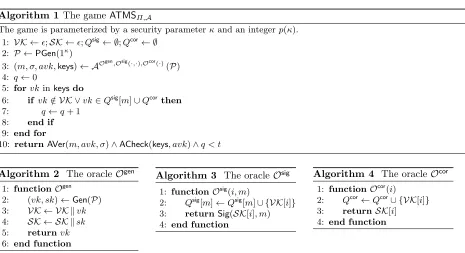
We define the security of an ATMS in the definition below, via a cryptographic game given in Algorithm 1.
Definition 11 (Security).At-ATMS schemeΠ= (PGen,Gen,Sig,Ver,AKey,ACheck,ASig,AVer)issecure if for any PPT adversary A and any polynomial p there exists some negligible function negl such that Pr[ATMSΠ,A(κ, p(κ)) = 1]<negl(κ).
The quantity q in the ATMS game counts how many keys the adversary is in control of among her chosen keys keys which will be used for aggregate-signature verification. The sequence keys can contain both adversarially-generated keys as well as some of the keysVKhonestly generated by the challenger. The variable q counts the number of adversarially controlled keys in keys. This includes those keys in keys for which the adversary has obtained a signature for the message in question (through the use of the oracle
Osig(·)) or which the adversary has corrupted completely (through the use of the oracleOcor(·)), as well as
those keys which have been generated by the adversary herself and therefore are not inVK.
It is straightforward to see that if Π is a secure ATMS, then the tuple (PGen,Gen,Sig,Ver) is a EUF-CMA-secure signature scheme.
Looking ahead, note that since theAKeyalgorithm is only invoked with the public keys of the participants, it can be invoked by anyone, not just the parties who hold the respective secret keys, as long as the public portion of their keys is published. Furthermore, notice that the above games allow the adversary to generate more public/private key pairs of their own and combine them at will.
Algorithm 1The gameATMSΠ,A
The game is parameterized by a security parameterκand an integerp(κ). 1: VK ←;SK ←;Qsig← ∅;Qcor← ∅
2: P ←PGen(1κ)
3: (m, σ, avk,keys)← AOgen,Osig(·,·),Ocor(·)
(P) 4: q←0
5: forvk inkeysdo
6: if vk /∈ VK ∨vk∈Qsig[m]∪Qcorthen
7: q←q+ 1
8: end if 9: end for
10: returnAVer(m, avk, σ)∧ACheck(keys, avk)∧q < t
Algorithm 2 The oracleOgen
1: functionOgen
2: (vk, sk)←Gen(P) 3: VK ← VK kvk 4: SK ← SK ksk 5: returnvk 6: end function
Algorithm 3 The oracleOsig
1: functionOsig(i, m)
2: Qsig[m]←Qsig[m]∪ {VK[i]}
3: returnSig(SK[i], m) 4: end function
Algorithm 4 The oracleOcor
1: functionOcor(i)
2: Qcor←Qcor∪ {VK[i]}
3: returnSK[i] 4: end function
Fig. 2: The ATMS security gameATMSΠ,A.
4.2 A Concrete Asset A
We now present an example of a simple fungible asset with fixed supply, which we denoteA, and describe its validity languageVA. This will be the asset (and validity language) considered in our construction and
proof. WhileVAis simple and natural, it allows us to exhibit the main features of our security treatment and
illustrate how it can be applied to more complex languages such as those capable of capturing smart contracts; we omit such extensions in this version. Note that our language is account-based, but a UTXO-based validity language can be considered in a similar manner.
Instantiating VA. The validity language VA for the assetA considers two ledgers: the mainchain ledger
L0 , MC and the sidechain ledger L1 , SC. For this asset, every transaction tx ∈ TA has the form tx= (txid,lid,(send,sAcc),(rec,rAcc), v, σ), where:
– txid is a transaction identifier that prevents replay attacks. We assume that txid contains sufficient information to identifylidby inspection and that this is part of syntactic transaction validation. – lid∈ {0,1}is the ledger index where the transaction belongs.
– send ∈ {0,1} is the index of the sender ledger Lsend and sAcc is an account on this ledger, this is the
sender account. For simplicity, we assume thatsAccis the public key of the account.
– rec∈ {0,1}is the index of the recipient ledgerLrecandrAccis an account (again represented by a public
key) on this ledger, this is the recipient account. We allow either Lsend = Lrec, which denotes a local
transaction, or Lsend6=Lrec, which denotes aremote transaction (i.e., a cross-ledger transfer).
– v is the amount to be transferred.
– σ is the signature of the sender, i.e. made with the private key corresponding to the public keysAccon the plaintext (txid,(send,sAcc),(rec,rAcc), v).
key that is associated with it, for simplicity we will assume that these are either identical or can always be derived from one another (this assumption is not essential for our construction).
The membership-deciding algorithm for VA is presented in Algorithm 5. It processes the sequence of
transactions (tx1,tx2, . . . ,txm) given to it as input in their order. Assuming transactions are syntactically valid, the function verifies for each transactiontxithe freshness oftxid, validity of the signature, and availabil-ity of sufficient funds on the sending account. For an intra-ledger transaction (i.e., one that hassend=rec), these are all the performed checks.
More interestingly, VA also allows for cross-ledger transfers. Such transfers are expressed by a pair of
transactions in which send6=rec. The first transaction appears in lid=send, while the second transaction appears in lid = rec. The two transactions are identical except for this change in lid (this is the only exception to thetxid-freshness requirement). Every receiving transaction has to be preceded by a matching sending transaction. Cross-chain transactions have to, similarly to intra-ledger transactions, conform to laws of balance conservation.
Note that VA does not require that every “sending” cross-ledger transaction on the sender ledger is
matched by a “receiving” transaction on the receiving ledger. Hence, if the assetAis sent from ledgerLsend
but has not yet arrived onLrecthen validity for this asset isnot violated. All the validity language ensures
is that appending thesidechain receive transaction to the rec will eventually be a valid way to extend the receiving ledger, as long as thesidechain sendtransaction has been included in send.
InstantiatingeffectLi→Lj. For the simple assetAoutlined above, every cross-ledger transfer is a “sending” transaction txwith Llid =Lsend6=Lrec appearing in Lsend, and its effect transaction is a “receiving”
trans-actiontx0 withLlid =Lrec 6=Lsend inLrecthat is otherwise identical (except for the different lid0 = 1−lid).
Hence, we defineeffectLsend→Lrec(tx) =tx
0 exactly for all these transactions and no other.
Instantiatingmerge(·). It is easy to construct a canonical functionmerge(·) once we see its inputs not only as ledger states (i.e., sequences of transactions) but we also exploit the additional structure of the blockchains carrying those ledgers. The canonical merge of the set of ledger statesL is the lexicographically minimum topologically sound merge, in which transactions of ledgerLi are compared favourably to transactions inLj ifi < j. However, note that the construction we provide below will work for any topologically sound merge function.
One can easily observe the following statement.
Proposition 1. The validity language VA is correct (according to Definition 7) with respect to the merge
function defined above.
4.3 The Sidechain Construction
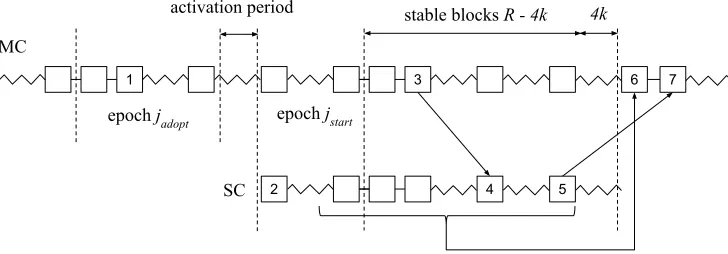
We now describe the procedures for running a sidechain in the configuration outlined at the beginning of this section: with independent staking on MC and merged staking on SC; direct observation ofMC and cross-chain certification ofSC. We describe the sidechain’s creation, maintenance, and the way assets can be transferred to it and back. The protocol we describe below is quite complex, we hence choose to describe different parts of the protocol in differing levels of detail. This level is always chosen with the intention to allow the reader to easily fill in the details. A graphical depiction of our construction that can serve as a reference is given in Figure 3.
Algorithm 5The transaction sequence validator (membership-deciding algorithm for VA).
1: functionvalid-seq(tx)
2: balance←Initial stake distribution;seen← ∅
3: .Traverse transactions in order 4: fortx∈txdo
5: .Destructuretx into its constituents 6: (txid,lid,(send,sAcc),(rec,rAcc), v, σ)←tx
7: if ¬valid(σ)then 8: returnfalse
9: end if
10: if lid=sendthen 11: .Replay protection 12: if seen[txid]6= 0then
13: returnfalse
14: end if
15: .Law of conservation
16: if balance[send][sAcc]−v <0then
17: returnfalse
18: end if
19: else
20: .The caselid=rec6=send
21: if seen[txid]6= 1then
22: returnfalse
23: end if
24: .Cross-ledger validity
25: tx0←effect−1
L(1−lid)→Llid(tx)
26: if tx0hasnot appeared beforethen
27: returnfalse
28: end if
29: end if
30: if seen[txid] = 0then
31: .Update sender balance when money departs 32: balance[send][sAcc]−=v
33: end if
34: .Update receiver balance when money arrives 35: if (seen[txid] = 0∧send=rec)∨
(seen[txid] = 1∧send6=rec) then 36: balance[rec][rAcc] +=v
37: end if
38: seen[txid]+ = 1 39: end for
40: returntrue
3
1 6 7
MC
epoch jadopt
activation period
epoch j
start
2 4 5
SC
stable blocks R - 4k 4k
Fig. 3: Our sidechain construction. Blocks are shown as rectangles. Adjacent blocks connect with straight lines. Squiggly lines indicate some blocks are omitted.MCis at the top,SCat the bottom. Epochs are sep-arated by dashed lines.ejadopt is the epoch of first signalling;ejstart is the activation epoch. Blocks of interest: 1. The first block signallingSCawareness; 2. TheSCgenesis block; 3. Atxsendtransaction for a deposit; 4. A
txrectransaction for a deposit; 5. Atxsendtransaction for withdrawal; 6. Asc certtransaction signalling trust
transition withinSCand certifying pending withdrawals; 7. A txrec transaction for withdrawal, certified in
asc certtransaction e.g. in block 6.
currentledger state of the ledger MC(resp.SC) as viewed by the party executing the protocol. Similarly, we denote byCMC(resp.CSC) the currently heldchain corresponding to the ledgerMC(resp.SC). Hence, for exampleMCalways represents the state stored in the stable part of the chainCMC.
Helper Transactions and Data. The construction uses a set ofhelper transactionswhich can be included in both blockchains, but do not get reported in the respective ledgers. These helper transactions store the appropriate metadata which is implementation-specific and allow the pegging functionality to be maintained. The transaction types sidechain support, sidechain certificate, sidechain success and sidechain failure, whose nature will be detailed later, are of this kind. Moreover, our concrete implementation of pegged ledgers extends certain transactions with additional information (such as Merkle-tree inclusion proofs) that are, for convenience, understood to be stripped off these transactions when the blockchain is interpreted as a ledger.
Initialisation. The creation of a new sidechain SC starts by any of the stakeholders of the mainchain adopting the code that implements the sidechain. This action does not require the stakeholders to put stake on the sidechain but merely to run the code to support it (e.g. by installing a pluggable module into their client software). In the following this is referred to as “adopting the sidechain” and captured by the predicate
SidechainAdoption. The adoption is announced at the mainchain by a special transaction detailed below. Each sidechain is identified by a unique identifieridSC.
Letjadoptdenote the epoch onMCwhen the first adoption transaction has appeared; the sidechainSC–
if its activation succeeds as discussed below – will start at the beginning of some later epochjstartand will have
its slots and epochs synchronized withMC. The software module implementing the sidechain comes with a set of deterministic rules describing the requirements for the successful activation of the sidechain, as well as for determiningjstart. These rules are sidechain-specific and are captured in a predicateActivationSuccess
and a functionActivationEpoch, respectively. One typical such example is the following: the sidechain starts at the beginning of MC-epoch jstart for the smallestjstart that satisfies: (i) jstart−jadopt > c1; (ii) at least
c2-fraction of stake on MCis controlled by stakeholders that have adopted SC; for some constantsc1,c2. Additionally, if such a successful activation does not occur until a failure condition captured by a predicate
The activation process then follows the steps outlined below, the detailed description is given in Algo-rithm 6).
Algorithm 6Sidechain initialisation procedures.
The algorithm is run by every stakeholderU that adopted the sidechain. We denote by (vk, sk) its public and private keys.
1: uponSidechainAdoption(idSC)do
2: sidechain state[idSC]←initializing
3: (vk0, sk0)←Gen(P)
4: σ←Sigsk(sidechain support,idSC, vk, vk0)
5: post(sidechain support,idSC, vk, vk0, σ)to MC
6: end upon
7: upon MC.NewEpoch()do 8: j←MC.EpochIndex()
9: if sidechain state[idSC] =initializingthen
10: if ActivationFailure()then 11: sidechain state[idSC]←failed
12: postsidechain failure(idSC)to MC
13: else if ActivationSuccess()then 14: sidechain state[idSC]←initialized
15: jstart←ActivationEpoch()
16: Postsidechain success(idSC) toMC
17: end if
18: end if
19: if sidechain state[idSC] =initialized∧j=jstartthen
20: η¯jstart←H(idSC, ηjstart)
21: VKjstart←2klast slot leaders ofejstart inSC
22: avkjstart←AKey(VKj
start)
23: G← idSC,SDjstart,η¯jstart,P, avkjstart
24: CSC←(G)
25: end if 26: end upon
First, every stakeholderUiofMC(holding a key pair (vk, sk)) that supports the sidechain posts a special transaction (sidechain support,idSC, vk, vk0), signed by skinto the mainchain. Herevk0 is a public key from an ATMS key pair freshly generated byUi; its role is explained in Section 4.3 below.
If the sidechain activation succeeds, then during the first slot of epochjstart the stakeholders ofMCthat
supportSC construct the genesis blockG= (idSC,SDjstart,η¯jstart ,H(idSC, ηjstart),P, avk
jstart) forSC.η
jstart is
the randomness for leader election onMCin epochjstart(derived onMCin epochjstart−1). It is reused to
compute the initial sidechain randomness ¯ηjstart as well, further ¯ηj0 forj
0 > j
startare determined independently
onSC using the Ouroboros coin-tossing protocol.8 Furthermore, P andavkjstart are public parameters and
an aggregated public key of an ATMS scheme; their creation and role is discussed in Section 4.3 below. Note that G is defined mostly for notational compatibility, as SDjstart is empty at this point anyway. G can be
constructed as soon asηjstart is known and stable.
The stakeholders that adopted SC post into MC a transaction sidechain success(idSC) to signify that SChas been initialized. If the sidechain creation expires, then, after the first block of the next epoch after expiration occurs, the stakeholders ofMCthat supportedSCpost the transactionsidechain failure(idSC) to MC. We assume that both predicatesActivationSuccessandActivationFailurecan be evaluated based on the state ofMConly, and hence spurious success/failure transactions will be considered invalid.
8
Maintenance. Once the sidechain is created, both the mainchain and the sidechain need to be maintained by their respective set of stakeholders (detailed below) running their respective instance of the Ouroboros protocol.
In the case of the mainchain, the maintenance procedure is given in Algorithm 7. This algorithm is run by all stakeholders controlling stake that is recorded on the mainchain. Each stakeholder, on every new slot, collects all the candidate MC-chains from the network (modelled via theDiffuse functionality) and filters them for both consensus-level validity (usingMC.ValidateConsensusLevel) and transaction validity (using the verifierMC predicate given in Algorithm 8). Out of the remaining valid chains, he chooses his new state
CMC via PickWinningChain. Then the stakeholder evaluates whether he is an eligible leader for this slot, basing its selection on the stake distributionSDj and randomnessηj, which are determined once per epoch in accordance with the Ouroboros protocol. If the stakeholder finds out he is a slot leader, he creates a new blockBby including all transactions currently valid with respect toCMC(as per the predicateverifytxMC given also in Algorithm 8), appends it to the chainCMC and diffuses the result9for other parties to adopt.
Algorithm 7Mainchain maintenance procedures.
The algorithm is run by every stakeholderU with stake onMCin every epochj≥jstart,skdenotes the secret key
ofU. An analogous mainchain-maintaining procedure was running also beforejstart and is omitted.
1: upon MC.NewSlot()do 2: sl←MC.SlotIndex() 3: .First slot of a new epoch 4: if sl modR= 1then
5: j←MC.EpochIndex()
6: SDj←MC.GetDistr(j)
7: ηj←MC.GetRandomness(j)
8: end if
9: C ←chains received viaDiffuse
10: .Consensus-level validation
11: Cvalid←Filter(C,MC.ValidateConsensusLevel)
12: .Transaction-level validation 13: Cvalidtx←Filter(Cvalid,verifierMC(·))
14: .Apply chain selection rule
15: CMC←MC.PickWinningChain(CMC,Cvalidtx)
16: .Decide slot leadership based onSDj andηj
17: if MC.SlotLeader(U, j, sl,SDj, ηj)then
18: prev←H(CMC[−1])
19: txstate←transaction sequence inCMC
20: tx←current transactions in mempool 21: txvalid←verifytxMC(txstatektx)[|txstate|:]
22: σ←Sigsk(prev,txvalid) 23: B←(prev,txvalid, σ) 24: CMC←CMCkB
25: Diffuse(CMC)
26: end if 27: end upon
The maintenance procedure forSCis similar, hence we only describe here how it differs from Algorithm 7. Most importantly, it is executed by all stakeholders who have adoptedSC, irrespectively of whether they own any stake onSC. Recall that the slots and epochs of the SC-instance of Ouroboros are aligned with the slots and epochs ofMC.
9 As in [20,13], we simplify our presentation by diffusing the complete chains, although a practical implementation
Algorithm 8TheMCverifier. 1: functionverifytxMC(tx)
2: bal←initial stake;avk←initial aggregate key 3: seen← ∅;pool←0;pfs mtrs← ∅;pfs used← ∅
4: fortx∈txdo
5: if type(tx) =sc certthen
6: (m, σ)←tx
7: if ¬AVer(m, avk, σ)then
8: continue
9: end if
10: (txs root, avk0)←m
11: avk←avk0
12: pfs mtrs[txs root]←true
13: else
14: (txid,lid,(send,sAcc),(rec,rAcc), v, σ)←tx
15: m←(txid,lid,(send,sAcc),(rec,rAcc), v) 16: if ¬Ver(m,sAcc, σ)∨seen[txid]6= 0then
17: continue
18: end if
19: if lid=sendthen
20: if bal[sAcc]−v <0then
21: continue
22: end if
23: bal[sAcc]−=v 24: else if send6=recthen
25: π←tx.π
26: (mtr,inclusion pf)←π
27: if π∈pfs used∨mtr6∈pfs mtrs∨ ¬mtr-ver(mtr,inclusion pf)then
28: continue
29: end if
30: end if
31: if lid=recthen 32: bal[rAcc] +=v
33: end if
34: if send6=recthen
35: if lid=sendthen
36: pool−=v
37: else
38: pool+=v
39: end if
40: end if
41: end if
42: seen←seenktx
43: end for 44: returnseen
45: end function
46: functionverifierMC(Cmc)
47: tx← ∅
48: forB∈Cmcdo
49: fortx∈B do
50: tx←txktx
51: end for
52: end for
53: returntx6=verifytxMC(tx)
Algorithm 9TheSCtransaction verifier. 1: functionverifytxSC(tx)
2: bal[MC]←InitialMCstake 3: bal[SC]←InitialSCstake 4: mc outgoing tx← ∅;seen← ∅
5: fortx∈txdo
6: (txid,lid,(send,sAcc),(rec,rAcc), v, σ, t)←tx
7: m←(txid,lid,(send,sAcc),(rec,rAcc), v) 8: if ¬Ver(sAcc, m, σ)∨seen[txid]6= 0then
9: continue
10: end if
11: if lid=sendthen
12: if bal[send][sAcc]−v <0then
13: continue
14: end if
15: if lid=MC∧send6=recthen
16: mc outgoing tx[txid]←t+ 2k
17: end if
18: end if
19: if lid=recthen 20: if send6=recthen
21: .Effect pre-image tx immature 22: if t <mc outgoing tx[txid]then
23: continue
24: end if
25: end if
26: bal[rec][rAcc] +=v
27: end if
28: if lid=sendthen 29: bal[send][sAcc]−=v
30: end if
31: seen←seenktx
32: end for 33: returnseen
34: end function
Algorithm 10 TheSCverifier. 1: functionverifierSC(Csc,Cmc)
2: tx←annotatetxSC(Csc,Cmc)
3: returntx6=verifytxSC(tx)
4: end function
Algorithm 11TheSCtransaction annotation. 1: functionannotatetxSC(Csc,Cmc)
2: tx← ∅
3: foreach time slottdo
4: tx0←
5: ifCsc has a block generated at slottthen
6: B←the block inCscgenerated att
7: fortx∈Bdo
8: tx0←tx0ktx
9: end for
10: end if
11: ifCmc has a block generated at slottthen
12: B←the block inCmcgenerated att
13: fortx∈Bdo
14: tx0←tx0ktx
15: end for
16: end if
17: fortx∈tx0 do
18: .Mark the time of eachtxintx0
19: tx.t←t
20: end for
21: tx←txktx0
22: end for 23: returntx
24: end function
The first difference is that all ocurrences of MC and CMC are naturally replaced by SC and CSC, respectively. This also means that the validity of received chains (resp. transactions), determined on line 13 (resp. 21), is decided based on predicateverifierSC(·,CMC) (resp.verifytxSC(·)) instead of the predicate verifierMC(·) (resp.verifytxMC(·)). Additionally, note thatverifytxSCmust be called with a sequence of transactions containing both the transactions inSCas well as the transactions in MCinterspersed and timestamped, similarly to the way done in Line 2 of Algorithm 10. This is straightforward to implement, as the sidechain maintainers also directly observe the mainchain. The predicatesverifytxSC andverifierSC are given in Algorithms 9 and 10, respectively.
Second, instead of the stake distributionSDj determined on line 6, a different distribution SD
∗
past, namely by slot 4kof epochj−1, just as inMC. Naturally, this also implies that the fourth parameter for theSlotLeaderpredicate on line 17 isSD∗j instead ofSDj.
Finally, the block construction procedure on line 23 is adjusted so that in the last 2kslots of each epoch, the created blocks on the sidechain also contain an additional ATMS signature of a so-called sidechain certifi-cate (how this certificertifi-cate is constructed and used will be described below). Hence, wheneversl modR >10k, line 23 is replaced byB←(prev,txvalid, σ, σsc certj+1) whereσsc certj+1=Sigsk(sc certj+1) andj is the current epoch index.
Depositing to SC. Once SC is initialized, cross-chain transfers to it can be made from MC. A cross-chain transfer operation in this case consists of two transactionstxsendandtxrecthat both havesend=MC,
rec=SC, and all other fields are also identical, except that eachtxi fori∈ {send,rec} containslid=i. The sending transaction txsend is meant to be included inMC, while thereceiving transaction txrec is meant to
be included inSC.
Whenever a stakeholder onMCthat has adoptedSCwants to transfer funds toSC, she diffusestxsend
with the correct receiving account onSCand the desired amount. Honest slot leaders inMCinclude these transactions into their blocks just like any intra-chain transfer transactions. Maintainers ofMCkeep account of a variablepoolSC, initially set to zero. Whenever a txsend is included into MC, they increase poolSC by the amount of this transaction.
Whentxsendbecomes stable inMC(i.e., appears inMC, this happens at most 2kslots after its inclusion),
the stakeholder creates and diffuses the correspondingtxrec which credits the respective amount of coins to
rAccinSC, to be included intoSC. In practice, this is akin to a coinbase transaction, as the money was not transferred from an existingSCaccount.
Note that depositing fromMCtoSCis relatively fast; it merely requires a reliable inclusion oftxsendinto
MCand consequently oftxrecintoSC, as guaranteed by the liveness of the underlying Ouroboros instances.
The depositing algorithm code is shown in Algorithm 12.
Algorithm 12 Depositing fromMCtoSC.
The algorithm is run by a stakeholderU in control of the secret keyskcorresponding to the accountsAcconMC.
1: functionSend(sAcc,rAcc, v) .SendvfromsAcconMCtorAcconSC 2: txid← {$ 0,1}k
3: σ←Sigsk(txid,MC,(MC,sAcc),(SC,rAcc), v)
4: txsend←(txid,MC,(MC,sAcc),(SC,rAcc), v, σ)
5: posttxsendto MC
6: end function
7: functionReceive(txid,sAcc,rAcc, v)
8: wait until txsend∈MC .MCis the stable part ofMC
9: σ←Sigsk(txid,SC,(MC,sAcc),(SC,rAcc), v) 10: txrec←(txid,SC,(MC,sAcc),(SC,rAcc), v, σ)
11: posttxrecto SC
12: end function
Withdrawing to MC. The withdrawal operation is more cumbersome than the depositing operation since not all nodes of MC have adopted (i.e., are aware of and follow) the sidechain SC. As transactions, the withdrawals have the same structure as deposits, consisting oftxsendandtxrec, with the only difference that
Whenever a stakeholder inSC wishes to withdraw coins fromSCto MC, she creates and diffuses the respective transaction txsend with the correct transfer details as before. If txsend is included in a block that
belongs in one of the firstR−4kslots of some epoch then letjsenddenote the index of this epoch, otherwise
letjsend denote the index of the following epoch. The stakeholder then waits for the end of the epoch ejsend
to pass andejsend+1 to begin.
At the beginning of ejsend+1, a special transaction calledsidechain certificatesc certjsend+1is generated by
the maintainers ofSC. It contains: (i) a Merkle-tree commitment to all withdrawal transactions txsend that
were included intoSCduring last 4kslots of epochjsend−1 and the firstR−4kslots of epochjsend(as these
all are already stable by slot R−2kof epochjsend); (ii) other information allowing the maintainers ofMC
to inductively validate the certificate in every epoch. The construction of sc certis detailed below, for now assume that the transaction provides a proof that the included information about withdrawal transactions is correct. The transactionsc certis broadcast into theMCnetwork to be included intoMCat the beginning ofejsend+1 by the first honest slot leader.
The stakeholder who wishes to withdraw their money intoMCnow creates and diffuses the transaction
txrecto be included inMC. This transaction is only included intoMCif it is considered valid, which means:
(1) it is properly signed; (2) it contains a Merkle inclusion proof confirming its presence in some already included sidechain certificate; (3) its amount is less or equal to the current value of poolSC. If included, MC-maintainers decrease the value ofpoolSCby the amount of this transaction. The code of the withdrawal algorithm is illustrated in Algorithm 13.
Algorithm 13 Withdrawing fromSCtoMC.
The algorithm is run by a stakeholderU in control of the secret keyskcorresponding to the accountsAcconSC.
1: functionSend(sAcc,rAcc, v) .SendvfromsAcconSCtorAcconMC 2: txid← {$ 0,1}k
3: σ←Sigsk(txid,SC,(SC,sAcc),(MC,rAcc), v) 4: txsend←(txid,SC,(SC,sAcc),(MC,rAcc), v, σ)
5: posttxsendto SC
6: end function
7: functionReceive(txid,sAcc,rAcc, v) 8: wait until txsend∈CSC
9: j0←epoch whereCSCcontainstxsend
10: if (txsend included in slotsl≤R−4 ofej0)then 11: jsend←j0
12: else
13: jsend←j0+ 1
14: end if
15: wait until sc certjsend+1∈CMC
16: π←Merkle-tree proof oftxsendinsc certjsend+1
17: σ←Sigsk(txid,MC,(SC,sAcc),(MC,rAcc), v, π) 18: txrec←(txid,MC,(SC,sAcc),(MC,rAcc), v, π, σ)
19: posttxrecto MC
20: end function
Algorithm 14 Constructing sidechain certificatesc cert.
The algorithm is run by everySC-maintainer at the end of each epoch,jdenotes the index of the ending epoch.
1: functionConstructSCCert(j)
2: T ←last 4kslots ofej−1and firstR−4kslots ofej
3: tx←transactions included inSCduringT 4: pendingj+1← {tx∈tx : tx.send6=tx.rec} 5: VKj+1←keys of last 2kSCslot leaders inej+1 6: avkj+1←AKey(VKj
+1)
7: m←
pendingj+1
, avkj+1
8: VKj←keys of last 2kSCslot leaders forej
9: σj+1←ASig
m,{(vki, σi)}di=1,VKj
10: sc certj+1←(
pendingj+1
, avkj+1, σ
j+1) 11: returnsc certj+1
12: end function
Namely, the sc certj transaction also contains an aggregate key avkj of an ATMS, and is signed by the previous aggregate keyavkj−1included insc cert
j−1.
sc certj is generated bySC-maintainers and contains:
– The epoch index j.
– The pending transactions from SC to MC. Let txbe the sequence of all transactions which are included inSCduring either the last 4kslots ofej−2or the firstR−4kslots ofej. All transactions intx that have SC=send6=rec=MCare picked up and combined into a listpendingj (sorted in the same order as inSC). Let
pendingj
denote a Merkle-tree commitment to this list.
– The new ATMS key avkj. The key is created from the public keys of the slot leaders of the last 2k slots of the epochj, using thresholdk+ 1. Hence, it allows to verify whether a particular signature comes from k+ 1 out of these 2kkeys.
– Signature valid with respect to avkj−1.
The fullsc certjis therefore a tuple j,hpendingji, avkj, σj
, whereσjis an ATMS signature on the preceding elements that verifies usingavkj−1.
The certificate sc certj+1 is constructed as follows: Both the stake distribution SD
∗
j+1 and the SC -randomness ¯ηj+1(and hence also the slot leader schedule forSCin epochj+ 1) are determined by the states of the blockchains MC and SC by the end of slot 10k of epoch j. Therefore, during the last 2k slots of epochj, the 2kelected slot leaders for these slots can already include a (local) signature on (their proposal of)sc certj+1into the blocks they create. Given the deterministic construction ofsc certj+1, all valid blocks ending up in the part ofSC-chain belonging to the last 2kslots of epochj will contain a local signature on the samesc certj+1, and by the chain growth property of the underlying blockchain, there will be at least
k+ 1 of them. Therefore, any party observingSCcan now combine these signatures into an ATMS that can be later verified using the ATMS keyavkj, it can hence create the complete certificatesc cert
j+1and serve it to the maintainers ofMCfor inclusion.
Transitioning trust. As already outlined above, our construction uses ATMS to maintain the authenticity of the sidechain certificates from epoch to epoch. We now describe this inductive process in greater detail.
Initially, during the setup of the sidechain, P ← PGen(1κ) is ran. Stakeholders generate their keys by invoking (ski, vki)←Gen(P). In caseGen(·) is a probabilistic algorithm, it is run in a derandomized fashion with its coins fixed to the output of a PRNG that is seeded byH(ats init, ηjstart) where “ats init” is a fixed label