Special Issues Brief
FEBRUARY 2015
Center on
GREAT TEACHERS
&
LEADERS
at American Institutes for Research
A Framework for Coherence
College and Career Readiness Standards,
Multi-Tiered Systems of Support, and
The authors would like to thank Lynn Holdheide, Lou Danielson, Meghan Zefran, and Rebecca Zumeta for their input and review. The authors also would like to thank the following individuals for their thoughtful reviews: Joseph Kovaleski from Indiana University of Pennsylvania, Marie Mancuso from the West Comprehensive Center, and Nancy
Special Issues Brief
A Framework for Coherence
College and Career Readiness Standards,
Multi-Tiered Systems of Support, and
Educator Effectiveness
FEBRUARY 2015
Lindsey Hayes
Contents
1 In Brief
2 Introduction
3 A Shared Context
4 A Framework for Coherence
6 A Deeper Dive: Instructional Shifts Supporting a Framework for Coherence 6 What: College and Career Readiness Standards
7 How: MTSS
7 Educator Effectiveness Systems: Evaluating the What + How
8 Examining Opportunities for Coherence
11 Opportunity 1. College and Career Readiness Standards: Create a Shared Focus
13 Opportunity 2. MTSS: Create Better Instructional Supports for Students 16 Opportunity 3. Educator Effectiveness Systems: Create Better Professional
Learning Supports for Teachers
20 Conclusion
1
In Brief
The Challenge The Opportunity The Lessons
College and career readiness standards, Multi-Tiered Systems of Support (MTSS), and educator effectiveness systems are critical instructional reform initiatives; however, these initiatives often are implemented in isolation from each other. This lack of coherence across the initiatives sends teachers and instructional leaders mixed messages about instructional practices, especially those practices aimed at supporting at-risk learners.
States can identify key connections across the three initiatives to create a framework for coherence that aligns reform efforts to improve teachers’ instructional practices and student outcomes.
Each reform is grounded in a common vision for success in which all students are college and career ready. The reforms share key instructional shifts intended to promote high expectations for students and drive continuous improvement of instruction. Building coherence across these initiatives is essential for creating lasting and meaningful changes to instruction and support for at-risk learners.
This Special Issues Brief from the Center on Great Teachers and Leaders (GTL Center) outlines a framework for coherence that supports states in connecting college and career readiness standards, Multi-Tiered Systems of Support (MTSS), and educator effectiveness systems. These distinct yet interrelated initiatives share a common goal: improve instructional quality to enhance educational outcomes for students. Lack of coherence and alignment across these initiatives diminishes opportunities to maximize the transformative impact of these initiatives on student learning. States have three distinct opportunities to strengthen coherence and alignment across the initiatives:
¡ Create a shared focus. College and career readiness standards are an opportunity for state education agencies, educators, and education stakeholders to create a shared focus on instruction that helps all students, including those students at risk for poor learning outcomes, to achieve college and career readiness.
¡ Create better instructional supports for students. An MTSS offers an instructional framework that creates opportunities for students to access college and career readiness instruction through tiers of services and supports that vary in intensity.
¡ Create better professional learning supports for teachers. Educator effectiveness systems that provide targeted feedback on standards-based, multi-tiered instruction create opportunities for professional learning and continuous instructional improvement that drive student growth.
WHO SHOULD READ THIS BRIEF? Policymakers, staff at regional centers and state education agencies, and regional support providers who support the implementation of college and career readiness standards, MTSS, and educator effectiveness systems at the state or district levels should read this brief. Intended to serve as a starting point, this brief allows states and districts to engage in a conversation about how these reform efforts can be mutually supportive, sustainable, and successful.
Introduction
Reform has become a permanent fixture in U.S. education policy. For educators, each school year brings an inevitable wave of new initiatives that must be piloted, refined, and scaled up—all with the goal of improving the quality of instruction and student learning. With education reforms driven by local, state, and national education priorities, however, the intensity and pace of the reforms have increased. Three of the most far-reaching instructional reforms that educators face today include the following:
¡ Implementation of college and career readiness standards, such as the Common Core State Standards
¡ Adoption of schoolwide intervention models, such as an MTSS
¡ Reform of educator effectiveness systems to emphasize performance evaluation and drive continuous improvement in the quality of instruction Each of these initiatives is a major driver in school reform. If implemented simultaneously and well, these initiatives can create lasting and meaningful change at the classroom, school, district, and state levels. An enduring challenge plaguing reform initiatives (and a common reason that reforms fail) is the lack of coherence and alignment across initiatives. Without coherence and alignment, teachers and instructional leaders are placed squarely at the intersection
of competing agendas, which may inadvertently send mixed messages about instructional practices. For example, if the instructional practices evaluated in an educator effectiveness model do not align with the instructional practices needed to propel students toward college and career readiness, then teachers receive instructional feedback that is disconnected from their practice and their students’ needs. Likewise, if instruction in an MTSS is not linked to the evidence-based instructional practices proven to be effective for at-risk learners, then it is unlikely that the achievement gap will be narrowed. Coherence and alignment are the keys to ensuring that reform initiatives support teachers to deliver high-quality instruction that puts students, including at-risk learners, on a trajectory toward success.
DEFINITION OF AN MTSS
“
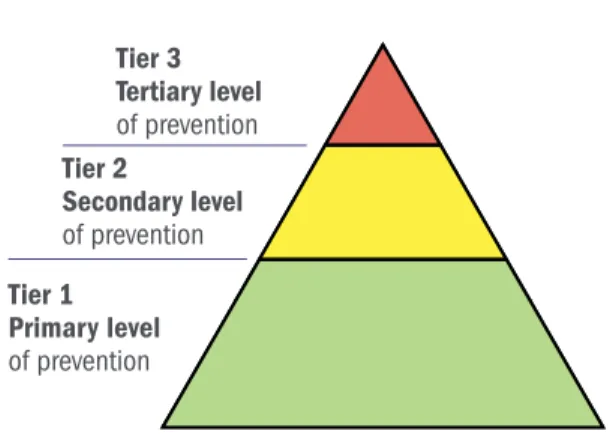
MTSS is a prevention frameworkthat organizes building-level resources to address each individual student’s academic and/or behavioral needs within intervention tiers that vary in intensity. MTSS allows for the early identification of learning and behavioral challenges and timely intervention for students who are at risk for poor learning outcomes. It also may be called a multi-level prevention system. The increasingly intense tiers (e.g., Tier 1, Tier 2, Tier 3), sometimes referred to as levels of prevention (i.e., primary, secondary, intensive prevention levels), represent a continuum of supports. Response to Intervention (RTI) and Positive Behavioral Interventions and Supports
(PBIS) are examples of MTSS.
”
Center on Response to Intervention at American Institutes for Research (2014)
“
When coherence across initiatives is missing, teachers and leaders receive mixed messages about instructional practices, especially those practices aimed at supporting at-risk learners.”
3
A Framework for Coherence
College and Career Readiness Standards, Multi-Tiered Systems of Support, and Educator Effectiveness
A Framework for Coherence
College and Career Readiness Standards, Multi-Tiered Systems of Support, and Educator Effectiveness
In this brief, we offer a conceptual framework states can use to create coherence across college and career readiness standards, MTSS, and educator effectiveness systems. Specifically, readers will:
¡ Examine the three initiatives’ shared goals and context and identify the instructional connections across initiatives that support better learning and outcomes for all students
¡ Explore three opportunities to strengthen conceptual coherence and alignment across the initiatives with the goal of improving teacher instructional practice and student outcomes
States and districts can use this brief as a starting point for conversations about how to make these reform efforts mutually supportive, sustainable, and successful.
A Shared Context
The three distinct yet interrelated education reform initiatives share a common goal—they aim to improve the quality of instruction and educational outcomes for students. The initiatives are grounded in a common vision for
success in which all students receive the instruction they need to be ready for college and careers by the time they exit high school. Student learning and growth are at the very core of these initiatives, a message that is emphasized at the local, state, and national levels of the education system. The federal government has specifically targeted educator effectiveness as the primary lever to improve outcomes for students and has communicated educator quality as a priority, through initiatives such as Race to the Top. Whether through new standards,
assessments, or performance indicators, educators are expected to monitor student growth with methods that inform students’ knowledge acquisition as well as identify the necessary services, supports, and adaptations to instruction that can help close achievement gaps.
There are strong parallels between the catalysts for these initiatives. Each initiative originated in the context of reform efforts focused on student outcomes and teacher accountability. For example, Common Core State Standards were conceived as a cohesive, rigorous set of expectations for the skills and knowledge that students need in order to be prepared for postsecondary success in the areas of education and employment. The Common Core State Standards promote consistent college and career readiness expectations for students, educators, employers, and community
“
All three reforms are grounded in a common vision for success in which all students receive the instruction they need to be college and career ready.”
members across all states to ensure that U.S. students are able to compete with their peers at home and in the global marketplace. Similarly, MTSS models grew out of research and evidence-based practices that demonstrated impact on student growth when implemented within organizational and systemic structures that improved access to quality instruction, services, and supports. Finally, recent reforms in educator effectiveness systems arose from the need to tie educator evaluation with meaningful opportunities for feedback, professional learning, and differentiated support across the career continuum. When all these elements are present in an educator effectiveness system, the system itself supports educators in the delivery of high-quality instruction and services.
A Framework for Coherence
The current lack of coherence and alignment across initiatives is exacerbated by inadequate structures to promote collaboration at both the state and the local levels. Coherence and alignment are necessary at all levels, particularly for reform efforts that directly target instructional improvement. Disjointed efforts that fail to produce instructional improvement also fail to achieve their ultimate mission—improvement in student growth. When instructional reform efforts work in concert, however, the result is a shared focus on instruction that supports instructional effectiveness and fosters student learning. The three initiatives under discussion in this brief naturally lend themselves to a coherent, aligned framework through a shared focus on instruction:
¡ College and career readiness standards outline what students need to learn.
¡ An MTSS creates a structure for the delivery of high-quality instruction and, when needed, additional supports and interventions varying in intensity.
¡ Educator evaluation systems outline what all teachers need to know and be able to do to support student learning.
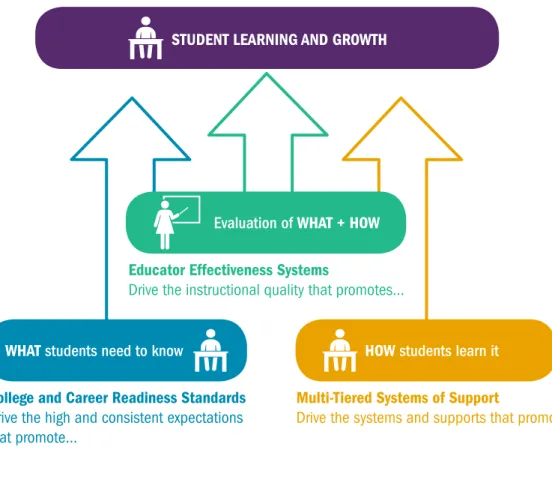
Integrating the instructional shifts necessary in these initiatives into the feedback loop within an educator effectiveness system provides educators with actionable steps to improve instructional quality, ultimately leading to increases in student growth. When considered as a distinct but interrelated set of reform efforts, implementation of the Common Core State Standards provides the “what,” MTSS provides the “how,” and educator effectiveness systems provide a way to evaluate our individual and collective capacity to effectively bridge the “what” and “how.” When considered together, these initiatives create an opportunity for coherence that drives continuous improvement of instruction and in turn student outcomes.
5
A Framework for Coherence
College and Career Readiness Standards, Multi-Tiered Systems of Support, and Educator Effectiveness
A Framework for Coherence
College and Career Readiness Standards, Multi-Tiered Systems of Support, and Educator Effectiveness
The following section of the brief explores each of the three initiatives more deeply to examine their roles within the framework for coherence.
Figure 1. Framework for Coherence
College and Career Readiness Standards
Drive the high and consistent expectations that promote...
Educator Effectiveness Systems
Drive the instructional quality that promotes...
Multi-Tiered Systems of Support
Drive the systems and supports that promote...
WHAT students need to know HOW students learn it
Evaluation of WHAT + HOW STUDENT LEARNING AND GROWTH
A Deeper Dive: Instructional Shifts Supporting
a Framework for Coherence
WHAT:
College and Career
Readiness Standards
College and career readiness standards set expectations for what students need to know and be able to do by the time they graduate from high school. The Common Core State Standards are the most widely adopted set of
college and career readiness standards, with over 40 states and the District of Columbia having adopted them (Common Core State Standards Initiative, 2015). The implementation of Common Core State Standards requires a number of instructional shifts (see sidebar). The instructional shifts of the Common Core place an emphasis on critical thinking skills along with focusing the curriculum on greater depth and rigor. It is important to note that even with the instructional shifts of the Common Core the emphasis remains on the development and mastery of basic reading and mathematics skills in the elementary grades. Within the Common Core there is a goal to improve common assessment practices, both formative and summative, as well as to help educators become more selective with respect to instructional materials and implementation of evidence-based methodologies. Students must be meaningfully engaged and guided toward deeper and self-regulated learning. Sound implementation of college and career readiness standards like the Common Core—the “what”—requires a different way of doing business that affects instruction in all subjects and grade levels. Doing business differently at the state, district, school, and classroom levels requires a comprehensive structure for service delivery.
Instructional Shifts
for the Common Core
ENGLISH LANGUAGE ARTS¡ Balancing informational and literary text
¡ Building knowledge in the disciplines
¡ Staircase of complexity
¡ Text-based answers
¡ Writing from sources
¡ Academic vocabulary MATHEMATICS ¡ Focus ¡ Coherence ¡ Fluency ¡ Deep understanding ¡ Application ¡ Dual intensity (EngageNY, 2012)
7
A Framework for Coherence
College and Career Readiness Standards, Multi-Tiered Systems of Support, and Educator Effectiveness
A Framework for Coherence
College and Career Readiness Standards, Multi-Tiered Systems of Support, and Educator Effectiveness
HOW:
MTSS
MTSS is a framework to help all students reach high standards, such as the Common Core State Standards or other rigorous college and career readiness standards. MTSS creates opportunities for students to access college- and career-ready instruction through varying tiers of intervention matched to individual students’ needs. Instruction within tiers features increasingly intensive evidence-based academic, social-emotional, and behavioral practices.
MTSS is also a comprehensive framework for continuous school improvement that uses ongoing measurement, monitoring, and evaluation of standards implementation and outcomes to drive data-based decision making. Sustainable MTSS are characterized by a continuum of resources that support the effectiveness of practitioners within a dynamic and collaborative problem-solving process. MTSS provides a framework for how students receive instruction that allows them to develop the skills necessary to succeed in school and life.
Educator Effectiveness Systems:
Evaluating the
WHAT + HOW
Educator effectiveness systems provide a framework to measure, monitor, and improve teaching practice. Professional learning is the critical component that distinguishes an educator effectiveness system from a
performance evaluation system. Well-designed educator effectiveness systems align data generated during the performance evaluation cycle with frequent and ongoing feedback, high-quality opportunities for professional learning, and differentiated support across the career continuum. Professional growth activities like preobservation and postobservation conferences and job-embedded professional learning provide educators with opportunities to practice and refine the delivery of high-leverage instructional strategies. Doing so within the context of an educator effectiveness system provides structured opportunities to monitor the fidelity with which
instructional practices are implemented, which in turn supports student growth.
A Deeper Dive: Instructional Shifts Supporting
a Framework for Coherence
WHAT:
College and Career
Readiness Standards
College and career readiness standards set expectations for what students need to know and be able to do by the time they graduate from high school. The Common Core State Standards are the most widely adopted set of
college and career readiness standards, with over 40 states and the District of Columbia having adopted them (Common Core State Standards Initiative, 2015). The implementation of Common Core State Standards requires a number of instructional shifts (see sidebar). The instructional shifts of the Common Core place an emphasis on critical thinking skills along with focusing the curriculum on greater depth and rigor. It is important to note that even with the instructional shifts of the Common Core the emphasis remains on the development and mastery of basic reading and mathematics skills in the elementary grades. Within the Common Core there is a goal to improve common assessment practices, both formative and summative, as well as to help educators become more selective with respect to instructional materials and implementation of evidence-based methodologies. Students must be meaningfully engaged and guided toward deeper and self-regulated learning. Sound implementation of college and career readiness standards like the Common Core—the “what”—requires a different way of doing business that affects instruction in all subjects and grade levels. Doing business differently at the state, district, school, and classroom levels requires a comprehensive structure for service delivery.
“
Professional learning is the distinguishing component of educator effectiveness systems. Educator effectiveness systems use evaluation data to guide opportunities for educator development and instructional improvement.”
Tier 3 Tertiary level of prevention Tier 2 Secondary level of prevention Tier 1 Primary level of preventionIn addition to focusing on the skills and competencies needed to implement college- and career-ready instruction within an MTSS framework, educator effectiveness systems must be flexible enough to respond to instruction for different purposes, for example, general classroom instruction versus individualized intervention.
Educator effectiveness systems can be a powerful lever to improve teacher and leader capacity to improve student results. To support college and career readiness for all students, educator evaluation systems should reflect high-leverage practices supported with strong evidence of results. Furthermore, evaluation systems must be designed to provide targeted, high-quality feedback on high-leverage practices to improve teacher instructional capacity. When educator evaluation systems are grounded in evidence-based practices and are designed to provide targeted support to build teacher capacity, then the ideal conditions are created for teachers to positively affect student growth.
Examining Opportunities for Coherence
The pace and intensity of education reform present a challenge to practitioners in the field. Not only must educators and leaders quickly adapt to change, they must do so in an environment with shrinking timelines and expanding accountability requirements. Although reform efforts are launched with the intention of improving outcomes for students, multiple reform initiatives could, in fact, work against one another because of the pace and intensity of change and, most important, the lack of coherence. When aligned, however, the initiatives can be mutually supportive.
Many initiatives occupying the space of instructional improvement have operated largely in isolation from
other efforts. The primary challenge is that stakeholders perceive these initiatives as separate, a perception that is reinforced by the fact that the initiatives often are spearheaded by different federal, state, and local departments. At the state and district levels, departmental organizational structures, different departmental priorities, and different implementation timetables have contributed to this perception of disconnection. It is not uncommon for state education agencies to house the administrative functions for curriculum and standards, MTSS, and educator
OPPORTUNITY 1.
College and Career Readiness Standards: Create a Shared Focus
OPPORTUNITY 2.
MTSS: Create Better Instructional Supports for Students
OPPORTUNITY 3.
Educator Effectiveness Systems: Create Better Professional Learning Supports for Teachers
9
A Framework for Coherence
College and Career Readiness Standards, Multi-Tiered Systems of Support, and Educator Effectiveness
A Framework for Coherence
College and Career Readiness Standards, Multi-Tiered Systems of Support, and Educator Effectiveness
effectiveness in different departments that have little or no contact with one another. At the federal level as well, different internal departments have launched and funded the initiatives.
The isolation of these reform efforts is evident at all levels of implementation. For example, variations on MTSS have been implemented in schools for the past decade but have been largely absent from the conversations about educator effectiveness that occurred in the past five years. Common Core State Standards, although in existence since 2009, have gained significant national attention only in the past two years, well after many educator effectiveness initiatives were established and piloted. Student growth is a significant factor in educator evaluation systems as states are in the process of negotiating the instructional shifts of college and career readiness standards, such as the Common Core. Although these initiatives are being implemented concurrently, they are often disconnected from one another.
Educators’ perceptions of these initiatives as isolated and competing contribute to reform fatigue in the field. Building coherence between initiatives makes the best use of time, resources, and efforts; advances long-term sustainability; and ultimately improves outcomes for students. The GTL Center introduced a coherence-building approach in its 2014 publication Creating Coherence: Common Core State Standards, Teacher Evaluation, and Professional Learning. This brief guides state- and district-level practitioners through a coherence-building process to create a plan for improving instruction. A similar approach can be applied to the initiatives discussed in this brief to create a framework for coherence that features three opportunities for alignment discussed in the following sections.
Need Support to Align Educator Effectiveness Reforms
in Your State?
The GTL Center offers multiple resources to assist in connecting and aligning a range of educator effectiveness reforms as part of a coherent educator talent development system. The following resources can help you align:
Common Core, Teacher Evaluation, and Professional Learning
¡ Creating Coherence: Common Core State Standards, Teacher Evaluation, and Professional Learning, Special Issues Brief, October 2014 (http://www.gtlcenter.org/ sites/default/files/CreatingCoherence.pdf)
¡ Creating Coherence: Connecting Teacher Evaluation and Support Systems to the Common Core, Professional Learning Module, October 2014 (http://www.gtlcenter.org/technical-assistance/ professional-learning-modules/creating-coherence-
connecting-teacher-evaluation-and-support-systems-common-core)
Common Core, Teacher Evaluation, and
Social and Emotional Learning
¡Teaching the Whole Child: Instructional Practices That Support Social-Emotional
Learning in Three Teacher Evaluation Frameworks, Research-to-Practice Brief, January 2014 (http://www.gtlcenter.org/ sites/default/files/TeachingtheWholeChild.pdf)
¡Social and Emotional Learning in the Daily Life of Classrooms, Professional Learning Module, April 2014 (http://www.gtlcenter.org/technical-assistance/ professional-learning-modules/social-and-emotional-learning-daily-life-classrooms)
Student Learning
Social, Emotional, and Academic Skills
Teaching Practices
Teacher Social and Emotional Capacities
Teacher Processes Student Outcomes
Professional Learning Teacher Evaluations Common Core State
Standards
State and District Initiatives
Integrating Social and Emotional Learning Across the Learning Process Common Core State Standards Instruction Teacher Evaluation Professional Learning
11
A Framework for Coherence
College and Career Readiness Standards, Multi-Tiered Systems of Support, and Educator Effectiveness
A Framework for Coherence
College and Career Readiness Standards, Multi-Tiered Systems of Support, and Educator Effectiveness
OPPORTUNITY 1.
College and Career Readiness Standards: Create a Shared Focus
WHAT
does this mean?
College and career readiness standards, such as the Common Core State Standards, represent a substantial increase in depth and rigor of content from kindergarten through Grade 12. The instructional shifts required by college and career readiness standards affect the way all students must be taught, but especially students with disabilities, students with limited English proficiency, and students receiving intensive interventions in basic reading or mathematics skills, and other students at risk for poor learning outcomes. These new, rigorous standards heighten the need for quality core and specialized instruction so that struggling learners have access to the curriculum. This instruction must be grounded in the evidence-based practices that are known to have positive impacts on student learning, for example, direct, explicit instruction and modeling coupled with opportunities for practice. Prominent within these shifts is an emphasis on analysis, synthesis, and application of knowledge. A proficient learner may be able to engage in higher order thinking activities with a great deal of independence, while students who have disabilities and other struggling learners may require individualized, specially designed instruction to participate in a meaningful way.
Because of the heightened demands of college and career readiness standards, educator evaluation models need to include the type of evidence-based instruction and support needed by students with disabilities to successfully negotiate these higher demands. Not only must educator evaluation models include instructional practices that provide such support, they must be integrated in a way that yields meaningful feedback so that educators themselves can be supported to implement these practices well. The following action steps should be taken by all stakeholders—including educators, evaluators, and state- and district-level administrators—to enable the delivery of the type of instruction envisioned in college and career readiness standards: ¡ Develop a common understanding of the evidence-based,
content-specific pedagogical skills and practices needed to ensure students with disabilities and other struggling learners can access and progress toward standards.
¡ Verify that educator evaluation frameworks support and reinforce this type of instruction.
¡ Create meaningful opportunities for educators to apply these practices— with significant feedback—during their careers in order to build capacity in the skills and competencies that are needed to support students with disabilities and other struggling learners.
WHY is this important?
Expectations established by college and career readiness standards create an opportunity to focus on the type of instruction that is needed to help all students, including those students at risk for poor learning outcomes, achieve college and career readiness. For students in need of intensive support, educators must identify evidence-based instructional practices that help scaffold the gap between the students’ current performance and the expectations of the grade-level curriculum. However, when the evidence-based practices that support access to the curriculum are not reflected in the educator effectiveness system, the following may happen:
¡ Teachers receive mixed messages about the type of instruction that should be used with students with disabilities and other students at risk for poor learning outcomes.
¡ Evaluators do not receive adequate training to recognize evidence-based instructional practices and provide meaningful feedback.
¡ Teachers serving the most at-risk populations may be disproportionally rated as ineffective because the instructional shifts and evidence-based practices they need to effectively instruct their students are not represented within the educator evaluation framework. This situation could create a potential disincentive for teachers to work with students who are at risk.
HOW does this connect to practice?
Aligning Common Core instructional shifts within educator evaluation models ensures that educators are upholding the rigorous expectations of college and career readiness. Furthermore, educator evaluation models provide feedback about whether teachers have the necessary skills and competencies to deliver evidence-based, content-specific instruction that promotes learning for students with disabilities and other at-risk learners. In practice, implementation of the type of instruction that supports students with disabilities and other at-risk learners in achieving college and career
13
A Framework for Coherence
College and Career Readiness Standards, Multi-Tiered Systems of Support, and Educator Effectiveness
A Framework for Coherence
College and Career Readiness Standards, Multi-Tiered Systems of Support, and Educator Effectiveness
readiness standards might look like the following (Fuchs et al., 2008; National Center on Intensive Intervention, n.d.; Vaughn, Wanzek, Murray, & Roberts, 2012):
¡ Systematic, explicit instruction that incorporates modeling (“I Do”), opportunities for guided practice (“We Do”) and extensive independent practice (“You Do”)
¡ Instruction arranged in small, manageable segments and sequenced in order from easier to more difficult
¡ Use of precise, specific and replicable language to explain academic concepts ¡ Frequent and structured opportunities for feedback and error correction
OPPORTUNITY 2.
MTSS: Create Better Instructional Supports for Students
WHAT does this mean?
Students at risk for poor learning outcomes require instruction that can be adjusted to match the intensity of their needs. The supports and services within an MTSS provide differentiated standards-based instruction that addresses students’ individual needs and enables them to succeed. Before the adoption of the MTSS model, struggling students were targeted for intervention through a process that relied primarily on referrals. The previous system was designed to react to academic and behavioral problems after they occurred instead of operating under a prevention model. The shift to a prevention model allows for early identification of risk and timely intervention to ensure that students are receiving the type of instruction they need to build critical foundational skills while accessing the grade-level curriculum. An MTSS features four essential components:
¡ Multi-level prevention system. Systems featuring multiple levels of instructional intensity represent a critical shift in the delivery of services and supports to struggling learners. Multi-level prevention systems place emphasis on high-quality core instruction for all learners as the primary level of prevention. Students requiring additional supports may receive a secondary level of prevention with supplemental, evidence-based instruction or a tertiary level with intensive, highly individualized interventions.
¡ Screening. An MTSS features screening processes to identify students at risk for poor learning outcomes.
¡ Progress monitoring. Data are collected at regular intervals to assess student performance and evaluate the effectiveness of instruction.
¡ Data-based decision making. Data-based decision making is perhaps the most critical component of an MTSS for students at risk for poor learning outcomes. Based upon available screening, diagnostic, and progress-monitoring data, educators can make decisions to adapt or adjust instruction to respond to student needs (National Center on Response to Intervention, 2010).
WHY
is this important?
MTSS provides an instructional framework that creates opportunities for students to access college and career readiness instruction, which is accomplished through increasingly intensive tiers of intervention matched to individual needs. To successfully implement an MTSS, educators must the have the skills and competencies to monitor student progress, analyze data, and adapt and individualize instruction in response to student needs. Ensuring purposeful alignment between the essential components of multi-tiered instruction and educator evaluation models accomplishes the following:
¡ Reinforces the content and skills that teachers must know and be able to do to deliver core instruction and supplemental intervention
¡ Recognizes that many districts and states have adopted or even mandate the use of MTSS or Response to Intervention (RTI) models of service delivery
¡ Helps educators set appropriate learning goals and targets based on standards and the needs of individual students and monitor of progress toward those learning goals
¡ Outlines a clear organizing structure for delivery of services and supports to ensure that all students—even those students with intensive needs— are working toward college and career readiness
¡ Reinforces the importance of ongoing and systematic collection of data to plan for effective instruction and school improvement
15
A Framework for Coherence
College and Career Readiness Standards, Multi-Tiered Systems of Support, and Educator Effectiveness
A Framework for Coherence
College and Career Readiness Standards, Multi-Tiered Systems of Support, and Educator Effectiveness
HOW does this connect to practice?
Educators can apply standards-relevant instruction across all levels of an MTSS. Although the instructional targets do not change, the services and instructional supports that students receive to access the standards will change. Evaluators must be equipped to recognize what high-quality, standards-relevant instruction looks like at each tier within an MTSS. The example in Figure 3, from the National Center on Intensive Intervention (2014), shows how supports and services can be differentiated across levels of an MTSS to help students access Common Core−aligned instruction.
Figure 3. Differentiated Supports and Services Across Tiers
National Center on Intensive Intervention, 2014
For more examples of standards-relevant instruction across levels of a tiered system, visit National Center on Intensive Intervention
http://www.intensiveintervention.org/illustration-standards-relevant-instruction-across-levels-tiered-system
National Center on
INTENSIVE INTERVENTION
at American Institutes for Research
Common Core State Standard Addressed
Common Core State Standard RI.2.1. Ask and answer such questions as who, what, where, when, why, and how to demonstrate understanding of key details in a text.
Subskill: Previewing a text
Core Instruction
1. Implement a standards-aligned reading program that includes strategic instruction in reading comprehension (e.g., retell, graphic organizers).
2. Introduce text by providing a preview and giving a purpose for reading as appropriate for grade level. 3. Incorporate opportunities for
peer-mediated and independent practice to demonstrate comprehension (e.g., retell activities, graphic organizers). 4. Incorporate class-wide motivation
strategies to promote engagement and on-task behavior, with individualized supports for students receiving supplemental intervention. 5. Periodically assess learning of
all students in the class using grade-level appropriate measures (e.g., ORF, MAZE) to determine the effectiveness of core instruction and identify students in need of additional supports.
Secondary Intervention
1. Use companion evidence-based materials that align with the core program (if available) and emphasize comprehension strategies. 2. Preteach comprehension strategies
and provide an explicit preview of text to activate background knowledge. Frontload content and any potentially challenging vocabulary.
3. Provide access to both grade-level and student-level text. 4. Provide small-group instruction with
multiple response formats (e.g., KWL charts, graphic organizers, retell activities), and give explicit corrective feedback.
5. Incorporate additional small-group or individual behavior strategies targeted
to individual needs in engagement and motivation.
6. Collect progress monitoring data one or two times per month using a valid, reliable tool.
Intensive Intervention
1. Use progress monitoring and error analysis data to identify specific skill deficits and possible adaptations to the secondary intervention. 2. Provide access to text at the students’
level. Break text into small sections (e.g., one paragraph) as appropriate for grade level.
3. Preteach content and necessary background knowledge needed for comprehension at the paragraph or sentence level when needed. 4. Incorporate an explicit review of
subject-specific and high-utility vocabulary words. 5. Prioritize concrete concepts
(e.g., who, what, when, and where) with multiple, varied opportunities for learning and practice. Consider using picture support to activate story recall.
6. Incorporate behavior strategies targeted to individual needs in self-regulation, organization, and/or social skills. 7. Collect progress monitoring data
weekly, at a level that is sensitive to change, and adjust instruction as needed.
OPPORTUNITY 3.
Educator Effectiveness Systems: Create Better Professional Learning
Supports for Teachers
WHAT
does this mean?
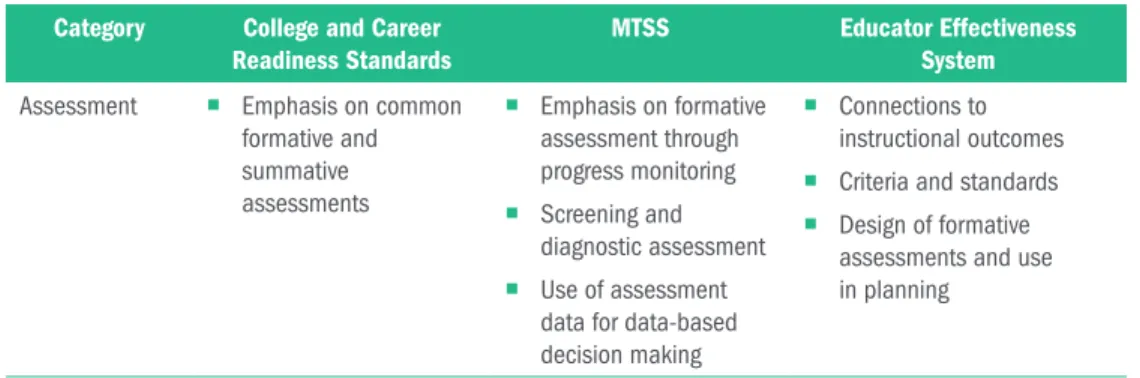
If college and career readiness standards represent the “what” of instruction and an MTSS represents “how” instruction is delivered, then educator effectiveness systems provide a means to assess how effectively educators deliver instruction that supports college and career readiness attainment. Educator effectiveness systems present both a challenge and an opportunity. Most observational frameworks—for example, Charlotte Danielson’s Framework for Teaching (Danielson Group, 2013) or the Marzano Center Teacher Observation Protocol (Marzano, Carbaugh, Rutherford, & Toth, 2014)—describe criteria for indicators of instructional quality. The challenge is that these indicators or elements of instructional practice must be broad enough to apply to a range of educators serving in a variety of settings while still specific enough to result in actionable feedback that can drive professional learning opportunities. If an educator effectiveness system relies on indicators of instructional quality that are not aligned with the indicators of instructional quality for college and career readiness standards and multi-tiered instruction, then the feedback resulting from the evaluation process will not be specific or actionable. Without targeted feedback, professional learning supports for teachers are disconnected from their practice. The type of evidence that educators are using to support their performance on indicators of instructional quality is a powerful opportunity for coherence across initiatives. Table 1 illustrates some of the broad connections for instructional practices across the three initiatives that can be used to provide evidence of effective implementation.
Table 1. Instructional Practices for Effective Implementation
Category College and Career
Readiness Standards MTSS Educator Effectiveness System
Assessment ¡ Emphasis on common
formative and summative assessments ¡ Emphasis on formative assessment through progress monitoring ¡ Screening and diagnostic assessment ¡ Use of assessment
data for data-based decision making
¡ Connections to
instructional outcomes
¡ Criteria and standards
¡ Design of formative
assessments and use in planning
17
A Framework for Coherence
College and Career Readiness Standards, Multi-Tiered Systems of Support, and Educator Effectiveness
A Framework for Coherence
College and Career Readiness Standards, Multi-Tiered Systems of Support, and Educator Effectiveness
Category College and Career
Readiness Standards MTSS Educator Effectiveness System
Instruction ¡ Instructional shifts ¡ Evidence-based
practices
¡ Scientifically validated
interventions
¡ Clear expectations for
learning and goal setting
¡ Explanations of content
¡ Questioning and discussion
techniques
¡ Student participation
¡ Opportunities for feedback
¡ Grouping of students
¡ Structure and pacing
Student Engagement
¡ Self-regulated learning ¡ Instructional
adjustments in response to student data and feedback
¡ Goal setting
¡ Student self-assessment
and monitoring of progress
¡ Opportunities for feedback
¡ Opportunities for reflection
Professional Collaboration
¡ Collaborative learning
and problem solving
¡ Structures for
collaboration (professional learning communities)
¡ Core building teams
¡ Grade-level teams
¡ Data teams
¡ Professional learning
communities
¡ Peer observation and
feedback ¡ Professional relationships with colleagues ¡ Ongoing professional learning Learning Environment
¡ School and classroom
climate
¡ Positive behavior
supports
¡ Establishing a culture of
learning
¡ Respect and rapport
¡ Managing classroom
procedures
¡ Managing student behavior
Cultural Responsiveness ¡ Culturally responsive instruction ¡ Culturally responsive instruction ¡ Culturally responsive expectations
¡ Family and student
communication
¡ Building relationships
WHY
is this important?
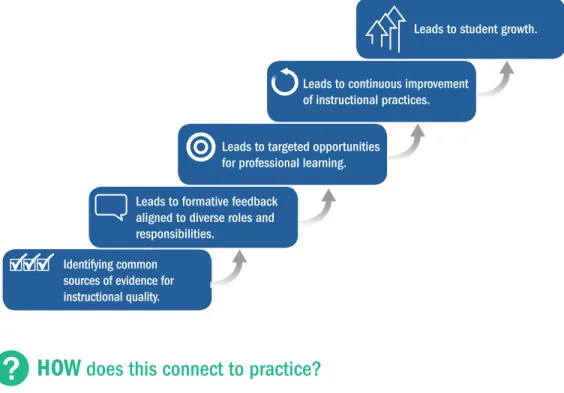
Identifying common sources of evidence for instructional quality within the context of an educator effectiveness system creates an aligned, integrated feedback loop that leads to continuous improvement of instruction and, ultimately, to student growth. By identifying common sources of evidence for instructional quality, educator effectiveness systems unite the instructional targets of college and career readiness standards within the delivery framework of an MTSS. An educator effectiveness system that purposefully identifies common sources of evidence for standards-aligned, multi-tiered instruction gives specific, actionable feedback that is more
closely aligned with the diverse roles and responsibilities of educators serving students with a variety of learning needs. When this feedback is used formatively, it can be used to inform the creation of professional learning supports that target the content and skills educators need to effectively teach all students, including the most at-risk learners. Formative feedback on indicators of instructional quality also helps to create professional learning opportunities that are personalized, job embedded, and differentiated across the career continuum. As shown through the graphic in Figure 2, this type of targeted professional learning can help teachers to continuously refine and improve their instructional practice and positively impact student growth.
Figure 2. Targeted Professional Learning
HOW
does this connect to practice?
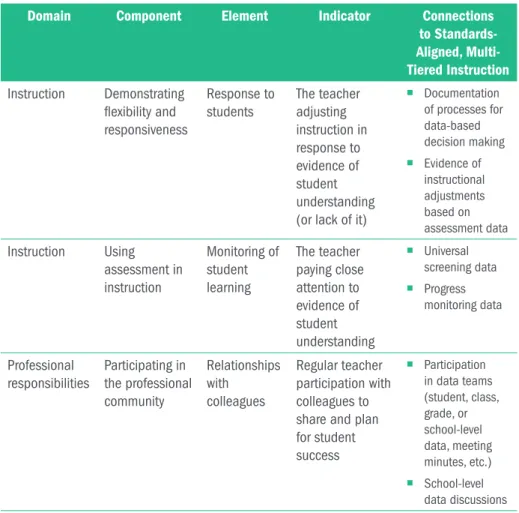
Connections between college and career readiness standards, MTSS, and educator effectiveness systems can be demonstrated at the level of individual practice. Practitioners, particularly at the state or local education agency levels, may find it helpful to situate these connections in the evaluation instrument or observational framework used in their state or district. The example that follows (Table 2) shows an excerpt from the 2013 edition of the Danielson Framework for Teaching (Danielson Group, 2013), which is a popular evaluation instrument in many states and districts across the country. The first four columns show the framework’s domains, components, elements, and indicators. The rightmost column connects
Identifying common sources of evidence for instructional quality.
Leads to formative feedback aligned to diverse roles and responsibilities.
Leads to targeted opportunities for professional learning.
Leads to continuous improvement of instructional practices.
19
A Framework for Coherence
College and Career Readiness Standards, Multi-Tiered Systems of Support, and Educator Effectiveness
A Framework for Coherence
College and Career Readiness Standards, Multi-Tiered Systems of Support, and Educator Effectiveness
essential components of standards-aligned, multi-tiered instruction that can serve as sources of evidence that the teacher is meeting the criteria in the performance indicators. By examining connections at the level of an evaluation instrument or observational framework, educators can identify common sources of evidence that document fidelity of standards-based, multi-tiered instruction and document evidence of effective practice within educator evaluation frameworks. Feedback generated from the evaluation process can be used to create coherent professional learning supports for educators that are responsive to the needs of teachers and students.
Table 2. Sources of Evidence for Standards-Aligned, Multi-Tiered Instruction in the Danielson Framework for Teaching
Domain Component Element Indicator Connections to Standards-Aligned, Multi-Tiered Instruction Instruction Demonstrating flexibility and responsiveness Response to students The teacher adjusting instruction in response to evidence of student understanding (or lack of it)
¡ Documentation of processes for data-based decision making ¡ Evidence of instructional adjustments based on assessment data Instruction Using assessment in instruction Monitoring of student learning The teacher paying close attention to evidence of student understanding ¡ Universal screening data ¡ Progress monitoring data Professional responsibilities Participating in the professional community Relationships with colleagues Regular teacher participation with colleagues to share and plan for student success ¡ Participation in data teams (student, class, grade, or school-level data, meeting minutes, etc.) ¡ School-level data discussions Danielson Group, 2013
Conclusion
College and career readiness standards, MTSS, and educator effectiveness systems impact teachers’ instructional practices and student learning through actions at all levels in the education system. When implemented coherently, these initiatives can be leveraged to:
¡ Create shared instructional focus
¡ Create better instructional supports for students
¡ Create better professional learning supports for teachers
Stakeholders, particularly classroom-based practitioners, school leaders responsible for educator evaluation, and state- and district-level policymakers, must purposefully consider the connections between these initiatives in order to maximize their impact. Articulating a framework for coherence is a first step in this challenging but necessary work and can serve as a starting point for practitioners and policymakers to do the following:
¡ Engage in more explicit and intentional instructional planning
¡ Refine and improve observation and feedback practices
¡ Develop targeted professional learning goals, outcomes, and plans for all educators
Forging conceptual connections between these initiatives creates a strong foundation for organizational and instructional coherence that will lead to a more supportive, sustainable, and successful environment for educators, and, ultimately, improved outcomes for students.
21
A Framework for Coherence
College and Career Readiness Standards, Multi-Tiered Systems of Support, and Educator Effectiveness
A Framework for Coherence
College and Career Readiness Standards, Multi-Tiered Systems of Support, and Educator Effectiveness
References
Center on Response to Intervention at American Institutes for Research. (2013). Response to intervention glossary of terms. Washington, DC: Author. Retrieved from http://www.rti4success.org/sites/default/files/CenterOnRTIGlossary.pdf Common Core State Standards Initiative. (2015). Standards in your state [Webpage].
Retrieved from http://www.corestandards.org/standards-in-your-state/ Danielson Group. (2013). The framework [Webpage]. Retrieved from http://
danielsongroup.org/framework/
EngageNY. (2012). Pedadgogcial shifts demanded by the Common Core State Standards [Webpage]. Retrieved from http://www.engageny.org/sites/default/ files/resource/attachments/common-core-shifts.pdf
Fuchs, L. S., Fuchs, D., Powell, S. R., Seethaler, P. M., Cirino, P. T., & Fletcher, J. M. (2008). Intensive intervention for students with mathematics disabilities: Seven principles of effective practice. Learning Disability Quarterly, 31(2), 79–92. Leo, S. F., & Coggshall, J. G. (2013). Creating coherence: Common core state
standards, teacher evaluation, and professional learning. Washington, DC: Center on Great Teachers and Leaders. Retrieved from http://www.gtlcenter.org/sites/ default/files/CreatingCoherence.pdf
Marzano, R. J., Carbaugh, B., Rutherford, A., & Toth, M. D. (2014). Marzano center teacher observation protocol for the 2014 Marzano teacher evaluation model. Blairsville, PA: Learning Sciences International. Retrieved from www.
marzanocenter.com/Teacher-Evaluation-2014-Model.pdf
National Center on Intensive Intervention. (n.d.). Designing and delivering intervention for students with severe and persistent academic needs (DBI Training Series Module 7). Retrieved from http://www.intensiveintervention.org/resource/designing-and-delivering-intensive-intervention-behavior-dbi-training-series-module-8
National Center on Intensive Intervention. (2014). Planning standards-aligned instruction within a multi-tiered system of support. Retrieved from http://www.intensiveintervention.org/sites/default/files/NCII_Standards_ ReadingComprehension.pdf
National Center on Response to Intervention. (2010). Essential components of RTI: A closer look at response to intervention. Washington, DC: U.S. Department of Education, Office of Special Education Programs, National Center on Response to Intervention.
Vaughn, S., Wanzek, J., Murray, C. S., Roberts, G. (2012). Intensive interventions for students struggling in reading and mathematics: A practice guide. Portsmouth, NH: RMC Research Corporation, Center on Instruction.
&
at American Institutes for Research
1000 Thomas Jefferson Street NW Washington, DC 20007-3835 877.322.8700
www.gtlcenter.org
www.air.org
Copyright © 2015 American Institutes for Research. All rights reserved.
This work was originally produced in whole or in part by the Center on Great Teachers and Leaders with funds from the U.S. Department of Education under cooperative agreement number S283B120021. The content does not necessarily reflect the position or policy of the Department of Education, nor does mention or visual representation of trade names, commercial products, or organizations imply endorsement by the federal government.