ISSN (Print) : 2320 – 3765 ISSN (Online): 2278 – 8875
I
nternational
J
ournal of
A
dvanced
R
esearch in
E
lectrical,
E
lectronics and
I
nstrumentation
E
ngineering
(An ISO 3297: 2007 Certified Organization)
Vol. 4, Issue 4, April 2015
GAIT RECOGNITION USING SVM and NN
Tavleen Kaur
#1, Dr.Rajneesh Talwar
*2Department of E.C.E & P.T.U, Jalandhar, India
ABSTRACT: Recognition of any individual is a task to identify people. Human recognition methods such as face, fingerprints and iris generally require a cooperative subject and close proximity or physical contact. These methods are not able to recognize an individual at a distance therefore recognition using gait is relatively new biometric technique without these disadvantages. Human identification using Gait is method to identify an individual by the way he walk or manner of moving on foot of human. Gait recognition is a type of biometric recognition and related to the behavioural characteristics of biometric recognition. Gait offers ability of distance recognition. Different parameters are used such as distance between head and pelvis and distance between feet and one another additional parameter used by us. However the majority of current approaches are model free which is simple and fast but we will use model based approach for feature extraction and for matching of parameters with database sequences. After matching of parameters CCR (Correct Classification Rate) will be obtained using SVM, NN technique. Some experimental results will show the effectiveness of proposed system.
KEYWORDS: Gait Recognition, SVM, NN and identification.
I. GAIT RECOGNITION
The identification through biometric is a better way because it associate with individual not with information passing from one place to another. The biometric is a field of technology that uses automated methods for identifying and verifying a human. In real time applications like in banks; airports; authentications and verifications are always required. In such type of applications biometric identification methods are used.
The biometric has two main characteristics:
A. Physiological:
These are biometrics which is derived from a direct measurement of a part of a human body. Then most prominent and successful of these types of measures that are Face, fingerprints, iris, palm print, DNA etc. These are related to body.
B. Behavioural:
Voice and Gait are related to behaviour of the person. Extract characteristics based on an action performed by an individual; they are an indirect measure of the characteristic of the human form. The main feature of a behavioural biometric is the use of time as a metric. Then established measures include keystroke-scan and speech patterns. Biometric identification should be an automated process. Therefore manual feature extraction would be both undesirable and time consuming; due to the large amount of data that must be acquired and processed in order to produce a biometric signature. And inability to automatically extract the desired characteristics which would render the process infeasible on realistic size data sets in a real-world application.
C. Gait Analysis:
Gait analysis is the systematic study of human locomotion; augmented by instrumentation for measuring body movements; body mechanics and the activity of the muscles. Gait based recognition is more suitable in video surveillance applications because of following advantages:
1. Recognition using gait do not need any user cooperation. 2. The gait of an individual can be captured at a distance. 3. Gait recognition does not require images of very High quality and provide good results in low resolution.
D. Approaches for Gait Recognition:
Some basic methods and approaches for gait recognition [10]:
ISSN (Print) : 2320 – 3765 ISSN (Online): 2278 – 8875
I
nternational
J
ournal of
A
dvanced
R
esearch in
E
lectrical,
E
lectronics and
I
nstrumentation
E
ngineering
(An ISO 3297: 2007 Certified Organization)
Vol. 4, Issue 4, April 2015
In this approach, gait is captured using a video-camera from a distance. Image and video processing techniques are employed to extract gait features for the purpose of recognition. For example stride, cadence, static body parameters extra.
D.2. Floor Sensor based gait recognition:
In this approach, a set of sensors or force plates are installed on the floor and such sensors enable to measure gait related features, when a person walks on them, e.g. maximum time value of heel strike and maximum amplitude value of the heel strike extra.
D.3. Wearable Sensor based gait recognition:
In this approach, gait is collected using body worn motion recording (MR) Sensors on human body. The MR sensors can be worn at different locations on the human body. The acceleration of gait, which is recorded by the MR sensor, is utilized for authentication [7, 8].
E. Steps of Gait Recognition System E.1. the Background Subtraction:
In this approach moving objects from background in the scene are identified first. Then some of the background subtraction techniques are applied on it .A common approach is to perform background subtraction; which identifies moving objects from the portion of video frame that differs from the background model. The background subtraction generates binary images containing black and white (moving pixels) also known as binary silhouettes. The background subtraction is a class of techniques for segmenting out objects of interest in a scene for applications such as surveillance. Therefore there are many challenges in developing a good background subtraction algorithm. 1st it must be robust against changes in illumination task. 2nd it should avoid detecting non-stationary background objects such as moving leaves; rain; snow and shadows cast by moving objects. And finally; its internal background model should react quickly to changes in background such as starting and stopping of vehicles.
E.2. Pre-processing:
Pre-processing is done on video frames to reduce presence of noise then some filters are applied which in turns blur the frames of image, which helps in shadow removal, after pre-processing motion detection is performed. Background subtraction technique uses the difference of current image and background to detect the motion. It delineates the foreground from background. Background subtraction generate binary image containing black (background) and white (moving pixel) then post processing is applied to obtain normalized silhouette images with less noise. They used morphological operators such as dilation and erosion to fill small holes inside silhouette and to filter small noise on the background. To reduce computational cost they proposed new silhouette representation method which only uses some of pixel on the contour.
E.3. Feature Extraction:
Feature extraction is a special form of dimensionality reduction. And when the input data is too large to be processed and it is suspected to be notoriously redundant (e.g. the same measurement in both feet) then the input data will be transformed into a reduced representation set of features (also named features vector). Then transforming the input data into the set of features is called feature extraction.
E.4. Recognition:
This is the final step of human identification using gait. In this step input videos are compared with sequences stored in database. Different types of classifiers are used for the recognition. Such as: MDA (Multi-linear Discriminant analysis) and LDA (Linear Discriminant Analysis). They use MDA approach to optimize the separability of gait features.
F. Gait Recognition System
System will identify unauthorized individual and compare his gait with stored sequences and recognize. The background subtraction is the common approach of gait recognition.
Using background subtraction, pre-processing is done to reduce noise. The background subtraction techniques are also classified into two types: non- recursive methods and recursive methods. Non recursive techniques use sliding window approach for background subtraction. The recursive methods use single Gaussian method and Gaussian mixture model. The Gait recognition method contains two parts
1. Training part 2. Testing part
ISSN (Print) : 2320 – 3765 ISSN (Online): 2278 – 8875
I
nternational
J
ournal of
A
dvanced
R
esearch in
E
lectrical,
E
lectronics and
I
nstrumentation
E
ngineering
(An ISO 3297: 2007 Certified Organization)
Vol. 4, Issue 4, April 2015
and the computer calculates the trajectory of each marker in three dimensions. And model is applied to calculate the movement of bones.
Applications of gait:
Gait recognition technology is not limited to security applications – researchers also envision medical applications. For example, recognizing changes in walking patterns early on can help to identify conditions such as Parkinson‟s disease and multiple sclerosis in their earliest stages.
i. Medical diagnostics: In computerized gait analysis and patient walks or run with sensors in his foot. The sensor sends some points of info- about foot pressure and timing and range of motion to computer and creates diagram. Doctor can review them and came up with treatmentplan.
ii. Biometric identification and forensics: Gait Pal and Pal Entropy Minor variations in gait style can be used as a biometric identifier to identify individual people.
II. SUPPORT VECTOR MACHINE
The theory of SVM is based on the idea of structural risk minimization. In many applications SVM has been introduced as a powerful tool for solving classification problems. There are many researchers have used SVM on gait recognition. It is to be noted that SVM is fundamentally a classifier of two-tier. SVM first maps the training samples into a high dimension space (typically much higher than the original data space) and then finds a separating hyper plane that maximizes the margin between two classes. Maximizing the margin is a quadratic programming (QP) problem and can be solved from its dual problem by introducing Lagrangian multipliers of technique. Without any knowledge of the mapping the SVM can find the optimal hyper plane by using the dot product functions in original space that are called kernels of image. There are several kernels proposed by researchers. Here we use radial basis function (RBF). Once the optimal hyper plane is established we can directly use a decision function to classify testing samples. For solving multi-class problems and various methods have been proposed for combining multiple two multi-classes SVMs in order to build a multi-class classifier such as „one-against-one‟ and „one-against-rest‟ methods. In this paper we use the one against-one method in which k (k*1) =2 classifiers are constructed and each one trains samples. In classification we use a voting strategy: each two-class SVM is considered as a voter (i.e. k (k * 1) =2 voters in all) and then each testing sample is classified to the class with maximum number of votes.
III. NEURAL NETWORK
ISSN (Print) : 2320 – 3765 ISSN (Online): 2278 – 8875
I
nternational
J
ournal of
A
dvanced
R
esearch in
E
lectrical,
E
lectronics and
I
nstrumentation
E
ngineering
(An ISO 3297: 2007 Certified Organization)
Vol. 4, Issue 4, April 2015
IV. RESULTS AND DISCUSSION
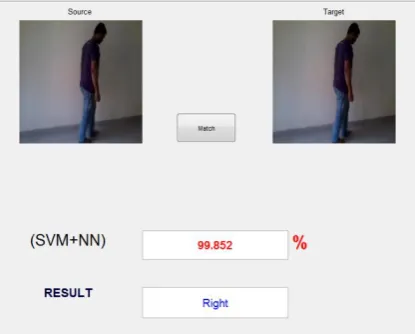
In the following figures, result of proposed algorithm is highlighted.
Figure 1: Correct Classification Rate
Figure 2: Comparison of Correct Classification Rate between previous and proposed technique
Figure 3: Matching between Source and Target image
V. CONCLUSION
ISSN (Print) : 2320 – 3765 ISSN (Online): 2278 – 8875
I
nternational
J
ournal of
A
dvanced
R
esearch in
E
lectrical,
E
lectronics and
I
nstrumentation
E
ngineering
(An ISO 3297: 2007 Certified Organization)
Vol. 4, Issue 4, April 2015
ACKNOWLEDGMENT
Thanks to my Guide and family member who always support, help and guide me during my dissertation. Special thanks to my father who always support my innovative ideas.
REFERENCES
[1] L. Wang, W. Hu, and T. Tan, “A New Attempt to Gait-Based Human Identification,” Proc. Int‟l Conf. Pattern Recognition, 2002.
[2] S. Stevenage, M. Nixon, and K. Vince, “Visual Analysis of Gait as a Cue to Identity,” Applied Cognitive Psychology, vol. 13, pp. 513- 526, 1999.
[3] S. Niyogi and E. Adelson, “Analyzing and Recognizing Walking Figures in XYT,” Proc. IEEE CS Conf. Computer Vision and Pattern Recognition, pp. 469-474, 1994.
[4] D. Cunado, M. Nixon, and J. Carter, “Using Gait as a Biometric, via Phase-Weighted Magnitude Spectra,” Proc. Int‟l Conf. Audio and Video-Based Biometric Person Authentication, pp. 95-102, 1997.
[5] J. Little and J. Boyd, “Recognizing People by Their Gait: The Shape of Motion,” Videre: J. Computer Vision Research, vol. 1, no. 2, pp. 2- 32, 1998.
[6] H. Murase and R. Sakai, “Moving Object Recognition in Eigen space Representation: Gait Analysis and Lip Reading,” Pattern Recognition Letters, vol. 17, pp. 155-162, 1996.
[7] P. Huang, C. Harris, and M. Nixon, “Human Gait Recognition in Canonical Space Using Temporal Templates,” IEE Proc. Vision Image and Signal Processing Conf., vol. 146, no. 2, pp. 93-100, 1999.
[8] A. Johnson and A. Bobick, “A Multi view Method for Gait Recognition Using Static Body Parameters,” Proc. Int‟l Conf. Audio and Video-Based Biometric Person Authentication, pp. 301-311, 2001.
[9] Y. Yang and M. Levine, “The Background Primal Sketch: An Approach for Tracking Moving Objects,” Machine Vision and Applications, vol. 5, pp. 17-34, 1992.
[10] Y. Kuno, T. Watanabe, Y. Shimosakoda, and S. Nakagawa, “Automated Detection of Human for Visual Surveillance System,” Proc. Int‟l Conf. Pattern Recognition, pp. 865-869, 1996.
[11] C. BenAbdelkader, R. Culter, H. Nanda, and L. Davis, “Eigen Gait: Motion-Based Recognition of People Using Image Self-Similarity,” Proc. Int‟l Conf. Audio- and Video-Based Biometric Person Authentication, pp. 284-294, 2001.
[12] R. Tanawongsuwan and A. Bobick, “Gait Recognition from Time- Normalized Joint-Angle Trajectories in the Walking Plane,” Proc. IEEE Conf. Computer Vision and Pattern Recognition, 2001.
[13] G. Shakhnarovich, L. Lee, and T. Darrell, “Integrated Face and Gait Recognition from Multiple Views,” Proc. IEEE Conf. Computer Vision and Pattern Recognition, 2001.
[14] A. Bobick and A. Johnson, “Gait Recognition Using Static, Activity-Specific Parameters,” Proc. IEEE Conf. Computer Vision and Pattern Recognition, 2001.