Implementations of CAESAR Candidates
Sachin Kumar · Jawad Haj-Yahya · Mustafa Khairallah · Mahmoud A. Elmohr · Anupam Chattopadhyay
Abstract Authenticated encryption with Associated Data (AEAD) plays a significant role in cryptography because of its ability to provide integrity, confidential-ity and authenticconfidential-ity at the same time. Due to the emer-gence of security at the edge of computing fabric, such as, sensors and smartphone devices, there is a growing need of lightweight AEAD ciphers. Currently, a world-wide contest, titled CAESAR, is being held to decide on a set of AEAD ciphers, which are distinguished by their security, run-time performance, energy-efficiency and low area budget. For accurate evaluation of CAE-SAR candidates, it is of utmost importance to have independent and thorough optimization for each of the ciphers both for their corresponding hardware and soft-ware implementations.
In this paper, we have carried out an evaluation of the optimized hardware implementation of AEAD ci-phers selected in CAESAR third round. We specifically focus on manual optimization of the micro-architecture, evaluations for ASIC technology libraries and the effect of CAESAR APIs on the performances. While these has been studied for FPGA platforms and standalone
S. Kumar, J. Haj-Yahya, and A. Chattopadhyay School of Computer Science and Engineering Nanyang Technological University
Singapore
E-mail: [email protected],[email protected], and [email protected]
M. Khairallah
School of Physical and Mathematical Sciences Nanyang Technological University
Singapore
E-mail: [email protected] M. A. Elmohr
Department of Electrical and Computer Engineering University of Waterloo
Ontario, Canada
E-mail: [email protected]
cipher implementation - to the best of our knowledge, this is the first detailed ASIC benchmarking of CAE-SAR candidates including manual optimization. In this regard, we benchmarked all prior reported designs, in-cluding the code generated by high-level synthesis flows. Detailed optimization studies are reported forNORX, CLOCandDeoxys-I. Our pre-layout results using com-mercial ASIC technology library and synthesis tools show that optimizedNORXis 40.81% faster and 18.02% smaller, optimizedCLOCis 38.30% more energy efficient and 20.65% faster and optimized Deoxys-I is 35.16% faster, with respect to the best known results. Similar or better performance results are also achieved for FPGA platforms.
Keywords ASIC Implementation·FPGA· Authen-ticated Encryption·Logic Optimization· Technology Mapping
1 Introduction
AEAD schemes protect both privacy and authenticity of the message when it is transformed into ciphertext where there may be additional information, such as a packet header, that travels alongside the ciphertext and must get authenticated with it. The need for AEAD emerged from the observation that securely combining a confidentiality mode with an authentication mode could be error prone and difficult [3, 24]. Number of practical attacks introduced into production protocols and applications by incorrect implementation, or lack, of authentication (including SSL/TLS)[4].
DK(AD, C), which either returns an invalid symbol⊥if the received ciphertext, associated data and the authen-tication data do not match, or the decrypted message M, otherwise. There are three main approaches which are adopted for AEAD: Encrypt then MAC (EtM), En-crypt and MAC (E&M) and MAC then EnEn-crypt (MtE) as shown in Figure 1. In September 2016, the CAESAR competition committee announced the selection of 15 AEAD schemes as candidates for round 3 of the CAE-SAR competition [10]. This competition signifies the current need for practical, secure and efficient AEAD schemes.
In the survey presented in [1], the round two candidates of the CAESAR competition were cate-gorized into five families on the basis of their base constructions: block cipher-based, stream cipher-based, key-less permutations, hash-function-based and dedi-cated schemes. AEAD ciphers based on block-cipher allows block-level parallelism while using the underly-ing block cipher, such as the Offset Code Book mode (OCB) [30, 29, 25], the Synthetic Counter-in-Tweak mode (SCT) [27] and the Offset Two-Round mode (OTR) [26]. An important aspect of the study of AEAD schemes is the evaluation of their hardware performance, which clearly needs more efforts. So far, nearly all candi-dates have been supported with a basic hardware imple-mentation [14]. However, the impleimple-mentations are done on various platforms, for different interfaces. Further-more, several designs have unique advantages to offer in some platforms, e.g., Field Programmable Gate Array (FPGA). However, FPGA boards are mainly used for verification of the design with the help of programmable gates but it does not provide actual performance met-rics of the design which can only be achieved by imple-menting the design in Application-Specific Integrated Circuits (ASIC). In addition, all the available hardware implementations of the CAESAR competition candi-dates on the ATHENa hardware evaluation website [14] are fully sequential implementations, i.e. to start pro-cessing a new block, all the previous blocks have to be finished. These implementations do not take full advan-tage of the specific characteristics of the schemes based on the aforementioned modes.
Generally, circuit optimization consists of two phases: logic synthesis and technology mapping. For certain target technologies, such as FPGA, logically op-timized circuits do not provide the optimal mapping to the underlying technology, leaving behind a lot of under-utilized hardware resources. This phenomenon is obvious in theAESSbox circuits proposed by Boyar [8, 9], which are logical optimizations of the circuit pro-posed by Canright [12]. These circuits are much smaller than the straight-forward ROM-based Sbox in terms of
gate count and circuit depth. These two features make them the natural choice for low area ASIC implementa-tions ofAES. Interestingly, on the other hand, practical results show that one can achieve a smaller area on FPGA by using the ROM approach [28].
1.1 Contribution
In this paper, hardware evaluation of AEAD ciphers selected in third round of CAESAR competition has been carried out. For ASIC synthesis, we applied delay-optimized and area-constrained synthesis techniques, i.e., in the former case, all AEAD ciphers are kept running until slack is zero in order to achieve maxi-mum speed while in the latter case, all designed are constrained to achieve minimum hardware area at par-ticular frequency. In what follows, benchmarking for both cases have been reported which includes critical path delay (ns), area in Kilo-Gate Equivalent (KGE), throughput (Gbps), throughput per area. Besides that, all AEAD ciphers are compared in terms of throughput per KGE and as well as throughput per energy.
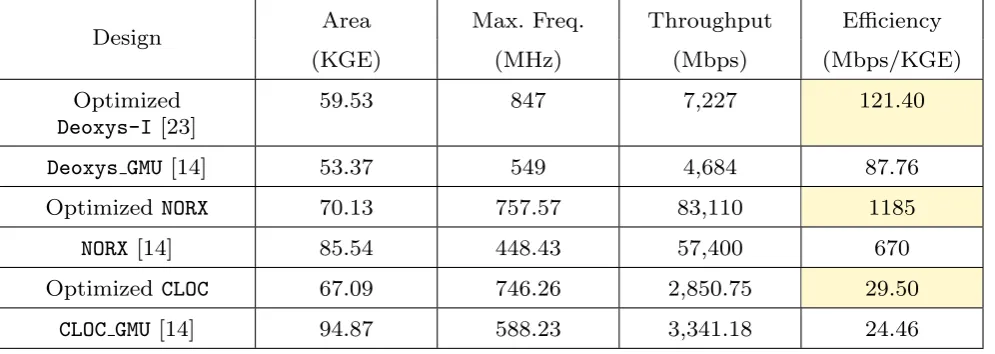
Apart from providing the ASIC benchmarking, de-tailed optimization studies are reported forNORX,CLOC andDeoxys-I. Our pre-layout results using commercial ASIC technology library and synthesis tools show that optimized NORX is 40.81% faster and 18.02% smaller, optimized CLOC is 38.30% more energy efficient and 20.65% faster and optimizedDeoxys-Iis 35.16% faster, with respect to the best known results as depicted in Table 1.
In addition, the effect of CAESAR APIs on perfor-mance might be significant as the use of API favors iterative implementations. The overhead of API was analyzed and its effect on the overall performance of the ciphers have been discussed in this paper. More-over, qualitative analysis has been carried out about the effect of technology-mapping and technology aware optimization on the cipher performance. The reason be-ing that some of the optimization fit more for FPGA and other suitable for ASIC, while the current hard-ware benchmarking in the CAESAR competition uses only one circuit for all technologies.
1.2 Organization
Plaintext
Encryption
Hash function
Key
Ciphertext MAC
(a)
Plaintext
Encryption
Hash
function
Key
Ciphertext MAC
(b)
Plaintext
Encryption
Hash
function
Key
Plaintext MAC
Ciphertext
Encrypt-then-MAC (EtM)
Encrypt-and-MAC (E&M)
(c)
MAC-then-Encrypt (MtE)
Fig. 1: Approaches to Authenticated Encryption with Associated Data
Table 1: Synthesis results of theDeoxys-I-128,NORX andCLOCimplementation using TSMC 65nm technology
Design
Area
Max. Freq.
Throughput
Efficiency
(KGE)
(MHz)
(Mbps)
(Mbps/KGE)
Optimized
Deoxys-I
[23]
59.53
847
7,227
121.40
Deoxys GMU
[14]
53.37
549
4,684
87.76
Optimized
NORX
70.13
757.57
83,110
1185
NORX
[14]
85.54
448.43
57,400
670
Optimized
CLOC
67.09
746.26
2,850.75
29.50
CLOC GMU
[14]
94.87
588.23
3,341.18
24.46
ASIC are presented in section 3. In section 4, Optimized NORX,Deoxys,CLOCdesigns as a case study are reported along with their simulation results. Section 5 provides the optimization techniques with respect to technology aware. Section 6 presents the influence of CAESAR API on the performance of the design. At the end, the paper has been summarized in the subsequent section.
2 Related work and motivation
AEAD Ciphers: Authenticated Encryption (AE) is a
concept that emerged in the cryptographic community in early 2000s, due to the need for both data privacy and authentication at the same time. In 2000, Charan-jit S. Jutla [22] proposed two Encryption modes that also provide message integrity. In 2009, six more modes
were standardized by NIST in the ISO/IEC 19772:2009 standard [19]. In 2013, The CAESAR Competition for Authenticated Encryption: Security, Applicability, and Robustness was announced in order to encourage the design of AE algorithms. In round 1, 57 different pro-posals have been submitted to the competition. Out of these 57 submissions, only 28 submissions qualified to the second round. FPGA implementations of all the 28 candidates have been developed and benchmarked for comparison. In September 2016, 15 candidates have been selected for the third round of the competition. To the best of our knowledge, no studies have been publicly published on the ASIC benchmarking of the candidates.
FPGA Benchmarking: The Cryptographic Engineering
ATHENa [14] aimed at fair, comprehensive, and auto-mated evaluation of hardware cryptographic cores tar-geting FPGAs, Systems on Chip, and ASICs. One of their on-going projects is the comparison of FPGA im-plementations of the CAESAR competition candidates. They have also provided high-speed round-based imple-mentations of round 2 and 3 candidates. The most re-cent benchmarking results are published in [17], where the authors provided a summary of available implemen-tations for round 3 candidates that are either designed by the CERG research group or other members of the cryptographic community. The benchmarking process was performed only for FPGA and some of the designs were implemented using High-Level Synthesis (HLS) as opposed to manual Register-Transfer-Level (RTL) de-sign [18]. Moreover, only the implementations that are compliant with the CAESAR Hardware API [16] were considered. The authors of [18] and [17] adopted a few assumptions that motivated their benchmarking pro-cess. These assumptions include:
– The rankings of different implementations will be the same regardless of whether the benchmarking is done using FPGA or ASIC.
– The rankings of different implementations will be the same regardless of whether the benchmarking is done using HLS or manual RTL.
– It is only fair to compare implementations with the same hardware API.
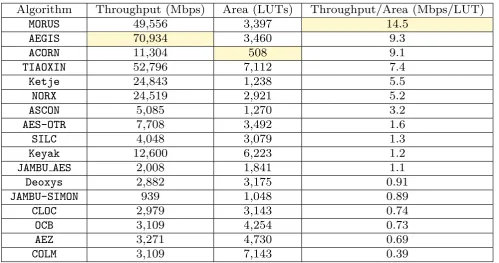
Table 2 shows one example of the FPGA bench-marking results targeted for Xilinx Virtex-6 FPGA, or-dered descending according to the efficiency (through-put/area).
Motivation: Since the assumptions mentioned earlier
are crucial to the benchmarking process, in this pa-per we discuss their validity. The first challenge to these assumptions was discussed in [23]. The authors in [23] showed that manual algorithm-specific optimiza-tion and the use of a customized API can lead to sig-nificant gains for these algorithms. Additionally, they showed, using preliminary experimentation, that the rankings from FPGA benchmarking do not extend to ASIC with no change. In fact, ASIC benchmarking should be conducted in a separate process, in addi-tion to FPGA benchmarking. These observaaddi-tions mo-tivated the investigation of the benchmarking process and challenging the previously well-established assump-tions. The results of this investigation are discussed in details in sections 4, 5 and 6. However, in the prepara-tion of ASIC benchmarking, we adopted the currently agreed API in order to be consistent with other bench-marking efforts. Nevertheless, we show how the relax-ation of API can lead to a very different benchmarking
results, which, however, remains consistent to general IC design practices.
3 ASIC Implementation of AEAD ciphers
There are mostly fifteen AEAD ciphers without consid-ering their variants in third round of CAESAR compe-tition [10]. AEGIS is one of them which is constructed by employingAESencryption round function except not considering the last round of it. The variantsAEGIS-128 andAEGIS-256 are required 5AESround functions and 6 AESround functions respectively in order to process 16 bytes message block. It was claimed by designers that AEGIS is faster than AES as its computational cost is half ofAES. Another authentication algorithm submit-ted to CAESAR known asAEZ which is mainly devel-oped with the help of AES primitives and enciphering schemes. In this algorithm, the plaintext is appended with a fixed authentication block. Its resulting strings is enciphered with an arbitrary-input-length block cipher which gets tweaked by the nonce and associated data (AD). This process results in strong security and us-ability properties such as nonce-reuse misuse resistance, user selectable ciphertext expansion. While both SILC andCLOCare designed by the same authors whereSILC stands for simple lightweight CFB andCLOC stands for compact low-overhead CFB. Both block ciphers are de-veloped for authenticated encryption with associated data (AEAD). It is claimed by the submitters thatCLOC design is targeted mainly for being secure and optimiz-ing its implementation costs. It can handle short-data input efficiently and is suitable for use with embedded processors. SILCis further development ofCLOC which aims at optimizing the hardware implementation cost of it. It is mainly appropriate for constrained hardware devices. CLOC is based on the AESblock cipher for 16-byte block length and TWINE block cipher [31] for 8-byte block length whereasSILCis constructed with the help of AES block cipher for 16-byte block length and present[7] andLED [15] for 8-byte block length.
Table 2: FPGA Benchmarking Results of Round 3 Candidates of the CAESAR Competition
Algorithm
Throughput (Mbps)
Area (LUTs)
Throughput/Area (Mbps/LUT)
MORUS
49,556
3,397
14.5
AEGIS
70,934
3,460
9.3
ACORN
11,304
508
9.1
TIAOXIN
52,796
7,112
7.4
Ketje
24,843
1,238
5.5
NORX
24,519
2,921
5.2
ASCON
5,085
1,270
3.2
AES-OTR
7,708
3,492
1.6
SILC
4,048
3,079
1.3
Keyak
12,600
6,223
1.2
JAMBU AES
2,008
1,841
1.1
Deoxys
2,882
3,175
0.91
JAMBU-SIMON
939
1,048
0.89
CLOC
2,979
3,143
0.74
OCB
3,109
4,254
0.73
AEZ
3,271
4,730
0.69
COLM
3,109
7,143
0.39
which leads to be two times faster thanAES-128 and 3.5 to 6.5 times faster than AES-GCM. The authors men-tioned that it has been analyzed for various attacks and provides full security nonce-respecting adversaries. TheAES-128 based AEAD cipher named asOCB- which stands for ”offset codebook” - is a block-cipher mode of operation for efficient authenticated encryption. This cipher is designed to be provably secure and operations performed are in parallel which allows both software and hardware acceleration. Besides this, it has static associated data (AD) feature which means when AD remains unchanged during series of encryption, there is no need to perform operation on AD each time. This results in reducing computational cost when multiple encryption are linked with the same associated data.
A new authenticated encryption design known as Deoxys is based on a tweak-able block cipher Deoxys-BCby employingAESround function as a build-ing block. It has two authenticated encryption modes i.e. Deoxys-I in which nonces are non-repeatable and Deoxys-IIin which nonces can be repeated. It has been claimed by the designers thatDeoxysprovides sufficient protection against linear crypt-analysis in single key model and security against other attacks due to hav-ingDeoxystweakey schedule. Some AEAD ciphers such as ASCON, Ketje and NORX are designed with the help of sponge function and its sister construction-known as duplex construction. InASCON, there are five states with the size of 64 bits with stronger keyed initialization and
andKeyak riverwhich are distinguished by permuta-tion width.Ketje builds on round-reduced versions of Keccak-f. The main advantage of Monkey Duplex based ciphers is that it can support different number of calls which eventually helps to invoke the permutation with a different number of rounds. This results in improving the performance of the AEAD schemes by optimizing the number of rounds aggressively.
One more lightweight cipher known asACORNis basi-cally a bit-based sequential authenticated cipher based on linear feedback shift register (LFSR). InACORN, the difference is injected into the state for authentication for better performance. This type of authentication en-cryption cipher is designed with the help of bit-based sequential stream cipher for the first time. High au-thentication security is achieved by employing six con-catenated linear feedback shift registers. In addition, ACORN also allows parallel computation. In ACORN, 32 steps can be computed in parallel which benefits high-speed hardware and software implementation. It was claimed by the designer that ACORN-128 is more hard-ware efficient than TRIVIUM [11] and AES-GCM. One more selected third round candidate,MORUSis suitable both for hardware and software efficient implementa-tion. It has three versions;MORUS-640-128, MORUS-1280-128 andMORUS-1280-256 where the first number denotes the state size (in bits) while second number denotes the key size in bits. InMORUS, state function is divided into five vectors where size of each vector is either 128-bit or 256-bit depends on the selected variants. There are four operation used inMORUS, namely XOR, AND, ro-tation in words and roro-tation in subwords. State update function has five similar rounds. Every round modifies two registers; one is modified by rotation in words while other one is with the help of ANDs, XORs and rotation in subwords. In addition,MORUSencryption can be seen as stream cipher with a large state which is kept up-dating continuously in a nonlinear way.
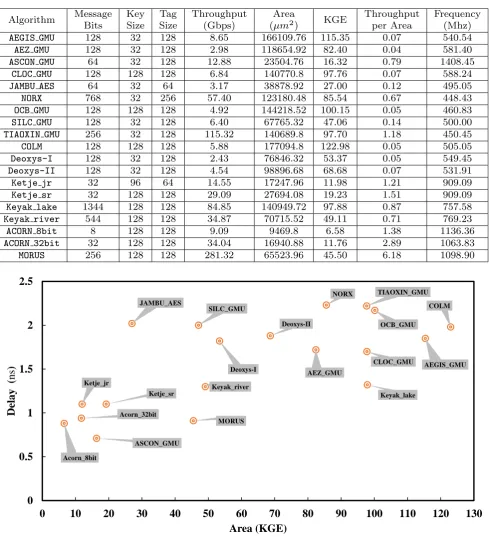
Some of above-mentioned AEAD ciphers (denoted as cipher GMU) are described in VHDL language by ATHENa-Automated Tool for Hardware EvaluatioN while rest are done by the designer themselves. All the above-mentioned AEAD ciphers are functionally ver-ified by Mentor Graphics ModelSim with the help of given test vectors. Each design is synthesized for min-imum delay as well as for minmin-imum hardware-area at minimum clock frequency by Synopsys Design Compiler version J-2014.09 using TSMC 65 nm technology stan-dard cell library. In Table 3, lists the throughput(Gbps), critical path delay (ns), area (KGE) and through-put per area etc. parameters of all above-mentioned AEAD ciphers by keeping the constraint for speed-optimization. The calculation of throughput has been
done by number of cyclesmessage size ×clock period in which num-ber of cycles have been considered from the ATHENa as to have accurate calculation of throughput.
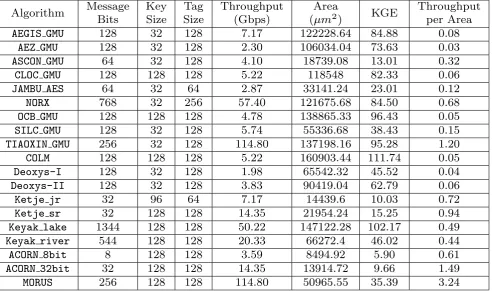
Since there is always a trade-off between area and delay, for area-optimization process, timing constraint is usually kept unchanged in order to achieve more re-alistic performance of the design. In what follows, the minimum frequency has been selected from Table 3 which is 448.43 Mhz and then the constraint to achieve minimum hardware area is applied to design compiler tool with the selected frequency. Table 4 lists the hard-ware area, throughput per area etc. of all the ciphers. With this constraint, it can easily be noticed that syn-thesis area has been reduced as compared with Table 3. In addition, the trend of hardware area performance at the given frequency of all AEAD ciphers is shown in Fig 3. Apart from listing synthesis results for speed optimization as well as for area optimization in Table 3 and Table 4, a comparison between area and criti-cal path delay has been carried out as shown in Fig-ure 2 by which one can easily visualize optimal perfor-mance of the ciphers for instances;ASCON GMUis smaller and faster among all other AEAD ciphers while COLM is consuming largest hardware area but its faster than TIAOXIN GMUwhich is slowest one among all mentioned ciphers.
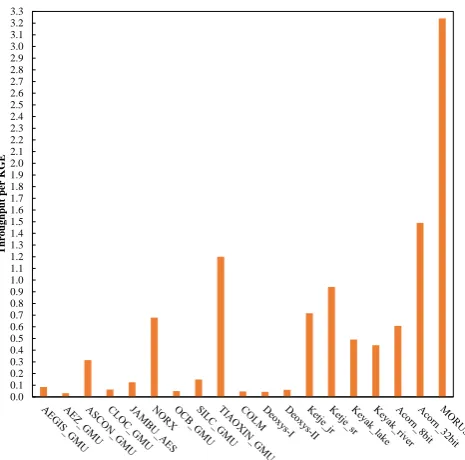
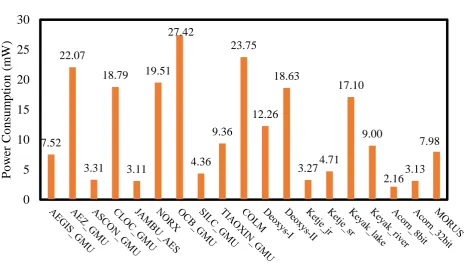
Figure 4 shows the trend of throughput per KGE of all the AEAD ciphers. Apart from that, power simula-tion is also computed from design compiler for all the ciphers as shown in Figure 5. Since the critical path delays of all designs in comparison are different for all the ciphers, to ensure that all designs will produce the correct outputs at the same data rate, the clock rate used for the power simulation is chosen based on the slowest design for each. One can notice from Figure 5, ACORN 8bit cipher is found to be most power-efficient whileOCB GMUdesign is the most power-hungry among all the designs.
Table 3: Synthesis results of AEAD ciphers implementation using TSMC 65nm technology at minimum achievable delay.
Algorithm Message Bits
Key Size
Tag Size
Throughput (Gbps)
Area
(µm2) KGE
Throughput per Area
Frequency (Mhz)
AEGIS GMU 128 32 128 8.65 166109.76 115.35 0.07 540.54
AEZ GMU 128 32 128 2.98 118654.92 82.40 0.04 581.40
ASCON GMU 64 32 128 12.88 23504.76 16.32 0.79 1408.45
CLOC GMU 128 128 128 6.84 140770.8 97.76 0.07 588.24
JAMBU AES 64 32 64 3.17 38878.92 27.00 0.12 495.05
NORX 768 32 256 57.40 123180.48 85.54 0.67 448.43
OCB GMU 128 128 128 4.92 144218.52 100.15 0.05 460.83
SILC GMU 128 32 128 6.40 67765.32 47.06 0.14 500.00
TIAOXIN GMU 256 32 128 115.32 140689.8 97.70 1.18 450.45
COLM 128 128 128 5.88 177094.8 122.98 0.05 505.05
Deoxys-I 128 32 128 2.43 76846.32 53.37 0.05 549.45
Deoxys-II 128 32 128 4.54 98896.68 68.68 0.07 531.91
Ketje jr 32 96 64 14.55 17247.96 11.98 1.21 909.09
Ketje sr 32 128 128 29.09 27694.08 19.23 1.51 909.09
Keyak lake 1344 128 128 84.85 140949.72 97.88 0.87 757.58
Keyak river 544 128 128 34.87 70715.52 49.11 0.71 769.23
ACORN 8bit 8 128 128 9.09 9469.8 6.58 1.38 1136.36
ACORN 32bit 32 128 128 34.04 16940.88 11.76 2.89 1063.83
MORUS 256 128 128 281.32 65523.96 45.50 6.18 1098.90
AEGIS_GMU AEZ_GMU
ASCON_GMU
CLOC_GMU JAMBU_AES
NORX
OCB_GMU SILC_GMU
TIAOXIN_GMU
COLM
Deoxys-I
Deoxys-II
Ketje_jr
Ketje_sr Keyak_lake
Keyak_river
Acorn_8bit
Acorn_32bit
MORUS
0
0.5
1
1.5
2
2.5
0
10
20
30
40
50
60
70
80
90
100
110
120
130
Dela
y
(
ns
)
Area (KGE)
Fig. 2: A comparative analysis of CAESAR third round candidates in terms of synthesis area (KGE) and delay(ns) in ASIC.
4 Cipher Optimization: Architectural
84.88
73.63
13.01 82.33
23.01 84.50
96.43
38.43 95.28
111.74
45.52 62.79
10.03 15.25
102.17
46.02
5.90 9.66 35.39
0 20 40 60 80 100 120
K
G
E
Fig. 3: Synthesis area (KGE) analysis of CAESAR third round candidates at particular frequency (based on the slowest among the ciphers) based on ASIC implementation results.
0.0 0.1 0.2 0.3 0.4 0.5 0.6 0.7 0.8 0.9 1.0 1.1 1.2 1.3 1.4 1.5 1.6 1.7 1.8 1.9 2.0 2.1 2.2 2.3 2.4 2.5 2.6 2.7 2.8 2.9 3.0 3.1 3.2 3.3
T
hro
ug
hp
ut
per
K
G
E
Fig. 4: Analysis of AEAD ciphers in terms of through-put per KGE based on ASIC results at particular fre-quency (based on the slowest among the ciphers).
raises the abstraction level for designing digital circuits. With the increasing complexity of embedded systems, these tools are particularly relevant in embedded sys-tems design. HLS proved to be very easy to use for creating a functional RTL design. While in many cases, HLS does not perform well in resource utilization and in many cases it provided a design with a slower maximum clock frequency relative to manual RTL coding[32]. In the paper [6], the various optimization points for area, speed as well as for throughput are presented forAEGIS which shows that there is large room for improvements over automatically generated implementations to im-prove the performance of AE ciphers selected in the third round of CAESAR. Therefore, in this section, manual optimization is carried out onNORX, CLOC and Deoxys-Ibased on the provided hardware architecture either from GMU or from designers itself.
4.1CLOC
7.52
22.07
3.31
18.79
3.11
19.51
27.42
4.36
9.36
23.75
12.26
18.63
3.27
4.71
17.10
9.00
2.16
3.13
7.98
0
5
10
15
20
25
30
P
o
w
er
C
o
n
su
m
p
tio
n
(
m
W
)
Fig. 5: Power consumption (mW) of AEAD ciphers in ASIC.
-2 0 2 4 6 8 10 12 14 16 18
0 1 2 3 4 5 6 7
Throughpu
t p
er ener
gy
Throu
ghpu
t p
er
area
Throughput per area Throughput per energy
Fig. 6: Analysis of AEAD ciphers in terms of throughput per KGE with respect to throughput per energy based on ASIC synthesis results.
ofCLOCby removing the redundancy from VHDL code generated from HLS. The undesired AES block is re-moved fromCLOCdesign with the help of pipeline tech-nique. Both CLOC GMU and Optimized CLOC are
Table 4: Synthesis area analysis using TSMC 65nm technology at the minimum frequency (448.43 Mhz).
Algorithm
Message
Bits
Key
Size
Tag
Size
Throughput
(Gbps)
Area
(
µm
2)
KGE
Throughput
per Area
AEGIS GMU
128
32
128
7.17
122228.64
84.88
0.08
AEZ GMU
128
32
128
2.30
106034.04
73.63
0.03
ASCON GMU
64
32
128
4.10
18739.08
13.01
0.32
CLOC GMU
128
128
128
5.22
118548
82.33
0.06
JAMBU AES
64
32
64
2.87
33141.24
23.01
0.12
NORX
768
32
256
57.40
121675.68
84.50
0.68
OCB GMU
128
128
128
4.78
138865.33
96.43
0.05
SILC GMU
128
32
128
5.74
55336.68
38.43
0.15
TIAOXIN GMU
256
32
128
114.80
137198.16
95.28
1.20
COLM
128
128
128
5.22
160903.44
111.74
0.05
Deoxys-I
128
32
128
1.98
65542.32
45.52
0.04
Deoxys-II
128
32
128
3.83
90419.04
62.79
0.06
Ketje jr
32
96
64
7.17
14439.6
10.03
0.72
Ketje sr
32
128
128
14.35
21954.24
15.25
0.94
Keyak lake
1344
128
128
50.22
147122.28
102.17
0.49
Keyak river
544
128
128
20.33
66272.4
46.02
0.44
ACORN 8bit
8
128
128
3.59
8494.92
5.90
0.61
ACORN 32bit
32
128
128
14.35
13914.72
9.66
1.49
MORUS
256
128
128
114.80
50965.55
35.39
3.24
and 20.60% gain in throughput per area when com-pared withCLOC GMUdesign.
4.2Deoxys
Deoxys is an interesting case study as it belongs to a subset of the CAESAR competition candidates that are amenable to parallelisation, i.e. different message blocks can be processed in parallel. This subset also include candidates such as: AEGIS, COLM, MORUS and OCB. Four of these five candidates are AES-based (ex-cept MORUS), so it is believed that any significant im-provement to the implementation of any of these al-gorithms will also benefit the other three alal-gorithms. We have implemented the Deoxys-I-128 4-stream ar-chitecture from [23] with full compliance to the CAE-SAR Hardware API. While that architecture is origi-nally targeted towards FPGA implementations, it was found that it also enhances the ASIC results, leading to 11.5% smaller area, 54.3% higher speed and 38.3% higher efficiency. The significance of these results is that it shows that parallelisation should be considered while performing benchmarking of different candidates. Be-sides, it shows that the FPGA and ASIC are not match-ing, as the API compliance reduces the performance of this architecture on FPGA as mentioned in [23], but
the ASIC design tools where able to optimize the API control unit to keep up with the high speed data path.
4.3NORX
In order to show the optimization potential for the au-tomatically generated code of the ciphers, we have per-formed hardware optimization for the NORX cipher as well with manual changes.
Table 5: Performance analysis ofCLOC GMUand OptimizedCLOC implemented by using TSMC 65nm technology.
AEAD Ciphers Delay (ns)
Frequency (Mhz)
Area
(µm2) KGE
Energy (pJ)
Throughput (Mbits/s)
Throughput per Area Optimized
CLOC 1.34 746.26 96605.28 67.09 26.25 2850.75 29.50
CLOC GMU 1.70 588.23 136618.56 94.87 42.55 3341.18 24.46
Improvement 21.17% 26.86% 29.29% 29.29% 38.30% -14.67% 20.60%
Table 6: Synthesis results of theDeoxys-I-128 implementation using TSMC 65nm technology
Impl. Area (KGE) Max. Freq. (Mhz)
Throughput (Mbps)
Efficiency (Mbps/KGE) OptimizedDeoxys 59.53 847 7,227 121.40
Deoxys GMU 53.37 549 4,684 87.76
Improvement -11.5% 54.3% 54.3% 38.3%
Table 7: Synthesis results of Optimized-NORXandNORX[14] implemented using TSMC 65nm technology at minimum delay.
AEAD Ciphers Delay (ns)
Frequency (Mhz)
Throughput (Gbps)
Area
(µm2) KGE Throughput/Area OptimizedNORX 1.32 757.57 83.11 100988.64 70.13 1.185
NORX[14] 2.23 448.43 57.40 123180.48 85.54 0.67 Improvement 40.8% 68.9% 44.8% 18.0% 18.0% 76.9%
Table 7 shows that with the optimized version of NORX, the Throughput is 44.8% higher than the original NORXwhile the area was reduced by 18%. Furthermore, it can be seen that the throughput per area metric was improved by 76.9% at the optimizedNORXcompared to the standardNORX architecture.
The synthesis area of NORX is further reduced by 36.7% when performing the simulation at minimum fre-quency (maximum time between both designs). The ef-ficiency (throughput per area) of optimizedNORXis im-proved by 37.3%.
4.4 Comparison between ASIC based results and FPGA based results
In addition, to have performance comparison in ASIC, optimized NORXand CLOC have also been implemented on FPGA platform (Virtex 6). In Table 9, the pre-layout results based on FPGA of both ciphers are tab-ulated along with its contenders. Optimized NORX is 39.13% faster and improved 30% throughput per area, 4% gain in throughput but requires 8% more area when compared with its contender while, based on ASIC re-sults, optimized NORX achieves 44.8% gain in through-put, 18% reduction in area and throughput per area metric improved by 76.9%. Similarly, based on FPGA result, optimized CLOC is faster by 3.4%, reduction in
area by 5.4% but throughput per area is reduced by 26.42%. ASIC based results show that optimized CLOC outperformed in terms of area, speed and through-put per area. These results prove that synthesis results based on FPGA are different from the results obtained from ASIC technology library. In addition, the analysis of throughput per area based on ASIC results as well as on FPGA results has been carried out for third round of CAESAR candidates in Figure 7.
0 2 4 6 8 10 12 14 16
0 250 500 750 1000 1250 1500 1750 2000 2250 2500 2750 3000 3250 3500
T
hro
ug
hp
ut
per
Ar
ea
(
M
bp
s/S
lice
)
T
h
ro
u
h
g
p
u
t
p
er
Ar
ea
(
M
b
p
s/K
G
E
) Based on ASIC Based on FPGA
Table 8: Synthesis area of OptimizedNORXandNORX at 448.43 Mhz based on ASIC results.
AEAD Ciphers Throughput (Gbps)
Area
(µm2) KGE Throughput/Area OptimizedNORX 49.20 77057.28 53.51 0.92
NORX[14] 57.40 121675.68 84.50 0.67
Improvement 36.7% 36.7% 37.3%
Table 9: Synthesis results based on FPGA ofNORXandCLOC
Design Max. Freq. Area(slice) Throughput(Mbps) Throughput/Area
(Mbps/slice)
NORX
OptimizedNORX 320 2398 40,960 17.09
NORX[14] 230 2226 29,440 13.22
Improvement 39.13% -8% 39.13% 29.3%
CLOC
OptimizedCLOC[13] 182 595 695.24 1.17
CLOC GMU[14] 176 629 999.68 1.59
Improvement 3.4% 5.41% -30.45% -26.42%
5 Cipher Optimizations: Technology-Aware
Another factor of hardware benchmarking is technology-mapping and/or technology aware op-timization. For example, optimizing architectures and circuits for ASIC implementations uses different techniques as opposed to other technologies such as FPGA. The main reason is that FPGA does not use logic gates as the building unit. It uses fixed size (e.g. 6-to-1) LUT-FF pairs. This issue has been extensively studied in [23]. The results showed that the efficiency of AES FPGA implementations can be almost doubled by using FPGA-specific optimization techniques. Again, this optimization had to be manually implemented as the HLS synthesis tools and the FPGA RTL opti-mization tools are not short enough to invoke them. However, the current trend in cryptographic hardware benchmarking, specially in the CAESAR competition is to use a ”one size fits all” approach, where most of the time only one circuit is developed per algorithm and used for all technologies.
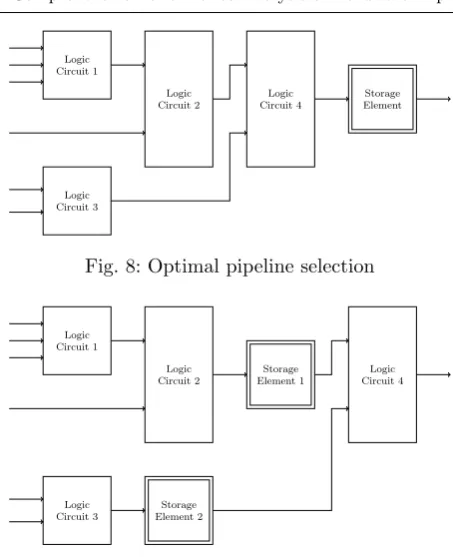
One of the examples where FPGA Technology-Aware design can be used to achieved huge efficiency gains is the pipeline retiming. Pipelining has been used by hardware designers/architects as a tool to increase throughput/run-time performance for a long time. However, a fully pipelined block cipher imple-mentations can be costly, due to the large area require-ments. A more realistic approach is to use multi-stream implementations. These implementations start from a sequential implementation that processes one block in
C cycles, and divides it into N pipeline stages. This leads to computing x blocks in N · C cycles, where x∈ {1,2, ..., N}. xdepends on the number of indepen-dent block streams the user can leverage. However, this is a double-edged weapon, due to the following reasons: 1. The time required to process one block in a sequen-tial implementation is∼C·T, whereTis the critical path delay of the implementation. If theN pipeline stages divide the critical path evenly into segments of T
N delay, the time required to process N blocks becomesT+t, wheretis a small overhead, leading to
∼Nx speed-up. Unfortunately, the critical path is usually not evenly divided, leading to a sub-optimal speed-up (< N).
Logic Circuit 1
Logic Circuit 2
Logic Circuit 3
Logic Circuit 4
Storage Element
Fig. 8: Optimal pipeline selection
Logic Circuit 1
Logic Circuit 2
Storage Element 1
Logic Circuit 3
Storage Element 2
Logic Circuit 4
Fig. 9: Sub-optimal pipeline selection
in [23], achieving 1.9×and 2.57× efficiency gains over the previous results, respectively.
While it is believed that such techniques are cur-rently known to a wide variety of hardware design-ers, the reason of adapting this approach is the lack of enough work-force to design circuits for the increas-ing of ciphers beincreas-ing proposed. This is one of the reasons that motivated the work in this paper, and we encour-age more hardware designers and research groups to join this process. It is also expected that in the next round of the competition the number of candidates will be smaller, which will allow more extensive studies on the candidates. For example, besides the technology aware benchmarking, lightweight implementations are not yet available for most of the candidates, as well.
6 Influence of CAESAR API on the Performance
6.1 What is API?
An Application Programming Interface (API) is a set of subroutine definitions, protocols, interfaces and tools for building application. In general terms, it is a set of clearly defined methods of communication between various components, while the components can be hard-ware, software or firmware. A good API makes it easier to develop a system or sub-system by providing all the
building blocks, which are then put together by the de-veloper.
The CAESAR Hardware API [16] is intended to meet the requirements of all algorithms submitted to the CAESAR competition, as well as many earlier de-veloped authenticated ciphers. The main purpose of the API is to guaranteeing compatibility among implemen-tations of the same algorithm developed by different designers, and to guaranteeing a fair benchmarking of authenticated ciphers in hardware.
6.2 Structure of the CAESAR Hardware API
The top-level block diagram of a high-speed, non-pipelined implementation of any authenticated cipher compliant with the CAESAR hardware API is shown in Figure 10.
The top-level unit, called AEAD, is divided into four lower-level units, called, PreProcessor, PostProcessor,
CMD FIFO, and Cipher-Core. The codes for the first
three units are provided as part of the Development Package [10] of the CAESAR benchmarking project. Due to the availability of this package as well as the well-defined hardware API of the CipherCore the de-velopers can focus on implementing theCipherCore it-self while not concerned with the internal details of the
PreProcessor,PostProcessor, andCMD FIFO.
Fig. 10: Top-level block diagram of AEAD architecture for CAESAR [14]
6.3 Discussion on the CAESAR Hardware API
For example, in [23] the authors have shown that with a custom interface and control unit, parallelism can in-crease the efficiency ofDeoxys-I-128 on FPGA by 75%. Table 10 show the comparison between the implemen-tations without the API support, while Table 11 shows the effect of API support on the 4-steam architecture in [23]. It can be seen that the API support cuts the performance and efficiency almost to by 50%, due to the strict requirements on the control unit design. How-ever, with the API support, the design becomes crippled due to the strict requirements on how the input is han-dled and how the software/hardware interface is imple-mented. Additionally, the API favors a certain type of implementations (basic iterative implementations). The control unit becomes huge when more control require-ments are added to the design due to architectural op-timization, such as parallelized/pipelined architectures or 8/32-bit data paths.
One example where the API adds a lot of redundant cost to the implementation is processing the length of the message. Many AEAD ciphers do not require any knowledge about the message length in advance. They only require knowledge of the last block. This is 1-bit worth of information that can be very efficiently com-municated as part of the input. However, the only way the API allows this information to be communicated is by sending the message length as part of the message header, which enforces the need for a huge counter in-side the control unit to detect when the last block is reached.
In addition, [20, 2] provided very small ASIC imple-mentations forAES, including both the encryption and decryption circuits. Both circuits have area of around 2000 GEs. While such implementations provide a proof-of-concept thatAES-based ciphers can have a very small footprint, these circuits cannot be directly incorporated in the CAESAR benchmarking process, as they handle the bytes inside every data block in and ”exotic” or-der, which is not allowed by the CAESAR Hardware API. While we believe that indeed such ordering may cause compatibility issues if the communicating devices do not follow the same ordering, there are still a wide variety of applications where the devices are developed by the same manufacturer and configured by the same user. One example of such applications is Wireless Sen-sor Networks (WSNs) and RFID Tags/Readers. These applications can benefit a lot from a small area cir-cuit, yet such scenarios are not captured by the current benchmarking process.
Moreover, the current benchmarking process [14] is targeted only to a specific technology, namely FPGA. In [17], the authors mentioned that one implementation was not considered for benchmarking for using clock
16.32
11.8
28 53.37
47.67
10.7
97.7 93.53
4.3 0
20 40 60 80 100 120
Area (KGE) with API Area (KGE) without API API Overhead (%) Ascon Deoxys-I Tiaoxin
Fig. 11: Area vs. API overhead for ASCON, Deoxys-I andTIAOXIN
gating, which is an ASIC design technique. Similarly, many design techniques can be excluded. Hence, we be-lieve that both ASIC and FPGA should be considered for the competition.
Another implementation have been rejected for sharing the same input port between both the secret and public data, aiming at more compact hardware and less number of pins. The implementation violates an essential requirement of the CAESAR Hardware API. However, the trade-off between pin-limited vs. logic-limited IC design is an important issue in hardware de-sign. There are many applications where the final chip is not bounded by the amount of logic inside, but by the large number of pins used. Such chips under-utilize the area just to accommodate the pins required. Hence, a fixed API may not be justified from the overall IC de-sign viewpoint.
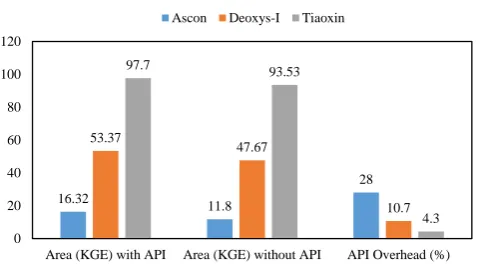
On the other hand, for the same architecture, such as basic iterative implementations, the API cost is al-most constant. Our ASIC results show that the area overhead due to the API support is between 4 and 5 KGE. Consequently, the effect of the API on area is more crucial for small designs, such asASCON, while it is negligible for designs with large area, such asTIAOXIN. To illustrate this phenomenon, figure 11 shows a simple comparison between the area of the implementations of three ciphers,ASCON (small), Deoxys-I(medium) and TIAOXIN(large) and the area overhead due to the API on each of them. The impact of the Hardware API on the area/performance on FPGA has been also discussed in [21]. The authors showed that the GMU Hardware API used in the SHA-3 competition hardware bench-marking, can cause 25% overhead in terms of the area compared to other interfaces they have provided. The CAESAR Hardware API is an updated version of the GMU Hardware API.
Table 10:Deoxys-I-128 implementation on Virtex 6 with custom interface
Impl. Number of Max. Freq. Throughput Efficiency Slices (MHz) (Mbps) (Mbps/Slice)
[23] 861 454 3,874 4.5
[14] 946 285 2,432 2.57
Table 11: Deoxys-I-128 implementation on Virtex 6 with API Support
Impl. Number of Max. Freq. Throughput Efficiency Slices (MHz) (Mbps) (Mbps/Slice)
[23] 805 225 1,920 2.38
[14] 956 285 2,432 2.54
is included in the benchmarking process and having a limit for the number of pins used. However, based on the results of the study in this paper, it is advisable to have more flexibility in developing hardware implemen-tations, in order to tweak the control unit to suit every algorithm or architecture. Figure 12 shows the trend be-tween area in KGE and delay (ns) ofNORX, Optimized NORX,CLOC GMU, optimizedCLOC, OptimizedDeoxys-I, ASCON GMU (with or without API), TIAOXIN GMU(with or without API)and Deoxys-I (with or without API) based on ASIC results.
Summary
In this paper, a comprehensive study regarding the hardware evaluation of AEAD ciphers has been car-ried out with the help of ASIC standard technology library. The benchmarking based on ASIC implemen-tation results has been reported in terms of area (KGE), frequency (Mhz), throughput(Mbps or Gbps), through-put per area etc. This paper also shows that design based on high level synthesis tool does not utilize all optimization technique. Thus, manual optimization is required. In order to support this, the ciphers NORX, Deoxys-I and CLOC have been manually optimized. The experimental result shows that optimized NORX, Deoxys-IandCLOCoutperformed in terms of area, de-lay, throughput per area and energy efficiency when compared with its respective contenders.
The comparison has been made between ASIC based results and FPGA results. At the end, influence of CAESAR APIs on the overall performance of cipher has also been analyzed. For instance; Deoxys-I-128 ci-pher, supporting CAESAR API cuts the performance and efficiency almost to by 50% compared to custom interface, due to the strict requirements on the control unit design.
References
1. Abed, F., Forler, C., Lucks, S.: General classification of the authenticated encryption schemes for the CAESAR competition. Computer Science Review (2016)
2. Banik, S., Bogdanov, A., Regazzoni, F.: Atomic-AES: A Compact Implementation of the AES Encryp-tion/Decryption Core. In: Progress in Cryptology– INDOCRYPT 2016: 17th International Conference on Cryptology in India, Kolkata, India, December 11-14, 2016, Proceedings 17, pp. 173–190. Springer (2016) 3. Bellare, M., Rogaway, P., Wagner, D.: A
conven-tional authenticated-encryption mode. manuscript, April (2003)
4. Bernstein, D.J.: Failures of Secret Key Cryptography. In-vited talk at FSE (2013)
5. Bertoni, G., Daemen, J., Peeters, M., Assche, G.V.: Du-plexing the Sponge: Single-Pass Authenticated Encryp-tion and Other ApplicaEncryp-tions. In: In A. Miri and S. Vau-denay, editors, pp. 320–337. Springer (2011)
6. Bhattacharjee, D., Chattopadhyay, A.: Efficient Hard-ware Accelerator for AEGIS-128 Authenticated Encryp-tion, pp. 385–402. Springer International Publishing, Cham (2015)
7. Bogdanov, A., Knudsen, L., Leander, G., Paar, C., Poschmann, A., , Robshaw, M., Seurin, Y., Vikkelsoe, C.: PRESENT: An Ultra-Lightweight Block Cipher. In: Paillier, P., Verbauwhede, I. (eds.) CHES 2007. LNCS, vol. 4727, pp. 450–466. Springer (2007)
8. Boyar, J., Peralta, R.: A new combinational logic mini-mization technique with applications to cryptology. In: International Symposium on Experimental Algorithms, pp. 178–189. Springer (2010)
9. Boyar, J., Peralta, R.: A Small Depth-16 Circuit for the AES S-Box. In: IFIP International Information Security Conference, pp. 287–298. Springer (2012)
10. CAESAR Competition: CAESAR submissions. https: //competitions.cr.yp.to/caesar-submissions.html (2016)
11. Canniere, C.D., Preneel, B.: Trivium: In New Stream Ci-pher Designs The eSTREAM Finalists. In: Springer ver-lag. Springer (2008)
0 0.5 1 1.5 2 2.5 0
10 20 30 40 50 60 70 80 90 100
Delay (
ns
)
A
re
a
(K
G
E
)
NORX Optimized NORX CLOC_GMU Optimized CLOC Optimized Deoxys ASCON_GMU with API ASCON_GMU without API TIAOXIN_GMU with API TIAOXIN_GMU without API Deoxys-1 with API Deoxys-1 without API
Fig. 12: The comparison between area’s and delay’s ofNORX, OptimizedNORX,CLOC GMU, optimizedCLOC,Deoxys-I (with or without API), OptimizedDeoxys-I,ASCON GMU(with or without API) andTIAOXIN GMU(with or without API) respectively based on ASIC results.
13. Elmohr, M.A., Kumar, S., Khairallah, M., Chattopad-hyay, A.: A Hardware-efficient Implementation of CLOC for On-Chip Authenticated Encryption. In: IEEE Com-puter Society Annual Symposium on VLSI (ISVLSI) (2018)
14. George Mason University: ATHENa: Automated Tools for Hardware EvaluatioN. https://cryptography.gmu. edu/athena/(2017)
15. Guo, J., Peyrin, T., Poschmann, A., Robshaw, M.: The LED block cipher. In: International Workshop on Crypto-graphic Hardware and Embedded Systems, pp. 326–341. Springer (2011)
16. Homsirikamol, E., Diehl, W., Ferozpuri, A., Farahmand, F., Yalla, P., Kaps, J.P., Gaj, K.: CAESAR Hardware API. Cryptology ePrint Archive, Report 2016/626 (2016) 17. Homsirikamol, E., Farahmand, F., Diehl, W., Gaj, K.: Benchmarking of Round 3 CAESAR Can-didates in Hardware: Methodology, Designs & Results. https://cryptography.gmu.edu/athena/ presentations/CAESAR_R3_HW_Benchmarking.pdf(2017) 18. Homsirikamol, E., Gaj, K.: An Alternative Ap-proach to Hardware Benchmarking of CAESAR Can-didates Based on the Use of High-Level Synthe-sis Tools. https://cryptography.gmu.edu/athena/ presentations/GMU_DIAC_2016_HLS.pdf(2016)
19. Information technology – Security techniques – Authen-ticated encryption. Standard, International Organization for Standardization (2009)
20. Jean, J., Moradi, A., Peyrin, T., Sasdrich, P.: Bit-Sliding: A Generic Technique for Bit-Serial Implementations of SPN-based Primitives. In: International Conference on Cryptographic Hardware and Embedded Systems, pp. 687–707. Springer (2017)
21. Jungk, B., Stttinger, M.: Hobbit - Smaller but faster than a dwarf: Revisiting lightweight SHA-3 FPGA implemen-tations. In: 2016 International Conference on ReCon-Figurable Computing and FPGAs (ReConFig), pp. 1–7 (2016). DOI 10.1109/ReConFig.2016.7857176
22. Jutla, C.S.: Encryption Modes with Almost Free Message Integrity. Cryptology ePrint Archive, Report 2000/039 (2000). http://eprint.iacr.org/2000/039
23. Khairallah, M., Chattopadhyay, A., Peyrin, T.: Looting the LUTs : FPGA Optimization of AES and AES-like Ciphers for Authenticated Encryption. The 18th Inter-national Conference on Cryptology in India - IndoCrypt (2017)
24. Kohno, T., Viega, J., Whiting, D.: The CWC authenti-cated encryption (associated data) mode. ePrint Archives (2003)
25. Krovetz, T., Rogaway, P.: The software performance of authenticated-encryption modes. In: International Work-shop on Fast Software Encryption, pp. 306–327. Springer (2011)
26. Minematsu, K.: Parallelizable Rate-1 Authenticated En-cryption from Pseudorandom Functions. In: EURO-CRYPT, pp. 275–292. Springer (2014)
27. Peyrin, T., Seurin, Y.: Counter-in-Tweak: authenticated encryption modes for tweakable block ciphers. In: Annual Cryptology Conference (2016)
28. Resende, J.C., Chaves, R.: AES Datapaths on FPGAs: A State of the Art Analysis. In: Hardware Security and Trust, pp. 1–25. Springer (2017)
29. Rogaway, P.: Efficient instantiations of tweakable blockci-phers and refinements to modes OCB and PMAC. In: In-ternational Conference on the Theory and Application of Cryptology and Information Security, pp. 16–31. Springer (2004)
30. Rogaway, P., Bellare, M., Black, J.: OCB: A Block Ci-pher Mode of Operation for Efficient Authenticated En-cryption. ACM Transactions on Information and System Security (TISSEC)6(3), 365–403 (2003)
31. Suzaki, T., Minematsu, K., Morioka, S., Kobayashi, E.: A Lightweight Block Cipher for Multiple Platforms. In: Selected Areas in Cryptography, pp. 339–354. Springer (2012)