Authenticated Encryption Mode IAPM using
SHA-3’s Public Random Permutation
Charanjit Jutla
IBM T. J. Watson Research Center New York 10598
Abstract. We study instantiating the random permutation of the block-cipher mode of operation IAPM (Integrity-Aware Parallelizable Mode) with the public random permutation of Keccak, on which the draft stan-dard SHA-3 is built. IAPM and the related mode OCB are single-pass highly parallelizable authenticated-encryption modes, and while they were originally proven secure in the private random permutation model, Kurosawa has shown that they are also secure in the public random per-mutation model assuming the whitening keys are uniformly chosen with double the usual entropy. In this paper, we show a general composabil-ity result that shows that the whitening key can be obtained from the usual entropy source by a key-derivation function which is itself built on Keccak. We stress that this does not follow directly from the usual indifferentiability of key-derivation function constructions from Random Oracles. We also show that a simple and general construction, again employing Keccak, can also be used to make the IAPM scheme key-dependent-message secure. Finally, implementations on modern AMD-64 architecture supporting 128-bit SIMD instructions, and not supporting the native AES instructions, show that IAPM with Keccak runs three times faster than IAPM with AES.
1
Introduction
Symmetric key encryption of bulk data is usually performed using either a stream cipher or a block cipher. A long message is divided into small fixed-size blocks and encryption is performed by either a stream-cipher mode or a block-cipher mode employing a cryptographic primitive that operates on blocks. The block primitives have traditionally been keyed-primitives, i.e. the block primitives also take a secret key as input. However, stream-cipher modes are sometimes de-signed to work with key-less block primitives as the state itself can maintain or carry some secret information. Examples include random-oracle domain exten-sions and authenticated-encryption in the streaming mode [11] using the sponge construction [5], proven secure under the strong notion of indifferentiability [20]. Note that the only underlying assumption in the sponge construction is that the fixed-length (input and output) permutation is indeed as good as picking such a permutation randomly from all such permutations with the same domain and range. The random permutation is publicly available, yet it is deemed ran-dom enough in the sense that without actually computing the permutation P
on x(such thatx was not the output of an earlier computation ofP−1(y) for somey), its valueP(x) is random and un-predictable. Indeed, this is the model under which most cryptographic hash functions operate including SHA-3 [24] (a draft standardization of Keccak [4]). We will refer to this as the public random-permutation (RP) model. This should be contrasted with the private random-permutation (RP) model, where the random-random-permutation is not available to the public and it can only be accessed via an oracle, such as an encryption/decryption algorithm which is built using this private random-permutation. Moreover, tak-ing AES[1] as an example, the model contends that the AES permutation keyed with a secret key becomes a private random-permutation. However, note that it requires that two (or more) such instantiations with randomly and independently chosen keys lead to completely independent private random-permutations, which is a strong requirement on the block primitive.
The challenge of designing such strong block-cipher primitives1, and at the same time advances in designing good random permutations enjoying prov-able bounds on differential trails [1, 4], has led to many proposals of encryp-tion schemes in the public random-permutaencryp-tion model. However, this has still been the case mostly in the stream-cipher mode. As mentioned above, the Kec-cak team has proved that one can build authenticated-encryption stream-cipher modes using the very same public Keccak permutation [6] on which SHA-3 (as a random oracle) is built. The question naturally arises if one can build authenticated-encryption block-cipher modes of operation using the Keccak per-mutation, i.e. in the public RP model.
In 2010, Kurosawa [19] showed that a modified version of the Integrity-aware-Parallelizable-Mode (IAPM) [15] authenticated encryption scheme is secure in the public RP model. Jutla in [15] had only shown that the IAPM scheme is secure in the private random-permutation model (e.g. instantiating it with keyed-AES). The result of Kurosawa shows that one can instantiate it (or at least the slightly modified version) by a public random-permutation, e.g. the key-less Keccak permutation. He also showed that the same applies to modified versions of OCB [23] which is a variant of IAPM that can also handle messages that are not of length exact multiples of block size. The main attraction of these schemes is that they provide single-pass authenticated-encryption, and in addition are fully-parallelizable. Essentially, both these properties were obtained in the private RP model by requiring two independent keysk1 andk2, the key k1 being say, the AES key, and k2 being a whitening key. The whitening key k2 is used to whiten the i-th block of input before encryption by AES under keyk1, and also to whiten the output of the AES encryption in the same way. We will refer to this as pre- and post-whitening with k2. The whitening refers to obtaining n-bits of new randomness from k2 and block indexi, and xor-ing it to the input block. The main idea here is that this randomness need only
1 We remark that AES, which builds such a keyed-primitive, has never been shown to
be pair-wise independent, which makes this a rather simple operation, e.g. a linear-feedback-shift-register operation.
The result of Kurosawa shows that one can get rid of the permutation key, i.e. k1 by setting it to a randomly chosen public constant, and the scheme is still secure for authenticated encryption (just by the pre- and post- whitening due to k2 using a pair-wise independent random function). This is then remi-niscent of the Even-Mansour construction [13], except that it uses a pair-wise independent function of the key k2. Further, its security bound has terms sim-ilar to the Even-Mansour bound, namely z∗q∗(2−n+ 2−|k2|), where z is the
number of encryption/decryption queries,qis the number of evaluations of the public permutation, and n is the block size of the primitive. Thus, as shown by Daemen [12], one must have large n, because of the “quadratic” nature of the bound. Thus, a 128-bit AES permutation (with a fixed key) is out of the question. However, this quadratic nature of the bound also applies to the sponge construction mentioned above, and hence Keccak actually uses a permutation on n= 1600 bits, in which case at least this concern goes away. We will refer to this version of IAPM that uses the key-less Keccak permutation as IAPM-Keccak.
However, once we are in the public random-permutation model, there are other issues which need to be addressed, which are usually swept aside in the (private) random-permutation model by making various independence assump-tions (most likely valid, but still not entirely satisfying). In the public random-permutation model, such independence assumption are definitely not valid a priori, and one must prove that composition of various components of an end-to-end encryption paradigm, e.g. a secure channel, are secure, especially if they are all using the same public random-permutation.
In particular, while one may make the benign assumption that the whitening keyk2 is chosen uniformly at random from all 256-bit strings (this is the mini-mum width required fork2 because of the above quadratic bound so as to match security obtained in the private RP model), it most likely was obtained from a wider, less-uniform random source and with lesser min-entropy (say, 128-bits) using a key-derivation function. Most likely, this key-derivation function itself is built using the same public random-permutation (e.g. Keccak of SHA-3).
Even if this key-derivation function is proven to be a random oracle in the indifferentiability sense, it does not prove that it can be composed “as is” with IAPM that is using the same key-less permutation Keccak. In fact, while [20] prove a composition theorem that says that a cryptosystemC can use an ideal primitiveI, instead of an algorithmalgbuilt using anotherpublicideal primitive
F, and still be equally secure, this composition theoremdoes nothold ifCitself is usingF(in our caseFis the Keccak permutation). We defer detailed discussion to Section 5.
indifferentiable from a random oracle can indeed be securely used to generate the 256-bit uniformly random whitening key of IAPM-Keccak. The final security bound we obtain is of the form q∗2κ+z∗q∗(2−n+ 2−256), whereκ is the min-entropy of the key-source. This matches the key-source security bound in the private RP model.
We also need to study security of secrecy under key-dependent message en-cryption (KDM-security) [7] as in the public RP model this could have ramifi-cations usually ignored in the private RP model. Further, apart from security issues like accidental encryption of the key itself, KDM security can have other applications [7]. In the random oracle model, [7] also show an encryption scheme that is KDM-secure. However, constructions of arbitrary output length random oracles from small fixed length random oracles or random permutations tend to be sequential or at best tree-like, and do not offer fully parallelization of IAPM. Further, while IAPM operates at full rate, i.e. rate of encryption of 1600 bits per invocation of Keccak permutation, the random oracle constructions have a lesser ratio than the bit-size of the permutation. Finally, IAPM provides authentication almost for free.
Fortunately, we show that a construction similar to [7] can be used to obtain KDM-security for IAPM. The main idea is to apply, for each message, a random oracle H on (kkIV) but only to obtain 256-bits of a fresh 256-bit whitening key k2. Then, this key k2 can be used to do the IAPM authenticated-encryption in the public RP model. It is a non-trivial task to prove that the same public random-permutation can be used to build the random oracle H also. Our result is also general and applies to any cryptosystem that is chosen plaintext attack (CPA) secure in the public RP model. In particular, it also applies to IAPM in the private random-permutation model (i.e. using keyed-AES). We also show, using our earlier composition theorem, that the key k need not be the wider source from which the keyk2 is obtained, but an already extracted keykfrom the wider source k′ using a random oracle built from the same public RP, as
long as the sourcek′ is erased after extraction ofk.
Finally, we prove that general IAPM like constructions, such as OCB and others which are based on pre- and post- whitening by pair-wise independent random numbers, are as secure in the public random-permutation model as in the private random-permutation model.
We also implement the KDM-secure IAPM scheme using the Keccak-1600 permutation and show that on modern Intel/AMD architectures supporting 128-bit SIMD operations (and not supporting native AES instructions) it runs at speeds 3 times faster than a similar IAPM scheme using keyed-AES.
2
Preliminaries
Definition 1. (ǫ-XOR-Universal Hash Function) [18] For any finite setH, an H-keyed (m, n)-hash function H has signature H: H × {0,1}m → {0,1}n. Such a hash function is called an ǫ-XOR-Universal hash function, if for every m-bit value M, and every n-bit valuec, Prh[H(h, M) =c] ≤ǫ, and further if for every pair of distinct m-bit values M1 and M2, and every n-bit value c, Prh[H(h, M1)⊕ H(h, M2) =c]≤ǫ, where the probabilities are over choosingh uniformly from H.
Definition. For a random variable X defined on {0,1}n, its min-entropy H∞(X) is the minimum over alln-bit stringsxof log (1/PrX[X =x]).
f f f f
S1 S2 Sm Sm+1
S1 S2 Sm S0
P1 P2 Pm checksum
C1 C2 Cm Cm+1
....
kdf
h
k
C0
IV
Si
hIV, ii
h
g (Simple)
truncµ
f
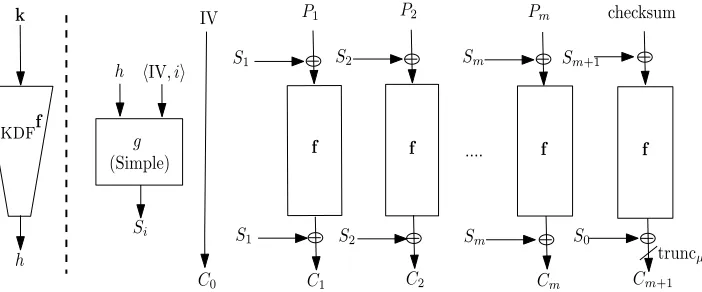
Fig. 1.IAPM in Public Random Permutation Model
3
Authenticated Encryption
We give definitions of authenticated encryption schemes in a public random permutation model. Let Coins be the set of infinite binary strings. LetK⊆ {0,1}∗
be the key space, andDbe a distribution on the key space.
DefinitionA (2-oracle, probabilistic, symmetric, stateless)authenticated-encryption scheme, with block size n, key spaceK, and distributionD, consists of the fol-lowing:
– initialization: All parties exchange information over private lines to es-tablish a private keyk ∈ K. All parties store k in their respective private memories.
– message sending with integrity:Let E and D be efficient 2-oracle al-gorithms, with E taking as input a keyk (in K), coins (in Coins), and a
In addition E and D have the property that if oracles O1 and O2 implement inverse functions of each other, then for allk∈ K, for allcoinsandP,
DO1,O2(k,(EO1,O2(k,coins, P)) =P
We will usually drop the random argument toE as well, and just think ofE as a probabilistic algorithm. The security of such a scheme is given by the following two definitions, the first defining confidentiality under chosen plaintext attacks, and the second defining message integrity. In the security definitions, we will count the length of plaintext inputs in terms ofn-bit blocks. Thus, a plaintext input of lengthmbits will be considered to have length⌈m/n⌉blocks.
Definition(Chosen-Plaintext Attack Security[2])
For any n > 0, consider a 3-oracle probabilistic adversary A. Consider an authenticated-encryption scheme with key-space K, key distribution D and 2-oracle algorithmsEandD. For anyn-bit permutationπ, letRealπkbe the oracle that on inputP returnsEπ,π−1
(k, P), andIdealπk be the oracle that on inputP returns Eπ,π−1
(k,0|P|). The IND-CPA advantage Adv
A of the adversaryA in thepublic random permutation modelis given by
|Pr[k←D;Aπ,π−1,Realπ
k = 1]−Pr[k←D;Aπ,π −1
,Idealπ
k = 1]|
where the probabilities are over choice of π as a random permutation on n -bits, and choice of k according to D, other randomness used by E, and the probabilistic choices ofA.
An authenticated-encryption scheme with block sizenis said to be (t,q1,q2, m, ǫ)-secure against chosen plaintext attack in the public random permutation modelif for any adversaryAas above which runs in time at mostt and asks at mostq1 queries toπandπ−1, and at mostq2 queries to the third oracle (these totaling at mostmblocks), its advantage AdvAis at most ǫ.
Definition (Message Integrity): Consider an adaptive 3-oracle (probabilistic) adversary A running in two stages. Adversary A has access to oracles O1, O2 and an encryption oracleEO1,O2(k,·). In the first stage (find)Aasksr queries of the encryption oracle. Let the oracle replies beC1, ..., Cr. Subsequently in the second stage,Aproduces a cipher-textC′, different from eachCi,i∈[1..r]. The adversary’s success probability is given by
SuccA def
= Pr[Dπ,π−1
(k, C′)6=⊥]
where the probability is over choice of O1 as a random permutation on n-bits (andO2 as its inverse), and choice ofkaccording toD, other randomness used byE, and the probabilistic choices ofA.
4
IAPM in Random Permutation Model
We will prove our results for more general (abstract) IAPM-like schemes, but to serve as a background we briefly review the definition of IAPM from [15, 16]. In the following, the operator “+” will stand for integer addition, and “⊕” forn-bit exclusive-or. Since with wide permutations onn bits, the “MAC” tag produced by the permutation may need to be truncated, the authentication check in decryption is defined slightly differently (as in OCB [23] and [19]). In the following, when usingn-bit permutations, we will refer ton-bit strings as a block.
Definition 2. Given a permutationf fromnbits tonbits, anH-keyed (2n, n )-hash-functiong, whereHis the set of allν-bit strings (ν≤n), the (deterministic) function e-iapmf,g:H× {0,1}n×({0,1}n)∗→({0,1}n)+ is defined as follows:
– Let the input toe-iapmf,g be h∈H, ann-bit (block) IV, and an m block
stringP (=P1, P2, ..., Pm).
– DefineC0=IV, and checksum = 0⊕Lmj=1Pj. – Define forj= 1 tom:
Cj =g(h,hIV, ji)⊕f(Pj⊕g(h,hIV, ji)).
– Cm+1=g(h,hIV,0i)⊕f(checksum⊕g(h,hIV, m+ 1i)).
– The output of the functione-iapmf,gis them+2 block stringC0, C1, ..., Cm+1.
The last block can be truncated to the required “MAC” tag-length, sayµ bits.
Definition 3. With the same parameters as above, the functiond-iapmf,g:H×
({0,1}n)+ →({0,1}n)∗∪ {⊥}is defined as follows:
– Let the input to d-iapmf,g be an h∈ H, an ((m+ 1)n+µ)-bit string C,
which is divided into (m+ 1) blocks IV, C1, ..., Cm and a tagT of µbits. – Define forj= 1 tom:
Pj =g(h,hIV, ji)⊕f−1(Cj⊕g(h,hIV, ji)). – T∗=g(h,hIV,0i)⊕f(Lm
j=1Pj⊕g(h,hIV, m+ 1i)).
– if (truncµ(T∗) =6 T) return ⊥, otherwise the output of d-iapmf,g is the m
block stringP1, ..., Pm.
See Fig. 1 (right of the dashed vertical line) for a schematic diagram. The left of the dashed line depicts key derivation using the same permutation, which is discussed in the next sub-section.
4.1 Public Random Permutation Model
If g is an efficiently computable function, the above two functions e-iapm and d-iapmcan be computed efficiently given oracle access tof andf−1. It is
may assume a benign setting where the ν-bit key habove is chosen uniformly fromH, it is most likely that this key is obtained using a key-derivation function (KDF) which in turn also used the same public permutation f. Thus, we will define a composite scheme which takes an arbitrarily long bit-string k as (key) input, uses a general-purpose KDF (with oracle access tof andf−1) to obtainh fromk, and then usese-iapmandd-iapmas per Definitions 2, 3 with parameter
g and with oracle access tof andf−1.
Definition 4. (IAPM in public random permutation model)[Fig. 1] Letf be an n-bit permutation. Letg be an (efficiently computable)H-keyed (2n, n )-hash function, where H is the set of all ν-bit strings (ν ≤ n). Let kdf be
an efficient (key-derivation) 2-oracle algorithm that takes arbitrary bit strings as input and produces ν-bit strings as output. The authenticated-encryption scheme IAPM(kdf,g,ν,µ,κ) with block sizen, and oraclesf andf−1is given
by the following key space, distribution, and 2-oracle encryption and decryption algorithms:
– The setK of keys is arbitrary bit strings. The distribution D onK is any distribution onKwith min-entropyκ.
– Leth=kdff,f −1
(k).
– The encryption under keykis given bye-iapmf,f −1
g (h,·,·), and the decryp-tion byd-iapmf,f
−1 g (h,·).
It is easy to see that the decryption algorithm correctly inverts the encryption algorithm.
In Section 5.1 we prove a general composition result for application of key-derivation functions, and using that it will follow that all security properties related to the above composite scheme can be reduced to related security prop-erties of the following IAPM scheme with uniformly chosen keys.
Definition 5. (IAPM with uniform keys in public RP model) Authenticated-Encryption scheme IAPM-uniform(g, ν, µ) with block size n, and oracle f and f−1 is given by a key space K that is the set of ν-bit strings, and a distribu-tionDon keys that is the uniform distribution onK. Moreover, the encryption and decryption algorithms under key k are given by e-iapmf,f
−1
g (k,·,·), and
d-iapmf,f −1
g (k,·) resp.
Definition 6. (Zero-IV IAPM) An IAPM scheme is called a zero-IV scheme if IV is always set to zero. Thus, C0 = 0 for all ciphertexts, and g function is computed with IV set to zero. As a consequence, the encryption function does not need the IV input.
5
Indifferentiability
A cryptosystemCis modeled as an interactive algorithm (or Turing Machine), and it is run by anenvironment E. The cryptosystem C has a private interface
Cpriv to the environment E and a public interface Cpub to the adversary. The
environment also controls the adversary. An ideal primitive is a cryptosystem whose interface just serves queries with answers. In this work, we focus on the notion of a public ideal primitive that has only a single interface which serves as both public and private interfaces. An important public ideal primitive is a random oracle (RO) which provides a random output to each query with the constraint that identical queries are replied with the same answer. We will refer to a random oracle that outputs exactlym-bits as anm-bit RO. Note that the input to anm-bit RO can be an arbitrarily long string.
Definition 7. An oracle algorithmalgwith its oracle instantiated by an ideal
primitiveFis said to be (tD,tS,q1,q2,L,ǫ)-indifferentiable from a public ideal primitive I if there exists an oracle algorithm (called simulator) S that runs in time tS and makes at most L oracle calls, and such that for any (2-oracle) distinguisherD the following holds:
|Pr[DalgF,F= 1] − Pr[DI,SI = 1]|< ǫ
where D runs in time tD and makes at most q1 (q2) calls to the first oracle (second oracle resp.). When the above property holds regardless of the run-time ofD, we will say thatalgF is (∞, tS, q1, q2, L, ǫ)-indifferentiable fromI.
Readers more familiar with the UC framework will note that the above is equiv-alent to saying that the public ideal functionality I is UC-realizable by algin
theF-hybrid model.
F
D
alg
≈
I
S
A
=
⇒
F
D
alg
≈
I
A′
C
C
∃
S
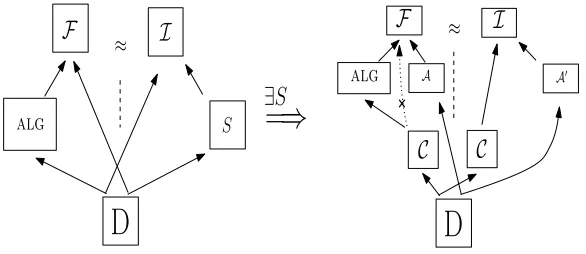
Fig. 2.Indifferentiability and Composition
to a public ideal primitive F is indifferentiable from a public ideal primitive I, then a cryptosystemC using algF (with adversary having access to F by the
above convention) is as secure as the cryptosystem C using I (with adversary having access to I). However, if C itself accesses the public ideal primitive F, then this composition theorem may not hold in general. In fact,Cneeds its oracle instantiated by eitherF or some other public ideal primitive in the I-world as well. In this situation, for the composition theorem to hold in general it is well known that in the definition of indifferentiability the distinguisher may need ac-cess to the same primitiveF in both worlds [10]. This, of course, would preclude programming ofF using the simulatorS.
However, we show that in some special situations of cryptosystems themselves accessing the public ideal primitive a composition result still holds. For the next definition, we will focus on cryptosystems that are themselves ideal primitives and further they use another public ideal primitive, sayF, as an oracle. Thus, the public interface of the former primitive is also F. We now specialize the definition of “as secure as” [20] to cater to such cryptosystems.
kdf
π
D →a x init
C∗ A
E
C
Dashed arrows indicate oracle responses.
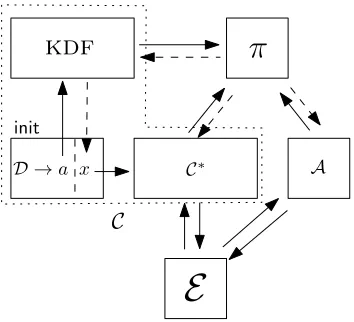
Fig. 3.Cryptosystem initialized using KDF
Definition 8. For public ideal primitivesF1andF2, a cryptosystemCF11is said to be (q1, q2, N,1−ǫ) as secure as a cryptosystemCF2
2 if for all environments
E the following holds: for all adversaryA1 making at most a total of q1 oracle calls there is an adversaryA2making at most a total ofq2 oracle calls such that
|Pr[E(CF1 1 ,A
F1
1 ) = 1]−Pr[E(C
F2 2 ,A
F2
2 ) = 1]| < ǫ,
5.1 KDF Composition
kdf
π
D →a x
init C∗ A
E
RO S
D →a x
init C∗ A
E
D →a x
init C∗ A
E S
RO2 RO1
D →a x
init C∗ A
E
RO1
π
Expt0 Expt1
Expt2 Expt4
k d f
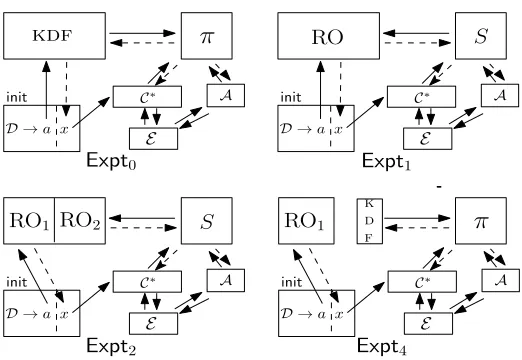
Fig. 4.Various Experiments in Theorem 1
Definition.We will say that a cryptosystemChas an initialization step init, if
Ccan be split into two partsinitandC∗. Further, over all calls fromE toC, only the first call leads to execution ofinitand which results in a private stateσ. The private stateσis used as an additional input byC∗ in all calls fromE toC.
Theorem 1. Let kdfbe an oracle algorithm such that with its oracle
instanti-ated with a public ideal primitive π, it is(∞, tS, q1, q2, L, ǫ)-indifferentiable from an m-bit RO. Let C1 be a 1-oracle cryptosystem that has an initialization step that generates a private state by samplingmuniformly random bits. LetDbe any distribution on finite length binary strings with min-entropy ν. Let C be a cryp-tosystem which is identical to C1 except that the initialization step is different and consists of runningkdfon an inputasampled fromD, with the oracle calls
of kdfredirected to the oracle of C1. The private state of the initialization step
is the output of kdf. Then, for all q3, and for all (q3≤)N < q2, cryptosystem
Cπ is(q3, q3, N,1−L∗N∗2−ν−2∗ǫ)as secure as cryptosystemCπ 1.
Remark 1. The cryptosystemCis depicted in Fig. 3 (and also inExpt0of Fig. 4). It is important to note that π is a public ideal primitive, and when proving security the adversary is allowed access toπ. The cryptosystem C1 can be seen represented inExpt4 of Fig. 4.
Remark 2. In most known realizations of RO such as the sponge construction [5], the simulatorS makes at mostL= 1 oracle calls.
phase of sampling a uniformly randomm-bit stringrand a second 1-oracle phase
C∗running with additional inputr. LetΨbe a 2-oracle cryptosystem with oracles
O1 andO2, with an initialization phase that samplesafromD, queriesO1with a to get xand runs the 1-oracle second phase C∗ with additional input x and oracleO2. Note thatΨ makes at most one call to the first oracleO1. Moreover, if the two oracles ofΨ are instantiated byO1=kdfπ andO2=π, then we get the cryptosystemCπ (see Fig. 3).
For any adversaryA, consider a composite 2-oracle algorithm D that is a composition ofE, the 1-oracle adversaryAandΨ as defined above. The oracle calls of 2-oracleΨ are directed to the two oracles ofDrespectively, and the oracle calls of the 1-oracleAare directed to the second oracle ofD. The algorithmD also outputs a single bit which is same as the bit output byE. Now consider two worlds: areal worldwhere the first oracle is instantiated bykdfπand the second
oracle byπ, and anideal worldwhere the first oracle ofD is instantiated by an m-bit RO and the the second oracle by S (which itself has oracle access to the samem-bit RO). HereS is the simulator as stipulated in the indifferentiability hypothesis ofkdfπ andm-bit RO. More formally, we will say that D is taking
part in the real world experiment or the ideal world experiment. The real and the ideal world experiments will also be denoted byExpt0andExpt1respectively (see Fig. 4). We will denote probabilities inExptiby a subscripti. LetN be any number less than q2. Note that the total number of calls to the second oracle of D is the sum of the total number of calls of Ψ to its second oracle and the total number of calls of A to its oracle. By the indifferentiability hypothesis, and conditioned on D making at most N(< q2) calls to the second oracle, the algorithmD cannot distinguish between the real world experiment and the ideal world experiment with probability more thanǫ. In other words,|Pr0[D= 1]−Pr1[D= 1]| ≤ǫ.
Let BAD be the event that inExpt1, the simulatorSmakes a call to its oracle (them-bit RO) which is identical to the single call made to the first oracle byD. Recall, inExpt1the first oracle ofD is same as them-bit RO oracle ofS. Now, the probability of D outputting 1 in Expt1 is at most the sum of the following two values: (a) the probability ofD outputting 1andevent BADnothappening, and (b) the probability of event BAD happening. Thus, Pr1[D= 1 ∧ ¬BAD]≤ Pr1[D= 1]≤Pr1[D= 1 ∧ ¬BAD] + Pr1[BAD].
Now, consider another experimentExpt2 (see fig. 4) which differs from the ideal world experimentExpt1 in that the commonm-bit RO oracle of S andD is replaced by two independent m-bit random oracles RO1 and RO2 (RO1 for the first oracle ofD and RO2 for the oracle ofS; see Fig. 4).
From the definition of a random oracle, i.e. the fact that it outputs random and independent values on different inputs, it is not difficult to see that the first probability (a) remains same inExpt2as inExpt1. More formally, this is proved by induction over a sequence of hybrid games, starting fromExpt1and ending in
oracle RO2. Thus, Pr2[D= 1 ∧ ¬BAD] ≤Pr1[D = 1]≤Pr2[D= 1 ∧ ¬BAD] + Pr1[BAD].
Now, consider experimentExpt3 which is same as experiment Expt2 except that the single call to the first oracle is replaced by just generating a uniformm -bit random value independently. This is just a syntactic change by definition of m-bit RO, and hence the probability (a) remains the same. Since the first oracle call does not access anym-bit RO, them-bit RO oracle ofSis the only RO that remains in Expt3. Thus the above inequalities continue to hold with subscript 2 replaced by 3. It also follows that Pr3[D = 1] −Pr3[BAD]≤ Pr1[D = 1]≤ Pr3[D= 1] + Pr1[BAD].
Next, considerExpt4 which is same asExpt3 except that the second oracle ofD is instantiated by primitiveπ. Again, by the indifferentiability hypothesis of kdfπ and m-bit RO, the probability Pr3[D = 1] differs from Pr4[D = 1] by
at most ǫ. Now, note that experiment Expt4 is identical to E running Cπ 1 and adversaryAπ. SinceD outputs the same bit that is output byE it follows that
|Pr4[E() = 1]−P r0[E() = 1]| ≤2∗ǫ+ max{Pr1[BAD], Pr2[BAD]}.
Since in bothExpt1andExpt2, the valuexis independent ofa(by definition of random oracle), it follows that all oracle calls of simulatorSin bothExpt1and
Expt2 are independent of a. Moreover, for each invocation of S,S itself makes at most L oracle calls. Since D has min-entropy ν, it follows by union bound that both Pr1[BAD] and Pr2[BAD], conditioned on total number of calls to the second oracle being less than N, are upper bounded by L∗N ∗2−ν and that completes the proof.
6
Key-Dependent Message Security
In this section we show that IAPM in public RP model (Def. 4) can be slightly modified by introducing a random nonce so that it even becomes key-dependent message (KDM) secure. KDM security was introduced and formalized in [7], extending the notion of circular security from [8]. Informally, KDM security means that an Adversary cannot distinguish between an encryption of some functionφof the key itself from encryption of a constant message. The function φis also allowed to be picked by the adversary adaptively.
6.1 KDM Security Definition
In the following, we will restrict the Adversary’s choice of oracle-algorithms φ tofixed-output-length algorithms, i.e. for all oraclesπ,|φπ(k)| is same for all k.
Definition (Key-Dependent Message Security) For any n > 0, consider a 3-oracle probabilistic adversaryA. Consider an (authenticated) encryption scheme with key-spaceK, key distributionDand 2-oracle-algorithmsEandD. For any n-bit permutationπ, LetRealπk be the oracle that on input a description of a 2-oracle fixed-output-length algorithmφreturnsEπ,π−1
(k, φπ,π−1
(k)), andIdealπk
be the oracle that on input P returns Eπ,π−1
(k,zero), where zero is a
bit-string of zeroes of length |φπ,π−1
(k)|. The IND-KDM advantage Advkdm
A of the adversaryAin thepublic random-permutation modelis given by
|Pr[k←D;Aπ,π−1,Realπ
k = 1]−Pr[k←D;Aπ,π −1
,Idealπ
k = 1]|
where the probabilities are over choice of π as a random permutation on n -bits, and choice of k according to D, other randomness used by E, and the probabilistic choices ofA.
An (authenticated) encryption scheme with block size n is said to be (t, q1,q2,t3,q3,m, ǫ)-secure against key-dependent message attack in thepublic random-permutation model if for any adversary A as above that restricts its queries to description of 2-oracle-algorithmsφthat run in timet3 and make at mostq3 oracle calls, and which itself (i.e.A) runs in time at mostt and asks at mostq1 queries toπandπ−1, and at mostq2 queries to the third oracle (these totaling at mostmblocks), its advantage Advkdm
A is at mostǫ.
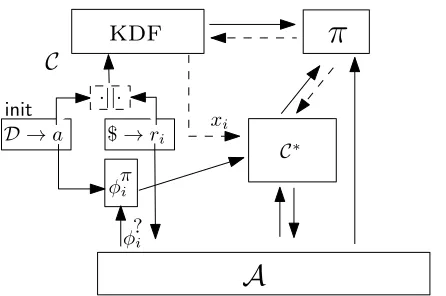
6.2 General Construction
kdf
π
D →a
init
C∗
A
C
$→ri
φi
φi
·||·
xi
π
?
Definition 9. Let C∗ be a 2-oracle stateless authenticated encryption scheme with block sizen, with key spaceK∗and distributionD∗onK∗given by uniform distribution on allν-bit strings, and encryption and decryption algorithmsE∗
and D∗. Letkdf be an efficient (key-derivation) 2-oracle-algorithm that takes
arbitrary bit strings as input and producesν-bit strings as output. Then, define another 2-oracle stateless probabilistic authenticated encryption schemeC with block sizenas follows (letO1 andO2 be its oracles):
– The setK of keys is arbitrary bit strings. The distribution D onK is any distribution onKwith min-entropyκ.
– The probabilistic encryption algorithm under keya, takes input P, chooses ρ-bit r uniformly at random, obtains x = kdfO1,O2(a||r), and outputs
hr, E∗O1,O2(x, P)i.
– The decryption algorithm under key a, takes as input hr, Ci, obtains x=
kdfO1,O2(a||r), and outputsD∗O1,O2 (x, C).
Theorem 2. Let C∗ as above be (t, q1,(q2 =) 1, m, ǫ1)-secure against chosen plaintext attacks in the public random-permutation model. Let β be such that, For each l (n-bit) block plaintext input, β∗l is the maximum number of calls that E∗ makes to its oracles. Letkdf as above with its oracle instantiated with
a public random-permutation onnbits be (∞,tS,q3,q4,L,ǫ2)-indifferentiable from aν-bit RO. Then, the authenticated encryption schemeC as defined above is(t′, q1′, q2′, t′3, q3′, m, δ)KDM-secure in the public random-permutation model,
for
– t′+t′
3+ (q1′+q3′)∗tS < t, and – β∗m+q1′+q3′ < q4, and where
– δ= 4∗ǫ2+ 2∗ǫ1+ (β∗m+q1′+q3′)∗L∗(q2′∗2−ρ+ 2−κ).
Remark 3. For authenticated encryption schemes such as IAPM,β is at most 2. Moreover, for mostν-bit RO constructions such as the sponge constructionLis at most 1. Also, note that in the theorem statement C∗ is required to be only single-usesecure, i.e.q2 = 1 or only one encryption query is allowed. Informally, this suffices as the encryption key xforC∗ is obtained as x=kdf(a||r), for a
freshr for each message.
Proof:We will focus on the proof for a single encryption query by the Adversary A. Proof for multiple queries follows by induction by considering hybrid experi-ments. See Fig. 5 for a depiction of this setting along with the construction ofC. We will denote both the public random permutation and its inverse as a single public ideal primitive πwhich offers both interfaces. All random variables will be denoted in boldface.
The real world experiment where encryption ofφ(a) is returned will be called
InExpt1, we replacekdfandπbyν-bit RO and the simulatorSas stipulated
in the indifferentiability ofkdf fromν-bit RO. By the indifferentiability claim
the difference in the probability of A outputting 1 is at most ǫ2. We will use subscript i to denote probabilities in experiment Expti. Thus, |Pr1[A = 1]− Pr0[A= 1]|< ǫ2.
Let BAD be the event that inExpt1, the simulatorSmakes a call to its oracle (the ν-bit RO) which is identical to the (single) call made to the ν-bit RO by
C, i.e. (a||r), where r is a ρ-bit uniform and independent random value. Now, Pr1[A= 1] is at most the sum of Pr1[A= 1∧ ¬BAD] and Pr1[BAD].
Now, consider experimentExpt2where we split the RO into two independent random oracles RO1 and RO2, where the call (a||r) is served by RO1 and all calls byS are served by RO2. This is similar to the situation depicted inExpt2 in Fig. 4. It is clear that Pr2[A= 1∧ ¬BAD] remains same as inExpt1.
We, also considerExpt3where the call (a||r) to RO1is replaced by just using a random and independent ν bit valuex. By definition of RO, this is same as
Expt2.
Next, we switch toExpt4 where we go back tokdfand public random
per-mutation π, except that there is no call to the kdfnow (similar to as shown
in Expt4 in Fig. 3). Now, note that the encryption of φ(a) is being performed under a keyx, which is aν-bit uniformly random value independent of all other variables includingaandr. Thus, by CPA security ofC∗, we can considerExpt5
where we replace the encryption ofφ(a) by a constant string of the same length, and the Adversary will not be able to distinguish with probability more thanǫ1. Thus, similar to proof of theorem 1,|Pr5[A() = 1]−P r0[A() = 1]| ≤2∗ǫ2 +ǫ1 + max{Pr1[BAD], Pr2[BAD]}.
We now bound both Pr1[BAD] and Pr2[BAD]}. We first focus on the former. First note thatris only revealed to the AdversaryAat the end of encryption by
C∗, whileC∗ runs independent of r. Thus, all calls byC∗ to S are independent ofr, and similarly all calls by Ato toS beforeC outputsrare independent of r. Thus the probability of any of these calls leading to event BAD is at most L∗2−ρ(recall,Lis the maximum number of calls bySto RO in any invocation ofS). Let there be a total of q′ such calls toS.
So, we now focus on calls byA toS after r is output byC to A. Let there be q′′ such calls. We will also split BAD as a disjunction of BAD′ and BAD′′,
where BAD′ is BAD restricted to theq′ calls above, and BAD′′ is conjunction
of BAD′ nothappening and BAD restricted to the q′′ calls of the latter kind.
Consider thei-th such call byA toS. We can write BAD′′ as a disjunction of
(COLi∧¬BAD′∧∀j < i:¬COLi) withiranging from 1 toq′′, whereCOListands for
collision in oracle calls ofSwith (a||r) inA’si-th invocation ofS. Further, since theseq′′disjuncts are mutually exclusive, the probability of BAD′′is exactly the
sum of the probability of each disjunct. We will refer to each disjunct as BAD′′
distributed till that point conditioned on BAD′ ∧ ∀j < i : ¬ COLi, the claim
follows.
Again, since the events BAD′′i are mutually exclusive, we get Pr1[BAD′′] = Pr2[BAD′′]. Now, Pr2[BAD′′] is easier to upper bound, as we now show. First note that Pr2[BAD′′] = Pr3[BAD′′], as the two experimentsExpt2andExpt3are identically distributed.
Recall, in Expt3, S is a simulator stipulated for each distinguisher in the indifferentiability claim, and thus it is defined givenA,AandC∗. It may also be a probabilistic algorithm. However, for fixed algorithmsC∗,A andA, it is also a fixed probabilistic algorithm.
Now, consider a 2-oracle distinguisher D which is built as follows by also using the uninstantiated 1-oracle S as a component (not to be confused with it being used as an oracle). The distinguisher D consists of composition of the 2-oracleC and 1-oracleA as inExpt3, except for the following change: for each of thei∈[1..q′′] calls of Ato its oracle, it also uses S internally to see ifS’sL
oracle calls collide with (a||r). Finally, the distinguisherD outputs 1 iff event BAD′′ happens, with its two oracles instantiated by RO andSRO.
Now by indifferentiability of kdfπ and π from RO and SRO, the above
probability ofD outputting 1 remains same if we go back to usingkdfπ andπ
as the two oracles ofD.
Next, consider D′ which is same as D but replaces the encryption of φ(a)
by C∗ by a constant string of the same length. Since in D and D′, C∗ is using
a random and independent ν-bit value as key (i.e. independent ofa), by CPA-security ofC∗,|Pr[D= 1]−Pr[D′= 1]|< ǫ1.
Since as component ofD′, the view ofAis independent ofa, the probability
of D′ = 1 is at mostq′′∗L∗2−κ, recalling that the min-entropy of a (or its distributionD) isκ.
Thus, Pr2[BAD′′] = Pr4[BAD′′]< ǫ1+q′′∗(L∗2−κ). Hence Pr1[BAD]≤2∗ǫ2 +ǫ1 +q′∗L∗2−ρ+q′′∗L∗2−κ.
7
Reducing Public to Private Random-Permutation
Model
We start by showing that the cryptosystem IAPM-uniform (Definition 5) in the public random-permutation (RP) model is as secure as the cryptosystem IAPM-uniform in the private random-permutation model. Later, in Section 7.2, we will use Theorem 1 to prove security of IAPM in the public RP model (i.e. as per Definition 4). Recall that in the public RP model, the adversary has access to oracles f and f−1 which the IAPM scheme uses. Security is proven under the probability of choosing f uniformly from all random permutations on n bits, where n is the block size of the IAPM scheme. In the private RP model, the adversarydoes nothave access to eitherf orf−1.
model is (q,q,N,1−q∗2−n −(2∗q∗N+N(N+ 1))∗ǫ) as secure as the cryp-tosystem IAPM-uniform(g, ν, µ)in then-bit private random-permutation model, if the environment makes at most one call to the decryption algorithm.
Remark 4. Since all invocations off andf−1in bothe-iapm
f,g andd-iapmf,g are “guarded” by xor-universal whitening functiong keyed with secret keyh, it would seem that it is easy matter to show that adversarial calls to f and f−1 do not collide with such calls from IAPM. However, the adversary has access to the ciphertexts from the various calls the environment makes to IAPM, and it needs to be shown that the adversary gains only negligible information about the secret keyhfrom the adaptively obtained ciphertext transcripts.
Remark 5. If the cryptosystem IAPM-uniform(g, ν, µ) with block sizen in the private RP model is (t, q1, q2, m, ǫ1)-secure for message integrity, then the above restriction in the theorem statement of only a single call to the decryption algorithmD can be removed. This is so because ifD is called with a ciphertext not returned by an earlier call to the encryption algorithmE, then in the private RP model it will return⊥with overwhelming probability (1−ǫ1). Therefore, by induction, even in the public RP model ⊥will be returned with overwhelming probability. Hence, the environment need not make this call at all. Further, it is well-known that in the private RP model, if an authenticated-encryption scheme is IND-CPA secure and secure for message integrity, then it is IND-CCA secure (i.e. secure against chosen-ciphertext attacks) [3, 17]. Hence from the above un-restricted version of the theorem it follows that if IAPM-uniform is IND-CPA secure and secure for message integrity in the private RP model then it is also IND-CCA secure in the public RP mode.
Remark 6. While the actual IAPM encryption scheme truncates the last block to obtain the “MAC tag”, for the purpose of studying security, this truncation is not required, and we can assume that the whole last block is returned to the environment. Thus, the truncation is only performed to save on the space required to represent the tag and is not a security requirement. Similarly, in OCB, ciphertext stealing is used to represent the final non-full-block ciphertext by truncating an invocation off. Again, for security purposes, the whole output of this invocation off can be returned.
Proof: Note that since the environment E and adversary A are not computa-tionally bounded, we can assume that they are deterministic. Also, note that underlying probability distribution is the key hchosen uniformly from H (the ν-bit keys of g), and the choice off as a random permutation. Thus, the space for the probability distribution is the set of pairs handf. Any variable which is a function ofhandf, will be called a random variable, and for clarity will be depicted in bold-face or capital. By the same convention, from now on, we will also denotef andhin bold-face, i.e.f andh. We will refer tof asthe permuta-tion, andhasthe key. Fixed values of any random variables will be denoted by small-case letters.
e-iapm. All queries by E to e-iapmwill be called plaintexts, and the i-th such
query will be denotedPi. Individual blocks inPiwill be denoted by subscripts. All replies to such queries will be called ciphertexts, and thei-th ciphertext will be denoted by Ci, and similarly, the j-th block on Ci will be denotedCi
j. All theCi together will be calledC. Thei-th query byAto f will be denotedVi, and i-th query to f−1 will be denoted Xi. The results of these queries will be denoted by Wi and Yi resp. We will call the ciphertexts, Wi andYi together as thetranscriptC˜. Since,AandE are deterministic, all queries ofE andAare a function of the transcript alone. The transcript itself is a random variable as it is a function off andh.
The (single) query to d-iapm will be denoted by C′ and will be called the
forged ciphertext. It is also a function of the transcript ˜C. Thus, given a fixed value ˜c of the transcript, all the plaintexts and the forged ciphertext are fixed as well (and in particular, do not depend onf andh). We will call all variables which are either part of the transcript or are a function of the transcript alone (i.e. are independent of f and h) as visible variables (these are visible to the environment). Thus, C, P, V, W, X, Y and C′ are visible variables. We will refer toP′ (which is the decryption ofC′) as a hidden variable, as it may not
be output if the authentication test fails. However, it is computed by d-iapm,
and indeed d-iapmfurther computes T∗ =f(Lm
j=1Pj′⊕g(h,hIV′, m+ 1i)) to compare it (more precisely, truncµ(T∗)) with the tagT given as part ofC′. We will also refer toLmj=1P′
j as a hidden variablePm+1′ . Note that hidden variables are not a function of the transcript alone, and these may also depend onf and h.
We will denote values that are invoked onf ine-iapmasMi
j, and its output as Ni
j. Note,Mji =Pji⊕g(h,hIVi, ji), and Nji=Cji⊕g(h,hIVi, ji). Similarly, the values invoked onf−1 in d-iapmwill be denotedN′
j and its output byMj′. Note, N′
j =Cj′ ⊕ g(h,hIV′, ji). Since Pji, Cji, Cj′ (and also the IVs) are visible variables, each of theseMi
j,NjiandNj′ can be written as a function of ˜C andh. Thus, all inputs to invocations of f and f−1 in both e-iapm and d-iapm,
except for the one used to computeT∗, have the property that they are
exclusive-or of a visible variable andg(h, a), whereais itself a visible variable. Associate to each such invocation off andf−1a valuea(for now, disregard the invocation off to computeT∗). Clearly, if the IV for all the queries toe-iapmare different, then
theavalues across different queries are different. Further, the avalues within a query are different by design. For the forged ciphertext query to d-iapm, if IV′
is different from all the IV in thee-iapmqueries, then the avalues used in the d-iapm query are also different within thed-iapm query and different from all
avalues used ine-iapm.
We will say that a blockC′
j in the forged ciphertextC′ isin-place if IV′ = IVifor somei, andC′
j=Cji, andCji is not the MAC tag block of ciphertextCi. Note, in this caseN′
j=Nji, and we will refer to Nj′ as also being in-place. As for the computation of T∗ in d-iapm, we will denote the input to f to
compute T∗ as M′
Now, given a fixed value of the transcript ˜c, and a fixed value hof the key h, define the eventiCOL(h,c˜) (for internal collisions) as disjunction of some two
Mi
j being same,orsome twoNjibeing same,orsome twoNj′ being same. Define
xCOL(h,˜c) (for external collision) as disjunction of someMi
j being same as some Vi′
or someYi′
,orsomeNi
j being same as someWi ′
or someXi′
,orsomeN′
j′ being same as some Wi′ or some Xi′, or some N′
j′ that is not in-place being same as someNi
j,orallNj′′ are in-place andM′
m+1is same as someVi ′
or some Yi′
. We will refer to disjunction ofiCOLandxCOLas simplyCOL. Finally, if we
also fix a value f forf, definehCOL(f, h,˜c) (for hidden collision) as disjunction
of someM′
j (j= 1 to m+ 1) being same as someVi ′
or someYi′ .
Now, we are interested in the probability of the eventCOL(h,C˜) orhCOL(f,h,C˜)
happening. When neither of these events happen the view of E is identical in the public and private RP model. Thus, its distinguishing probability is up-per bounded by the sum of the two collision probabilities2. The bound on the collision probabilities follows by the following lemmas 1, 2, 3 and 4.
For ˜c = (c, w, y), define uc to be the number of blocks in c, uw to be the number of blocks (queries) inwand uy be the number of blocks (queries) in y. For any fixed ˜c,h, defineF˜c,hto be the set of permutations as follows: IfCOL(h,˜c) holds then this set is empty. Otherwise, the set contains all permutationsf with the following restrictions:
1. ∀i, j:f(Mi
j(h,˜c)) =Nji(h,˜c), 2. ∀i∈[1..uw] :f(Vi(˜c)) =wi, 3. ∀i∈[1..uy] :Xi(˜c) =f(yi),
Define|˜c|=uc+uw+uy. Then, for ˜c,h, such thatCOL(h,˜c) does not hold, the
probability Prf[f ∈Fh˜c] depends only on |˜c|, and in particular is independent of h. Thus, for the rest of this paragraph, for any fixed ˜c, consider any hsuch that ¬COL(h,˜c) holds. Moreover, define num(˜c) to be the ratio of number of
permutations on 2n blocks and |Fh,˜
c|, which is same as (2n)!/(2n − |c˜| −1)!. Note that Prf[f ∈ Fh,˜c] is same as 1/num(˜c). In the following lemma, recall that for each fixed and deterministic adversary, the transcript ˜Cis a function of permutationf and keyh. Hence, it should more precisely be written as ˜C(f, h).
Lemma 1. For any fixed˜c= (c, x, z), any fixedhsuch that¬COL(h,˜c), and any
fixed f,C˜(f, h) = ˜c is equivalent tof ∈Fh,˜c.
Proof: That ˜C(f, h) = ˜c impliesf ∈Fh,˜c. follows from the definition of the set Fh,˜c. The reverse direction is proved by induction over the order of adversarial queries. Since the adversary is deterministic, the first query, whetherPi or V1 or X1 is fixed. In case the first query was P1 (and first IV is IVi), given the fixedh, it also fixesM1, which then leads toC1
j =g(h,hIV1, ji)⊕f(Mj1). But,
2 Actually, the distinguishing probability is upper bounded by sum ofxCOLandhCOL,
N1
j(h,˜c) is defined as g(h,hIV
1, ji)⊕ c1
j. Thus, Cj1 =Nji(h,c˜) ⊕c1j ⊕f(Mj1). Since, f ∈ Fh,˜c, by definition of the set Fh,˜c, we have Nji(h,c˜) = f(Mj1), and henceC1
j =c 1 j.
A similar but simpler argument also shows thatW1 = w1 or Y1 =y1 (in case the first query wasV1 or X1 resp.). In other words ˜C1= ˜c1. This in turn fixes the next query, and we continue the argument inductively.
Lemma 2. For anyc˜= (c, x, z),
Prf,h[ ˜C= ˜c∧ ¬COL(h,˜c)] =
1
num(˜c)∗Prh[¬COL(h,˜c)]
The proof of this lemma follows easily by applying lemma 1.Proof:
Prf,h[ ˜C= ˜c∧ ¬COL(h,˜c)]
=X
h
Prf,h[h=h∧C˜ = ˜c∧ ¬COL(h,˜c)]
=X
h
Prf,h[h=h∧f ∈Fh,˜c∧ ¬COL(h,˜c)]
=X
h
Prf[f ∈Fh,˜c]∗Prh[h=h∧ ¬COL(h,c˜)]
= 1
num(˜c)∗Prh[¬COL(h,˜c)]
where the first equality follows from lemma 1, and the second equality follows asf andhare independent.
Letu′
cbe the number of blocks inC′ (which is completely determined by ˜c).
Lemma 3. For every constant transcriptc˜,
Prh[COL(h,˜c)]<(2(uw+uy)∗(uc+u′c) +uc(uc+ 1))∗ǫ
Proof: We will assume that E does not repeat queries to e-iapm, and further
each such query uses a distinct IV. Since g is an xor-universal hash function, andhis chosen uniformly from its set of keysH (which is just allν-bit strings), the result follows by noting that each disjunct iniCOLandxCOLcompares either
g(h, a) (for some constant value adetermined by ˜c) or (g(h, a)⊕g(h, a′)) (for
some distinct constant valuesaanda′) with some constant value determined by
˜ c.
Lemma 4. For every constant transcript ˜c, and every constant h such that
¬COL(h,˜c)
Proof:Recall that eventhCOLis the disjunction of anyM′
i being same as either some Vi′
or some Yi′
. Moreover, recall that for j = 1 to m, M′
j = f− 1(N′
j), whereN′
j =Cj′ ⊕g(h,hIV′, ji), andMm+1′ =
Lm
j=1 Pj′ ⊕g(h,hIV′, m+ 1i).
Now, by lemma 1,f ∈Fh,˜c implies that the random variable transcript ˜C is fixed to ˜c. Since,C′ is completely determined by ˜C, the value ofC′ is also fixed.
We will denote this fixed value ofC′ byc′. For eachj′ = 1 tom, there are two
cases to consider: (a) eitherN′
j′ is in-place and same as someNji But, then Mj′′ =Mji, and from being in-place it also follows thatP′
j′ =Pji. In addition, since¬xCOL(h,˜c) holds, thenM′
j′ does not collide with anyVi ′
orYi′. (b) IfN′
j′ is not in-place, then since¬COL(h,˜c) holds,N′
j′ does not collide with any Wi′
or Xi′
, or with any otherN′
j′′, or with anyNi
j. Thus,Mj′′ =f−1(N′ j′) is different from all Vi′
and Yi′
(as f is a permutation). Also, it is uniformly randomn-bit value even conditioned onf ∈Fh,˜c.
We also need to determine the probability of M′
m+1 colliding with Vi ′
or Yi′
. If allN′
j′ satisfied (a) above, then allN′
j′ are in place and by¬COL(h,˜c), it follows thatM′
m+1 does not collide withVi ′
or Yi′. If someN′
j′ is not in-place, then by (b) above, M′
j′ is a uniformly random value, and also independent of all other M′
j′′ (as¬COL(h,˜c) implies that N′
j′ does not collide with otherN′ j′′). Thus,M′
m+1is uniformly randomn-bit value, and probability of it colliding with anyVi′
or Yi′
is 2−n.
Coming back to the proof of theorem 3,
Pr[¬COL(h,C˜) ∧ ¬hCOL(f,h,C˜)]
=X
˜ c,h
Pr[ ˜C= ˜c∧h=h∧ ¬COL(h,c˜)∧ ¬hCOL(f, h,c˜)]
=X
˜ c,h
Pr[f ∈Fh,˜c∧h=h∧ ¬COL(h,˜c)∧ ¬hCOL(f, h,c˜)]
above equations,
Pr[¬COL(h,C˜) ∧ ¬hCOL(f,h,C˜)]
≥(1−(uw+uy)∗2−n)∗X ˜ c
Pr[ ˜C= ˜c∧ ¬COL(h,c˜)]
= (1−(uw+uy)∗2−n)∗X ˜ c
1
num(˜c)∗Prh[¬COL(h,˜c)]
≥(1−(uw+uy)∗2−n)∗
(1−(2(uw+uy)∗(uc+u′c) +uc(uc+ 1))∗ǫ)∗ X
˜ c
1
num(˜c)
≥(1−(uw+uy)∗2−n)∗
(1−(2(uw+uy)∗(uc+u′c) +uc(uc+ 1))∗ǫ)
where the equality above follows by lemma 2, the second last inequality by lemma 3, and the last inequality by definition ofnum(˜c), which we recall is same as (2n)!/(2n− |˜c| −1)!.
Thus, the probability of eitherCOLorhCOLhappening is at most (uw+uy)∗
2−n+ (2(uw+uy)∗(uc+u′
c) +uc(uc+ 1))∗ǫ. In the definition of “as secure as” (Definition 8), the cryptosystemsC1andC2 have public ideal primitivesF1 andF2resp. Here,C1is IAPM in the public RP model, andF1is justf andf−1 combined in one interface. Also, C2 here is IAPM in the private RP model and it does not need access to any public oracle. However, the adversary continues to have access to a different public random permutation (and its inverse). Now, note that adversaryA1’s queries to the public oracle are (uw+uy) in number. This number remains the same asA2is exactly the same asA1. The numberN of total queries toF1 (i.e.f andf−1) is of course upper bounded by (uc+u′c+ uw+uy). Thus, IAPM-uniform in public RP model is (q, q, N, 1−q∗2−n + (2∗q∗N+N(N+ 1))∗ǫ) as secure as IAPM-uniform in the private RP model.
7.1 General Schemes
From the structure of the proof of Theorem 3, the theorem is easily generalizable to different variants of IAPM such as OCB [23], the authenticated-encryption with associated data (AEAD) scheme due to Hawkes and Rose [14], the OCB variant for associated data OCB-AEAD [22], and the modified IAPM and OCB schemes due to Kurasawa [19]. Note that the proof in [19] just estimates the probability of event COL(h,C˜), where as to upper bound it correctly it requires
the detailed consideration above (see Remark 2 above).
7.2 Corollaries
random-permutation model. To start with, we state a theorem from [16], which states the security of IAPM for message integrity in the private RP model.
Theorem 4. [16] Let g be an ǫ-xor-universal H-keyed (2n, n)-hash function, whereH is the set of allν-bit strings (ν ≤n). LetAbe an adaptive adversary in the message integrity experiment in the private RP model for the authenticated-encryption scheme IAPM-uniform(g, ν, µ)with block sizen. LetAmake at most z queries, these totaling at mostm blocks. Let A make a query with at most v blocks in the second stage. If4m2<2n and4v2<2n, then
SuccA≤2−µ+ (m2+ 3v)·(ǫ+ 2−n)
This theorem along with theorem 3 implies that IAPM-uniform(g, ν, µ) is secure for message integrity in the public random-permutation model, with
SuccA≤2−µ+ (m2+ 3v)·(ǫ+ 2−n) +q∗2−n+ (2∗q∗m+m(m+ 1))∗ǫ
whereAmakes at mostzqueries to the encryption oracle, these totaling at most mblocks, andAmakes at mostqqueries to the public random permutation.
Then, using theorem 1, we get the following corollary for the composite IAPM scheme (Definition 4) that uses a key derivation function with oracle access to the same public random permutation.
Corollary 1. Letkdfbe an oracle algorithm such that with its oracle
instanti-ated with a public ideal primitiveπ, it is(∞, tS, q1, q2, L, ǫ1)-indifferentiable from aν-bit RO. Letg be anǫ-xor-universalH-keyed(2n, n)-hash function, whereH is the set of all ν-bit strings (ν ≤n). LetAbe a 3-oracle adaptive adversary in the message integrity experiment in the public RP model for the authenticated-encryption scheme IAPM(kdf, g, ν, µ, κ)with block size n. LetA make at most
z encryption queries, these totaling at most m blocks. LetA make a query with at most v blocks in the second stage. LetA make at most q queries to its first two oracles (the public random permutation). If 4m2 <2n and 4v2 <2n, and (m+q)< q2, then SuccA is at most
2−µ+ (q+m2+ 3v)∗2−n+ (2∗q∗m+ 2m2+ 3v)∗ǫ+L∗(m+q)∗2−κ+ǫ1
A similar corollary (with similar bounds) holds for IND-CPA security of IAPM(kdf,
g,ν,µ,κ) in the public random-permutation model, again by using theorems 3 and 1, and the known result from [16] about message secrecy of IAPM-uniform in the private RP model.
string (typically ν is either 256 bits, or 512 bits or a maximum of 1024 bits), then applying the sponge-style random oracle implementation to (a||r) with r at most 512 bits would only need a single application of a 1600-bit permutation to get 1024 bits random oracle output (with 576-bit security, also known as capacity). Thus, we only formally state the corollary for KDM-security of the IAPM-uniform instance. Moreover, by our general composition theorem 1, we can continue to use the a key-derivation function built using the same public random permutation to derive this shortν-bit uniform key. Note that theorem 2 only requires a single-use encryption scheme (see Remark 1 after that theorem). This means that we can instantiate with an IAPM scheme that does not require IVs, or the IV can be permanently set to zero.
Corollary 2. Letkdfbe an oracle algorithm such that with its oracle
instanti-ated with a public ideal primitiveπ, it is(∞, tS, q1, q2, L, ǫ1)-indifferentiable from aν-bit RO. Letg be anǫ-xor-universalH-keyed(2n, n)-hash function, whereH is the set of allν-bit strings (ν ≤n). LetAbe a 3-oracle adaptive adversary in the IND-KDM experiment in the public RP model for the authenticated-encryption scheme obtained from zero-IV IAPM-uniform(g, ν, µ)with block sizenandkdf
as per Definition 9. Let A make at most z encryption queries, these totaling at most m blocks. Let A make at most q queries to its first two oracles (the public random permutation). Let A only make (kdm) queries with description of 2-oracle algorithms φ that make at most q3 oracle calls. If 4m2 < 2n and (m+q+q3)< q2, then
Advkdm
A ≤2∗(q+m2)∗2−n+ 2∗(2∗q∗m+ 2m2)∗ǫ+ 4∗ǫ1+ (m+q+q3)∗L∗(z∗2−ρ+ 2−ν)
We also need to prove that the schemeC as per Definition 9 instantiated with zero-IV IAPM-uniform(g, ν, µ) is secure for message-integrity. This is proven by first noting that the the adversary in the message-integrity experiment’ find stage cannot distinguish between the real-world and the ideal world by Corol-lary 2. Thus, we can consider the adversary to be in the usual message-integrity experiment as in Section 3 for the scheme C (i.e. with no key-dependent mes-sage queries). The rest of the proof follows by showing that for each encryption query in the find stage, the key to IAPM-uniform is a uniformly random and independentν-bit value. This is proven similarly to the analysis in the proof of Theorem 2. The adversary’s probability of success SuccAis same as Adv
kdm
A but with additional terms 2−µ+v∗L∗(z∗2−ρ+ 2−ν), where v is the number of blocks in the second stage. Recall, µis the length of the MAC tag.
8
Concrete Instance
on. During and after the SHA-3 selection process,keccak has undergone
ex-tensive cryptanalysis, and is considered indistinguishable from a public random permutation. We will instantiate the public random permutation bykeccak.
Thus, we consider block size n= 1600. The key source K min-entropy can be kept just as in encryption modes using private random permutations such as keyed-AES. This is justified by the security bounds obtained for message-integrity (and similar bounds for message secrecy) in Corollary 1. Thus, we let κ = 128 to be the min-entropy of the key-source. The ǫ-XOR-universal hash function g must have ǫ≤2−256, as there are quadratic termsq∗m∗ǫ in both Corollary 1 and 2. Thus, the size of the key ν for IAPM-uniform should be at least 256 as well, and we will set ν = 256. We also letµ= 128 to be the MAC tag length. For KDM securityρshould be 256 bits as well, though 128 bits may be enough. In the security bound obtained in Corollary 2 the dependence onρ is given by the term (m+q+q3)∗z∗2−ρ. Thus, the quadratic term comes from z, the total number of encryptions, and it does not lead to key-recovery, but just the possible loss of secrecy of that particular message.
Theǫ-xor-universal (2n,n)-hash functiong is as follows. LetFbe the Galois field GF(2256). The key 256-bit key h to g is considered as an element of F. The function g(h, IV, i), where IV and i are less than 128-bits long and are considered elements ofFis computed asg(h, IV, i) =h∗(IV ∗2128+i) inF. It is extended ton= 1600 bits by prefixing zero bits. Note in zero-IV IAPM, this just becomesh∗iinF. It is easy to see that this yields anǫ-xor-universal hash function for inputs restricted to 128-bits, withǫ= 2−256.
To be precise, here is the complete KDM-secure authenticated encryption scheme IAPM:
– In the initialization stage, letkbe a key sampled from a sourceDwith min-entropyκ. Run akdfwith 256-bits output onkto obtaink′. Permanently
erasek.
– To encrypt a messageP, choose a fresh random 256-bitR, and computeh=
trunc256 (keccak(k′||R)). Run zero-IV IAPM-uniform encryption function
onP with keyhto obtain ciphertextC. OutputhR, Ci.
– To decrypt a ciphertexthR, Ci, computeh=trunc256(keccak(k′||R)), and run the zero-IV IAPM-uniform decryption function onCwith keyh. Output the result.
The kdf above can be implemented using the sponge construction [5] using keccak. Note that habove is obtained using a simple modification
(optimiza-tion) of the sponge construction restricted to inputs that are at most 1600-bits.
8.1 Implementation