Survey on Implementation of E-learning System
Using Cloud Solutions.
Abhay S. Jadhav#1, Mahesh Toradmal*2, Ganesh K. Pakle#3
#1, 3
Department of Information Technology, SGGSIE&T,Nanded, Maharashtra,India-413606 #2
Ibus Corporation Pvt.Ltd. Pune-411046, India.
Abstract— For rapid and optimum project development of
Enterprise Application, many industries prefer Framework based structure and IaaS(Infrastructure as Services) which depend upon cloud service providers such as Amazon, Google, Microsoft. This paper presents Comparative study of different Frameworks integrations for finding suitable and efficient frameworks integrations for e-learning application according to pros and cons of respective framework integration. We can arrange Model-View-Controller architecture accordingly, for sophisticated way of implementation and easier modification. Different Clouds provides pay and use services which are more efficient for saving cost of maintenance and thus reduces extravagance. We present study on Amazon services like EC2, SQS and S3 in the consideration of parameters of Reliability, Availability and Security. For e-learning there is dynamically and rapidly changing data model concomitants with high upload rate of files and efforts to evolve suitable services for e-learning architecture shall be prime focus of discussion. With the objective evaluation of above discussed points it can be concluded that E-learning model, with localized and decentralized needs , fetching appropriate services from Amazon infrastructure in optimum extent is highly possible.
Keywords— Struts, Spring, Hibernate, IaaS, Deployment
Models.
I. INTRODUCTION
In today’s world, J2EE platform is most frequently used by industries for advantages parameters of security, reliability, rapid development, stability and maintenance[2].But for web based system and web services many industries prefers framework based architecture for increasing efficiency and maintenance. Many e-commerce, e-business, e-learning application have developed using light-weighted “three-tire-architecture”. A frameworks integration system uses Model-View-Controller mechanism by which highly weighted enterprise application converted into light weighted separation for layers. It removes problem like heavy development burden, Hard to understand logic, redundancy of code by optimum use of framework [1]. By using Object Relational tools like hibernate, EJB, EBin problem on slower accessing data is reduced with minimum efforts developer effectively interact with Database. We analyze study of various frameworks integration and improving and changing methods according to issue founds.
Web based E-learning is new trend in education, which overcomes drawbacks of traditional education system and
client-server application. It satisfies need of various factors in education domain and provides quality of education. There different cloud computing service providers which provides Infrastructure as Service for e-learning system such a Amazon,Google,IBM,Microsoft,Yahoo[3].We discuss about various solution provided by cloud service providers for e-learning domain and suitable instances for e-learning system deployment. Each services providers having difference instance for holding data and managing transactions which are differ in cost.
In following section we discuss about different frameworks, there features and effective use in model-view-controller tier. For e-learning deployment we study model available for deployment and provides Infrastructure as Service and there prose and cones with various instances of some service providers and concluded suitable cloud in stances and resources require for to mid way Enterprise application.
II. LITERATURE SERVE.
Jiya Jiang, Tong Liu,Yu Liu[2] proposed E-business System can be constructed by using Model-View-Controller Architecture rather than using J2EE Platform. Model contains business data, business Object and Business logic ,View contains information required for interacting with user and Controller which handles the action and passing data as well as request from view to Model and vice versa[2]. View layer implemented by struts1.3, It manages all the configuration using Strut-config.xml. Which support others frameworks like spring, Hibernate
and JDBC. In this merchandise manager interact with
system and follows flow of request passing from
presentation layer which checks all the validation after it
TABLE I
COMAPRATIVE STUDY OF SPRING, STRUT AND HIBERNET FOR MVC
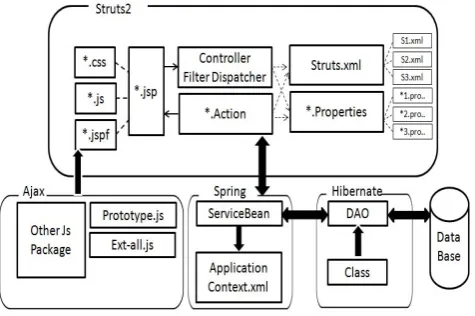
Chunsheng Zhao, Mai Jiang, Zhiyong He [1] presented E-Commerce system in which Struts 1.3 integrates with JSTL, so it uses the JSTL EL. The EL has basic object graph traversal, but relatively weak collection and indexed property support. While in Strut 2 it removes by using more powerful and flexible expression language called "Object Graph Notation Language" (OGNL).Which provides high indexing property support. E-commerce application can be designed using integrating three Frameworks which are Struts 2, spring, Hibernate. Struts2 has powerful web performance processing mechanism, Spring Framework used for decoupling the complex business logic and business object, ORM framework Hibernate focus on data object’s O/R mapping and persistence. All Components fulfills request Duties as follows [1]
A) Web presentation layer-
Strut2 mechanism is used for presentation layer to interact with external user. It work on principle of aspect oriented programming it uses presentation and core model layer based on OGNL and values stack mechanism. Strut 2 filter dispatcher mechanism searches request in strut-xml file and forwards the specific request to Spring Container. It also contains Ajax for user convenient, CSS for page designing,
Client side validation handled by JavaScript. The corresponding international appropriate documents
(*.properties) and controller forwarding document (struts.xml) configured in processing flow of presentation layer[1].
B) Business Logic layer-
It contained all business operations, business data and business objects which divided into several abstract and implemented layers. This layer implemented in between
business logic performance action in presentation layer, assembling and dividing business logic service and the transactions between businesses in business logic layer, DAO layer. It calls Hibernate Template to persistent data objects in data persistence layer [7].
C) Data Persistence Layer and Domain Model Layer: For Efficient and faster accessing the database, it stores the domain object to database and performing the operation on the data object. Web tool like hibernate having its own algorithm to data object operation. Hibernate provides its own API, commands and easy to use hibernate template. Data processing becomes faster and efficient by using HQL and Criteria query and different database can be integrate using .hbm file of hibernate this seems to be very effective when system migrates form one Database to other. Domain model layer contains business object which act as carrier between different data layers. Reusing a business object is main focus of implementing domain model layer [1].
Framework Features Advantage Limitation
Strut 1.3
Merge of Web Work,
MVC Design Patten
Heavy weight,
Integrate with JSTL Expression Language
Automatically Exception handling,
Database link pool management
Separate request Processor with same lifecycle
A synchronization model
Strut2.0
merge of Web Work,
MVC Design Patten
heavy weight,
Integrate with Object graph Notation Language
Exception handling, Database link pool management
Different request processor with different life cycle,
Thread Safe Synchronization model
Reconfiguring,
Weak indexing,
Spring
IoC container,
Transaction management ,
Loosely coupled.
Spring Object Relational Mapping
Enable the use of EJB ,
Light-weighted architecture\ with support for Tag Library,
Controller implementation Based Easy for switching platforms,
Flexible handler mapping and model transfer
lack of a common controller,
Rich Selection of controller,
Formation for vendor-specific implementations of libraries
Hibernate
persistence framework
Session management
Transaction management
Entity management
Detached entities
Supports Inheritance, Associations, Collections, contains all
relationships
Database Independent
Fast performance by supporting catching mechanism and annotation
More API to learn
debugging some more difficult
Ankur Bawiskar[3] Constructs University management System with help of by using multitier Architecture of MVC framework in which University student interact with system by using view layer implementing using Strut 2,by enrolling into system it uses available facility like downloading papers and other e-learning facility. The Spring framework uses easily integrated with any other ORM tool such as Hibernate with the help of XML mapping and also with iBATIS. Spring 2.0 also integrating with Strut 2.0 framework and forming interactive API [4].Comparative study of frameworks which is shown in Table I. and Flow is generated as shown in Fig 1.
III.CLOUD COMPUTING SOLUTIONS FOR E-LEARNING
SYSTEM
Now a days with the significant growth in the cloud based system so many industries gives their attention towards the cloud computing solutions. E-learning is promising application area since its typical requirement coincides well with the cloud characteristics as it contains properties like dynamically allocation of computation and storage resources [8]. In this paper we represent some possible cloud solution for an E-learning System with emphasizing its possible pros and cons. It is of paramount importance to choose most suitable cloud model for an E-learning application in terms of scalability, portability and security, there are different deployment alternatives of cloud computing and their benefits [8].
Internet technologies recent progress gives us opportunities to access the environment that allows users to run and access their applications. This environment contains data center that are monitored and maintained by content providers [9]. There are two main points in cloud computing technology mainly interactivity and collaboration [10]. Cloud Computing enables on demand network access to a shared pool of configurable computing resources like networks, servers, storage, applications and services that can be rapidly provisioned and released with minimal management efforts or content providers interaction[11].
There are three cloud deployment modules in the cloud market
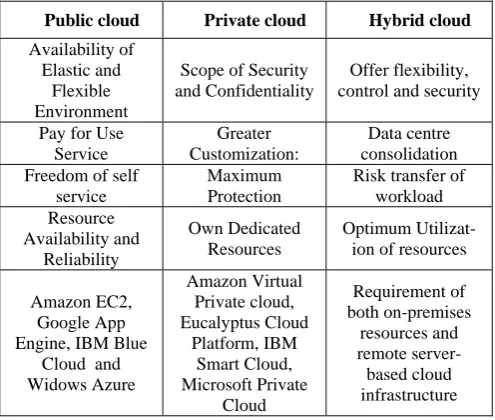
1) Public Cloud: This model is used by the general
public cloud customer in which the cloud service provider has the full ownership with its own policy, value, and profit, costing and charging model and it is most common model of cloud computing [12].
2) Private Cloud: This cloud is operated within single
organization and managed by organization or third party regardless whether it is located premise or off premise [12]. Security and privacy concepts enforce most of the organization to use this model.
3) Hybrid Cloud: This Cloud Infrastructure is
combination of two clouds i.e. public cloud or private cloud but that is bound together by standardized technology which enables data and application portability [12].
A) Overview of cloud based E-learning System:
Many education organizations do not have sufficient resources and infrastructure needed to run E-learning solution, so that E-E-learning Software has the versions of base applications that are cloud oriented.
There are some advantages of cloud based E-learning solutions [13]:
1) Lower Costs: you don’t required high-powered
and high priced computer system to run cloud based web applications because applications run on cloud not on desktop PC.
2) Improved Performance: There are fewer programs
are loaded into device memory so that cloud based E-learning system boot and run faster.
3) Instant software updates: As the application is web
based update occurs automatically.
4) Data reliability increased: Even if desktop
computer crashes the data still remain accessible as it remains on cloud.
5) Device independence: As applications run on
cloud you can change computers or networks.
6) Improved Improbability: Unauthorized person
can’t access any data by finding out digital assets [10].
TABLEII
COMPARATIVE STUDY BETWEEN PUBLIC, PRIVATE AND HYBRID CLOUD
Public cloud Private cloud Hybrid cloud
Availability of Elastic and
Flexible Environment
Scope of Security and Confidentiality
Offer flexibility, control and security
Pay for Use Service
Greater Customization:
Data centre consolidation Freedom of self
service
Maximum Protection
Risk transfer of workload Resource
Availability and Reliability
Own Dedicated Resources
Optimum Utilizat-ion of resources
Amazon EC2, Google App Engine, IBM Blue
Cloud and Widows Azure
Amazon Virtual Private cloud, Eucalyptus Cloud
Platform, IBM Smart Cloud, Microsoft Private
Cloud
Requirement of both on-premises
resources and remote
server-based cloud infrastructure
There are some disadvantages of cloud computing:
1) Network: You required stable internet connections,
if cloud connection get terminated during session user may lose unsaved data, time [14].
2) Security: As all data and application stored on a
system where they do not have full control, so that many organization feel unsecure [15].
3) Portability: Due to limitation of proprietary
IV.INFRASTRUCTURE-AS-A-SERVICE CLOUD SOLUTION: Matheus Cunha[16] investigated Current user of Infrastructure-as-a-service cloud faces difficulties in estimating cloud resources according to their application needs [16]. Cloud computing offers business model containing provision of on-demand, pay-per-use resources (e.g., computing, storage, applications and platforms), in the form of internet services [17], [18]. There are several cloud computing solutions exist, ranging from open source platforms which enables creation of private clouds inside organization [19], [20], to commercial cloud providers such as Microsoft’s Windows Azure [21], Amazon’s EC2 [22], Google’s AppEngine [23], Salesforce [24] and Rackspace [25]. EC2 and Rackspace, these are examples of infrastructure-as-a-service (IaaS) clouds [17], these cloud providers offers virtual servers i.e. virtual machines with specific capacity for CPU, memory and storage, and it also offers virtual storage which can be remotely created, accessed and managed as services through public applications programming interfaces (APIs). In this way customers of these cloud providers can easily acquiring there required computing resources without having burden for managing physical infrastructure. I-a-a-s cloud providers bring a new challenge for cloud customers i.e. to select the best cloud resources according to the needs and characteristics of applications [16], for example EC2 cloud providers’ offers more than 10 virtual machines or instances types with varied levels of computational capacity and prices [22]. Therefore, developers need to have a deep understanding of the requirements of their applications as well as of the expected performance of the different cloud resources and services that each provider offers [16].
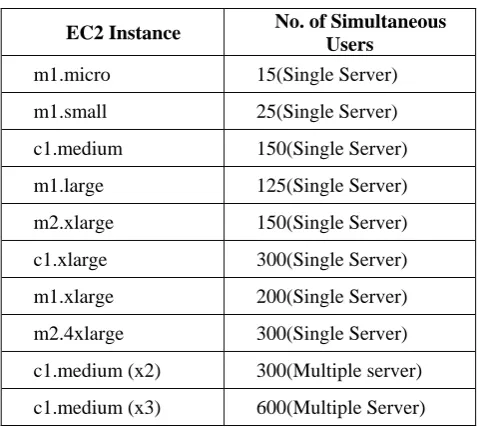
CloudStone project [16] performs the Experimental results on Amazon EC2 which providing Infrastructure as a service which contains olio application in rubies and rails platform. Olio Application contains Web Server, Application Server and Database and Fagan which is session-based workload generator used for testing of application. It takes number of experimental test on Single as well as multiple server configuration and impact on different cloud EC2 instances for variety of workload on cost-effective manner.
Hobin Yoon[6] performs experimental analysis on Simple Queue Services(SQS) and Simple Storage Service provided by Amazon web Services for Infrastructure as Service. It determine device Rate Control for obtain suitable latencies According to latency Variation for SQS and elimination of bottlenecks with increasing parallelism for S3.Massage latencies of rate Controlled mechanism It is analyze that
1) Best performance of SQS shown with limit of 10 massages in Queue. It serves Services to client which sending massage to it one by one.
2) Request will not make by receiver if there is no massage in server that avoid unnecessary polling of massages.
3) Oldest massage Saturated in delete queue which is deleted by delete
4) Sender sends the message if It is not older than 15 seconds it prevents duplicate massages if it is not deleted timely fashion.
Amazon provides secure, scalable and reliable service storage S3 which is used in big data application where large data file transfer from external event source to S3.It signifies that end user must select appropriate data transfer services which they need.S3 having transfer manager component which is mainly divided into dynamic thread creation and increasing connection count limit which is in between 50 to 200.It shows by minimal modification in transfer manager and client environment it achieves 6 times performance increment.
TABLE III
PERFORMANCE RESULT OF AMAZON EC2 INSTANSES
While Amazon Simple Storage Services (S3) providing platform for reliable accessing data with fault tolerance and highly scalable manner, Richard K. Lomotey and Ralph Deters [5] presents problem on high communication latency that makes it uninteresting for mobile consumption of enterprise data in a highly distributed environment which presents MiLAMob which is middleware-centric framework simplifies real time authentication process. Proposed OAuth 2.0 technique such as Facebook, Google+ authenticated from security tokens with Amazon S3 Repository, by this approach mobile consumer can efficiently access enterprise data with less processing efforts. End users login through than username and password pair using any social network such as facebook, yahoo, and google+. If user is valid social account holder middleware fetches user credential and stores into repository by which company keep records of customers which have been contacted. By this MiLAMob completely deprecated existence of Amazon S3. MiLAMob with Amazon S3 can be used as better Framework for other IaaS based public cloud services such as Dropbox for file sharing. Because e-business portal there is rapidly changing data on server and now days, Most of the portals are switching to Apps in android platform
EC2 Instance No. of Simultaneous Users
m1.micro 15(Single Server)
m1.small 25(Single Server)
c1.medium 150(Single Server)
m1.large 125(Single Server)
m2.xlarge 150(Single Server)
c1.xlarge 300(Single Server)
m1.xlarge 200(Single Server)
m2.4xlarge 300(Single Server)
c1.medium (x2) 300(Multiple server)
V. CONCLUSION
In this study, We discuss MVC framework which provides more efficiency, maintainability, reusability and separate functional layers hence most of the industries uses that for system development and implementation. By considering high growth of e-learning domain we conclude that better e-learning enterprise system can be developed by integrating Struts 2.0, Spring 2.0 and Hibernate. but It realize that if application is not so large we can managed by Spring3.0 and Hibernate and reduce the extra burden of Struts framework because it is heavy weight application.
E-learning system provides SaaS to key factors in education domain and need to use Infrastructure as Service from cloud service provider .By above sections, We conclude that combination of EC2(Elastic cloud) and S3(simple secure storage) is more suitable for e-learning application. In sense that, Application deployed on EC2 medium instance and Database is on S3 repository because database always changing in e-learning application especially for education domain and extra security can be maintains by OAuth 2.0 technique.
REFERENCES
[1] Chunsheng Zhao, Mai Jiang, Zhiyong He,”The Design of E-Commerce System Architecture Based on Struts2, Spring and Hibernate”2010 IEEE 978-1-4244- 7618-3 /10.
[2] Jiya Jiang , Tong Liu , Yu Liu,” The Construction of E-Business Portal Based onStruts, Spring and Hibernate”2009 IEEE 978-1-4244-4589-9/09
[3] Ankur Bawiskar, Prashant Sawant, Vinayak Kankate, Dr. B. B. Meshram,” Integration of Struts, Spring and Hibernate for an University Management System” International Journal of Emerging Technology and Advanced Engineering June 2012
[4] International Journal of Emerging Technology and Advanced Engineering Website: www.ijetae.com (ISSN 2250-2459, Volume 2, Issue 6, June 2012).
[5] Richard K. Lomotey and Ralph Deters,” Middleware-Layer for
Authenticating Mobile Consumers of Amazon S3 Data” 2013 IEEE
International Conference on Cloud Engineering.
[6] Hobin Yoon, Ada Gavrilovska, Karsten Schwan, Jim Donahue,” Interactive Use of Cloud Services: Amazon SQS and S3” 2012 12th IEEE/ACM International Symposium on Cluster, Cloud and Grid Computing
[7] Zhang Haiyang, Zhu Yongzhi, “Research of Hibernate +Struts+ Spring integrate technology,” Computer Knowledge and Technology, vol. 5, pp. 2443-2446, Sep. 2009.
[8] Engin Leloglu, Tolga Ayav, Burak Galip Aslan,” A Review of Cloud Deployment Models for E-Learning Systems” IEEE conference paper, dated 2013
[9] Al-Zoube, M.: “E-Learning on the Cloud”, International Arab Journal of e-Technology, Vol. 1, No. 2, pp. 58-64, June 2009. [10] Pocatilu, P., Alecu, F., Vetrici, M.: “Measuring the Efficiency of
Cloud Computing for E-learning Systems”, WSEAS TRANSACTIONS on COMPUTERS, Issue 1, Volume 9, pp. 42-51, January 2010.
[11] Mell, P., Grance, T.: “The NIST Definition of Cloud Computing” National Institute of Standards and Technology Special Publication 800-145, September 2011.
[12] Dillon, T., Wu, C., Chang, E.: “Cloud Computing: Issues and Challenges”, 24th IEEE International Conference on Advanced
Information Networking and Applications, pp. 27-33, 2010.
[13] Rao, N.M., Sasidhar, C., Kumar, V.S.: “Cloud Computing Through Mobile-Learning”, (IJACSA) International Journal of Advanced Computer Science and Applications Vol.1, No. 6, pp. 42-47, December 2010.
[14] Campbell, S.: “e-Learning in “the Cloud”,
http://www.syberworks.com/articles/elearning-in-the-cloud-article.htm, September 2012, unpublished.
[15] Open Cloud Manifesto, http://www.opencloudmanifesto.org, September 2012, unpublished.
[16] Matheus Cunha, Nabor Mendonc¸a and Am´erico Sampaio, “Investigating the Impact of Deployment Configuration and User Demand on a Social Network Application in the Amazon EC2 Cloud”, 2011 Third IEEE International Conference on Coud Computing Technology and Science.
[17] M. Armbrust, A. Fox, R. Griffith, A. Joseph, R. Katz, A. Konwinski, G. Lee, D. Patterson, A. Rabkin, I. Stoica et al., “Above the clouds: A berkeley view of cloud computing,” EECS Department, University of California, Berkeley, Tech. Rep. UCB/EECS-2009-28, 2009.
[18] I. Foster, Y. Zhao, I. Raicu, and S. Lu, “Cloud computing and grid computing 360-degree compared,” in Grid Computing Environments Workshop, 2008. GCE’08. Ieee, 2009, pp. 1–10. [19] Eucalyptus, “Eucalyptus the open source cloud plataform,” 2009,
http: //open.eucalyptus.com/.
[20] OpenNebula, “Open source tookit for cloud computing,” 2010, http: //www.opennebula.org/.
[21] Azure, “Windows azure platform,” 2010, http://www.microsoft.com/ windowsazure.
[22] EC2, “Amazon elastic compute cloud,” 2010, http://aws.amazon.com/ ec2.
[23] AppEngine,“Googleappengine,”2010,http://code.google.com/ appengine/.
[24] S.Force, “Sales force,” 2010, http://www.salesforce.com/. [25] Rackspace, “The rackspace cloud,” 2009,
http://www.rackspacecloud.com/.