PPP
-Completeness with Connections to Cryptography
Katerina Sotiraki* MIT
Manolis Zampetakis† MIT
Giorgos Zirdelis‡ Northeastern University
Abstract
Polynomial Pigeonhole Principle (PPP) is an important subclass ofTFNPwith profound connections to the complexity of the fundamental cryptographic primitives: collision-resistant hash functionsandone-way permutations. In contrast to most of the other subclasses ofTFNP, no complete problem is known forPPP. Our work identifies the firstPPP-complete problem without any circuit or Turing Machine given explicitly in the input: constrained-SIS, and thus we answer a longstanding open question from [Pap94].
constrained-SIS: a generalized version of the well-known Short Integer Solution problem (SIS) from lattice-based cryptography.
In order to give intuition behind our reduction forconstrained-SIS, we identify anotherPPP -complete problem with a circuit in the input but closely related to lattice problems:BLICHFELDT.
BLICHFELDT: the computational problem associated with Blichfeldt’s fundamental theorem in the theory of lattices.
Building on the inherent connection ofPPPwith collision-resistant hash functions, we use our completeness result to construct the first natural hash function family that captures the hardness of all collision-resistant hash functions in a worst-case sense, i.e. it is natural and
universal in the worst-case. The close resemblance of our hash function family withSIS, leads us to the first candidate collision-resistant hash function that is both natural and universalin an average-case sense.
Finally, our results enrich our understanding of the connections betweenPPP, lattice prob-lems and other concrete cryptographic assumptions, such as the discrete logarithm problem over general groups.
*email: [email protected]. The author was partly supported by NSF grants 1350619, 1718161,
CNS-1414119 and by the Chateaubriand Fellowship of the Office for Science and Technology of the Embassy of France in the United States.
†email: [email protected]. The author was supported by NSF grants CCF-1551875, CCF-1617730, CCF-1650733.
‡email: [email protected]. The author was supported by NSF grants 1314722, 1413964,
1
Introduction
The fundamental task of Computational Complexitytheory is to classify computational problems according to their inherent computational difficulty. This led to the definition ofcomplexity classes such as NP which contains the decision problems with efficiently verifiable proofs in the “yes” instances. Thesearchanalog of the classNP, calledFNP, is defined as the class ofsearchproblems whose decision version is inNP. The same definition extends to the classFP, as the search analog ofP. The seminal works of [JPY88, Pap94] considered search problems inFNP that aretotal, i.e. their decision version is always affirmative and thus a solution must always exist. This totality property makes the definition ofFNPinadequate to capture the intrinsic complexity of total prob-lems in the appropriate way as it was first shown in [JPY88]. Moreover, there were evidences for the hardness of total search problems e.g. in [HPV89]. Megiddo and Papadimitriou [MP89] de-fined the classTFNPthat contains the total search problems ofFNP, and Papadimitriou [Pap94] proposed the following classification rule of problems inTFNP:
Total search problems should be classified in terms of the profound mathematical principles that are invoked to establish their totality.
Along these lines, many subclasses for TFNP have been defined. Johnson, Papadimitriou and Yannakakis [JPY88] defined the class PLS. A few years later, Papadimitriou [Pap94] defined the complexity classes PPA, PPAD, PPADS and PPP, each one associated with a profound mathematical principle in accordance with the above classification rule. More recently, the classes
CLSandPWPPwere defined in [DP11] and [Jer16], respectively. In Section 1.1 we give a high-level description of all these classes.
Finding complete problems for the above classes is important as it enhances our understand-ing of the underlyunderstand-ing mathematical principles. In turn, such completeness results reveal equiv-alences between total search problems, that seemed impossible to discover without invoking the definition of these classes. Since the definition of these classes in [JPY88, Pap94] it was clear that the completeness results about problems that do not have explicitly a Turing machine or a circuit as a part of their input are of particular importance. For this reason it has been established to call such problemsnaturalin the context of the complexity of total search problems (see [FRG18]).
Many natural complete problems are known forPLSandPPAD, and recently natural complete problems forPPA were identified too (see Section 1.1). However, no natural complete problems are known for the classes PPP, PWPP that have profound connections with the hardness of important cryptographic primitives, as we explain later in detail.
Our Contributions. Our main contribution is to provide the first natural complete problems for
PPP and PWPP, and thus solve a longstanding open problem from [Pap94]. Beyond that, our
PPPcompleteness results lead the way towards answering important questions in cryptography and lattice theory as we highlight below.
UniversalCollision-ResistantHashFunction. Building on the inherent connection ofPWPP with collision-resistant hash functions, we construct a natural hash function familyℋcSIS with the following properties:
Moreover, if an (average-case hard) collision-resistant hash function family exists, then there exists an efficiently samplable distribution𝒟overℋcSIS, such that(𝒟,ℋcSIS)is an (average-case hard) collision-resistant hash function family.
- Average-Case Hardness. No efficient algorithm can find a collision in a function chosen uniformly at random from ℋcSIS, unless we can efficiently find short lattice vectors in any (worst-case) lattice.
The first property ofℋcSISis reminiscent of the existence ofworst-caseone-way functions from the assumption that P ̸= NP [Sel92]. The corresponding assumption for the existence of worst-case collision-resistance hash functions is assumingFP̸=PWPP, but our hash function familyℋcSIS is the first natural definition that does not involve circuits, and admits this strong completeness guarantee in the worst-case.
The construction and properties of ℋcSIS lead us to the first candidate of anatural and uni-versal collision-resistant hash function family. The idea of uniuni-versal constructions of cryptographic primitives was initiated by Levin in [Lev87], who constructed the first universal one-way func-tion and followed up by [Lev03, KN09]. Using the same ideas we can also construct collision a universal collision-resistant hash function family as we describe in Appendix C. The constructed hash function though invokes in the input an explicit description of a Turing machine and hence it fails to be natural, with the definition of naturality that we described before. In contrast, our candidate construction is natural, simple, and could have practical applications.
Complexity ofLatticeProblems inPPP. The hardness of lattice problems inNP∩coNP[AR04] has served as the foundation for numerous cryptographic constructions in the past two decades. This line of work was initiated by the breakthrough work of Ajtai [Ajt96], and later developed in a long series of works (e.g. [AD97, MR07, Reg09, GPV08, Pei09, GVW13, BLP+13, BV14, GSW13, GVW15b, GKW17, WZ17, PRSD17]). This wide use of search (approximation) lattice problems further motivates their study.
We make progress in understanding this important research front by showing that:
1. the computational problem BLICHFELDT associated with Blichfeldt’s theorem, which can be viewed as a generalization of Minkowski’s theorem, isPPP-complete,
2. thecSISproblem, a constrained version of the Short Integer Solution (SIS), isPPP-complete, 3. we combine known results and techniques from lattice theory to show that most
approxi-mation lattice problems are reducible toBLICHFELDTandcSIS.
These results create a new path towards a better understanding of lattice problems in terms of complexity classes.
Complexity ofOther Cryptographic Assumptions. Besides lattice problems, we discuss the relationship of other well-studied cryptographic assumptions andPPP. Additionally, we formu-late a white-box variation of thegeneric group model for the discrete logarithm problem [Sho97]; we observe that this problem is inPPPand is another natural candidate for beingPPP-complete.
1.1 Related Work
PLS. The class of problems whose totality is established using a potential function argument. Every finite directed acyclic graph has a sink.
PPA. The class of problems whose totality is proved through a parity argument. Any finite graph has an even number of odd-degree nodes.
PPAD. The class of problems whose totality is proved through a directed parity argument. All directed graphs of degree two or less have an even number of degree one nodes.
PPP. The class of problems whose totality is proved through a pigeonhole principle argument. Any map from a set S to itself either is onto or has a collision.
Using the same spirit two more classes were defined after [Pap94], in [DP11] and [Jer16].
CLS. The class of problems whose totality is established using both a potential function argu-ment and a parity arguargu-ment.
PWPP. The class of problems whose totality is proved through a weak pigeonhole principle. Any map from a set S to a strict subset of S has a collision.
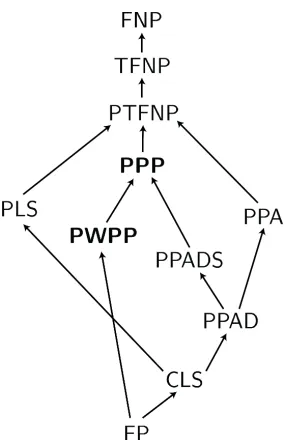
Figure 1: The classes PPP and
PWPPin theTFNP world. Recently, a syntactic analog PTFNP of the semantic class
TFNP has been defined in [GP17], and a complete problem for this class has been identified. It has also been shown that all the classes we described above are subsets ofPTFNP. Ora-cle separations between all these classes are known [BCE+98], with the only exception of whetherPLSis contained inPPAD.
PLS-completeness. The class PLS represents the complex-ity of local optimization problems. Some important problems that have been shown to be PLS-complete are: Local Max-Cut [SY91], Local Travelling Salesman Problem [Pap92], and Finding a Pure Nash Equilibrium [FPT04]. Recently, impor-tant results for the smoothed complexity of the Local Max-Cut problem were shown in [ER17, ABPW17].
PPAD-completeness. Arguably, the most celebrated applica-tion of the complexity of total search problems is the charac-terization of the computational complexity of finding a Nash equilibrium in terms ofPPAD-completeness [DGP09, CDT09]. This problem lies in the heart of game theory and economics. The proof that Nash Equilibrium is PPAD-complete initiated a long line of research in the intersection of computer sci-ence and game theory and revealed connections between the two scientific communities that were unknown before (e.g.
[EGG06, CDDT09, VY11, KPR+13, CDO15, Rub15, Rub16, CPY17, SSB17]).
Lemma. Similarly, other problems have been showed to be PPA-complete, all involving some circuit as an input in their definition [ABB15, DEF+16, BIQ+17]. Recently, the first naturalPPA -complete problem, without a circuit as part of the input, has been identified in [FRG18]. This illustrates an interesting relation betweenPPAand complexity of social choice theory problems.
CLS-completeness. The CLSclass was defined in [DP11] to capture the complexity of problems such as P-matrix LCP, computing KKT-points, and finding Nash equilibria in congestion and network coordination games. Recently, it has been proved that the problem of finding a fixed point whose existence invokes Banach’s Fixed Point Theorem, isCLS-complete [DTZ18, FGMS17].
TFNP and cryptography. The connection of TFNP and cryptography was illustrated by Pa-padimitriou in [Pap94], where he proved that if PPP = FP then one-way permutations cannot exist. In [BO06], a special case of integer factorization was shown to be in PPA∩PPP. This was generalized in [Jer16] by proving that the problem of factoring integers is in PPA∩PPP
under randomized reductions. Recently, strong cryptographic assumptions were used to prove the average-case hardness ofPPADandCLS[BPR15, GPS16, HY17]. In [RSS17] it was shown that average-casePPADhardness does not imply one-way function, whereas in [HNY17] it was shown that any hard on average problem in NPimplies the average case hardness ofTFNP. Finally, in [KNY17] it is proved that the existence ofmulti-collision resistant hash functionsis equivalent with a variation of the total search problemRAMSEY, which is not known to belong to any of the above complexity classes. Interestingly, they prove that another variation of RAMSEY called colorful-Ramsey(C-RAMSEY) is PWPP-hard. Although this an important result, the problemC-RAMSEY
still invokes a circuit in the input and in not known to be inPWPP, hence does not resolve the problem of identifying a natural complete problem forPWPP.
TFNP and lattices. In [BJP+15] it was shown that the computational analog of Minkowski’s theorem (namely MINKOWSKI) is in PPP, was conjectured that it is also PPP-complete. The authors justified their conjecture by showing thatEQUAL-SUMS, a problem from [Pap94] that is conjectured to bePPP-complete, reduces toMINKOWSKI. Additionally, they show that a number theoretic problem calledDIRICHLETreduces toMINKOWSKI, and thus is inPPP. In [HRRY17] it is proven that the problem NUMBER-BALANCINGis equivalent to a polynomial approximation of Minkowski’s theorem in the`2 norm (via Cook reductions for both directions).
1.2 Roadmap of the paper
We start our exposition with a brief description of the results contained in this paper. First we briefly describe the PPP-completeness of BLICHFELDT that illustrates some of the basic ideas behind our main result thatcSISisPPP-complete. The complete proof of the PPP-completeness of BLICHFELDTcan be found in Section 3. We suggest to readers that have experience with the fundamental concepts of the theory of lattices to skip the details Section 3.
Then, we present a brief description of our main theorem and its proof. The complete proof of thePPP-completeness ofcSIScan be found in Section 4.
In Section 5 we describe the PPP-completeness of a weaker version of cSIS and its relation with the definition of the first natural universal collision resistant hash function family in the worst-case sense. This proof also provides the first candidate for a collision resistant hash func-tion family that is both natural and universal in the average-case sense.
1.3 Overview of the Results
Before we describe our results in more detail we define the classPPP more formally. The class
PPPcontains the set of problems that are reducible to thePIGEONHOLE CIRCUIT problem. The input to PIGEONHOLE CIRCUITis a binary circuit 𝒞 : {0, 1}n → {0, 1}n and its output is either
an ¯
x∈ {0, 1}n such that𝒞(
¯ x) =
¯
0, or a pair ¯ x,
¯
y∈ {0, 1}nsuch that
¯ x̸=
¯
yand𝒞( ¯ x) =𝒞(
¯ y). Our first and technically most challenging result is to identify and prove thePPP-completeness of two problems, both of which share similarities with lattice problems. For our exposition, a lattice ℒ ⊆ Zn can be viewed as a finitely generated additive subgroup of Zn. A lattice
ℒ = ℒ(B):= B·Znis generated by a full-rank matrix B∈ Zn×n, calledbasis. In the rest of this
section we also use thefundamental parallelepipedof ℒdefined as𝒫(ℒ):=B·[0, 1)n.
1.3.1 BLICHFELDTisPPP-complete.
We define the BLICHFELDT problem as the computational analog of Blichfeldt’s theorem (see Theorem 3.1). Its input is a basis for a lattice ℒ ⊆ Zn and a set S ⊆ Zn of cardinality greater
or equal to the volume of 𝒫(ℒ). Its output is either a point in S that belongs toℒ, or for two (different) points inSsuch that their difference belongs toℒ. In the overview below, we explain why such an output always exists. Notice that finding a solution toBLICHFELDTbecomes trivial if the input representation of S has length proportional to its size, i.e. one can iterate over all element pairs of S. The problem becomes challenging when S is represented succinctly. We introduce a notion for a succinct representation of sets that we callvalue function. Informally, a value function for a set S is a small circuit that takes as input ⌈log(|S|)⌉ bits that describe an indexi∈ {0, . . . ,|S| −1}, and outputssi ∈S.
We give a proof overview of our first main theorem, and highlight the obstacles that arise, along with our solutions.
Theorem 3.5. TheBLICHFELDTproblem isPPP-complete.
PPP Membership of BLICHFELDT Overview. We denote with [n] the set {0, . . . ,n−1}. We define the mapσ :Zn → 𝒫(ℒ)∩Znthat reduces any point inZnmodulo the parallelepiped to
𝒫(ℒ)∩Zn, i.e. (mod 𝒫(ℒ)). Using
σ we can efficiently check the membership of anyv ∈ Zn
inℒ, by checking ifσ mapsvto the origin. Observe that ifσ(x) =σ(y)thenx−y∈ ℒ.
We show in Lemma 3.2 that vol(𝒫(ℒ)) =|𝒫(ℒ)∩Zn|, hence the input requirement for Sis
equivalent to |S| ≥ |𝒫(ℒ)∩Zn|. Notice that the points of S after applying the map
σ, either
have a collision in𝒫(ℒ)∩Zn or a preimage of the origin exists inS. It follows by a pigeonhole
argument that a solution toBLICHFELDTalways exists. For the rest of this part we assume that |S|=|𝒫(ℒ)∩Zn|and letn=⌈log(|S|)⌉.
We construct a circuit𝒞 :{0, 1}n→ {0, 1}nthat on input an appropriate indexi, evaluates the
value function ofSto obtainsi ∈ S, and computesσ(si). The most challenging part of the proof
is to construct an efficient map fromσ(S) to [|𝒫(ℒ)∩Zn|] in the following way. We define an
appropriate parallelepiped D = [L1]×[L2]× · · · ×[Ln] where the Li are non-negative integers,
and a bijectionπ :𝒫(ℒ)∩Zn →D. BecauseDis a cartesian product, a natural efficient indexing
procedure exists as described in Lemma 2.1. This allows to map π(σ(si))to j ∈ [|𝒫(ℒ)∩Zn|].
The circuit 𝒞 outputs the binary decomposition of j. It follows that any ¯
x such that 𝒞( ¯ x) =
¯ 0 corresponds to a vector x ∈ S such that σ(x) = 0. On the other hand, a collision 𝒞(
¯
x) = 𝒞( ¯ y) with
¯ x ̸=
¯
y corresponds to a collisionσS(x) =σS(y), whereσS is the restriction ofσ on S, and
PPP Hardness of BLICHFELDT Overview. We start with a circuit 𝒞 : {0, 1}n → {0, 1}n that is an input toPIGEONHOLE CIRCUIT. We construct a setSand a latticeℒas input toBLICHFELDT
in the following way. The setS contains the elementss ¯ x = ¯ x 𝒞( ¯ x)
∈ {0, 1}2n and is represented
succinctly with the value function that maps ¯ xto s
¯
x. Notice that |S| =2n. The latticeℒconsists
of all ¯
v ∈ {0, 1}2n that satisfy the equation [0
n In]·
¯
v = 0 (mod 2). By Lemma 2.3, one can efficiently obtain a basis from this description of ℒ and in addition the volume of 𝒫(ℒ) is at most 2n. Thus, Sandℒis a valid input forBLICHFELDT.
The output of BLICHFELDT is either an s ¯ x = ¯ x 𝒞( ¯ x)
∈ S∩ ℒ that (by construction of ℒ)
implies𝒞( ¯
x) =0, or two different elements ofS,s ¯ x = ¯ x 𝒞( ¯ x) ,s ¯ y = " ¯ y 𝒞( ¯ y) # withs ¯
x−s
¯
y∈ ℒthat
implies ¯ x̸=
¯
yand (by construction ofℒ)𝒞( ¯ x) =𝒞(
¯ y).
1.3.2 cSISisPPP-complete.
Part of the input to BLICHFELDT is represented with a value function which requires a small circuit. As we explained before this makesBLICHFELDTa non-natural problem with the respect to the definition of naturality in the context of the complexity of total search problems. We now introduce a natural problem that we call constrained Short Integer Solution (cSIS), and show that it isPPP-complete. ThecSISproblem is a generalization of the well-knownShort Integer Solution (SIS) problem, and discuss their connection in Section 5.2.
The input is A ∈ Zn×m
q , G ∈ Zdq×m and b ∈ Zdq, for some positive integer q and m ≥
(n+d)⌈log(q)⌉. The matrix G has the property that for every b we can efficiently find an x ∈ {0, 1}m such thatGx= b(mod q). We define such matrices asbinary invertible. The output
is either a vectorx ∈ {0, 1}m such that Ax = 0 (mod q) andGx= b(mod q), or two different
vectors x,y ∈ {0, 1}m such thatA(x−y) = 0 (mod q)and Gx = Gy = b (mod q). We give a
proof overview of the next theorem, and a full proof in Section 4.
Theorem 4.11. ThecSISproblem isPPP-complete.
PPP Membership of cSIS Overview. We show the membership of cSIS in PPP for the general class of binary invertible matricesGin Section 4. In order to simplify the exposition, we assume that q = 2` andGto be the “gadget” matrix concatenated with a random matrixV. That is,G has the form
Id⊗γT VwhereγT = [1, 2, . . . , 2`].
LetA∈Zn×m
q ,G∈Zdq×m, andb∈Zdqbe the input tocSIS. We now explain whym≥(n+d)`
suffices to always guarantee a solution to cSIS. First, observe that the first `·d columns of G, corresponding to the gadget matrix [Id⊗γT], are enough to guarantee that for everyr′ ∈Zmq−`d
there exists an rsuch that G
r r′
= b (mod q). Hence, there are at least qm−`d solutions to the
equationGx=b (mod q). Also, there are 2`n possible values forAx (mod q). By a pigeonhole argument a solution tocSIS always exists. To complete the membership proof, issues similar to
BLICHFELDT with the circuit representation of the problem instance appear, but we overcome them using similar ideas.
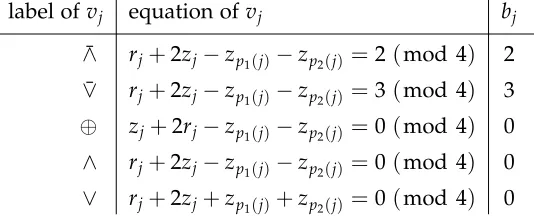
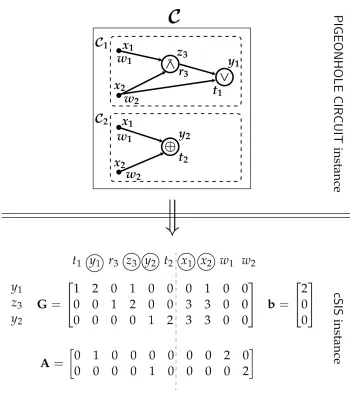
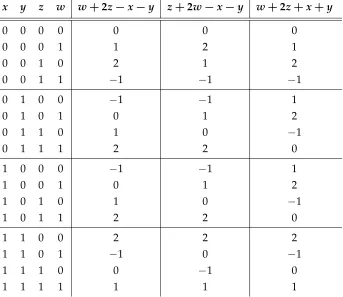
of cSIS is a pair of matrices and a vector, we need to represent this circuit in an algebraic way. In particular, we device a way to encode the circuit in a binary invertible matrix Gand a vector b. To gain a better intuition of why this is possible, we note that a NAND gate x ∧¯ y = z can be expressed as the linear modular equation x+y+2z−w = 2 (mod 4), where x,y,z,w ∈ {0, 1}. By a very careful construction, we can encode these linear modular equations in a binary invertible matrixG. For further details we defer to Section 4.
SincecSISwithq=4 returns a vector such thatAx=0 (mod 4)andPIGEONHOLE CIRCUIT
asks for a binary vector such that ¯ x=
¯
0, a natural idea is to letAbe of the form[0 In], where the
identity matrix corresponds to the columns representing the output of circuit𝒞 inG. Finally, we argue that a solution tocSISwith inputA,Gandbas constructed above, gives either a collision or a preimage of zero for the circuit𝒞 as required.
It can be argued that this reduction shares common ideas with the reduction of 3-SAT to
SUBSET-SUM; this shows the importance of the input conditions for cSIS and hints to the nu-merous complications that arise in the proof. Without these conditions, we could end up with a trivial reduction to anNP-hard problem! Fortunately, we are able to show that our construction satisfies the input conditions ofcSIS.
1.3.3 Towards a Natural and Universal Collision-Resistant Rash Family.
PWPPis a subclass ofPPPin which a collision always exists; it is not hard to show that variations of bothBLICHFELDT andcSISarePWPP-complete. We tweak the parameters of valid inputs in order to guarantee that a collision always exists. ThePWPP-complete variation ofcSIS, which we denote byweak-cSIS, gives a function family which is a universal collision-resistant hash function family in a worst-case sense: if there is a function family that contains at least one function for which it is hard to find collisions, then our function family also includes a function for which it is hard to find collisions.
We now describe the differences of cSIS and weak-cSIS. As before we assume that q = 2`. The input toweak-cSISis a matrix A∈ Zn×m
q , and a binary invertible matrixG ∈ Zdq×m. Notice
that there is no vectorb in the input, and the relation between n,m,d and `is that mhas to be strictlygreater that`(n+d). Namely,m> `(n+d). This change in the relation of the parameters might seem insignificant, but is actually very important, as it allows us to replacebincSISby the zero vector. This transforms weak-cSISinto a pure lattice problem: on input matricesA,Gwith corresponding basesBA andBG, whereGis binary invertible, find two vectorsxandysuch that x,y∈ ℒ(BG)andx−y∈ ℒ(BA).
The great resemblance of weak-cSIS with SIS and its completeness forPWPP lead us to the first candidate for a universal collision-resistant hash functionℋcSIS= {h
¯
s :{0, 1}k → {0, 1}k
′ }: - The key
¯
sis a pair of matrices(A,G), whereGis binary invertible. - Given a key
¯
s = (A,G)and a binary vector ¯
x∈ {0, 1}k,h
¯
s(
¯
x)is the binary decomposition
ofAu(mod q), whereu=
r
¯ x
such thatGu=0(mod q).
1.3.4 Other Lattice Problems Known to be inPPP.
We show that the computational analog of Minkowski’s theorem, namelyMINKOWSKI, is inPPP
via a Karp-reduction to BLICHFELDT. We note that a Karp-reduction showing MINKOWSKI ∈
PPP was shown in [BJP+15]. Based on these two problems and the known reductions between
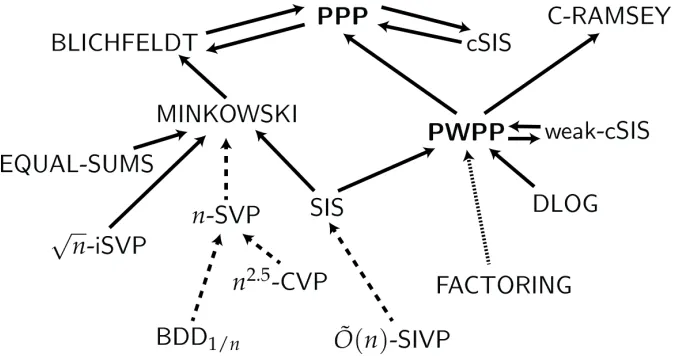
lattice problems, we conclude that a variety of lattice (approximation) problems belong to PPP; the most important among them aren-SVP, ˜O(n)-SIVPandn2.5-CVP(see Figure 2).
1.3.5 Other Cryptographic Assumptions inPPP.
By the definition, the class PWPPcontains all cryptographic assumptions that imply collision-resistant hash functions. These include the factoring of Blum integers, the Discrete Logarithm problem overZ*pand over elliptic curves, and theSISlattice problem (a special case ofweak-cSIS). Also, Jeˇrábek [Jer16] showed that the problem of factoring integers is inPWPP.
We extend the connection betweenPPPand cryptography by introducing a white-box model to describegeneral groups, which we define to be cyclic groups with a succinct representation of their elements and group operation (i.e. a small circuit). We show that the Discrete Logarithm over general groups is inPPP. An example of a general group isZ*q. These connections are also summarized in Figure 2.
Figure 2: Solid arrows denote a Karp reduction, and dashed arrows denote a Cook reduction.
1.4 Open questions.
Numerous new questions arise from our work and the connections we draw betweenPPP, cryp-tography and lattices. We summarize here some of them.
Open Problem 1.1. Is there a worst-to-average case reduction fromweak-cSISto itself?
This result will provide the first natural, in the sense that does not invoke explicitly a Turing machine in the input, anduniversalcollision resistant hash function family.
Open Problem 1.2. IsSISorMINKOWSKI PPP-hard?
Open Problem 1.3. Isγ-SVPinPPPforγ=o(n)?
Open Problem 1.4. Isγ-CVP PPP-hard forγ=Ω(
√ n)?
2
Preliminaries
General Notation. Let[m]be the set{0, . . . ,m−1},N={0, 1, 2, . . .}andZ+={1, 2, 3, . . .}We
use small bold letters x to refer to real vectors in finite dimensionRd and capital bold lettersA
to refer to matrices inRd×`. For a matrix A, we denote byaiT its i-th row and byai,j its (i,j)-th
element. LetIndenote then-dimensional identity matrix. We denote withEi,j the matrix that has
all zeros except that ei,j = 1. A function negl(k)is negligibleif negl(k) < 1/kc for any constant
c>0 and sufficiently largek. All logarithms log(·)are in base 2.
Vector Norms. We define the`p-norm ofx∈Rdto be‖x‖
p = ∑ixpi
1/p
and the`∞-norm ofxto be‖x‖∞ =maxi|xi|. For simplicity we use ‖·‖for the`2-norm instead of‖·‖2. It is well known that‖x‖p≤ n1/p−1/q‖x‖
qfor p≤qand‖x‖p ≤ ‖x‖qforp >q.
2.1 Complexity Classes and Reductions
Binary Strings and Natural Numbers. We use bold and underlined small letters to refer to binary strings. Binary strings
¯
x ∈ {0, 1}k of lengthk can also be viewed as vectors in Zk. Every
binary string ¯
x∈ {0, 1}k can be mapped to a non negative integer number through the nonlinear
map bc : {0, 1}* → Z+ calledbit composition, where bc(
¯
x) = ∑ki=−01 ¯
xk−i2i. It is trivial to see that
actuallybcis a bijective mapping and hence we can define the inverse mappingbd:Z+→ {0, 1}*
calledbit decomposition, which is also trivial to compute for any given numberm∈Z+.
The bit decomposition function bd is extended to integer vectors and the result is the concate-nation of the bit decomposition of each coordinate of the vector. Similarly, this is also extended to integer matrices. Then of course the bit composition function bc is no longer well defined because its output can be either a number or a vector of numbers, but for simplicity we still use the notationbcand it will be made clear from the context whether the output is a number or a vector of numbers. Whenbd is applied to a set{m1, . . . ,mk}the output is still a set with the bit
decomposition of each element{bd(m1), . . . ,bd(mk)}.
Boolean Circuits. A boolean circuit 𝒞 with n inputs and 1 output is represented as a labeled directed acyclic graph with in-degree at most 2, with exactly nsource nodes and exactly 1 sink node. Each source node is an input of𝒞 and the sink node is the output of 𝒞. Each of the input nodes of𝒞is labeled with a number in[n]denoting the ordering of the input variables. Each node with in-degree 1 is labeled with one of the 2 boolean functions with 1 variable{id,¬}. Each node with in-degree 2 can be labeled with one of the 16 boolean function with two variables, but for our purposes we are going to use only the following five boolean functions:nand, nor, xor, and, or, with corresponding symbols{∧¯ , ¯∨ ,⊕,∧,∨}. Every boolean circuit defines a boolean function onnvariables𝒞 :{0, 1}n→ {0, 1}. Let
¯
xbe a binary string of lengthn, i.e. ¯
x∈ {0, 1}n. The value
𝒞( ¯
x)of the circuit on input ¯
xis computed by evaluating of𝒞 one by one in a topological sorting of𝒞, starting from the input nodes. Then,𝒞(
¯
x)is the value of the output node. The size|𝒞|of 𝒞 is the number of nodes in the graph that represents𝒞.
Circuits. We can now define a circuit 𝒞 with n inputs and m outputs as an ordered tuple of m boolean circuits 𝒞 = (𝒞1, . . . ,𝒞m) which defines a function 𝒞 : {0, 1}n → {0, 1}m, where
𝒞( ¯
x) = (𝒞1( ¯
x), . . . ,𝒞m( ¯
x)). The size |𝒞| of 𝒞 is equal to |𝒞1|+· · ·+|𝒞2|. It is known that
Search Problems. A search problem in FNP is defined by a relation ℛ that on input x of size n and for every y of size poly(n), ℛ(x,y) is polynomial-time computable onn. A solution to the search problem with inputx is ayof size poly(n)such thatℛ(x,y)holds.
A search problem istotalif for every input x of size n, there exists a y of size poly(n)such that ℛ(x,y)holds. The class of total search problems inFNP is calledTFNP.
Karp Reductions Between Search Problems. A search problem 𝒫1 isKarp-reducibleto a search problem 𝒫2 if there exist polynomial-time (in the input size of 𝒫1) computable functions f and gsuch that if x is an input of 𝒫1, then f(x)is an input of𝒫2 and if yis any solution of 𝒫2 with input f(x)then g(x,f(x),y)is a solution of𝒫1.
Cook Reductions Between Search Problems. A search problem𝒫1 isCook-reducibleto a search problem 𝒫2 if there exists a polynomial-time (in the input size of 𝒫1) oracle Turing machine𝒯 such that if x is an input of 𝒫1, 𝒯 computes a y such that y is a solution of 𝒫1 whenever all the oracle answers are solutions of 𝒫2. The set of all search problems that are Cook-reducible to problem𝒫 is denoted byFP𝒫.
The PPP Complexity Class. The class PPP is a subclass of TFNP and consists of all search problems Karp-reducible to the following problem calledPIGEONHOLE CIRCUIT.
PIGEONHOLE CIRCUITProblem.
PIGEONHOLE CIRCUITProblem.
Input: A circuit𝒞 withninputs andnoutputs. Output: One of the following:
1. a binary vector ¯
xsuch that𝒞( ¯ x) =
¯ 0, or 2. two binary vectors
¯ x̸=
¯
y, such that𝒞( ¯
x) =𝒞( ¯ y).
The weak PPP Complexity Class. The class PWPP is the set of all search problems Karp-reducible to the following problem calledCOLLISION.
COLLISIONProblem.
COLLISIONProblem.
Input: A circuit𝒞 withninputs andmoutputs withm<n. Output: Two binary vectors
¯ x̸=
¯
y, such that𝒞( ¯ x) =𝒞(
¯ y).
2.2 Set Description Using Circuits
Let S ⊆ Nn and let bd(S) ⊆ {0, 1}k, i.e. the elements of S can be represented using k bits. As
we will see later there is an inherent connection between proofs of both the inclusion and the hardness ofPPPand the succinct representation of subsetsSusing circuits. We define here three such representations: thecharacteristic function, thevalue functionand theindex function.
Characteristic Function. We say that a circuit 𝒞ℋS with k binary inputs and one output is a characteristic function representation ofSif𝒞ℋS(
¯
x) =1 if and only if ¯
x∈bd(S).
Value Function. Let (s,𝒱S) be a tuple where 𝒱S is a circuit with ⌈log(s)⌉ binary inputs and k outputs and s ∈ Z+. Let f(s,𝒱S) : [s] → {0, 1}k be a function such that f(s,𝒱S)(bc(
¯
x)) = 𝒱S( ¯ x)for all
¯
xwithbc( ¯
x)< s. Then,(s,𝒱S)is a value function representation ofSif and only if f(s,𝒱S)is a
bijective map between[s]andbd(S). The value𝒱S( ¯
x)can be arbitrary whenbc( ¯ x)≥s.
Index Function. Let (s,ℐS) be a tuple where ℐS is a circuit with k binary inputs and ⌈log(s)⌉ outputs ands∈Z+. Let f(s,ℐS) :bd(S)→[s]be a function such that f(s,ℐS)(x¯) =bc(ℐS(x¯))for all
¯
x ∈bd(S). Then,(s,ℐS)is an index function representation ofSif and only if f(s,ℐS)is a bijective
map betweenbd(S)and[s]. The valueℐS(
¯
x)can be arbitrary when ¯
Some remarks about the above definitions are in order. First, given a succinct representation ofSit is computationally expensive to compute|S|, thus we provide it explicitly usings. Second, even though the input and the output of each circuit have to be binary vectors, we abuse notation and let the input of the index function and the characteristic function, and the output of the value function to be a element in Nn. Formally, according to the above definitions the output of 𝒱S is the bit decomposition of an element inS, namelybc(𝒱S(
¯
x)) ∈ S. In the rest of the paper, we abuse notation and dropbcto denote by 𝒱S(
¯
x)the vector in S. Similarly, we dropbcandbdfor the characteristic and the index functions.
To illustrate the definitions of succinct representations of sets, we explain how to define them in the simple case of the set([0,L1]× · · · ×[0,Ln])∩Zn. Although this is a simple example, it is
an ingredient that we need when we show the connection of lattice problems with the classPPP.
Lemma 2.1. Let L1, . . . ,Ln>0and S= ([0,L1]× · · · ×[0,Ln])∩Zn. Then, the following exist:
1. a characteristic function representation𝒞ℋSof S, where|𝒞ℋS|=O(nmaxilogLi),
2. a value function representation(𝒱S,s)of S, where|𝒱S|=O(n2maxilogLi)and
3. an index function representation(ℐS,s)of S, where|ℐS|=O(n2maxilogLi).
Proof. Let `1= ⌊L1⌋+1, . . . ,`n =⌊Ln⌋+1.
1. Given the bit decomposition of a vector x ∈ Zn, we can easily test if x belongs to S by
checking whether xi ≤ `i for all i. Such a comparison needs O(logLi)boolean gates and
hence the size of𝒞ℋSisO(nmaxilogLi).
2. Let k be the input number to our value function, the vector that we assing to k is thek-th vector in the lexicographical ordering of the elements in bd(S). We compute this vector x∈Zncoordinate by coordinate. We start fromx
1. Observe for anyt∈Z+, the number of
vectors inSwith x1= t is equal to∏in=2`i and hence the number of vectors withx1 ≤ tis equal to(t+1)·∏ni=2`i. Therefore,x1 =⌊k/∏ni=2`i⌋. Then, the dimension of the problem
reduces by one and therefore we can repeat the same procedure to compute x2 as the first coordinate of the(k−(∏ni=2`i)· ⌊k/∏in=2`i⌋)-th vector in the set S′ = ([0,L2]× · · · × [0,Ln])∩Zn−1. Then we apply the procedure recursively. Moreover, this whole task can be
made into an iterative procedure, with a circuit of sizeO(n2max
ilogLi).
3. Letx∈ Sbe the vector whose index we want to compute. The index that we assign to this vector is its position in the lexicographical ordering of the vectors in bd(S). The number of vectors y ∈ S with y1 < x1 that are before x in the lexicographical ordering is equal to (x1−1)·∏in=2`i. Therefore, using the recursion of the construction of the circuit for
the value function of Sabove, we see that the lexicographical index can be computed by a circuit of sizeO(n2max
ilogLi).
2.3 Lattices and Lattice Problems
Lattice. An-dimensional latticeℒ ⊂Rn is the set of all integer linear combinations ofd linearly
independent vectors B = (b1, . . . ,bd)in Rn, ℒ = ℒ(B) = n
∑d
i=1aibi : ai ∈Z
o
. The integer d is the rank of the lattice, and if it is equal to the dimension n we refer to ℒ as full-rank. The matrixBis called the basisof latticeℒ(B). Unless explicitly stated, the lattices on all definitions, statements and proofs are assumed to be full-rank integer lattices. Our results can be easily extended tod-rank lattices, but for ease of exposition we present only the full-rank case. A useful lemma we will use is the following:
Lemma 2.2. LetB∈Zn×n,U∈Zn×nbe a unimodular matrix, i.e.det(U) =±1, thenℒ(B) =ℒ(BU).
Smith Normal Form. A matrix D ∈ Zn×n is in Smith Normal Form (SNF)if it is diagonal and
di+1,i+1 dividesdi,i for 1 ≤ i < n. Moreover, any non-singular matrixA ∈ Zn×n can be written
as A = UDV, where D ∈ Zn×n is a unique matrix in SNF, and U,V ∈ Zn×n are unimodular
matrices. Also, the matricesU,D,Vcan be computed in polynomial-time inn[KV05].
Dual Lattice. The dual lattice ℒ* is defined as the set of all vectors in the span of B that have integer inner product withℒ. That is,ℒ* ={y∈span(B) : ∀x∈ ℒ, ⟨y,x⟩ ∈Z}.
q-ary Lattice. A lattice ℒ ⊆ Zn is called a q-ary lattice if (qZ)n ⊆ ℒ. Let A ∈ Zm×n, we define
the following two types ofq-ary lattices
Λq(A) = n
x∈Zn |xT =yTA(mod q)wherey∈Zmo, (2.1)
Λ⊥
q(A) ={x∈Zn|Ax=0(mod q)}. (2.2)
The following lemma forq-ary lattices is useful in our proofs. For a simple proof of this Lemma 2.3 we refer to Sections 2.3 and 2.4 of [AP11].
Lemma 2.3. LetA∈Zm×n q , then:
1. Λ⊥q(A) =qΛ*q(A)anddetΛ⊥q(A)≤qn,
2. there exists a polynomial-size circuitℬ𝒮 that on inputbd(A)it outputsbd(B)such thatB∈Zn×m
andΛ⊥q(A) =ℒ(B).
Fundamental Parallelepiped. The fundamental parallelepiped of ℒ(B) is defined as the set 𝒫(B) = {∑ni=1tibi : 0 ≤ ti < 1}. Given a full-rank lattice ℒ(B), we can define the operator
(mod 𝒫(B))on vectors inRnsuch thaty=x(mod 𝒫(B))ify=B B−1x− ⌊B−1x⌋
.
Determinant. The determinant of a lattice is the volume of the fundamental parallelepiped, det(ℒ) =p
det(BTB)or simply|det(B)|for full-rank lattices.
Lattice Cosets. For every c ∈ Rn we define the lattice coset as ℒ+c = {x+c : x ∈ ℒ}. Let
B∈Zn×nbe a set of nlinearly independent integer vectors. We define the set ofinteger cosetsof
ℒ(B)as follows Co(ℒ(B)) ={ℒ(B) +c|c∈Zn}.
We now state a fundamental relation between Co(ℒ(B)), det(ℒ(B))and𝒫(ℒ(B)).
Proposition 2.4. Let B ∈ Zn×n be a set of n-dimensional linearly independent vectors. It holds that
det(ℒ(B)) =|Co(ℒ(B))|=|𝒫(ℒ(B))∩Zd|.
3
BLICHFELDT
is
PPP
-Complete
The concept of lattices was introduced by Hermann Minkowski in his influential bookGeometrie der Zahlen [Min10], first published at 1896. In his book, Minkowski developed the theory of the geometry of numbers and resolved many difficult problems in number theory. His fundamental theorem, known asMinkowski’s Convex Body Theorem, was the main tool of these proofs.
Despite the excitement created by Minkowski’s groundbreaking work, it was only after 15 years that a new principle in geometry of numbers was discovered. The credit for this discovery goes to Hans Frederik Blichfeldt, who in 1914 published a paper [Bli14] with his new theorem and some very important applications in number theory1.
In this section, we characterize the computational complexity of Blichfeldt’s existence the-orem and in later sections we discuss its applications (see Section 6). We recall the statement of Blichfeldt’s theorem below, introduce its computational search version, and prove that it is
PPP-complete.
Theorem 3.1(Blichfeldt’s Theorem [Bli14]). LetB∈ Zn×nbe a set of n-dimensional linearly
indepen-dent integer vectors and a measurable set S⊆Rn. Ifvol(S)>det(ℒ(B)), then there existx,y∈S with
x ̸=yandx−y∈ ℒ(B).
A proof of Theorem 3.1 can be found in Chapter 9 of [OLD01]. We now define the computational discrete version of Blichfeldt’s theorem.
BLICHFELDTProblem.
BLICHFELDTProblem.
Input: An n-dimensional basis B ∈ Zn×n and a set S ⊆ Zn described by the value function representation(s,𝒱S).
Output: Ifs <det(ℒ(B)), then the vector0. Otherwise, one of the following:
0. a numberz∈ [s]such that𝒱S(z)̸∈Sor two numbers z,w∈[s]such that𝒱S(z) =𝒱S(w), 1. a vectorxsuch thatx∈ S∩ ℒ,
2. two vectorsx̸=y, such thatx,y∈Sandx−y∈ ℒ.
Lemma 3.2. BLICHFELDTis inPPP.
Proof. We show a Karp reduction fromBLICHFELDTto thePIGEONHOLE CIRCUITproblem. Let B and (s,𝒱S) be the inputs of BLICHFELDT. We define the lattice ℒ = ℒ(B) and R = 𝒫(B)∩Zn to be the set of all the integer vectors in the fundamental parallelepiped 𝒫(B). Let
`= ⌈log(det(ℒ))⌉andm=⌈log(s)⌉. We remark that`=⌈log(|R|)⌉(see Proposition 2.4) andm is equal to the number of binary inputs of𝒱S. Our goal is to construct a circuit𝒞 with ` inputs and ` outputs such that given a solution of the PIGEONHOLE CIRCUIT problem with input 𝒞, we efficiently find a solution ofBLICHFELDT. Ifs< det(ℒ), then we output0without invoking
PIGEONHOLE CIRCUIT. Therefore, for the rest of the proof we focus on the case s ≥ det(ℒ) which implies m ≥ `. We can also assume without loss of generality that s = det(ℒ). If this is not the case, then we can equivalently work with the set S′ which is described by the value function representation (det(ℒ),𝒱S′), where 𝒱S′ has ` inputs and outputs the value of 𝒱S after padding the input with m−` inputs in the most significant bits. We do this so that the input conditions ofPIGEONHOLE CIRCUITare satisfied. For simplicity, we assume S = S′ for the rest of the proof.
Before defining 𝒞, we note that numbers that satisfy case “0.” in the output ofBLICHFELDT
exist if and only if (s,𝒱S) is not a valid value function of S. Therefore, an output of case “0.” certifies that the input ofBLICHFELDTis not a valid input.
First, let us assume that det(ℒ) =2`. Intuitively, we want𝒞 to be a mapping from any vector x ∈ S to the integer coset ofx in Co(ℒ). A useful observation is that if two vectors in S belong to the same coset, then their difference belongs toℒ. The first step to implement this idea is to find a set of representatives for Co(ℒ). The setRof integer vectors in𝒫(B)is such a set. Finally, to finish the construction of𝒞 we need an index function representation of R, so that the output of𝒞 is in{0, 1}`. When det(ℒ)̸=2` we need to make some simple changes in the reduction, we
decribe these changes at the end of the proof.
The main difficulty that we encounter in formalizing the above intuition hides in the con-struction of a polynomial-size circuit ℐR for the index function of the set R. Let r = |R|. We
define the circuit ℐR : bd(R)→ {0, 1}` such that ℐ
R defines a bijective map between bd(R)and
bd([r]). The circuitℐR first computes the Smith Normal Form of the basis B=UDV, which can be done by a circuit that has size polynomial in |bd(B)|[KV05], then uses the index function of the set𝒫(D)∩Zn, as defined in Lemma 2.1, to map each element ofRto a number in [r].
Claim 3.3. There exists a bijection π between R and 𝒫(D)∩Zn, which can be implemented by a
polynomial-size circuit.
Proof of Claim 3.3. In the Smith Normal Form of B, we have that U ∈ Zn×n, V ∈ Zn×n are
unimodular matrices andD∈ Zn×nis a diagonal matrix. SinceVis unimodular by Lemma 2.2,
ℒ(DV) = ℒ(D) and, hence, D is a basis of ℒ(DV). This implies that the function φ(x) =
x(mod 𝒫(D))is a bijection between𝒫(DV)∩Znand𝒫(D)∩Zn, with inverse map
φ−1(y) =
y (mod 𝒫(DV)). Observe that both φ and φ−1 can be implemented with a polynomial-size
circuit. By the unimodularity of U, the map h(x) = U−1x defines a bijection between 𝒫(B)∩
Zn and 𝒫(DV)∩Zn, with h−1(y) = Uy. As above, both h and h−1 can be implemented by polynomial-size circuits. Hence, the functionπ(x) =h(φ(x))is a bijection between R= 𝒫(B)∩ Zn and 𝒫(D)∩Zn with inverse map
π−1(y) = φ−1(h−1(y)) 2. The size of the circuits that
implementπ andπ−1is also polynomial.
Proof of Proposition 2.4. By the unimodularity ofUandVwe have that det(D) =det(B). SinceD is diagonal, the number of integer points in 𝒫(D)is equal to det(ℒ(D)). Hence,|𝒫(B)∩Zn| =
|𝒫(D)∩Zn|=det(ℒ(D)) =det(ℒ(B)).
Now we are ready to describeℐR. LetD=diag(d1, . . . ,dn), observe that
RD ={x∈Znsuch thatx∈ 𝒫(D)}= ([0,d1]× · · · ×[0,dn])∩Zn.
We use Lemma 2.1 to construct an index functionℐRD. Finally, we define the index function of R asℐR(x) =ℐRD(π(x))).
Let σ :Zn → Rbe the function that computes the modulo𝒫(B), i.e. σ(x) =x (mod 𝒫(B)).
Now, we have all the components to define our circuit 𝒞 to reduceBLICHFELDT to PPP. The circuit𝒞 takes as input a boolean vector
¯
x∈ {0, 1}` and computesℐ
R(σ(𝒱S(
¯
x))), whereℐR is as defined above. Namely, the circuit𝒞first computes the vectorx= 𝒱S(
¯
x), which belongs inS, then it computes a vector c∈ 𝒫(B)such thatx∈ c+ℒ, maps it to a vector in𝒫(D)and lastly maps
2The fact that
this vector to a boolean vector using the index function ofRD. Since we assume|R|=2`we have that 𝒞 has ` inputs and` outputs and hence it is a valid input to PIGEONHOLE CIRCUIT. Any solution of this PIGEONHOLE CIRCUIT instance gives a solution to our BLICHFELDT instance. ThePIGEONHOLE CIRCUITwith input 𝒞returns one of the following:
1. a boolean vector ¯
x ∈ {0, 1}` such that𝒞(
¯ x) =
¯ 0.
If 𝒱S(bc( ¯
x)) ̸∈ S, then bc( ¯
x)is a solution to our initial BLICHFELDT instance. Otherwise, lety = σ(𝒱S(
¯
x)) and ¯
y= bd(y). In this case, we have thatℐR( ¯ y) =
¯
0, which implies that ℐRD(π(y)) =
¯
0. From the definition ofℐRD in Lemma 2.1, we get thatπ(y) =0and hence
y = 0. Finally,σ(𝒱S(
¯
x)) =0 implies 𝒱S( ¯
x) ∈ 0+ℒ and sox = 𝒱S( ¯
x)is a solution to our initialBLICHFELDTinstance.
2. two boolean vectors ¯ x,
¯
y∈ {0, 1}`, such that𝒞(
¯ x) =𝒞(
¯ y).
Using the same reasoning as in the previous case we conclude that eitherbc( ¯ x),bc(
¯ y)is a solution to our initialBLICHFELDTinstance or there exists ac∈ Rsuch that𝒱S(
¯ x),𝒱S(
¯ y)∈ c+ℒ(B)and hence if x = 𝒱S(
¯
x), y = 𝒱S( ¯
y)then we have that x−y ∈ ℒ and so x,y is a solution to our initialBLICHFELDTinstance.
The only thing left to finish the proof is the case in which det(ℒ(B))<2`. In this case the circuit
𝒞 is defined as
𝒞( ¯ x) =
(
¯
x ifbc( ¯
x)≥det(ℒ(B)) ℐR(σ(𝒱S(
¯
x))) ifbc( ¯
x)<det(ℒ(B)). When 𝒞 is as above, there are no solutions
¯ xand
¯
yto the PIGEONHOLE CIRCUITproblem with input𝒞such thatbc(
¯ x),bc(
¯
y)≥det(ℒ(B)). Hence, all solutions ofPIGEONHOLE CIRCUITimply a solution to our initialBLICHFELDTinstance as described before.
We now proceed to show thePPP-hardness ofBLICHFELDT.
Lemma 3.4. BLICHFELDTisPPP-hard.
Proof. We prove thatPIGEONHOLE CIRCUITis reducible to theBLICHFELDTproblem.
Let 𝒞 : {0, 1}n → {0, 1}n be an arbitrary instance of PIGEONHOLE CIRCUIT. We construct an
instance of BLICHFELDT based on q-ary lattices as follows. Fix q = 2 and let A = [0 In] ∈
Zn×2n
2 , where In is the n-dimensional identity matrix. We define the lattice Λ⊥q(A) and using
Lemma 2.3 we compute B = ℬ𝒮(A) such that ℒ(B) = Λ⊥q(A). Next, we define the set S =
¯ x 𝒞( ¯ x) such that ¯
x ∈ {0, 1}n
⊆ Z2n
2 . Accordingly, the circuit 𝒱S has 𝒞 hardcoded, and on
input ¯
x∈ {0, 1}n it outputs𝒱
S(
¯ x) =
¯ x 𝒞( ¯ x) , where ¯ x 𝒞( ¯ x)
is viewed as a vector inZ2n
2 and not
as a binary string. Notice that|S|=2n since for every ¯
x∈ {0, 1}nthere is one element in Swith
its n-bit prefix equal to ¯
x. Thus, theBLICHFELDTinstance is defined by Band(2n,𝒱S). Notice
that fory=
¯ x 𝒞( ¯ x)
∈Swe have
Ay=𝒞( ¯
x) (mod 2). (3.1)
We will see that any solution to the above BLICHFELDT instance gives a solution for the
1. a single vector y=
¯ x 𝒞(
¯ x)
∈S∩ ℒ(B).
Then, by (3.1) it holds that 𝒞( ¯
x) = 0 (mod 2) which means 𝒞( ¯ x) =
¯
0 and hence ¯ x is a solution toPIGEONHOLE CIRCUIT.
2. two vectorsx,y∈S, such thatx̸=yandx−y∈ ℒ(B).
In this case, we havex =
¯ x 𝒞(
¯ x)
and y =
¯ x 𝒞(
¯ x)
such thatx−y ∈ Λ⊥
q(A). Thus, A(x−
y) = 0 (mod 2) which by (3.1) implies 𝒞( ¯
x) = 𝒞( ¯
y), and becausex ̸= y it has to be that
¯ x ̸=
¯
y. So, the solution toPIGEONHOLE CIRCUIT is the pair ¯ x,
¯ y.
Finally, we argue that 2n ≥ det(ℒ(B)) so that theBLICHFELDT problem does not output 0 trivially. This follows directly from Lemma 2.3 sinceq=2.
Combining Lemma 3.2 and Lemma 3.4, we prove the following theorem.
Theorem 3.5. BLICHFELDTisPPP-complete.
4
Constrained Short Integer Solution is
PPP
-Complete
In this section we define the first PPP-complete problem that is natural, i.e. does not explicitly invoke any circuit as part of its input in contrast to the BLICHFELDT problem. We call this problem theconstrained Short Integer Solution(cSIS) problem because it shares a similar structure with the well-known and well-studied Short Integer Solution problem that was defined in the seminal work of Ajtai [Ajt96], and later studied in [Mic04, MR07, GPV08, MP12].
To expand on the complexity theoretic importance and potential of cSIS, we note the SIS
problem is contained inPPPby its collision-resistance nature but it is unknown if it is alsoPPP -hard. This poses a fascinating open question, since it implies a unique characterization of a concrete cryptographic assumption using a complexity class and vice versa. We view our result in this section (as well as in the next section) as a first step towards this direction, by showing thatcSISisPPP-complete.
Similar to the presentation of the previous section; we first define cSIS, then prove its PPP
membership and finally show itsPPP-hardness. In all these steps, a matrix with a special struc-ture, that we callbinary invertibleplays an important role, and thus we define it below and prove a key property that we use.
Definition 4.1(BinaryInvertibleMatrix). Let`∈Z+,q≤2`andd,k∈ N. First, we define the `-thgadget vectorγ`to be the vectorγ` =1 2 4 . . . 2`−1T ∈Z`q. Second, letU∈ Zdq×(d·`)be
a matrix with non-zero elements only above the(`+1)-diagonal and V∈ Zd×k
q be an arbitrary
matrix. We define the matrixG=
(Id⊗γT` +U) V∈Zdq×(d·`+k)to be abinary invertiblematrix.
Z8, where the symbol?represents any element inZ8. G=
1 2 4 ? ? ? ? ? ? · · · ? ? ? ? ? · · · ? ? 0 0 0 1 2 4 ? ? ? · · · ? ? ? ? ? · · · ? ? 0 0 0 0 0 0 1 2 4 · · · ? ? ? ? ? · · · ? ?
..
. ... ... . .. ... ...
0 0 0 0 0 0 0 0 0 · · · 1 2 4 ? ? · · · ? ?
drows
| {z }
d·`columns
| {z }
kcolumns
It is evident from the definition of a binary invertible matrix, that it is not a fixed matrix but rather a collection of matrices. That is, after we fixq, the exact values ofGdepend on the choice of UandV. For example, a special case of a binary invertible matrix is thegadget matrixG=Id⊗γ`T
with U = 0d×(d·`) and k = 0, that was defined in [MP12] and used in many cryptographic constructions (e.g. [GSW13, BGG+14, GVW15b, GVW15a, MW16, BP16, BKM17, BTVW17, PS18]). Next, we formalize the main property of binary invertible matrices that is in the core of our proof for the inclusion ofcSISinPPP, and also explains the name “binary invertible”.
Proposition 4.2. Let G =
(Id⊗γT` +U) V ∈ Zdq×(d·`+k) be a binary invertible matrix and r′
be an arbitrary vector in Zkq. Then, for every b ∈ Zd
q, there exists a vector r ∈ {0, 1}d·` such that
G
r r′
= b (mod q). Additionally, the vector r is computable by a polynomial-size circuit and it is
guaranteed to be unique when q=2`.
Proof. For a simple illustration of the proposition, for a moment assume that G =
W V
∈
Zd×(d+k)
q , whereqis prime,W ∈ Zqd×d is an upper triangular matrix, andV∈ Zkq×d is arbitrary.
Then, for everyb∈Zd
q, using backwards substitution we can efficiently compute a vectorx∈Zdq
such thatG
x r′
=b(mod q).
For the general case where G =
(Id⊗γT` +U) V, we use again backward substitution.
But because we require r to be binary, we make r to be the the binary decomposition of the corresponding solution inZq. More precisely, we dividerintodparts of`coordinates each, such
that r = [r1 . . . rd]T. We define gTi to be the i-th row of the matrix G. Then, the d-th part of r
is equal tord = bd
bd−gTd 0 r′ (mod q)
. Next, we recursively compute the t-th part rt of r,
assuming we have already computed the partsrt+1, . . . ,rd. The recursive relation forrt is
rt =bd
bt−gTt 0 .. . 0 rt+1
where b =
b1 b2 . . . bd T
. The fact that r can be computed by a polynomial sized circuit, follows easily from (4.1).
In the special case of q = 2`, it is easy to see that for every x ∈ [q] there exists a unique rt∈ {0, 1}` such thatγ`Trt= x(mod q). Additionally, (whenq=2`) for anyrt ∈ {0, 1}`, it holds
thatγT`rt<q, and thusγT`rt =xoverZ. But in this case,rtis the binary decomposition ofx, and
it is unique. Because everyrt is unique, we get thatris also unique.
Remark4.3. The property of Proposition 4.2 is the only property of binary invertible matrices that we need for our proofs. We could potentially define binary invertible matrices in a more general way. For example, a binary invertible matrix could be a permutation of the columns of a matrix of Definition 4.1. Our results follow immediately for the more general class of matrices that satisfy the properties of Proposition 4.2. Let us denote by𝒮 this set of matrices. We focus on the more restrictive case of Definition 4.1, not only for ease of the exposition, but also because given a matrixAthere is no known efficient procedure to check whetherA∈ 𝒮. In fact, this problem isNP-complete, since we can encode aSUBSET-SUMinstance inAand reduceSUBSET-SUMto checking whether A ∈ 𝒮. Alternatively, we could define a promise version ofcSIS where G, is promised to be in𝒮. However, this would deprive us from asyntacticdefinition ofcSIS.
We now define the Constrained Short Integer Solution problem.
cSISProblem.
cSISProblem.
Input: A matrixA ∈ Zn×m
q , a binary invertible matrix G ∈ Zdq×m and a vectorb ∈ Zdq where
`∈Z+,q≤2`andm≥(n+d)·`.
Output: One of the following:
1. a vectorx∈ {0, 1}m such thatx∈Λ⊥
q(A)andGx=b(mod q),
2. two vectorsx,y∈ {0, 1}msuch thatx̸=ywithx−y∈ Λ⊥
q(A)andGx=Gy=b(mod q).
Lemma 4.4. cSISis inPPP.
Proof. We show a Karp reduction from cSIS to the PIGEONHOLE CIRCUIT problem that works for any positive integerq≥2.
Let A ∈ Zn×m
q , G ∈ Zdq×m, b ∈ Zdq be the inputs to the cSISproblem and define k = m−d·`.
From the definition of cSIS, we have that k ≥ n·`. We define the circuit 𝒞 that takes as input a vector
¯
x ∈ {0, 1}n·` and outputs a vector
¯
z ∈ {0, 1}n·`. For any input
¯
x ∈ {0, 1}n·`, we define
the vectorr′ =
¯ x 0k−n·`
∈ Zk
q, and by Proposition 4.2 we compute a vectorr ∈ {0, 1}d·` such that
G
r r′
=b(mod q). Let𝒞1 :{0, 1}n·` → {0, 1}d·` be the circuit that on input
¯
x computesr.
The circuit 𝒞 on input ¯
x, first use 𝒞1 to compute r = 𝒞1( ¯
x), and then outputs the binary
decomposition of the vectorA
r r′
(mod q), wherer′ =
¯ x 0k−n·`
. Overall, the description of𝒞is
𝒞( ¯ x) =bd
A
𝒞1( ¯ x)
¯ x 0k−n·`
(mod q)
.