Article
Randomized clinical trial of a split-dose bowel
preparation with 2L polyethylene glycol plus castor
oil versus 1L polyethylene glycol plus castor oil and
ascorbic acid before colonoscopy
Xu Tian 1, Bing Shi1, Xiao-Ling Liu 1, Hui Chen 2 and Wei-Qing Chen 1,*
1 Department of Gastroenterology, Key Laboratory for Biorheological Science and Technology of Ministry of Education (Chongqing University), Chongqing University Cancer Hospital & Chongqing Cancer Institute & Chongqing Cancer Hospital, Chongqing, China; (TX, [email protected]; SB, [email protected]; LXL, [email protected]; CWQ, [email protected])
2 Department of Gastroenterology, Chongqing Key Laboratory of Translational Research for Cancer Metastasis and Individualized Treatment, Chongqing University Cancer Hospital & Chongqing Cancer Institute & Chongqing Cancer Hospital, Chongqing, China; [email protected]
* Correspondence: [email protected]; Tel.: +86-0-18222275023 (W.-Q.C)
Abstract: Our aim was to evaluate efficacy and safety of 30mL CaO alone or plus Asc in bowel preparation before colonoscopy. Two hundred and forty six patients were allocated randomly to ingest 2L PEG with 30mL CaO, 1L PEG with 30mL CaO plus 5g Asc, or 3L PEG. We used Boston Bowel Preparation Scale (BBPS) to evaluate bowel preparation efficacy. We also determined other outcomes such as procedure time, polyp or adenoma detection rate and adverse events (AEs). Of 282 patients recruited, 36 were excluded. Groups were matched for baseline characteristics except weight (P = 0.020) and body mass index (BMI) (P = 0.003). Patient’s satisfaction were higher in 2L PEG-CaO (P = 0.016) and 1L PEG-CaO-Asc groups (P = 0·017). Patients’ compliance was 67.5%, 71.4% and 80.5% in 3L PEG, 2L PEG-CaO and 1L PEG-CaO-Asc groups (P = 0.014). Adequate bowel preparation rate was 75%, 78.57% and 53.66% in 3L PEG, 2L PEG-CaO and 1L PEG-CaO-Asc groups (P = 0.021). There were no differences in terms of remaining outcomes. Despite an increase in patients’ satisfaction and compliance, 1L PEG-CaO-Asc significantly decreased adequate bowel preparation rate. However, 2L PEG-CaO improved the patients' satisfaction and compliance and increased adequate bowel preparation rate.
Keywords: Castor oil; Ascorbic acid; Bowel preparation; Polyethylene glycol
1. Introduction
Colorectal cancer (CRC) remains the major contributor to cancer-related morbidity and mortality[1].Colonoscopy been considered to be the preferred tool for effectively screening and early treating CRC[2]. Issued data showed an approximate 50% reduction in mortality of CRC after resection of abnormal colonic lesions were performed by colonoscopy[3,4]. However, poor quality of bowel preparation will significantly decrease the efficacy and safety of colonoscopy procedure[5]. Published data suggested that inadequate bowel preparation was directly associated with more than 40% of colonoscopy failures[6]. Moreover, inadequate bowel preparation was related to lower polyp or adenoma detection rate[7], longer operation time[8], and higher risk of procedure related complications and incomplete colonoscopy rate[9].
To date, polyethylene glycol (PEG) solutions remain the preferred option of bowel preparation before colonoscopy[10]. However, required high volume of liquid obviously reduces patients’ tolerability and compliance[11]. Thus, adjunctive drugs such as bisacodyl and ascorbic acid have been added into PEG solutions in order to minimize the required volume of liquid[10,12]. However,
desired quality of bowel preparation has not already been achieved. Consequently, it remains an open question how to improve bowel preparation efficacy before colonoscopy.
Castor oil was derived from the seed of Ricinus communishas and has been widely used as a safe and effective stimulant laxative for colon cleansing in many settings[13-16]. For example, Apisarnthanarak et al[13]
detected comparative patients’ satisfaction and efficacy of colo
n cleansing between castor oil and sodium phosphate. Yang et al[16]unfolded that the laxative efficacy of castor oil was comparable with that of bisacodyl. It is noted that the regime of bisacodyl plus PEG[17]and the regime of sodium and phosphate[18] achieved desired quality of bowel preparation, decreased the required volume of liquid, and improved compliance with the recommended regime when compared to standard PEG regime. Moreover, study also suggested that 2L PEG containing ascorbic acid (Asc) obtained similar bowel preparation efficacy with 3L PEG[19], and which was superior to that of 2L PEG with NaP[20]. So, we rationally speculated that 2L PEG containing castor oil may have comparative efficacy with 2L PEG with bisacodyl or NaP in colon cleansing, and which is not inferior to high-volume 3L PEG regime. Moreover, two trials[21,22]suggested that 1L PEG with bisacodyl and Asc was associated with improved patient’s tolerability and desired quality of bowel preparation compared with 2L PEG with Asc. Consequently, we also speculated that CaO plus Asc may halve the required liquid of PEG solutions.Previous studies[23-25]suggested a higher rate of adverse effects such as abdominal cramping, abdominal fullness, nausea, vomiting, fainting and insomnia after orally taken a large dose 50 or 60 mL of CaO. However, some trials found that low dose 30mL of CaO did not obviously increase the incidence of adverse events[13,26,27]. Thus, we hypothesized that 30mL of CaO may enhance colon cleansing of PEG, and 30mL of CaO plus Asc[28]may halve the required liquid volume of PEG. The aim of the present trial was to ascertain the efficacy and safety of low volume PEG with CaO and lower volume PEG with CaO plus Asc.
2. MATERIALS AND METHODS
2.1. Study design
A single-center, randomized, observer-blinded three-arm study was conducted from October 2017 to December 2018 at the endoscopy center at Chongqing University Cancer Hospital (Chongqing, China). In total, 80 patients received lower volume 1L PEG with CaO plus Asc (1L-PEG-CaO-Asc), low volume 2L PEG with CaO (2L-PEG-CaO), or traditional volume 3L PEG. At the time of registration, subjects were randomly assigned to one of three groups. They were randomized by a computer-generated list and were provided with written instructions. All patients provided written informed consent before taking part in the present study. We obtained ethical approval from the Ethics Committee of Chongqing University Cancer Hospital and Chongqing Cancer Hospital. The trial is registered at Chinese Clinical Trial Registry (www.chictr.org.cn) with identifier ChiCTR-IIR-17012418.
2.2. Patients
2.2.1. Inclusion criteria
Participants met the following criteria were considered: (1) age above 18 and under 75 years; (2) adult outpatients who will be scheduled to morning colonoscopy regardless of sex; (3) did not participate in other clinical trials which also aimed at investigating bowel preparation efficacy; (4) agree to participate, and give signed written informed consents.
2.2.2. Exclusion criteria
We excluded patients who met following criteria: (1) lactation; (2) pregnancy; (3) experienced the abdominal surgery such as gynecologic surgery, appendectomy, and laparoscopy; (4) neurological diseases; (5) contraindication of colonoscopy, (6) allergy to ingredients of PEG, castor oil or ascorbic acid or (6) other reasons that are considered to be unsuitable for study participation by the responsible investigators.
According to the findings from our previous meta-analysis[29], all participants enrolled in our study were instructed to take low fat and residue diet without food color the day before colonoscopy examination, and all begin to fast at 20:00 pm on the day before colonoscopy examination. Patients were allowed eating bun, bread, and chocolate in order to enhance tolerance, decrease incidence of AEs such as hypoglycemia if they experienced serious hunger feeling. Moreover, investigators explained the purpose of colonoscopy and the importance of adequate bowel preparation before colonoscopy examination. In order to obtain adequate bowel preparation and take the fear away, investigators also explained the processes of bowel preparation for patients and the methods of processing all possible AEs associated with bowel preparation. Moreover, the study protocols of all 3 groups have been outlined in our published protocol[30].
2.4. Study Endpoints
2.4.1. Primary outcome
We defined the bowel preparation efficacy and adequate bowel preparation rate as the primary outcome in the present study[30]. We used the Boston Bowel Preparation Scale (BBPS) to evaluate the quality of bowel preparation[31]. BBPS is a comprehensive scoring system of evaluating bowel preparation efficacy before colonoscopy[31], and has been widely used in clinical practice worldwide[32,33]. Details of BBPS have been described in our published study protocol[30].
2.4.2. Secondary outcomes
We also measured cecal intubation time (endoscopists recorded the time of started colonoscopy examination until colonoscopy reached ileocecal part), withdraw time (endoscopists recorded the time of completely withdrew colonoscopy from anus), cecal intubation success rate (the proportion of successfully reached ileocecal part), detection rate of polyp and adenoma (the proportion of polyp and adenoma detecte in the whole colonoscopy procedure), patients’ satisfaction (patients answered the questioner through selecting yes or no), patients’ tolerability (patients expressed feeling with a Likert scale ranged from 1 (not good) to 4 (excellent)), patients’ willingness to repeat colonoscopy (patients expressed feeling to repeat colonoscopy through selecting yes or no), and quality of sleep (patients were instructed to self-evaluate the quality of sleep when compared to previous night's sleep) as the secondary outcomes.
2.4.3. Safety assessments
The direct investigator recorded all AEs related to bowel preparation and colonoscopy such as abdominal fullness, abdominal pain, nausea, vomiting and others into the case report form. It is noted that any symptom that existed before the start of the bowel preparation was not be recorded as AEs.
2.5. Sample size and statistical analysis
The bowel preparation efficacy was primarily tested in the present study, and thus we calculated the anticipated sample size based on this outcome. Based on the findings from previous studies[19,21], we proposed that the rate of adequate bowel preparation in 3L PEG, 2L PEG with 30mL CaO, and 1L PEG with 30mL CaO plus Asc will be 85%, 90%, and 95%. We assumed the significance and power to be 0.05% and 80%, respectively, and thus the sample size required to detect a difference will be 255 patients according to the non-inferiority design. Because the dropout rate was expected to be 10%, each trial group will be made up of at least 94 participants.
Continuous variables were expressed as mean ± standard deviation (SD), and discontinuous variables were expressed as counts and percentages. Data were analysed on a Full Analysis Set basis with SPSS for Windows release 22.0 software (SPSS, Chicago, Illinois, USA). χ2 analysis or Fisher’s exact test was used for comparison of categorical data. Normally distributed continuous data were analyzed by means of one-way ANOVA. Kruskal–Wallis H test was used only for analysis of non-normally distributed data. Differences were considered significant at P < 0·050.
3. Results
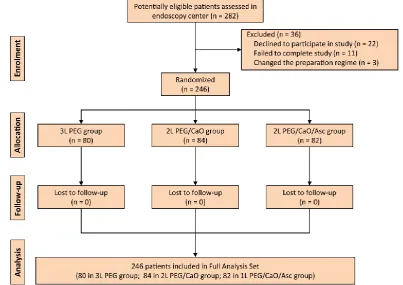
During the study period, a total of 282 consecutive patients were screened, but 36 patients were excluded due to various reasons. Therefore, 246 patients were randomized and included in the full analysis set (FAS). A flow diagram that describes patients' enrollment is depicted in Figure 1.
Figure 1. CONSORT diagram for the trial. PEG, polyethylene glycol; CaO, castor oil; Asc, ascorbic acid.
The three groups were comparable in terms of age, sex, height, medical conditions, the indication for colonoscopy, previous colonoscopy, willingness to repeat colonoscopy and quality of sleep (Table 1). The weight (p = 0.020) and body mass index (BMI) (P = 0.003) in 3L PEG and 1L PEG-CaO-Asc groups were higher than that in 2L PEG-CaO group. The most common reasons for colonoscopy were abdominal pain/distention/discomfort, changed in bowel habit, and post-polypectomy surveillance.
3.2. Primary Outcome
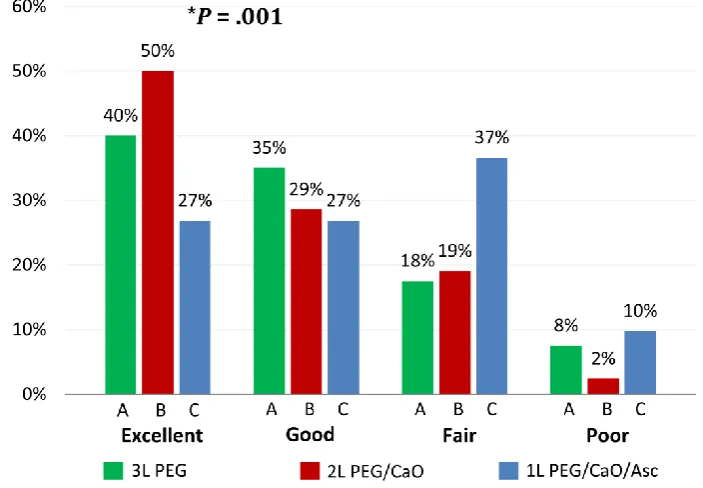
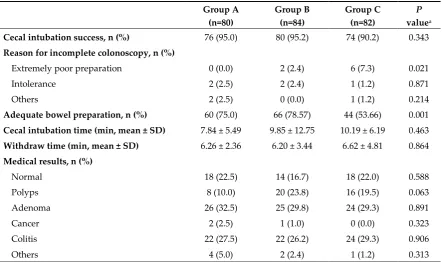
All methods showed no significant difference in terms of quality of bowel preparation scoring, with a mean (SD) total score of 6.95 ± 1.83 for the 3L PEG group, 7.29 ± 1.60 for 2L PEG-CaO-Asc group and 6.35 ± 1.83 for the 1L PEG-CaO-Asc (P = 0.062). The analysis of the segmental (right, mid, and recto-sigmoid colon) BBPS scale showed no difference for the right side (2.26 ± 0.76 vs 2.27 ± 0.71 vs 1.97 ± 0.8), mid colon (2.26 ± 0.76 vs 2.44 ± 0.59 vs 2.08 ± 0.6) and recto-sigmoid colon (2.42 ± 0.60 vs 2.59 ± 0.59 vs 2.30 ± 0.74). Table 2 presents the results of bowel cleansing quality assessment based on the BBPS. Percent of adequate bowel preparation, defined as total BBPS score ≥ 6 was 75.0%, 78.57% and 53.6% in 3L PEG, 2L PEG-CaO and 1L PEG-CaO-Asc groups, and the difference was statistically significant (p = 0.001) (Figure 2). Further analysis based on paired comparison found that 3L PEG (P = 0.010) and 2L PEG-CaO (P = 0.002) significantly increased the percent of adequate bowel preparation compared to 1L PEG-CaO-Asc regime. Moreover, the reasons for incomplete colonoscopy mainly were extremely poor preparation and intolerance, however the percent of extremely poor preparation in 1L PEG-CaO-Asc group was significantly higher than that in 3L PEG (7.3% vs 0.0%) and 2L PEG-CaO (7.3% vs 2.4%) groups.
Table 1. Characteristics of the patients
Age (mean ± SD, years) 48.98 ± 12.47 52.26 ± 12.07 52.66 ± 8.79 0.273
Sex, n (%) 0.930
Male 42 (52.5) 44 (52.4) 40 (48.8)
Female 38 (47.5) 40 (47.6) 42 (51.2)
Height (mean ± SD, cm) 162.10 ± 8.53 161.62 ± 7.33 160.88 ± 7.15 0.771 Weight (mean ± SD, kg) 62.08 ± 11.23 58.39 ± 8.29 65.17 ± 12.72 0.020 BMI (mean ± SD, kg) 23.62 ± 3.92 22.31 ± 2.60 25.13 ± 4.34 0.003 Medical conditions, n (%)
No 54 (67.5) 58 (69.0) 50 (61.0) 0.510
DM 2 (2.5) 4 (4.8) 6 (7.3) 0.378
Hypertension 14 (17.5) 10 (11.9) 12 (14.6) 0.598
Cardiac disease 2 (2.5) 2 (2.4) 2 (2.4) 1.000
Multiple 4 (5.0) 0 (0.0) 4 (4.8) 0.113
Others 4 (5.0) 10 (11.9) 8 (9.8) 0.287
Indication for colonoscopy, n (%)
Diarrhea 4 (5.0) 6 (7.1) 2 (2.4) 0.378
Constipation 0 (0.0) 1 (0.0) 2 (2.4) 0.659
Abdominal
pain/distention/discomfort 30 (37.5) 38 (45.2) 44 (53.7) 0.118
Change in bowel habit 12 (15.0) 10 (11.9) 8 (9.8) 0.592
Change in stool characteristics 4 (5.0) 3 (3.6) 0 (0.0) 0.117
GI bleeding 0 (0.0) 4 (4.8) 2 (2.4) 0.171
Surveillance 14 (17.5) 12 (14.3) 8 (9.8) 0.357
Physical examination 6 (7.5) 2 (2.4) 10 (12.2) 0.052
Others 10 (12.5) 8 (9.5) 6 (7.3) 0.537
Previous colonoscopy, n (%) 34 (42.5) 30 (35.7) 28 (34.1) 0.506 Satisfied with bowel preparation, n
(%) 0.032
Very good / good 70 (87.5) 82 (97.6) 80 (97.6)
General/not good 10 (12.5) 2 (2.4) 2 (2.4)
Completion of bowel preparation, n
(%) 0.014
No 6 (7.5) 2 (7.1) 0 (0.0)
Yes 74 (92.5) 82 (92.9) 82 (100.0)
Willingness to repeat colonoscopy, n
(%) 0.159
No 26 (32.5) 24 (28.6) 16 (19.5)
Yes 54 (67.5) 60 (71.4) 66 (80.5)
Quality of sleep, n (%) 0.078
No change 26 (32.5) 30 (35.7) 40 (48.8)
Worse 54 (67.5) 54 (64.3) 42 (51.2)
30mL; 1L PEG with Cao 30mL plus Asc 5g, 1L polyethylene glycol with castor oil 30mL plus ascorbic acid 5g. BMI, body mass index; SD, standard deviation.
aStatistical significance between groups was tested by one way ANOVA or Pearson χ2 analysis (Fisher’s exact test if cell < 5).
Figure 2. Proportion of bowel preparation efficacy in terms of each level among three groups.
*Statistical significance among these three groups was tested by χ2 analysis for good/excellent group.
PEG, polyethylene glycol; CaO, castor oil; Asc, ascorbic acid.
Table 2. Efficacy of bowel cleansing assessed by Boston Bowel Preparation Scale
Group A (n=80)
Group B (n=84)
Group C (n=82)
P valuea Right side of colon, (mean ± SD) 2.26 ± 0.76 2.27 ± 0.71 1.97 ± 0.87 0.172 Mid colon, (mean ± SD) 2.26 ± 0.76 2.44 ± 0.59 2.08 ± 0.68 0.072 Recto-sigmoid colon, (mean ±
SD) 2.42 ± 0.60 2.59 ± 0.59 2.30 ± 0.74 0.145
Total score, (mean ± SD) 6.95 ± 1.83 7.29 ± 1.60 6.35 ± 1.83 0.062 Group A, B and C represents 3L PEG, 2L PEG with CaO 30mL, and 1L PEG with Cao 30mL plus Asc 5g respectively. 3L PEG, 3L polyethylene glycol; 2L PEG with CaO 30mL, 2L polyethylene glycol with castor oil 30mL; 1L PEG with Cao 30mL plus Asc 5g, 1L polyethylene glycol with castor oil 30mL plus ascorbic acid 5g.
aStatistical significance between groups was tested by one-way ANOVA.
3.3. Secondary Outcome
groups completed bowel preparation, whereas all the patients in 1L PEG-CaO-Asc group accomplished bowel preparation (p = 0.014). In addition, only 67.5% patients in 3L PEG group were willing to repeat colonoscopy in the endoscopy center if necessary, but 71.4% and 80.5% patients in 2L PEG-CaO and 1L PEG-CaO-Asc groups were willing to do so although significant results were not detected (P = 0.159). There was no significant differences in quality of sleep, the rates of abdominal fullness, abdominal pain, nausea, vomiting and other AEs among three groups (Table 4).
Table 3. Characteristics of the colonoscopy procedures
Group A (n=80)
Group B (n=84)
Group C (n=82)
P valuea Cecal intubation success, n (%) 76 (95.0) 80 (95.2) 74 (90.2) 0.343 Reason for incomplete colonoscopy, n (%)
Extremely poor preparation 0 (0.0) 2 (2.4) 6 (7.3) 0.021
Intolerance 2 (2.5) 2 (2.4) 1 (1.2) 0.871
Others 2 (2.5) 0 (0.0) 1 (1.2) 0.214
Adequate bowel preparation, n (%) 60 (75.0) 66 (78.57) 44 (53.66) 0.001 Cecal intubation time (min, mean ± SD) 7.84 ± 5.49 9.85 ± 12.75 10.19 ± 6.19 0.463 Withdraw time (min, mean ± SD) 6.26 ± 2.36 6.20 ± 3.44 6.62 ± 4.81 0.864 Medical results, n (%)
Normal 18 (22.5) 14 (16.7) 18 (22.0) 0.588
Polyps 8 (10.0) 20 (23.8) 16 (19.5) 0.063
Adenoma 26 (32.5) 25 (29.8) 24 (29.3) 0.891
Cancer 2 (2.5) 1 (1.0) 0 (0.0) 0.323
Colitis 22 (27.5) 22 (26.2) 24 (29.3) 0.906
Others 4 (5.0) 2 (2.4) 1 (1.2) 0.313
Group A, B and C represents 3L PEG, 2L PEG with CaO 30mL, and 1L PEG with Cao 30mL plus Asc 5g respectively. 3L PEG, 3L polyethylene glycol; 2L PEG with CaO 30mL, 2L polyethylene glycol with castor oil 30mL; 1L PEG with Cao 30mL plus Asc 5g, 1L polyethylene glycol with castor oil 30mL plus ascorbic acid 5g.
aStatistical significance between groups was tested by one way ANOVA or Pearson χ2 analysis (Fisher’s exact test if cell < 5).
Table 4. Comparison of adverse event
Group A (n=80)
Group B (n=84)
Group C (n=82)
P valuea
No AE, n (%) 14 (18.0) 16 (19.0) 20 (24.0) 0.518
Abdominal fullness, n (%) 6 (8.0) 4 (5.0) 10 (12.0) 0.209
Abdominal pain, n (%) 9 (11.0) 8 (10.0) 8 (10.0) 0.925
Nausea, n (%) 12 (15.0) 14 (17.0) 5 (6.0) 0.089
Vomiting, n (%) 6 (8.0) 4 (5.0) 5 (6.0) 0.711
Others, n (%) 0 (0.0) 1 (1.0) 1 (1.0) 1.000
Group A, B and C represents 3L PEG, 2L PEG with CaO 30mL, and 1L PEG with Cao 30mL plus Asc 5g respectively. 3L PEG, 3L polyethylene glycol; 2L PEG with CaO 30mL, 2L polyethylene glycol with castor oil 30mL; 1L PEG with Cao 30mL plus Asc 5g, 1L polyethylene glycol with castor oil 30mL plus ascorbic acid 5g. AEs, adverse event.
aStatistical significance between groups was tested by the Pearson χ2 analysis (Fisher’s exact test if cell < 5).
Although many novel and promising approaches have been proposed, colonoscopy remains a routine method of screening and early treating CRC[2]. However, the quality of bowel preparation will significantly affect the efficacy and safety of colonoscopy examination[5], and evidence suggests an about 25% of inadequate bowel preparation before colonoscopy[5]. It must be important to note that poor bowel preparation will also increase the rate of incomplete colonoscopy and adverse events and lower polyp and adenoma detection rate[34,35]. Thus, several methods have been proposed to improve the quality of bowel preparation[36-38]. Of these all methods, PEG solutions remain the first-line recommendation for bowel preparation prior to colonoscopy due to desire laxative efficacy[10], however required high volume of liquid will reduce tolerability and compliance to bowel preparation[11]. Thus, numerous studies have been performed to explore the potential of reducing the volume of the cleansing solution by adding adjunctive prokinetics such as bisacodyl[39,40], but the evidence suggests that gastrointestinal prokinetics can induce dose-dependent cardiac adverse effects[41]. So it is important to find a novel adjunctive laxative.
Castor oil is extracted from the seed of the castor-oil plant[42]. CaO has a high content of the hydroxylated unsaturated fatty acid ricinoleic acid[43], and it has been demonstrated that released ricinoleic acid has the ability of inducing strong laxative effect by activating small-intestinal smooth-muscle cells via the EP3 prostanoid receptor[44]. Moreover, CaO will not cause serious side effects[27], and thus it has been used as a safe stimulant laxative in many settings[45-47]except for pregnant women[48]
.
Evidence suggested low dose CaO (30 mL) has similar laxative efficacy of cleaning colon to bisacodyl[16]. Moreover, studies[26,27]also showed that 30mL of CaO can reduce liquid loading of bowel preparation solutions. And thus, we designed a regime of 2L split PEG with 30mL CaO to perform bowel preparation before colonoscopy. The findings of our randomized controlled trial suggested that 2L split PEG plus 30mL CaO can increase the adequate bowel preparation rate and patients’ satisfaction toward and patients’ compliance with regime with comparable BBPS score and AEs rate compared to traditional 3L split PEG solution.A number of studies found that PEG with Asc regime obtained comparative efficacy, acceptability, tolerability, and safety related to the standard PEG regime[11,49-51]. Moreover, a recent meta-analysis also demonstrated the efficacy and safety of low-volume PEG containing Asc regime for bowel cleansing[52]. Asc produces cathartic effects because of it will become saturated at a high dose[53,54]. Asc contribute toward decreasing the total volume of PEG solution required for gut lavage and improve patient’s tolerability[27]. For these reasons, we have further designed a lower-volume PEG preparation with 30mL CaO plus 5g Asc. The finding of our study showed that this modified lower-volume PEG regime obtained higher patients’ satisfaction and compliance. However, it is noted that this modified bowel preparation regime significantly decreased the adequate bowel preparation rate compared with traditional 3L split PEG regime. In the present study, patients with higher BMI were assigned to oral ingestion of 1L split PEG with 30mL CaO plus 5g Asc. Studies have found that high BMI is an independent factor associated with inadequate bowel preparation for colonoscopy[55-57]. This difference may be the contributor to the inconsistent finding. So, further study was needed in order to determine the adjunctive efficacy of combination of CaO and Asc.
We must acknowledge that our study has some limitations. First, we included patients who were schedule to morning and afternoon colonoscopy examination in this study. However, the time of colonoscopy did not have a significant difference among these three groups. Second, we performed this study in single-center and obtained results supported by insufficient number of patients. Thus, we suggest to design a multi-center study with larger scale to perform a more precise assessment. Third, evaluation of electrolyte levels or hematological analysis was not carried out during the whole colonoscopy examination. However, we did not detect any significant difference in the rate of adverse events.
5. Conclusions
In conclusion, the results of this study indicate that the 30mL CaO in addition to 2L PEG
before colonoscopy is safe, and it can improve patients’ satisfaction toward and compliance with
the process of bowel preparation, increase the adequate bowel preparation rate, and obtain comparable quality of bowel preparation compared to 3L split PEG. Both preparation methods
However, patients taking 1L PEG with 30mL CaO plus Asc 5mg in general showed more
inadequate bowel preparation although it improved patients’ satisfaction and compliance
related to 3L PEG regime.
Author Contributions: Conceptualization, Xu Tian and Wei-Qing Chen; Data curation, Xu Tian and Xiao-Ling Liu; Formal analysis, Xu Tian; Funding acquisition, Wei-Qing Chen; Investigation, Xu Tian, Bing Shi and Hui Chen; Methodology, Xu Tian and Bing Shi; Project administration, Qing Chen; Resources, Xu Tian and Wei-Qing Chen; Software, Xu Tian; Supervision, Wei-Wei-Qing Chen; Validation, Xu Tian, Bing Shi, Xiao-Ling Liu and Wei-Qing Chen; Visualization, Xu Tian; Writing – original draft, Xu Tian and Hui Chen; Writing – review & editing, Wei-Qing Chen.
Funding: Please add: This research was funded by the Clinical Research Foundation of Chongqing University Cancer Hospital & Chongqing Cancer Hospital (grant number: LY2017004)..
Acknowledgments: We expressed the warm appreciation to all patients voluntarily participated in our clinical trial.
Conflicts of Interest: The authors declare no conflict of interest.
References
1. Torre LA, Bray F, Siegel RL, Ferlay J, Lortet-Tieulent J, Jemal A. Global cancer statistics, 2012.
CA Cancer J Clin. 2015;65(2):87-108.
2. Tian X, Chen WQ, Huang JL, et al. Effects of polyethylene glycol 2 L alone or with ascorbic acid compared with polyethylene glycol 4 L alone for bowel preparation before colonoscopy: protocol for a systematic review and network meta-analysis. BMJ open. 2017;7(10):e018217. 3. Quintero E, Castells A, Bujanda L, et al. Colonoscopy versus fecal immunochemical testing
in colorectal-cancer screening. N Engl J Med. 2012;366(8):697-706.
4. Zauber AG, Winawer SJ, O'Brien MJ, et al. Colonoscopic polypectomy and long-term prevention of colorectal-cancer deaths. N Engl J Med. 2012;366(8):687-696.
5. Froehlich F, Wietlisbach V, Gonvers JJ, Burnand B, Vader JP. Impact of colonic cleansing on quality and diagnostic yield of colonoscopy: the European Panel of Appropriateness of Gastrointestinal Endoscopy European multicenter study. Gastrointest Endosc. 2005;61(3):378-384.
6. Ponchon T, Boustiere C, Heresbach D, Hagege H, Tarrerias AL, Halphen M. A low-volume polyethylene glycol plus ascorbate solution for bowel cleansing prior to colonoscopy: the NORMO randomised clinical trial. Dig Liver Dis. 2013;45(10):820-826.
7. Lebwohl B, Kastrinos F, Glick M, Rosenbaum AJ, Wang T, Neugut AI. The impact of suboptimal bowel preparation on adenoma miss rates and the factors associated with early repeat colonoscopy. Gastrointest Endosc. 2011;73(6):1207-1214.
8. Harewood GC, Sharma VK, de Garmo P. Impact of colonoscopy preparation quality on detection of suspected colonic neoplasia. Gastrointest Endosc. 2003;58(1):76-79.
9. Rex DK, Imperiale TF, Latinovich DR, Bratcher LL. Impact of bowel preparation on efficiency and cost of colonoscopy. Am J Gastroenterol. 2002;97(7):1696-1700.
10. Clark RE, Godfrey JD, Choudhary A, Ashraf I, Matteson ML, Bechtold ML. Low-volume polyethylene glycol and bisacodyl for bowel preparation prior to colonoscopy: a meta-analysis. Ann Gastroenterol. 2013;26(4):319-324.
11. Flavio V, Stefano P, Cesare H, et al. A randomized controlled trial evaluating a new 2-L PEG solution plus ascorbic acid vs 4-L PEG for bowel cleansing prior to colonoscopy. Dig Liver
Dis. 2012;44(3):224-227.
12. Valiante F, Pontone S, Hassan C, et al. A randomized controlled trial evaluating a new 2-L PEG solution plus ascorbic acid vs 4-L PEG for bowel cleansing prior to colonoscopy. Dig
Liver Dis. 2012;44(3):224-227.
13. Apisarnthanarak P, Rotjanaaree B, Komoltri C, Charoensak A, Apisarnthanarak A, Hargrove NS. Prospective, randomized comparison of castor oil and sodium phosphate preparation for barium enema. J Med Assoc Thai. 2009;92(2):243-249.
15. Jansson M, Geijer H, Andersson T. Bowel preparation for excretory urography is not necessary: a randomized trial. The British journal of radiology. 2007;80(956):617-624.
16. Yang HC, Sheu MH, Wang JH, Chang CY. Bowel preparation of outpatients for intravenous urography: efficacy of castor oil versus bisacodyl. The Kaohsiung journal of medical sciences. 2005;21(4):153-158.
17. Brahmania M, Ou G, Bressler B, et al. 2 L versus 4 L of PEG3350 + electrolytes for outpatient colonic preparation: a randomized, controlled trial. Gastrointest Endosc. 2014;79(3):408-416.e404.
18. Bae SE, Kim KJ, Eum JB, et al. A Comparison of 2 L of Polyethylene Glycol and 45 mL of Sodium Phosphate versus 4 L of Polyethylene Glycol for Bowel Cleansing: A Prospective Randomized Trial. Gut and liver. 2013;7(4):423-429.
19. Zhang S, Li M, Zhao Y, et al. 3-L split-dose is superior to 2-L polyethylene glycol in bowel cleansing in Chinese population: a multicenter randomized, controlled trial. Medicine. 2015;94(4):e472.
20. Cohen SM, Wexner SD, Binderow SR, et al. Prospective, randomized, endoscopic-blinded trial comparing precolonoscopy bowel cleansing methods. Diseases of the colon and rectum. 1994;37(7):689-696.
21. Ji EK, Lee JW, Im JP, et al. Comparable Efficacy of a 1-L PEG and Ascorbic Acid Solution Administered with Bisacodyl versus a 2-L PEG and Ascorbic Acid Solution for Colonoscopy Preparation: A Prospective, Randomized and Investigator-Blinded Trial. Plos One. 2016;11(9). 22. Kang SH, Lee JH, Yoo IK, et al. Sa1753 A Comparison of Bowel Preparation Between 2L
Ascorbic Acid Mixed PEG and 1L Ascorbic Acid Mixed PEG With Bisacodyl. Gastrointestinal
Endoscopy. 2016;83(5):AB287-AB287.
23. Avgerinos A, Kalantzis N, Rekoumis G, Pallikaris G, Arapakis G, Kanaghinis T. Bowel preparation and the risk of explosion during colonoscopic polypectomy. Gut. 1984;25(4):361. 24. Chen C, Ng W, Fy, Lee S. Magnesium citrate-bisacodyl regimen proves better than castor oil
for colonoscopic preparation. Journal of Gastroenterology & Hepatology. 1999;14(12):1219. 25. Ghazikhanlou SK, Jafari MR, Shams S. A comparison of the efficacy, adverse effects, and
patient compliance of the sena-graph®syrup and castor oil regimens for bowel preparation.
Iranian Journal of Pharmaceutical Research Ijpr. 2010;9(2):193.
26. Hotta N. The Use of Castor Oil for Bowel Preparation for Colon Capsule Endoscopy. Open
Journal of Medical Imaging. 2016;06(4):103-107.
27. Ohmiya N, Hotta N, Mitsufuji S, et al. Multicenter feasibility study of bowel preparation with castor oil for colon capsule endoscopy. Dig Endosc. 2018.
28. Rivas JM, Perez A, Hernandez M, Schneider A, Castro FJ. Efficacy of morning-only 4 liter sulfa free polyethylene glycol vs 2 liter polyethylene glycol with ascorbic acid for afternoon colonoscopy. World J Gastroenterol. 2014;20(30):10620-10627.
29. Song GM, Tian X, Ma L, et al. Regime for Bowel Preparation in Patients Scheduled to Colonoscopy: Low-Residue Diet or Clear Liquid Diet? Evidence From Systematic Review With Power Analysis. Medicine. 2016;95(1):e2432.
30. Tian X, Chen WQ, Liu XL, Chen H, Liu BL, Pi YP. Comparative efficacy of combination of 1 L polyethylene glycol, castor oil and ascorbic acid versus 2 L polyethylene glycol plus castor oil versus 3 L polyethylene glycol for colon cleansing before colonoscopy. Medicine. 2018;97(17):e0481.
31. Heron V, Parmar R, Menard C, Martel M, Barkun AN. Validating bowel preparation scales.
Endosc Int Open. 2017;5(12):E1179-E1188.
32. Calderwood AH, Jacobson BC. Comprehensive validation of the Boston Bowel Preparation Scale. Gastrointestinal Endoscopy. 2010;72(4):686-692.
33. Yan G, Ju-Sheng L, Hou-De Z, Mu-Xian L, Chun-Sheng C, Sheng-Zhou W. Pilot validation of the Boston Bowel Preparation Scale in China. Digestive Endoscopy. 2013;25(2):167-173.
34. Chokshi RV, Hovis CE, Hollander T, Early DS, Wang JS. Prevalence of missed adenomas in patients with inadequate bowel preparation on screening colonoscopy. Gastroenterology. 2012;75(6):1197-1203.
adenoma detection rate. American Journal of Gastroenterology. 2014;109(11):1714-1723.
36. Chang CW, Shih SC, Wang HY, et al. Meta-analysis: The effect of patient education on bowel preparation for colonoscopy. Endosc Int Open. 2015;3(6):E646-E652.
37. Lichtenstein GR, Cohen LB, Uribarri J, . Review article: Bowel preparation for colonoscopy--the importance of adequate hydration. Alimentary Pharmacology & Therapeutics. 2010;26(5):633-641.
38. Myriam M, Barkun AN, Charles M, Sophie R, Omar K, Alain V. Split-Dose Preparations Are Superior to Day-Before Bowel Cleansing Regimens: A Meta-analysis. Gastroenterology. 2015;149(1):79-88.
39. Martínek J, Hess J, Delarive J, et al. Cisapride does not improve precolonoscopy bowel preparation with either sodium phosphate or polyethylene glycol electrolyte lavage.
Gastrointestinal Endoscopy. 2001;54(2):180-185.
40. Masahiro, Tajika, Yasumasa, et al. Efficacy of mosapride citrate with polyethylene glycol solution for colonoscopy preparation. World Journal of Gastroenterology. 2012;18(20):2517-2525. 41. Tonini M, ., Ponti F, De, Nucci A, Di, Crema F, . Review article: cardiac adverse effects of
gastrointestinal prokinetics. Alimentary Pharmacology & Therapeutics. 1999;13(12):1585-1591. 42. Gaginella TS, Phillips SF. Ricinoleic acid: Current view of an ancient oil. American Journal of
Digestive Diseases. 1975;20(12):1171-1177.
43. Watson WC, Jr RSG. Studies on the digestion, absorption and metabolism of castor oil.
Biochemical Pharmacology. 1962;11(3):229-236.
44. Sorin T, Althoff TF, Nüsing RM, Martin D, Stefan O. Castor oil induces laxation and uterus contraction via ricinoleic acid activating prostaglandin EP3 receptors. Proceedings of the
National Academy of Sciences of the United States of America. 2012;109(23):9179-9184.
45. Bradley A, Taylor P. Does bowel preparation improve the quality of intravenous urography?
The British journal of radiology. 1996;49(826):906-909.
46. Jansson M, ., Geijer H, ., Andersson T, . Bowel preparation for excretory urography is not necessary: a randomized trial. British Journal of Radiology. 2007;80(956):617-624.
47. Yang HC, Wang JH, Chang CY, Sheu MH. Bowel Preparation of Outpatients for Intravenous Urography: Efficacy of Castor Oil Versus Bisacodyl. Kaohsiung Journal of Medical Sciences. 2005;21(4):153-158.
48. Sicuranza GB, Figueroa R. Uterine rupture associated with castor oil ingestion. Journal of
Maternal-Fetal Medicine. 2003;13(2):133-134.
49. Ponchon T, Boustière C, Heresbach D, Hagege H, Tarrerias AL, Halphen M. A low-volume polyethylene glycol plus ascorbate solution for bowel cleansing prior to colonoscopy: The NORMO randomised clinical trial ☆. Digestive & Liver Disease Official Journal of the Italian
Society of Gastroenterology & the Italian Association for the Study of the Liver. 2013;45(10):820-826.
50. Marmo R, Rotondano GG, Marone A, et al. Effective bowel cleansing before colonoscopy: a randomized study of split-dosage versus non-split dosage regimens of high-volume versus low-volume polyethylene glycol solutions. Gastrointestinal Endoscopy. 2010;72(2):313-320. 51. Sietske C, Kleibeuker JH, Koornstra JJ. Low-volume PEG plus ascorbic acid versus
high-volume PEG as bowel preparation for colonoscopy. Scandinavian Journal of Gastroenterology. 2010;45(11):1380-1386.
52. Xie Q, Chen L, Zhao F, et al. A Meta-Analysis of Randomized Controlled Trials of Low-Volume Polyethylene Glycol plus Ascorbic Acid versus Standard-Volume Polyethylene Glycol Solution as
Bowel Preparations for Colonoscopy. Vol 92014.
53. Flavio, Valiante, Angelo, et al. Bisacodyl plus split 2-L polyethylene glycol-citrate-simethicone improves quality of bowel preparation before screening colonoscopy. World
Journal of Gastroenterology. 2013;19(33):5493-5499.
54. Tajika M, Tanaka T, Ishihara M, et al. A Randomized Controlled Trial Evaluating a Low-Volume PEG Solution Plus Ascorbic Acid versus Standard PEG Solution in Bowel Preparation for Colonoscopy. Gastroenterology Research and Practice,2015,(2015-11-15). 2015;2015(5):1-12.
55. Fayad NF, Kahi CJ, Abd El-Jawad KH, et al. Association between body mass index and quality of split bowel preparation. Clinical gastroenterology and hepatology : the official clinical
56. Hyun JH, Kim SJ, Park JH, et al. Lifestyle Factors and Bowel Preparation for Screening Colonoscopy. Annals of coloproctology. 2018;34(4):197-205.
57. Sharara AI, Harb AH, Sarkis FS, Chalhoub JM, Habib RH. Body mass index and quality of bowel preparation: Real life vs. clinical trials. Arab journal of gastroenterology : the official publication of the Pan-Arab Association of Gastroenterology. 2016;17(1):11-16
© 2019 by the authors. Submitted for possible open access publication under the terms and conditions of the Creative Commons Attribution (CC BY) license (http://creativecommons.org/licenses/by/4.0/).
1. Torre, L.A.; Bray, F.; Siegel, R.L.; Ferlay, J.; Lortet-Tieulent, J.; Jemal, A. Global cancer statistics, 2012.
CA Cancer J Clin 2015, 65, 87-108, doi:10.3322/caac.21262.
2. Tian, X.; Chen, W.Q.; Huang, J.L.; He, L.Y.; Liu, B.L.; Liu, X.; Zhou, H.; Liu, B.R. Effects of polyethylene
glycol 2 L alone or with ascorbic acid compared with polyethylene glycol 4 L alone for bowel
preparation before colonoscopy: protocol for a systematic review and network meta-analysis. BMJ open
2017, 7, e018217, doi:10.1136/bmjopen-2017-018217.
3. Quintero, E.; Castells, A.; Bujanda, L.; Cubiella, J.; Salas, D.; Lanas, A.; Andreu, M.; Carballo, F.; Morillas,
J.D.; Hernandez, C., et al. Colonoscopy versus fecal immunochemical testing in colorectal-cancer
screening. N Engl J Med 2012, 366, 697-706, doi:10.1056/NEJMoa1108895.
4. Zauber, A.G.; Winawer, S.J.; O'Brien, M.J.; Lansdorp-Vogelaar, I.; van Ballegooijen, M.; Hankey, B.F.;
Shi, W.; Bond, J.H.; Schapiro, M.; Panish, J.F., et al. Colonoscopic polypectomy and long-term
prevention of colorectal-cancer deaths. N Engl J Med 2012, 366, 687-696, doi:10.1056/NEJMoa1100370.
5. Froehlich, F.; Wietlisbach, V.; Gonvers, J.J.; Burnand, B.; Vader, J.P. Impact of colonic cleansing on
quality and diagnostic yield of colonoscopy: the European Panel of Appropriateness of Gastrointestinal
Endoscopy European multicenter study. Gastrointest Endosc 2005, 61, 378-384.
6. Ponchon, T.; Boustiere, C.; Heresbach, D.; Hagege, H.; Tarrerias, A.L.; Halphen, M. A low-volume
polyethylene glycol plus ascorbate solution for bowel cleansing prior to colonoscopy: the NORMO
randomised clinical trial. Dig Liver Dis 2013, 45, 820-826, doi:10.1016/j.dld.2013.04.009.
7. Lebwohl, B.; Kastrinos, F.; Glick, M.; Rosenbaum, A.J.; Wang, T.; Neugut, A.I. The impact of suboptimal
bowel preparation on adenoma miss rates and the factors associated with early repeat colonoscopy.
Gastrointest Endosc 2011, 73, 1207-1214, doi:10.1016/j.gie.2011.01.051.
8. Harewood, G.C.; Sharma, V.K.; de Garmo, P. Impact of colonoscopy preparation quality on detection
of suspected colonic neoplasia. Gastrointest Endosc 2003, 58, 76-79, doi:10.1067/mge.2003.294.
9. Rex, D.K.; Imperiale, T.F.; Latinovich, D.R.; Bratcher, L.L. Impact of bowel preparation on efficiency
and cost of colonoscopy. Am J Gastroenterol 2002, 97, 1696-1700, doi:10.1111/j.1572-0241.2002.05827.x.
10. Clark, R.E.; Godfrey, J.D.; Choudhary, A.; Ashraf, I.; Matteson, M.L.; Bechtold, M.L. Low-volume
polyethylene glycol and bisacodyl for bowel preparation prior to colonoscopy: a meta-analysis. Ann
Gastroenterol 2013, 26, 319-324.
11. Flavio, V.; Stefano, P.; Cesare, H.; Angelo, B.; Manuela, D.B.; Angelo, Z.; Vincenzo, D.F.; Michele, D.B.
A randomized controlled trial evaluating a new 2-L PEG solution plus ascorbic acid vs 4-L PEG for
bowel cleansing prior to colonoscopy. Dig Liver Dis 2012, 44, 224-227.
12. Valiante, F.; Pontone, S.; Hassan, C.; Bellumat, A.; De Bona, M.; Zullo, A.; de Francesco, V.; De Boni, M.
bowel cleansing prior to colonoscopy. Dig Liver Dis 2012, 44, 224-227, doi:10.1016/j.dld.2011.10.007.
13. Apisarnthanarak, P.; Rotjanaaree, B.; Komoltri, C.; Charoensak, A.; Apisarnthanarak, A.; Hargrove, N.S.
Prospective, randomized comparison of castor oil and sodium phosphate preparation for barium
enema. J Med Assoc Thai 2009, 92, 243-249.
14. Bradley, A.J.; Taylor, P.M. Does bowel preparation improve the quality of intravenous urography? The
British journal of radiology 1996, 69, 906-909, doi:10.1259/0007-1285-69-826-906.
15. Jansson, M.; Geijer, H.; Andersson, T. Bowel preparation for excretory urography is not necessary: a
randomized trial. The British journal of radiology 2007, 80, 617-624, doi:10.1259/bjr/78311002.
16. Yang, H.C.; Sheu, M.H.; Wang, J.H.; Chang, C.Y. Bowel preparation of outpatients for intravenous
urography: efficacy of castor oil versus bisacodyl. The Kaohsiung journal of medical sciences 2005, 21,
153-158, doi:10.1016/s1607-551x(09)70294-3.
17. Brahmania, M.; Ou, G.; Bressler, B.; Ko, H.K.; Lam, E.; Telford, J.; Enns, R. 2 L versus 4 L of PEG3350 +
electrolytes for outpatient colonic preparation: a randomized, controlled trial. Gastrointest Endosc 2014,
79, 408-416.e404, doi:10.1016/j.gie.2013.08.035.
18. Bae, S.E.; Kim, K.J.; Eum, J.B.; Yang, D.H.; Ye, B.D.; Byeon, J.S.; Myung, S.J.; Yang, S.K.; Kim, J.H. A
Comparison of 2 L of Polyethylene Glycol and 45 mL of Sodium Phosphate versus 4 L of Polyethylene
Glycol for Bowel Cleansing: A Prospective Randomized Trial. Gut and liver 2013, 7, 423-429,
doi:10.5009/gnl.2013.7.4.423.
19. Zhang, S.; Li, M.; Zhao, Y.; Lv, T.; Shu, Q.; Zhi, F.; Cui, Y.; Chen, M. 3-L split-dose is superior to 2-L
polyethylene glycol in bowel cleansing in Chinese population: a multicenter randomized, controlled
trial. Medicine 2015, 94, e472, doi:10.1097/md.0000000000000472.
20. Cohen, S.M.; Wexner, S.D.; Binderow, S.R.; Nogueras, J.J.; Daniel, N.; Ehrenpreis, E.D.; Jensen, J.; Bonner,
G.F.; Ruderman, W.B. Prospective, randomized, endoscopic-blinded trial comparing precolonoscopy
bowel cleansing methods. Diseases of the colon and rectum 1994, 37, 689-696.
21. Ji, E.K.; Lee, J.W.; Im, J.P.; Ji, W.K.; Su, H.K.; Koh, S.J.; Kim, B.G.; Lee, K.L.; Sang, G.K.; Kim, J.S.
Comparable Efficacy of a 1-L PEG and Ascorbic Acid Solution Administered with Bisacodyl versus a
2-L PEG and Ascorbic Acid Solution for Colonoscopy Preparation: A Prospective, Randomized and
Investigator-Blinded Trial. Plos One 2016, 11.
22. Kang, S.H.; Lee, J.H.; Yoo, I.K.; Lee, J.M.; Kim, S.H.; Choi, H.S.; Kim, E.S.; Keum, B.; Jeen, Y.T.; Lee, H.
Sa1753 A Comparison of Bowel Preparation Between 2L Ascorbic Acid Mixed PEG and 1L Ascorbic
Acid Mixed PEG With Bisacodyl. Gastrointestinal Endoscopy 2016, 83, AB287-AB287.
23. Avgerinos, A.; Kalantzis, N.; Rekoumis, G.; Pallikaris, G.; Arapakis, G.; Kanaghinis, T. Bowel
preparation and the risk of explosion during colonoscopic polypectomy. Gut 1984, 25, 361.
24. Chen, C.; Ng, W., Fy; Lee, S. Magnesium citrate-bisacodyl regimen proves better than castor oil for
colonoscopic preparation. Journal of Gastroenterology & Hepatology 1999, 14, 1219.
25. Ghazikhanlou, S.K.; Jafari, M.R.; Shams, S. A comparison of the efficacy, adverse effects, and patient
compliance of the sena-graph®syrup and castor oil regimens for bowel preparation. Iranian Journal of
Pharmaceutical Research Ijpr 2010, 9, 193.
26. Hotta, N. The Use of Castor Oil for Bowel Preparation for Colon Capsule Endoscopy. Open Journal of
Medical Imaging 2016, 06, 103-107.
27. Ohmiya, N.; Hotta, N.; Mitsufuji, S.; Nakamura, M.; Omori, T.; Maeda, K.; Okuda, K.; Yatsuya, H.; Tajiri,
H. Multicenter feasibility study of bowel preparation with castor oil for colon capsule endoscopy. Dig
Endosc 2018, 10.1111/den.13259, doi:10.1111/den.13259.
free polyethylene glycol vs 2 liter polyethylene glycol with ascorbic acid for afternoon colonoscopy.
World J Gastroenterol 2014, 20, 10620-10627, doi:10.3748/wjg.v20.i30.10620.
29. Song, G.M.; Tian, X.; Ma, L.; Yi, L.J.; Shuai, T.; Zeng, Z.; Zeng, X.T. Regime for Bowel Preparation in
Patients Scheduled to Colonoscopy: Low-Residue Diet or Clear Liquid Diet? Evidence From Systematic
Review With Power Analysis. Medicine 2016, 95, e2432, doi:10.1097/MD.0000000000002432.
30. Tian, X.; Chen, W.Q.; Liu, X.L.; Chen, H.; Liu, B.L.; Pi, Y.P. Comparative efficacy of combination of 1 L
polyethylene glycol, castor oil and ascorbic acid versus 2 L polyethylene glycol plus castor oil versus 3 L
polyethylene glycol for colon cleansing before colonoscopy. Medicine 2018, 97, e0481.
31. Heron, V.; Parmar, R.; Menard, C.; Martel, M.; Barkun, A.N. Validating bowel preparation scales. Endosc
Int Open 2017, 5, E1179-E1188, doi:10.1055/s-0043-119749.
32. Calderwood, A.H.; Jacobson, B.C. Comprehensive validation of the Boston Bowel Preparation Scale.
Gastrointestinal Endoscopy 2010, 72, 686-692.
33. Yan, G.; Ju-Sheng, L.; Hou-De, Z.; Mu-Xian, L.; Chun-Sheng, C.; Sheng-Zhou, W. Pilot validation of the
Boston Bowel Preparation Scale in China. Digestive Endoscopy 2013, 25, 167-173.
34. Chokshi, R.V.; Hovis, C.E.; Hollander, T.; Early, D.S.; Wang, J.S. Prevalence of missed adenomas in
patients with inadequate bowel preparation on screening colonoscopy. Gastroenterology 2012, 75,
1197-1203.
35. Clark, B.T.; Tarun, R.; Loren, L. What level of bowel prep quality requires early repeat colonoscopy:
systematic review and meta-analysis of the impact of preparation quality on adenoma detection rate.
American Journal of Gastroenterology 2014, 109, 1714-1723.
36. Chang, C.W.; Shih, S.C.; Wang, H.Y.; Chu, C.H.; Wang, T.E.; Hung, C.Y.; Shieh, T.Y.; Lin, Y.S.; Chen, M.J.
Meta-analysis: The effect of patient education on bowel preparation for colonoscopy. Endosc Int Open
2015, 3, E646-E652.
37. Lichtenstein, G.R.; Cohen, L.B.; Uribarri, J., . Review article: Bowel preparation for colonoscopy--the
importance of adequate hydration. Alimentary Pharmacology & Therapeutics 2010, 26, 633-641.
38. Myriam, M.; Barkun, A.N.; Charles, M.; Sophie, R.; Omar, K.; Alain, V. Split-Dose Preparations Are
Superior to Day-Before Bowel Cleansing Regimens: A Meta-analysis. Gastroenterology 2015, 149, 79-88.
39. Martínek, J.; Hess, J.; Delarive, J.; Jornod, P.; Blum, A.; Pantoflickova, D.; Fischer, M.; Dorta, G. Cisapride
does not improve precolonoscopy bowel preparation with either sodium phosphate or polyethylene
glycol electrolyte lavage. Gastrointestinal Endoscopy 2001, 54, 180-185.
40. Masahiro; Tajika; Yasumasa; Niwa; Vikram; Bhatia; Hiroki; Kawai; Shinya; Kondo. Efficacy of
mosapride citrate with polyethylene glycol solution for colonoscopy preparation. World Journal of
Gastroenterology 2012, 18, 2517-2525.
41. Tonini, M., .; Ponti, F., De; Nucci, A., Di; Crema, F., . Review article: cardiac adverse effects of
gastrointestinal prokinetics. Alimentary Pharmacology & Therapeutics 1999, 13, 1585-1591.
42. Gaginella, T.S.; Phillips, S.F. Ricinoleic acid: Current view of an ancient oil. American Journal of Digestive
Diseases 1975, 20, 1171-1177.
43. Watson, W.C.; Jr, R.S.G. Studies on the digestion, absorption and metabolism of castor oil. Biochemical
Pharmacology 1962, 11, 229-236.
44. Sorin, T.; Althoff, T.F.; Nüsing, R.M.; Martin, D.; Stefan, O. Castor oil induces laxation and uterus
contraction via ricinoleic acid activating prostaglandin EP3 receptors. Proceedings of the National
Academy of Sciences of the United States of America 2012, 109, 9179-9184.
45. Bradley, A.; Taylor, P. Does bowel preparation improve the quality of intravenous urography? The
46. Jansson, M., .; Geijer, H., .; Andersson, T., . Bowel preparation for excretory urography is not necessary:
a randomized trial. British Journal of Radiology 2007, 80, 617-624.
47. Yang, H.C.; Wang, J.H.; Chang, C.Y.; Sheu, M.H. Bowel Preparation of Outpatients for Intravenous
Urography: Efficacy of Castor Oil Versus Bisacodyl. Kaohsiung Journal of Medical Sciences 2005, 21,
153-158.
48. Sicuranza, G.B.; Figueroa, R. Uterine rupture associated with castor oil ingestion. Journal of
Maternal-Fetal Medicine 2003, 13, 133-134.
49. Ponchon, T.; Boustière, C.; Heresbach, D.; Hagege, H.; Tarrerias, A.L.; Halphen, M. A low-volume
polyethylene glycol plus ascorbate solution for bowel cleansing prior to colonoscopy: The NORMO
randomised clinical trial ☆. Digestive & Liver Disease Official Journal of the Italian Society of
Gastroenterology & the Italian Association for the Study of the Liver 2013, 45, 820-826.
50. Marmo, R.; Rotondano, G.G.; Marone, A.; Bianco, M.A.; Stroppa, I.; Caruso, A.; Pandolfo, N.; Sansone,
S.; Gregorio, E.; D'Alvano, G. Effective bowel cleansing before colonoscopy: a randomized study of
split-dosage versus non-split dosage regimens of high-volume versus low-volume polyethylene glycol
solutions. Gastrointestinal Endoscopy 2010, 72, 313-320.
51. Sietske, C.; Kleibeuker, J.H.; Koornstra, J.J. Low-volume PEG plus ascorbic acid versus high-volume
PEG as bowel preparation for colonoscopy. Scandinavian Journal of Gastroenterology 2010, 45, 1380-1386.
52. Xie, Q.; Chen, L.; Zhao, F.; Zhou, X.; Huang, P.; Zhang, L.; Zhou, D.; Wei, J.; Wang, W.; Zheng, S. A
Meta-Analysis of Randomized Controlled Trials of Low-Volume Polyethylene Glycol plus Ascorbic Acid versus
Standard-Volume Polyethylene Glycol Solution as Bowel Preparations for Colonoscopy; 2014; Vol. 9, pp. e99092.
53. Flavio; Valiante; Angelo; Bellumat; Manuela; Bona; Michele; Boni. Bisacodyl plus split 2-L polyethylene
glycol-citrate-simethicone improves quality of bowel preparation before screening colonoscopy. World
Journal of Gastroenterology 2013, 19, 5493-5499.
54. Tajika, M.; Tanaka, T.; Ishihara, M.; Mizuno, N.; Hara, K.; Hijioka, S.; Imaoka, H.; Sato, T.; Yogi, T.;
Tsutsumi, H. A Randomized Controlled Trial Evaluating a Low-Volume PEG Solution Plus Ascorbic
Acid versus Standard PEG Solution in Bowel Preparation for Colonoscopy. Gastroenterology Research
and Practice,2015,(2015-11-15) 2015, 2015, 1-12.
55. Fayad, N.F.; Kahi, C.J.; Abd El-Jawad, K.H.; Shin, A.S.; Shah, S.; Lane, K.A.; Imperiale, T.F. Association
between body mass index and quality of split bowel preparation. Clinical gastroenterology and hepatology :
the official clinical practice journal of the American Gastroenterological Association 2013, 11, 1478-1485,
doi:10.1016/j.cgh.2013.05.037.
56. Hyun, J.H.; Kim, S.J.; Park, J.H.; Wie, G.A.; Kim, J.S.; Han, K.S.; Kim, B.C.; Hong, C.W.; Sohn, D.K.
Lifestyle Factors and Bowel Preparation for Screening Colonoscopy. Annals of coloproctology 2018, 34,
197-205, doi:10.3393/ac.2018.03.13.
57. Sharara, A.I.; Harb, A.H.; Sarkis, F.S.; Chalhoub, J.M.; Habib, R.H. Body mass index and quality of
bowel preparation: Real life vs. clinical trials. Arab journal of gastroenterology : the official publication of the