Verifiable computation using multiple provers
Andrew J. Blumberg* Justin Thaler† Victor Vu‡ Michael Walfish§
Abstract
The increasing ubiquity of the cloud computing paradigm has renewed focus on the classical problem of allowing weak clients to check the results of computationdelegatedto powerful servers. Recent advances in proof-based verifiable computation have led to several near-practical protocols. Protocols based on
interactive proofs(IPs) work with highly restrictive models of computation and are thus efficient only for a limited class of computations. In contrast, protocols based onargument systemsapply to a much larger class of computations, but efficiency requires amortization of very expensive setup costs.
This paper initiates the study of the practical efficiency ofmultiprover interactive proofs(MIPs). We present a new MIP for delegating computation that extends insights from a powerful IP protocol (Goldwasser et al., STOC, 2008). Without reductions or amplification, our protocol uses only two provers (departing from prior work on MIPs), and achieves both the efficiency of interactive proof-based protocols and the generality of argument system-based protocols. Also, this result, together with recently developed machinery, creates a potential avenue toward concretely efficient argumentswithoutsetup costs.
We describe Clover, a built system for verifiable computation, based on our protocol. Although Clover does not implement the full theory (it has setup costs), it applies to problems that existing IPs cannot efficiently handle, and achieves performance comparable to, or better than, the best argument systems.
*The University of Texas at Austin
†Yahoo! Labs. The majority of this work was performed while the author was a graduate student at Harvard University. Supported by an NSF Graduate Research Fellowship.
‡Sandia National Laboratories §
1 Introduction
In recent years, the rise of cloud computing has renewed interest in the problem of how a weak client can verifiably outsource computation to a powerful but untrusted server. As a motivating example, suppose that a client wants to use the cloud to perform an expensive computation. There are many potential sources of error in the results, including bugs in the server, hardware failures, and malicious behavior. In such applications, it is often infeasible for the client to locally verify the correctness of the results.
There are many solutions to this problem (e.g., replication [6, 29, 45, 50, 55], trusted hardware [30, 65], attestation [5, 56, 62, 66, 67, 73], or auditing [45, 47, 59]) that make strong assumptions about the usage model or setup (e.g., uncorrelated errors, a chain of trust, intermediate results amenable to checking, etc.).
It has long been known that there are theoretical solutions to this problem that make no such assumptions other than perhaps standard cryptographic ones [8, 9, 40, 40, 42, 46, 51, 54, 72]. Roughly speaking, the client, orverifier, and server, orprover, represent a high-level program as a circuit; verification consists of the prover using cryptographic or complexity-theoretic machinery to convince the verifier that it holds a valid assignment to the wires of the circuit. Recently, there has emerged a new area of secure systems research, called proof-based verifiable computation [78], that strives to build real systems using refinements of the theory [17, 18, 26, 31, 61, 68–71, 75, 76]. Principal goals of these systems are to have minimal overhead for the prover and for verification to be cheaper for the verifier than doing the computation locally.
Three approaches have been implemented. The first is based oninteractive proofs(IPs) [11, 40, 42, 54, 72] and is due to Cormode et al. (CMT) [31, 74, 75], who refined the GKR protocol [40]. The second approach combines cryptographic commitments [51] with probabilistically checkable circuit encodings (of the kind that appear in probabilistically checkable proofs, or PCPs [8, 9]) to obtain efficientargument systems[25] (i.e., interactive proofs secure only against polynomial-time provers). Setty et al. [26, 69–71] build on work of Ishai et al. [46] and GGPR [37]. The third approach is based onnon-interactivearguments (also known as SNARGs [39] or SNARKs [21]). Parno et al. describe a system [61] that realizes the full promise of GGPR [37]; Ben-Sasson et al. [17, 18] likewise build on GGPR and several other works [15, 24].
The IP-based approach of CMT has a number of advantages. Most notably, for circuits withregular
wiring patterns (defined formally in §4.5.3; roughly, the circuit consists of repeated, structurally similar blocks [31, 74]), CMT does not require preprocessing, has a highly efficient verifier, and achieves extremely low overhead for the prover [74] (small constant factors over native execution). By contrast, the argument systems require an expensive preprocessing stage for the verifier and have very high prover overhead. On the other hand, CMT is less general. It applies only to small-depth circuits (i.e., parallelizable computation). And it does not supportnon-deterministic circuits, which can be extremely useful for representing high-level programs as circuits [15, 17, 26, 61, 69, 71]; operations such as random memory access and comparisons, among others, are problematic for interactive proofs but not argument systems.
Our goal in this paper is to develop a protocol that simultaneously achieves the efficiency of CMT and the generality of the argument systems. To accomplish this, we give up on the single prover of prior built systems. Instead, we develop a practical implementation ofmulti-prover interactive proofs(MIPs), using CMT as a base. Specifically, our protocol usestwoprovers, and provided that the provers do not communicate once the interrogation phase of the protocol begins, the verifier will detect arbitrary error or misbehavior on their part.
MIP model tolerates correlated error.
Our second motivation stems from intense recent interest in non-interactive and succint arguments [17, 21, 22, 24, 32, 33, 37, 41, 43, 53, 58, 61], especially SNARKs (succinct non-interactive arguments of knowledge)
withoutpreprocessing. Bitansky and Chiesa [23] give a powerful technique for obtaining such SNARKs; using fully-homomorphic encryption (FHE) [38], they compile any complexity preserving1MIP that also has a proof-of-knowledge (PoK) property into a complexity preserving SNARK (under a natural but non-standard assumption). This reduction (and other closely related ones [3, 35, 48, 49]) creates a potential avenue toward a concretely efficient SNARK: (1) develop a more practical compiler (in particular, one not based on FHE), and (2) develop a complexity preserving MIP with PoK that has inexpensive concrete costs (few provers, few queries, etc.). In this work, we focus on the second of these prongs, in the hope that future work will target the first. Of course, Bitansky and Chiesa also describe a complexity preserving MIP with PoK, but it has substantially higher quantitative costs, as discussed in Sections 2 and 4.5.3.
Summary of contributions.This paper contains both theoretical contributions and systems innovations. As our primary contribution, we describe a new MIP (with PoK) for the problem of non-deterministic circuit evaluation (§3–§4). Our MIP improves on prior work by several logarithmic factors (which reduces concrete costs substantially). Also, ours is the first complexity preserving MIP that has two provers and requires only one protocol repetition. Our protocol combines several new ideas (a new circuit arithmetization and a soundness analysis that avoids repetition, as outlined in Section 4), with existing ideas [12, 31, 40, 76].
We also describe a built system, calledClover(Section 5); given code written in a subset of C, Clover produces a verifier and provers that implement the protocol. This system allows us to perform a preliminary evaluation of the concrete efficiency properties of our MIP (§6). We find that Clover has better applicability than existing IP-based approaches (i.e., CMT) and better efficiency than existing argument-based approaches. However, Clover does not implement our MIP in full generality; specifically, Clover requires preprocessing (also known as setup costs for the verifier). The reason for the discrepancy is that our MIP avoids preprocessing only for regular circuits and Clover does not yet produce such circuits for general-purpose computations. (However, such circuits exist in principle: we show that the RAM-into-circuit techniques of Ben-Sasson et al. [15] can be modified to yield regular circuits.) Instead, Clover applies techniques [70, 71, 76] that produce
irregular circuits. Amortizing the resulting setup costs requires working over abatchof computation instances (the same computation, with different inputs). While not ideal, the restriction is not disastrous: this model is encountered in realistic applications of cloud computing (MapReduce, other data parallel computations, etc.).
2 Related work
Although there has been a great deal of classical systems work on verifiable computation, the majority of the literature either makes strong assumptions about the usage model (e.g., trusted hardware) or is special-purpose. See for example [61, 62, 70] for partial surveys of the area. Herein we focus on the recent body of work on proof-based verifiable computation, and the tools it draws on.
GKR-CMT. We described GKR-CMT [31, 40, 74, 76] in the introduction; our MIP extends several ideas from this protocol, achieving the following advantages. First, our protocol’s costs depend logarithmically on the circuit’s size, with no dependence on the depth. In GKR-CMT, by contrast, the verifier’s costs grow logarithmically in the circuit’s size andlinearlyin the depth, rendering the protocol inapplicable to deep circuits. Second, our protocol does not require circuits to be layered, leading to much smaller circuit representations. Third, our protocol requires fewer rounds, improving over GKR-CMT by a factor equal to the circuit depth. Fourth, our protocol handles non-deterministic circuits; this permits the use of efficient reductions from high-level programs to circuits [15, 61, 69, 76], a point we elaborate on below.
1An argument system or MIP iscomplexity preservingif when applied to a computation that can be solved by a (non-deterministic) Random Access Machine that runs in timeT(n)and spaceS(n), the verifier runs in timeO˜(n), and the provers run in total time
˜
Fast reductions from RAMs to circuits. Ben-Sasson et al. [15], building on foundational work by, e.g., Gurevich and Shelah [44] and Robson [63], develop efficient methods for turning high-level programs (non-deterministic RAMs) into non-(non-deterministic circuits. We adapt the techniques of [15] to construct circuits that compose with our MIP.
Prior work on MIPs. Babai et al. famously proved that MIP=NEXP [12]: the class of problems solvable by multi-prover interactive proofs with a polynomial-time verifier equals the class of languages solvable in non-deterministic exponential time. The protocol that they use in their proof inspired a number of our techniques. In both protocols, the verifier runs a sum-check protocol (§3.3) with one prover to determine whether some polynomial identity holds, and then asks another prover for help in performing the final check. The actual polynomial identity that we use differs substantially from that of Babai et al. Moreover, their analysis assumes that provers are non-adaptive. While a protocol secure against non-adaptive provers can always be transformed into one secure against adaptive provers [14, 36], these transformations either use many provers or require repeating the protocol many times, leading to unacceptable concrete costs.
As stated in the introduction, Bitansky and Chiesa also do foundational work in MIPs, in particular giving the first (and, prior to our work, the only) complexity preserving MIP [23]. However, their MIP has substantially higher quantitative costs than ours, particularly for the provers. In our MIP, both provers run in
O(|C|log2|C|)time for a given circuitC. While [23] does not include a careful accounting of logarithmic factors, we estimate that even an optimized implementation of the MIP described in [23] requires total runtime at leastΩ(˜ |C|log6|C|)for the provers, whereΩ˜ hides factors of log log(|C|). (In Section 4, we briefly describe the reasons for these higher costs.) In addition, the MIP of [23] requires either hundreds of provers or else thousands of repetitions.2
One might wonder whether state of the art PCPs, together with parallel repetition, would lead to 2-prover complexity preserving MIPs. The answer is no, because the work required to construct the PCP does not preserve the prover’s space complexity.
Refereed games and refereed delegation of computation. Recent work in the setting ofrefereed games
[28, 52] andrefereed delegation of computation(RDoC) [27] has provided verifiable computation protocols using two provers. These approaches assume that at least one of the provers is honest (the difference between them is that refereed games provide information-theoretic security, while RDoC protocols are secure against polynomial time provers). By contrast, MIPs do not assume thateitherof the provers is honest.
Canetti et al. [27] report on an RDoC implementation that, for some computations, achieves a slowdown for the prover of a factor of 8. While our MIPs cannot compete with this efficiency, the assumption of a correct and honest prover is not suitable for all cryptographic settings, as noted in the introduction. Moreover, it is MIPs’ combination of information-theoretic security and security, even when all provers are dishonest, that allows them to be compiled into single-prover arguments [23, 49].
Argument systems without pre-processing. A standard technique for producing argument systems is to compile one from a short PCP [8, 9, 19, 20, 34], using collision-resistant hash functions [13, 51, 57]. Ben-Sasson et al. [15, 16] focus on reducing the concrete costs of short PCPs, toward a potentially practical solution. On the one hand, such an approach is appealing: there is no preprocessing for the verifier. On the other, although we do not know the concrete costs (existing work on this topic is still theoretical, though implementation efforts are reportedly underway), they are likely to be quite high: the short PCPs in [16] require many repetitions for soundness amplification.
Argument systems with pre-processing. Ishai et al. [46] obtain interactive argument systems, usinglong
PCPs (short PCPs are complicated and often a bottleneck); however, the verifier requires pre-processing. Gennaro et al. (GGPR) [37], working in a similar model to [43, 53], use an ingenious encoding of circuits to
2
construct efficientnon-interactiveargument systems that also avoid short PCPs. This work is the theoretical foundation of several of the built systems described below.
SNARKs. SNARKs are a kind of non-interactive argument. At a high level, there are four known techniques for constructing SNARKs. We break these down into two sub-classes:
Non-complexity preserving SNARKs.One can construct SNARKs by compiling them from short PCPs usingextractable collision resistant hash functions[21, 32, 33, 41, 58]. However, this approach does not directly yield complexity preserving SNARKs because existing fast constructions of short PCPs do not preserve the space complexity of the prover. A second approach avoids short PCPs but requires a costly pre-processing stage for the verifier (see argument systems with pre-processing above) [24, 37, 43, 53].
Complexity preserving SNARKs.A third approach to constructing SNARKs is compiling them from MIPs of knowledge [23], as discussed in the introduction. If the original MIP is complexity preserving, the resulting SNARK is too (the resulting SNARK isdesignated-verifier). A fourth method,bootstrapping[22], uses an “inefficient” SNARK to produce one that is both publicly verifiable and complexity preserving. While bootstrapping yields remarkable asymptotic results, the approach is intrinsically indirect (roughly speaking, it requires running the inefficient SNARK on many sub-computations).
Built systems. CMT [31] implements the interactive proof of GKR [40]; Vu et al. incorporate refinements into a system called Allspice [76], and Thaler [74] accelerates the prover. In another line of work, Setty et al. [69–71] refine the argument protocol of Ishai et al. [46]; the best-performing in this line is called Zaatar.3 Parno et al. realize the SNARKs of GGPR [37] in Pinocchio [61]. Ben-Sasson et al. [17, 18] borrow and optimize this SNARK and combine it with the RAM-to-circuit reductions described above [15]; we will refer to this work as BCTV. Pantry [26] builds on Zaatar [69] and Pinocchio; it compiles C to SNARKs (as does BCTV), handles programs that work with RAM (as does BCTV), and computations that work with external state (which BCTV does not handle). Finally, Buffet [77] incorporates the best features of Pantry and BCTV.
Each of these systems separates into a front-end (an algorithm that transforms a high-level program into a circuit) and a back-end (the “proof machinery”). The approaches built on GKR-CMT have the most efficient back-end when they apply, but their applicability is limited, as noted earlier. The back-ends of Zaatar and Pinocchio have the same rough efficiency as each other. However, Pinocchio provides non-interactivity and zero-knowledge (by definition), which Zaatar does not (neither does GKR-CMT). The remaining differences in the systems (Pinocchio, Pantry, BCTV, Buffet) concern thefront-ends; this is because all of these systems are built on the same back-end, namely the protocol of Pinocchio (whose parameters are optimized by BCTV). Of these systems, Buffet’s circuits are equal or better in efficiency than its predecessors (the differences approach two orders of magnitude for computations that interact with RAM), with almost no sacrifice of expressiveness relative to the most expressive system (which is BCTV).
3 Preliminaries
3.1 Problem statement: multi-prover interactive proofs
We begin by defining multi-prover interactive proofs (MIPs). We primarily consider two-prover protocols and specialize the definition to this case.
Definition 3.1. A two-prover interactive proof protocol for a languageL ⊆ {0, 1}∗involves three parties: a probabilisticverifierand twoprovers. The verifier exchanges a sequence of messages with each prover; each prover’s message is a function of the input message and the messages that it has seen so far. At the end of the interaction, the verifier outputs 0 or 1.(V,P1,P2)form a two-prover interactive protocol forLif the following two conditions are satisfied, where the probabilities below are taken overV’s internal randomness.
3
• Completeness: For any inputx ∈ L, the verifierV outputs 1 with probability 1 when interacting with proversP1andP2.
• Soundness: For allx 6∈ Land all provers P∗
1, P2∗, the probability that V outputs 1 on inputx when interacting withP1∗andP2∗is at most, for some <1/3. The parameteris called thesoundness error
of the protocol.
For simplicity, we will often refer to two-prover interactive proofs simply as MIPs. We also consider functions f: {0, 1}∗ → R, for a finite range R, rather than languages. An MIP for f is an MIP for the language{(x,f(x))}. We will sometimes consider MIPs for functionsf withk >1 outputs; to apply the definition above to such functions, we interpret ak-tuple of outputs over rangeRas a single output over the larger rangeRk. Clearly an MIP forf is interesting only if it is cheaper forVthan computingf unaided. We
remark that the requirement of <1/3 is chosen for consistency with the MIP literature (see e.g. [7, Chapter 8]); in our implementation,will be less than 2−23. Finally, a prover may in practice not be a single machine (e.g., a prover may be implemented on a compute cluster).
Cost model. Whenever we work over a finite field F, we assume that a single field operation can be computed in a single machine operation.
3.2 Other definitions
Circuits and transcripts. Aarithmetic circuitCis defined over a fieldFand has input gates, output gates, intermediate gates, and directed wires between them. Each gate computes addition or multiplication overF. Ccan benon-deterministic(i.e., it can take auxiliary inputs). We will describe the gates inCas havingvalues: the value of an addition (multiplication) gate is set to be the sum (product) of its in-neighbors. We refer to the number of gates inCas itssize, and denote this quantity by|C|. A fundamental notion used by our MIP is that of acorrect transcriptfor a circuitCgiven inputx∈ {0, 1}nand output(s)y∈ R.
Definition 3.2. Atranscriptfor an arithmetic circuitC is an assignment of values to the circuit gates; a
correcttranscript for{C,x,y}is a transcript in which the values assigned to the input gates are those ofx, the intermediate values correspond to the correct operation of each gate inC, and the values assigned to the output gates arey. Given a triple{C,x,y}, we refer to the problem of determining whether there is a correct transcript for{C,x,y}as the non-deterministic circuit evaluation problem.
Low-degree extensions. Letg:{0, 1}m →
Fbe any function. We say that a polynomial˜g:Fm → Fis a polynomial extension ofg if ˜g agrees withg everywhere thatg is defined; i.e., if ˜g(x) = g(x) for all
x∈ {0, 1}m. Notice that˜gis defined over
Fmwhereasgis defined only over{0, 1}m. We will often work with
multilinear extensions, meaning that˜ghas degree at most one in each of itsmvariables.
3.3 Technical background
Schwartz-Zippel lemma. We will often make use of the following basic property of polynomials.
Lemma 3.1([79]). LetFbe any field, and letf :Fm→Fbe a nonzero polynomial of total degreed. Then on any finite setS⊆F, Prx←Sm[f(x) =0]≤d/|S|. In particular, any two distinct polynomials of total degree dcan agree on at mostd/|S|fraction of points inSm.
Sum-check protocol. Our MIP makes essential use of two standard tools from the literature on IPs and MIPs: sum-check protocols [54, 72] (see also [7, §8.3.1] and [64, §3.2.3]), and low-degree tests [10, 12, 60]. We describe sum-check protocols here and low-degree tests in context (§4.4).
Sum-check protocols are interactive; there is a verifierVSCand a proverPSC, andVSCbegins with an
K =P
u1∈{0,1} P
u2∈{0,1}· · · P
um∈{0,1}g(u1,. . .,um). If the true sum isK, then a correctPSCcan convince
VSC; otherwise,VSCis highly unlikely to be convinced.
The power of this protocol is thatVSChas to do far less work than the apparently exponential work that is required to compute the sum locally.VSC’s main burden is to perform asingleevaluation ofg(r1,. . .,rm),
for a point(r1,. . .,rm)chosen uniformly at random fromFm. Moreover, the protocol requires only 2m−1 messages to be exchanged overmrounds, with each message consisting of a small number of field elements.
3.4 Framework provers V
Ψ
Ψ
accept/ reject 1 1 2 3C
C
yΨ, x
transcript . . . 2 P2 P1 verifier
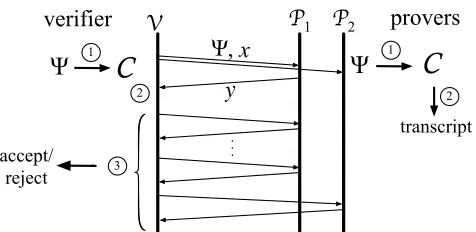
Figure 1—Our high-level framework. In stepÀ, a veri-fierV and two proversP1,P2compile a computation Ψto an arithmetic circuit,C. In stepÁ,Vrequests eval-uation ofΨon inputx;P1returns purported outputy, and both provers obtain atranscriptfor the execution ofConx. In stepÂ,V queriesP1in rounds and sub-mits a final query toP2; ify6=Ψ(x), then the responses from non-colludingP1,P2do not, except with very low probability, convinceVthatΨwas executed correctly. Here we introduce the framework around which our MIP
is designed. This high-level description also loosely ap-plies to many of the recently implemented systems for proof-based verifiable computation [17, 18, 26, 31, 61, 69–71, 75, 76]; the primary difference is our use of two provers.
Our MIP has three steps, depicted in Figure 1. In Step 1, V starts with a specification Ψ of a Random Access Machine computing a functionf, and sendsΨto the provers. In practice,Ψwill typically be a program expressed in a high-level language (in our prototype implementation, a subset of C). The provers and the verifier compileΨinto a (non-deterministic) arithmetic circuitC.4
In Step 2,P1andP2execute the computationΨon inputx, andP1returns outputy. In performing this step, the provers are expected to obtain a correct transcript for
{C,x,y}. Notice that if the claimed output is incorrect— that is, ify6=f(x)—then a correct transcript for{C,x,y}
simply does not exist: in any transcript that represents
the inputs and the computation of each gate correctly, the output wires would not bey.
In Step 3,P1andP2want to prove toV that a correct transcript for{C,x,y}exists. Of course, there is a simple proof that a correct transcript exists: the transcript itself. Unfortunately,V can check this transcript for correctness only by examining all of it, which would be as much work as having executedΨin the first place. Instead,P1andP2use low-degree extensions toencodethe transcript (as a much longer string) in such a way that a transcript’s correctness (or lack thereof) can be determined by inspecting only a few of the locations in the encoded version; this “inspection” will take the form of queries from the verifier to the provers.
Herein, our primary focus will be on Step 3, i.e., on giving a novel two-prover protocol for (non-deterministic) circuit evaluation.
4 An MIP for non-deterministic circuit evaluation
4.1 Overview of the ideas
Given an arithmetic circuitC, inputx, and claimed outputsy, our protocolencodesa purported transcriptW
(Defn. 3.2) as a polynomialGex,yin such a way thatGex,yevaluates to 0 on a particular subset of its domain if and only ifW is correct for{C,x,y}. Omitting many details, our MIP then uses a sum-check protocol (§3.3), run with P1, to check thatGex,y in fact evaluates to 0 all over the subset in question. At the end of this
sum-check protocol,P1is forced to make a claim aboutW(we 4) for a pointw4 chosen at random by the
4
verifier, whereWe is the multilinear extension ofW. Even checking this claim is too expensive forV, soV outsources it toP2, using a low-degree test (§4.4).
In many respects, our approach can be seen as a careful adaptation of the ideas underlying the GKR protocol [40] to the multi-prover setting. While GKR verifies the correctness of a transcript for{C,x,y}layer by layer, with a a different instance of the sum-check protocol required for each layer ofC, our MIP verifies the whole computation in one shot, using a single invocation of the sum-check protocol.
While this “sum-check protocol + low-degree test” paradigm for constructing two-prover MIPs is not new [12], several aspects of our protocol require new ideas. One is the choice of the polynomialGex,y, which
is meant to vanish at all Boolean inputs if and onlyP1’s answers are consistent with a correct transcriptW. The difficulty in defining a suitable polynomial is that, for each output gatea,Gex,ymust ensure both thatW(a)
is consistent with claimed outputy andthatW(a)is correct, given the values ofa’s in-neighbors. Though our definition ofGex,ymay appear obvious in hindsight, it carefully exploits cancellation to achieve this property
(Lemma 4.1 has details).
To the best of our knowledge, some aspects of our soundness analysis are also novel. In particular, in standard analyses of low-degree tests, the assumption is that a prover is a function only of the queries issued by the verifier within the test. However, recall that in our contextV uses a low-degree test to checkP1’s claim aboutW(we 4), andP1’s claim can depend not just onw4, but instead on the entire sequence of messages exchanged withV over the course of the protocol. This makes it non-trivial to apply existing analyses of low-degree tests to our setting, without resorting to expensive generic reductions or the use of additional provers to forceP1to be non-adaptive.
4.2 Details of the MIP
We imagine a single input vectorxand a claimed outputy(which may be a vector), for a given computation
Ψ, compiled to an arithmetic circuitCof fan-in two. We stress thatCmay be non-deterministic. Each entry in
x,y, and all intermediate values, are contained in a finite fieldF=Fp(the integers mod a large primep). In
our built system,pwill always be 300 or 400 bits (§5).
Denote the number of gates inC, or its size, as|C|, and takes=dlog|C|e. Now, assume we have fixed an ordering of the gates. Associate with every gate inCa label ofsbits, in the natural way: the zero’th gate gets the label 0, the next gate gets the label 1, etc. We will move back and forth between representing a label as an integer (for example, 0, 1, etc.) and as a bit vector: (0,0,. . . ,0), (0,0,. . . ,1), etc.
Now, we will model a transcript ofCas a list of every gate inC(including the input gates) together with a purported value for that gate. It is convenient to represent that list as a functionW:{0, 1}s→
Fthat maps a gate’s label to the gate’s purported value; it is also convenient to imagine thatP1is holding such a function
W. At this point,Vwants to know whetherWis a correct transcript (Defn. 3.2).
How canV checkW for correctness? IfV asksP1only for the values ofW for the input and output gates,Vhas no way of knowing if the answers are correct. IfV asksP1for all ofW, thenV does not save work. Instead,V translates the claim thatWis correct into an equivalent algebraic claim that is amenable to probabilistic checking. This algebraic claim concerns the properties of a carefully constructed polynomial.
To present this polynomial, we must introduce some functions that captureC’s structure: add, mult, and io. Let add :{0, 1}3s→ {0, 1}denote a function that takes as input three gate labels:
add(a,b,c) =
(
1 if gateaadds the outputs of gatesbandc
0 otherwise
Likewise, mult :{0, 1}3s → {0, 1}returns 1 when gateais the product of gatesbandc, and 0 otherwise.
These two functions, add(·,·,·)and mult(·,·,·), are used in GKR [40], and are calledwiring predicatesby CMT [31].5We add a third wiring predicate: let io :{0, 1}3s→ {0, 1}denote a function that takes as input
5
gate labels(a,b,c)and returns 1 when gateais a (non-auxiliary) input gate or one of the output gates, andb
andcare the in-neighbors ofa(input gates have in-neighborsb=c=0); otherwise, io returns 0.
Notice that add, mult, and io are independent of the inputs and purported outputs. Our last function, however, depends on the inputs and purported outputs. DefineIx,y:{0, 1}s→Fsuch thatIx,y(a) =xaifais
the label of an input gate,Ix,y(a) =yaifais the label of an output gate, andIx,y(a) =0 otherwise.
We now use add, mult, io, andIx,yto write a function that captures whether a transcriptWis correct for
{C,x,y}.
Lemma 4.1. ForGx,y(a,b,c)defined as below,Gx,y(a,b,c) =0 for all(a,b,c)∈ {0, 1}3sif and only ifWis
a correct transcript for{C,x,y}:
Gx,y(a,b,c) =io(a,b,c)·(Ix,y(a)−W(a))+add(a,b,c)·(W(a)−(W(b)+W(c)))+mult(a,b,c)·(W(a)−W(b)·W(c)).
Proof. IfWis not a correct transcript, there are five cases:
1. Supposea∈ {0, 1}sis the label of an input gate. IfW(a)6=x
a, thenGx,y(a, 0, 0) =Ix,y(a)−W(a) =
xa−W(a)6=0.
2. Supposea ∈ {0, 1}sis the label of a non-output addition gate with in-neighborsbandc. IfW(a)6=
W(b) +W(c), thenGx,y(a,b,c) =W(a)−(W(b) +W(c))6=0.
3. Suppose a ∈ {0, 1}s is the label of a non-output multiplication gate with in-neighborsb and c. If
W(a)6=W(b)·W(c), thenGx,y(a,b,c) =W(a)−(W(b)·W(c))6=0.
4. Supposea∈ {0, 1}sis the label of an output addition gate with in-neighborsbandc. Ify
a6=W(b) +
W(c), thenGx,y(a,b,c) =Ix,y(a)−W(a) + (W(a)−(W(b) +W(c))) =ya−(W(b) +W(c))6=0.
5. Supposea ∈ {0, 1}sis the label of an output multiplication gate with in-neighborsbandc. Ify a 6=
W(b)·W(c), thenGx,y(a,b,c) =Ix,y(a)−W(a) + (W(a)−(W(b)·W(c))) =ya−(W(b)·W(c))6=0.
On the other hand, ifWis a correct transcript then it is immediate from the definition ofGx,ythatGx,y(a,b,c) =
0 for all(a,b,c)∈ {0, 1}3s.
The lemma implies that in order forV to check thatWis a correct transcript, it suffices forVto check thatGx,yvanishes on all inputs in the Boolean hypercube. However, this check must be “outsourced” because
Vcannot handle all ofGx,y. We briefly consider a straw man approach to such outsourcing: use a sum-check
protocol (§3.3) to check whether 0=? P
a,b,c∈{0,1}sGx,y(a,b,c). This is a straw man because, first, the
sum-check protocol works with a polynomial (andGx,yis not a polynomial), and, second, a sum of zero does not
actually imply thatGx,yvanishes on the desired subspace (the evaluations ofGx,y(a,b,c)could “cancel out”).
As a next step, consider the following polynomial extensionGex,y:F3s→FofGx,y:
e
Gx,y(u1,u2,u3) =ioe(u1,u2,u3)·(Ifx,y(u1)−W(ue 1))
+addf(u1,u2,u3)·(W(ue 1)−(W(ue 2) +W(ue 3)))
+multg(u1,u2,u3)·(W(ue 1)−W(ue 2)·W(ue 3)). (1)
Here,io,e Ifx,y,We,add, andf mult respectively denote polynomial extensions of io,g Ix,y,W, add, and mult. For
efficiency, all of the polynomial extensions appearing in Equation (1) must be low-degree. We will always use themultilinearextensionWe ofW, and we will always use multilinear or carefully chosencubicextensions
e
io,add andf mult of io, add, and mult (these choices are essential for practical efficiency, as discussed ing Section 4.5.2). At this point, we have a polynomial (in 3svariables) overF, and we want to use the sum-check protocol directly to prove toV that 0=P
a,b,c∈{0,1}sGex,y(a,b,c). However, as noted above, cancellations
mean that a sum of zero does not guarantee thatGex,y(a,b,c)evaluates to 0 over all(a,b,c)∈ {0, 1}3s, which
was the algebraic property that we were trying to establish. This brings us to the actual protocol.
Specifically, define
Fx,y(t) =
X
u∈{0,1}3s
e
Gx,y(u)·tu. (2)
Here, the bit stringu ∈ {0, 1}3s in the exponent denotes the integerP3s−1
i=0 ui ·2i(i.e., the integer whose
binary representation isu). Notice thatFx,yis the zero polynomial if and only ifGex,yvanishes on{0, 1}3s(and
hence if and only ifGex,y encodes a correct transcript, and hence if and only ifyis the correct output). But by
the Schwartz-Zippel lemma, any non-zero low-degree polynomial has few roots, so ifVpicks a random point
q∈Fand determines thatFx,y(q) =0, it is safe forVto believe thatFx,yis the zero polynomial and hence
thatGex,yvanishes on{0, 1}3sas claimed byP1(our soundness analysis is made formal in Appendix A). Thus, in our MIP,Vchoosesquniformly at random fromF, and is convinced thatW is a correct transcript for (C,x,y) as long asFx,y(q) = 0. As explained below,V will outsource the computation ofFx,y(q) by
writingFx,y(q)in a form that is amenable to checking via the sum-check protocol (this approach was first
proposed by Babai et al. in the original MIP=NEXP proof [12]).
To this end, notice that for any q ∈ F and u ∈ {0, 1}3s, we can write qu as a multilinear
polyno-mial gq in the coordinates of u as follows. Define q(i) = q2 i
. Then it holds that qu = Q3s−1
i=0 q(i)
ui =
Q3s−1
i=0 1+ (q(
i)−1)u
i
:=gq(u). Defining the polynomialhqasGex,y·gq, we obtain the following identity:
Fx,y(q) =
X
u∈{0,1}3s
e
Gx,y(u)·gq(u) =
X
u∈{0,1}3s
hq(u). (3)
Notice thathqis a low-degree polynomial in the coordinates ofu(hqhas degree at most 3 in each variable,
if the multilinear extensions of add, mult and io are used in the definition ofGex,y). We now describe howV outsources computation ofP
u∈{0,1}3shq(u)toP1using a sum-check protocol. 4.3 Interaction with the first prover
The full protocol is given in Figure 5 (in Appendix E) and proceeds as follows.V picks a randomq∈F(see above for motivation) and sends it to the proverP1. The two parties then run the sum-check protocol over the polynomialhqto prove toV that 0=Pu∈{0,1}3shq(u) =Fx,y(q).
Now, the final check in the sum-check protocol requiresVto evaluatehq(·)at a randomly selected point
(w1,w2,w3)(see Section 3.3). If V could do this efficiently, we would be done. However, in our setting V cannot evaluatehq(w1,w2,w3): doing so would require evaluatingGex,y(w1,w2,w3)and hence (by the definition ofGex,y) evaluatingW(we 1),W(we 2), andW(we 3), which in turn would require constructingW(e ·), which would be at least as much work as handling the unencoded transcriptW.
Instead,V asksP1for help:P1givesVthree field elements that are purported to beW(we 1),W(we 2), and
e
W(w3). Then, using a now-standard technique (see, e.g. [40]) the protocol reduces the uncertainty surrounding the correctness of these values to a claim:v4
?
=W(we 4). This reduction is the content of lines 7–21 in Figure 5, and occurs as follows. Let`(t)be the degree-two curve passing through the pointsw1,w2, andw3defined via
`(0) =w1,`(1) =w2, and`(2) =w3.V asksP1to send her a degree 2sunivariate polynomialH∗claimed to equalWe ◦`, i.e.,We restricted to the curve`.Vchecks thatH∗(0),H∗(1), andH∗(2)equalv1,v2, andv3 respectively.Vthen picks a random pointτ ∈F, choosesw4as`(τ), evaluatesH(τ), and treatsH(τ)as an implicit claim byP1about the value ofW(we 4). The Schwartz-Zippel lemma implies that ifH∗6=We ◦`, then
H∗(τ) 6=W(e `(τ))with probability 1−2s/Foverτ
R
←−F. Hence,V choosesτ at random fromF, and is convinced thatH∗ =We ◦`(and hence thatvi=W(we i)fori∈ {1, 2, 3}) as long asH∗(τ) =W(we 4)(again, our formal proof of soundness appears in Appendix A).
At this point, the protocol has provided the following guarantee toV, which we state loosely.V should believe that 0=Fx,y(q)—and hence that a correct transcript exists and hence that the computation was done
Vcheck this? As noted, it would be too expensive forVto evaluateWe. For this purpose,Vturns to the second prover.
4.4 Interaction with the second prover
To validateP1’s claim thatv4 =W(we 4),Vengages the second prover,P2, using alow-degree test[10, 60] (see Figure 5, lines 23–24). We use thepoint vs. planelow-degree test, as analyzed by Moshkovitz and Raz [60]. This test works by askingP2to send a very small “excerpt” of the encoded transcriptWe; to get this transcript,P2must execute the computation, just as P1 does. The “excerpt” is a low-degree polynomial claimed to equalWe restricted to a low-dimensional subspace. In the test we use, this subspace is a plane that passes throughw4, andVconcealswhichpoint in the subspace isw4. BecauseV obtains (a description of)We over the entire subspace,Vextracts an implicit claim byP2about the value ofW(we 4). At this point,Vrejects if there is a discrepancy in the two provers’ claims aboutW(we 4)(see Figure 5, line 24).
In more detail, in the point vs. plane test,V sendsP2a random planeQ(i.e., a two-dimensional affine subspace ofFs) through the pointw4, parameterized in a way that reveals no information about the pointw4 toP2, other than thatw4lies somewhere onQ.P2responds with a bivariate polynomialH∗Qof degreesin each variable claimed to equalWe ◦Q. Let(t1,t2)be the point such thatQ(t1,t2) =w4.V considersH∗Q(t1,t2) to beP2’s claim about the value ofW(we 4).
Moshkovitz and Raz [60] have analyzed the point vs. plane test to be sound for reasonable field sizes (see Lemma A.1 in Appendix A for details). Note that Moshkovitz and Raz state explicitly that they made no attempt to optimize the constants appearing in their analysis, and even small improvements in the constants would yield substantial improvements to the soundness guarantee for our protocol. This would allow us to work over smaller fields; the current implementation works over a very large field so as to achieve low soundness error, and the field size is a substantial contributor to the costs of our implementation.
4.5 Guarantees and costs
4.5.1 Correctness
Our MIP guarantees completeness and soundness, as defined in Section 3.1. An upper-bound on our MIP’s soundness error,, assuming|F|>|C|8, is(29·log|C|)/|F|1/8. Thus, for a field size of 300 bits, <2−23for any circuitCwith fewer than 240gates, and for a field size of 400 bits, <2−35. We establish this formally in Appendix A.
4.5.2 Overview of Costs
We now give a brief overview of the costs of our MIP, before formalizing them in Theorem 4.1.
V’s costs. The principal bottleneck inV’s running time is thatV’s final check in the sum-check protocol requires evaluating the low-degree extensionsadd andf mult atg (w1,w2,w3)∈F3s. We take two approaches. The first approach requires pre-processing but applies to arbitrary circuits; we use this approach in our prototype implementation (cf. §5). The second uses carefully generated circuits for which the verifier can evaluateadd andf mult in polylogarithmic time, and hence avoid a pre-processing phase. We have not yetg implemented this circuit generator, leaving it to near-term future work. In more detail:
Approach 1.Our implemented compiler from high-level programs to circuits uses the multilinear extensions
f
add andmult. While this leads tog O(|C|) pre-processing time forV, the costs can be amortized (§5 gives details).
incur the cost of compiling the high-level program into the circuit. In this approach, the verifier processes the input inO(n)time, and the rest of the protocol requires polylogarithmic time intotal.
P1’s andP2’s costs. In both Approach 1 and Approach 2,P1in each round has to compute a univariate polynomial, defined as a sum of up to|C|3other univariate polynomials. However, techniques of CMT [31] and Thaler [74] show that under both approaches, each gate in C contributes toO(1) terms in the sum, allowingP1to run inO(|C|log|C|)time.P2’s computation is identical in both approaches: the point-vs-plane test requiresP2to evaluateW(e ·)at(log|C|+1)2points. This can be done with 4|C|field multiplications per point using a memoization idea from [76, §5.1]. In settings (such as our built system) in whichVwants to evaluate a circuitCon many inputs, bothP1andP2can reuse some work across instances. In §5, we describe such reusable work assetup costsforP1andP2.
Remark. Thaler [74] also shows how to reduce the prover’s total work in the GKR-CMT protocol to be proportional to|C|rather than|C|log|C|for a large class of wiring patterns, and demonstrates experimentally that these techniques can reduce the prover’s runtime by two orders of magnitude relative to the original CMT implementation that appeared in [31]. These techniques apply equally well to the first prover in our MIP protocol. However, we have not yet incorporated them into our prototype implementation (indeed, our prototype currently uses circuits that do not satisfy the conditions required by the optimizations of [74]).
The next subsection formalizes the costs and guarantees of Approach 2.
4.5.3 A complexity preserving MIP
Theorem 4.1. There is a two-prover MIP protocol satisfying the following properties. In order to check that aT(n)-timeS(n)-space Random-Access MachineMnon-deterministically accepts an inputxof lengthn, the MIP verifier runs in timeO(n·polylog(T(n))), and both MIP provers run in timeO(T(n)·polylog(T(n)))
and spaceO(S(n)·polylog(T(n)))if given an (input, witness) pair(x; w)forM. Moreover, each MIP prover can be computed “gate-by-gate” as a circuit by an evaluator algorithm in timeO(T(n)·polylog(T(n)))and spaceO(S(n)·polylog(T(n))).
To clarify, Bitansky and Chiesa [23] obtained an identical result to Theorem 4.1 up to factors hid-den by the polylog(T(n)) terms, using very different techniques from our own (their MIP uses m = Θ(logS(n)/log log(S(n)) many provers, but one can obtain a two-prover MIP from their construction using a generic reduction that “only” blows up the costs by logarithmic factors). We state Theorem 4.1 not for its novelty, but because it formalizes the costs and properties of our MIP.
We note, however, that our MIP has substantially improved quantitative costs compared to [23]. When instantiated on a particular circuitC, both of our provers run in timeO(|C|log2|C|), whereas the provers in the MIP of [23] appear to require total time at leastΩ(˜ |C|log6|C|), even before invoking the reduction to two provers. There are two main reasons for their higher costs. First, their protocol requires running
Ω(log|C|/log log|C|)low-degree tests, compared to our single low-degree test. Second, each of the polyno-mials to which they apply a low-degree test has total degreeΩ(˜ log2|C|); in comparison, the polynomial used in our MIP has total degreeO(log|C|). This means that each low-degree test in the MIP of [23] requires the prover to either evaluate the relevant polynomial atΩ(˜ log4|C|)points or compute this many coefficients, and each such evaluation appears to requireΩ(˜ |C|log|C|)time.
Bitansky and Chiesa also showed how to transform any MIP with the properties guaranteed by Theorem 4.1 into a four-message complexity preserving argument system.
Proof of Theorem 4.1. The proof relies on the following lemma, which shows that it is possible to very efficiently transform an arbitrary RAM program into an arithmetic circuitC for which there existcubic
extensions of add and mult can be evaluated in polylogarithmic time. Moreover, when applying the sum-check protocol to the polynomialhqderived from these extensions, the proverP1can still be made to run in time
Lemma 4.2. LetMbe an arbitrary (non-deterministic) Random Access Machine that on inputs of lengthn
runs in timeT(n)and spaceS(n).Mcan be transformed into an equivalent (non-deterministic) arithmetic circuitCover a fieldFof size polylog(T(n)). Moreover, there exist cubic extensionsadd andf mult of theg wiring predicates add and mult ofCthat satisfy the following properties.
1. Chas sizeO(T(n)·polylog(T(n))).
2. The cubic extensionsadd andf mult ofg Ccan each be evaluated in timeO(polylog(T(n))).
3. An (input, witness) pair(x;w)that makesMaccept can be mapped to a correct transcriptWforCin timeO(T(n)·polylog(T(n)))and spaceO(S(n)·polylog(T(n))). Furthermore,wis a substring of the transcriptW, and any correct transcriptW0 forCpossesses a witnessw0for(M,x)as a substring.
4. P1can run in timeO(|C|log|C|)when applying the sum-check protocol to the polynomialhq=Gex,y·gq
derived fromadd,f mult, and the transcriptg W(see Equation (1)).
5. Ccan be evaluated “gate-by-gate” in timeO(T(n)·polylog(T(n)))and spaceO(S(n)·polylog(T(n))).
The proof of Lemma 4.2 adapts techniques for transforming RAMs into circuits pursued by Ben-Sasson et al. [15], combined with techniques of Thaler [74] for obtaining the appropriate cubic extensions. A detailed sketch of this result is in Appendix D.
Given a (non-deterministic) Random Access MachineM, letCbe the circuit whose existence is guaranteed by Lemma 4.2. Insights of CMT [31] show that each gate in the circuitC contributes independently to each ofP1’s messages. Thus,P1 can compute each message in timeO(T(n)·polylog(T(n)))and space
O(S(n)·polylog(T(n)))by evaluating the circuit gate-by-gate, computing the contribution of each gate to the current message, and “forgetting” the value of the gate immediately after. While this requiresP to reevaluate the circuit for every message,P1sends only 3 log|C|many messages in total, and therefore revaluation ofC
introduces only aO(log|C|)factor overhead inP1’s runtime. (To clarify, if we did not care about keeping the space complexity ofP1 small, thenP1can store the value of each gate and avoid this overhead). We conclude that when applying our MIP protocol toC,P1runs in total timeO(T(n)·polylog(T(n)))and space
O(S(n)·polylog(T(n))).
Similar observations imply thatP2 can be made to run within the same time and space bounds when applied to the circuitC, completing the proof of the theorem.
Proof-of-Knowledge. Bitansky and Chiesa [23] also give a hardness assumption under which any complex-ity preserving MIP that satisfies aproof-of-knowledge(PoK) property can be transformed into a complexity preserving SNARK. In Appendix C, we show that our MIP satisfies this PoK property, and hence the transformation of [23] can turn it into a complexity-preserving SNARK.
5 Clover, the built system
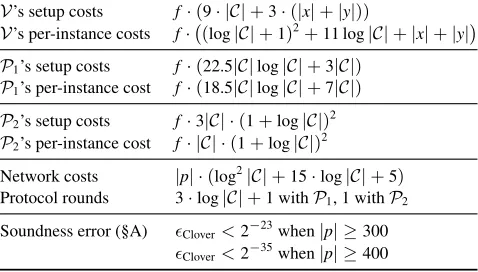
V’s setup costs f·(9· |C|+3·(|x|+|y|))
V’s per-instance costs f· (log|C|+1)2+11 log|C|+|x|+|y|
P1’s setup costs f·(22.5|C|log|C|+3|C|) P1’s per-instance cost f·(18.5|C|log|C|+7|C|) P2’s setup costs f·3|C| ·(1+log|C|)2 P2’s per-instance cost f· |C| ·(1+log|C|)2
Network costs |p| ·(log2|C|+15·log|C|+5)
Protocol rounds 3·log|C|+1 withP1, 1 withP2
Soundness error (§A) Clover<2−23when|p| ≥300
Clover<2−35when|p| ≥400 |x|,|y|: number of elements in input, output
|C|: number of gates inC |p|: length of an element inF
Figure 2—Costs of Clover (the built system) for a com-putation represented as an arithmetic circuitCwith|C|
gates.f represents the cost of field multiplication. Costs of Clover. Figure 2 reports the concrete costs
of our built system. To briefly compare these costs to those of built systems based on arguments with pre-processing [17, 18, 26, 61, 69], the costs for the prover and verifier in these systems are the same as, or lower than, Clover’s—inasymptoticterms. However, in con-crete terms, the argument systems require many ex-pensive cryptographic operations. For instance, in Za-atar [69], each operation in the setup phase requires a modular exponentiation that costs two orders of mag-nitude more [69, §5.1] than a field operation—the only kind of operation required for Clover. Additional com-parisons are in §2.
6 Experimental evaluation
We are interested in two performance metrics: (1) the ver-ifier’sbreak-even batch size, i.e., the minimum number of computation instances that the verifier must outsource
in a batch before the cost of local execution exceeds the cost of verification, and (2) the prover’s overhead, split into per-instance and setup costs (see Figure 2). We note that item (1) accounts for the verifier’s per-instance verification time and per-computation setup cost (which is the dominant cost in all of the protocols in the literature).
Points of comparison. Besides local computation, our points of comparison are CMT-batching [76] (the refinement to CMT that is part of Allspice) and Zaatar [69]. To explain this choice of baseline, we give a ballpark comparison among three systems for verifiable computation: Zaatar [69], Pinocchio [61], and CMT-batching [76]. We choose these three because we are focused on the “back-end” in this paper. As noted in Section 2, the other systems for general-purpose verifiable computation—BCTV [17, 18], Pantry [26], and Buffet [77]—differ primarily in their “front-ends”; their back-end is Pinocchio or optimizations thereof.
For the verifier’s costs, Zaatar’s per-instance verification time is roughly three times Pinocchio’s, but Pinocchio’s setup costs are considerably larger [78, Figs. 2-3]; as a result, Pinocchio’s break-even point is roughly twice Zaatar’s [78, Fig. 4]. And when CMT is applicable, it has the best batch sizes in the literature, by several orders of magnitude [76]. For the prover’s costs, Pinocchio’s prover costs roughly twice Zaatar’s; for details, see [78, Fig. 5][76, §8][76, Fig. 10][26, §2.3,§9]. Summarizing, CMT-batching and Zaatar do better on the key metrics (prover costs, verifier break-even points), so these are the comparison points for Clover.6,7
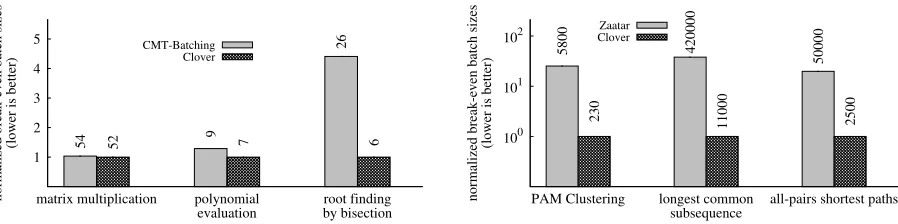
Top-level summary of results. Clover achieves break-even batch sizes that are competitive with CMT-batching (for computations for which CMT-CMT-batching evenhasa break-even batch size) and are significantly superior to Zaatar, while simultaneously yielding prover costs that are competitive to both.
Method and setup. We evaluate Clover on the following benchmark computations: (1)m×m matrix multiplication (m=128), (2) evaluating a degree-2 polynomial inmvariables (m=512), (3) finding the roots
6An area where Zaatar is not the best is amortization behavior. Whereas Zaatar’s setup costs amortize only over a batch, Pinocchio’s set-up costs amortize over an indefinite number of instances of the same computation. And BCTV’s amortize over an indefinite number of instances of all computations of the same length. Clover and Zaatar work under the same amortization model. 7
1 2 3 4 5
matrix multiplication polynomial
evaluation by bisectionroot finding
normalized break-even batch sizes
(lower is better)
CMT-Batching Clover
54 9
26
52 7 6
(a) Break-even batch sizes for matrix multiplication (m=128), polynomial evaluation (m=512), and root finding by bisection (m=256,L=8) under CMT-batching and Clover.
100 101 102
PAM Clustering longest common
subsequence all-pairs shortest paths
normalized break-even batch sizes
(lower is better)
Zaatar Clover
5800 420000
50000
230 11000 2500
(b) Break-even batch sizes for PAM clustering (d=128,m=20), all-pairs shortest path (m=25), and longest common subsequence (m=300) under Zaatar and Clover. The y-axis is log-scaled.
Figure 3—Clover has a superior break-even size in all of our experiments.
of a degree-2 polynomial inmvariables using bisection (m=256,L=8), (4) clustering a set ofmdata points, where each data points haveddimensions, using PAM clustering (d=128,m=20), (5) Floyd-Warshall all-pairs shortest paths in a graph withmvertices (m=25), and (6) finding the longest common subsequence of two length-mstrings (m=300). These computations were expressed in a high-level language and automatically compiled into circuits. The sizes of the resulting circuits range from 1 million gates for polynomial evaluation to 12.6 million gates for longest common subsequence. We evaluated Clover against CMT-batching for the first three computations, and against Zaatar for the remaining ones.
We run CMT-batching and Zaatar over a finite field with a 128-bit prime modulus for computations that take integer inputs and a field with a 220-bit prime modulus for computations that take floating-point inputs. We run Clover with a 300-bit prime modulus field for all computations, corresponding to soundness error of at most 2−23. Costs grow roughly linearly with the bit length; for example, increasing the modulus to 400 bits to guarantee soundness error 2−35results in a 20–41% increase in the numbers reported below.
We run the verifier and provers on different machines in the same local cluster and usegetrusageto measure their CPU usages. Each machine has two Intel Xeon E5-2680 2.7 GHz processors with 32GB of RAM (Clover required approximately 8GB of RAM in our largest experiment.) To compute the verifier’s break-even batch size, we run one instance locally and one instance under verification (splitting the verifier’s costs into setup and per-instance costs), then solve for the pointβ at which verification ofβ instances is cheaper running them locally.
Clover’s break-even batch size. Figures 3(a) and 3(b) show Clover’s break-even batch sizes in comparison to batching and Zaatar, respectively. Clover’s break-even batch size is slightly smaller than CMT-batching’s for matrix multiplication and polynomial evaluation and much smaller for root finding by bisection. Against Zaatar, Clover fared even better, achieving a break-even batch size that is 20–40×smaller.
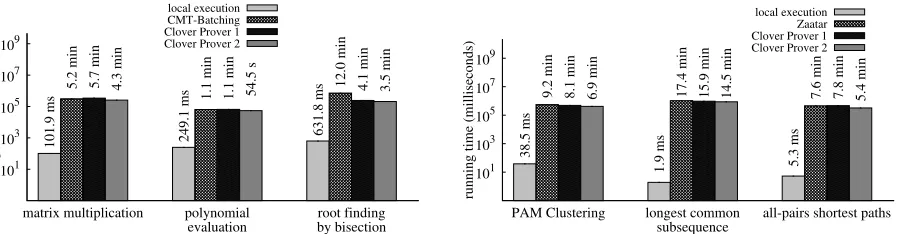
Clover’s prover overhead. Figures 4(a) and 4(b) show the running time of Clover’s two provers in com-parison to the two baseline protocols’ provers and to local execution of the computation. Clover’s provers’ per-instance costs are competitive with both baseline protocols’ provers for all computations, despite having to work in a larger 300-bit modulus field. Its total per-instance prover overhead is no more than twice that of the baseline protocols, and it beats CMT-batching in the root finding computation. Clover’s provers have setup costs that are not shown in the referenced figures. However, these costs are no more than 3×each prover’s per-instance costs; they can be easily amortized away at reasonable batch sizes.
101
103
105
107
109
matrix multiplication polynomial
evaluation root findingby bisection
running time (milliseconds)
local execution CMT-Batching Clover Prover 1 Clover Prover 2
101.9 ms 249.1 ms 631.8 ms
5.2 min
1.1 min 12.0 min
5.7 min
1.1 min 4.1 min
4.3 min 54.5 s 3.5 min
(a) Per-instance running time of local executions and of the CMT-batching and Clover provers for matrix multiplication (m=128), polynomial evaluation (m=512), and root finding by bisection (m=256,L=8). The y-axis is log-scaled.
101 103 105 107 109
PAM Clustering longest common
subsequence all-pairs shortest paths
running time (milliseconds)
local execution Zaatar Clover Prover 1 Clover Prover 2
38.5 ms
1.9 ms 5.3 ms 9.2 min 8.1 min 6.9 min 17.4 min 15.9 min 14.5 min 7.6 min 7.8 min 5.4 min
(b) Per-instance running time of local execution and of the Za-atar and Clover provers for PAM clustering (d=128,m=20), all-pairs shortest path (m=25), and longest common subsequence (m=300). The y-axis is log-scaled.
Figure 4—Clover’s provers are competitive with both CMT-batching’s and Zaatar’s provers. Clover’s first prover’s setup costs (not shown) are 1.5×its per-instance costs; Clover’s second provers’s setup costs are 2–3×its per-instance costs; CMT-batching’s prover’s setup costs are 0.3×its per-instance costs; and Zaatar’s prover has no significant setup costs. References
[1] Open MPI (http://www.open-mpi.org).
[2] https://github.com/scipr-lab/libsnark, 2014.
[3] W. Aiello, S. N. Bhatt, R. Ostrovsky, and S. Rajagopalan. Fast verification of any remote procedure call: Short witness-indistinguishable one-round proofs for np. In U. Montanari, J. D. P. Rolim, and E. Welzl, editors,ICALP, volume 1853 ofLecture Notes in Computer Science, pages 463–474. Springer, 2000.
[4] P. A. Alsberg and J. D. Day. A principle for resilient sharing of distributed resources. pages 562–570, 1976. [5] S. Alsouri, S. Katzenbeisser, and S. Biedermann. Trustable outsourcing of business processes to cloud computing
environments. InThe Conference on Network and System Security (NSS), 2011.
[6] D. P. Anderson, J. Cobb, E. Korpela, M. Lebofsky, and D. Werthimer. SETI@home: An experiment in public-resource computing. CACM, 45(11):56–61, Nov. 2002.
[7] S. Arora and B. Barak. Computational Complexity: A modern approach. Cambridge University Press, 2009. [8] S. Arora, C. Lund, R. Motwani, M. Sudan, and M. Szegedy. Proof verification and the hardness of approximation
problems. J. of the ACM, 45(3):501–555, May 1998.
[9] S. Arora and S. Safra. Probabilistic checking of proofs: a new characterization of NP. J. of the ACM, 45(1):70–122, Jan. 1998.
[10] S. Arora and M. Sudan. Improved low-degree testing and its applications. Combinatorica, 23(3):365–426, 2003. [11] L. Babai. Trading group theory for randomness. InSTOC, 1985.
[12] L. Babai, L. Fortnow, and C. Lund. Non-deterministic exponential time has two-prover interactive protocols.
Computational Complexity, 1(1):3–40, 1991.
[13] B. Barak and O. Goldreich. Universal arguments and their applications.SIAM J. Comput., 38(5):1661–1694, 2008.
[14] M. Ben-Or, S. Goldwasser, J. Kilian, and A. Wigderson. Multi-prover interactive proofs: How to remove intractability assumptions. In J. Simon, editor,STOC, pages 113–131. ACM, 1988.
[15] E. Ben-Sasson, A. Chiesa, D. Genkin, and E. Tromer. Fast reductions from RAMs to delegatable succinct constraint satisfaction problems. InITCS, Jan. 2013.
[16] E. Ben-Sasson, A. Chiesa, D. Genkin, and E. Tromer. On the concrete-efficiency threshold of probabilistically-checkable proofs. InSTOC, June 2013.
[17] E. Ben-Sasson, A. Chiesa, D. Genkin, E. Tromer, and M. Virza. SNARKs for C: Verifying program executions succinctly and in zero knowledge. InCRYPTO, pages 90–108, Aug. 2013.
[18] E. Ben-Sasson, A. Chiesa, E. Tromer, and M. Virza. Succinct non-interactive zero knowledge for a von Neumann architecture. InUSENIX Security, Aug. 2014.
[19] E. Ben-Sasson, O. Goldreich, P. Harsha, M. Sudan, and S. Vadhan. Robust PCPs of proximity, shorter PCPs and applications to coding.SIAM J. on Comp., 36(4):889–974, Dec. 2006.
May 2008.
[21] N. Bitansky, R. Canetti, A. Chiesa, and E. Tromer. From extractable collision resistance to succinct non-interactive arguments of knowledge, and back again. InITCS, pages 326–349, Jan. 2012.
[22] N. Bitansky, R. Canetti, A. Chiesa, and E. Tromer. Recursive composition and bootstrapping for SNARKs and proof-carrying data. InSTOC, pages 111–120, June 2013.
[23] N. Bitansky and A. Chiesa. Succinct arguments from multi-prover interactive proofs and their efficiency benefits. InCRYPTO, pages 255–272, 2012.
[24] N. Bitansky, A. Chiesa, Y. Ishai, R. Ostrovsky, and O. Paneth. Succinct non-interactive arguments via linear interactive proofs. InIACR TCC, Mar. 2013.
[25] G. Brassard, D. Chaum, and C. Cr´epeau. Minimum disclosure proofs of knowledge.J. of Comp. and Sys. Sciences, 37(2):156–189, 1988.
[26] B. Braun, A. J. Feldman, Z. Ren, S. Setty, A. J. Blumberg, and M. Walfish. Verifying computations with state. In
SOSP, 2013.
[27] R. Canetti, B. Riva, and G. Rothblum. Practical delegation of computation using multiple servers. InACM CCS, 2011.
[28] R. Canetti, B. Riva, and G. N. Rothblum. Refereed delegation of computation. Inf. Comput., 226:16–36, 2013. [29] M. Castro and B. Liskov. Practical Byzantine fault tolerance and proactive recovery.ACM Trans. on Comp. Sys.,
20(4):398–461, Nov. 2002.
[30] A. Chiesa and E. Tromer. Proof-carrying data and hearsay arguments from signature cards. InICS, 2010. [31] G. Cormode, M. Mitzenmacher, and J. Thaler. Practical verified computation with streaming interactive proofs. In
ITCS, 2012.
[32] G. D. Crescenzo and H. Lipmaa. Succinct NP proofs from an extractability assumption. In A. Beckmann, C. Dimitracopoulos, and B. L¨owe, editors,CiE, volume 5028 ofLecture Notes in Computer Science, pages 175–185. Springer, 2008.
[33] I. Damg˚ard, S. Faust, and C. Hazay. Secure two-party computation with low communication. In R. Cramer, editor,
TCC, volume 7194 ofLecture Notes in Computer Science, pages 54–74. Springer, 2012. [34] I. Dinur. The PCP theorem by gap amplification. J. of the ACM, 54(3):12:1–12:44, June 2007.
[35] C. Dwork, M. Langberg, M. Naor, K. Nissim, and O. Reingold. Succinct proofs for NP and spooky interactions.
Manuscript, available athttp: // www. cs. bgu. il/ ~ kobbi/ papers/ spooky_ sub_ crypto. pdf, 2004. [36] L. Fortnow, J. Rompel, and M. Sipser. On the power of multi-power interactive protocols. InStructure in
Complexity Theory Conference, pages 156–161. IEEE Computer Society, 1988.
[37] R. Gennaro, C. Gentry, B. Parno, and M. Raykova. Quadratic span programs and succinct NIZKs without PCPs. InEUROCRYPT, May 2013.
[38] C. Gentry.A fully homomorphic encryption scheme. PhD thesis, Stanford University, 2009.
[39] C. Gentry and D. Wichs. Separating succinct non-interactive arguments from all falsifiable assumptions. InSTOC, pages 99–108, June 2011.
[40] S. Goldwasser, Y. T. Kalai, and G. N. Rothblum. Delegating computation: Interactive proofs for muggles. In
STOC, 2008.
[41] S. Goldwasser, H. Lin, and A. Rubinstein. Delegation of computation without rejection problem from designated verifier CS-proofs.IACR Cryptology ePrint Archive, 2011:456, 2011.
[42] S. Goldwasser, S. Micali, and C. Rackoff. The knowledge complexity of interactive proof systems. SIAM J. on Comp., 18(1):186–208, 1989.
[43] J. Groth. Short pairing-based non-interactive zero-knowledge arguments. InASIACRYPT, 2010.
[44] Y. Gurevich and S. Shelah. Nearly linear time. In A. R. Meyer and M. A. Taitslin, editors,Logic at Botik, volume 363 ofLecture Notes in Computer Science, pages 108–118. Springer, 1989.
[45] A. Haeberlen, P. Kouznetsov, and P. Druschel. PeerReview: Practical accountability for distributed systems. In
SOSP, 2007.
[46] Y. Ishai, E. Kushilevitz, and R. Ostrovsky. Efficient arguments without short PCPs. InConference on Computational Complexity (CCC), 2007.
[47] S. Jha, S. Katzenbeisser, C. Schallhart, H. Veith, and S. Chenney. Semantic integrity in large-scale online simulations.ACM Transactions on Internet Technology (TOIT), 10(1), Feb. 2010.
[48] Y. T. Kalai, R. Raz, and R. Rothblum. How to delegate computations: The power of no-signaling proofs.
Electronic Colloquium on Computational Complexity (ECCC), 20:183, 2013.
J. Feigenbaum, editors,STOC, pages 565–574. ACM, 2013.
[50] G. O. Karame, M. Strasser, and S. Capkun. Secure remote execution of sequential computations. InIntl. Conf. on Information and Communications Security, 2009.
[51] J. Kilian. A note on efficient zero-knowledge proofs and arguments (extended abstract). InSTOC, 1992. [52] G. Kol and R. Raz. Competing provers protocols for circuit evaluation. In R. D. Kleinberg, editor,ITCS, pages
473–484. ACM, 2013.
[53] H. Lipmaa. Progression-free sets and sublinear pairing-based non-interactive zero-knowledge arguments. In
IACR TCC, 2011.
[54] C. Lund, L. Fortnow, H. J. Karloff, and N. Nisan. Algebraic methods for interactive proof systems.J. of the ACM, 39(4):859–868, 1992.
[55] D. Malkhi and M. Reiter. Byzantine quorum systems.Distributed Computing, 11(4):203–213, 1998.
[56] J. M. McCune, B. J. Parno, A. Perrig, M. K. Reiter, and H. Isozaki. Flicker: An execution infrastructure for TCB minimization. InEuroSys, 2008.
[57] S. Micali. Computationally sound proofs.SIAM J. on Comp., 30(4):1253–1298, 2000.
[58] T. Mie. Polylogarithmic two-round argument systems.J. Mathematical Cryptology, 2(4):343–363, 2008. [59] F. Monrose, P. Wycko, and A. D. Rubin. Distributed execution with remote audit. InNDSS, 1999. [60] D. Moshkovitz and R. Raz. Sub-constant error low degree test of almost-linear size.SIAM J. Comput.,
38(1):140–180, 2008.
[61] B. Parno, C. Gentry, J. Howell, and M. Raykova. Pinocchio: Nearly practical verifiable computation. InIEEE Symposium on Security and Privacy, 2013.
[62] B. Parno, J. M. McCune, and A. Perrig. Bootstrapping Trust in Modern Computers. Springer, 2011. [63] J. M. Robson. AnO(TlogT)reduction from RAM computations to satisfiability. Theor. Comput. Sci.,
82(1):141–149, 1991.
[64] G. N. Rothblum. Delegating Computation Reliably: Paradigms and Constructions. PhD thesis, Massachusetts Institute of Technology, 2009.
[65] A.-R. Sadeghi, T. Schneider, and M. Winandy. Token-based cloud computing: secure outsourcing of data and arbitrary computations with lower latency. InTRUST, 2010.
[66] R. Sailer, X. Zhang, T. Jaeger, and L. van Doorn. Design and implementation of a TCG-based integrity measurement architecture. InUSENIX Security, 2004.
[67] A. Seshadri, M. Luk, E. Shi, A. Perrig, L. van Doorn, and P. Khosla. Pioneer: Verifying integrity and guaranteeing execution of code on legacy platforms. InSOSP, 2005.
[68] S. Setty, A. J. Blumberg, and M. Walfish. Toward practical and unconditional verification of remote computations. InHotOS, 2011.
[69] S. Setty, B. Braun, V. Vu, A. J. Blumberg, B. Parno, and M. Walfish. Resolving the conflict between generality and plausibility in verified computation. InEuroSys, Apr. 2013.
[70] S. Setty, R. McPherson, A. J. Blumberg, and M. Walfish. Making argument systems for outsourced computation practical (sometimes). InNDSS, 2012.
[71] S. Setty, V. Vu, N. Panpalia, B. Braun, A. J. Blumberg, and M. Walfish. Taking proof-based verified computation a few steps closer to practicality. InUSENIX Security, 2012.
[72] A. Shamir. IP = PSPACE.J. of the ACM, 39(4):869–877, 1992.
[73] F. Stumpf, A. Fuchs, S. Katzenbeisser, and C. Eckert. Improving the scalability of platform attestation. InACM Workshop on Scalable Trusted Computing, 2008.
[74] J. Thaler. Time-optimal interactive proofs for circuit evaluation. InCRYPTO, 2013.
[75] J. Thaler, M. Roberts, M. Mitzenmacher, and H. Pfister. Verifiable computation with massively parallel interactive proofs. InUSENIX HotCloud Workshop, 2012.
[76] V. Vu, S. Setty, A. J. Blumberg, and M. Walfish. A hybrid architecture for interactive verifiable computation. In
IEEE Symposium on Security and Privacy, 2013.
[77] R. Wahby, S. Setty, Z. Ren, A. J. Blumberg, and M. Walfish. Efficient RAM and control flow in verifiable outsourced computation. Cryptology ePrint Archive, Report 2014/674, 2014.
[78] M. Walfish and A. J. Blumberg. Verifying computations without reexecuting them: from theoretical possibility to near practicality. Technical Report TR13-165, Electronic Colloquium on Computational Complexity (ECCC), Nov. 2013.http://eccc.hpi-web.de/report/2013/165/. Forthcoming inCommunications of the ACM (CACM).