Working Draft Version 2.0
21 March 2003
Ken Crisler(ed.)
1, Mikael Anneroth
2, Angela Sasse
3, Petri Pulli
41 Motorola, USA 2 Ericsson, Sweden
3 University College London, UK 4 University of Oulu, Finland
A User-Focused Reference
Model for Wireless
Contents
1 ABSTRACT 4
2 INTRODUCTION 5
3 OVERVIEW OF THE REFERENCE MODEL 6
3.1 GENERAL STRUCTURE 6
3.2 LINKAGE TO SCENARIO ANALYSIS RESULTS 9
3.3 VALUE PLANE OVERVIEW 9
3.4 CAPABILITY PLANE OVERVIEW 9
4 THE VALUE PLANE 10
4.1 SAFETY 10
4.2 BELONGING 12
4.3 CONTROL 13
4.4 PRIVACY 14
4.5 SELF-ACTUALISATION 16
4.6 HUMAN CAPABILITY AUGMENTATION 17
5 THE CAPABILITY PLANE 19
5.1 UBIQUITOUS COMMUNICATIONS ACCESS 19
5.2 UBIQUITOUS INFORMATION ACCESS 20
5.3 CONTEXT ADAPTATION 22
5.4 PERSONALISATION 23
5.5 NATURAL INTERACTION 24
5.6 PRESENCE AWARENESS (INC. PERSONAL SAFETY AND SECURITY) 25
6 AN EXAMPLE SCENARIO 27
REFERENCES 29
APPENDIX A. CYBERWORLD REFERENCE MODEL OVERVIEW 31
A.1 THE CYBERWORLD BUILDING BLOCKS 31
A.1.1 PRESENCE 31
A.1.2 IDENTITY 32
A.1.3 INTERACTION 32
A.1.4 APPLICATION 32
1 Abstract
2 Introduction
This paper is an output of Working Group 1, the Human Perspective of the Wireless World, of the Wireless World Research Forum (WWRF). The WWRF has as its objective "to formulate visions on strategic future research directions in the wireless field, among industry and academia, and to generate, identify, and promote research areas and technical trends for mobile and wireless system technologies." To this end, the forum produced a Book of Visions [1] in 2001 detailing a wide-ranging set of research issues for future wireless
systems. In 2002, the forum's goal has been to formulate a research framework and reference model for systems beyond 3G. It is the purpose of this paper to contribute to the discussion and ultimate formulation of the reference model from the perspective of the wireless user.
The paper is structured into five main sections. Section 3 presents an overview of the proposed reference model, including descriptions of its general structure, how the model relates to the results of user scenario analysis (the subject of an independent WG1
3 Overview of the Reference Model
This section of the paper provides a high-level view of the reference model and the structural constructs that have been adopted to describe the components of the model.
3.1 General
Structure
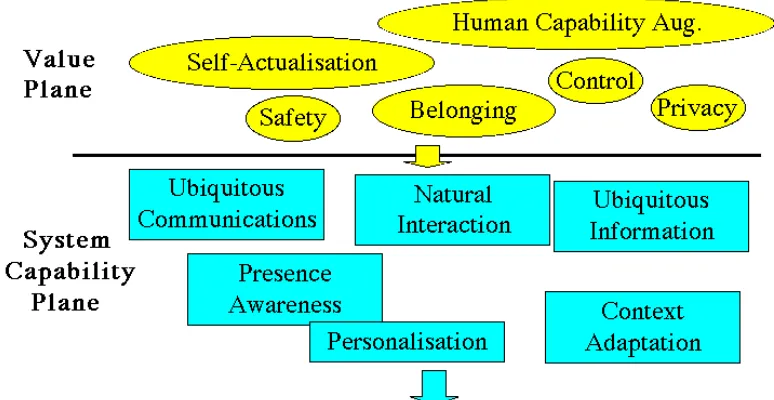
We propose a reference model consisting of two main areas or planes (Figure 1). The two planes offer the opportunity to reveal characteristics at different levels of abstraction that are relevant to a user centred view of wireless systems. The value plane addresses the core human needs, e.g. safety or belonging, that products and systems need to satisfy. Addressing these core needs demands that certain functionalities exist in the system. The functionalities are the subject of the system capability plane. The system capability plane places
requirements on the system, e.g. applications and services that are needed to realise the needed capabilities. In this way, this reference model is envisioned as able to link into other models that describe how these applications and services are enabled.
Figure 1: Reference Model
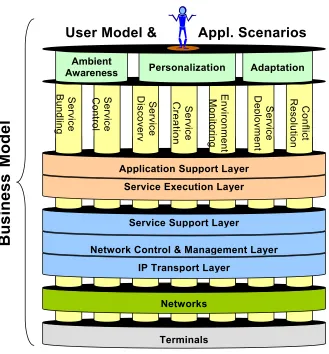
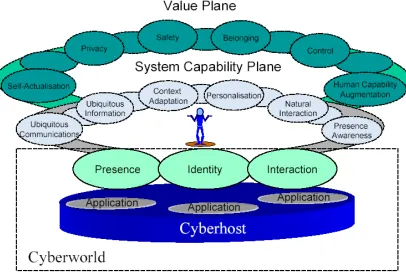
WWRF has developed a model for representing a service architecture (see Figure 2). Later in this whitepaper, when we need to illustrate a linkage to supporting services, we generally refer to aspects of theWG2 model. An alternative model, based on the work of the Wireless Strategic Initiative (WSI) project is known as the Cyberworld model. A Cyberworld reference model incorporating the two user-centred planes is illustrated in Figure 3. Additional information on the Cyberworld reference model is provided in Appendix A.
Figure 2: WWRF WG2 Reference Model
Business
Model
Ambient
Awareness Personalization Adaptation
User Model & Appl. Scenarios
Serv ic e Bundling Serv ic e
Control Monitoring Environment
Conflict Resolution Serv ic e De p lo yment Serv ic e C rea tion Serv ic e Discover y
Application Support Layer Service Execution Layer
Service Support Layer
Network Control & Management Layer IP Transport Layer
Networks
Figure 2: A User-Centred Cyberworld Reference Model for Wireless World
The structure of our reference model provides a framework for describing the characteristics of each component in the model and its relationship to other components. To describe the components of the model, we have adapted the format and formalism of the User
Environment Design (UED) model as described by Beyer and Hotzblatt [2]. The UED provides an excellent starting point as it is intended to document the organisation of a system from the user's point of view and capture the structure and function of the system without straying into the realm of implementation. This approach keeps our focus on a high-level view of what the system does.
We sought to retain the benefits of the UED model while adapting the UED formalism slightly to address our objective. At the highest level, the reference model shows a set of focus areas and their relationships. In the standard application of a UED, the focus areas are action-oriented (e.g. format a page, copy a text box, etc), while the components of our model are more like topic domains. Since we are attempting to describe a reference model, not a design, we adopt the following descriptive elements for each model component:
Purpose: a brief description of the scope of the focus area.
Functions: In the UED formalism, these are the actions that can be invoked by the user or
areas within the capability plane list the functions drawn from the other reference models (e.g. that of WG2) that are relevant to the capability. Likewise, a focus area within the value plane lists components from the capability plane here.
Dependencies: These illustrate the relationships between the function areas. In a standard
UED, these relationships, referred to as 'links', are indicative of trajectories through the system. For example, a use case could be generated by following a path from area to area sequentially according to these links. Since our focus areas are not actions, this approach is not appropriate. Instead, we use this to represent dependencies, for example complementary (e.g. context adaptation and personalization) areas or potentially conflicting (e.g. belonging and privacy) areas.
Constraints: key assumptions that influence the model.
Issues: a listing of critical issues that need to be resolved through future research.
3.2 Linkage
To
Scenario Analysis Results
Another focus for the work of WG1 has been to collect, examine and analyse scenarios and use cases for future wireless systems. This work is described in a separate whitepaper output [3]. One of the outputs of this scenario analysis is a catalogue of requirements and critical capabilities for systems beyond 3G. This enumeration of capabilities, in turn, has driven the definition of the components of our reference model. Thus, our reference model is ultimately a reflection of the requirements as derived from user-focused scenarios.
As our catalogue of scenarios expands over time, it will be important to update the reference model to account for any new or changing requirements implied by new scenarios.
3.3 Value
Plane
Overview
The value plane of the model describes the core human needs that wireless systems must satisfy (or at least not degrade) in order to be successful. Research on technology and change has established that successful applications and services must address and fit in with human values to be successful [7]. Our initial analysis has indicated that we can group these core needs into six focus areas: safety, belonging, privacy, control, self-actualisation and human capability augmentation. The details of each of these components and their inter-relationships are described in Section 4.
3.4 Capability
Plane
Overview
Meeting the needs described in the value plane demands that the system provide a set of basic functionalities to the user. These are described as components within the capability plane. Our initial analysis led us to group the capabilities into six focus areas: ubiquitous
4 The Value Plane
The value plane of the model describes the core human needs that wireless systems must satisfy (or at least not degrade) in order to be successful. Research on technology and change has established that successful applications and services must address and fit in with human values to be successful [7]. This is especially true for applications and services used in a personal (as opposed to work) context, and paid for directly by end-users. The majority of scenarios that have been envisioned in the context of the WWRF fall within this sector. Our initial analysis has indicated that we can group these core needs into six focus areas: safety, belonging, privacy, control, self-actualisation and human capability augmentation. These focus areas are based on Maslow’s hierarchy [9]of human needs, and in line with recent re-conceptualisations proposed by Jordan[8] and Shneiderman[10].
4.1 Safety
4.1.1 Summary
Safety is the most basic human need. Most people, most of the time, value their own safety, and that of other people, especially those close to them. Physical safety is the most
immediate and obvious concern, but mental well-being can be affected through fear,
harassment, etc. At the most essential level, this means that mobile devices, applications and services must be safe to use, both in the short and long term. Any perceived safety risks of mobile technology – whether they have a factual basis or not – will result in either non-acceptance, or give rise to worrying, which can be distracting (and thus interfere with other values, see 4.1.3). Prolonged or severe worrying is likely to affect mental health/safety.
On the other hand, mobile technology can provide or enhance safety of persons or property, so applications and services that provide these are likely to be highly valued. New
technology and services should enhance protection of people and their property, by providing warnings of approaching danger (e.g. “you are now approaching an area where muggings occur frequently”), identifying safe or safer routes and options, or summoning assistance. Technology should in particular aim to enhance safety of vulnerable persons, such as children, the elderly and disabled. This could be achieved through continuous monitoring and detection of states, and raising alerts: directly to the person monitored (“your blood pressure is dangerously high – seek medical assistance”) or others (“a person previously convicted of sex offences following your child”).
4.1.2 Functions
information correctly. Furthermore, natural interaction (see 5.4) will be required since the users will include children and elderly (see 4.1.4).
4.1.3 Dependencies
Belonging (see 4.2), since awareness about the physical or mental state of others, even when they are not close, will increase empathy and communication. Ability to provide assistance and support when needed reinforces relationships with others.
All these contribute to self-actualization (see 4.5), since many people define themselves – at least partly – through their relationships with others.
Privacy (see 4.4), since constant monitoring generates data about people’s whereabouts, activities, and states.
Control (see 4.3) is an important related value as it is affected by who has access to the data and how they use it.
4.1.4 Constraints
Users must be able to feel a very high degree of confidence in such technologies. Services must always be available when they are needed, and function reliably. Systems must be designed to safety-critical standards, and users and operators must be faced with simple, transparent choices and receive appropriate feedback– they should never have to worry whether they have operated the technology correctly when in an emergency situation. The design of such applications will have to consider (and test) the impact of safety alerts, because over-zealous alerting could have the opposite effect of re-assurance most users seek.
Some applications and services in this area can be envisaged as traditional mobile services, but most are likely to require co-operation or joint ventures with other public or commercial service providers, such as emergency services, security and healthcare providers.
4.1.5 Issues
For most people, most of the time, safety ranks higher than any other value. It is also a highly emotive issue, especially when vulnerable persons (and especially children) are involved. Other values – such as privacy and control – tend to be sacrificed when there is a perception of serious risk to safety. More research is required on what the balance of
4.2 Belonging
4.2.1 Summary
This value has been captured by John Donne’s observation that “no man is an island”. Communication and relationships with others are the most basic human need after safety. (Arguably, past successes of mobile communications have been almost exclusively sustained by meeting needs springing from these two basic values). Belonging goes beyond the traditional, synchronous, person-to-person communication provided by a phone call. Most individuals want to, and do, belong on a multitude of groups and social networks, such as family, local communities, social and professional peer groups. Applications and services must therefore support the interactions and activities that define these groups. Shneiderman [10] identified 4 types of high-level interaction that pertain to almost all “belonging” activities: collect, relate, create, donate. However, different communities can have highly specific needs, so specific support for different professional and recreational interactions is needed. As well as supporting communication within groups and communities, support for communication across existing geographical, language and social barriers should be supported. Opening new channels of communication between individuals and groups is likely to reduce stereotyping and build shared social capital.
4.2.2 Functions
Satisfying this value may require ubiquitous support for one-to-one, one-to-many, and many-to-many synchronous and asynchronous communication and interaction through a variety of media (text, speech, graphics, still and moving images, 3-D, haptic, olfactory). Ubiquitous communication (see 5.1), ubiquitous information access (see 5.2) and presence awareness (see 5.5) are key pre-requisites to support initiation and maintenance of relationships and communities. To be truly effective, communication between participants must be supported by natural interaction (see 5.5).
4.2.3 Dependencies
Safety and security (see 4.1), since engaging in a relationship always involves making oneself vulnerable (by disclosing information, emotive state, etc.). Participants in relationships and communities must be able to trust each other to not exploit these vulnerabilities (see 4.2.5).
Control (see 4.3), since participants must be able to control access to communities and the information generated by its members.
4.2.4 Constraints
4.2.5 Issues
Whilst virtual communities have thrived on the early internet technologies – such as chatrooms and the web – more advanced sharing and interaction will require more sophisticated virtual spaces. Sophisticated virtual spaces are currently limited to a small number of locations. Is it possible to support participation in virtual spaces whilst on the move? More advanced input-output devices and low-delay connections would be required to support this. Haptic and olfactory interfaces are still in their infancy; yet, for applications such as remote dating, smell is essential.
Integration and transcoding of different media and languages will be needed to facilitate community building on a global scale.
Most people belong to more than one community, and many people want more than one identity to represent themselves in different communities and types of interaction – stay anonymous or hide behind different identities. This can be very liberating and empowering in perfectly legitimate contexts – e.g. some patients are more able to open up and discuss problems with a therapist when they can remain anonymous. However, anonymity and false or multiple identities can also be used for criminal purposes, which conflicts with safety (see 4.1) – legal and/or policy frameworks will need to be created to support this. Certain
services may need to operate stringent controls when issuing users with identities for participating in services, which increases cost.
4.3 Control
4.3.1 Summary
Not feeling “in control” is a state that causes distress and anxiety in most people. This lack of control can be real or perceived. Ubiquitous information and communication access without sufficient control by the individual could lead to constant interruptions. As Meier [17] states, this must be avoided:
“Observation of human interaction suggests that a prime cause of stress in human behaviour is the appearance of signals or cues calling for the initiation of a new operation before the
current one is completed. A choice must be made as to which is more important. At the
present time the telephone and intercom systems almost always win, and a flurry of calls
leaves behind a debris of incompleted sequences of behaviour uponwhich effort has been
expended but for which personal rewards have not yet been realised. Increasing interruptions seem to be associated with increasing stress.”
4.3.2 Functions
Individuals must be able to “switch off” and “opt out” when they feel like it; communities must be able to screen participants and restrict access. personalisation and customisation (see 5.4) can be a way of allowing individuals to control interruptions, and disclosing data
selectively (essential to maintain privacy, see 4.4). Devices that can detect and adapt to contexts (see 5.3) can reduce the need for users to remember to switch, but context recognition needs to work very well to be effective. This means accurate recognition of physical and social contexts, and user goals and emotional states must be possible before this can be contemplated. For personalization to be manageable, natural interaction (see 5.5) is required.
4.3.3 Dependencies
Controlling one’s availability is essential in one respect, but at the same time it prevents the person who is trying to reach that individual from satisfying their goal. Not being available when others want to communicate can jeopardise belonging (see 4.2), because unavailability and endless “message-chasing” cause frustration in others. Individuals who over-control their availability are less likely to be open to spontaneous and serendipitous experiences and influences, which can in the long-term jeopardise self-actualization (see 4.5).
4.3.4 Constraints
Extensive customisation and personalization of devices or service profiles may require too much effort from users. Also, if the user has to remember to switch between different states, it increases the mental load, and possibility of error.
4.3.5 Issues
The desire to “switch off” and “opt out” may conflict with social, professional and legal obligations – legal frameworks and/or policies may be needed to regulate availability for different applications.
4.4 Privacy
4.4.1 Summary
Privacy is often described as a basic human right – the need for privacy only arises when there is “a public”. Mobile technology and services create a wealth of data that can be used to – intentionally or unintentionally – invade the privacy of individuals or groups. In the design of any new application or service, the privacy implication of data generated must be considered. Most invasions of privacy occur when data is used for a purpose other than the primary one supported by the application – e.g. when data are accumulated over a period of time to establish patterns of activity of preferences. Policies specifying the use of
implementation and operating practice must strictly follow those policies. Policies and risks must be clearly communicated to users.
4.4.2 Functions
To give individuals the ability to guard their privacy, they need control, which will leverage personalisation capabilities (see 5.4) as a means to make personal choices about who they give access to which of their data, and for what purpose. Ubiquitous information access (see 5.2) would allow individuals to locate their personal data, and establish who is using it, and for what purpose.
4.4.3 Dependencies
Safety (see 4.1), because information needed to support safety (location, mental or physical state of a person, presence of others) can almost always be used for other purposes, many of which would be regarded as an invasion of privacy.
Belonging (see 4.2), because in communicating and interacting with others, we reveal information about ourselves.
Control (see 4.3), because the most basic means of protecting one’s privacy is by controlling what information is released to whom, and for what purpose.
Similarly, being over-protective of one’s privacy can lead to missed opportunities for self-actualization (see 4.5) and human capability augmentation (see 4.6).
4.4.4 Constraints
Privacy is subject to legislation, which differs in different countries. There is a fundamental trade-off between privacy and other values (see above). Much of the published literature on privacy – and most legal frameworks – currently concentrate on protecting certain types of
data, without establishing what people regard as private information. Adams & Sasse [5] have provided a user-perception based model of privacy; essentially, to design for privacy, it is necessary to determine what data is generated, and implement policies that clearly state who can use the data, and for what purpose. The policies, and any risks to privacy of individuals or groups must be made clear to users before they start commencing a service, to avoid emotional backlashes when invasions of privacy do occur (see 4.4.5).
4.4.5 Issues
been a research topic for a number of years, but what has been developed is not sufficient to provide a balance between data subjects and data users. More radical ideas need to be investigated – e.g. data that self-destruct after a period of time, or agents that help users track down and “reclaim” their data.
4.5 Self-actualisation
4.5.1 Summary
When basic needs are taken care of, most humans look to achieve and create. Some people find actualization in their relationships with others (see 4.2), but for many people, self-actualisation means achieving goals in a chosen field of education, or in a profession. Many people also have a strong need to create – poetry, paintings, music, needlework. Such activity may be a form of communication – i.e. a way of expressing themselves and share that
expression with others. For many, however, such activity may be primarily about an internal sense of achievement, both in the final product, or mastering skills needed to create it.
4.5.2 Functions
Ubiquitous communication (see 5.1) and information access (see 5.2) provide the foundation for self-actualization activities, since they allow people to access the human and data
resources they need for these activities. At the same time, these capabilities prevent self-actualization. Ubiquitious communication can lead to constant interruptions (see also 4.3), which interfere with goals and give people no time for concentration and reflection. Ubiquitous information access can lead to too much or too complex data, which can jeopardise the quality of decision-making and/or prevent satisficing1.
Context adaptation (see 5.3) and personalisation (see 5.4) can make technologies smart enough to recognise and support individual goals, while natural interaction (see 5.5) allows people to focus on their goals and activities, rather than on how to operate the technology.
4.5.3 Dependencies
Since self-actualization is the highest-order value, for most people, the other– more basic - values have to be fulfilled before self-actualization becomes their main concern. This means a person’s self-actualization activities must not be allowed to compromise their own, or other’s safety (see 4.1), belonging (see 4.2), ability to control (see 4.3) and privacy (see 4.4). It is highly likely that many individuals will consider, and opt for human capability
augmentation (see 4.6) to reach goals they could not otherwise attain.
1 Satisficing is an alternate strategy to optimization, wherein lower bounds representing a “good
4.5.4 Constraints
The freedom to express oneself is limited by legal and social conventions.
4.5.5 Issues
Ubiquitous communication and information access can both enable and hinder
self-actualization (see 4.5.2). The possibility of jeopardising satisficing should be of particular concern, since it will not only lead to dissatisfaction among users, but affect individual and collective performance in the long term. Research is needed to determine how these need to be implemented to support people’s activities in different areas.
Context awareness and personalization could be harnessed to find the right configuration for different people and activities; Dertouzos[18] suggests that machine learning techniques can be developed to support this, and support for managing multiple and/or conflicting goals.
Another area of research is how professional responsibilities are likely to develop. The more technology supports us in our professional activities, the more we delegate responsibility. When wrong decisions are made, who is responsible – the person who made the decision, or those who developed the technology that lead him to make that decision. After the “human error” judgements in aircraft accidents in the mid-eighties placed the blame on the pilots flying highly automated aircraft, today, designers of safety-critical systems have to assume responsibility when their design makes it difficult for a user to “do the right thing”.
4.6 Human Capability Augmentation
4.6.1 Summary
The notion of human capability augmentation means that technology should amplify, enhance, or develop human capabilities – physical, mental, or social. Applications and services should aim to substitute when such capabilities are below par, or missing, in an individual or group. Mobile devices should include enhancements that wholly or partially substitute capabilities missing in older or disabled individuals – e.g. allowing partially deaf people to hear. Mobile devices should also aim to enhance human capabilities that do not function perfectly in most human adults; e.g. most adults do not have perfect memory, which can impair performance and/or lead to social embarrassment. Mobile devices could amplify human memory performance by, for example, discreet, automatic capture and retrieval of images and names of people and places, and thus enhance mental performance and social interaction.
4.6.2 Functions
4.6.3 Dependencies
Safety – any such technology must be safe in prolonged use.
Belonging – human capability augmentation will enhance the ability to communicate and interact, and make some user groups able to participate in a much wider range of
relationships and activities than before.
Control – individuals may want to choose when to use augmentation, and customise augmentation to suit their own needs and preferences.
4.6.4 Constraints
For many capabilities, to be effective, functions have to be highly customised/personalised – this carries a potentially high cost implication.
4.6.5 Issues
Human capability augmentation as discussed/presented is often considered the most advanced set of values to tackle. Whilst this may be the case when aiming to augment capabilities of the “average” human, augmentation for those with impaired physical, mental or social capability is part of universal access, meaning that new applications and services, must, wherever possible, be accessible to all. Technologies and services must not create new access barriers for specific social groups or those with impairment. Human capability
5 The Capability Plane
If we look at the total user experience (or the user satisfaction) it is determined by how well we meet some or all of the user's needs. In order to meet the needs presented in the value plane of this model, some basic functionalities (capabilities) need to be present in any system. This chapter describes these basic functionalities and tries to provide both a linkage between the Value plane and the Capability plane as well as the linkage the Capability plane functions have to more technically based reference models (e.g. the reference model of WG 2 within WWRF). In our initial analysis of the capability plane we have identified six key focus areas:
• Ubiquitous communication access • Ubiquitous information access • Context adaptation
• Personalisation • Natural interaction • Presence awareness.
The description of each component in the capability plane follows the structure given in section 3.1.
A lot of issues are uncovered when scratching on the surface of all of the described capabilities. In this whitepaper we will only list a few of the most evident issues, some of which have previously been identified in the Book of Visions 2001 [1].
Considering the constraints for the different research areas, some similarities are found regarding those that deal with different aspects of information (e.g. all areas except
ubiquitous communication access and natural interaction).2 In each of these areas, laws and
regulations governing the use, ownership and distribution of personal information will present significant constraints on the use of information in different situations and the deployment of information based communication systems and services.
5.1 Ubiquitous communications access
5.1.1 Summary
With the development of ever smaller, faster, and cheaper communications devices, they will become embedded in everyday artefacts: clothing, walls, furniture, white goods, cars, and many different kinds of handheld gadgets that we will carry around with us. It will make
2 Hoping to improve readability of the document, we will only describe these common constraints
anytime/anywhere communication possible. Communication both between persons and between persons and machines (or machine-to-machine for that matter) will be enabled.
5.1.2 Functions
Value plane mapping: Communication access available whenever needed is the basis for services aimed at satisfying the values of safety and belonging for the user.
System reference model mapping: This focus area will link into the IP based communication subsystem. It puts requirements upon things like network wide handover, distributed network decision-making, integrated management and seamless dynamic service creation.
5.1.3 Dependencies
One of the conflicting dependencies within this focus area is the matter of privacy versus availability. When and how can the user be left alone if the whole world is communication enabled? How can the end user control it?
Within the capability plane, solutions from the Natural Interaction focus area will create new means of interaction to communication appliances that surrounds us. The area also has interdependency with the Ubiquitous Information Access focus area whereas the services building on the communication access feed on information access.
5.1.4 Constraints
The extent of deployment of communication systems in different areas of our society will limit the degree of ubiquity acheived.
5.1.5 Issues
In order to realise the notion of ubiquitous communication access further experience and understanding needs to be acquired regarding issues around privacy, security, addressing and presence awareness.
There is also a need to explore the requirements and needs of users in different
communication environments. How will the possibilities and complexity of ubiquitous communication systems be managed both from an end user perspective and from a communication provider perspective?
5.2 Ubiquitous
information
access
5.2.1 Summary
user, presence information available to a group of users, charging preferences from an Internet Service Provider to digital content ready for consumption via wireless services. Data and metadata should be understood by all services regardless of underlying data formats. In the world of ubiquitous information access there is also the notion of autonomous agents processing information on behalf of users or services. Thus, automating tedious information gathering tasks or negotiations for the best deals for a particular product or service.
5.2.2 Functions
Value plane mapping: Looking at services satisfying the user needs of belonging & control
ubiquitous information access is a key. Being able to share data between a closer community of users or always be able to get information of the present location are just examples of the types of services in this area.
System reference model mapping: The function area will link into the Service Semantic level of the WG2 framework. Requirements will for instance be on meta-definitions of services, service information and content, media adaptation and knowledge representation.
5.2.3 Dependencies
This focus area shares the same conflicting dependency with privacy versus openness as most of the capability plane focus areas. There is a threshold when the information I convey about myself is starting to inflict upon my personal integrity.
Another dependency is regarding the availability of the information versus the ownership of the information. Should all information be available to every entity present within the ubiquitous communication world and what is the price associated to using information? Who is the owner of my location and other context dependent data that describes my current situation?
As potential sources of information to be shared, there is a dependency relationship between
Personalisation, Context Adaptation and Presence Awareness with the Ubiquitous
Information Access area.
5.2.4 Constraints
No unique constraints identified.
5.2.5 Issues
There is also a need to explore and define the user requirements and technologies available for handling the complexity of all data that will surround us in the future. Will the there be a need for virtual space management tools like avatars and virtual personal assistants in order to cope with information?
Other issues important to this area are information security, privacy, control over
information, information overload, adaptability, quality, information management, DRM (ownership), publication, information access and active vs. passive sharing of information.
5.3 Context
adaptation
5.3.1 Summary
Context is information that can be used to characterise the situation of an entity - the entity being a person, location or object - that is important to the user-interaction with an
application. This of course includes the user and applications themselves.
A system is context-aware if it uses context to provide relevant information and/or services to the user, where relevancy depends on where the user is, what he is doing, what he has done or is thinking of doing in the future. Also to detect change, the system has to remember past values. Thus context-aware systems are about what is currently happening in the present situation as well as maintaining a context memory about the past and a predictive model of the future.
Context adaptation is about adapting capability (of a service, device or the communication network) and information to elements of context information including location, situation, personal role, task and environment.
5.3.2 Functions
Value plane mapping: Towards the value plane this capability is used for services towards the values of Security and Human Capability Augmentation.
System reference model mapping: This area hooks into the Service semantic as well as the
generic services elements/ service platform within the WG2 reference model.
5.3.3 Dependencies
Again we face the conflict between privacy and openness.
Links can be found to areas such as ubiquitous information access, personalisation and
presence awareness.
5.3.4 Constraints
5.3.5 Issues
Privacy issues underlie most context-aware applications: the more the application knows, the better it can perform, but the more it knows, the more invasive it is of privacy. We also need to trust the information to be credible. Another issue is regarding the consistency and predictability of data – how to infer appropriate action based on data concerning the user’s present context and comparing this with historical data of the user’s past context.
There are many issues related to interpretation of contextual data. There will always be possible cultural differences in interpretation of contextual data. Even within the same cultural setting, the same contextual data may be interpreted differently by different users depending on their unique point of reference. This points to the need to intelligently translate contextual data into a form with relevant semantic meaning to users and applications.
As humans we have senses of sight, hearing, touch, smell, etc. Current contextual sensors can today only capture a tiny part of these.
5.4 Personalisation
5.4.1 Summary
Personalisation is very closely coupled to the capability of Context Adaptation. One can see
that mobile phone users are showing a great interest in customisation of their phones with different coloured covers, ring tones, background images, etc. All of this effort is to make their mobile phone stand out and mirror their own personality. This is also starting to be reflected in the services accessible through the fixed or mobile Internet. In an attempt to build customer loyalty, personalisation is used to build a meaningful one-to-one relationship by knowledgeably addressing each individual’s needs and goals in a specific context[20].
To be able to provide a service tailored to a user’s specific needs, concepts including ambient information, content filtering, user profiles and adaptation to terminal capabilities play an important role.
Traditionally the implementations of personalisation are based upon the use of user and service profiles. Now new elements can be considered to incorporate a sense of context-awareness into services. For example, concepts like the use of intermediaries[20] can be employed to create a dynamically adapted personalised mobile service.
5.4.2 Functions
Value plane mapping: Self-actualisation and belonging are two values addressed by the use of the personalisation capability.
5.4.3 Dependencies
Service personalisation is not limited to content and information only, but needs to address service logic and communication mechanisms as well. We find close dependencies with both
ubiquitous communication & information access as well as context adaptation.
5.4.4 Constraints
No unique constraints identified.
5.4.5 Issues
Specification and modelling of generic and dynamic personalisation information and representation are issues to consider. Privacy, security, cultural variations, consistency & predictability, information filtering and fusion are additional issues that need to be
highlighted within this capability area. Others cover dynamic information gathering, history and behaviour coverage, knowledge-management and personalised assistance.
5.5 Natural
interaction
5.5.1 Summary
In a future where people are surrounded with means of communication and information access at any time there is a need to capsulate the underlying, sometimes complex, technology with intelligent intuitive interfaces that are embedded in all kinds of objects. Within natural interaction there is an extension of traditional user interfaces using more of our senses (speech, vision, tactile, olfactory etc), i.e. multimodal interaction. We also include issues like sensors, virtual and augmented reality. The interaction type should always be optimised and appropriate to context of use and personal preferences.
5.5.2 Functions
Value plane mapping: It is obvious that natural interaction capabilities will help enable services offering human capability augmentation (e.g. information presentation tailored to the users sight capabilities) as well as safety (e.g. interaction with mobile services while driving a car). There are also possibilities to satisfy values around control and self-actualisation.
5.5.3 Dependencies
Incorporating natural interaction capabilities into mobile services, there is a need to interwork with capabilities within the ubiquitous information access, personalisation and context adaptation areas.
5.5.4 Constraints
The possibilities within this capability area are mostly controlled by the evolution of the technologies at hand, some of which do not even exist today (e.g. olfactory input and output devices).
5.5.5 Issues
Broad research issues exist like quality, device technology, sensor and recognition techniques, ease of use, user group dependencies, cultural variations and mixed modality interaction. How will new interaction techniques like haptic interfaces, multi-modal interaction, conversational and ambient interfaces change the way we experience the ubiquitous communication and information space in the future?
There is a need to further understand the implications of body area networks and how they will enable more natural user interaction models in the future. Also augmented and virtual spaces are two neighbouring areas where novel interaction techniques will be a necessity.
5.6 Presence awareness (inc. personal safety and security)
5.6.1 Summary
Presence is not something you measure; it is a subjective experience that you must feel. However information about a person’s whereabouts or the occurrence of an event can help to create a feeling of presence for the user receiving the information.
Presence can be divided into two categories, Social and Environmental presence. Social
presence has been defined as “the extent to which other beings also exist in the world and
appear to react to you”. Environmental presence has been defined as “the extent to which the environment itself appears to know you are there and react to you”. So far presence features for communication services have been strongly associated with the first category within different instant messaging applications. Applications include features to enable the user to see whether or not other users within a group are available for communication. This
information can be actively or automatically published to all persons within a group. The second category applies more to the Context adaptation focus area and feeds the system with information about the users whereabouts. (For more information refer to Lombard and Ditton [13])
Awareness during a communication session is sometimes referred to as Virtual presence or
of other persons is continuous throughout the whole session [14][15] . Continuous virtual presence, both within and outside communication, is a form of the social awareness.
5.6.2 Functions
Value plane mapping: Maps into the value plane regarding Belonging, Self-Actualisation,
Control and Human Capability Augmentation.
System reference model mapping: This function area will link into the Generic service element and service platform subsystem of the technology reference model. It puts requirements upon things like environmental monitoring and service control.
5.6.3 Dependencies
There are two design tradeoffs that presence-based applications face. The first one is
Informativeness vs. Privacy and considers how much information about a person’s status that
can be shown before it violates the privacy of that person. Increasing the privacy most of the time means decreasing the presence information. The second tradeoff is Overhead vs. Control
and is about the amount of effort that is required to maintain the accuracy in the presence information. A largely automatic presence update mechanism will require little overhead work, but also give the user little control over his/her own presence.
Looking at presence information, the concepts of Credibility and Trust are highly
important[12]. A user must be able to trust the presented information in e.g. a buddy list. In order to do that, he/she must fully understand it. The user must also feel certain about how much presence information is displayed to other users. Fast updates in both your own and others presence information are required for the information to be perceived as credible.
Natural interaction will also impact how well the end users will adopt presence awareness capabilities.
5.6.4 Constraints
Regulations defining ownership for presence information may constrain the ways in which this information can be revealed and used.
5.6.5 Issues
Issues around presence awareness deal with unobtrusiveness, privacy, identification,
6 An Example Scenario
As a means of testing the usefulness of the proposed reference model, we will examine a user scenario for the wireless world. By attempting to map the system functions and requirements suggested by the scenario onto those of our model, we can begin to validate the model and possibly identify areas for further development. For our example scenario, we propose to use one of the scenarios for ambient intelligence developed by the IST Advisory Group (ISTAG) in 2001. In particular, the 'Road Warrior' scenario[16] is identified as providing the richest scenario with respect to wireless communications.
7 Summary/Conclusions
In this whitepaper, we've described a proposal for a user-focused reference model for systems beyond 3G. The general structure of the proposed model involves two "planes": the Value Plane and the Capability Plane. The two planes offer the opportunity to reveal
characteristics at different levels of abstraction that are relevant to a user centred view of wireless systems. The value plane addresses the core human needs, e.g. safety or belonging, that products and systems need to satisfy. Addressing these core needs demands that certain functionalities exist in the system. The functionalities are the subject of the system capability plane. The system capability plane places requirements on the system, e.g. applications and services that are needed to realise the needed capabilities. In this way, this reference model is envisioned to link into other models that describe how these applications and services are enabled.
The structure of our reference model provides a framework for describing the characteristics of each component in the model and its relationship to other components. The definition of our components is driven from the enumeration of system requirements and capabilities resulting from analyses of a catalogue of future wireless world scenarios. Thus, our reference model is ultimately a reflection of the requirements as derived from user-focused scenarios.
To describe the components of the model, we have adapted the format and formalism of the User Environment Design (UED) model. The UED provides an excellent starting point as it is intended to document the organisation of a system from the user's point of view and capture the structure and function of the system without straying into the realm of implementation. This approach keeps our focus on a high-level view of what the system does.
References
[1] Wireless World Research Forum (2001). The Book of Visions 2001 - Visions of the Wireless World. Version 1.0.
[2] Beyer, H. & Holtzblatt, K. (1998). Contextual Design: Defining Customer-Centered Systems, Morgan Kaufmann, ISBN 1-55860-411-1.
[3] Marturano, L., Pulli, P., et al. (2002) An Analysis of User Scenarios for the Wireless
World, WWRF-WG1 Whitepaper.
[4] Dey, A., (2001) Understanding and Using Context, Personal and Ubiquitous Computing Journal, Volume 5 (1), 2001, pp. 4-7.
[5] A. Adams & M. A. Sasse (2001): Privacy in Multimedia Communications: Protecting Users, Not Just Data. In A. Blandford,J. Vanderdonkt & P. Gray [Eds.]: People and Computers XV - Interaction without frontiers. Joint Proceedings of HCI2001 and ICM2001, Lille, Sept. 2001. pp. 49-64. Springer.
[6] A. Adams & M. A. Sasse (1999): Privacy Issues in Ubiquitous Multimedia
Environments: Wake Sleeping Dogs, Or Let Them Lie? In M. A. Sasse & C. Johnson [Eds.]: Human-Computer Interaction INTERACT '99 - Proceedings of IFIP TC.13 International Conference 30th August-3rd of September 1999, Edinburgh, pp 214-221. IOS.
[7] B. Friedman (2002) Network Browser Security and Human Values: Theory and Practice. National Science Foundation Project at University of Washington
http://www.ischool.washington.edu/research/projectdetails.cfm?ID=4
[8] P. W. Jordan (2000): Designing Pleasurable Products: The New Human Factors. Taylor & Francis.
[9] A. Maslow (1968): Toward a psychology of being. 2nd Ed. New York: Van Nostrand
Reinhold.
[10] B. Shneiderman (2002): Leonardo’s Laptop: Human needs and the new computing technologies. Cambridge, Mass.: MIT Press.
[11] Special issue on Personalization of Communications of the ACM, August 2000.
[12] Fogg, B.J. and Tseng, H. (1999). The Elements of Computer Credibility. In proceedings of CHI’99, Pittsburgh, PA, USA.
[13] Lombard, M. and Ditton, T. (1997). At the Heart of It All: The Concept of Presence. Journal of Computer Mediate Communication (3)2. Available at: http://www.presence-research.org/
(2002-12-03).
[14] Rodenstein, R. and Donath, J.S. (2000). Talking In Circles: Designing a Spatially-Grounded Audioconferencing Environment. In proceedings of CHI’2000. The Hague, Amsterdam.
[15] Berg, S., Taylor, A.S. and Harper, R. (2002). Mobile Phones for the Next Generation: Device Designs for Teenagers. In proceedings of NordiCHI’2002.
[16] IST Advisory Group (2001), Scenarios for Ambient Intelligence in 2010
[17] Meier, R. L. (1962). A communications theory of urban growth. Boston: MIT Press.
[18] Dertouzos, M. (2001). The Unfinished Revolution: Human-centred computers and what they can do for us. New York: HarperCollins.
[19] Simon, H. A. (1957): Models of man. New York: Wiley.
Appendix A. Cyberworld Reference Model Overview
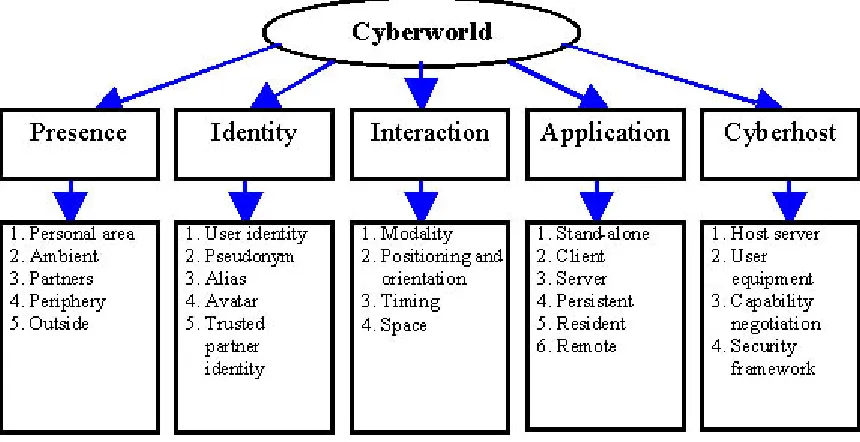
The Cyberworld reference model describes building blocks which contribute towards an evolution of the general reference model for wireless world. Five important components are identified: Presence, Identity, Interaction, Application and Cyberhost. Above these, we may consider the two user-centred planes (Value Plane and Capability Plane) discussed in the main body of the whitepaper. The Cyberworld structure for the wireless world is illustrated in Figure A-1.
Figure A-1: Cyberworld Structure for Wireless World
A.1 The
Cyberworld
Building Blocks
A.1.1 Presence
The Presence component in Cyberworld describes the sphere of information that is presented
or available to the user. It defines five dynamic subspheres: Personal, Ambient, Partners,
Periphery and Outside. Personal is the zone containing all personal information and tools that can be reached or accessed by the user. The Ambient is about the environment containing the personal area. Partners are people or machines that are interacting or exchanging
information with the user. Periphery is defined as the area that the user is aware of and that is not part of the previous spheres. Outside is everything else that the user does not have
A.1.2 Identity
Mobile services and applications are expected to run within a secure environment. The function of Identity is to provide the security and privacy while at the same time allowing a tailored interaction based on user needs. The Identity function includes User identity, Trusted partner identity, Avatar, Pseudonym and Alias that are used to fulfil identity and secure requirements in mobile service execution. For example family members might use a trusted partner identity. Avatar is a digital character representation of the user. Pseudonym looks like a normal user identity, but is in reality a second and unofficial identity. Finally, Alias refers to a second unofficial identity.
A.1.3 Interaction
Interaction relates to issues of Modality, Positioning, Orientation and Timing. The Modality
is about interaction classification, which could be defined according to different criteria like level of interaction, amount of interaction, etc. Positioning and Orientation are key functions for successful Augmented Reality and Virtual Reality applications. Timing is used for
tracking movements, logging activity, etc.
A.1.4 Application
The Application is a particular instantiation of a set of mobile services enabling a user to accomplish a specific task or objective. Applications may be classified in one of the following categories: Stand-alone, Client, Server, Persistent (i.e. ROM based), Resident or
Remote.
A.1.5 Cyberhost
The Cyberhost provides a standardized local execution environment for mobile services and
applications. A capability negotiation and security framework are the most important generic
Cyberhost requirements. It should alsosupport the negotiation of capabilities with other
Cyberhost servers and underlying service platforms and it should offer a security framework