Universally Composable Security With Local Adversaries
Ran Canetti and Margarita Vald? Boston University and Tel Aviv University
Abstract. The traditional approach to formalizing ideal-model based definitions of security for multi-party protocols models adversaries (both real and ideal) as centralized entities that control all parties that deviate from the protocol. While this centralized-adversary modeling suffices for capturing basic security properties such as secrecy of local inputs and correctness of outputs against coordinated attacks, it turns out to be inadequate for capturing security properties that involve restricting the sharing of information between separate adversarial entities. Indeed, to capture collusion-freeness and and game-theoretic solution concepts, Alwen et.al. [Crypto, 2012] propose a new ideal-model based definitional framework that involves a de-centralized adversary. We propose an alternative framework to that of Alwen et. al. We then observe that our framework allows capturing not only collusion-freeness and game-theoretic solution concepts, but also several other properties that involve the restriction of information flow among adversarial entities. These include some natural flavors of anonymity, deniability, timing separation, and information confinement. We also demonstrate the inability of existing formalisms to capture these properties.
We then prove strong composition properties for the proposed framework, and use these properties to demon-strate the security, within the new framework, of two very different protocols for securely evaluating any function of the parties’ inputs.
?
Table of Contents
1 Introduction . . . 1
1.1 Our contributions in more details . . . 2
2 Collusion-preserving Computation . . . 7
3 Defining security of protocols . . . 7
3.1 Basic UC security . . . 8
3.2 The Local UC model of protocol execution . . . 9
3.3 Protocol emulation . . . 11
3.4 Realizing ideal functionalities; Hybrid protocols . . . 12
3.5 Emulation with respect to the dummy adversary . . . 13
4 Local Universal composition . . . 14
4.1 The universal composition operation and theorem . . . 14
4.2 A proof . . . 14
5 Relation to UC framework . . . 18
5.1 LUC security implies UC security . . . 18
5.2 Equivalence and merger functionalities . . . 20
5.3 Relation among notions in presence of global setup . . . 21
6 Applicability of LUC security . . . 22
6.1 Anonymity . . . 22
6.2 Bi-Deniability . . . 28
6.3 Confinement . . . 32
6.4 Incentive-structure Preservation . . . 36
7 A solution via physical computation . . . 38
7.1 Building blocks . . . 38
7.2 The Physical-GMW protocol . . . 49
8 A solution via semi-trusted mediator . . . 53
8.1 Functionalities . . . 54
8.2 Tools and assumptions . . . 54
8.3 Oblivious computation ofπ. . . 55
8.4 An ideal functionality for secure function evaluation . . . 56
8.5 A compiler for secure multi-party computation . . . 56
8.6 Proof of security . . . 59
8.7 Putting all together . . . 69
1 Introduction
Rigorously capturing the security properties of cryptographic protocols has proven to be a tricky en-deavor. Over the years, thetrusted party(or, simulation) paradigm has emerged as a useful and general definitional methodology. The basic idea, first coined in [GM84,GMR85,GMW87], is to say that a proto-col "securely realizes" a given computational task if participating in the protoproto-col ”emulates” the process of interacting with an imaginary "trusted party" that securely receives parties’ inputs and locally com-putes their outputs. Intuitively, this paradigm allows expressing and capturing many security properties. Moreover, it has an attractive potential "composability" property: any system using a trusted party F
should behave the same way when we replace the trusted party with the realizing protocol. Over the years, many security definitions were based on this intuitive idea, e.g.,
[GL90,MR91,Can00,DM00,PW00,Can01,PS04,CDPW07]. First, these definitions formulate an execu-tion model; then they formalize the noexecu-tion of emulating an ideal task with an "ideal world" attacker, called simulator. The security requirement is based on the inability of an external observer to distinguish an “ideal world” execution from a real one.
These formalisms differ in many ways; however, they have one major thing in common: they all model the attacker as a centralized entity, who can corrupt parties, coordinate their behavior and, in-tuitively, constitute an "evil coalition" against the protocol being executed. This seems to be an over-simplification of real life situations. Indeed, in real life, parties are often individuals who are not neces-sary controlled by the same entity or have anything in common. It would seem that letting the malicious parties coordinate their attacks should be a strengthening of the model; however, when this power is also given to the adversary in the ideal model (aka the simulator), the security guarantee can potentially be weakened. Therefore, a natural question to ask is whether it is justified to model the attacker as a centralized entity or does this modeling unduly limit its expressiveness?
Indeed, the existing formalisms do capture basic properties such as privacy of inputs, and correctness of outputs against coordinated attack. However, as has been observed in the past, there exist security concerns that are not naturally captured using the centralized adversary approach. Consider for instance thecollusion- freeness concern: a protocol iscollusion-free if even misbehaving protocol participants cannot use the protocol to exchange "disallowed" information without being detected. As pointed out by [ILM05], "centralized simulator" formalisms do not capture the inability of parties to collude. That is, with a centralized adversary, a protocol might allow collusions between corrupted parties even when it realizes an ideal task that is collusion-free.
An additional known limitation of standard security notions is cryptographic implementations of game-theoretic mechanisms. In contrast to cryptography, game theory considers rational players that behave according to their individual goals. In many realistic settings, the incentive structure depends on whom players can collaborate with and the cost of this collaboration. Security with a centralized adversary does not guarantee that the incentive structure with respect to collaboration is preserved when moving from the ideal protocol to the one that realizes it. Consequently, it does not correctly capture the incentive structure and does not suffice for preserving game-theoretic solution concepts that restrict the formation of coalitions.
either wholly or none at all). However, as we demonstrate below, there are a number of security concerns that cannot be naturally captured even by the above formalizations of local simulation.
Our contributions.We provide an alternative formalization of the local simulators approach in a way that preserves its intuitive appeal and captures reality more tightly. In particular, we establish a general security notion that allows capturing the requirements of arbitrary tasks while preserving the local view of each individual componentand each communication link between componentsin the system. This notion enables expressing variety of partitions of the system. Specifically, our first contribution is to refine the UC framework to deal with the locality of information available to clusters of components. The new formalism, called local UC (LUC), assigns a different adversary/simulator to each ordered pair of participants. Intuitively, the adversaries/simulators assigned to a pair of parties handle all the communication between the two parties. Informally,
Ifπis anLUC-secureprotocol that implements a trusted partyF, then eachindividual compo-nentparticipating inπ affects each other entity in the system no more than it does so in the ideal execution withF.
Note that this is conceptually different from the guarantees provided by the UC framework of [Can01] and the CP framework of [AKMZ12]. In the UC framework, protocols that implement a trusted party are guaranteed to have similar effect on the external environment as in the ideal execution withF. In the CP framework, the protocol is guaranteed to have the same effect as the trusted partyindividually on each entity. In the LUC framework, it is guaranteed thateach entity affects each other entityin the same way as in the ideal execution.
This refined granularity allows LUC to capture various concerns that cannot be captured by previous frameworks. We show how LUC captures some actual security concerns and demonstrate the inabil-ity of existing notions to capture these concerns. Specifically, we address some flavors of anonyminabil-ity, deniability, collusion-freeness, information confinement, and preservation of incentive structure. We also extend the UC composition theorem and the dummy adversary theorem to the new framework. We obtain strong composition result that enables "game theoretic composition", i.e., composition that preserves the power of coalitions (whatever they may be). Moreover, our strong composition also pre-serves deniability and confinement.
Next we present two protocols for secure function evaluation with LUC security. The protocols, called the Physical GMW and the Mediated SFE protocols, satisfy the new security definition. The protocols are very different from each other: The Physical GMW protocol, which is strongly inspired by [ILM05], models players sitting in a room equipped with machines and jointly computing a function. The Me-diated SFE protocol is a simplified version of [AKL+09]. Like there, we use a semi-trusted mediator. That is, if the mediator is honest then the protocol is LUC secure. It is also UC secure in the standard sense even if the mediator is corrupted. It is interesting to note that although these two protocols have significantly different nature, they are both analyzable within our framework.
1.1 Our contributions in more details
A first attempt to bridge this gap would be to follow the formalisms of [ASV08,AKMZ12,MR11] and consider one adversary per party. However, this modeling does not completely capture reality either. Consider for instance the following scenario: one of two parties A and B is having a conversation with a third partyC. Later Cis instructed to transfer this information to some potentially misbehaved fourth party D without revealing whether the source was A or B. Clearly for the protocol to make intuitive sense,AandB need to assume thatC is trusted, or “incorruptible’’. However, going back to the suggested model we notice that the adversary associated withC participates in both conversations and can thus correlate the communication without corruptingCat all, thereby harming the anonymity in a way that is not intended by the protocol. In other words, the suggested modeling does not distinguish between the “obviously insecure” protocol that allowsC to be corrupted, and the “obviously secure” protocol that uses an incorruptible C. We conclude that having a single adversary per party does not faithfully model honest parties. This motivates us to look for a more refined model.
To adequately capture locality, we extend the UC model as follows: For each party identity (denoted PID) we consider an adversary for any PID it might communicate with. In other words, each pair of PIDs has a pair of adversaries, where each adversary is in a different side of the "potential communica-tion line". Each local adversary is in charge of a specific communicacommunica-tion line and is aware only of the communication via this line.
We also let the environment directly control the communication, by letting the local adversaries com-municate with each other only through the environment. This is an important definitional choice that is different from [AKMZ12]. In particular, this means that the centralized simulator no longer exists and, each local adversary is replaced with a local simulator in the ideal process, where the protocol is re-placed by the trusted party. The trusted party may allow different subsets of simulators to communicate by forwarding messages between them. Therefore, the communication interface provided by the trusted party to the simulators represents partition of the system to clusters. The effect of this modeling is that the simulator for an entity can no longer rely on other parties’ internal information or communication in which it was not present. This way, a proof of security relies only on each entity’s local information, and potentially, represents independence of clusters defined by the trusted party.
To preserve meaningfulness, we allow the local adversaries to communicate across party identities only via the environment or with ideal functionalities. Aside from these modifications in the adversarial in-terface, the model is identical to the UC model.
Capturing concerns. We discuss variety of security concerns that are captured by LUC security but not in other security notions:
Collusion-freeness. To provide initial evidence for the expressiveness of LUC, we consider any UC-secure protocol for multi-party UC-secure computation (e.g. the [CLOS02] protocol). While this pro-tocol UC realizes any ideal functionality (even ones that guarantee collusion freeness) in the pres-ence of malicious adversaries, it allows individually corrupted parties to collude quite freely, even when the environment does not pass any information among parties. Indeed, this protocol does not LUC-realize any ideal functionality that guarantees collusion-freeness. This is so even in the pres-ence of only semi-honest adversaries. The reason for the failure in the LUC model is the inabil-ity of the separate simulators to produce consistent views on adversaries’ shared information (i.e., scheduling, committed values etc.) We note that this concern is also captured by the definitions of [LMS05,ASV08,AKL+09,AKMZ12].
received, and thus hides information regarding the existence of the sender.
Consider the following one-time-dropbox functionality. The dropbox is a virtual box initialized with some random file. People can put files into ones dropbox. In addition, the owner can one time query the dropbox if any new file has been received; if there are any incoming files in the box, they would be delivered to the owner; else the default file would be delivered.
Indeed, whenever receiving a file from this dropbox, there is no certainty regarding the existence of a sender. Correspondingly, any protocol that LUC-realizes the dropbox functionality is guaran-teed to provide anonymity regarding the existence of a sender. This is not so for standard UC security. An additional anonymity concern that we consider is timing-anonymity. Timing-anonymity means hiding the time in which an action took place. For example consider the
following email feature: whenever sending an email, the sender can delay the sending of the email by some amount of time (say, randomly chosen from some domain).
Indeed, upon receiving an email, the receiver does not know when this email was sent. This property can be captured via an ideal functionality in a straightforward way. Again, any protocol that LUC-realizes this functionality will provide anonymity regarding the time of sending. This is not so for standard UC security.
An additional anonymity property already mentioned here is sender-anonymity. The common way to achieve this anonymity property in practice is onion routing. In the work of [CL05] the onion-routing problem is defined in the UC framework; however, they only address a potential solution to the anonymity concern rather than the concern itself. In contrast, we formalize the sender-anonymity property. We also show how UC security (and even CP security) fail to capture this prop-erty. Specifically, we define an ideal functionality and show a protocol that is clearly non-anonymous but still CP-realizes the functionality according to the definition of [AKMZ12]. This protocol is not LUC secure.
Deniability. It was pointed out in [CDPW07,DKSW09] that UC security does not guarantee deniability due to issues with modeling of the PKI. While these issues were resolved in the context of global setup and deniable authentication in the generalized UC framework, it turns out that the UC for-malism does not capture another deniability flavor, called Bi-deniability (the name is taken from [OPW11]): A protocol isBi-deniableif the protocol participants can "deny" before a judge having participated in the protocol by arguing that any "evidence" of their participation in the protocol could have been fabricated without their involvement,even if there exists an external entity that has an ac-cess to parties’ log files of the communication. In the context of authentication, the judge is provided with “evidences” of sender’s participation not only by the receiver but also by this external entity. Specifically, the sender can argue that any “evidence” of participation was fabricated by this exter-nal entity, even though this exterexter-nal entity cannot communicate with the receiver and only has an access to the communication log files of the sender. This notion is stronger than standard deniability, in which sender’s log files are ideally hidden from the judge. To motivate bi-deniability consider a corporation that is obligated to store its communication log files. The log files are collected by an external law enforcement agency. Clearly, it would be desirable to ensure that even if these files are disclosed, the corporation can always deny their authenticity.
In this work, we give a simulation-based definition of Bi-deniable authentication and prove its equiv-alence to LUC secure authentication. Moreover, due to the strong connection between Bi-deniability and LUC security, we obtain that Bi-deniability is preserved under composition. In addition, we show that UC framework fails to capture this flavor of deniability.
changes in the basic UC model, but still considers a centralized adversary. We show that the defini-tion of [HKN05] is excessively strong and protocols that clearly enforce confinement fail to admit it. The root of the problem is the centralized adversary that enables information flow to unauthorized entities.
Intuitively, separate adversaries controlling different parts of the network or different groups of par-ties would indeed capture this requirement more tightly. We present a formal definition of confine-ment and show that LUC security implies it. Similarly to Bi-deniability, we obtain composability with respect to confinement. In addition, we show the inability of UC to capture confinement. More specifically, we show that any UC functionality that enforces confinement is super-ideal in some well defined sense. As before, this is not so for LUC functionalities.
Game-theoretic implications.As pointed out in [ILM05] standard security does not suffice for imple-mentation of general equilibria due to collusion. In order to overcome this problem, new notions were defined in [ILM05,ILM08,ILM11,AKMZ12]. Specifically, [ILM05,ILM08,ILM11] define no-tions of mechanism implementation; however, these nono-tions are specific to the problem at hand and are not suitable for reasoning about standard security. [AKMZ12] translate their security no-tion to the game-theoretic setting and define a corresponding model of mediated games. In addino-tion, they show that their constructed compiler achieves preservation of incentive-structure (more details appears in Section 2). In this work, we show how protocols modeled in the LUC framework can be viewed as games. Moreover, we show that any protocolthat LUC-securely realizes some ideal functionality preserves the incentive structure of the realized functionality. More concretely, for any LUC-secure protocol π there exists an efficient mapping between real world strategies and ideal world strategies that can be computed by each player in a local manner and achieves indistinguish-able payoffs. This implies that any Nash Equilibrium (NE) in the ideal-world game is mapped to a computational NE in the real-world game and no new equilibria are introduced.
Composition and dummy adversary.We demonstrate that LUC-security is preserved under composi-tion. Due to the local nature of the model, this preservation applies not only to basic security concerns under composition, but rather to much more general concerns such as deniability, confinement, and game-theoretic solution concepts. The obtained game-theoretic composition implies that Nash equilib-rium is preserved under non-concurrent composition.
We also extend the dummy adversary notion to the local UC framework, and show its equivalence to the general LUC-security notion.
An interesting line for future research is to try to cast the LUC framework within the Abstract Cryptog-raphy framework [MR11]. In particular, such a work might provide a unified basis for the LUC, CP and UC frameworks.
1.1.1 LUC secure protocols
We sketch the two general multiparty computation protocols that we analyze in this work.
The physical GMW protocol.The GMW version we use is the protocol from [Gol04]. Still, our con-struction is strongly inspired by [ILM05]. We cast the protocol in the physical world by considering a set of players sitting in a room and jointly computing a function by evaluation the gates of its circuit. In order to properly compute the function, the players use the following physical machinery: boxes with serial number, and machines for addition, multiplication, duplication, and shuffle of boxed values. In more details, LetP1, ..., Pnbe a set of parties in the room and letf be the function of interest. Next:
1. Sharing the inputs:Each player partitions its input to random shares, one share for each player and then, it publically sends those shares, in opaque boxes, to the players.
3. Output reconstruction:Each player publically hands the Boxes of the output shares to the appropriate parties. Lastly, each party privately opens the boxes and computes its output.
Theorem 1 (Informal statement).Letfbe a PPT function. Then, there exists a protocol that information-theoretically LUC-realizes the SFE functionality with respect to adaptive adversaries.
Throughout the process, everyone sees which operations are performed by each player. Still, the actual values inside the boxes remain secret.
In contrast with classic GMW protocol, here the byzantine case is not done by introducing ZK proofs; rather the primitives themselves are robust.
We achieve LUC-security for any number of corrupted parties. While the work of [ILM05] requires at least one honest party for the collusion-freeness to hold, we achieve LUC security (which implies collusion-freeness) even when all the parties are corrupted. In addition, this protocol meets the strong notion ofperfect implementationdefined by [ILM11], and therefore achieves privacy, strategy, and com-plexity equivalence.
The Mediated-SFE protocol. We present here a high-level description of the mediated protocol, fol-lowing [AKL+09].
LetP1, ..., Pn, and mediator Mbe a set of parties and let π be a k-round protocol that UC-securely
computes functionF. (Inspired by [AKMZ12], we think of the protocol as running directly over unau-thenticated communication channels.) The protocol π is compiled to a new LUC-secure protocol for computingF with a semi-trusted mediator, where all the communication is done through the mediator. Specifically, for each round of the protocolπdoes:
1. Each party andMruns two-party secure computation, which outputs toMthe next round messages of this party inπ.
2. Msends a commitment to the relevant messages to each partyPi.
3. In the last round ofπ, the mediatorMand each party run secure two-party computation, where each party obtain its output.
Theorem 2 (Informal statement).Given a (poly-time) functionf = (f1, ..., fn)and a protocolπthat UC-realizes the SFE functionality. Then there exists a protocolΠthat LUC-realizes the SFE function-ality with respect to adaptive adversaries.
WhenMis honest it separates the parties ofπand makes them be independent of each other. WhenM
is corrupted, the independence disappears. Still, we obtain standard UC security.
We strengthen the protocol to be immune to powerful adversaries that control the scheduling, gain infor-mation via leakage in the protocol, and are able to adaptively corrupt players. In contrast to [AKMZ12], we do not assume ideally secure channels between parties and the mediator.
2 Collusion-preserving Computation
For clarity, we briefly review the work of [AKMZ12], since it is the most related work to ours. This work defines a security model which we denote by the CP model (for Collusion Preserving computation).
The CP model is a special case of LUC and is similar to the GUC model of [CDPW07]. The differ-ences between CP and GUC are the following: Instead of centralized adversary, the CP model considers an adversary for each party, and each adversary can corrupt only the party associated with its identity. In addition, the adversaries communicate neither with the honest parties nor with each other. In the CP model, all communication is done via functionalities called resources. The CP security definition is an extension of the GUC definition to the multiple adversary setting. LetRandF be n-party resources. Letπandφben-party protocols using resourcesRandFrespectively. Then, we say that a protocolπ
CP-realizesφif for any set ofnadversaries{Ai}i∈[n]there exists a set ofnsimulators{Si}i∈[n]such that no environment can distinguish between an execution ofπ running with{Ai}i∈[n] andφrunning with{Si}i∈[n].
The main results presented in the [AKMZ12] paper are the following:
– A composition theorem with respect to the same resource within the CP model. That is, protocols using different resources cannot be composed.
– A compiler for Secure Function Evaluation with a semi-trusted mediator as a resource. [AKMZ12] models the communication links between parties and the mediator as ideal channels, where abso-lutely no information regarding communication is seen by the environment (and the adversaries). In addition to the ideally secure channels, the analysis of the CP compiler heavily relies on the fact that the mediator is modeled as a resource as opposed to a party with its own adversary. This does not allow the environment to witness any communication, and therefore enables simulation in the CP model.
– A proof that the above compiler preserves the incentive-structure. That is, they translate their security notion to the game-theoretic setting and define a corresponding model of mediated games. Then they show that their security notion implies that any strategy in the ideal-world game (with ideal SFE resource) can be mapped to a strategy in the game defined by the CP compiler and vice versa.
Summary of the main differences between our modeling and results from that of [AKMZ12]:
– The LUC execution model requires all the communication to go via the environment. This gives a less idealized and more realistic modeling of communication. In our constructed compiler, the mediator is modeled as a party and all the communication in the protocol is done via the environment. We remark that this more realistic modeling would not allow the CP compiler to achieve CP security. – The LUC composition theorem is with respect to any protocol. That is, LUC securely holds even if
protocols use different functionalities.
– The LUC model can capture additional concerns (e.g., flavors of anonymity, deniability, confine-ment).
– The LUC model provides more general implication and composition for game theoretic modeling (i.e., any LUC secure realization preserves structure-incentive as opposed to a specific construction of CP).
3 Defining security of protocols
3.1 Basic UC security
We first briefly review the basic computational model, using interactive Turing machines (ITMs). Al-though we do not modify the underlying computational model, familiarity with it is important for un-derstanding our model.
Systems of ITMs.To capture the mechanics of computation and communication in computer net-works, the UC framework employs an extension of the Interactive Turing Machine (ITM) model. A computer program (such as for a protocol, or perhaps program of the adversary) is modeled as an ITM. An execution experiment consists of a system of ITMs which are instantiated and executed, with mul-tiple instances possibly sharing the same ITM code. (More formally, a system of ITMs is governed by acontrol functionwhich enforces the rules of interaction among ITMs as required by the protocol exe-cution experiment. Here we will omit the full formalisms of the control function, which can be found in [Can01].)
A particular executing ITM instance running in the network is referred to as an ITI, and we must have a means to distinguish individual ITIs from one another even if they happen to be running identical ITM code. Therefore, in addition to the program code of the ITM they instantiate, individual ITIs are parametrized by a party ID (pid) and a session ID (sid). We require that each ITI can be uniquely iden-tified by the identity pairid = (pid, sid), irrespective of the code it may be running. All ITIs running with the same code and session ID are said to be a part of the same protocol session, and thepartyIDs are used to distinguish among the various ITIs participating in a particular protocol session. Thesids are unique. We also refer to a protocol session running with ITM code as an instance of protocol. ITMs are allowed to communicate with each other via the use of three kinds of I/O tapes: local input tapes, local subroutine output tapes, and communication tapes. Writes to the local input tapes of a particular ITI must include both the identity and the code of the intended target ITI, and the ITI running with the specified identity must also be running the specified code, or else an error condition occurs. If a target ITI with the specified identity does not exist, it is created (“invoked”), and given the specified code. We also require that when an ITI writes to the local subroutine output tape of another ITI, it must provide its own code. Finally, all “external” communications are passed via the communication tapes, which disclose to the recipient neither the code of the intended recipient ITI, nor the code of the sending ITI (but merely their identities). The control function determines which external-write instructions are “allowed”; “un-allowed” instructions are ignored.
The UC Protocol Execution Experiment. The UC protocol execution experiment is defined as a system of ITMs that’s parametrized by three ITMs. An ITM π specifies the code of the challenge protocol for the experiment, an ITMAspecifies the code of the adversary, and an ITMZprovides the code of the environment. The protocol execution experiment defines precise restrictions on the order in which ITIs are activated, and which ITIs are allowed to invoke or communicate with each other. Formally, the restrictions are enforced via the control function. The formal details of the control function can be found in [Can01], but we informally describe some of the relevant details. The experiment initially launches only an ITI runningZ. In turn,Z is permitted to invoke only a single ITI runningA, followed by (multiple) ITIs running the “challenge protocol” provided that these ITIs running π all share the samesid. This sid, along with the PIDs of all the ITIs running, may be chosen arbitrarily byZ. In summary, the environment can communicate only with the ITI running the code of the adversaryA, and ITIs participating in a single session of protocolπ(in a limited way). The output of the environmentZ
in this basic UC protocol execution experiment is denoted byEXECπ,A,Z.
Ideal Functionalities.An ideal functionality F is an ITM whose code represents a desired (inter-active) function to be computed by parties or other protocols which may invoke it as a subroutine (and thus, in a perfectly secure way). Thepid of any ITI runningF is set to the special value⊥, indicating that the ITI is an ideal functionality.F accepts input from other ITIs that have the samesidasF, and may write outputs to multiple ITIs as well. Every ideal functionalityF also induces an ideal protocol IDEALF. Parties runningIDEALF with the session IDsidact as dummy parties, simply forwarding
out-put received fromF to the subroutine output tape of the ITI which instructed byF.The definition of dummy adversary presented here is different from the standard definition of [Can01] and allow the ideal functionality to choose the output destination.
UC Emulation and Realizations. In the basic UC framework, a protocolπ is said to UC-emulate another protocolφif, for any adversaryA, there exists a simulatorSsuch that for all environmentsZit holds thatEXECφ,S,Z ≈EXECπ,A,Z. That is, no environment behaves significantly differently in the
protocol execution experiment when interacting with the challenge protocolπ, under any given attack, than it does when interacting with the emulated protocolφ, under a simulation of that same attack. We say that a protocolπUC-realizes ideal functionalityF if it is UC-emulatesIDEALF.
3.2 The Local UC model of protocol execution
The model of protocol execution is defined in terms of a system of ITMs as in [Can01]. At first, a set of party IDs is chosen. Then, we consider a pair of adversaries for all potentially communicating ITIs based on the chosen party IDs. In addition, jointly with the environment, these adversaries has a complete control over the communication between ITIs which under their custody, as opposed to the UC framework, where a centralized adversary controls all the communication in the system. Formally, all the technical difference from the UC framework is concentrated in the control function, presented below. The underlying computational model remains unchanged.
Execution of protocolπwith environmentZand adversaryA
An execution of protocolπwith an adversaryAand environmentZis a run of an extended, parametrized system of ITMs as, with initial ITMZ, and the following control function: 1. Z may onlypass inputsto parties. At first,Zchooses a set of party IDsP and SIDs. The first ITIs
thatZ passes input to is set to be the adversaries. That is, the identities of these ITIs are required to have a special valueid = ((i, j),⊥)wherei, j ∈ P. The code of these ITIs is set (by the control function) to be A. Besides the adversaries, all the ITIs thatZ passes input to are required to have the same SID,s, and party identityPID∈ P. The code of all these ITIs is set (again, by the control function) to beπ. Call this instance the main instance ofπ.
2. An adversaryA(i,j) (that is, an adversary with codeA and id ((i, j),⊥)) can either pass output to Z, or deliver messages to the incoming communication tape of any party (ITI) in the system with PID=iwhere the sender identity of delivered messages must be PID=j. There are no restric-tions on the contents of delivered messages with the following exception: Messages of the form (Corrupt, id, p)can be delivered only once A(i,j) receives an input(Corrupt, id, p)from
Z. Hereid = (PID,SID)is the identity of the recipient party,PID = i, andp denotes potential additional parameters. These messages are used to model party corruption; see discussion in the text. 3. ITIs other thanZ or the adversaries can send messages to an appropriateA(i,j) according to their PID and the PID of the recipient, and also pass inputs and outputs to any other ITI other than Z
and the adversaries as long as the designated partyPIDis the same as of the sender. In addition, the outputs of the main parties ofπ(namely, the parties with codeπand with SID =s) may be channeled toZ; see discussion in the text.
The responses to(Corrupt)messages are assumed to be specified withinπand may vary according to the specific corruption model and the parameters included in the message.
Fig. 1:A summary of the model for protocol execution.
Letπbe a protocol over a fixed set of parties. The model is parametrized by three ITMs: the protocol
executing π is the following extended, parametrized system of PPT ITMs(Z, CLEXECπ,A ) (as defined in the UC model). The initial ITM in the system is the environmentZ. The control functionCLEXECπ,A
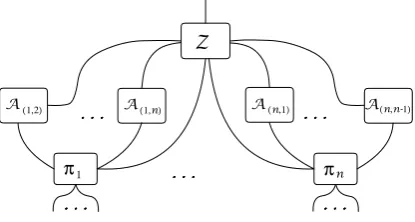
is defined in the paragraphs below. Figure 1 presents a summary of the model. A graphical depiction appears in Figure 2
The input of the initial ITMZrepresents some initial state of the environment in which the protocol execution takes place. In particular, it represents all the external inputs to the system, including the local inputs of all parties. As a first step,Zchoose a setPof party IDs and SIDs1. The first ITIs to be invoked byZ is set by the control function to be the adversaries. See discussion regarding static invocation in 3.2. An adversary with identity id = ((i, j),⊥) where i, j ∈ P, denoted A(i,j), is invoke for each ordered pairi, j ∈ P. The adversaries code is set to beA. In addition, as the computation proceeds,Z
can invoke any ITI, by passing inputs to it, subject to the restriction that all these ITIs have SIDsand PID∈ P.The code of these ITIs is set by the control function to beπ, regardless of the code specified byZ.Consequently, all the ITIs invoked byZ, except for the adversaries, are parties in a single instance ofπ.We call this instance themain instanceofπ in this execution. In addition, each timeZ passes input to main parties, it may choose identityidwhich will appear as the identity of the sender (thisid
should be unique and no other party can use this SID).The control function remembers allZ’s “fake” identities. All input (as well output) requests, made by the main parties, to one of these fake destinations are written onZ’s output tape (as presented before, input and output requests to non-existing ITIs will invoke a new ITI).2Other than that,Zmay not communicate with any other ITIs. That is,Zcannot pass inputs to any ITI other than the adversaries or the main parties of the main instance ofπ, nor can any ITI other than these pass outputs toZ.
Each adversaryA(i,j)is allowed to send messages to any ITI in the system with PID=iwhere the sender identity of delivered messages must be PID=j. There need not be any correspondence between the messages sent by the parties and the messages delivered by the adversaries. The adversaries may not pass input to any party, nor can it pass output to any party other thanZ. It is important to notice that there is no direct communication between the adversaries and all their communication must go through the environment.
Adversaries may alsocorruptparties. Corruption of a party (ITI) with identityidis modeled via a special(Corrupt, id, p)message delivered byA(i,j)to that ITI, wherepdenotes potential additional parameters. The control function allows delivery of that message only if A(i,j) previously received a special(Corrupt, id, p)from the environmentZ and partyIDisi.
Any ITI other thanZand the adversaries, namely the parties and sub-parties of the main instance of
π, as well as the ITIs invoked by the adversaries, are allowed to pass inputs and outputs to any other ITI other thanZ and the adversaries subject to the restriction that the recipient have the samePIDas the sender (except when the recipient is an ideal functionality). In addition, they can send messages to the adversaries where adversary’sPID(i,j)requires sender’s PIDiand recipient’s PIDj. (These messages may indicate an identity of an intended recipient ITI; but the adversaries is not obliged to respect these indications.)
For all input and output requests the control function will omit the code of the sender (except when the sender is a dummy party or the recipient isZ).
The response of the party or sub-party to a (Corrupt) message is not defined in the general model; rather, it is left to the protocol. Here we specify one corruption model, namely that of Byzantine party corruption. We extend the known definition to fit multiple adversaries. Here, once a party or a sub-party receives a(Corrupt)message, it sends to that adversary its entire current local state. Also, in all future activations, a corrupted ITI merely forwards the incoming information to that adversary and follows instructions of all PID related adversaries.
1
This is different from the UC model where the party IDs can be chosen during protocol execution and may depend on any information available.
2
LetLEXECπ,A,Z(k, z) denote the random variable describing the output of the execution of the
system(Z, CLEXECπ,A ), whereZ’s input iszandkis the security parameter in use.
π1 πn
Z
A(1, n)
A(1,2) (
n,1) A(n,n-1)
A
.... .... .... .... .... .... .... .... .... .... .... ....
.... .... ....
Fig. 2:The model of protocol execution. The environment Z writes the inputs and reads the subrou-tine outputs of the main parties running the protocol, while the adversaries, jointly withZ control the communication. In addition,Z may interact freely with all adversaries. The parties ofπ may have sub-routines, to whichZhas no direct access.
On the use of static invocation and predefined PIDs.Recall the order of activations of ITMs in an execution of a protocol: OnceZ activated it chooses a set of PIDs and invokes all the adversaries attacking the protocol. For technical reasons, we restrict ourselves to protocols over a predefined set of PIDs in order to make the above mechanism meaningful. We remark that it is possible to formulate alternative mechanism that invokes the adversaries during the execution of the protocol and not prior to it. Such a more general mechanism do not require the PIDs of the participants to be determined in advance. Also, the results presented in this work hold with the more general formalism. However, such formalism would further complicate the model, and the extra generality does not seem essential in many cases.
3.3 Protocol emulation
This section formalizes the general notion of emulating one protocol via another protocol. In preparation for the formal definition, we first recall the notions of probability ensembles and indistinguishability, and extend the definition ofbalanced environmentspresented in [Can01]. We then define LUC-emulation in its general form.
Distribution ensembles and indistinguishability.A probability distribution ensemble
X ={X(k, z)}k∈
N, z∈{0,1}? is an infinite set of probability distributions, where a distributionX(k, z)
is associated with eachk∈Nandz∈ {0,1}?. The ensembles considered in this work describe outputs of computations where the parameter z represents input, and the parameter k represents the security parameter.
Definition 1. Two binary probability distribution ensembles X and Y are indistinguishable (written X≈Y) if for anyc, d∈Nthere existsk0∈Nsuch that for allk > k0and all we have:
Pr [X(k, z) = 1]−Pr [Y (k, z) = 1]< k−c
.
As in [Can01], the probability distribution ensembles considered in this work represent outputs of systems of ITMs, namely outputs of environments. More precisely, we consider ensembles of the form LEXECπ,A,Z =
n
LEXECπ,A,Z(k, z)k∈N, z∈{0,1}?
o
distributionsX(k, z)andY(k, z)only when the length ofzis polynomial ink. This essentially means that we consider only environments that set the security parameter to be some polynomial fraction of the length of their input.
Balanced environments.In order to keep the notion of protocol emulation from being unnecessarily restrictive as discussed in [Can01], we extend the definition ofBalanced environmentsand consider only environments where the amount of resources given to each adversary (namely, the length of the adversary’s input) is at least some fixed polynomial fraction of the amount of resources given to the pro-tocol. To be concrete, we consider only environments where, at any point in time during the execution, the overall length of the inputs given byZto the parties of the main instance ofπis at mostktimes the the length of input to each adversary.
The UC framework formalizes the general notion of emulating one protocol via another protocol. We extend their definition to LUC-emulation in its general form.
Definition 2. [LUC-emulation]Letπandφbe PPT protocols. We say thatπLUC-emulatesφif for any PPT adversaryAthere exists an PPT adversaryS such that for any balanced PPT environmentZ we have:LEXECπ,A,Z ≈LEXECφ,S,Z
3.4 Realizing ideal functionalities; Hybrid protocols
Ideal functionalities.defined in the UC framework. See Section 3.1 for details.
Ideal protocols.The definition is similar to the UC framework with a difference in the input/output interface of thedummy parties. More formally, letF be an ideal functionality andsidbe the session ID. Whenever a dummy party is activated with inputv, it writesvonto the input tape of the ideal func-tionalityF(sid,⊥)( recall that this message includes the code of the dummy party). Messages delivered by the adversaries, including corruption messages, are ignored. Whenever a dummy party receives a valuevfromFon its subroutine output tape, it writes this value on the subroutine output tape of an ITI instructed byF. In contrast, in the UC framework, dummy parties are obligated to forward any received output to the invoking ITI. This restriction is problematic since dummy parties can also be invoked by an ideal functionality, and therefore the destination of the output is undefined. Our approach can be applied in the UC framework to overcome this problem.
LetLIDEALF,A,Z(k, z)denote the random variableLEXECLIDEALF,A,Z(k,z).
LetLIDEALF,A,Z denote the ensemble{LIDEALF,A,Z(k, z)}k∈N, z∈{0,1}? .
Realizing an ideal functionality.Protocols that realize an ideal functionality are defined as proto-cols that emulate the ideal protocol for this ideal functionality:
Definition 3. LetF be an ideal functionality and letπ be a protocol. We say thatπ LUC-realizesF if πLUC-emulates the ideal protocol forF.
Hybrid protocols.As in the UC framework, we definehybrid protocolsto be protocols where, in addition to communicating via the adversary in the usual way, the parties also make calls to instances of ideal functionalities. In other words, anF-hybrid protocolπ, denoted byπF, is a protocol that includes subroutine calls toLIDEALF, the ideal protocol forF.
Recall that running LIDEALF means invoking “dummy parties” forF, which in turn invoke an
3.5 Emulation with respect to the dummy adversary
Informally, the dummy adversary, denoted D, only delivers to parties messages that were generated by the environment, and delivers to the environment all messages generated by the parties. The formal definition can be found in [Can01].
Letπ,φbe protocols. We say that protocolπLUC-emulates protocolφwith respect to the dummy adversaryDif there exists an adversarySDsuch that for any environmentZwe haveLEXECφ,SD,Z ≈
LEXECπ,D,Z.
Claim. Letπ, φbe protocols. ThenπLUC-emulatesφaccording to the standard definition if and only if it LUC-emulatesφwith respect to the dummy adversary.
Proof. The proof is similar to the proof presented in [Can01]. The construction of the adversary is iden-tical to the construction in [Can01] and the construction of the distinguishing environment is straight-forwardly extended to communicate with multiple adversaries. For completeness we present the proof below.
If π LUC-emulates φ according to definition 2 then it LUC-emulates φ with respect to dummy adversary. Letπ, φbe protocols and letSD be the adversary guaranteed by the definition of emulation
with respect to dummy adversary. We show thatπLUC-emulatesφaccording to the standard definition. Given an adversary A we construct an adversary S as follows. Simulator S interacting with parties runningφ with appropriate PID and runs simulated instances ofA andSD that are invoked with the
same identity as ofS. In addition:
1. S forwards any input from the environment to the simulatedA, and forwards any output ofAto the environment.
2. When the simulatedAdelivers a message mto an ITI with identityidand codec,S activatesSD
with input(m, id, c). Similarly, any output generated bySDis copied to the incoming
communica-tion tape ofA.
3. WheneverSD writes a messagem on some tape of some ITI,S writesm to that tape of that ITI.
Finally, whenSobtains a messagem on its incoming communication tape, it proceeds as follows: It first writes1mon the input tape ofSD; in the next activation it writesmon the incoming
commu-nication tape ofSD.
Validity ofS.Analysis of the running time ofScan be found in [Can01].
Next we assert the validity ofS. Assume for contradiction that there is an adversaryAand environ-mentZsuch thatLEXECφ,S,Z6≈LEXECπ,A,Z. We construct an environmentZDsuch that
LEXECφ,SD,ZD6≈LEXECπ,D,ZD. EnvironmentZDruns an interaction between simulated instances of Z andA. LetP be the PID set chosen byZ. Next, ZD declare the same setP (this invokes all the
adversaries according toP) In addition:
1. All the inputs generated byZto the adversaries are forwarded to the internal adversaries, and all of adversaries’ outputs are forwarded toZ.
2. WheneverZD receives an output valuev from adversary with identity((i, j),⊥),ZD passesvto
the simulatedAwith the same identity. Similarly, whenever a simulatedAwith identity((i, j),⊥) delivers a message m to some ITI,ZD instructs the external adversary with the same identity to
deliver messagemto that ITI.
3. All inputs fromZto the parties ofπare forwarded to the external parties, and all the outputs coming from the external parties are forwarded toZas coming from the parties ofπ.
4. In addition, wheneverZD passes input of lengthmto some party, it first passes input1p(m) to all
external adversaries, wherep()is the maximum between the polynomials bounding the run times of
φandπ.
5. Finally,ZDoutputs whatever the simulatedZ outputs.
It can be readily verified that the ensemblesLEXECφ,S,Z andLEXECφ,SD,ZDare identical. Similarly,
4 Local Universal composition
This section extends the universal composition theorem to LUC framework. First we recall the compo-sition operation as defined in [Can01] and states the extended compocompo-sition theorem. Later, we present the proof.
4.1 The universal composition operation and theorem
Universal composition.We recall the composition operator of the UC framework, called theuniversal
composition operatoruc(), is defined as follows. Given a protocol φ, a protocol π (that presumably
makes subroutine calls toφ), and a protocolρ(that presumably LUC-emulatesφ), the composed protocol
πρ/φ =UC(π, ρ, φ)is identical to protocolπ, with the following modifications.
1. Whereverπcontains an instruction to pass inputxto an ITI runningφwith identity(sid, pid), then
πρ/φ contains instead an instruction to pass inputxto an ITI runningρwith identity(sid, pid). 2. Wheneverπρ/φreceives an output passed fromρ(sid, pid´)(i.e., from an ITI runningρwith identity
(sid, pid´)), it proceeds asπproceeds when it receives an output passed fromφ(sid, pid´).
Whenφis understood from the context we use the shorthandπinstead forπρ/φ. Note that the definition presented above is the definition in [Can01].
Subroutine Respecting protocols.We recall the definition presented in [Can01]. An instance of a protocolρin an execution ofπρis subroutine respecting if no sub-party of this instance passes inputs or outputs to or from an ITI which is not a party or sub-party of this instance. Furthermore, all sub-parties of this instance ignore all inputs and outputs received from parties other than the parties and sub-parties of
ρ. Protocolρis subroutine respecting if any instance ofρin any execution ofπρ, for anyπ, is subroutine respecting.
Theorem 3 (Universal composition).Letπ,ρ,φbe PPT protocols. In addition,ρLUC-emulatesφand ρ,φare subroutine respecting. Then protocolπρ/φLUC-emulates protocolπ.
4.2 A proof
The proof uses the equivalent formulation of emulation with respect to dummy adversary and is a straightforward extension of the proof presented in [Can01].
Construction of Aπ. Letπ,φ,ρ be PID respecting PPT protocols, whereρLUC-emulates φ, and
and letπρ = πρ/φbe the composed protocol. We wish to construct an adversaryAπ so that noZwill be able to tell whether it is interacting withπρand the dummy adversary or withπandA
π. That is, for
anyZ,Aπshould satisfyLEXECπρ,D,Z ≈LEXECπ,A π,Z.
The fact thatρLUC-emulatesφguarantees that there exists an adversarySsuch that for any envi-ronmentZρwe have:LEXECρ,D,Zρ ≈LEXECφ,S,Zρ.
The adversaryAπ is constructed out ofSand presented in Figure 3. The construction is identical to
[Can01].
Validity ofAπ.First, note thatAπ is PPT . In fact, the polynomialp(·)bounding the running time ofAπcan be set to be the polynomial bounding the running time ofZ.
Next, assume that there exists an environment Z that violates the validity of adversary Aπ. We
construct an environmentZρthat violates the validity of the adversarySwith respect to a single run of
ρ. More specifically, fix some input valuezand a valuekof the security parameter, and assume that LEXECπρ,D,Z(k, z)−LEXECπ,A
π,Z(k, z)≥ (1) We show that
LEXECρ,D,Zρ(k, z)−LEXECφ,S,Zρ(k, z)≥
AdversaryAπ
AdversaryAπproceeds as follows, interacting with parties running protocolπand environmentZ.
1. When activated with input(m, id, c), wheremis a message,id= (sid, pid)is an identity, andcis a code for an ITM, do:
(a) If the specified recipient is a party of an instancesid´ ofρ, or a subsidiary thereof, then first locate the internally running instanceS(sid0)that handles the protocol instance withSID =sid.
(That is, eithersid´ =sidorsidis theSIDof a subsidiary of a party withSID = sid´.) If no such instance ofSis found, then internally invoke a new instance ofSwith identity(sid). Next, activate this instance ofSwith input(m, id, c)and follow its instructions.
(b) Else (i.e., the specified recipient is not a party or sub-party of an instance of ρ), deliver the messagemto the recipient.
2. When activated with an incoming messagemfrom some party, do:
(a) Ifmwas sent by some partyφ(sid, pid)of protocolφ, or a subsidiary thereof, then internally activate the instanceS(sid) ofS with incoming messagemfromφ(sid, pid), and follow its in-structions. (If no such instance ofSexists then invoke it, internally, and label itS(sid).)
(b) Ifmwas sent by another party or sub-party ofπ, then pass output(m, id)toZ.
3. When an instance ofS internally generates a request to deliver a messagem to some party, then delivermto this party. When an instance ofS requests to pass an outputvto its environment then outputvtoZ, but with the the exception thatAπmimics the time bounds of a dummy adversaryD. That is,Aπstops delivering output toZas soon as the output length exceeds the overall input length ofAπ.
Fig. 3:The adversary for protocolπ.
wheret=t(k,|z|)is a polynomial function.
In preparation to constructingZρ, we define the following distributions, and make some observations
onAπ. Consider an execution of protocolπwith adversary Aπ and environmentZ. Lett = t(k,|z|) be an upper bound on the number of instances ofφwithinπ in this execution. For0 ≤ l ≤t, Let the
l-hybrid model for running protocolπdenote the extended system of ITMs that is identical to the basic model of computation, with the exception that the control function is modified as follows. The first l
instances ofφto be invoked are treated as usual. The parties of all other instances ofφare replaced with the corresponding parties ofρ. LetLEXEClπ,Aπ,Z(k, z) denote the output of this system of ITMs on inputzand security parameterkfor the environmentZ.
We also define the following variants of adversary Aπ and environmentZ.LetAˆπ denote the ad-versary that is identical to Aπ, with the following exception. Aˆπ expects to have its input include an additional flag,a, that determines whether to consider invoking an instance ofSin this activation. That is, ifa = 1then Aˆπ operates as Aπ. If a = 0 thenAˆπ skips the condition in Step (1a) in 3; instead it always runs Step (1b). LetZ(l)denote the environment that is identical toZ, with the following excep-tions. WheneverZ generates a message(m, id, c)to be delivered to the party runningρwith identity
id, thenZ(l)passes input(m, id, c, a)to the adversary, whereais set as follows. Letid= (sid, pid). Ifsidis theSIDof one of the firstlinstances ofφ, thenZ(l)setsa= 1. Otherwise,a= 0.
We observe that, when Aˆπ interacts withZ(l)and parties running π in thel-hybrid model, then it internally runs at most l instances of the simulatorS. The remaining instances of S are replaced by interacting with the actual parties or sub-parties of the corresponding instances of ρ. Consequently, we have that the output of Z(t) from an interaction with π and Aˆ
π in the t-hybrid model is
LEXECt
π,Aˆπ,Z(t)(k, z) = LEXECπ,Aπ,Z(k, z). Similarly, the output of
Z(0)from an interaction with
πandAˆπin the0-hybrid model is distributed identically to the output ofZfrom an interaction withπρ
in the basic model of computation, i.e.LEXEC0
π,Aˆπ,Z(0)(k, z) = LEXECπ
ρ,D,Z(k, z). Consequently, Inequality 1 can be rewritten as:
LEXEC0
π,Aˆπ,Z(0)(k, z)−LEXEC
t
π,Aˆπ,Z(t)(k, z)≥ (3)
We turn to constructing and analyzing environmentZρ. The construction ofZρis presented in Figure 4. We first note that Zρ is PPT. This follows from the fact that the entire execution of the system is completed in polynomial number of steps.
The rest of the proof analyzes the validity of Zρ. It follows from 3 that there exists a value l ∈ {1, ..., m}such that
LEXEC l
π,Aˆπ,Z(l)(k, z)−LEXEC
l−1
π,Aˆπ,Z(l)(k, z)
≥
t (4)
However, for everyl∈ {1, ..., m}we have
LEXECρ,S,Zρ(k,(z, l)) = LEXEC
l−1
π,Aˆπ,Z(l)(k, z) (5)
and
LEXECφ,D,Zρ(k, (z, l)) = LEXEC
l
π,Aˆπ,Z(l)(k, z) (6)
Equations 5 and 6 follow from inspecting the code of Zρ andAπ. In particular, if Zρ interacts with
parties runningφthen the view of the simulatedZwithinZρis distributed identically to the view ofZ
when interacting withπand adversaries runningAˆπin thel-hybrid model. Similarly, ifZρinteracts with parties runningρthen the view of the simulatedZwithinZρis distributed identically to the view ofZ
run when interacting withπand adversaries runningAˆπin the(l−1)-hybrid model. Here it is important
to note that, since bothρandφare subroutine respecting, the only communication between the external instance ofρorφ, and the ITIs outside this instance, is the inputs and outputs of the main parties of this instance. In addition, since ITIs can input and output to ITIs with the same PID, it is ensured that no ITIs invoked with party ID not inP.
From Equations 4, 5and 6 it follows that:
LEXECρ,D,Zρ(k,(z, l))−LEXECφ,S,Zρ(k,(z, l))
≥
t (7)
EnvironmentZρ
EnvironmentZρproceeds as follows, given a valuekfor the security parameter, inputzρ, and
expecting to interact with parties running a single instance ofρ. We first present a procedure called Simulate(). Next we describe the main program ofZρ.
Procedure Simulate(s, l)
1. Expect the parametersto contain a global state of a system of ITMs representing an execution of protocolπin thel-hybrid model, with adversaryAˆπand environmentZ. Continue a simulated
exe-cution from states(making the necessary random choices along the way), until one of the following events occurs. Letφldenote thelth instance ofφthat is invoked in the simulated execution, and let sidldenote the SID ofφl.
(a) Some simulated party passes inputxto a party with identity(sidl, pid). (That is, the recipient
party participates in thelth instance ofφ.) In this case, save the current state of the simulated system ins, pass inputxthe actual party with identity(sidl, pid), and complete this activation
(use the identity of the simulated party).
(b) The simulated Z passes input (m, id, c, a) to some simulated adversary Aˆπ with identity
((i, j),⊥), where id = (sidl, pid) or a subroutine thereof for some pid. In this case, save
the current state of the simulated system ins, write the message(m, id, c)to the appropriate external adversary (with the same identity(i, j),⊥) and complete this activation.
(c) The simulated environmentZ halts. In this case,Zρoutputs whateverZ outputs and halts. Main program forZρ
1. When activated for the first time, interpret the inputzρas a pairzρ = (z, l)wherezis an input for Z, andl∈N. Initialize a variablesto hold the initial global state of a system of ITMs representing
an execution of protocolπ in thel-hybrid model, with adversaryAˆπand environmentZon inputz
and security parameterk. LetP be the PID set chosen byZ. Next,Zρdeclare the same setP (this invokes all the adversaries according toP) and run Simulate(s, l).
2. In any other activation, letxbe the new value written on the subroutine-output tape. Next: (a) Update the states. That is:
i. If the new value,x, was written by some partyP(id)with identityid= (sidl, pid)then write
(x, id)to the subroutine-output tape of the simulated party runningπwith party IDpid. (we use the samepidsinceφandρare PID respecting protocols).
ii. If the new value,x, was written by some adversary with identity((i, j),⊥), then update the state of the simulated copy ofAˆπ with identity((i, j),⊥)to include an outputxgenerated
byS(sidl).
(b) Simulate an execution of the system from states. That is, run Simulate(s, l).
5 Relation to UC framework
In this section we show that the LUC framework is a generalization that enhances expressiveness; it captures all the old specification, and in addition allow to capture stronger properties that are not cap-turable in the standard UC model. We define two general transformations between functionalities in the LUC model and functionalities in the standard UC model. The generality of the transformations is the key point here. In order for the relations to be well defined we consider protocols over fixed set of parties and restrict ourselves to a compatible UC analog of the LUC environment, denotedstatic PIDs
environment.
Static PIDs environment. In order to reason in a meaningful way regarding the relation between LUC security and UC security we cast the LUC environment into the UC framework. As mentioned be-fore, the UC environment can choose the PIDs adaptively during an execution of a protocol, as opposed to the LUC framework where it is obligated to declare all PIDs ahead of time. To bridge this gap we consider UC environments, calledstatic PIDs environments, which behave as follows: As a first step, the environmentZchooses a set of party IDsP. Later on, whenAis invoked, it passesPas part ofA’s input.
5.1 LUC security implies UC security
In order to show that LUC is a generalization of the UC model we need as a first step to formally define a UC analog of each LUC functionality, this we call splitter functionalities. Intuitively, the main difference between the models is that in UC there is a centralized adversary where in LUC we have an adversary for each PID pair. Therefore, in LUC the functionality expect to receive messages from adversaries with different PIDs, where in the UC model the functionality receives messages from only one adversary. The splitter functionality is essentially a coordinator between the internal LUC functionality and the UC world outside. As before, we denote byA(i,j)the adversary running codeAwith identity((i, j),⊥). Definition 4 (Splitter functionality).LetFbe a functionality in the LUC model. The splitter function-ality, denoted byspF, is the suitable UC analog ofF. That is, the functionalityspF behaves the same asFwith the following differences in the interface:
1. Upon receiving an input (m,(i,j)) from the external adversaryA, spF behaves asF would upon receiving inputm from adversaryA(i,j).
2. WheneverF generate outputout to adversaryA(i,j), thenspF gives(out,(i,j)) to the ex-ternal adversary.
This transformation is extended in the natural way to protocols. Letπ be a LUC protocol in theQ -hybrid model. The analog UC protocol ofπ, is a protocol in thespQ-hybrid model where all instructions inπto communication withQare replaced with instructions to communicate withspQ.
Having defined the splitter functionalities, we are ready to show that LUC security implies UC security with its analog UC functionality. Moreover, we show that there are functionalities which can be UC realized but not LUC realized.
Theorem 4. [General statement] LetQ andF be functionalities in the LUC model. Let πQ andφF be PPT protocols. If πQ LUC-emulates φF then πspQ UC-emulates φspF with respect to static PIDs environments.
Sketch of Proof The idea of the proof is that LUC realization of a protocol allows the adversaries to communicate only with the hybrid ideal functionality (if any). Therefore, considering a UC realization of the analog protocol is essentially splitting the centralized adversary into a set of disjoint adversaries which we obtained by the LUC realization.
adversary SD so that no static PIDsZ will be able to tell whether it is interacting withπspQ and the
dummy adversary or withφspF andS
D. That is, for any static PIDsZ,SDshould satisfy
EXECπspQ,D,Z ≈EXECφspF,S
D,Z (8)
The general outline of the proof proceeds as follows. The fact thatπQ realizesφF guarantees that there exists an adversary (called a simulator)S, such that for any environmentZF we have:
LEXECπQ,D,Z
F ≈LEXECφF,S,ZF (9)
AdversarySD is constructed out ofS and operates as follows. Recall thatZ expects to interact with
parties running πspQ. To mimic the communication in πspQ, SD runs internally all the copies of S
according to the PIDs setPreceived fromZ. That is,SDruns a copy ofSfor each(i, j)wherei6=j∈
P. In addition, when output generated by any internal adversary,SD passes this output toZ, together
with the identity of the sender. Any input message given byZ is forwarded to an appropriate internal adversary according to the PIDs involved. When the simulated copy of S wish to give input m to F
thenSDgives(m,(i,j))tospF. Similarly, any output generated byspF is copied to an appropriate
internal adversary.
The validity of SD can be inferred by the standard technique of assuming an existence of
distin-guishing environmentZand constructing a distinguishing environmentZF as done in 3.5. ut
Corollary 1. [Realizing functionalities] Let F andQ be functionalities in the LUC model and π be someQ-hybrid protocol. IfπQ LUC-realizesFthenπspQUC-realizesspF with respect to static PIDs environments.
Here we omit the proof since it uses similar proof technique to Theorem 4.
Now we are ready to show that the converse of Theorem 1 does not hold. In fact, we show a stronger result. Not only that there exist protocols that are UC secure and not LUC secure, but also that there exist functionalities that are UC realizable and not LUC realizable. In other words:
Lemma 1. There exist functionalitiesF in the LUC model such thatspF is UC-realizable by a plain protocol, butFcannot be LUC realized by a plain protocol.
Sketch of Proof Recall that the LUC model does not allow the adversaries to coordinate. Intuitively, any LUC functionality which supplies the adversaries with nontrivial common knowledge among cor-rupted parties would not be realizable without communication. We formalize this intuition by presenting such a functionality. Consider the following 2-party functionalityF:
F running with partiesP1, P2and adversariesA(1,2),A(2,1). InitI1 = 0 – Upon receiving an inputI1fromP1 recordI1and send it toA(1,2).
– Upon receiving an input (change_input, ,I10) from A(1,2), if no output was yet given change the recorded value toI10.
– Upon receiving an input (deliver_output) fromA(2,1)send (output,I1) toP2
It can be verified that the splitter version of this functionalityspF can be securely realized by a plain protocol (i.e., without any setup) that simply instructsP1to sendI1toP2.
Now we show thatF is not securely realizable in LUC. Assume existence of plain protocolπand consider the following environmentZ: Instead of invokingP1the environment honestly playing the role
P1inπ.
In the real world the output ofP2is the value used byZasP1’s input. SinceFdo not know the value used byZin the communication withP2the output ofP2in the ideal word will be easily distinguishable.
5.2 Equivalence and merger functionalities
In order to reason about UC security in the LUC model we need to cast UC functionalities in the LUC framework. This transformation is done by a wrapper functionality, which we call merger functional-ity. the merger functionality designed to compensate for the difference between the models and enable consistency between the local adversaries.
Definition 5. [Merger functionality]LetFbe a functionality in the UC model. The merger variant ofF, denoted bymF, behaves the same asFwith the following differences in the interface:
1. Upon receiving an inputinfrom some external adversaryA(i,j),mF behaves asF would upon receiving inputin from adversaryA.
2. WheneverF generate outputout to the adversary,mF givesout to all external adversaries (in increasing order of PIDs).
3. Upon receiving input(Deliver,m, (`,k)) from some external adversaryA(i,j),mF outputs (Delivered,m, (i,j))toA(`,k).
This transformation is similarly extended to protocols. Let π be a UC protocol in the Q-hybrid model. The analog LUC protocol ofπ, is a protocol in themQ-hybrid model where all instructions inπ
to communication withQare replaced with instructions to communicate withmQ. First, we show the following relation between merger and splitter functionalities:
Claim. LetQbe a functionality in the UC model andQ0 be the splitter functionality ofmQ. ThenQ0
andQare equivalent with respect to static PIDs environment.
Sketch of Proof Here we need to show thatQ0UC-realizesQand vice versa. LetSbe an adversary participating inIDEALQ0. We construct a simulatorS∗ with access toQsuch that no environment can
distinguish whether it is communicating withS andIDEALQ0 or withS∗ andIDEALQ. The idea of
the construction is that, given access toQ, the simulatorS∗can run the splitter functionality ofmQby itself. More formally, upon receiving a set of PIDsP,S∗runs internallySon inputP. In addition:
All inputs fromZ are forwarded toS and all outputs ofS are forwarded toZ. wheneverS gives input(m,(i,j))toQ0thenS∗givesm toQ. any output outreceived fromQis transferred toSas
(out,(i,j))for all ordered pairs ofi6=jsuch thati, j∈ P.
We omit the validity proof due to resemblance to previous results. The proof in the other direction is
done similarly. ut
Now we are ready to prove the following equivalence:
Theorem 5. LetF,Qbe functionalities in the UC model and letπbe someQ-hybrid protocol. ThenπQ UC-realizesFwith respect to static PIDs environments if and only ifπmQ LUC-realizesmF.
Sketch of Proof First, we show that UC realization ofF implies LUC realization ofmF. Letπbe a
Q-protocols such thatπQUC-realizesF. We wish to construct an adversarySso that noZwill be able to tell whether it is interacting withπmQ and the dummy adversaryDor withmF andS. That is, for anyZ,Sshould satisfy
LEXECπmQ,D,Z ≈LEXECmF,S,Z (10)
The general outline of the proof is similar to the proof of Theorem 1. The fact that πQ realizesF
guarantees that there exists an adversarySD, such that for any environmentZF we have:
EXECπQ,D,Z
F ≈EXECF,SD,ZF (11)
The adversaryS is constructed out of the adversarySD. The main idea is that the simulator copies are
able to jointly runSD by using the communication service offered by the merger functionality. More