Intelligent Decision Support Systems - A Tool for
Human Resource Allocation in Information
Technology Projects
Krishnan Ramanathan
1, Dr. Anil Jadhav
21
Teaching Associate, MBA (ITBM),
Symbiosis Centre for Information Technology, Pune, India
2Professor and Associate Director- MCA Programme,
Sinhgad Institute of Business Administration and Computer Applications, Pune, India
Abstract: Software project Management is important for a project to be completed successfully. The major problems faced by project managers are how to competently allocate human resources to develop quality software at a less cost. Previous Researchers have proposed many solutions to help project managers and resource managers in allocation of human resources in the best way.
There is an increasing demand in the Software Industry for automation of Manpower allocation and task scheduling with the help of tools. The major factor for measuring the success of any project is the human factor. The objective of this paper is to summarize the tools and methods used by various researchers to provide solutions for some key problems that projects managers and Resource managers face related to managing personnel in software projects; and how this affects the project outcomes.
The field of human resource management (HRM) has undergone regular and many innovations in technology. This encompasses the human resource information system (HRIS), electronic human resource management (e-HRM) and virtual human resource management (VHRM) [20]. In the era of extensive competition, organizations are now looking at the need to use DSS (Decision Support System) technologies into HRM (Human Resource Management) field for effective decision making. HRIDSS which is a component of Intelligent System applications plays an important role to aid the decision making process. This study suggests the prospective use of Intelligent Decision Support systems for human resource allocation to software projects.
Keywords: Human resource management (HRM), Strategic Human Resource Management (SHRM), Human Resource Information System (HRIS), Decision Support System (DSS), Intelligent Decision Support System (IDSSS), Software Project Management (SPM), Human Resource Intelligent Decision Support System (HR IDSS).
I.
I
NTRODUCTIONSoftware engineering projects are complex and their
performance is the outcome of a combination of many
factors right from technical to human factors, from
employees’ skills to development tools and processes to
business objectives.. The right selection and combination
of the above mentioned factors by the Project manager is
necessary to obtain the desired results. The main objective
of companies in the software industry is to maximize the
profit by increasing the cost of software products, by
decreasing the manufacturing cost, utilizing the available
resources effectively, sticking to deadlines and fulfilling
the client requirements. Due to the complexities and scope
of the project, it has made the task of the project manager
very worse. In the current state of affairs, the decision
makers are under constant pressure to make quick and
timely but correct decisions.
The tools and techniques that supports managerial decision
making with the help of information and techniques to
handle complex, semi-structured and unstructured
problems is called as Decision Support System (DSS) [23].
II.
A
RTIFICIAL INTELLIGENCE IN DECISION SUPPORT SYSTEMA DSS is an computerized system that helps the people
who take decisions in solving unstructured and semi
structured problems by implementing various data analysis
tools and models.
Lately, there has been much advancement in the field of
DSS, where artificial intelligence techniques and methods,
are being used. The new term which has derived is:
Intelligent Decision Support Systems – IDSS [25].
The study and design of systems that show evidence of
some type of intelligence is called Artificial Intelligence.
Intelligence means the process of learning new concepts
and performing different tasks that justify and help in
arriving at practical conclusions about the environment of
which we are a part of; understand a natural language; and
perceive and understand a visual scene [21].
The avenues for research in information processing and
analysis have got a great boost since the amalgamation of
Artificial Intelligence (AI) with Decision Support Systems
(DSSs). There has been a very noticeable and significant
impact on decision support technologies and other types of
technologies. This is due to the extraordinary advances in
intelligent technologies [30].
III.
T
YPES OFDSS
DSS has been defined by many researchers. Keen and Scott
Morton (1978), have defined DSS as 'The application of
existing and appropriate computer-based technology to
assist in improving the effectiveness of managerial decision
making in complex activities.”
The concept of decision support systems (DSS) evolved
during the period from 1970s to 1980s; from both the
earlier types of technology support for making decisions.
The first of them was management information systems
(MIS), which provided managers with accurate information
by related to the organizations strategies.
The second one was operations research (OR), which used
arithmetical models to evaluate and understand the exact
areas of concern.
Earlier, it was an accepted fact that DSS could be designed
for the decision-makers holding different positions in an
organization. It was also perceived that DSS could support
decisions relating to the operations of the organization, in
managing the finances and decision making that involved
strategies.
DSS is divided in to the following categories [34]
1.
Communication driven DSS
2.
Data driven DSS
3.
Document driven DSS
4.
Knowledge driven DSS
5.
Model driven DSS
Suggestions that aid decision making by incorporating
knowledge based systems which are a subset of intelligent
decision support systems should reflect Domain expertise
[4].
Intelligent decision support systems use artificial
intelligence techniques to solve difficult, indefinite and
problems that are badly structured by using data and
knowledge from experts and different models to support
the decision makers in the organizations [25].
IDSS gives the authority to the user to gather information,
evaluate it as per his requirements and take the final
decision.
This is possible because the IDSS assumes that the
decision maker has identified the problem and knows how
to solve it. The features of an IDSS are that it is user
friendly in terms of interacting with the user; it is scalable
and customized for providing support for unstructured
problems that would lead to a quality outcome from the
decisions taken [24].
IDSS are used in many areas like Manufacturing,
management strategies, planning and development. IDSS
can be used as support tools to solve domain specific
problems.
Lately, a new type of DSS commonly known as Active
DSS has evolved as a result of the relationship between
DSS technologies and Artificial Intelligence and this
technology will play an important part in the years to come
[29].
Active DSS which is a part of Intelligent System
applications is a result of latest DSS technologies.
Applications of Active DSS which include
Knowledge-based systems, Expert systems and Intelligent Decision
Support System (IDSS) are classified under Intelligent
System studies. Expert systems are now being replaced by
the intelligent system applications [8]. The two main
reasons why intelligent systems are developed are
a)
To view, move and sort the continuously
increasing excess data, information and
knowledge.
b)
As a support for effective and quality decision
making keeping in mind the user needs.
Intelligent systems can be application specific so that it is
more helpful for the users. [29].
IV.
IDSS
FORH
UMANR
ESOURCE(HR
IDSS)
HR has moved a long way from the traditional methods to
Strategic Human Resources Management (SHRM). This
has given rise to the need to have a strong technology
support for human resource management functions to
support the dynamic changes. A robust human resource
decision support system has a great impact on functions of
an organization which in turn also creates a great cultural
change.
Generally, the role of HRIS is limited to daily operational
activities. Due to the dynamic environment in which the
organizations work today, HRIS no longer can be used as a
mere store of information but needs to incorporate features
that allow the organization to take decisions in the areas of
performance evaluation, training needs etc. One of the
most important features of an HRDSS is that it should
make use of advance tools, techniques and methodology so
that it will be able to provide quality and precision
decisions at various levels in the organization.
V.
P
ROBLEMD
ESCRIPTIONSoftware projects involve a lot of rigor especially from the
team and require employees with multiple skills. One of
the critical activities in software project planning is
assigning employees to the appropriate tasks. In recent
years due to the magnitude and complexity involved in
planning of a software project, the need for developing
effective computer aided tools is on the rise. Generally,
scheduling of tasks and human resource allocation are
considered as two separate activities by the existing
methods. The major reason why projects are not completed
on time and why they lack planning and scheduling is
because many existing models are built on the assumption
that each single task can have an employee who is not
assigned to any other task at that given point of time.
One of the important areas of concern for any organization
is that the performance of employees should be up to the
mark to ensure effective delivery in order to satisfy the
client. Due to excessive workload, sometimes Human
Resource (HR) Managers fail to implement policies to
improve staff performance. Due to the problems mentioned
above, the organizations have felt the need to Automated
Intelligent Decision Support System (AIDSS) to arriving at
practical and optimal solutions.
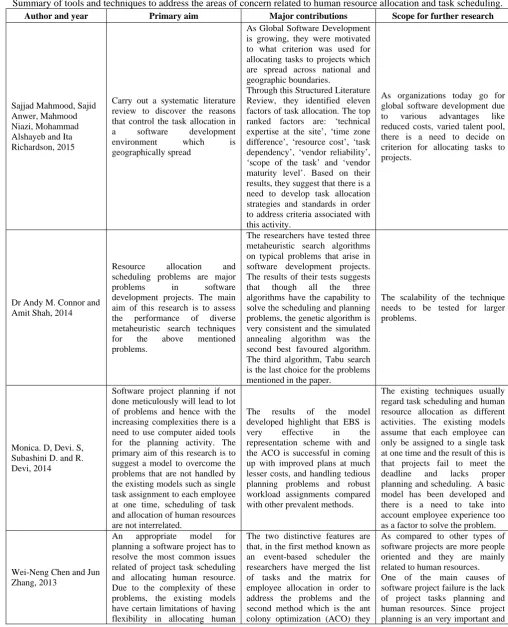
The following table highlights the problems related to task
scheduling and human resource allocation faced by the
software companies and summarizes the various
approaches the researchers have used over a period of time
to address the above mentioned challenges. The table also
presents the future work that can be done in the area of HR
with specific reference to human resource allocation to
software projects.
TABLE I
Summary of tools and techniques to address the areas of concern related to human resource allocation and task scheduling.
Author and year Primary aim Major contributions Scope for further research
Sajjad Mahmood, Sajid Anwer, Mahmood Niazi, Mohammad Alshayeb and Ita Richardson, 2015
Carry out a systematic literature review to discover the reasons that control the task allocation in a software development environment which is geographically spread
As Global Software Development is growing, they were motivated to what criterion was used for allocating tasks to projects which are spread across national and geographic boundaries.
Through this Structured Literature Review, they identified eleven factors of task allocation. The top ranked factors are: ‘technical expertise at the site’, ‘time zone difference’, ‘resource cost’, ‘task dependency’, ‘vendor reliability’, ‘scope of the task’ and ‘vendor maturity level’. Based on their results, they suggest that there is a need to develop task allocation strategies and standards in order to address criteria associated with this activity.
As organizations today go for global software development due to various advantages like reduced costs, varied talent pool, there is a need to decide on criterion for allocating tasks to projects.
Dr Andy M. Connor and Amit Shah, 2014
Resource allocation and scheduling problems are major problems in software development projects. The main aim of this research is to assess the performance of diverse metaheuristic search techniques for the above mentioned problems.
The researchers have tested three metaheuristic search algorithms on typical problems that arise in software development projects. The results of their tests suggests that though all the three algorithms have the capability to solve the scheduling and planning problems, the genetic algorithm is very consistent and the simulated annealing algorithm was the second best favoured algorithm. The third algorithm, Tabu search is the last choice for the problems mentioned in the paper.
The scalability of the technique needs to be tested for larger problems.
Monica. D, Devi. S, Subashini D. and R. Devi, 2014
Software project planning if not done meticulously will lead to lot of problems and hence with the increasing complexities there is a need to use computer aided tools for the planning activity. The primary aim of this research is to suggest a model to overcome the problems that are not handled by the existing models such as single task assignment to each employee at one time, scheduling of task and allocation of human resources are not interrelated.
The results of the model developed highlight that EBS is very effective in the representation scheme with and the ACO is successful in coming up with improved plans at much lesser costs, and handling tedious planning problems and robust workload assignments compared with other prevalent methods.
The existing techniques usually regard task scheduling and human resource allocation as different activities. The existing models assume that each employee can only be assigned to a single task at one time and the result of this is that projects fail to meet the deadline and lacks proper planning and scheduling. A basic model has been developed and there is a need to take into account employee experience too as a factor to solve the problem.
Wei-Neng Chen and Jun Zhang, 2013
An appropriate model for planning a software project has to resolve the most common issues related of project task scheduling and allocating human resource. Due to the complexity of these problems, the existing models have certain limitations of having flexibility in allocating human
The two distinctive features are that, in the first method known as an event-based scheduler the researchers have merged the list of tasks and the matrix for employee allocation in order to address the problems and the second method which is the ant colony optimization (ACO) they
Author and year Primary aim Major contributions Scope for further research
resources. The researchers have developed a new method with an event-based scheduler (EBS) and an ant colony optimization (ACO) algorithm to handle the above mentioned problems.
have used the ACS option to develop the ACO approach for software project planning problem.
complex activity, there is a growing need for developing effective computer aided tools for software project planning.
Sangita Gupta and Suma. V., 2013
The objective of this paper is to find out the factors which will be used by the companies to form a project team and to establish the correlation among the factors.
In this paper, the decision tree method is used for data classification as the data is from various databases. Data from employer’s past database was used to forecast the performance in the current project. Characteristics like technical skills, domain knowledge and analytical skills played a crucial part in selecting a candidate for the software project. The researchers came to a conclusion that there is a High correlation between, technical skills which affects the performance of employees in IT companies.
There is a need to identify those human aspects which needed attention to reduce failure rate of software projects.
C. Chantrapornchai, D. Sawangkokrouk and T. Leadprathom, 2013
To study the process of human resource allocation and task scheduling and to integrate the activities with the automatic process of allocation and task scheduling.
Typically, resource allocation and scheduling of tasks go hand in hand. But, the majority of the project management software considers them as two different activities. The researchers have implemented two scheduling schemes such as ASAP and ALAP in the tool. They have used different criteria like assignment of more than one task to each staff, assignment of one task to many staff, reassignment of same task to the staff. These criteria are the business rules which have to be incorporated in the algorithm to make both the tasks more effective.
Allocation of resources and scheduling activities are related, but most of the project management software treat them as separate processes.
Devika Samad, 2012
Organizations have to take many tough decisions but the toughest of them is related to hiring and promoting people. In HRM the most important activity is to select the appropriate personnel for the right job which is very difficult because there are many applicants for the dame post. Proper profiling is not done to include all the criteria while decision making. There is a need to use web based platform services to so that the efficiency and accuracy of selecting the right candidates increases.
The researchers have used a Ranking and Decision Making module that will perform search, match the job to the candidate, and direct the profiles received from the third party recruitment sources. The ranking system will generate a rank in a logical order. The weighting system will check the candidates profile against the Functional requirements and provide a list of shortlisted employees.
Computer aided tools will help the human resource manager in taking right decisions while making a right decision in selecting people.
H. Kane and A. Tissier, 2012
Optimizing the costs of group projects keeping in mind that time was an important factor was the explicit aim of the researchers in creating a mathematical model.
In a multi-project management the allocation of resources is a great challenge. The results derived from the model helps in reducing the additional cost as compared to the budgeted expense by reducing the tasks.
Author and year Primary aim Major contributions Scope for further research
Daniel Nadler, 2012
To understand the kind of problems the organizations face when it comes to human resource scheduling in multiple project environment.
The researcher has concluded that the attributes that have a major influence on human resource management process in an environment where multiple projects run simultaneously, were the consistency and validity of time schedules, failure in calculating the present and future
workloads, tremendous dependency on external factors
and on the requisite tools. Further the researcher has said that lack of standard processes for human resource allocation in a multi project environment, generates a need to have computerized tools for the organizations.
The supporting software tools far from satisfying the needs of organizations dealing with simultaneous multiple projects. There is a lack of standardized methods on how to organize the human resources the available tools differ greatly within this application. There is a need to research into the availability and compare the existing applications which could help the organizations’ to find the right tool for their needs.
Mangesh Gharote, Rahul Patil and Sachin Lodha, 2012
The researchers address the issue of allocation of workforce of an IT firm. For this they have developed a linear programming model to allocate freshers and trainees to projects based on their skill set matching.
The procedure followed by the Resource Managers usually to find out which employee matches the requirement with the help of tools is repetitive, time consuming and involves a lot of effort. The assignment of the trainees to the requirement is normally those whose names appear at the top of the search in spite of the fact that he/she may be better suited to some other project. This leads to requirement mismatch and inadequate assignment of members to the project. The allocation tool developed by the researchers provides different solutions, displays the effect of allocation and its consequences and helps the Resource manager with decision support.
There are many workforce management (WFM) software’s available in the market. These software’s are appropriate for companies where employees can be categorized for e.g. business process outsourcing firms. Multi-skilled workforce leads to inefficiencies in the implementation of the software. This is the reason why many companies have their own workforce planning systems. Resource managers face a big challenge to efficiently allocate resources for a large number of employees.
V. Yannibelli and A. Amandi, 2011
The primary objective of the researchers’ is to recommend a knowledge-based approach to help the project managers at the initial phase of scheduling software projects.
To solve the problem mentioned in the paper, the researchers’ have proposed knowledge based genetic algorithm that creates practical schedules based on different situations faced by the project managers. The algorithm evaluates the schedules based on available information about employees who have worked on similar projects in the past.
The Initial scheduling of a given software project is a task that is manually developed by project managers and it eats up a lot of time effort, and requires a considerable skill in scheduling, and understanding about the available human resources is necessary that can be considered for the various activities involved in the project. There is a need to replace the manual scheduling which is erroneous with automated tools and processes.
Sabina Mirzaei Nobari, 2011
This aim of this study is to improve employee recruitment process by developing a fuzzy rule based Decision support system.
The researchers’ propose to develop a DSS that will remove the faults in the process of conducting employment test. For designing a better DSS they have developed a Fuzzy Topsis which is further used to develop a fuzzy decision support system (FDSS).
Author and year Primary aim Major contributions Scope for further research
Peleg Yiftachel, Irit Hadar, Dan Peled, Eitan Farchi and Dan Goldwasser, 2011
The two main aims of this research are the researchers first want to increase their understanding of decisions related to resource allocation and what is the impact on the output. The second aim is to develop a model to change the existing process of resource allocation to improve the output of the software development processes.
The researchers have developed an economic model to evaluate the resource allocation problem by studying the inputs to the software development phases that are the actual work performed, the output to be achieved and the various functions that processes the input into output. The researchers have created an experimental environment to test the impact of allocation decisions on the output.
Misallocating resources among software development phases can have serious consequences. Millions of dollars are spent annually because of improper allocation which results in faults in software or projects getting stalled.
Rohayati Ramli, Shahrul Azman Noah and Maryati Mohd Yusof, 2010
The objective of this research is to develop an Ontology-based model which would be a vital input to the Human Resource Decision Support System in order to provide assistance to the decision makers in forecasting and predicting supply and demand.
The researchers have proposed a Framework of DSS model for Human resource planning decision support system.
There is a need for developing an HRDSS as employment trend changes due to domestic and global factors. And Human Resource Planning is of utmost importance.
Hamidah Jantan, Abdul Razak Hamdan and Zulaiha Ali Othman, 2010
One of the major challenges HR professionals face is how to deal with the organization’s talents. Allotting the right person to the right job and at the desired time is a big challenge. Keeping this problem in mind the researchers have used decision tree classification technique to predict the potential human talent.
The observation of the researchers is that the C4.5 as a classification technique for employee’s performance prediction is very effective. It can be easily understood by humans and can produce decision tree and a set of rules which can help in improving the accuracy of prediction.
There is a scope to develop HRIDSS application and intelligent techniques that can be applied to various functions of HR.
Hamidah Jantan, Abdul Razak Hamdan, and Zulaiha Ali Othman, 2009
The researchers have highlighted the importance of using the Knowledge Discovery in Database (KDD) or Data Mining, for developing a prospective HR system architecture for talent forecasting.
The architecture proposed by the researchers consists of four components - Knowledge Discovery in Database (KDD), Model Management System, Knowledge Base System (KBS) and Advisory System Though this architecture focuses on prediction for academician future performance, it can also be used for the various tasks related to Data Mining such as association, classification and clustering in managing the talent available.
The various factors which influence the current HR practices are human experience, knowledge, preference and judgment. These factors result in varying, erroneous, dissimilar and startling decisions. Potential techniques like use of DSS in HR need to be used to solve the challenges the problem of allocation of right people to the right task.
Massimiliano Di Penta, Mark Harman, and Giuliano Antoniol, 2009
The most important factors affecting the project cost and the deadline are allocation of resources and assignment of tasks to teams. This research highlights how optimization techniques which are search-based coupled with a queuing simulation model can handle these issues.
This paper showed how search-based techniques can be used to solve the problem of human resource allocation and task assignment to teams. The paper reported two real life projects to show that both Simulated Annealing and Genetic Algorithms can provide solutions to provide valuable support to software managers’ decisions. The approach followed by the researchers’ permits having a balance of important objectives like deadlines, staffing plans, resource allocation.
Lack of proper planning, together with wrong cost estimation, is one of the main reasons why software fail. Allocating resources to a software project and assigning tasks to teams is an important task for project managers. Tools are necessary to solve staffing problems and task allocation.
Luis Daniel Otero a, Grisselle Centeno , Alex J. Ruiz-Torres and Carlos E. Otero, 2008
The most common problem that software industry face is meeting deadlines i.e. product delivery on time. This delay is due to the time
The researchers have proposed the Best Fit Resource methodology for personnel assignment and have also
Author and year Primary aim Major contributions Scope for further research
spent on training the team members and other people involved to master the required skills for the project. Hence, it is of utmost importance that there has to be a streamlined process for assigning personnel taking into consideration their skill sets so that product can be delivered on time. This paper presents a new method that assigns the resources to the tasks when best possible skill sets are not available.
extended it to multiple tasks scenario. The BFR methodology uses the skill-relationship tables to explain the importance of past knowledge of skills and how it contributes to acquiring the required skills. The BFR technology could also be used to provide solutions to multiple tasks where the suitable resources have to be identified.
skills of the people and decisions become subjective. Incorporating new tools and techniques into the resource allocation process will provide more effective staffing decisions to high-priority projects.
M. Saidi Mehrabad and M. Fathian Brojeny, 2007
The aim of this research work is to show a model for design and implementation of an expert system that will help the organizations to do the following activities - to select the suitable candidates that match the company requirements, Job rotation and fixing salary and other benefits based on their qualification.
Implementation of intelligent techniques to various HRM functions is being widely accepted by organizations. This work has shown the use of expert system as a tool for various HR operations because of the nature of flexibility in the knowledge created and the justifications of the decisions taken.
Human resource is one of the most strategic resources for a society and also for every type of organization. Expert systems can be used in the HR domain for various activities and one of them is assigning the right person based on the skill to the right project. DSS can help the managers in taking quality decisions in this regard and can develop quality software on time.
Muh-CherngWu and Shih-Hsiung Sun, 2006
This research highlights the decision making problem and has studied the learning effect which has not be done in the earlier studies. The objective of a mixed nonlinear program for scheduling projects and allocation of staff problems is to cut down on the outsourcing cost.
A mixed integer nonlinear program has been designed to simulate the problem related to decision making. A genetic algorithm (GA) is designed to solve the nonlinear program.
The GA tries different permutations and combinations for about 20 times with random feeds. The scheduling of each task can be decided based on the decision taken for allocation of staff and whether to outsource or not.
Several projects run simultaneously in organizations. The managers face the problem of scheduling tasks and allocating resources for the same. Project scatter effect could be considered while developing tools.
Adnane Belout and Clothilde Gauvreau, 2004
Research done in the past concluded that for the success of a software project, Personnel factor was the only trivial factor. The objective of this paper is to retest the findings related to issues of validity of the measures used in the previous study.
The researchers have examined the construct validity of the human resource factor. They have also arrived at the conclusion that P.I.P. instrument evaluates motivation, training, work experience and the commitment as dependent variables. The researchers also feel that project success has to be viewed from the sponsor’s, project managers and the sponsor as project manager’s view.
There is a great scope for research on HRM in the project management domain. Apart from personnel factors the managers have to take into account other factors like skill, experience to be able to match resource allocation with task scheduling.
Antoniol, G., Cimitile, A., Di Lucca, G. A., and Di Penta, M., 2003
In this paper the primary focus is on developing an approach based on queueing theory and stochastic simulation to solve the problem staffing to projects and the quality of service in a distributed multi-phase maintenance processes.
Author and year Primary aim Major contributions Scope for further research
Janat Shah, Ramkumar Rangnathan and D Samanth, 2001
This paper attempts to build a comprehensive framework for resource planning for software firm.
Based on the conceptual framework identified, the researchers have developed a mathematical model explaining the variables, parameters already identified and constraints. Using this model they have calculated the cost of the personnel by studying the revenue gained from each project with the man-hours required and what specific technologies used at various levels. The model finally tries to achieve a cost-benefit analysis of various projects. This helps the organization in deciding the number of people of certain technology to be recruited which projects to be undertaken and calculates the projected cost.
Indian companies are facing from stiff competition from low cost third-world nations and hence it becomes imperative for them to address the problem of manpower utilization as a top priority and have a structured process to be competitive in order to achieve high profitability. Use of computer aided tools will help the managers to identify the right talent, train them and allot them to suitable projects without being subjective in their decision making.
V
I.
C
ONCLUSIONHow well a software project performs depends on the
performance of its employees which is the result of optimal
human resource allocation and efficient scheduling of
tasks. The problem of human resource allocation and
scheduling of tasks to employees as described in the
literature of this paper is a major area of concern which
RM and project managers have to deal with. Through
relevant literature, this paper summarizes the tools
developed to cope with the above mentioned issues. This
paper therefore highlights the importance of HRIDSS: an
Automated Intelligent Decision Support System which can
overcome some flaws of the existing systems. The
problems faced by the companies namely, rising project
cost, failure to meet deadlines and the human resource
allocation problems can be overcome with the
implementation of HRIDSS. Some of the approaches
discussed above only consider reducing the cost in terms of
time or money, and they do not take into account the
practical issues which can affect the actual development
process when the plan is applied in the actual situation. The
other major challenge the companies face is that since the
workforce is highly flexible and the requirements are very
specific there emerge situations when the resources are
allocated inefficiently. This paper therefore recommends
that various organizations need to establish and implement
intelligent systems such as HRIDSS in the future to solve
various HR and SPM related problems in organizations and
ease the burden on Resource Managers and Project
Managers.
R
EFERENCES1. Adnane Belout and Clothilde Gauvreau, Factors influencing project success: the impact of human resource management, International Journal of Project Management 22: 1-11, 2004
2. Antoniol, G., Cimitile, A., Di Lucca, G. A., and Di Penta, M., Assessing staffing needs for a software maintenance project through queuing simulation, IEEE Transactions on Software Engineering, 30(1), 43–58, 2003.
3. C. Chantrapornchai, D. Sawangkokrouk and T. Leadprathom, Project Management Software: Allocation and Scheduling Aspects,
International Journal of u- and e- Service, Science and Technology Vol. 6, No. 3, 2013
4. Chi, R., & Turban, E., Distributed intelligent executive information systems, Decision Support Systems, 14, 117-130, 1995
5. Daniel Nadler, Human Resource Allocation in a Multiple Project Environment, Master’s thesis in Industrial Management,, VAASA 2012 https://www.tritonia.fi/download/gradu/4928, 2012.
6. Devika Samad, 2012, A decision support system that provides an automated short listing of potential employees in recruitment and hiring of any organization, www.academia.edu.
7. Dr Andy M. Connor and Amit Shah, Resource Allocation Using Metaheuristic Search, Computer Science & Information Technology (CS & IT) pp. 353–364, 2014.
8. Faye, R. M., Mora-Camino, F., Sawadogo, S., & Niang, A., An Intelligent Decision Support System for Irrigation System Management, Paper presented at the IEEE International Conference, 1998.
9. H. Kane and A. Tissier, A Resource Allocation Model for Multi-Project Management, 9e Conférence Internationale de Modélisation, Optimisation et SIMulation - MOSIM’12 06 au 08 Juin 2012 - Bordeaux – France, 2012.
10. Hamidah Jantan, Abdul Razak Hamdan and Zulaiha Ali Othman, Human Talent Prediction in HRM using C4.5 Classification Algorithm, Hamidah Jantan et al. / (IJCSE) International Journal on Computer Science and Engineering Vol. 02, No. 08, 2526-2534, 2010.
11. Hamidah Jantan, Abdul Razak Hamdan and Zulaiha Ali Othman, Intelligent Techniques for Decision Support System in Human Resource Management. Decision Support Systems, Advances in, Book edited by: Ger Devlin, ISBN 978-953-307-069-8, pp. 342, 2010.
12. Hamidah Jantan, Abdul Razak Hamdan, and Zulaiha Ali Othman, Knowledge Discovery Techniques for Talent Forecasting in Human Resource Application, International Science Index Vol:3, No:2, waset.org/Publication/11782, 2009.
13. Holtzman, S., Intelligent Decision Systems. Reading, MA: Addison-Wesley, 1989.
14. Janat Shah, Ramkumar Rangnathan and D Samanth, Capacity Planning for Human Resources In The Software Industry, Decision Support Systems 31, 17-38, 2001.
15. M. Saidi Mehrabad and M. Fathian Brojeny, The development of an expert system for effective selection and appointment of the jobs applicants in human resource management, Computers & Industrial Engineering (Impact Factor: 1.69). 09/2007; 53(2):306–312. DOI: 10.1016/j.cie.2007.06.023
17. Massimiliano Di Penta, Mark Harman, and Giuliano Antoniol, The use of Search-Based Optimization Techniques to Schedule and Staff Software Projects: an Approach and an Empirical Study, SOFTWARE—PRACTICE AND EXPERIENCE, Softw. Pract. Exper., 00(00), 1–7, 2009
18. Monica. D, Devi. S, Subashini D. and R. Devi, Scheduling and Resource Allocation for Employees In Software Projects, International Journal of Advanced Computational Engineering and Networking, ISSN: 2320-2106, Volume-2, Issue-5, 2014
19. Muh-CherngWu and Shih-Hsiung Sun, A project scheduling and staff assignment model considering learning effect, Int J Adv Manuf Technol 28: 1190-1195, 2006
20. Ngai, E. W. T., Law, C. C. H., and Wat, F. K. T., Importance of the Internet to Human Resource Practitioners in Hong Kong. Personnel Review, 37(1), 66-84, 2008.
21. Patterson, D. W., Introduction to Artifcial Intelligence and Expert Systems, Prentice Hall, Englewood Cliffs, 1990.
22. Peleg Yiftachel, Irit Hadar, Dan Peled, Eitan Farchi and Dan Goldwasser, The Study of Resource Allocation among Software Development Phases: An Economics-Based Approach, Advances in Software Engineering Volume 2011 (2011), Article ID 579292, 21 pages, 2011
23. Qian, Z., Huang, G. H., & Chan, C. W., Development of an intelligent decision support system for air pollution control at coal-fired power plants. Expert System with Applications, 26(3), 335-356, 2004.
24. Quintero, A., Konare, D., & Pierre, S., Prototyping an Intelligent Decision Support System for improving urban infrastructures management., European Journal of Operational Research, 162(3), 654-672, 2005.
25. Ribeiro, R., Intelligent Decision Support Tool for Prioritizing equipment Repairs in Critical/Disaster Situations, Zarate, s.n., 2006.
26. Rohayati Ramli,Shahrul Azman Noah, Maryati Mohd Yusof,
Ontological-Based Model for Human Resource Decision Support System (HRDSS),On the Move to Meaningful Internet Systems: OTM 2010 Workshops - Confederated International Workshops and Posters: International Workshops October 25-29, 2010. Proceedings Source: DBLP, 2010.
27. Sajjad Mahmood, Sajid Anwer, Mahmood Niazi, Mohammad
Alshayeb and Ita Richardson, Identifying the factors that influence task allocation in global software development: preliminary results, Proceedings of the 19th International Conference on Evaluation and Assessment in Software Engineering, Article No. 31, ACM New York, NY, USA ©2015, ISBN: 978-1-4503-3350-4, 2015. 28. Sangita Gupta and Suma V, Empirical Study on Selection of Team
Members For Software Projects – Data Mining Approach, International Journal of Computer Science and Informatics, ISSN (PRINT): 2231 –5292, Volume 3, Issue 2, 2013
29. Shim, J. P., Warkentin, M., Counrtney, J. F., Power, D. J., Sharda, R., & Carlsson, C., Past, present, and future of decision support technology, Decision Support System, 33(2), 111-126, 2002. 30. Tonfoni, G. & Jain, L.,Innovations in decision support systems. s.l.,
In G. Tonfoni and L. Jain, editors, 2003.
31. Turban, E., Aronson, J.: Decision Support Systems and Intelligent Systems. Prentice-Hall, 6th. Ed.
32. V. Yannibelli and A. Amandi, A Knowledge-Based Evolutionary Assistant to Software Development Project Scheduling, Expert Systems with Applications, vol. 38, pp. 8403-8413, 2011.
33. Wei-Neng Chen and Jun Zhang, Ant Colony Optimization for Software Project Scheduling and Staffing with an Event-Based Scheduler, IEEE Transactions on Software Engineering, Vol. 39, No. 1, 2013