Application of Dymola Based simulation to optimize smart Home
Subhra Debdas1, Ramanand Jha2
1
Electrical Engineering Department Research Scholar, Sainath University Ranchi, Jharkhand 834001, India
2
Applied Engineering Department, Uttar Pradesh Technical University Noida, Delhi 201306, India
Abstract
Different scheduling and coordination algorithms controlling household appliances’ operations can potentially lead to energy consumption reduction and/or load balancing in conjunction with different electricity pricing methods used in smart grid programs. In order to easily implement different algorithms and evaluate their efficiency against other ideas, a flexible simulation framework is desirable in both research and business fields. However, such a platform is currently lacking or underdeveloped. In this article Dymola simulation framework is focus on demand side residential energy consumption coordination in response to different pricing methods.
Keywords: Smart grid, Smart home, Dymola
1. Introduction
The aim of this project was to develop a model of a smart house connected to an external grid using the Modelica
based tool Dymola and to design control laws that control production and consumption on the grid using C++. The control structure was designed and implemented in C++ since the simulation in Dymola has no pre-defined causality which makes it difficult to do control of the system. By using Dymola to simulate the physical parts and using the imperative programming language C++ to make decisions, it is possible to use the strength of Dymola and the strength of C++. The control system continuously gather information from the grid such as power consumption, voltage level and priorities for different loads and acts using this information to optimize the energy use. The grid should in an automated fashion act and gather information to keep the grid operating in an optimal way. Apart from modelling a DC grid on household level a grid connecting several households should also be modelled. This grid connecting several houses will form a model over a smart cell. Control laws for this cell should be able to distribute electricity from
local wind farms, solar power plants and over production from households in an efficient way. To model and control smart grids is important [1]. These grids can be used to distribute variable produced electricity such as wind power, in a more efficient way than the current electricity grid. Furthermore these grids can be used to reduce consumption peaks and improve the reliability of the grid. A DC grid is modelled instead of AC since the basic smart control aspect is still the same with a DC grid and is easier to model. Furthermore some researchers believe that future smart grids will be implemented using DC components and DC grids. Since many micro generating sources are DC in their nature, such as solar power plants, it will be possible to avoid transformations losses using DC. Also an important role in future smart grids will be the ability to store energy, preferable in battery equipped cars, and since energy storage in batteries are done in DC, using DC grids will further avoid transformation losses[2].
The main objective of this paper is to propose and develop a flexible simulation framework to study the behaviours and impacts of smart grid enabled household appliances. This proposed simulation framework should be accurate enough to reflect the general or average behaviours of traditional patterns of energy consumption. It should be designed to be flexible to allow expansions for other purposes, such as a study of the integration of renewable energy sources. It should be scalable to enable metro scale and also precise individual household simulations.
2. Smart Grid Components
The electrical grid has been cited as the greatest engineering achievement of the 20th century, but it now faces new challenges of sustainability, energy security, reliability, etc. Developed countries have a well-developed grid, and seek to improve it, while developing regions are still expanding their grids. Over the past decade, the electricity generation, transmission and distribution landscape around the globe has changed drastically – in the traditional grid of the 20th century there were relatively few points of power generation or injection and millions of points of power consumption. With rapid proliferation of distributed and renewable generation, the 21st century grid will have numerous points of power injection as well as millions of points of consumption. Electric Vehicle (EV) roll out has further increased the complexity of the traditional electricity grid. To manage a grid with such increasing number of intermittent energy sources and EVs, smarter automation and IT systems are imperative. Peak load management through control of loads (such as through demand response, which can be considered a dynamic form of Demand Side Management, or DSM) has assumed high priority for electric utilities as there is a growing peak demand, leading to a supply gap during peak hours of consumption in many parts of the world. Beyond such drivers, increased deregulation, consumer choice for green power, which is inherently variable, and many more factors are giving thrust for the transition to smarter grids that can address all these issues.
The applications or building blocks of a smart grid are:
Supervisory Control and Data Acquisition Systems (SCADA)
with Energy Management Systems (EMS) and Distribution Management Systems (DMS)
Enterprise IT network covering all substations and field offices
with reliable communication systems
Enterprise Resource Planning (ERP) and Asset Management
Systems
Mapping of electrical network assets and consumers
Modernization of the substations with modern switchgear and
numerical relays
Advanced Metering Infrastructure with two way communication
and Meter Data Management Systems (MDMS)
Electronic Billing Systems and Customer Care Systems
Distribution Automation (DA) and Substation Automation
Systems
Outage Management Systems (OMS)
Mobile Crew Management Systems
Analytics (converting data into business intelligence)
Enterprise Application Integration
Forecasting, Dispatch and Settlement Tools
Wide Area Measurement and Control Systems
2.1 Indian Smart Grid Relevance
The transmission and distribution losses are still very high in the Indian power system and distribution network loss reduction continues to be the top priority of both utilities and government. Solutions of smart grid will monitor, measure and even control power flows in real time that can help identify losses and thereby appropriate technical and managerial actions can be taken to arrest the losses. Restructured-Accelerated Power Development and Reforms Program (R-APDRP) some of the basic building blocks of smart grids are being implemented in all urban areas (1401 towns) all across India and this infrastructure can be effectively leveraged to transform these utilities to smarter grids with low incremental costs which would result in better utilization of R-APDRP assets as well as those installed under new smart grid programs.
Utilities:
[2] Peak load management – multiple options from direct load control to consumer pricing
Incentives
[3] Reduction in power purchase cost [4] Better asset management
[5] Increased grid visibility [6] Self-healing grid [7] Renewable integration
Customer side:
[1] Electricity for all
[2] Improve reliability of supply to all customer i.e. no outage and power cut.
[3] Reliability of power supply-no more voltage stabilizer [4] Transparent interface with utilities
[5] Choices for customers including green energy [6] Shifting loads from peak periods to off-peak periods
Government and regulations:
[1] Satisfied customer [2] Sound utilities
[3] Tariff upgrade and modernization [4] Reduction of emission
3. Smart House Modeling
A smart house is a house that is fully integrated with the smart grid. It communicates with the grid how much power it generates and consumes. Using this information the house can decide how much power should be sold to the grid during times of overproduction and how much power can be bought from the grid during times of low micro generation in households, without violating the grid conditions. Each smart house is equipped with a System Controller, which continuously gathers information from the house [6-10]. Using this information the system controller makes decisions to make sure that the internal grid conditions are not violated and the micro generation units are used in an effective way. This system can be combined with smart loads such as dishwasher and other electric appliances that can be controlled by the system controller to run during times of over production and/or when the electricity price is low. Smart houses should be able to integrate and control solar panels, wind turbine and batteries on a household level to make sure that these units are used in a cost efficient way and that the internal DC bus is operating without violating the grid conditions. Many believe that battery equipped cars would be the perfect energy storage for the smart house. Using these already available batteries the consumer will not need to invest in extra storage and the system controller would
make sure that the car is fully charged when needed. Furthermore when the car is connected to the house it can be used as an energy buffer for the micro generation units to more effectively be able to use these energy sources. A schematic idea of the smart house is seen in figure 1. [2]
Fig.1 Smart home architecture
Connecting these houses to a local medium voltage grid that is controlled by system controller forms a smart cell. The system controller on this level controls a number o generators, such as wind turbines or solar panels, a battery and a number of houses. The main task for the controller on this level is to maintain voltage on the grid and provide the houses with power.
3.1 Dimola Implementation
3.2 System Control
Based on that system control (fig.2) total operation of a smart house is optimized. At the first sample the system controller block calls the function which control the overall programs in Dymola.
Fig. 2. Overview of an typical Modelica model of a smart house with two generators, one battery, one external connector and three loads.
All resources, generators, batteries and loads, are equipped with a generic smart block. The Modelica model of a generic generator can be seen in figure 3. The implementation of the generator will be presented here as an example, loads and batteries are implemented in a very similar way.
Fig. 3. Overall model of a generic generator
4. Result Analysis
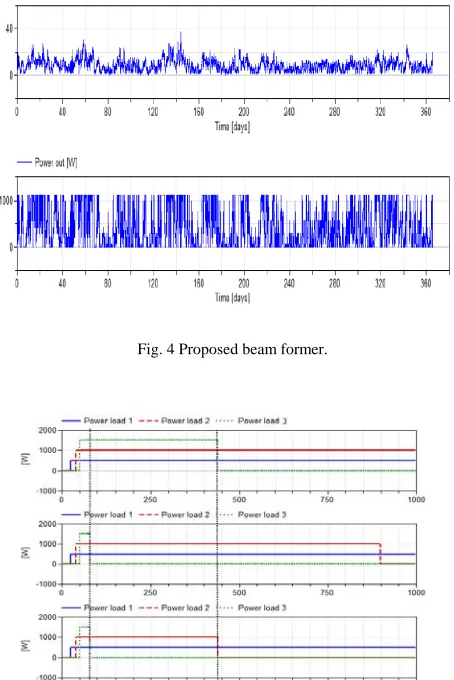
This scenario was designed to test if the external medium voltage grid and the smart houses were able to adapt to changing conditions of the external high voltage grid. At t = 0 sec the medium voltage grid voltage v = 0 volt. The voltage at both the medium voltage grid and the houses internal grids were controlled to the desired voltage level. At t = 80s the external high voltage grid fails and the medium voltage grid goes into islanding mode and operates without any external connection. The system controller at this level is forced to use all its resources to try to maintain the voltage level.
Fig. 4 Proposed beam former.
Fig.5. Short term scenario
5. Conclusions
simulated tools into smart grid architecture. This method is fast to compute cost of electricity for smart home and optimize it as per predetermine schedules and establish more superior in all contains levels.
References
[1] “Canada Announces Funds for Smart grid Research”. February 12, 2011. Smart meters telling it like it is. Last access on Nov. 2, 2012.
[2] “Plug Into the Smart grid”. 2011. GE imagination at work. Last access on Nov. 2, 2012.
[3] “E-Radio-Inc and CBC/Radio-Canada team up to improve the way electricity is consumed”. January 8, 2010.
[4] “2011 State of the Consumer Report”. Jan. 31, 2011. Smart Grid consumer collaborative. Last access on Nov. 2, 2012.
[5] “Revealing the Values of the New Energy Consumer”. 2011. Accenture. Last access on Nov.2,2012.
[6] “Eco Pinion – Resurgence for Retail Electricity Choice and Competition Survey Report”. April 2011. Eco align. Last access on Nov. 2, 2012.
[7] “Consumer Attitudes and the Benefits of Smart grid Technologies”. Jan. 24, 2011. Parks Associates. Last access on Nov. 2, 2012.
[8] “Make Every Plug Talk”. 2010. Talking plug-know your energy. Last access on June 10, 2011.
[9] “E-Radio-Inc and CBC/Radio-Canada team up to improve the way electricity is consumed”. January 8, 2010.
[10]“Energate announces commercial readiness of one-way FM Demand Response solution”. October 19, 2010.
[11]“Climate Talk is a common information model developed for the exchange of information between disparate systems and devices”. 2011.
[12]“Communication Modularity – A Practical Approach to Enabling Residential Demand Response”. May 2011. EPRI-Electric Power Research Institute. Last access on June 10, 2011.
[13]“Eco Factor ushers in the automated era of home energy management”. June 9, 2011. Smartgridnews.com. Last access on June 10, 2011.
[14]“Cisco Smart grid Strategy: The Grid’s First Operating System”. July 15, 2010. Smartgridnews.com. Last access on Nov 2, 2012.
[15]K. Moslehi and R. Kumar, “Smart grid - a realiability perspective,” Smart Grid, IEEE Transactions, 2010.
Subhra Debdas was born in Naihati, West Bengal, India, on November, 1978.He graduated in Electrical Engineering in 2001 from the Bengal Engineering College (IIEST) Shibpour, Howrah, West Bengal, India and M.Tech in Electrical Power System from the Bengal Engineering and Science University (IIEST) Shibpour, Howrah, West Bengal, India. The author is now a research scholar of Sainath University Ranchi, Jharkhand India. His special field of research includes power quality, harmonic detection and real time condition monitoring system, smart grid. Mr.S. Debdas became a Member (M) of IET (UK), IACSIT (China) and IAENG.
Dr. Ramanand Jha was born in Anisabad, Patna Bihar, India. He got his PhD Applied Engineering in 1988 from Indian Institute of Science Bangalore. The author is now a working as HOD in Applied Engineering, Uttar Pradesh Technical University, Delhi. The author has more than twenty years of teaching experiences in India and Abroad and more than thirty publications in international journal of repute.