Testing of chilli seed extractor coupled with chilli seed
grader
P.A. Borkar S.P. Umbarkar R.P. Murumkar M.R. Rajput
Dr. Panjabrao Deshmukh Krishi Vidyapeeth, Akola (M.S.) - 444 104
Abstract
The study was conducted to test the performance of PKV chilli seed extractor coupled with chilli
seed grader. The chilli seed extractor coupled with grader was tested using 100 kg sample size and
replicated five times. The average time required for seed extraction and grading of 100 kg chilli fruits was
observed to be 55 min. The seed extractability was observed to be 98.71 per cent. Grading efficiency and
cleaning efficiency was observed to be 86.20 and 84.40 per cent. The germination percentage of chilli
seeds in all the cases was observed to be above 70%. The chilli seed extractor coupled with grader was
found to be techno-economically feasible and can generate rural employment for 120 man days.
Keywords: Wheat sowing, Broadcasting, Seed cum fertilizer drill, harrowing
Introduction
Chilli fruits used in daily diet is grown on 810400 ha in India with the annual production of
747900 tonnes (Anon, 1996) out of which Maharashtra state produces 68400 tonnes. For planting chilli
seeding on this area about 1400 tonnes seed is required every year. About 3500 tonnes chilli fruits are
required to break for obtaining this seed. Farmers take out the seed by hammering chilli fruits with a
wooden stick, separating the husk manually using hand separator. This method is tedious mainly due to
inhalation of fine particles of chilli fruits. Its pungency results in continuous sneezing and irritation of
labours body. Many a times, it is difficult to get labour for this operation. The problem becomes severe on
large scale i.e. seed processing plants, seed companies, etc. moreover the existing method has low output
and efficiency.
Materials And Methods
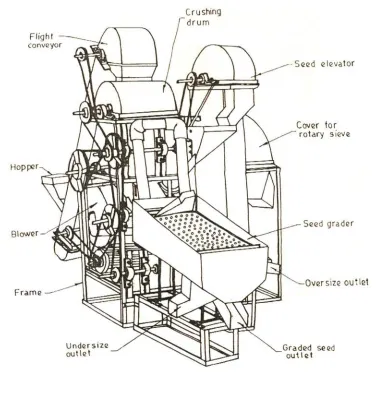
Considering the breakage requirement of dry red chilli fruits a chilli seed extractor was
fabricated (Fig.1.1) consisting of drum with spike enclosed inside the casing and the spike are
arranged in such a way that, when rotated, each spike on drum passes between the two spikes on
the stationary belt (Phirke and Umbarkar,1996). This arrangement enables to break all the chilli
fruits entering the casing. The screen is provided to separate the seed from chilli fruits below the
drum itself to minimize the further seed handling. The seed is separated through the outlet
provided to the crushing drum. In the concave, the arrangement is made to shift the cut pieces of
chilli fruits into screw conveyor through the closed duct for further separation in rotary perforated
sieve. The broken pieces of chilli fruits are conveyed axially to the circular screen as well as
stirred through screw conveyor resulting in better separation. Outlet of screw conveyor opens in
the rotary perforated sieve enclosed in concentric cylinder where remaining separation of seed is
carried out. Here two outlets are provided one for seed and other for husk. An elevator is
fabricated with hopper provided at the down end of the elevator, receiving seed from both the
seed outlets (crushing drum seed outlet and concentric cylinder seed outlet) and conveying to the
grading unit. The trapezoidal shaped seed cups are fitted on canvas belt which moves on two
rollers by providing power to one of the roller. Fourteen cups are incorporated at the spacing of
200 mm on canvas belt and the velocity of the belt is adjusted to 0.42 m/s in order to match with
the 50-70 kg/h feeding rate of seed. The arrangement of aspiration is provided at the outlet of the
seed elevator for separation of small husk pieces from seed. The seed grading unit is fabricated
provided with four point suspension system resting on main frame with reciprocating motion.
Two easily removable sieves (scalper and grader sieve) are provided in this unit which
reciprocates to and fro with a specific eccentricity (stroke length 12.6 mm) and frequency (380
oscillations/min).
The specifications and operating parameters of chilli seed extractor coupled with grader
are shown in Table 1.1.
Table 1.1: Specifications of chilli seed extractor coupled with grader
Sr. No. Particulars Specifications
1. Overall dimensions, mm
Length 1420
Width 2440
Height 1780
2. Total weight, kg 413
3. Type of drive V belt and pulley
4. Prime mover
Type Electric motor
Power, hp 2.0
Speed, rpm 1440
5. Capacity, kg/h 100-125
6. Concentric sieve size, mm
(round)
4.00
7. Grader with dimensions, mm
Scalper sieve 730 x 455
Grader sieve 730 x 455
Length of stroke, mm 12.6
Frequency of eccentric
oscillations/min
380
Sieve size, mm
Scalper (r) 4.00
Grader (r) 2.10
The chilli seed extractor coupled with grader was tested using 100 kg sample size and
replicated five times. Before testing the physical characteristics such as bulk density, 1000 chilli
weight, seed, moisture content and colour were determined.
The variety used was Jayanti. The seed extractability and grading efficiency was
calculated. Cleaning efficiency was calculated as suggested by the Bureau of Indian Standards
(BIS)as given below (IS 5817:1980)
Cleaning efficiency = 𝐸 (𝐸−𝐺)(𝐸−𝐹)(𝐼−𝐺) 𝐹(𝐸−𝐺)2(𝐼−𝐹)
Where,
E=Fraction of clean seed at clean seed outlet
F=Fraction of clean seed in feed and
G=Fraction of clean seed at foreign metter outlet
The germination of mechanically extracted seed was also determined.
Results and Discussion
The physical characteristics of chilli were studied and are shown in Table 1.2.
Table 1.2: Physical characteristics of chilli
1. Bulk density, g/mP
3
0.074
2. 1000 chilli weight, g 656.20
3. Pendecle, per cent 7.06
4. Husk, per cent 57.85
5. Seed content, per cent 35.09
6. Moisture content, per cent 9.00
7. Colour Dark red
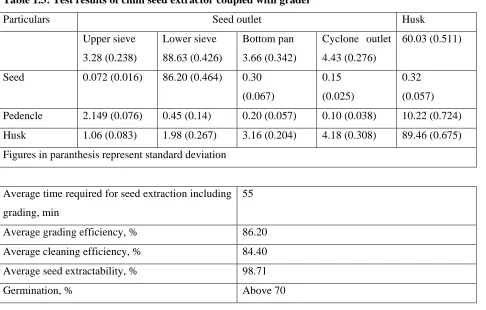
The test results of the chilli seed extractor coupled with grader are shown in Table 1.3.
Table 1.3: Test results of chilli seed extractor coupled with grader
Particulars Seed outlet Husk
Upper sieve 3.28 (0.238) Lower sieve 88.63 (0.426) Bottom pan 3.66 (0.342)
Cyclone outlet
4.43 (0.276)
60.03 (0.511)
Seed 0.072 (0.016) 86.20 (0.464) 0.30
(0.067)
0.15
(0.025)
0.32
(0.057)
Pedencle 2.149 (0.076) 0.45 (0.14) 0.20 (0.057) 0.10 (0.038) 10.22 (0.724)
Husk 1.06 (0.083) 1.98 (0.267) 3.16 (0.204) 4.18 (0.308) 89.46 (0.675)
Figures in paranthesis represent standard deviation
Average time required for seed extraction including
grading, min
55
Average grading efficiency, % 86.20
Average cleaning efficiency, % 84.40
Average seed extractability, % 98.71
Germination, % Above 70
The sample size was 100 kg chilli fruits and replicated five times. The total seed coming from
both the seed outlet was 39.94 per cent. Husk from husk outlet was 60.03 per cent through which 0.32 per
cent seed loss was observed.
The material collected from cyclone was 4.43 per cent through which the seed loss was observed
to be 0.15 per cent. Out of the total seed falling on the grader unit (sieve unit) the upper sieve separated
the oversize material such as pedencle, husk pieces, etc. to the tune of 3.20 per cent in which very low
seed content was observed to the tune of 0.072 per cent. The lower sieve separated 88.63 per cent seed in
which the husk content was 1.98 per cent and broken pedencles were 0.45 per cent. The bottom pan
collected 3.66 per cent material through which low grade seed observed to the tune of 0.15 per cent. The
average time required for seed extraction and grading of 100 kg chilli fruits was observed to be 55 min.
The seed extractability was observed to be 98.71 per cent. Grading efficiency and cleaning efficiency was
observed to be 86.20 and 84.40 per cent.
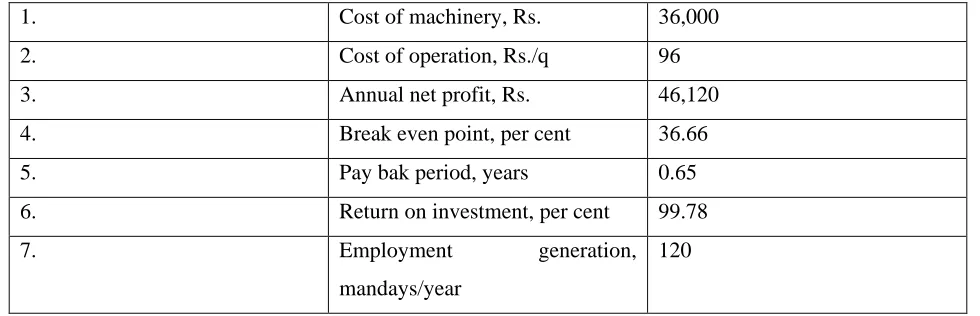
The economic analysis of chilli seed extractor with grader is shown in Table 1.4.
Table 1.4: Cost analysis of chilli seed extractor with grader
1. Cost of machinery, Rs. 36,000
2. Cost of operation, Rs./q 96
3. Annual net profit, Rs. 46,120
4. Break even point, per cent 36.66
5. Pay bak period, years 0.65
6. Return on investment, per cent 99.78
7. Employment generation,
mandays/year
120
The chilli seed extractor with grader can generate 120 mandays rural employment with a period
of 0.65 year pay back period and 36.66 per cent break even point with annual net profit of Rs. 46, 120/-
can be obtained with BEP 36.66 per cent and cost of operation per quintal was Rs. 96/-. The germination
of this mechanically extracted seed in all cases was above 70 per cent.
Conclusion
The study revealed that the chilli seed extractor technology coupled with grader was found to be
techno-economically feasible and can generate rural employment.
References
Anon (1996). Agricultural situation in India. Directorate of Economics and Statistics. Ministry of
Agriculture, Govt. of India, New Delhi.
Phirke, P.S. and S.P. Umbarkar (1996). Development of chilli seed extractor, New Agriculturist, Vol. 7
(2). Pp 109-113.