Generic related-key and induced chosen IV attacks using the
method of key differentiation
Enes Pasalic and Yongzhuang Wei
1. University of Primorska FAMNIT & IAM, Koper, Slovenia, e-mail: [email protected]
2. Guilin University of Electronic Technology, Guilin City, Guangxi Province 541004, P.R. China, e-mail: walker−[email protected]
Abstract
Related-key and chosen IV attacks are well known cryptanalytic tools in crypt-analysis of stream ciphers. Though the related-key model is considered to be much more unrealistic scenario than the chosen IV model we show that under certain cir-cumstances the attack assumptions may become equivalent. We show that the key differentiation method induces a generic attack in a related-key model whose time com-plexity in the on-line phase is less than the exhaustive key search. The case of formal equivalency between the two scenarios arises when so-calleddifferentiable polynomials with respect to some subset of key variables are a part of the state bit expressions (from which the output keystream bits are built). Then the differentiation over a key cube has the same effect as the differentiation over the corresponding IV cube, so that a generic nature of a related-key model is transferred into a more practical chosen IV model. The existence of such polynomials is confirmed for the reduced round stream cipher TRIVIUM up to some 710 rounds and an algorithm for their detection is pro-posed. The key differentiation method induces a time/related-key trade-off (TRKTO) attack which (assuming the existence of differentiable polynomials) can be run in a chosen IV model. The resulting trade-off curve of our TMDTO attack is given by
T2M2D2 = (KV)2 (V denoting the IV space), which is a significant improvement
over the currently best known trade-offT M2D2= (KV)2 [12].
Keywords: Stream ciphers, Cryptanalysis, Chosen IV attacks, Related-key attacks, Time-Memory-Data trade-off attacks, Differntiable polynomials, Key differentiation.
1
Introduction
The use of concepts similar to differential cryptanalysis for block ciphers was frequently employed in cryptanalysis of stream ciphers during the eSTREAM project [14]. These attacks are commonly referred as chosen IV or related-key attacks where the attacker is supposed to freely choose IV values and/or different keys in order to extract certain information about the secret state and/or key bits.
about the state bits. Also a similar approach was deployed in [25] in cryptanalysis of TURING cipher. In other direction the eSTREAM proposal Py [8] (and its tweaks PyPy and PyPy6) was successfully cryptanalyzed using the differential cryptanalysis [24].
A general framework of differential cryptanalysis in stream ciphers was studied in [7], where the effect of IV/key difference is analyzed through the differential characteristics at the state variables ((∆key,∆IV) → ∆S). In more recent papers [16, 17, 28], the approaches based on statistical analysis or efficient application of chosen IV attacks have been investigated. In this context we also mention a generic attack known as Cube Attack [11], where the method of tweaking the polynomials (as a generic method applicable in a black box scenario) may lead to efficient attacks on certain stream cipher designs. In this approach, the attacker is supposed to heuristically find the so-called cube indices of an IV vector so that the chosen IV attack with respect to the summation of outputs over all cube points eventually results in linear equations. While this has been successfully applied to TRIVIUM [10] with the KSA reduced to 672 rounds, the verfication of the algorithm [5] has shown that the method fails in providing linear equations when the number of rounds is increased to 735 or 770.
Related-key attacks on stream cipher are often of limited practical significance, though there are examples of its efficient applications and it is regarded as a standard attack scenario (cf. [7]). For instance, related-key weaknesses of the stream cipher RC4 led to a practical attack on the WEP protocol [18]. Furthermore, a related-key approach was used to mount a distinguishing attack on the family of stream ciphers Py, PyPy, PyPy6 and TpyPy [27]. The output keystream sequence of these ciphers could be distinguished from a true (pseudo)random sequence when the identical IV is used to encrypt two messages with different and related keys. Related-key attacks have also been widely employed in block cipher cryptanalysis, see e.g. [26, 13, 23].
Though the main idea of the above mentioned cube attacks is somewhat similar to the approach taken in this work, there are significant differences between the two. In the first place, our approach does not necessarily seeks for linear (low degree) equations. The generic approach that combines the ideas of a chosen IV and a TMDTO attack only requires the existence of so-called differentiable polynomialsas a part of the keystream bit expressions. In other words, we consider the case when the output keystream contains a polynomial of the formd(IV, K) =Qml=1(IVil+kjl)g(IV
∗, K∗), whereg(IV∗, K∗) is some
complex function in the key and IV variables but does not depend on the key variables
kj1, . . . , kjm (and possibly does not depend on the variables IVi1, . . . , IVim either). In
addition, if the IV cube IVi1, . . . , IVim is not covered by some larger IV cube (where
covering has a standard notion cf. Section 2.3) the differentiation over the key cube or alternatively over the IV cube given above leads to the cancellation of all the terms but the polynomial g(IV∗, K∗). Since this polynomial does not depend on the key variables
kj1, . . . , kjm the removal of these variables induces a generic TMDTO attack with the
currently best known trade-off curve. The trade-off curve is given by T2M2D2 = (KV)2, where T, M, D denote respectively the time, memory and data complexity while K and
V denote the key and IV space. This is a significant improvement over the currently best known trade-off T M2D2= (KV)2 of Dunkelman and Keller [12].
on the degree and the complexity of the function g(IV∗, K∗) which may be arbitrary complex function in the remaining key andIV variables. On the other hand, our method needs a certain justification that the scenario described above is realistic. While the existence of such polynomials (and their identification) in the state bit expressions after running the KSA may be highly unlikely, many ciphers initially load the key and IV bits into the state in a linear manner. This state is called presetup state, and is further processed through KSA to yield the initial state of the cipher. For instance, the presetup state for TRIVIUM, SNOW 2.0 [15], GRAIN-128 [20] and many other ciphers, is formed by loading the key and IV bits in a specific linear manner. We demonstrate that the linear relations of the formQml=1(IVil+kjl) are indeed present in a real-life ciphers such as
TRIVIUM. TRIVIUM actually generates 66 such relations of the form (IVi+kj) in the first
66 steps of the KSA procedure (in a consecutive manner). Then, gradually, more complex linear relations are built (containing more terms) due to its simple state update mechanism that, apart from taking some state bits in a linear manner, takes two consecutive terms to build a quadratic term out of these. Therefore, quite likely the state bits of TRIVIUM may contain the expressions of the formd(IV, K) =Qml=1(IVil+kjl)g(IV
∗, K∗).
Even though, in the case of TRIVIUM, we may only suspect the existence of differen-tiable polynomials in the keystream bits satisfying the above mentioned conditions, there is no guarantee that the linear relations generated in the early phase of the KSA are later preserved. Therefore, a simple algorithm for the purpose of testing the unknown keystream expressions for the existence of these differentiable polynomials is devised. No-tice also that when in particular TRIVIUM is considered our observation may largely reduce the search for suitable IV cubes. Indeed, if for instance moderate cube sizes are tested, say cubes of size 15 for instance, since we are only checking the cubes with consec-utive indices we would just check some 65 cubes (assuming 80 cube indices). In the case of the exhaustive search 8015 = 252.5 cubes need to be checked which is infeasible, and definitely unfavourable compared to our method. Our algorithm has proved successful in identifying the existence of differentiable polynomials for the reduced round TRIVIUM of up to 710 rounds. Nevertheless, due to utterly increased complexity and the form of the state bit equations other differentiable polynomials (which are nonconsecutive with respect to the key and IV indices in the linear product) are also discovered.
In a more restrictive model of related-key attack, using the assumption that a sub-set of the key variables and all the IV variables are kept fixed while the remaining key variables are varied over all possible values, we show that the key differentiation leads to a time/related-key trade-off (TRKTO) curve rather than to a standard time-memory trade-off (TMTO) curve [4, 19, 9, 22]. Instead of the relation T · M = N charac-teristic for a TMTO curve, the relation T ·RK = K, involving the space of related keys RK and the key space K, is approximately satisfied. The parameters T, M and
N stands respectively for time, memory complexity and the state size. The motiva-tion for studying this attack model, apart from a theoretical contribumotiva-tion and the fact that related-key attacks are considered as a valid attack scenario, may in certain set-tings also be justified from the application point of view. Namely, a closer inspection of the expression d(IV, K) = Qml=1(IVil +kjl)g(IV
∗, K∗), as a part of a much larger
the differentiation over a key cube (varying some key variables over all possible values) gives identical result as the differentiation over the corresponding IV cube. That is, as-suming that the remaining terms in s(IV, K) does not cover the above IV cube we get
L
IVi1,...,IVilb(x) = L
kj1,...,kjlb(x) = g(IV
∗, K∗). This means that under the conditions
described previously the two models of attack are equivalent in the sense that in both cases the result may be a complete elimination of a certain subset of key variables. The existence of differentiable polynomials then essentially leads to a generic TMTDO attack which is mounted in a chosen IV model, and the resulting trade-off curve of our TMDTO attack is given by T2M2D2= (KV)2, whereT, M, D denote respectively the time, mem-ory and data complexity whileK andV denote the key and IV space. This is a significant improvement over the currently best known trade-off T M2D2 = (KV)2 of Dunkelman and Keller [12].
The paper is organized as follows. In Section 2 the main differential attack scenarios are discussed. It is then shown that the key differentiation in general eliminates the pres-ence of the key variables the differentiation is performed on. The notion of differentiable polynomials is introduced in Section 3, and furthermore an algorithm for testing their existence is given. A generic related-key attack based on the method of key differenti-ation is described in Section 4, and its corresponding IV model is also discussed here. Furthermore, a comparison to cube testers and chosen IV statistical analysis is given in this section. In Section 5, we derive new TMDTO curves based on the key differentiation method and compare our curves with the currently best known ones. The concluding remarks are given in Section 6.
2
Key and IV differentiation attack models
In this section we give a brief overview of different attack scenarios in connection to their algebraic representations. In particular, the key differentiation method in a related-key model of attack is introduced.
2.1 Algebraic representation of the initialization process
Technically, given a stream cipher that allows an exact algebraic description, the cipher is fully specified by the key/IV setup algorithm (KSA) and encryption algorithm whose input parameters includes the key, IV, and state size.
Prior to the execution of KSA the key and IV bits are initially loaded into the state of the cipher, thus so-called presetup stateSps = (sps
0 , sps1 , . . . , spsL−1) is created. The KSA
procedure then processes these bits in an iterative and nonlinear manner. The result of this phase is a so-calledinitial stateS= (s0, s1, . . . , sL−1) of the cipher. For simplicity, we
assume the key and IV vector are of the same length κ, and the size of the state L≥2κ
is chosen to be at least twice the key length to withstand time-memory-data trade-off attacks, see for instance [9, 22]. Now given a fixed keyK and a publicly knownIV(i) the state bitss(i)r ,r= 0, . . . , L−1 can be expressed as,
s(i)r =fr(IV1(i), . . . , IVκ(i), k1, . . . , kκ) =gr(IV1(i), . . . , IVκ(i), k1, . . . , kκ) +hr(k1, . . . , kκ)
LetI,J ={1,2, . . . , κ}denote the set of indices for the IV vector respectively the key bits. Then another convenient algebraic representation, used in [28], is to represent the secret bits as a collection of terms as follows,
s(i)r =
{1,2,...,κ}
M
I=∅
ar,IIVI(i)
⊕JJ=∅br,I,JKJ=
= M
I⊂I;I6=∅
ar,IIVI⊕JJ=∅br,I,JKJ
| {z }
gr(i)
⊕[⊕JJ=∅br,JKJ]
| {z }
hr
, for 0≤r≤L−1, (2)
where ar,I, br,I,J are algorithm specific binary coefficients, and for a given subset I =
{i1, . . . , il} ⊂ Ithe termIVI denotesIVI =IVi1IVi2· · ·IViland similarlyKJ =kj1kj2· · ·kjp
for some J ={j1, . . . , jp} ⊂ J. We note that treating both the key and IV(i) as variables
the coefficients ar,I, br,I,J do not depend on the specific choice of IV’s.
Given an algebraic description of the state of the cipher after running the KSA, the attacker can try to reduce the complexities of these relations by either applying the chosen IV attack, related key attack or alternatively to combine these two. Though similar in their essence, the cryptanalytic aspects significantly differ depending in which scenario the attack is performed.
2.2 Chosen IV attacks
A chosen IV attack is a very realistic scenario in which the attacker chooses a certain subset of all possible IV’s in order to combine the relations of resulting state bits and to hopefully derive simple relations between the state bits and secret key bits. Assume that for a fixed key, the attacker is able to trace a certain subset of IV’bits say I∗ for which relatively simple relations may be derived. The easiest way to understand this approach is to fix some portion of IV bits to zero in all positions but those that correspond to some
I∗={i1, i2, . . . , im}that we vary over all its possible values. Thus, given such anIV and
its subset of indicesI∗ such thatIVi= 0 ifi6∈I∗, any secret state bitsr,r= 0, . . . , L−1,
can be expressed as,
sr =
M
ξ⊂I(l)
ar,ξIVξ(l)
⊕JJ=∅br,ξ,JKJ
⊕[⊕JJ=∅br,JKJ] =IVi(l)1
⊕JJ=∅br,i1,JKJ
⊕ (3)
⊕ IVi(l)2 ⊕JJ=∅br,i2,JKJ
⊕ · · · ⊕IVi(l)1 IVi(l)2 · · ·IVi(l)
m[⊕
J
J=∅br,I∗,JKJ]⊕[⊕JJ=∅br,JKJ].
Then summing over all possible values of the IV cube specified by the indices from I∗, i.e., adding together the state bit expressions for all possible values of the IV variables
IVi1, . . . , IVim the attacker obtains,
I∗
M
I=∅
sr =⊕JJ=∅br,I∗,JKJ =g(k1, . . . , kκ).
essentially means that the KSA of the considered cipher has additional property that the coefficients ar,I = 0 in (2) for any I such that I∗ 4I. Here, we have used the covering
relation for monomials IVI∗ and IVI, whereIVI∗ 4 IVI means that I∗ ={i1, . . . , im} ⊂
I = {i1, . . . , ip}. This is exactly the idea that has been used in [28], where an
semi-exhaustive search was performed over the suitable set of indices I∗ of length (weight) 6 to derive linear expressions relating keystream bits of a reduced KSA TRIVIUM [10] and the secret key bits. This means that for the particular IV cubes found in [28] the function
g(k1, . . . , kκ) was extremely simple (essentially a linear function in the secret key bits)
which then allowed an efficient attack on a reduced round TRIVIUM. This framework has been later generalized in [11] and [1], where the same idea was presented in a wider scope; the attack is known as “cube attack”.
2.3 Related-key attacks
In a related-key model the attacker can observe the operation of a cipher under several different keys whose values are initially unknown, but where some mathematical relation-ship connecting the keys is known to the attacker. In connection to the chosen IV model let now the set J ={j1, . . . , jp} denote the set of positions over which the key variables
are varied, while the remaining key variables are kept fixed. Then given some fixed IV vector the equation (2) can be rewritten as follows,
s(i)r =
{1,2,...,κ}
M
M=∅
br,IKM =KJg(kjp+1, . . . , kjκ) + M
I;J64I
br,IKI, r= 0, . . . , L−1, (4)
whereg does not depend on the key variables with indices fromJ. Then, similarly to the chosen IV case, varying the key variables kj1, . . . , kjp over all possible values gives,
M
(kj1,...,kjp)∈{0,1}p
KJg(kjp+1, . . . , kjκ) + M
I;J64I
br,IKI=g(kjp+1, . . . , kjκ).
The cancellation of the remaining terms in the first sum is due to the fact that KJ equals
to zero for all (kj1, . . . , kjp)∈ {0,1}
pbut for (k
j1, . . . , kjp) = (1, . . . ,1). On the other hand,
in the second sum due to the condition J 64I there will always be some variable kjl such
that jl ∈ I but jl 6∈ J, which in turn implies the cancellation of such a monomial when
the summation is performed over all possible values of (kj1, . . . , kjp)∈ {0,1}
p.
Example 1 Let the secret state bitsr be evaluated as sr =k1k3k4k5⊕k1k3k6⊕k2k5k6⊕ k2k6⊕k3⊕k1; after the IV value has been specified. Then differentiating w.r.t. k1 andk3
we have,
X
(k1,k3)∈{0,1}2
sr =k4k5+k6.
Note that k2 is also eliminated but only due to the particular form of sr.
3
Differentiable polynomials
The two attack models discussed in the previous section both have certain limitations. In a related-key model the key differentiation method is always possible which inevitably leads to a certain reduction of the key variables, but the attack assumptions are rather restrictive. On the other hand, in a chosen IV model the current approaches such as the cube attack may lead to finding low degree equations in key variables (even linear) but there is no guarantee that such equations really exist.
In what follows we introduce a notion of differentiable polynomials that will help us to treat the state polynomials in an efficient way. For convenience, if some function that generally depends on all the key and IV variables, which is denoted by g(IV, K), does not depend on some subset of the key and IV variables with indices from J∗ and I∗, respectively, we writeg(K\KI∗, IV \IVJ∗). For simplicity, let us assume that some state
bit of the cipher is given by,
sr = (kj1 +IVi1)(kj2 +IVi2)· · ·(kjm+IVim)g(k1, . . . , kκ, IV1, . . . , IVκ)
= Y
i∈I∗,j∈J∗
(kj+IVi)g(K\KI∗, IV \IVJ∗) =pJ∗,I∗g(K\KI∗, IV \IVJ∗), (5)
where I∗ ={i1, . . . , im} ⊂ I and J∗ ={j1, . . . , jm} ⊂ J.
Definition 1 A polynomiald(K, IV) =pJ,Ig(K\KI∗, IV\IVJ∗)with the separation of the
key and IV variables is called differentiable with respect to the key variables kj1, . . . , kjm
and the IV variables IVi1, . . . , IVim.
Notice that the above polynomiald(K, IV) may be differentiated either over theIV cube with indices from I∗ or over the key cube with indices fromJ∗, that is,
I∗
M
I=∅
d(K, IV) =
J∗
M
J=∅
d(K, IV) =g(K\KI∗, IV \IVJ∗).
A major difference between the two approaches that the key variables kj1, . . . , kjm will
vanish after the differentiation over the key cube even though g does depend on these variables, that is, if g is of the form g(K, IV \IVJ∗), cf. Section 2.3. The next example
illustrates the case when the differentiation over an IV cube does not necessarily imply the removal of the key variables. Such a class of polynomials is called non-differentiable polynomials with respect to some subset of key variables.
Example 2 Let sr = k1(k1 ⊕IV1)k2(k2 ⊕IV2)g(k3, . . . , kκ, IV3, . . . , IVκ). Then clearly
the differentiation with respect to IV1 and IV2 cannot eliminate the presence of k1, k2 as,
M
IV1,IV2
sr=k1k2g(k3, . . . , kκ, IV3, . . . , IVκ).
On the other hand, if sr = (k1⊕IV1)(k2⊕IV2)g(k3, . . . , kκ, IV3, . . . , IVκ) then,
M
IV1,IV2
Thus, we can only eliminate those key variables inpJ∗,I∗ that do not appear in the
expres-sions of the formkj(kj+IVi). This is the reason why the effect of the differentiation of the
above polynomial d(IV, K) was the elimination of the considered key variables regardless of the scenario of attack.
It is completely unrealistic to expect that the state bit expressions are of the form as d(IV, K) is, no matter how complex the function g(K \KI∗, IV \ IVJ∗) might be.
Nevertheless, it might be the case that d(IV, K) ∈ sr and the remaining terms are such
that for anyIV cube that coversIV∗(IV∗ 4IV) the coefficientar,I = 0 in (2) so that the
terms (polynomials) ar,IIVI
⊕JJ=∅br,I,JKJ
are not present in the symbolic expression of
sr for any I such thatIV∗ 4IV. This may be justified by the fact that the state update
algorithm is not sufficiently fast and nonlinear to ensure that the symbolic expressions of the state bits behave as randomly generated functions in the key and IV variables. This is also the main reason for the weakness of reduced round TRIVIUM where the differentiation over relatively small sized IV cubes (of length 12) gave a rise to linear equations. Therefore, if the attacker has some a priori knowledge about the structure of the cipher (s)he might guess that some differentiable polynomials of the above form constitute a part of the state bit (keystream) polynomials.
We now generalize our approach to consider arbitrary complex polynomials using the above representation. A standard representation given by (1) and (2) was obtained by extracting theIV monomials and the corresponding polynomials in the key bits. Instead, we can extract a suitable maxterm of the form pJ∗,I∗ = Qi∈I∗,j∈J∗(kj +IVi) and the
corresponding polynomial g(K\KI∗, IV \IVJ∗). That is, let us assume that the output
keystream bit zt can be written as,
zt=pJ∗,I∗g(K\KI∗, IV\IVJ∗)
{1,2,...,κ}
M
I=∅
ar,IIVI(i)
⊕JJ=∅br,I,JKJ
, ar,I = 0 if I∗ 4I. (6)
The term pJ∗,I∗ =Qi∈I,j∈J(kj+IVi) is called a maxterm with respect to variables from
I asar,I = 0 for allI∗4I. Then, we have
M
IVi1,...,IVim
zt=g(K\KI∗, IV \IVJ∗).
This means that most of the terms are cancelled leaving out only the functiongthat does not depend on the key variables with indices from J∗. If for instance g is affine function in the key andIV bits this gives one linear equation, and the whole procedure is repeated using some other maxterms (including other key and IV variables). A special case arises when g(K\KI∗, IV \IVJ∗) = 1 since in this case we cannot perform the differentiation
w.r.t. all the IV variables as we do not get any dependency on the key variables. Thus, in this specific case we may for instance compute,
M
IVi2,...,IVim
zt=kjl+IVil,
Example 3 Let the state bitsr of the cipher be given by,
sr = (k1⊕IV1)(k2⊕IV2)(k3⊕IV3)g1(k4, . . . , kκ, IV4, . . . , IVκ) +
+ (k1⊕IV1)(k2⊕IV2)g2(k4, . . . , kκ, IV4, . . . , IVκ) +
+ (k1⊕IV1)(k4⊕IV4)g3(k5, . . . , kκ, IV5, . . . , IVκ)
The differentiation with respect to the maxterm pJ,I = (k1 ⊕IV1)(k2 ⊕IV2)(k3 ⊕IV3)
yields,
M
IVj;j∈J
sr=g1(k4, . . . , kκ, IV4, . . . , IVκ),
where J ={1,2,3}.
3.1 Differentiable polynomials of TRIVIUM
In this section we demonstrate that our description of a cipher, having a specific structure as previously described, is justified for some real-life algorithms as the case of TRIVIUM confirms. It might be the case that some other ciphers that mix the key andIV variables in a linear manner also admit such a description though we do not pursue this issue further. TRIVIUM is a hardware oriented stream cipher that reached the final third phase of the eSTREAM project. It uses three LSFRs whose total length is 288, thus the state of the cipher is given by S = (s1, s2, . . . , s288). The state is contained in the three LFSRs
so that the first register comprises the state bits s1, . . . , s93, the second register stores s94, . . . , s177, and s178, . . . , s288 are kept in the third register. In the output mode the
following computations are performed:
– Define t1 =s66⊕s93,t2=s162⊕s177, and t3 =s243⊕s288.
– The output keystream is formed as z=t1⊕t2⊕t3.
– Update theti’s according to
t1 =t1⊕s91·s92⊕s171; t2 =t2⊕s175·s176⊕s264; t3 =t3⊕s286·s287⊕s69;
– Finally the registers are updated as follows:
(s1, . . . , s93) = (t3, s1, . . . , s92); (s94, . . . , s177) = (t1, s94, . . . , s176);
(s178, . . . , s288) = (t2, s178, . . . , s287);
The initialization loads the 80-bit key to s1, . . . , s80, and the 80-bit IV vector to the
positions s94, . . . , s173. The remaining state bits are filled with zeros apart froms286, s287
and s288 which are set to one; this way the presetup stateSps is completed. The key/IV
setup is performed by clocking the cipher 4·288 = 1152 times without producing the output.
very first clock the update variables are computed as t1 =k66⊕IV78,t2 =IV69⊕IV80,
and t3 =k69. Hence, s(1)94 =k66⊕IV78 and thereby one linear relation is obtained. It is
straightforward to check that the KSA of TRIVIUM admits 12 linear relations after the first 12 clocks,
s(i)94 =k67−i⊕IV79−i, i= 1, . . . ,12,
which leads to the following internal state after 12 clocks:
(s(12)1 , . . . , s(12)66 , k55, . . . , k66, s(12)79 , . . . , s(12)93 , k55⊕IV67, . . . , k66⊕IV78, s(12)106, . . . , s(12)288).
After these 12 immediate linear relations among the key and IV bits, the state bits94 at t= 13 is given by,
s(13)94 = (k54⊕IV66)⊕k79k80.
Then, during the further state updates the following recursion is valid,
s(13+i)94 = (k54−i⊕IV66−i)⊕k79−ik80−i⊕k81−i, i= 1, . . . ,53.
Thus in total there are 66 linear relations among the key and IV bits k67−i ⊕IV79−i,
for i = 1, . . . ,66. It is important to notice that the linear relations in TRIVIUM of the form k67−i ⊕IV79−i, i = 1, . . . ,66, are consecutive due to the selection of the update
positions (using two consecutive bits as a quadratic update term). Thus, due to the update algorithm of TRIVIUM, the state bits of a reduced round TRIVIUM will contain differentiable expressions of the form
(k66−i−j⊕IV78−i−j)(k66−i+1−j⊕IV78−i+1−j)· · ·(k66−j⊕IV78−j)
| {z }
KJ
, (7)
as their subterm, where j∈[0,54] and i+ 1 is then length of the IV cube. For instance, if only 288 rounds of the KSA are used then we were able to perform differentiation over theIV cubes of length four and to retrieve the key bits in the same manner as it was done in [28, 11]. Moreover, the computer simulations performed on reduced round TRIVIUM indicate that differentiable polynomials in the above form are present in the state bit expressions if the KSA is run up to 700 rounds.
Note that the above linear relations are only a part of in general huge symbolic ex-pressions that describe a particular state/output keystream bit. Furthermore, these linear relations may also be multiplied with some polynomials g(IV, K) which may or may not depend on a certain portion of the key bits. We cannot trace these huge symbolic ex-pressions unless the number of rounds is relatively small, for instance if the initialization process only takes some 200-300 rounds. Therefore, we need some kind of heuristic algo-rithm to test for the presence of differentiable polynomials.
3.2 An algorithm for the determination of the existence of differentiable polynomials
Assume that our targeted cube is specified by the indices fromI∗={i
1, . . . , im}, thus the
differentiation is performed over all possible values of IVi1, . . . , IVim. Now, ifz
by (6) the result of differentiation is g(K\K∗, IV \IV∗) which does not depend on the key and IV variables with indices fromJ∗ and I∗, respectively. More precisely, for fixed
α∈IV \IV∗ and β ∈K\K∗, we have
M
IVi1...,IVim
zt=g(β, α) = const. ∀γ∈K∗.
Moreover, there are three cases that need to be considered.
(1) For a fixed α ∈ IV \IV∗ and some fixed value of the key variables from K∗,
say γ ∈ K∗, we can randomly choose different β ∈ K\K∗ and check the differentiated value, LIV
i1...,IVimz
t=g(β, α). If the values ofg(β, α) is changeable then it means that deg(g) ≥1, i.e, functiong depends only on the key variables ofK\K∗.
(2) For a fixedα∈IV \IV∗, if this constant value is equal to 0 (i.e, const=0) then it might be the case thatLIV
i1...,IVimz
t= 0 is identically zero which might indicate that the
differentiation is performed over anIV cube that is too large. This also means that there is a possibility that zt cannot be represented in the form given by (6). Nevertheless, this case can be checked further by taking different α ∈IV \IV∗. If the differentiated value
L
IVi1...,IVimz
t=g(β, α),(β ∈K\K∗) still remains zero then with a very high probability
the output keystream bit does not contain a differentiable polynomial in the above form with respect to the IV cube specified by the indices from I∗.
(3) For a fixedα ∈IV \IV∗, we select some random different β ∈K\K∗ and check
L
IVi1...,IVimz
t =g(β, α). If the differentiated value L
IVi1...,IVimz
t =g(β, α) = 1, then
with a high probability we have g= 1.
The algorithm can be described by the following steps:
INPUT : A targeted IV cube with indices from I∗, the corresponding key cube with indices from J∗, and a cipher to be tested.
1. Select some fixed α ∈ IV \IV∗ and randomly chosen different β ∈ K \K∗ and
γ ∈K∗.
2. For each given α∈IV \IV∗ and β ∈K\K∗, compute LIVi
1...,IVimz
t=g(β, γ, α)
by varying many different γ ∈ K∗ and if LIV
i1...,IVimz
t = g(β, γ, α) 6= const go
back to (1) and choose another α∈IV \IV∗ and β ∈K\K∗. If LIV
i1...,IVimz
t=
g(β, γ, α) = const for many different γ ∈K∗, then perform the next step. 3. For each fixed α ∈ IV \IV∗, check LIV
i1...,IVimz
t = g(β, α) by using different β ∈ K\K∗. If the values of g(β, α) is changeable then report the Existence of differentiable polynomial with α ∈ IV \IV∗. If the values of g(β, α) is constant,
then perform the next step.
4. If LIV
i1...,IVimz
t = g(β, α) = 0, then report the Nonexistence of differentiable
polynomial w.r.t. α∈IV \IV∗. On contrary, ifLIVi
1...,IVimz
t=g(β, α) = 1, then
Remark:
(1) In Step 2, to check thatg(K\K∗, IV \IV∗) does not depend on the key variables with indices from J∗, we may also choose a method similar to Probabilistic Neutral Bits (PNB) method introduced in [2].
(2) In the case that g(K\KJ∗, IV \IVI∗) = 1, i.e, the function g itself is a constant
function and therefore it cannot be used to distinguish the correct subkey in our TMTO attack. Nevertheless, this also indicates that the differentiation should be performed over a smaller cube.
We give a few computer simulated examples below concerning the cubes with consec-utive indices of the TRIVIUM cipher. Notice, that we are not restricted to consider only the cubes with consecutive indices (cf. Example 6) as our algorithm works for any choice of the indices.
Example 4 For a reduced round TRIVIUM, let the targeted cube be{IV67, . . . , IV78}(12
bits in total), and let the remaining IV bits be given by IVi = 1, for i ≡ 0 (mod 3),
otherwise IVi = 0. Let also the corresponding key cube be given by {k55, . . . , k66}, i.e., k67−i ⊕IV79−i, i = (1, . . . ,12). Then computer simulations show that the first bit of the
output after 582 rounds of the initalization contains a differentiable polynomial.
Example 5 Similarly, if the targeted cube is {IV54, . . . , IV76} (23 bits in total) and let
the corresponding key cube be {k42, . . . , k64}, i.e.,k67−i⊕IV79−i,for i= 3, . . . ,25.. Then
the existence of differentiable polynomials could be confirmed for TRIVIUM reduced to 632 rounds.
Example 6 For TRIVIUM reduced to 710 rounds it seems that the cubes with consecutive indices are not necessarily preferable. Let
I∗ ={15,19,20,22,25,28,30,38,41,47,49,51,56,58,61,65,66,68,69,70,72,76,79},
where#I∗ = 23, and let the remaining bits of the initial vector be set to one (IVi = 1). Let
also the corresponding key cube be related to the IV bits through the relation kj =IVj−12
so that J∗ ={i−12 :i∈I∗}. Our simulations show that there are IV cubes of length 22 (and the corresponding key cubes) such that we could identify the existence of differentiable polynomials of the form
22
Y
i=1
(k67−j ⊕IV79−j)×g(K\KI∗, IV \IVJ∗,
where(ki, IVj)are pairs satisfying the relation ofk67−j⊕IV79−j, j∈ {3, . . . ,66}.) Then the
first bit of the output of 710 reduced round TRIVIUM show the existence of differentiable polynomials.
4
Generic key differentiation attacks in a related-key model
assumption that the key differentiation may only be performed over a portion of the key variables, our approach also utilizes some ideas of TMTO attacks so that the tables storing the differentiated expressions are created in the precomputation phase. In brief, for any possible value of a subset of the key variables of cardinality 2κ−m over which the key differentiation is not performed a small symbolic expression in a few key variables is stored as one entry of the table. The correct values of these key bits are identified by comparing the evaluations of the differentials stored in the table during the precomputation phase to the differentials evaluated via the observed keystreams. This attack is only of theoretical significance, as it will be shown later that its complexity roughly corresponds to an attack based on the birthday paradox of Biham [6], but since the details of the attack are essentially the same as in the case the attack has been performed in a chosen IV model we give a full description.
Let the secret state bits of the cipher after running the KSA be given by s0i =
fi(IV1, . . . , IVκ, k1, . . . , kκ), i = 0, . . . , L −1. Also for t ≥ 0 let the new state be
up-dated through (st+10 , . . . , st+1L−1) ←S (st0, . . . , stL−1), and the output at time t is computed as zt =ht(st
0, . . . , stL−1). For convenience, for J∗ ={ki1, . . . , kim} ⊂ K we introduce the
following notation ∆J⊂J∗zt = zt(IV, K) +zt
ki∈J:1+ki←ki(IV, K). That is, we perform a
formal key differentiation by considering the modulo two sum of the original keystream expression and the expression obtained by replacing the key variables from the set J by their inverted values ki+ 1. To reduce the computational complexity in the
precomputa-tion phase a key guessing method prior to differentiaprecomputa-tion is deployed. The attack proceeds as follows.
Off-line precomputation phase
1. Let G={j1, j2, . . . , jκ−m} ⊂ {1,2, . . . , κ} be a set of indices for which we evaluate
the si’s for all 2κ−m possible choices of the key variables kj1, kj2, . . . , kjκ−m. Thus,
given an IV vector the attacker may compute symbolic expressions for the state bit equations st
i = fit(IV, K) to obtain sti = fit(kjκ−m+1, . . . , kjκ), i = 0, . . . , L−1,
t= 0, . . . κfor each possible value ofkj1, kj2, . . . , kjκ−m. This way 2
κ−m×Lsymbolic
state bit expressionssti=fit(kjκ−m+1, . . . , kjκ) aretemporarilystored in a table for
each t. Each of these expressions contains no more than 2m terms (the expressions
depend on the m key variables).
2. The attacker then performs the differentiation of the output keystream expres-sions zt = ht(st1, . . . , stL−1) = ˜ht(kjκ−m+1, . . . , kjκ) with respect to some subset
D = {kjκ−m+1, . . . , kjκ−c} of the key bits of cardinality #D = m−c, where c is
a small positive integer, e.g. c= 1 or c= 2. The resulting differentials
M
J⊂D;J6=∅
∆Jzt= ˜ht,D(kjκ−c+1, . . . , kjκ), . . . , M
J⊂D;J6=∅
∆Jzt+d+r= ˜ht+d+r,D(kjκ−c+1, . . . , kjκ),
keystream sequences. The whole procedure can be repeated for the other subsets of the key bits D0 = {kj0
κ−m+1, . . . , kj0κ−c} so that the nonlinear expressions in c
key variables are disjoint with the previous expressions (different key variables are chosen).
The computation of the above differentials is performed for each guessed value of
kj1, . . . , kjκ−m and the functions ˜h
t,D, . . . ,˜ht+d+r,D are stored in a tableT which is
later used in the on-line phase of the attack.
The additional r differential values LJ⊂D;J6=∅∆Jzt+d+1, . . . ,LJ⊂D;J6=∅∆Jzt+d+r
are stored for the purpose of identifying the right key variables kj1, kj2, . . . , kjκ−m,
see Step 3. in the on-line phase below. The total storage required is therefore of order O((r+d)2κ−m) ≈ O(2κ−m), and the time complexity is dominated by the computation of differentials O(2κ−m2m) =O(2κ).
On-line phase
1. The attacker observes the output keystream bits zt,J, . . . , zt+d+r,J (where J ⊂D=
{kjκ−m+1, . . . , kjκ−c}) generated by a fixed and known IV and different 2
m−c keys
(alternatively the key is fixed and 2m−c chosen IV’s are used if the transformation
of the attack scenario is possible). These keys are derived form a single (master) key by varying the key variables {kjκ−m+1, . . . , kjκ−c} over all possible values. The data
complexity is therefore 2m−c related-key keystream sequences of lengthd+r ≈2c+κ,
see below for the specification ofr.
2. From the observed keystreams zt,J, . . . , zt+d,J, J ⊂Dthe attacker can evaluate the differentialsLJ⊂D;J6=∅∆JzJt, . . . ,LJ⊂D;J6=∅∆JzJt+din time instancest, t+1, . . . , t+
d. The evaluation only uses the observed keystream bits and is performed once for all. The time complexity is of order O(d2m−c). For instance, at timetthe attacker computes,
[ M
J⊂D;J6=∅
∆Jzt]ev. = (zt|k
jκ−m+1 +z
t
|kjκ−m+1+1) + (zt|kjκ−m+2 +z|ktjκ−m+2+1) +· · ·+
+ (zt|k
jκ−m+1,kjκ−m+2,...,kjκ−c +z
t |kjκ
−m+1+1,kjκ−m+2+1,...,kjκ−c+1).
These values are used to solve 2κ−m many systems of nonlinear equations of size 2c that are stored in the tableT,
[ M
J⊂D;J6=∅
∆Jzt]ev.= ˜ht,D,G(kjκ−c+1, . . . , kjκ), . . . ,[ M
J⊂D;J6=∅
∆Jzt+d]ev.= ˜ht+d,D,G(kjκ−c+1, . . . , kjκ),
thus retreiving kjκ−c+1, . . . , kjκ for each guessed key value from G. The time
com-plexity of this step is of order O(23c2κ−m), corresponding to solving 2κ−m many systems of size 2c.
3. To identify the correct key bitskj1, kj2, . . . , kjκ−m (and thereby the correct values of
kjκ−c+1, . . . , kκ) the attacker compares the differentials of the true outputs
[ M
J⊂D;J6=∅
∆Jzt+d+1]ev., . . . ,[ M
J⊂D;J6=∅
to the differentials
M
J⊂D;J6=∅
∆Jzt= ˜ht+d+1,D,G(kjκ−c+1, . . . , kjκ), . . . , M
J⊂D;J6=∅
∆Jzt+d+r= ˜ht+d+r,D,G(kjκ−c+1, . . . , kjκ).
The latter differentials are computed by evaluating the nonlinear equations stored in the table T for each guessed value kj1, kj2, . . . , kjκ−m. Due to the computational
complexity of Step 3. above, the parameter c is chosen so that c κ−m. To extract the correct key bits kj1, kj2, . . . , kjκ−m and kjκ−c+1, . . . , kjκ the constant r
must satisfy r > κ−m−c. The selection of such r then enables the extraction of a unique correct partial key. All other key candidates are expected not to pass the above differential test.
4. Once the correct values ofkj1, kj2, . . . , kjκ−m andkjκ−c+1, . . . , kκ have been retrieved,
the remaining key bits kjκ−m+1, . . . , kjκ−c can be found by repeating the same
pro-cedure for different disjoint choices of these ckey variables.
The complexity estimate is governed by the choice of the parameters m and c. In-creasing m makes the attack more unrealistic as the attacker is supposed to observe 2m sequences generated by different keys and the same IV. Both time and memory com-plexity in the off-line precomputation phase are dominated by computing and storing the differentials. The time complexity is of order O(2κ) and the memory complexity of this phase is O(2κ).
In the on-line phase the attacker performs 23c2κ−m×m/ccomputations, which corre-sponds to solving 2κ−m many systems of nonlinear equations of size 2c for m/cdifferent disjoint subsets of the c key variables. This is the worst case complexity as these non-linear equations may be of significantly smaller size than 2c. Thus, the time complexity in the on-line phase is O(23c2κ−m), and the memory requirements are negligible. Still, the attacker in the on-line phase makes use of the table T of size O(2c2κ−m). The data complexity is 2m−c×m/c related-key keystream sequences of length 2c+κ.
We illustrate the whole idea with an example, considering a hypothetical toy cipher.
Example 7 Let us consider a toy cipher that uses the secret keyK= (k1, k2, k3, k4, k5, k6) =
(0,1,1,1,0,0) and some known IV. Assume that the first three (secret) initial state bits are given by,
s0 = k1k2k3+k3k4+k3+k4+k2k5+k1k2k6+k3k5k6,
s1 = k1k3k4+k2+k4+k2k6+k3k5k6+k1k2k5+k1k2k4k6+k1k2k4k5, s2 = k1k2k4+k2k3k4+k1+k2+k3+k2k3k5+k1k4k6+k4k6+k1k2k3k6,
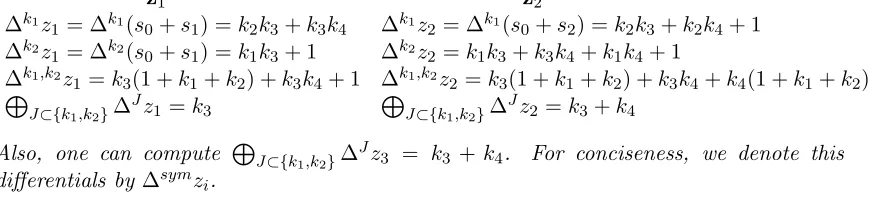
and furthermore letz1 =s0+s1,z2 =s0+s2, andz2 =s0+s1+s2. The attacker for each
the differentials ∆k1,k2z
1, ∆k1,k2z2, and ∆k1,k2z3 which is summarized in Table 1 below.
The computation of these differentials is only given for the case (k5, k6) = (0,0),
z1 z2
∆k1z
1= ∆k1(s0+s1) =k2k3+k3k4 ∆k1z2 = ∆k1(s0+s2) =k2k3+k2k4+ 1
∆k2z
1= ∆k2(s0+s1) =k1k3+ 1 ∆k2z2 =k1k3+k3k4+k1k4+ 1
∆k1,k2z
1 =k3(1 +k1+k2) +k3k4+ 1 ∆k1,k2z2 =k3(1 +k1+k2) +k3k4+k4(1 +k1+k2)
L
J⊂{k1,k2}∆
Jz
1 =k3 LJ⊂{k1,k2}∆
Jz
2=k3+k4
Also, one can compute LJ⊂{k1,k2}∆Jz
3 = k3 +k4. For conciseness, we denote this
differentials by ∆symzi.
(k5, k6) = (0,0) (k5, k6) = (0,1) (k5, k6) = (1,0) (k5, k6) = (1,1) ∆Jzev.i
∆symz
1 k3 k3+k4+ 1 k3+k4+ 1 k3+k4 ∆Jzev.1 = 1
∆symz
2 k3+k4 k4+ 1 k3+k4 k4+ 1 ∆Jzev.2 = 0
∆symz
3 k3+k4 1 k3+ 1 k4 ∆Jzev.3 = 0
Table 1: A table with symbolic expressions
The attacker observes the outputs z1, z2, z3 for the incremented values of the key bits k1 andk2, thus he is able to evaluate the actual differentials (the last column in the table).
For the given values of K we may check that either (k5, k6) = (0,0) or (k5, k6) = (1,0)
are the partial key candidates since the differentials in the first (or the third) column give a solvable set of equations. For instance, if (k5, k6) = (0,0) then,
M
J⊂{k1,k2}
∆Jz1ev. = (z1|k1=0+z1|k1=1) + (z1|k2=1+z1|k2=0) + (z1|(k1,k2)=(0,1)+z1|(k1,k2)=(1,0)) =
= (1 + 1) + (1 + 0) + (1 + 1) = 1 =k3,
and similarlyLJ⊂{k1,k2}∆Jz2ev.= 0 =k3+k4, andLJ⊂{k1,k2}∆Jz3ev. = 0 =k3+k4. This
system also gives the correct values for the key bits k3 = 1 and k4 = 1. Note that e.g. the
differentials in the second column exclude the value (k5, k6) = (0,1) since the differential
w.r.t. z3 is different than the evaluated one, and the same is true for the fourth column.
To filter out the key candidate (k5, k6) = (1,0) a few more differentials need to be stored
in the table and evaluated during the on-line phase.
In this example the key bits k1, k2 can then be either found by an exhaustive search or a
similar procedure is repeated but now the differentiation is performed over k3 and k4 .
4.1 Adopting our related-key algorithm in a chosen I V model
We now once again consider a suitable representation of the keystream polynomial in order to discuss the formalism of translating the generic key-related attack into a chosen IV attack. If the output bit zt may be represented as,
zt=pJ∗,I∗g(K\KI∗, IV \IVJ∗)
{1,2,...,κ}
M
I=∅
where pJ∗,I∗ = Ql=1m (IVil +kjl), then we already remarked that it is irrelevant whether
the differentiation is performed over the IV cube with indices from I∗ or over the key cube with indices from J∗. This essentially means that the effect of the differentiation is exactly the same in both cases, more precisely the key variables with indices from J∗ are no longer present in the differentiated polynomial.
A major difference compared to standard chosenIV attacks is that the differentiation over theIV cube corresponding toI∗would leave a complex polynomialgas the differential value so that no simple relations among key variables could be deduced. Indeed, the above equation can be rewritten as,
zt=IVi1IVi2· · ·IVimg(K\KI∗, IV \IVJ∗)
{1,2,...,κ}
M
I=∅
a0r,IIVI(i)⊕JJ=∅br,I,JKJ,
where again a0r,I = 0 ifI∗ 4I.
Thus, the result of theIV differentiation is some arbitrarily complex polynomialg(K\
KI∗, IV\IVJ∗) which due to the absence of key variables with indices fromJ∗is processed
in a similar way as in the case of the related-key method.
It is important to notice that our assumption about the knowledge of the remaining IV bits, that is the portion IV∗ =I \ {IVi1, . . . , IVim} may give a rise to unfair comparison
to some other trade-off attacks and therefore we consider two variants. In the first model, the assumption is that we know the subsetI \{IVi1, . . . , IVim}ofIV bits in advance which
gives a better trade-off curve. In the second scenario, this subset of bits is not known in advance (which is more realistic assumption) and the algorithm is then supposed to create more tables for storing computed differentials for many choices (the number of choices will follow the birthday paradox) of these IV bits. The algorithm proceeds as follows.
Off-line precomputation phase
1. Assume that a fixed portion IV \ {IVi1, . . . , IVim} of the IV vector is known, and
suppose the presence of a differentiable polynomial in the keystream bit
zt=ptJ∗,I∗gt(K\KI∗, IV \IVJ∗)
{1,2,...,κ}
M
I=∅:I∗64I
ar,IIVI⊕JJ=∅br,I,JKJ,
has been detected. The attacker now performs the differentiation of the output keystream expressions,
M
(IVi1,...,IVim)∈GF(2)m
zt=gt(K\KI∗, IV \IVJ∗).
lengthdare uniquely distinguished with respect to the subkey. Since there are 2κ−m such sequences our estimate is that d≈κ is sufficient.
The total storage required is therefore of order O(2κ−m), and the time complexity is dominated by the computation of differentials, which is O(2κ−m2m) =O(2κ).
On-line phase
1. The attacker observes the output keystream bits zt,I∗, . . . , zt+d,I∗ generated by a fixed secret key and for all possible values of the IV variables with indices in I∗, whereas the remaining IV bits are known and kept fixed. This means that zt,I∗
is actually a sequence of bits computed for each possible value ofIVi1, . . . , IVim. The
data complexity is therefore 2m output keystream sequences of length d.
2. From the observed keystreams zt,I∗, . . . , zt+d,I∗ the attacker can evaluate the differ-entials
M
IVi1,...,IVim∈GF(2)m
zt,I∗, . . . , M IVi1,...,IVim∈GF(2)m
zt+d,I∗
in time instancest, t+ 1, . . . , t+d. The evaluation only uses the observed keystream bits and is performed once for all. The time complexity is of order O(d2m).The
binary differential sequence of lengthd is then matched to the entries stored in the tableT, so that the portion of the key bitsJ \J of cardinalityκ−mis retrieved. The time complexity of this step is negligible, and the last step corresponds to recovering the remainingmkey bits by an exhaustive search, thus the time complexity isO(2m).
4.2 A comparison to cube testers and statistical chosen IV attacks
In 2009, the concept of the cube testers was introduced by Aumasson et. al in [1]. In difference to the standard cube attacks, the cube testers focus on detecting the nonran-dom behaviors of a given cipher system. These nonrannonran-dom behaviors usually include the property of balancedness, the presence of linear/neutral variables and some other crite-ria. It was demonstrated that the cube testers can detect the nonrandomness over 18 reduced rounds of MD6 algorithm only with 217 complexity. Moreover, cube testers can
also successfully detect nonrandomness on TRIVIUM reduced to 885 rounds with only 227 complexity (these results are current the best known records). It is clear that cube testers only detect nonrandom behavior rather than recovering the secret key.
Unlike the cube testers, our key differentiation attacks perform a key extraction pro-cess. Though the differentiation polynomial detection method in our attack shares a similar principle as the neutral variables tests in cube testers, the goal of our key differen-tiation attacks is to perform a generic TMTDO attack to recover the secret key rather than detecting the nonrandomness of the cipher system. More precisely, let us still consider that the output keystream bit zt can be written as,
zt=pJ∗,I∗g(K\KI∗, IV\IVJ∗)
{1,2,...,κ}
M
I=∅
ar,IIVI(i)⊕JJ=∅br,I,JKJ, ar,I = 0 if I∗ 4I. (8)
For standard cube testers, the nonrandomness ofg(K\KI∗, IV\IVJ∗) =LIV
i1,...,IVimz
t
may be checked. For instance, the fact that the key variables KI∗ are not present
inLIVi
1,...,IVimz
t does not give an immediate approach for employing this result in a
key recovery attack. On the other hand, our key differentiation attack aims at recovering these secret bits in (K\KI∗) using TMTDO methods (see also Section 5, whereas a guess
and determined attack is used for the remaining key bits. Therefore, for the recovery of secret key bits, the key differentiation attacks have a more generic approach than cube testers.
In 2008, Fischer et. al proposed a new method for key recovery attacks on stream ciphers [17] based on the framework for chosen IV statistical distinguishers [16]. The basic idea comes from the distributed algebraic structure of the encryption (Boolean) functionF(K, V), whereK andV denote the secret key bits and the initialization vector bits, respectively. Given a partitionV = (U, W), an adversary can obtain simpler Boolean functions C(K, W) from F by varying over the bits in U only. If this function C(K, W) has some nonrandom behavior, for instance imbalanced property, or there are many key bits that have no influence on the values of C(K, W), then the adversary can perform a key recovery attack, where the nonrandom behavior is usually detected by using the approximation of the polynomial description of C(K, W), alternatively the probabilistic neutral key bits method [2] is used. Moreover, it is shown that the attack can perform a partial recovery of the key bits for 672 reduced rounds Trivium and to Grain-128 reduced to 80 rounds [17].
There are two main differences between chosen IV statistical analysis in [17] and our key differentiation attacks: (1) The distinguisher of chosen IV statistical analysis comes from the observation of the algebraic structure of functionC(K, W). But our distinguisher is based on the differential properties of summed output values of C(K, W) by varying over the bits in U, i.e., the expression of the form PUC(K, W) is considered. (2) The distinguisher used in the chosen IV statistical analysis if a probabilistic one due to the probabilistic approximations (with probabilityp < 1) of the given functionsC(K, W). On contrary, the distinguisher in our key differentiation attacks always have probabilityp= 1, which is completely determined by the function PUC(K, W). Therefore, the chosen IV statistical analysis and our key differentiation attacks have different attack principles.
5
Time-memory trade-off attacks
all possible IVs.
The time-memory trade-off (TMTO) attacks was first introduced by Hellman in the context of a chosen plaintext attack [21] to block ciphers, as a trade-off solution between the two extreme approaches above. The precomputed tables that cover the whole key space are smaller but the attack also implies a non-negligible time complexity in the on-line phase. Denoting byKa total key space the resulting trade-off is given asT M2=K2, whereM is the memory storage used in the precomputation phase, andT is the time complexity in the on-line phase. A convenient choice for these parameters is M =T =K2/3 which gives a
complexity beyond the exhaustive key search. The attack also includes a precomputation step that corresponds toK encryptions. The basic idea is to reuse the precomputed table (which is done once for all) for retrieving secret keys in subsequent encryptions, assuming that the same plaintext target has been encrypted. Remark that the attack is meaningful only if M, T < K.
In the realm of stream ciphers the first TMDTO (time-memore-data trade-off) attack was proposed independently by Babbage [4] and Goli´c [19]. Let N denote the size of the internal state of the cipher (in our notation N = 2L). Then, given D data points (keystreams produced by the same secret key and different IVs) the goal of the attacker is to recover any secret state that corresponds to one of these D keystreams. In the precomputation phase the attacker evaluates the function,
f : (logN)-bit state→(logN)-bit output keystream,
and sorts the pairs (s, f(s)) with respect to the second coordinate in a table T. If N/D
such pairs are stored then by the birthday paradox one expects that one among the D
keystreams will be found in the table. The time complexity is therefore T =D and the precomputation and memory complexity are of the same size, i.e., P =M =N/D. The main problem with this approach is that the internal state of modern ciphers is made large (commonly |N| ≥2κ) and therefore D must be very large so that the resulting attack (a point on the trade-off curve N = T ·M) is faster than exhaustive search. In particular, one may choose T = M = D = N1/2 which also constitutes an attack, and it suggests that the length of the state is at least 2κ bits to achieve a theoretical κ bit security, see [4].
The TMDTO attack of Babage and Golic was improved by Biryukov and Shamir [9], using the Hellman’s tables in the context of stream ciphers. In this case multiple Hellman’s tables are created, where N/D of the total internal state. The attack again aims at recovering any of the secret states corresponding to Ddifferent keystreams. The main benefit of this approach is an improved TMTO curve given by,
T M2D2 =N2, P =M =N/D,
which is valid for 1≤D2≤T. The most useful point on the curve isT =M =N1/2 and D =N1/4. A further refinement of this approach was suggested in [22]. It was observed that the TMTO curve is not related to the state size but rather to the effective size of the state. Therefore, increasing the state of the cipher while keeping the sizes of the key and
D= 214(κ+v) rather than usingT =M =N12 and D=N14, where the state spaceN = 2L
can be significantly larger than 2κ+v. Forκ=v, the on-line phase of the TMTO attack is
T =M = 2κ and the precomputation phase isP = 2κ+v/D= 232κ.
Prior to the work of Dunkelman and Keller [12], all the TMTO attacks against stream ciphers have treated the initialization vector as a part of secret material. That is, the function to be inverted was of the form f : (K, IV) → Output Prefix, where “Output Prefix” is a portion of the keystream of length κ+v generated by the cipher. As argued in [12], in the context of a chosen IV attack, this treatment is not necessarily optimal.
Let V = 2v denote the number of all possible IVs and let D be the number of
keystreams generated by the same secret key and different IVs. The attacker may in advance select a portion of all possible IV’s, of cardinality V /D, and for eachIV in this set he prepares Hellman’s tables. But this time, since IVs are known, the function to be inverted is f :K → Output Prefix. The resulting trade-off curve using this approach turns out to be,
T M2D2 = (KV)2.
Thus, the curve is essentially the same as the original curve of Biryukov and Shamir, but the difference lies in its extended range of applicability. Namely, the restriction on the parameters in the original curve T ≥D2 is removed which gives more flexibility to select the trade-off parameters.
In the sequel we compare the performance of our attack to the standard TMDTO attacks mentioned above. Since the method of key differentiation is applicable in a related-key and chosen IV scenario, we consider the two cases separately. While in a related-key model our trade-off curve coincides with the key collision attack of Biham [6], in a chosen
IV scenario our method yields a better trade-off curve than the above approaches.
5.1 TMDTO attack in a related-key model
The basic assumption of our related-key model is that theIV is known in advance (or even not used) while the keys to be used in encryptions are related in a known (incremental) manner. This means that in a classical TMTO attack the function to be inverted is of the formf : (K,fixed IV)→Output Prefix, where due to the increment of a subset of m
key variables only the remainingκ−m key bits are to be considered as unknown. As no multiple data points, in a standard sense, are used (the IV is fixed) the Hellman’s tables is given by T M2=K2, where we set D= 1.
As already noticed, our attack induces a trade-off curve given by M T =K or alter-natively M D = K, as D = T. In the related-key model the collision attack of Biham [6], which is essentially an application of the birthday paradox, seems to be the most appropriate method for the sake of comparison. Instead of precomputing the encryptions under all possible keys, in this method encryptions under 2κ−m randomly chosen keys are stored in a table. Then if the attacker observes 2m many encryptions with different keys,
by the birthday paradox one expects that one of these keys will match to one of the keys stored in a table. The method is very simple and the resulting TMDTO curve is given by
M ·T =K, where M = 2κ−m is the memory complexity and T is the on-line time
the attacker only needs to perform a single table look-up, i.e. T = 1 for each data point. In our case the attack assumption is more restrictive, that is we assume that a portion of the secret key is incremented in different sessions. This means that the keys are not random. For both attacks, once the master key has been found all the other derived keys are compromised as well. However, if IV is not fixed better methods than the collision attack exist.
5.2 TMDTO attack in a chosen I V model
In the sequel we compare the TMDTO curve of Dunkelman and Keller to the trade-off curve that will be derived for our method. It turns out that our curve will be defined by
T2M2D2 = (KV)2, which then implies a better performance of our attack.
In the approach of Dunkelman and Keller, the attacker chooses V /D many IVs in advance and given theDkeystreams generated by different IVs with probability 40% the secret key will be found in the precomputed Hellman’s tables. When the key differentiation is equivalent to the IV differentiation (the effect of elimination of a certain subset of key variables), we assume that a targeted subset of IV bits of cardinality m is incremented during different sessions, whereas the remaining part of theIV bits of size v−m is fixed and has to be known in advance. The knowledge of thesev−m IV bits would then favour our attack, and the resulting trade-off curve would be given byM T =K as in the case of the related-key attack. Indeed, the memory requirement is of size O(2κ−m) and the time complexity is O(2m), which then gives M T =K.
Therefore, to make a fair comparison between the two methods, we assume the attacker has no a priori knowledge of this subset ofIV bits (which is a more reasonable assumption by the definition of an IV). Now, the attacker is supposed to create 2(v−m)/2 tables for randomly chosen IVs, where only a portion ofv−mbits of theseIVs is to be matched to thev−mbits of theIV used in encryption. Then, if 2(v−m)/2 many sessions with different
IVs are observed, then by the birthday paradox there will be a prepared table to match one of theseIVs at thesev−mpositions. This obviously implies a certain increase of the storage, namely by factor 2(v−m)/2 (compared to the known IV case), that is,
M0 = 2(v−m)/2M = 2(v−m)/22(κ−m).
Similarly, D0 = 2(v−m)/2D = 2(v−m)/22m, while the time complexity remains the same
T0 = T = 2m. Indeed, the attacker observes the used IVs and performs no operations until the portion of some IV gives a match. Then he computes the differentials for that session, retrieveκ−msecret key bits and find the remaining key bits using an exhaustive search.
It is straightforward to deduce that our attack induces the following TMDTO curve,
T0M0D0 =KV, or T02M02D02 = (KV)2.
same secret keys and different and relatedIVs, andDs is the number of different sessions
that use different values for the subset ofv−m IV bits.
In the above scenario, the method in [12] can also be adopted to take advantage of the known portion of the IV bits. The attacker only needs to consider v−m IV bits while the remaining m bits can be set to arbitrary value (due to the assumption that the encryption in any single session exhaust all possible values of these bits). Thus, it suffices to construct Hellman’s tables for 2(v−m)/2 randomly chosen IV values, where for each IV t tables of size s are constructed. Therefore, the memory requirement is
st2(v−m)/2. The t tables store the start and the end value of the repeated computation,
x→fi(x)→fi2(x) =fi(fi(x))· · · →fit(x), fori= 0, . . . , t−1, for somesrandom starting
points x. Here, fis are small modifications of function f to be inverted. Given the IV
vector for which the Hellman’s tables are created, to find the value of the secret key in the table (that is to find x given some f(x)) the t2 calls to fis are needed, which is the
time complexity of the attack. In order to cover the whole key space the size of Hellman’s tables must satisfy st2 = K. Using these relations, the following trade-off curve can be derived,
T M2 =t2s2t22(v−m) =K2V2−m⇒T DVM2 =K2V.
Compared to the original TMDTO curve of Dunkelman and Keller given byT M2D2 =
(KV)2, the modification of the attack scenario yields a certain improvement.
Let us compare the performance of the algorithms taking into account these modifi-cations. Obviously our time complexity is 2m which cannot be reached by the TMDTO
of Dunkelman and Keller unless the memory usage is unreasonably high. For m = 40,
|IV|=|K|= 80, the following trade-off parameters are obtained for our method,
M = 260, T = 240, D=DsDV = 220240= 260.
If we now allow even for a larger memory storage M = 270 the trade-off parameters of
Dunkelman and Keller are given as,
K=st2, M =st2(v−m)/2 ⇒ t= 230, s= 220 ⇒T = 260 which is clearly inferior to our trade-off.
Another comparison (and many others can be given) relates to the particular instance used in [12]. The authors consider an application of their method to a stream cipher with parameters |K|= 64, and |V| =|IV|= 40. For this instance, they select the following point on their TMDTO curve,T =M = 248, D= 232.
Fixing the memory storage M = 240 and m = 30, the modified TMDTO curve
T DVM2 = K2V, that compensates for a partial knowledge of the IV bits, gives in this
case,
K =st2, M =st2(v−m)/2 ⇒ t= 229, s= 26 ⇒T = 258.
If m= 30 is chosen in our attack, then the corresponding trade-off is,
6
Conclusions
We have developed a theoretical framework for using the technique of key differentiation in the cryptanalysis of certain stream cipher designs. The attack is generic in a related-key model while in a more realistic chosen IV model the key differentiation process may only be performed if the presence of so called differentiable polynomials is identified in keystream expressions. We leave the question of finding other suitable stream cipher algorithms susceptible to this attack open.
References
[1] J-P. Aumasson, I. Dinur, W. Meier, and A. Shamir. Cube testers and key recovery attacks on reduced-round MD6 and Trivium. In Fast Software Encryp-tion 2009, volume LNCS 5665, pages 1–22. Springer-Verlag, 2009.
[2] J-P. Aumasson, S. Fischer, S. Khazaei, W. Meier, and C. Rechberger. Fast software encryption.
[3] S. Babbage. Cryptanalysis of LILI-128. Preproceedings of NESSIE 2-nd workshop, Egham, 2001.
[4] S. H. Babbage. Improved exhaustive search attacks on stream ciphers. InEuropean Convention on Security and Detection, volume 408, pages 161–166. IEE, 1995.
[5] S. S. Bedi and N. R. Pallai. Cube attacks on Trivium. Cryptology ePrint Archive, Report 2009/015, 2009. http://eprint.iacr.org/.
[6] E. Biham. How to decrypt or even substitute DES-encrypted messages in 228 steps.
Information Processing Letters, vol. 84(3):117–124, 2002.
[7] E. Biham and O. Dunkelman. Differential cryptanalysis in stream ciphers. Cryp-tology ePrint Archive, Report 2007/218, 2007. http://eprint.iacr.org/.
[8] E. Biham and J. Seberry. Py (Roo: A fast and secure stream cipher using rolling arrays. Avaliable on ECRYPT Stream Cipher Project page, 2005. http://www. ecrypt.eu.org/stream/py/py.ps.
[9] A. Biryukov and A. Shamir. Cryptanalytic time/memory/data tradeoffs for stream ciphers. InAdvances in Cryptology—ASIACRYPT 2000, volume LNCS 1976, pages 1–13. Springer-Verlag, 2000.
[10] C. Canniere and B. Preneel. TRIVIUM specifications. Avaliable at ECRYPT Stream Cipher Project page, 2005. http://www.ecrypt.eu.org/stream/trivium. html.
[11] I. Dinur and A. Shamir. Cube attacks on tweakable black box polynomials. In
[12] O. Dunkelman and N. Keller. Treatment of the initial value in Time-Memory-Data Tradeoff attacks on stream ciphers. Information Processing Letters, vol. 107(5):133–137, 2008.
[13] O. Dunkelman, N. Keller, and J. Kim. Related-key rectangle attack on the full SHACAL-1. InSelected Areas in Cryptography 2006, volume LNCS 4356, pages 28–44. Springer-Verlag, 2006.
[14] ECRYPT. Call for stream cipher primitives.http://www.ecrypt.eu.org/stream/.
[15] P. Ekdahl and T. Johansson. SNOW—a new stream cipher. In Proceedings of First Open NESSIE Workshop, KU-Leuven, 2000.
[16] H. Englund, T. Johansson, and M. S. Turan. A framework for chosen IV statistical analysis of stream ciphers. InAdvances in Cryptology—INDOCRYPT 2007, volume LNCS 4859, pages 268–281. Springer-Verlag, 2007.
[17] S. Fischer, S. Khazaei, and W. Meier. Chosen IV statistical analysis for key recovery attacks on stream ciphers. volume LNCS 5023, pages 236–245. Springer-Verlag, 2008.
[18] S. Fluhrer, I. Mantin, and A. Shamir. Weaknesses of the key scheduling algo-rithm of RC4. In Selected Areas in Cryptography 2001, volume LNCS 2259, pages 1–24. Springer-Verlag, 2001.
[19] J. Dj. Goli´c. Cryptanalysis of alleged A5 stream cipher. In Advances in Cryptology—EUROCRYPT’97, volume LNCS 1233, pages 239–255. Springer-Verlag, 1997.
[20] M. Hell, T. Johansson, and W. Meier. A stream cipher proposal: Grain-128. InIEEE International Symposium on Information Theory (ISIT 2006), 2006.
[21] M. Hellman. A cryptanalytic time-memory tradeoff. IEEE Trans. on Inform. Theory, IT-26(4):pages 401–406, 1980.
[22] J. Hong and P Sarkar. New applications of time memory data tradeoffs. In
Advances in Cryptology—ASIACRYPT 2005, volume LNCS 3788, pages 353–372. Springer-Verlag, 2005.
[23] S. Hong, J. Kim, S. Lee, and B. Preneel. Related-key rectangle attacks on reduced versions of SHACAL-1 and AES-192. In Fast Software Encryption 2005, volume 3557, pages 368–383. Springer-Verlag, 2005.
[24] W. Hongjun and B. Preneel. Differential cryptanalysis of the stream ciphers Py, Py6 and PyPy. InAdvances in Cryptology—EUROCRYPT 2007, volume LNCS 4515, pages 276–290. Springer-Verlag, 2007.