P a g e | 1411
A New Scheme for Secure Search of Encrypted Cloud Data on
Mobile Cloud
Policherla Baji
1,
G.V Manikanth
2
1PG Scholar, Dept of CSE, Prakasam Engineering College, Singarayakonda, Prakasam(Dt), AP, India.
2Asst Professor, Dept of CSE, Prakasam Engineering College, Singarayakonda, Prakasam(Dt), AP, India.
ABSTRACT
Versatile Cloud Storage goes about as the essential record stockpiling for the cell phones.
Information security is a vital worry in such distributed storage gadgets on the grounds that the cell
phone clients to store and recover records or information on the cloud through remote
correspondence, which enhances the information accessibility and encourages the document sharing
procedure without depleting the nearby cell phone assets. In this, an activity and vitality sparing
encoded hunt plan is utilized down streamlined pursuit and recovery handle that diminishes the
system movement for the correspondence of the chose record and decreases the document recovery
time. This plan includes three procedures, for example, the procedure of confirmation is utilized by
the information proprietor to validate the information clients. The record set and its file are put away
in the cloud subsequent to being encoded by the information proprietor amid the preprocessing and
ordering stages. The information client seeks the documents relating to a catchphrase by sending a
demand to the cloud server in the pursuit and recovery forms.
I. INTRODUCTION
Cloud computing or in simpler shorthand just "the cloud", also focuses on maximizing the effectiveness of the shared resources. Cloud resources are usually not only shared by multiple users but are also dynamically reallocated per demand. This can work for allocating resources to users. For example, a cloud computer facility that serves European users during European business hours with a specific application (e.g., email) may reallocate the same resources to serve North American users during North America's business hours with a different application (e.g., a web server). This approach should maximize the use of computing power thus reducing environmental damage as well since
less power, air conditioning, rack space, etc. are required for a variety of functions. Mobile Cloud Computing (MCC) is the combination of cloud computing, mobile computing and wireless networks to bring rich computational resources to mobile users, network operators, as well as cloud computing providers. The ultimate goal of MCC is to enable execution of rich mobile applications on a plethora of mobile devices, with a rich user experience. MCC provides business opportunities for mobile network operators as well as cloud providers. More comprehensively, MCC can be defined as
May 2017
P a g e | 1412
mobile devices anywhere, anytime through the channel of Ethernet or Internet regardless of heterogeneous environments and platforms based on the pay-as-you-use principle. In this, a traffic and energy saving encrypted search scheme is used for simplified search and retrieval process that reduces the network traffic for the communication of the selected index and reduces the file retrieval time. This scheme involves three processes such as the process of authentication is used by the data owner to authenticate the data users. The file set and its index are stored in the cloud after being encrypted by the data owner during the preprocessing and indexing stages. The data user searches the files corresponding to a keyword by sending a request to the cloud server in the search and retrieval processes
1) Latency sensitivity: these wireless
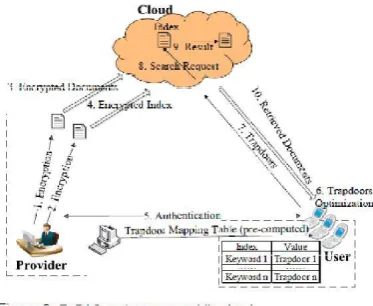
networks incur longer network latency, which can slow down a single search request if the search request requires many network round trips. For example, in the traditional design shown in Figure 1, a single search requires three round trips and results in notable latency for wireless communication.
2) Poor connectivity: Mobile devices are
normally incapable of maintaining a long-running connection with the Cloud, mostly for energy-saving purposes. Multiple search requests could incur numerous re-connection operations and extra authentication costs.
3) Low network transmission rate: Mobile
devices are normally equipped with low-power transmission components, bringing slower transmission
rates.
Advantages:
We proposed a novel encrypted search system EnDAS over the mobile cloud, which improves network traffic and search time efficiency compared with the traditional system. We started with a thorough analysis of the traditional encrypted search system and.
analyzed its bottlenecks in the mobile cloud: network traffic and search time inefficiency. Then we developed an efficient architecture of EnDAS which is suitable for the mobile cloud to address these issues, where we utilized the TMT module. RSBS algorithm to cope with the inefficient search time issue, while a trapdoor compression method was employed to reduce network traffic costs. Finally our evaluation study experimentally demonstrates the performance advantages of EnDAS
II. RELATED WORKS
P a g e | 1413
instead of sending undifferentiated results, and further ensures the file retrieval accuracy. Cong Wang et al. [5] has proposed ranked search greatly enhances system usability by returning the matching files in a ranked order regarding to certain relevance criteria (e.g., keyword frequency), thus making one step closer towards practical deployment of privacy-preserving data hosting services in Cloud Computing. Jianfeng Wang et al., [6] has proposed new verifiable fuzzy keyword search scheme based on the symbol-tree which not only supports the fuzzy keyword search, but also enjoys the verifiability of the searching result.
III. PROPOSED SYSTEM
To effectively support an encrypted search scheme with a high security level over cloud data, we introduce a new architecture that is named as traffic and energy efficient encrypted keyword search . The basic idea behind traffic and energy efficient encrypted keyword search is to offload the calculation and the ranking load of the relevance scores to the cloud. It has been highlighted that offloading some computation intensive applications onto the cloud can be an efficient low power design philosophy. Cloud providers can provide computing cycles, and users can use these cycles to
reduce the amounts of computation on mobile systems and save energy. However, at the same time, offloaded applications intend to increase the transmission amount and thus increase the energy consumption from another aspect. This double effects motivates us to carefully redesign the traditional file encrypted search and retrieval process. We first take an overview of major processes for all file encrypted search and retrieval schemes. There are normally three main processes:
The process of authentication is used by the data owner to authenticate the data users.
The file set and its index are stored in the cloud after being encrypted by the data owner during the preprocessing and indexing stages.
The data user searches the files corresponding to a keyword by sending a request to the cloud server in the search and retrieval processes.
A. Modified Process of Search and
Retrieval
During the preprocessing and indexing stages, the data owner gets a TF table as index and
uses Order Preserving Encryption (OPE) to encrypt it. As a result, the cloud server is able to calculate the relevance scores and rank them without decrypting the index. This renders the offloading of the computational load secure and possible.
i) If a data user wants to retrieve the top-k relevant files based on a keyword, he first obtains authentication from the data owner and then receives the keys to encrypt the keyword.
ii)The data user stems the keyword to be queried and encrypts it using the keys.
iii) The data user wraps the encrypted keyword into a tuple, adding some noise to avoid statistic information leak; this tuple is used to perform the retrieval. Then, it is sent to the cloud server together with the number k. The wrap method renders the keywords indistinguishable for an attacker, which will be introduced.
May 2017
P a g e | 1414
user’s mobile clients without performing any decryption on these files.
Fig 1 Encrypted Search architecture for traffic and energy efficient encrypted keyword search
v) The data user decrypts these files in the mobile client and recovers the original data. Comparing Fig 3.3 and Fig 3.4, we conclude that the search and retrieval processes in traffic and energy efficient encrypted keyword search are indeed simplified to a single access than TRS. We call it ORS (One Round trip Search), which offload the computation load of “relevance score calculation” from mobile users to the cloud and can intuitively reduce the communication process between the users and cloud server. Moreover, since the relevance score calculation is offloaded to the cloud server, it directly sends the top-k relevant files back to the data user after it receives the retrieval request, which can also reduce the traffic amount for file retrievals at the same time.
B. Onion Routing
Onion routing is a technique for
anonymous communication over a computer network. In an onion network, messages are encapsulated in layers of encryption, analogous to layers of an onion. The encrypted data is transmitted through a series of network nodes called onion routers, each of which "peels" away a single layer, uncovering the data's next
destination. When the final layer is decrypted, the message arrives at its destination. The sender remains anonymous because each intermediary knows only the location of the immediately preceding and following nodes. An onion is the data structure formed by "wrapping" a message with successive layers of encryption to be decrypted ("peeled" or "unwrapped") by as many intermediary computers as there are layers before arriving at its destination. The original message remains hidden as it is transferred from one node to the next, and no intermediary knows both the origin and final destination of the data, allowing the sender to remain anonymous.
C.Modules
Data Owner Module
The data owner should build a TF table as index and encrypt it using OPE in order to offload the calculation and ranking load of the relevance scores to the cloud. So as to control the statistics information leak, we implement our one-to-many OPE in the data owner module. The authentication between the data owner and the data user is provided in order to ensure the security of traffic and energy efficient encrypted keyword search . In the case of the term frequency (TF) tf (t, d), the simplest choice is to use the raw frequency of a term in a document, i.e. the number of times that term t occurs in document d. If we denote the raw frequency of t by f(t, d), then the simple TF scheme is tf (t, d) = f(t, d).
Fig 2 Data flow diagram for data owner module
P a g e | 1415
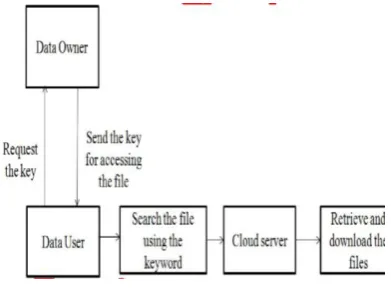
The data user sends his identity to the data owner and gets the secret keys if authenticated. An
authenticated user stems the keyword to be queried, encrypts it with the keys and hashes it to get its entry in the index. Then the encrypted keyword is sent to the cloud server. On receiving the encrypted keyword, the cloud server will find the top-k relevant files and sent back to the data user where the top-k is configured by the users. The data user decrypts the files and recovers the original data.
Fig 3 Data flow diagram for data owner module
Cloud Server Module
During the file retrieval process, the authenticated data user sends the encrypted keywords to
the cloud server and gets top-k ranked files back.
Fig 4 Data flow diagram for cloud server
IV SIMULATION RESULTS
The implementation of this project is done using JAVA. JAVA is an object oriented
programming language which derives much of its syntax from C and C++ but has a simpler object model and fewer low-level facilities. Programs written in Java are executed at a greater speed.
V. CONCLUSION
In this project , as an initial attempt to create a traffic and energy efficient encrypted keyword search tool over mobile cloud storages. The security study of traffic and energy efficient encrypted keyword search showed that it is secure enough for mobile cloud computing, while a series of experiments highlighted its efficiency. Traffic and energy efficient encrypted keyword search is slightly more time and energy consuming than keyword search over plain-text, but at the same time it saves significant energy compared to traditional strategies featuring a similar security level.
REFERENCES
[1] Ankur Verma, Bhagyashri Patki, Priyanka Sawant, Prajkta Waingankar and Dike Onkar D
(2015), “Efficient Similarity Search over Encrypted Data on Cloud”, International Journal of Current Engineering and Technology E-ISSN 2277 – 4106, P-ISSN 2347 – 5161
[2] Antti P. Miettinen Jukka K. Nurminen (2010) “Energy efficiency of mobile clients in cloud computing”, dl.acm.org/citation.cfm?id=1863107
[3] Bing Wang, Shucheng Yuy, Wenjing Lou Y., Thomas Hou, (2014) “Privacy-Preserving Multi-Keyword Fuzzy Search over Encrypted Data in the Cloud” IEEE Transactions on cloud computing
May 2017
P a g e | 1416
Search over Outsourced Cloud Data”, IEEE Transactions on parallel and distributed systems, vol. 23, no.
8.
[5] Cong Wang, Ning Cao, Jin Li, Kui Ren, and Wenjing Lou (2010) “Secure
Ranked Keyword Search over
Encrypted Cloud Data”,
dl.acm.org/citation.cfm?id=1846307
[6] Jianfeng Wang et al., (2013) “Efficient Verifiable Fuzzy Keyword Search over Encrypted Data in Cloud Computing” , Journal of Computer Science and Information system, volume
10, Issue 2.
[7] Jon Oberheide, Kaushik
Veeraraghavan, Evan Cooke, Jason Flinn, Farnam Jahanian (2010)
“Virtualized In-Cloud Security Services for Mobile Devices”, https://jon.oberheide.org/files/mobivirt 08-mobilecloud.pdf
[8] Li Chen, Xingming Sun, Zhihua Xiaand Qi Liu (2014) “ An Efficient and Privacy-Preserving Semantic Multi-Keyword Ranked Search over Encrypted Cloud” Data International Journal of Security and Its Applications Vol.8, No.2, pp.323-332 [9] Ming Li et al., (2013) “Toward
Privacy-Assured and Searchable Cloud Data Storage
Services”, IEEE Transactions on Network, volume 27, Issue 4.
[10] Zachary A. Kissel, and Jie Wang,
(2013) “Verifiable Symmetric
Searchable Encryption for Multiple
Groups of Users”,