PIRMAP: Efficient Private Information Retrieval
for MapReduce
Travis Mayberry, Erik-Oliver Blass, and Agnes Hui Chan
College of Computer and Information Science Northeastern University, Boston MA-02115, USA {travism,blass,ahchan}@ccs.neu.edu
Abstract. Private Information Retrieval (PIR) allows a user to retrieve bits from a database while hiding the user’s access pattern. However, the practicality of PIR in a real-world cloud computing setting has recently been questioned. In such a setting, PIR’s enormous computation and communication overhead is expected to outweigh the cost saving advantages of cloud computing. In this paper, we first examine existing PIR protocols, analyzing their efficiency and practicality in realistic cloud settings. We identify shortcomings and, subsequently, present an efficient protocol (PIRMAP) that is particularly suited to MapReduce, a widely used cloud computing paradigm. PIRMAP focuses especially on the retrieval of large files from the cloud, where it achieves good communication complex-ity with query times significantly faster than previous schemes. To achieve this, PIRMAP enhance related work to allow for optimal parallel computation during the “Map” phase of MapReduce, and homomorphic aggregation in the “Reduce” phase. To improve computational cost, we also employ a new, faster “somewhat homomorphic” encryption, making our scheme practical for databases of use-ful size while still keeping communication costs low. PIRMAP has been imple-mented and tested in Amazon’s public cloud with database sizes of up to 1 TByte. Our evaluation shows that non-trivial PIR such as PIRMAP can be more than one order of magnitude cheaper and faster than trivial PIR in the real-world.
Keywords: Privacy, MapReduce, cloud computing, Private Information Retrieval
1
Introduction
Cloud computing has recently been identified as an important business technology [10], as it offers greater flexibility and reduced costs to companies outsourcing data and com-putation. The cost advantage of cloud computing comes from the fact that cloud users do not need to maintain their own, expensive data center, but instead can pay a cloud provider for hosting. However, despite the hype, hesitations remain among potential cloud users. Lack of security and privacy guarantees has been identified as a major adoption obstacle for both large enterprise [19] and governmental organizations [14].
are realistic and have already been reported [11, 21]. This shows that users need to take precautions to ensure the privacy and integrity of their cloud data.
While encryption of data at rest helps to protect data confidentiality, it is often not sufficient: the subsequent data access patterns can leak information about patients. For example, if the outsourced data in question contains encrypted patient records, the cloud provider might learn that a patient has been diagnosed with cancer when it sees that the patient’s records have been retrieved by an oncologist. In general, it is hard to assess which information may be leaked, what inferences an adversary may make, and what risks the leakage may incur.
Private Information Retrieval (PIR) offers a solution to the information leakage problem by hiding access patterns [6, 12], independent of an encryption mechanism. In PIR, a database stored at a server holdsnstrings each of sizelbits, and a user can query for onel bit string without leakingwhich string to the database. A trivial way to accomplish this is to simply transmit the entire database to the user. However, this iscommunicationinefficient, and research focuses on achieving lower communication bounds. In contrast,computationalcost of every PIR scheme is necessarilyO(n·l), as the server must “touch” every piece of the database if the server is to remain oblivious of the requested piece.
In existing work, the server’s computation is comprised of expensive cryptographic operations over the entire database. Because of the significant overhead this imposes, it has recently been questioned whether PIR will ever becomepracticalin a real-world cloud computing setting, cf. Sion and Carbunar [18]. Typically, cloud providers such as Amazon charge their customers for both data transferandCPU hours [2]. Due to the necessary condition that PIR protocols compute over the entire database for each query, it has been argued that trivial PIR (retrieving the whole(l·n)bit database) is not only faster, but alsocheaperfor the cloud customer compared to a PIR query that involves lengthy computation [5, 16, 18].
Another open question is how to perform PIR in a real-world cloud computing en-vironment. In contrast to a single machine server storing the data, one of the biggest challenges in cloud computing is a design that scales easily to the large distributed systems which are characteristic in cloud settings. In order to alleviate this difficulty, major cloud providers (e.g., Amazon, Google, IBM, Microsoft) offer an interface to the prominent MapReduce [8] API for distributed computing to their users. MapReduce comprises not only parallelization (“Map”) of work, but an aggregation (“Reduce”) of individual results to keep computational burden on the user side low.
This paper considers the single-server, computationally-private information retrieval setting. This is appropriate, because, although a cloud provider may allow access to many servers, they must all be considered a single “trust entity”: they are under the control of the same organization. Trust-wise, the cloud as a single, large server with many distributed CPUs. In the single-server setting, it is known that unconditionally secure PIR cannot be more efficient than transferring the entire database [7], so we are concerned instead with a computationally secure protocol (cPIR). Further use of the term PIR will be in reference to computationally-secure PIR, unless otherwise noted.
setting than considered by previous work. In a scenario withnfiles each of sizelbits andl≫n, PIRMAP achieves communication complexity linear inlwith low constants. PIRMAP is designed for and leverages MapReduce parallelization and aggregation. We have implemented PIRMAP in Hadoop MapReduce, and its performance will be presented in Section 5.
Our contributions are:
1.)An analysis of existing work with respect to its practicality in a MapReduce cloud setting.
2.)PIRMAP, an efficient, practical PIR scheme for MapReduce with optimal com-munication complexity O(l) when retrieving an l bit file for l ≫ n. Additionally, PIRMAP has computational complexity as good or better than prominent related work due to use of a more efficient homomorphic encryption. PIRMAP runs on top of stan-dard MapReduce, not requiring changes to the underlying cloud infrastructure.
3.)An implementation of PIRMAP that is usable in real-world MapReduce clouds today, e.g., Amazon. We evaluate PIRMAP, first, in our own (tiny) local cloud and, sec-ond, with Amazon’s cloud. We verify its practicality by scaling up to 1 TByte of data in Amazon’s cloud setting. Compared to the previously largest single database PIR exper-iment with up to 28 GByte of data [16], this demonstrates the efficiency and practicality of PIRMAP in the real-world. PIRMAP is more than one order of magnitudecheaper andfasterthan trivial PIR, and – in our particular scenario – we can significantly out-perform related work. PIRMAP’s source code is available for download [17].
2
Problem Statement
PIR:A PIR protocol is a series of interactions between a user and a server storingn files that results in the user retrieving one file while the server does not learn which file. More formally, the server cannot guess with probability greater than1/nwhich file was queried. Note that this probability does not increase over multiple queries. This effec-tively hides the user’s access pattern as each query is computationally indistinguishable from the others. The only information leaked is the number of files queried.
ACP IRlnprotocol(Query,Transfer,Recover)is a computationally-secure pri-vate information retrieval protocol over a database ofnelements, each of bit lengthl. TheQueryfunction generates the query and sends it to the server.Transferis run on the server and involves transforming the received query into the results of the query and sending it back to the client. Finally,Recoveris run by the client to transform the response from the server into the correct plaintext query result.
MapReduce:With the trend towards more computers and more cores rather than
by splitting computation into two phases, each of which can be run in parallel on many computing nodes.
The first phase is called the “Map” phase. MapReduce will automatically split the input to the computation equally among available nodes in the cloud data center, and each node will then run a function calledmapon their respective pieces (called Input-Splits). It is important to note that the splitting actually occurs when the data is uploaded into the cloud (in our case when the patient record/files are uploaded) and not when the job is run. This means that each “mapper” node will have local access to its InputSplit as soon as computation has started and you avoid a lengthy copying and distributing pe-riod. The map function runs a user defined computation on each InputSplit and outputs a number ofkey-valuepairs that go into the next phase.
The second phase, “Reduce”, takes as input all of the key-value pairs emitted by the mappers and sends them “reducer” nodes in the data center. Specifically, each reducer node receives a single key, along with the sequence of values output by the mappers which share that key. The reducers then take each set and combine it in some way, outputting a single value for each key.
Despite being widely used, MapReduce is a very specific computational model and not all algorithms can be easily adapted to it. A practical PIR such as PIRMAP has to take its specifics into account – as we will see below.
3
Related Work Analysis
Despite the large amount of theoretical research, there has not been much investigation into practical PIR. Recently, Trostle and Parrish [20] experimented with the state of the art and found that it took at least 8 minutes to retrieve a file of size only 3 MB, out of a data set of 3 GB on commodity hardware. Additionally, existing schemes have sig-nificant communication overhead for files of that size and larger. For example, Lipmaa [13], enjoying the most efficient asymptotic communication complexity today, requires 30 MB of communication in the above scenario.
In examining related work, we make two nonstandard observations which apply to our MapReduce cloud setting. First, since computation for PIR must necessarily be O(n·l), computation will most likely be the bottleneck in any protocol. The time to communicate queries and responses will be relatively small in our setting, compared to the time it takes to calculate over the entire database. Therefore, it may be useful to trade some extra communication for smaller computational burden. The second observation relates to MapReduce itself. Since each mapper may run on a different node in the cloud, communication and synchronization within the cloud are very expensive. To take full advantage of the cloud, there should be few, if any, inter-dependencies between stages of computation.
Overview One of the first cPIR schemes to achieve sublinear communication is that of Kushilevitz and Ostrovsky [12], using an additively homomorphic cipherEas follows:
1. The server arranges annelements database as a√n×√nmatrix
2. Query(x)– The user generates a vectorv of length√nwherevx = E(1), and
3. Transfer(v) – Vector v is sent to the server. The server multiplies v with the database matrix and returns the result as vectorv′
4. Recover(v′)– v′ now consists of√nencrypted elements, one of which is the element the user is interested in. The user chooses this element and decrypts it, discarding the rest.
The scheme is sound, because the user sends a vectorvwhich “zeroes out” all the rows in the matrix besides the row requested. The communication costs isO(l·√n)
which is still quite high for large values of n. Kushilevitz and Ostrovsky [12] also show that this protocol can be repeated recursively to achieve communication less than O(nc)for anyc >0, but at the cost of worse constants and computational complexity. This “square-root solution” computes only once over the database, but has impractically large communication costs.
Lipmaa [13] reduces communication complexity toO(l·logn+k·log2n), where k is a security parameter. This is accomplished by generalizing the Kushilevitz and Ostrovsky [12] scheme into a family of protocols, parameterized by a dimension α. The Kushilevitz and Ostrovsky [12] scheme can be seen as two-dimensional, because the database elements are arranged in a√n×√nmatrix. Ifα= log(n), the database is viewed as a log(n)dimensional2×2×. . . ×2 matrix. In this manner, the user may send a sequence oflog(n)vectors, each only length 2 which “zero out” half of the remaining database elements at each step. It is conceptually similar to specifying a path in a binary tree, and when the leaf node is reached the only element that will remain non-zero is the one corresponding to that node.
The down side of this scheme is that it requires computing over the entire database twice(∑logi=1n21i = 2). While not a significant problem asymptotically, as mentioned
before, cPIR schemes are usually bottlenecked by their computational cost. Increasing this cost by 100% dramatically effects the efficiency of the scheme, especially given the cloud setting where twice the computation corresponds to twice the monetary cost. Another problem is that the computational complexity of Lipmaa [13] isO(n·l·k2),
because it requires modular exponentiations on ciphertexts of sizek. This is a significant overhead that we can avoid by using a more efficient homomorphism.
Although Lipmaa [13] requires only one round of communication with the user, it is iterative in that it requireslog(n)rounds of computation on the server, each round depending on the output of the previous round and operating on a smaller set of data. As we will see, a large part of the cost for MapReduce is in initializing the parallel computation, so restarting MapReducelog(n)times adds a significant overhead.
More recently, Aguilar-Melchor and Gaborit [1] have proposed a scheme using lattice-based homomorphic encryption (similar to NTRU) which has much better com-putational complexity, both asymptotically and in practice. Their scheme also takes advantage of the fact that modern GPUs can solve large parallel problems very quickly. Aguilar-Melchor and Gaborit [1] are able to achieve fast query response times, but at the cost of a large communication cost. Additionally, their protocol is tuned specifically to the requirements of GPUs and would not scale well in a real-world distributed cloud environment like MapReduce.
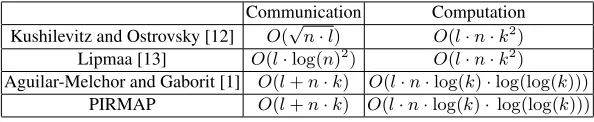
Table 1: Communication and computational complexities of related work. Communication Computation
Kushilevitz and Ostrovsky [12] O(√n·l) O(l·n·k2)
Lipmaa [13] O(l·log(n)2) O(l·n·k2)
Aguilar-Melchor and Gaborit [1] O(l+n·k) O(l·n·log(k)·log(log(k)))
PIRMAP O(l+n·k) O(l·n·log(k)·log(log(k)))
and Ostrovsky [12]. They also achieve much faster query response, but again, with large communication costs.
Comparison of existing work To understand how existing work compares and is suited to the application targeted in this paper, we start by examining asymptotic computation and communication complexities in Table 1. We can see that Lipmaa [13] has very good communication complexity with relatively bad computational complexity, while Aguilar-Melchor and Gaborit [1] have the opposite. While our protocol PIRMAP has the same asymptotic complexities than Aguilar-Melchor and Gaborit [1], this does not adequately describe the costs involved with PIR: we are primarily addressing a concrete, practical setting where constants become very important.
Consequently, in Table 2, we present analytically calculated communication costs for specific database and file sizes. Aguilar-Melchor and Gaborit [1] state that their requests are of size 25kb·nand the responses are6·l. For databases withl > n· k, Lipmaa [13] requires transmitting log2(n)elements of size k in the request and receiving a response of sizelog(n)·l. We chose to usek = 2048, as suggested by Lipmaa [13].
In Table 2, we can see that even though Lipmaa [13] has good asymptotic commu-nication, there is room for improvement in a concrete setting, especially for databases composed of large files. Aguilar-Melchor and Gaborit [1], similarly to PIRMAP, is designed specifically for these types of databases but it also has relatively high commu-nication costs due to large constants.
Table 2: Real communication costs of related work in MB for different database sizes.
1 MB Files 5 MB Files 10 MB Files
1 GB 10 GB 100 GB 1 GB 10 GB 100 GB 1 GB 10 GB 100 GB
Lipmaa 10 13 17 38 55 71 66 100 133
Aguilar-Gaborit 29 240 2350 35 77 499 62 83 295
PIRMAP 3 6 38 11 12 18 22 22 26
4
PIRMAP
PIRMAP modifies the PIR protocol by Lipmaa [13], specifically addressing the short-comings perceived in regards to retrieval of large files in a parallelization-aggregation computation framework such as MapReduce. We start by giving an overview of PIRMAP which can be used withanyadditively homomorphic encryption scheme.
Upload.In the following, we assume that the cloud user has already uploaded its files into the cloud using the interface provided by the cloud provider.
Query.Our data set holdsnfiles, each oflbits length. Additional parameterk spec-ifies the block size of a cipher. For ease of presentation, we consider the case where all files are the same length, but PIRMAP can easily be extended to accommodate variable length files using padding. PIRMAP is summarized as follows:
1. Query– If the user wishes to retrieve file1≤x≤nout of thenfiles, he creates a vectorv = (v1, . . . , vn), wherevx = E(1)andvi = E(0)∀i ̸= x. Here,E is
any IND-CPA additively homomorphic encryption scheme. The user sendsvto the cloud.
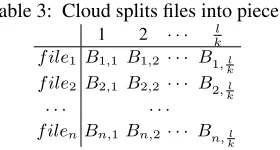
2. Multiply– The cloud arranges files into a table T similar to Table 3. The cloud divides each fileiinto kl blocks{Bi,1, . . . , Bi,l
k}and multiplies each block byvi,
i.e.,B′i,j=vi·Bi,j. Here, “·” denotes scalar multiplication.
3. Sum– The cloud adds column-wise to create one result vectorr= (r1, . . . , rl k).
Each elementriof that vector is of sizek, so the total bit length ofrislbits. Vector
ris an encryption of filex. Vectorris returned to the user who decrypts it.
Table 3: Cloud splits files into pieces 1 2 · · · kl f ile1 B1,1 B1,2 · · · B1,l
k
f ile2 B2,1 B2,2 · · · B2,l k
· · · · · · f ilenBn,1 Bn,2 · · · Bn,l
k
The computation consists of multiplying each of then· l
k blocks by a value in the
request vector and then performing(n−1)· kl additions to obtain the final sum. The computational complexity of this scheme isO(n·l·M(k) + (n−1)·l·A(k), where M(k)is the cost of performing one scalar multiplication in the additively homomorphic encryption system, andA(k)is the cost of one addition. The communication complexity can be broken down into two parts: user to cloud and cloud to user. The user sends a vector of sizencontaining ciphertexts of sizek, so the bandwidth complexity user-cloud isO(n·k). The cloud sends back a vector ofkl entries, each of sizeO(k), resulting in complexityO(l). This results in the overall communication complexity ofO(n·k+l).
PIRMAP achieves better overhead than related work [4, 13] in practice, due to the specific values of n andl in our setting. Existing work in PIR is efficient onlyfor data sets with large values fornand small values forl. PIRMAP would do poorly in that setting, because the complexity would be dominated by n. However, PIRMAP’s cloud-to-user communication isoptimalatO(l), because the cloud must send back a message at least the size of the file the user queries for. For values of l larger than n·k, PIRMAP allows for complexity ofO(l)with small constants. We argue that in practice this is often true. For example, if a user has a 1 TB data set of 10 MB files,
l
n ≈ 800. In contrast, under the same conditions, arranging the files in a
√
n×√n matrix would result in a download cost of 1024·10MB ≈ 10GB. Even if n > l, the actual communication costs are low for practical choices of the parameters, see Section 5. Many cloud providers such as Amazon do not charge the user for uploads, but only for downloads. This is an additional benefit of our scheme, because the query result (communication the user is charged for) is always very close to optimal, even when the overall communication is not.
Our assumption ofl > nis realistic and useful for many real-world applications. For example, medical records may contain one or more images (x-ray, MRI, etc) which would make them several megabytes at the very least.
Optimization:Although the cloud performs most of the computation in this scheme,
the user is still required to generate a vector of ciphertexts of lengthnand then decrypt the resulting response. As encryption is relatively expensive for additive IND-CPA ci-phers, this might require a non-trivial amount of computation that might hurt, e.g., users with low-powered devices such as smartphones. A way to alleviate this problem is to have a moderately powerful trusted server to pre-generate vectors of ciphertexts and up-load them to the cloud for the users to use. This trusted server would generatem “dis-posable” vectors of sizensuch thatVi,j=E(1)wherej= HMAC(i)andVi,j=E(0)
Although the particular encryption scheme we use (see Section 4.2 below) can per-form encryptions very quickly and does not require the use of this optimization, we point it out as a general improvement regardless of the cipher used.
4.1 PIRMAP Specification
In our protocol, the cloud performs two operations: multiplication of each block by the corresponding value in the “PIR vector”v, and column-wise addition to construct the encrypted file chosen by the user. These two stages translate exactly to map and reduce implementations respectively. The files will be distributed evenly over all participating nodes where the map function will split each file into blocks and multiply the blocks by the correct encrypted value. The output of these mappers is a set of key-value pairs where the key is the index of the block, and the value is the product of the block and encrypted PIR value. These values are all passed on to the reducers, which take a set of values for each key (block position or column) and add them together to get the final value for each block.
Being interested inf ilex, the user executes the aboveQueryto computevwhich is
sent to the MapReduce cloud. There, each mapper node evaluatesMultiplyon its locally stored file and generates key-values pairs for the reducer. The reducer simply computes theSumstep by adding all values with the same key and sending them back to the user. The user receives kl values of sizekfrom the reducers and decrypts to getf ilex.
User Cloud
functionGenQuery(n, x) v:={}
fori= 1to ndo ifi=xthen
vi:=E(1) else
vi:=E(0) end if end for end function
functionMap(f ile, v) fori= 1to ndo
c:=Bi·vi Emit(i, c)
end for end function
functionReduce(key, v) total:= 0
fori= 1to ndo total:=total+vi end for
Emit(key, total)
end function
4.2 Encryption Scheme
Since the map phase of our protocol involves multiplying every piece of the data set by an encrypted PIR value, it is important that we choose an efficient cryptosystem. Tra-ditional additively homormorphic cryptosystems, such as Paillier’s, use some form of multiplication as their homomorphism. That is, for elementsaandb,E(a)· E(b) =
E(a+b). Since our map phase consists of multiplying ciphertexts by unencrypted scalars, we would have to do exponentiation of a ciphertext. PIRMAP, and all PIR schemes, must compute on the whole data set, so this step would be computationally intensive.
trapdoor group assumption. Fully homomorphic encryption schemes support an unlim-ited number of computations without increasing the size of the ciphertexts. In contrast, this scheme results in ciphertexts which grow in size byO(log2n)bits fornadditions. In return for this size increase, we can have an encryption scheme where the additive homomorphism is integer addition. This scheme encryptsnbits with security parameter k > nas follows:
KeyGen(1k): Generate a primemofkbits and a randomb < m;bandmare secret.
EncryptE(x) =b·(r·2n+x) modm, for a randomr
DecryptD(c) =b−1·c modm mod 2n
This encryption has the desired homomorphic propertyE(a) +E(b) = E(a+b). This scheme issomewhat homomorphic, because it cannot support an unlimited number of additions. When two ciphertextsc1andc2are added, you can express the sum as
b·(r1·2n+x1) +b·(r2·2n+x2) =b·([r1+r2]·2n+x1+x2).
Asmremains secret, note that the cloud performs addition as integer addition, not modulom. If the inside term(r1+r2)·2n+x1+x2exceedsmand “wraps around”,
then it will not be decrypted correctly, because application of the modulus will cause a loss of information. The modulusmmust be chosen large enough to support the number of additions expected to occur. To supporttadditions,mshould be increased bylog2t
bits. Additionally, each scalar multiplication can be thought of as up to2n additions, meaning that the size of m must be doubled for each supported scalar product. For our PIR scheme, mmust be chosen to beO(2k+ log2(n))to support the required
homomorphic operations.
In return for the reasonable increase in ciphertext size caused by the larger modulus (about 300% in our evaluations in Section 5), we are able to do very efficient computa-tions over the encrypted data. Additionally, encryption is equivalent to only two multi-plications, an addition and a modular reduction, while decryption is one multiplication and a reduction. This compares very favorably with other homomorphic encryption schemes, such as Paillier, requiring a modular exponentiation.
With our encryption scheme defined, we can now express more precise computa-tional complexities for the protocol. Our previous complexity was parameterized over M(k) and A(k), the complexity of scalar multiplication and addition, respectively. For our encryption, addition is simply regular integer addition. Since each cipher text is at most 2k+ log2(n) bits long, addition is O(2k + log2(n)). We can do scalar
multiplication as integer multiplication as well. Integer multiplication can be done for mbits inO(mlog(m) log(log(m)))[9], so M(k) = O(2k+ log2(n) log(2k+ log2(n)) log(log(2k+ log2(n)))). The complexity is then dominated by the
multipli-cation cost and results in:
O(n· l
k ·(k+ log(n)) log(k+ log(n)) log(log(k+ log(n)))) (1)
=O((n·l+n·log(n)) log(k+ log(n)) log(log(k+ log(n)))) (2)
server has the resources to find key(m, k)by brute force. This allows us to simplify to O(n·l· log(k)· log(log(k))).
4.3 Privacy Analysis
PIRMAP inherits privacy properties of the work it is based on, i.e., Lipmaa [13] and the PIR variant by Trostle and Parrish [20]. In the following, we sketch our privacy rationale.
PIRMAP is privacy-preserving,iffan adversary (the cloud) cannot guess, after each query, with probability greater than1/n, which file was retrieved by the user after an invocation of the protocol. There are two pieces of information that the adversary has access to: the set of uploaded files and the vectorvof PIR values. The uploaded files are independent of any encryption used in the PIR protocol and can be efficiently simulated by the adversary. Therefore, privacy depends only onv.
Vectorvcontains many encryptions of “0” and one encryption of “1”. The problem of determining which file was selected is then equivalent to distinguishingbetween encryptions of “0” and encryptions of “1” in the underlying encryption. However, the scheme we use is provably secure against distinguishing under the Trapdoor Group Assumption [20]. Consequently, PIRMAP preserves user privacy.
5
Evaluation
We have evaluated the performance of our scheme in three contexts: a local “cloud” (a single server with multiple CPUs), a commodity laptop, and Amazon’s EC2 cloud using Elastic MapReduce [2]. We have implemented PIRMAP in Java for standard Hadoop MapReduce version 1.0.3 and the source code is available for download [17].
5.1 Setup
Local We used a local server to prototype and debug our application and to do de-tailed timing analysis requiring many runs of MapReduce. This server, running Arch Linux 2011.08.19, has a dual 2.4 GHz quad-core Xeon E-5620 processor and 48 GB of memory. Based on specs and benchmark results, this local server is closest to an “EC2 Quadruple Extra Large” instance, which has dual 2.9 GHz quad-core Xeon X-5570 processors and 24 GB of memory.
100 200 500 1000 2000 5000 10000
10 20 30 40 50 60 70 80 90 100
Time (s)
Total amount of data (GByte) Trivial PIR
PIRMAP Baseline
Fig. 1: Time per query, local server
0.01 0.02 0.05 0.1 0.2 0.5 1 2 5 10
10 20 30 40 50 60 70 80 90 100
Cost ($)
Total amount of data (GByte) Trivial PIR
PIRMAP Baseline
Fig. 2: Cost per query, local server
100 200 500 1000 2000 5000 10000 20000 50000 100000
50 100 150 200 1000
Time (s)
Total amount of data (GByte) Trivial PIR PIRMAP Baseline
Fig. 3: Time per query, Amazon
2 5 10 15 20 50 100
50 100 150 200 1000
Cost ($)
Total amount of data (GByte) Trivial PIR
PIRMAP Baseline
Fig. 4: Cost per query, Amazon
and time required foranyPIR scheme that uses MapReduce, independent of the en-cryption and exact PIR method used.
To highlight the advantage of computational PIR, we have also included the time and cost required for the “trivial” PIR scheme. The trivial scheme is one where the user downloads the entire data set and simply discards the files he is not interested in. This is very bandwidth intensive, but computationally lightweight. Sion and Carbunar [18] conjecture this trivial PIR to be the most cost effective in the real-world. We have calcu-lated the cost based on the amount that Amazon charges to download the corresponding amount of data and the time based on a 11.28 Mbps connection, an average as reported by Nasuni [15]. Note that we generally do not count the cost for long-term storage of data at Amazon. Although potentially significant for large amounts of data, the user has to pay for this regardless of whether he wants queries to be privacy-preserving or not. PIRMAP does not increase the amount of storage in Amazon.
shows that query generation is not very taxing. To compare with Lipmaa [13], we used
openssl speed rsato time determine how many RSA private key operations can
be computed per second. Each scalar multiplication in that scheme is equivalent to one modular exponentiation, or one RSA private key operation as required by Lipmaa [13]. This estimation is quite generous for Lipmaa [13], because it does not include disk ac-cess or homomorphic additions (modular multiplication), but we believe it is close due to the time being largely dominated by exponentiations.
Table 4: Query time in minutes, including generation, evaluation, and decryption, for databases of varying sizes, composed of 5 MB files.
5 GB 10 GB 15 GB 20 GB 25 GB 30 GB Lipmaa 1852 3704 5508 7312 9116 10920
Aguilar-Gaborit 4 7 11 14 17 20
PIRMAP 1 2 3 3 4 4
Amazon Besides the local experiments, to demonstrate the scalability of PIRMAP, we have also evaluated it on Amazon’s Elastic MapReduce cloud. Amazon imposes a maximum limit of 20 instances per MapReduce job by default. In keeping with this restriction, we used 20 “Cluster Compute Eight Extra Large” instances which each having dual eight-core Xeon E5-2670 processors and 64 GB of RAM.
5.2 Results
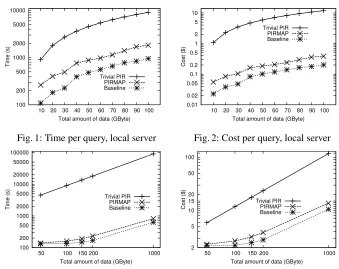
Time and total cost:Figures 1 to 4 show our evaluation results. Figures 1 and 2 show the local server evaluation, while figures 3 and 4 show evaluation with Amazon. In each figure, the x-axis shows the total amount of data stored at the cloud, i.e., number of files ntimes file sizel. The y-axis shows either the time elapsed (for the whole query from the time the user submits the query until MapReduce returns the result back) or the cost implied with the query. In all four graphs, we scale the y-axis logarithmically, and in figures 3 and 4 we also scale the x-axis logarithmically. Each data point represents the average of at least 3 runs. Relative standard deviation was low at≈5%.
To verify the impact of varying file sizesl, for our local evaluation, we show results with file sizes of 1 MB and 3 MB, attaining approximately equal runtime in both cases. This is to be expected because, in each data point, we have fixed the size of the database so varying retrieval sizes merely reshapes the matrix without changing the number of elements in it. The execution is dominated by the scalar multiplications that occur dur-ing the map phase, and the same number of those is required no matter the dimension of the matrix.
unrealistic optimum, PIRMAP introduces only20%of overhead in the case of Amazon. Locally, we experience slightly larger overhead of100%. This is because executing on Amazon has a much higher “administrative” cost due to the higher number of nodes and more distributed setting. These results indicate not only PIRMAP’s efficiency over Trivial PIR and Baseline, but also its real-world practicality: in a small database com-prising 10,000 files of size 1 MB each (10 GByte), a user can retrieve a single record in ≈3min for only≈$0.03. In a huge data set with1,000,000files, a single file can be retrieved in≈13min for≈$14. In scenarios where it is necessary to retrieve data in a fully privacy-preserving manner, we conjecture that this to be acceptable.
Although a comparison with related research is not straightforward (as PIRMAP tar-gets a very special scenario), we put our results into perspective with those of Aguilar and Lipmaa. We show that, while Lipmaa’s scheme has very good communication plexity in all cases, it is completely impractical due to the enormous amount of com-putation needed to respond to queries. We also show that our scheme is comparable with that of Aguilar, in terms of computation, and beats it in communication cost by a significant margin.
Query Generation and Decryption:Due to the efficiency of the encryption in
PIRMAP, PIR query generation is very fast. One ciphertext (element ofv) is generated for each file in the cloud, so the generation time is directly proportional to the number of files. We omit in-depth analysis, but in our trials on our commodity laptop running on a single core it takes about 2.5 seconds per 100,000 files in the cloud. Decryption is slightly more expensive than encryption, but we still managed, on the same machine, to decrypt approximately 3 MB per second. We conclude this overhead to be feasible for the real-world.
Bandwith: PIRMAP introduces bandwith overhead, 1.) to upload v, and 2.) to
downloadthe encrypted version of the file. For security, we setk= 2048bit, so each of thenelements of vector v has size 2048 bit. For a data set with 10,000 files (10 GByte), this requires the user to upload≈2.5MByte. As this can become significant with larger number of files, we suggest to then use the optimization in Section 4, espe-cially for constrained devices.
6
Conclusion
Retrieval of previously outsourced data in a privacy-preserving manner is an important requirement in the face of an untrusted cloud provider. PIRMAP is the first practical PIR mechanism suited to real-world cloud computing. In the case where a cloud user wishes to privately retrieve large files from an untrusted cloud, PIRMAP is communica-tion efficient. Designed for prominent MapReduce clouds, it leverages their parallelism and aggregation phases for maximum performance. Our analysis shows that PIRMAP is an order of magnitude more efficient than trivial PIR and introduces acceptable over-head over non-privacy-preserving data retrieval. Additionally, we have shown that our scheme can scale to cloud stores of up to 1 TB on Amazon’s Elastic MapReduce.
Bibliography
[1] C. Aguilar-Melchor and P. Gaborit. A Lattice-Based Computationally-Efficient Private In-formation Retrieval Protocol, 2007.http://eprint.iacr.org/2007/446.pdf. [2] Amazon. Elastic MapReduce, 2010. http://aws.amazon.com/
elasticmapreduce/.
[3] E.-O. Blass, R. Di Pietro, R. Molva, and M. ¨Onen. PRISM – Privacy-Preserving Search in MapReduce. InProceedings of Privacy Enhancing Technologies Symposium, pages 180– 200, Vigo, Spain, 2012. ISBN 978-3-642-31679-1.
[4] C. Cachin, S. Micali, and M. Stadler. Computationally private information retrieval with polylogarithmic communication. InAdvances in Cryptology, EUROCRYPT, pages 402– 414, Prague, Czech Republic, 1999.
[5] Y. Chen and R. Sion. On securing untrusted clouds with cryptography. InWorkshop on Privacy in the Electronic Society, pages 109–114, Chicago, USA, 2010.
[6] B. Chor, O. Goldreich, and E. Kushilevitz. Private Information Retrieval. InProceedings of Symposium on Foundations of Computer Science, 1995.
[7] B. Chor, O. Goldreich, E. Kushilevitz, and M. Sudan. Private Information Retrieval. In Proceedings of Symposium on Foundations of Computer Science, pages 41–50, 1995. [8] J. Dean and S. Ghemawat. MapReduce: Simplified Data Processing on Large Clusters. In
Proceedings of Symposium on Operating System Design and Implementation, pages 137– 150, San Francisco, USA, 2004.
[9] M. F¨urer. Faster integer multiplication. InProceedings of Symposium on Theory of Com-puting, 1997.
[10] Gartner. Gartner Identifies the Top 10 Strategic Technologies for 2011, 2010. http: //www.gartner.com/it/page.jsp?id=1454221.
[11] Google. A new approach to China, 2010. http://googleblog.blogspot.com/ 2010/01/new-approach-to-china.html.
[12] E. Kushilevitz and R. Ostrovsky. Replication is not needed: single database, computationally-private information retrieval. InProceedings of Symposium on Founda-tions of Computer Science, pages 364–373, 1997.
[13] H. Lipmaa. An Oblivious Transfer Protocol with Log-Squared Communication. In Confer-ence on Information Security, pages 314–328, Taipei, Taiwan, 2005.
[14] D. McClure. GSA’s role in supporting development and deployment of cloud computing technology, 2010.http://www.gsa.gov/portal/content/159101.
[15] Nasuni. State of Cloud Storage Providers Industry Benchmark Report, 2011. http://cache.nasuni.com/Resources/Nasuni_Cloud_Storage_ Benchmark_Report.pdf.
[16] F.G. Olumofin and I. Goldberg. Revisiting the Computational Practicality of Private Infor-mation Retrieval. InProceedings of Financial Cryptography, 2011.
[17] PIRMAP. Source Code, 2012.http:/pasmac.ccs.neu.edu.
[18] R. Sion and B. Carbunar. On the Computational Practicality of Private Information Re-trieval. InProceedings of Network and Distributed Systems Security Symposium, pages 1–10, San Diego, USA, 2007.
[19] Symantec. State of Cloud Survey, 2011.http://www.symantec.com.
[20] J. Trostle and A. Parrish. Efficient computationally private information retrieval from anonymity or trapdoor groups. InProceedings of Conference on Information Security, pages 114–128, Boca Raton, USA, 2010.