www.ijiset.com
A Group Policy Based Authentication for Cloud Sharing
M.Sushma1, R. RajaKumar2
1
Dept.of CSE, JNTUA, Andhra Pradesh, India, [email protected]
2
Dept.of CSE, JNTUA, Andhra Pradesh, India,[email protected]
Abstract
In past years, the brisk change of dispersed stockpiling organizations makes it less requesting than at some other time for cloud customers to bestow data to each other. To ensure customers' sureness of the genuineness of their common data on cloud, different frameworks have been proposed for data reliability examining with spotlights on various helpful segments, e.g., the sponsorship of component data, open uprightness assessing, low correspondence/computational survey cost, low stockpiling overhead. Regardless, a substantial segment of these strategies consider that elite the principal data proprietor can adjust the normal data, which limits these techniques to client read-just applications. Starting late, a few attempts started considering more down to earth circumstances by allowing various cloud customers to modify data with trustworthiness accreditation. Eventually, these attempts are still far from realistic as a result of the tremendous computational cost on cloud customers, especially when high mix-up area probability is required by the structure. In this paper, we propose a novel dependability checking on arrangement for cloud data sharing organizations depicted by multi-customer adjustment, open looking at, high bumble area probability, beneficial customer repudiation furthermore practical computational/correspondence investigating execution. Our arrangement can restrict customer impersonate attack, which is not considered in existing methods that sponsorship multi-customer modification. Cluster examining of various assignments is also adequately supported in our arrangement. Wide tests on Amazon EC2 cloud and various client contraptions (contemporary and PDAs) exhibit that our arrangement allows the client to survey the respectability of a common record with a reliable computational cost of 340ms on PC (4.6s on PDA) and a restricted correspondence cost of 77KB for 99% screw up recognizable proof probability with data degradation rate of 1%.
Keywords: TPA, Cloud, Storage model, Integrity, Session, Auditin, Dynamic data.
1. Introduction
THE constant change of cloud frameworks has upheld different open conveyed stockpiling applications. In particular, more conveyed stockpiling applications are being used as facilitated exertion stages, in which data are proceeded in cloud for limit and in addition subject to standard changes from various customers. Certifiable delineations are cloud-based limit synchronization stages, for instance, Drop box for Business and Sugar sync ,
Version Control Systems (VCS, for instance, Subversion and Concurrent Versions System , which engage distinctive partners to work in a condition of agreement, getting to and changing same records on cloud servers wherever at whatever time. For right execution of this kind of aggregate applications, one issue is to ensure data respectability, i.e., each data change operation is to make sure performed by an endorsed assembling part and the data stays set up and update to date starting there. This issue is basic given the way that conveyed stockpiling stages, even clearly comprehended cloud stages, may experience gear/programming frustrations, human errors and outside harmful attacks. In like manner, we watched that there have been inconceivable mistakes between the amounts of data degradation events reported by customers and those perceived by organization suppliers, which moreover makes customers address paying little respect to whether their data on cloud are really set up.
1.1Existing System
www.ijiset.com
private POR arrangement with the support of component data is starting late proposed with Cash et al. [2] by utilizing Oblivious RAM. Albeit various tries have been made to guarantee the respectability of data on remote server, most of them simply consider single data proprietor who has the structure secret key and is the principle party allowed to modify the basic data on cloud. With a particular finished objective to improve the past endeavors to support different researchers, Wang et al. [9] at first proposed an open genuineness inspecting arrangement for shared data on cloud in perspective of ring imprint based homomorphism authenticators. In their arrangement, customer revocation is not considered and the assessing cost creates with social affair size and data size. Starting late, Wang et al. [2] enhanced their past open genuineness affirmation arrangement with the sponsorship of customer repudiation. In any case, if the cloud center point accountable for mark overhaul is exchanged off in the midst of customer revocation process, aggressors can discover the puzzle keys of all other genuine customers. Plus, check cost of the TPA (can in like manner be customers) in ref. [8] is basically influenced by the bumble ID probability essential and is in like manner direct to the amount of data modifier. Bunch affirmation is not maintained in their arrangement. Thusly, this arrangement is obliged in its adaptability
In existing frameworks that support multi-customer modification. Bunch surveying of different errands.
Just the data proprietor holds puzzle keys can change the data and each and every other customer who offer data with the data proprietor simply have examined assent. If these game plans are irrelevantly contacted support distinctive researchers with data respectability accreditation, the data proprietor needs to stay web, gathering changed data from various customers and recuperating confirmation names for them.
Clearly, this kind of insignificant development will display a colossal workload this kind of condition happens normally, being it all around or not, with existing dispersed stockpiling stages.
As our design adequately reinforces bundle assessing, we can audit all change archives meanwhile to extra cost. Thusly, our arrangement can be easily associated with existing VCSs to powerful support respectability accreditation without changing their novel framework.1.2
Disadvantages of Existing System
Since the cloud servers may give back an invalid result now and then, for instance, server gear/programming disillusionment.
Human upkeep and malignant strike.
New sorts of insistence of data respectability and accessibility are required to guarantee the security and assurance of cloud customer's data.
2. Proposed System
Wish to have a technique for assessing the cloud server to ensure that the server stores all their latest data with no pollution. To offer such an organization, a movement of arrangements has been proposed. In any case, for most of these present arrangements, simply the data proprietor.
In cloud have both examined and make advantages, Wang proposed an open reliability assessing arrangement using ring mark based homomorphism authenticators. Regardless, the flexibility of ref.
To wrap things up, our proposed arrangement licenses aggregate of dependability surveying operations for various endeavors (reports) through our cluster uprightness investigating strategy, which propel our arrangement to the extent analyzing efficiency and data degradation acknowledgment probability.
The TPA suggests any social event that checks the uprightness of data being secured on the cloud. As our proposed arrangement grants open uprightness assessing, the TPA can truly be any cloud customer the length of he/she has induction to the all inclusive community keys.
2.1 Advantages of Proposed System
In the arrangement, the customer disavowal issue is not considered and the analyzing cost is straight to the social affair size and data size.
www.ijiset.com
3. System Architecture
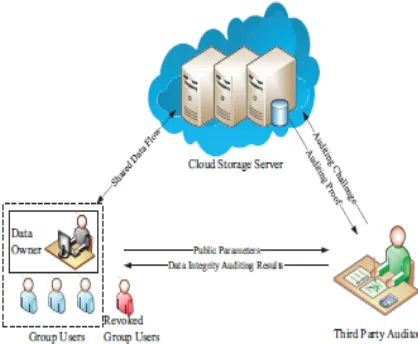
Fig 1. The cloud storage model
In the circulated stockpiling model as showed up in Fig 1, there are three components, particularly the appropriated stockpiling server, bundle customers and a Third Part Auditor (TPA).
Pack customers contain a data proprietor and different customers who are endorsed to get to and change the data by the data proprietor. The dispersed stockpiling server is semi-trusted, who gives data stockpiling organizations to the social affair customers. TPA could be any component in the cloud, which will have the ability to coordinate the data respectability of the regular data set away in the cloud server. In our structure, the data proprietor could encode and exchange its data to the remote disseminated stockpiling server. Furthermore, he/she shares the advantage, for instance, get to and change (aggregate and execute if central) to different social occasion customers. The TPA could capably affirm the trustworthiness of the data set away in the disseminated stockpiling server, even the data is as frequently as could be allowed updated by the social occasion customers. The data proprietor is one of a kind in connection to the following social affair customers, he/she could securely deny a get-together customer when a get-together customer is found vindictive or the understanding of the customer is passed.
4. Literature Survey
4.1 Study about Provable Data Possession at
Untrusted Stores
We exhibit a model for provable data possession (PDP) that allows a client that has secured data at an untrusted server to watch that the server has the principal data without recouping it. The model makes probabilistic confirmations of possession by assessing unpredictable courses of action of squares from the server, which unquestionably diminishes I/O costs. The client keeps up a steady measure of metadata to affirm the check. The test/response tradition transmits somewhat, predictable measure of data, which minimizes framework correspondence. Thus, the PDP model for remote data checking supports significant data sets in by and large passed on limit systems. We show two provably-secure PDP arranges that are more beneficial than past courses of action, despite when differentiated and plans that finish weaker sureties. In particular, the overhead at the server is low (or even consistent), rather than straight in the range of the data. Tests using our execution check the sound judgment of PDP and reveal that the execution of PDP is restricted by circle I/O and not by cryptographic figuring..
4.2 Study about Dynamic Provable Data Possession
www.ijiset.com
5. Simulated Result
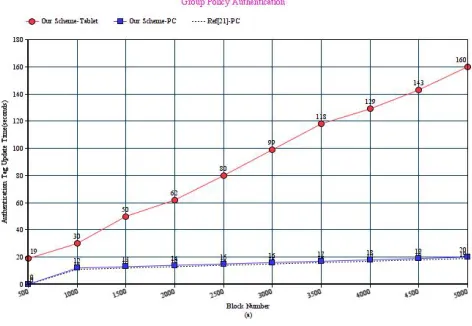
The overhaul methodology of information squares in our plan is like the setup strategy. As appeared in Fig.2 (a), the upgrade expense is relative to the quantity of altered hinders, since it needs to create another confirmation for every square. To repudiate a client, the computational expense and correspondence expense are required for gathering clients and the TPA are insignificant. The cloud server overhauls the relating verification labels when client repudiation happens. Fig.2 (b) demonstrates that our label upgrade exhibitions of the Basic User Revocation and the Advanced User Revocation are practically identical on cloud server. This is on the grounds that the cloud hubs required for label upgrade methodology in our propelled calculation perform errands in parallel, and the main extra cost contrasted and our fundamental calculation is the last label conglomeration process. Despite the fact that our propelled client denial calculation requires more cost and cloud hub assets, it accomplishes better unwavering quality for the framework as we talked about in Section 4.3.1. In functional sending, the parameters can be chosen to exchange one for the other (i.e., cost versus unwavering quality) in view of the framework's genuine requirement.Fig.2 (a) - (b) demonstrate that our plan is similar to ref.[21] regarding execution on square upgrade and client repudiation.
Fig. 2. (a) Block update cost (b) User revocation cost on Cloud
6. Conclusion
www.ijiset.com
References
[1] C. Wang, S. S. Chow, Q. Wang, K. Ren, and W. Lou, "Privacypreserving open assessing for secure disseminated stockpiling," IEEE Trans-exercises on Computers, vol. 62, no. 2, pp. 362–375, 2013.
[2] J. Yuan and S. Yu, "Confirmations of retrievability with open sureness likewise, enduring correspondence cost in cloud," in Proceedings of the Worldwide Workshop on Security in Cloud Computing, ser. Cloud Registering '13. Hangzhou, China: ACM, 2013, pp. 19–26.
[3] B. Wang, L. Baochun, and L. Hui, "Open assessing for imparted data to powerful customer denial in the cloud," in Proceedings of the 32nd IEEE International Conference on Computer Communications,ser. INFOCOM '13, Turin, Italy, 2013, pp. 2904–2912.
[4] D. Cash, A. Kp, and D. Wichs, "Dynamic confirmations of retrievability through unaware ram," in EUROCRYPT 2013, ser. Address Notes in Software building, T. Johansson and P. Nguyen, Eds. Springer Berlin Heidelberg, 2013, vol. 7881, pp. 279–295.
[5] A. Shamir, "How to share a puzzle," Commun. ACM, vol. 22, no. 11, pp. 612–613, Nov. 1979.
[6] "Amazon ec2 cloud," http://aws.amazon.com/ec2/.
[7] D. E. Eastlake and P. E. Jones, "US Secure Hash Algorithm (SHA1)," http://www.ietf.org/rfc/rfc3174.txt?number=3174. [8] A. De Caro and V. Iovino, "jpbc: Java mixing based cryptography," in Proceedings of the sixteenth IEEE Symposium on Computers and Correspondences, ISCC 2011, Kerkyra, Corfu, Greece, June 28 - July 1, 2011, pp. 850–855.
[9] J. Yuan and S. Yu, "Secure and reliable cost open disseminated stockpiling checking on with deduplication," in Proceedings of the main IEEE Gathering on Communications and Network Security, ser. CNS'13, Washington, USA, 2013, pp. 145–153.
[10] D. Boneh, B. Lynn, and H. Shacham, "Short checks from the weil coordinating," in Proceedings of the seventh International Conference on the Theory and Application of Cryptology and Information Security: Drives in Cryptology, ser. ASIACRYPT '01. London, UK, UK: Springer-Verlag, 2001, pp. 514–532.
M.Sushma received the B.Tech Degree in CSE from Mallareddy College of Engeneering and Management Sciences, JNTUH in 2014. She is currently working towards the Master’s Degree in Computer Science and Engineering, in Sri Venkateswara Engineering College for Women, JNTUA. She interest lies in the areas of Web Development Platforms, SQL, and Cloud Computing Technology.