42
For Raeigly Distribution Simulation with
the Help of Kendall Distribution Function
Archimedean Copula Parameter Estimation
Mine DOĞANP
1
P
, Ayşe METİNKARAKAŞP
2
P
, Murat KARAKAŞP
3
P 1
P
Bitlis Eren University, Art and Science Faculty, Statistics Department, 13000, Bitlis
P
2*
P
Bitlis Eren University, Art and Science Faculty, Statistics Department, 13000, Bitlis P
3
P
Bitlis Eren University, Art and Science Faculty, Mathematics Department, 13000, Bitlis Corresponding Author: [email protected]
Abstract
In this paper, we model the dependence structure between random variables that we generated dependent Raeighly distribution using Archimedean copula and Kendall distribution function. In connection with this, we define basic properties of copulas and their nonparametric method. The aim of Kendall distribution function is selected suitable copula function for using data set. For dependence structures of the data set, we calculated Kendall Tau and Spearman Rho values which are nonparametric. Based on this method, parameters of copula are obtained. To explain the relationship between the variables, three Archimedean copula families were used; Gumbel, Clayton, Frank, Ali Mikhail Haq and Joe copula. Nonparametric estimation of copula parameters and we find the suitable Archimedean copula family for this data set.
Key Words: Copula functions; Kendall Tau; Kendall Distribution Function; Raeighly distribution.
MSC 2010: 62A01, 62H20, 62H12.
1. Introduction
Copulas were introduced to first in the context of theory metric spaces. The statistical properties and applications of copulas has been developing in recent years. In 1959 A.Sklar ıntroduced the general notions of a copula (1981 By.B.Schweızer and E.F.Wolff) [6]. A copula function is links univariate marginal to their multivariate distribution. We can model relationship between random variables. Copula function is presenting the dependence structure and it is providing degree of dependence structure. Copula is continuous
transformation and invariant under increasing. Copulas can use for modeling dependence in several applied fields such as econometric, finance and actuarial studies. This article explores Archimedean copula definitions us to reduce the study of multivariate copula to a single univariate function. Throughout the paper we work bivariate Archimedean copulas; Clayton, Gumbel, Frank, Ali Mikhail Haq and Joe.
2. Material and Method
The copula is defined as a function 𝐶: [0,1]2→
[0,1] that ensures the boundary conditions
𝐶(𝑢, 0) = 𝐶(0, 𝑢) = 0 𝑎𝑛𝑑 𝐶(𝑢, 1) = 𝐶(1, 𝑢) = 𝑢, ∀𝑢 ∈ [0,1]
∀(𝑢1, 𝑢2,𝑣1, 𝑣2)∈ [0,1]4, such that 𝑢1≤ 𝑢2, 𝑣1≤ 𝑣2,
𝐶(𝑢2, 𝑣2 )− 𝐶(𝑢2, 𝑣1) − 𝐶(𝑢1, 𝑣2) + 𝐶(𝑢1, 𝑣1) ≥ 0.
Ultimately, for twice differentiable and 2-increasing property can be replaced by the condition
𝑐(𝑢, 𝑣) = 𝜕2
𝜕𝑢𝜕𝑣𝐶(𝑢, 𝑣) ≥ 0 (2.1)
Where 𝑐(𝑢, 𝑣) is the copula density.In the following for 𝑛 uniform random 𝑈1, 𝑈2, … , 𝑈𝑛 variables the joint distribution function 𝐶 is defined
𝐶(𝑢1, 𝑢2, … 𝑢𝑛, 𝜃) = 𝑃(𝑈1≤ 𝑢1, 𝑈2≤ 𝑢2,… 𝑈𝑛 ≤ 𝑢𝑛)
43
2.1. Sklar Theorem
Let 𝑋 and 𝑌be random variables with continuous distrubution functions 𝐹𝑋and 𝐹𝑌, with 𝐹𝑋(𝑋) and
𝐹𝑌(𝑌) uniformly distrubuted on the interval [0,1].
Then there exists a copula such that for all 𝑥, 𝑦 in R,
𝐹𝑋𝑌(𝑋, 𝑌) = 𝐶(𝐹𝑋(𝑋), 𝐹𝑌(𝑌) (2.2)
The copula 𝐶 for (𝑋, 𝑌) is just the joint distribution function for the couple 𝐹𝑋(𝑋), 𝐹𝑌(𝑌) provided 𝐹𝑋 and 𝐹𝑌continuons
[1,2,3,4,5,6,7,8,9,1011,12,14,15,16,17,18,19,20]. 2.2. Archimedean Copula
Let 𝜑 define a function
φ
:[0,1]
→
[0, ]
∞
that is continuous and supplies:
φ
(1)
=
0, (0)
φ
= ∞
.
For all
t
∈
(0,1)
,φ
'( )
t
<
0
,ϕ
is decreasing, for allt
∈
(0,1)
ϕ
′′
( )
t
≥
0
,ϕ
is convex.φ
has an inverseϕ
−1: 0,[ ] [ ]
∞ → 0,1 , that is to say this equation has the similar properties out of( 1) (0) 1
φ
− = andφ
( 1)− ∞ =( ) 0. The Archimedean copula is given byC u v( , )=
φ
( 1)− [ ( )φ
u +φ
( )].v (2.3) [1,2,3,4,5,6,7,8,9,1011,12,14,15,16,17,18,19,20]. 2.3. Clayton copulaThe Archimedean copula is defines with the help of generator function ( )t t 1
θ φ
θ − − =
Cθ( , )u v =(u−θ +v−θ −1)1/θ (2.4)
θ is the copula parameter restricted to (0, )∞ [13]. 2.4. Frank copula
The Archimedean copula is defines with the help of generatorfunction;
( )
1{ }
ln , / 0 ; 1
t e
t R
e θ
φ = − − −θ − θ∈
− −
( )
(
)(
)
(
)
1 1
1 , ln 1
1
u v
e e
C u v
e
θ θ
θ θ θ
− − − − = − +
− −
(2.5)
θ
is the copula parameter restricted to(
0,
∞
)
[13]. 2.5. Gumbel copulaThe Archimedean copula is defines with the help of generator function φ
( ) ( )
t = −lnt θ ,θ ≥1;
(
1)
( , ) exp [( ln ) ( ln ) ]
Cθ u v = − − uθ + − vθ θ (2.6)
𝛳 is the copula parameter restricted to [1, ∞) [13]. 2.6. Ali Mikhail Haq Copula
This Archimedean copula is defined with the help of generator functionϕ
( )
t =ln 1
−θ( )
1−t
/t
( )
( )( )
,
1 1 1
uv C u v
u v
θ = −θ − − (2.7)
Where θ is the copula parameter restricted to
[ ]
−1,1 [13] .2.7. Joe Copula
This Archimedean copula is defined with the help of generator function ϕ
( )
t = −ln 1
−( )
1−t θ
( )
, 1( ) ( ) ( ) ( )
1 1 ( 1 1 1/C u v u v u v
θ
θ θ θ θ
θ = −
− + − − − −
(2.8) Where θ is the copula parameter restricted to
[ ]
1,∞ [13].2.7. The Nonparametric Estimation
44
Table1. The link between Archimedean copulas and Kendall Tau.Family Range of
θ
τ
Gumbelθ
∈ ∞
[
1,
)
θ 1θ −
Clayton
θ
∈
[
0,
∞
)
2
θ
θ
+Frank
θ
∈ −∞ ∞
(
,
)
1( )
4
1 1 D θ
θ
− −
Ali Mikhail
Haq
[
1,1
]
θ
∈ −
(
) (
2)
2
2 1 ln 1 3 2
3 3
θ θ
θ
θ θ
− −
− −
Joe
θ
∈ ∞
[
1,
)
1 4DJ( )
θθ
+
Here D is debye functions [5,6,15] 2.8. Kendall Distribution Function and Properties
In the past, it proposed a nonparametric method for forecasting the dependence function of a double of random variables for Archimedean copula (Genest and Rivest, 1993). The state of emphasizing a probability model for independent observations
(
x y
1,
1)
,
…
,
(
x y
n,
n)
from a bivariate nonGaussian distribution function H(X,Y) might be reduced by denoted
H
and its marginal ofF
X andF
Y, its related dependence functionC
.C
is the association copula with generatorϕ
and Kendall Distribution function the function given by( )
Pr{
( , ,}
1
K u = C U … Un≤u
(Genest and Rivest, 1993) give that if C is Archimedean copula, forecast of Archimedean copula is singly defined by function on the space
(0,1);
( )
( )
( )
'
u
K u u
u
φ φ
= −
a nonparametric estimation of K is shown by
( ) { } 1
1
n
Kn u I Uj u n j∑
= ≤ +
=
.
To define the generator function
φ
, we show the paces; to forecast Kendall Tau value utilizing the non-parametric estimation and nonparametric forecast ofK
. ForK u
n( )
nonparametric estimation ofK u
( )
i) The nonparametric forecast of Archimedean copula Kendall Tau correlation coefficient using ii) Define the pseudo-observations
(
)
{
}
,
, / 1, 1, 2, , 1
Ui Fn Xi Yi
n
I Xj Xi Yj Yi n i n
j
= =
≤ ≤ + = …
∑ =
( )
( )
1 1
Ui u number of Ui u Kn u
n n
≤ ≤
= =
+ +
iii) Form a parametric estimation of
K
( ) ( )
' ( )
u K u u
u
φ φ = −
iv) The election of Archimedean copula that suitable for the data may be done by minimum a range
2 ( ) ( ) ( )
K u Kn u dKn u n
φ −
∫
(2.7)
45
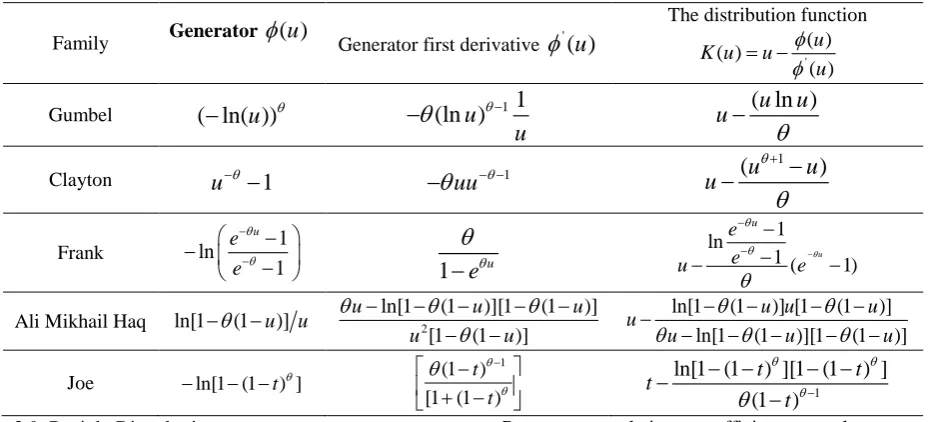
Table 2. Kendall Distribution functions of Archimedean copulas.Family Generator
φ
( )
u
Generator first derivativeφ
'( )
u
The distribution function
' ( ) ( )
( ) u
K u u
u
φ
φ
= −Gumbel
( ln( ))
−
u
θ(ln )
u
11
u
θ
θ
−−
u
( ln )
u
u
θ
−
Clayton
u
−θ−
1
1uu
θθ
− −−
u
(
u
1u
)
θ
θ
+
−
−
Frank ln 1 1 u e
e
θ
θ −
−
− − −
1
e
θuθ
−
1 ln
1 ( u 1)
u
e e
u eθ
θ θ
θ
−
−
−
− −
− −
Ali Mikhail Haq ln[1−
θ
(1−u)] u ln[1 2 (1 )][1 (1 )] [1 (1 )]u u u
u u
θ
θ
θ
θ
− − − − −
− −
ln[1 (1 )] [1 (1 )] ln[1 (1 )][1 (1 )]
u u u
u
u u u
θ
θ
θ
θ
θ
− − − −
−
− − − − −
Joe −ln[1 (1− −t) ]θ
1
(1 ) [1 (1 )
t t
θ θ
θ
− −
+ −
1
ln[1 (1
) ][1 (1
) ]
(1
)
t
t
t
t
θ θ
θ
θ
−− −
− −
−
−
2.9. Raeigly Distrubution
X is variable which has Raeigly distribution, accordingly pdf of X,
2 2 2 ( ; )
2 x x
y f x σ e σ
σ
−
= =
where,
σ
is parameter of distribution. The cumulative function of this distribution is given2 2 2 ( ; ) 1
x
F x σ e σ
− = − .
The Rayleigh distribution is a special case of the Weibull distribution [13].
3. Application
The first section, the method that has been suggested by Genest given. In this section, out of
Pearson correlation coefficient, another one measures of dependence denominated correlation. We based on Kendall Tau that has been nonparametric measures of dependence. We have seen that the doubled correlations are all positive. Namely, Kendall Tau value is positive. This study consists of estimation of Archimedean copula. Genest and Mackay (1986) simplified method and lead to estimate the parameters of Archimedean copula that focus on Kendall Tau value. Namely, Kendall Tau value is positive. This study consists of estimation of Archimedean copula. Genest and Mackay simplified method and lead to estimate the parameters of Archimedean copula that focus on Kendall Tau statistics. In this study, we generated dependent Raeigly distribution 𝑋~𝑅𝑎𝑦𝑙(3)and 𝑌~𝑅𝑎𝑦𝑙(3).Here
𝑛 = 200 data were used. We calculated Kendall Tau value in such that 0.029 for(𝑋, 𝑌).Using this that is shown parameters of copulas calculated and results are given table 3.
Table 3. Non parametric estimation of Archimedean copula
Family Gumbel Clayton Frank AMH Joe
𝜃� 1.0298 0.059 -1.1417 0,1262 1,0517
Finally, this study consists of fitting a suitable copula to the data. The results of estimations are given table 4.
Table 4. Fitting a suitable copula the data
pairs Gumbel Clayton Frank AMH Joe
46
4. ConclusionIn this paper, we modeled the dependence structure between 𝑋~𝑅𝑎𝑦𝑙(3) and 𝑌~𝑅𝑎𝑦𝑙(3) using Archimedean copula.According to table 4, 𝐾𝑛(𝑢) the nonparametric estimation of 𝐾(𝑢) is calculated by using pseudo-observations, and using table 2, for Gumbel, Clayton, Frank respectively𝐾𝐺(𝑢), 𝐾𝐶,
𝐾𝐹(𝑢), 𝐾𝐴𝑀𝐻(𝑢) and 𝐾𝐽(𝑢) values calculated. In
table 4 𝐾𝑛(𝑢) value compared 𝐾𝐺(𝑢), 𝐾𝐶,
𝐾𝐹(𝑢), 𝐾𝐴𝑀𝐻(𝑢) and 𝐾𝐽(𝑢). Consequently, using
the square distance measure, with 0,000001 value, Joe copula gives better fits than Gumbel,Clayton, Frank and AMH.
References
[1]Cherubini U, Luciano E. (2013), Value-at-risk trade-off and capital allocation with copulas.
Economic Notes, vol. 30, pp. 235–256.
[2]Fang, Hong-Bin, Kai-Tai Fang, and Samuel Kotz. (2002). The meta-elliptical distributions with given marginals. Journal of Multivariate Analysis vol. 82, no., pp.11-16.
[3]Frees EW, Valdez EA. (1998). Understanding relationships using copulas. North American Actuarial Journal, vol. 2, pp. 1-25.
[4]Genest C, MacKay J. (1986). The joy of copulas: bivariate distributions with uniform marginal. The American Statisticien, vol. 40, pp. 280-283.
[5]Genest, C., et al. (1999), A characterization of quasi-copulas. Journal of Multivariate Analysis, vol. 69, no.2 , pp.193-205.
[6]Genest C, Rivest LP. (1993), Statistical inference procedures for bivariate archimedean copulas. Journal of the American Statistical Association, vol.88, pp.1034-1043.
[7]Genest C, Favre AC. (2006), Everything you always wanted to know about copula modelling but were afraid to ask. Journal of Hydrologic Engineering, vol.12, pp. 347-368.
[8]Genest C, Gendron M, Boudeau-Brien M. (2009), The advent of copulas in finance. The European Journal of Finance, vol. 15, pp. 609-618.
[9]Mai, Jan-Frederik. (2017) Simulating copulas: stochastic models, sampling algorithms, and applications. World Scientific.
[10]Malevergne Y, Sornette D . (2003), Testing the gaussian copula hypothesis for financial assets dependences. Quantitative Finance vol.3, pp. 231-250.
[11]Metin A, Çalık S. (2012), Copula function and application with economic data. Turkish Journal of Science and Technology, vol. 7, pp. 199-204.
[12]Karakas M.A. (2017), Dependence Structure analysis with Copula GARCH method and for data set suitable copula selection , Natural Science and Discovery, vol. 3, pp.13-24.
[13]Kundu D., Ragab M. (2005), Generalized
Rayleigh Distribution: Different Methods Estimation. Computational Statistics and Data Analysis, vol.49,pp. 187-200.
[14]Naifar N. (2010), Modeling dependence structure with archimedean copulas and applications to the iTraxx CDS index. Journal of Computational and Applied Mathematics, vol. 235, pp. 2459-2466.
[15]Nelsen R. (1999), An Introduction to Copulas. Springer-Verlag, New York, USA. 272p.
[16]Oh, Dong Hwan, and Andrew J. Patton. (2017), Modeling dependence in high dimensions with factor copulas." Journal of Business & Economic Statistics, vol.35, no.1,pp. 139-154.
[17]Rosenberg J, Schuermann T. (2006), A general approach to integrated risk management with Skewed, Fat-tailed Risks. Journal of Financial Economics, vol. 79, pp. 569-614.
[18]Schweitzer B, Wolff EF. (1981), On nonparametric measures of dependence for random variables. Annals of Statistics, vol. 9, pp. 879-885.
[19]Shih JH, Louis TA. (1995), Inferences on the association parameter in copula models for bivariate survival data. Biometrics, vol.51, pp. 1384-1399.