Article
Olive Biophenol Integral Extraction at a Two-Phase
Olive Mill
Riccardo Delisi 1,2,*, Rosaria Ciriminna 2, Stefano Arvati 1, Francesco Meneguzzo 3 and Mario Pagliaro 2,*
1 Renovo Bioindustry, via P. Verri 1, 46100 Mantova, Italy; [email protected] 2 Istituto per lo Studio dei Materiali Nanostrutturati, CNR, via U. La Malfa 153, 90146 Palermo, Italy;
3 Istituto di Biometeorologia, CNR, via G. Caproni 8, 50145 Firenze, Italy; [email protected] * Correspondence: [email protected] (R.D.); [email protected] (M.P.)
Abstract: The biophenol integral extraction protocol from vegetation water developed in the early 2000s for the three-phase olive mill was adapted to a large two-phase mill operating in Sicily during the 2016/2017 season. The new set-up allows extensive recovery of olive phenolics, transforming previous waste into a source of revenues for the milling company and of valued bioproducts for its bioeconomy partner, while eliminating a source of potential pollution altogether.
Keywords: biophenols; olive oil; polyphenols; hydroxytyrosol
Wet Pomace vs Olive Mill Waste Water
The production of large amounts (10-30 million m3) of wastewater at olive mills in the short period of time of olive harvesting and milling is a well known environmental and economic hurdle in Mediterranean countries where most (about 75%) olive oil production takes place every year.i Called also vegetation water, olive mill wastewater (OMWW) originates from water contained in the olive fruits plus added water (0.3-0.8 m3 per 1000 kg of olives, depending on the process) to the milled paste in order to extract the highest quantity of oil from the paste via centrifugation in the three-phase milling process. For decades, the latter has been the process of choice to produce extra virgin olive oil (EVOO). The oil yield increases proportionally to the amount of added water, but external processing water further increases dissolution in the aqueous phase of valued biophenols, today widely associated to health benefits of EVOO.ii Indeed, due to the large amount of phenolic compounds and long-chain fatty acids toxic to microorganisms, plants and animals, both chemical oxygen demand (COD) and the corresponding biochemical oxygen demand (BOD5) of OMWW are very high, with 1 m3 of OMWW being equivalent to 100-200 m3 of domestic sewage.iii This means that OMWW cannot be used for irrigation and need to be disposed of as a pollutant at significant economic cost for olive mills, contributing to further rise the manufacturing cost of EVOO.
Several treatment methods have been proposed to improve the quality of OMWW and reduce its phytotoxicity prior to disposal,iv including recent successful photooxidation with UV light over recyclable photocatalyst.v The simplest disposal practices are storage/evaporation in lagoons and controlled dispersion in soil. Emission limits, however, are generally surpassed and soil and water contamination easily occurs with serious environmental consequences for the environment (and closure of olive mills not conforming to environmental laws).vi
Starting in the early 1990s, a new continuous centrifuge two-phase milling process in which very little water is added, started to be commercially adopted,vii first in Spain (world’s leading country for olive oil production) and then in Greece and in Italy. In place of OMWW, the new milling process affords high quality EVOO along with a wet pomace consisting of olive pulp (ca. 35%) and seed residues dispersed in water released by the olive fruit and about 2.5% of processing water. Composted with agricultural wastes, this two-phase olive mill waste (TPOMW) becomes an excellent fertilizer ideally recycled in land growing olive trees (compost-amended soils have a 15% higher olive
2 of 6
oil content than those treated with inorganic fertilization).viii Yet, the significant phytotoxicity of TPOMW requires its disposal as an industrial waste, while the large amount of solid matter can lead to fermentative phenomena complicating its processing and increasing disposal costs.
Integral Extraction from Wet Pomace
Extracted with different methods from OMWW or from TPOMW,ix olive biophenols are powerful antioxidant and anti-inflammatory molecules exerting multiple health benefits, x increasingly used in a variety of nutraceutical,xi food and beverage,xii and cosmetic formulations.xiii Among several biophenol extraction techniques developed in the last two decades, the process invented by Crea in 2001 allows to obtain an integral bouquet of olive biophenols starting from OMWW.xiv
In the process, the vegetation waters are centrifuged using a three-phase spin-dryer in order to remove the solid residuals and oil traces. The resulting aqueous phase, called “olive juice”, is chemically stabilized by the addition of citric acid, and then left to age in closed vessels for several months in order to allow for the full hydrolysis of the main glycosides (oleuropein and verbascoside). Once aging is complete (full hydrolysis of oleuropein), the resulting biophenol extract (tradenamed Hidrox)xv is processed in different ways to obtain derivatives suitable for nutraceutical or cosmetic formulations. Remarkably, the corresponding water phase possesses negligible COD and BOD5 values.
This process has been in use in California now for more than a decade, resulting in manifold applications of the Hidrox extract. Aiming at adapting the Crea’s protocol to the two-phase milling process, we focused on the use of TPOMW as a source of biophenols, as well as trying to recover the emulsified olive oil usually lost in the wet pomace.
The new technology was developed at a large olive mill based in Chiaramonte Gulfi, Sicily, a renown Italian production centre of high quality extra virgin olive oil (EVOO) during the 2016 olive milling season. Two different modified industrial centrifuges were employed, placed immediately downstream the EVOO production line. In the first step, the TPOMW was forced in a two-phase horizontal spin-dryer in order to separate the solid particles from the liquid phase (oil + water). After that, the emulsified liquid phase went into a vertical three-phase centrifuge, namely a 3-phase separating decanter in which two liquids of different densities are separated from each other, and from the residual solid particles (d > 1 mm).
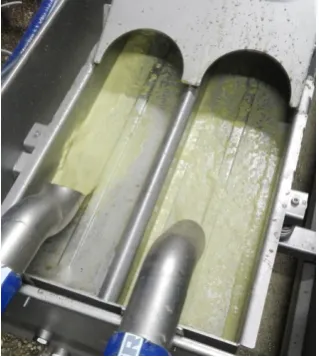
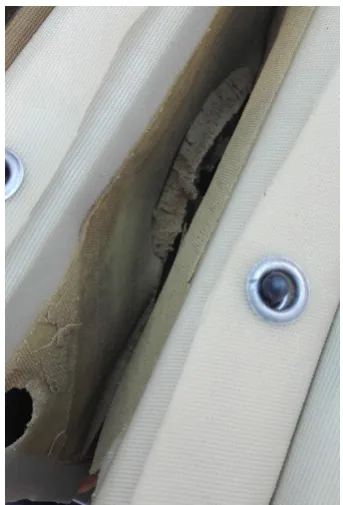
A second extraction EVOO oil phase was obtained along with a water phase rich in phenolics and other water-soluble compounds. In the latter olive juice, though, biophenols are more concentrated than in the corresponding juice obtained from the three-phase OMWW as very little water is added during the two-phase milling process. The water phase output of the vertical centrifugation, containing approximately 1-2% of micrometer solid residue comprised of olive pulp, peel and wax (Figure 1), was clarified using an industrial press filter (Figure 2). Following the Crea’s protocol, the resulting olive juice was stabilized with citric acid.
3 of 6
Figure 2. Solid-cake resulting from the three-phase vertical centrifugation removed using a press filter.
Along with the olive juice, the new process recovers from the wet pomace an excellent yield of extra virgin olive oil (90% of the not yet extracted oil, with acidity below the threshold of EVOO), without the need to use n-hexane. The new extraction plant was placed directly downstream the mill’s wet pomace output. Hence, no oxidative or other degenerative phenomena could take place, with the newly recovered oil maintaining both extra virgin olive oil flavour and colour (actually the greenish colour was more eye-catching than first extraction oil because of additional chlorophyll extraction from the TPOMW). The EVOO obtained from this second round of extraction had significant economic value, 4-5 times higher than the value of hexane-extracted olive oil.
Another valued output of the new extraction process was a dried pomace with 60% less humidity compared to that of conventional wet pomace which could indeed be sold to a local factory which further commercializes the dried ‘nocciolino’ (seed) as solid biofuel to power domestic and commercial biomass heaters. No waste was discharged into the environment, whereas the milling company supplying the wet pomace not only got rid of previous significant costs associated to processing the TPOMW as industrial waste, but converted it in a triple source of extra revenues obtained from selling: i) the TPOMW used as phenolics source to the extraction company; ii) high quality second-extraction EVOO; and iii) the dried pomace to a ‘nocciolino’ company.
High Quality Biophenol Extracts
4 of 6
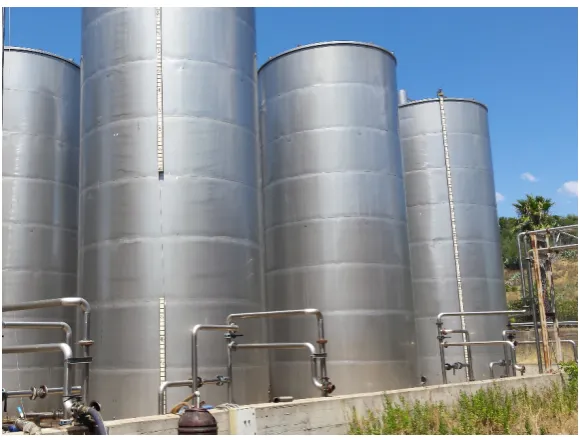
Figure 3. Silos stocking the olive juice obtained in Sicily in 2016 from a two-phase olive mill.
The juice from different lots was left to undergo hydrolysis according to Crea’s original protocol for several months at buffered pH. The HPLC analyses aimed to assess the total biophenol, hydroxytyrosol (HT) and tyrosol (T) concentration were carried out in Italy by an accredited laboratory (Centro Analisi Biochimiche, Rizziconi) further recognized by Italy’s Agriculture Ministry for olive oil analysis. All juice samples contain a large amount of total phenols (Table 1). The first lot, coming from the early harvested drupes, contained the highest biophenol amount, in agreement with the known higher phenolics content in greener olive drupes.
Table 1. Total phenolics, tyrosol and hydroxytyrosol in in three lots of olive juice as obtained from early to late harvesting a
Entry Total biophenol
(ppm)
Hydroxytyrosol (ppm)
Tyrosol (ppm)
Hydroxytyrosol (wt%)
Tyrosol (wt%)
Lot 1 7288 545.1 79 7.48 1.42
Lot 2 5318 444 68.8 8.40 1.41
Lot 3 5810 355.3 53.7 6.11 0.98
aHPLC analytical method 0178-00 with syringic acid as internal standard; data from the accredited Laboratory Centro Analisi
Biochimiche (Rizziconi, Italy).
Data in Table 2 show that after one month of aging, the pH buffered at 3.2 and the activity of the yeast (Saccharomyces), promoted the hydrolysis of the biophenol glycosides leading to increasing concentration of both HT and T.
Table 2. Total phenolics, tyrosol and hydroxytyrosol in in three lots of olive juice obtained from early to late harvesting, after one montha
Entry Total biophenol
(ppm)
Hydroxytyrosol (ppm)
Tyrosol (ppm)
Hydroxytyrosol (wt%)
Tyrosol (wt%)
Lot 1 5542 448 102.9 8.08 1.4
Lot 2 5144 486 74.7 9.45 1.4
Lot 3 4623 412.6 57 8.93 1.2
aHPLC analytical method 0178-00 with syringic acid as internal standard; data from the accredited Laboratory Centro Analisi
Biochimiche (Rizziconi, Italy).
5 of 6
coming from a three-phase mill, likely due to the higher phenol concentration, as well as to the initial lower outdoor temperature during December 2017 and January 2017 in the area hosting the silos (Caltagirone, 610 m above sea level), both responsible for partial inhibition of the Saccharomyces yeast strain. This hypothesis was confirmed by the data obtained after four months aging (Table 3).
Table 3. Total phenolics, tyrosol and hydroxytyrosol in three lots of olive juice obtained from early to late harvesting, after 4 monthsa
Entry Total biophenol
(ppm)
Hydroxytyrosol (ppm)
Tyrosol (ppm)
Hydroxytyrosol (wt%)
Tyrosol (wt%)
Lot 1 5045 743 126 14.73 2.5
Lot 2 3530 1004 127 28.44 3.6
Lot 3 1387 711 79 51.26 5.7
aHPLC analytical method 0178-00 with syringic acid as internal standard; data from the accredited Laboratory Centro Analisi
Biochimiche (Rizziconi, Italy).
The considerably higher temperatures recorded in February and March 2017 (+2.69 °C for February and +2.52°C for March, in Italy, in comparison to the 1971-2000 mean)xvi promoted the glycoside hydrolysis to such an extent that in the aqueous extract from Lot 2, hydroxytyrosol represented 51.26 wt. % of the olive polyphenol composition, namely in the very high concentration range (40-90 wt. %) required for advanced medical applications such as the treatment of early-stage Parkinson disease.xvii In 2001, Crea was the first scholar to associate a powerful anti-inflammatory activity to hydroxytyrosol.xviii Today, this biophenol is widely recognised to be the chemical agent responsible for multiple health benefits including the prevention of neurodegeneration.xix
Olive Bioeconomy
In conclusion, we have adapted to the two-phase olive mill the integral biophenol extraction protocol originally developed by Crea for the three-phase olive mill in 2001. The extraction, now, is from the wet pomace (‘alperujo’ in Spanish), and not from the vegetation waters. Furthermore, the olives were specific Cultivars grown in southern Sicily where the unique climate and geographical conditions afford particularly high amounts of biophenols.xx This translates into significant higher amounts of total biophenols in the aqueous extract, eventually affording an extract with hydroxytyrosol concentration exceeding 1000 ppm and 51.26 wt. % of the olive polyphenol composition.
In brief, the integral extraction process originally developed in 2001 for the three-phase olive mill, has kept its promises to make the olive bioeconomy possible at affordable costs. The olive mill company transformed waste formerly processed at high cost in a triple source of revenues. The bioeconomy company obtained a biophenol-rich extract ready for multiple health beneficial applications, and the environment benefited from not receiving any pollutants. On November 18 2016, Italy’s Labour Minister visited the new Sicily-based biophenol extraction plant,xxi as a prominent example of the circular bioeconomy now actively supported in Europe as a tool to promote economic growth, as well as to address societal food, energy and climate challenges.xxii
Acknowledgements: This article is dedicated to Professor Roberto Crea for all he has done pioneering olive
biophenol extraction and biochemistry. Thanks to Frantoi Cutrera (Chiaramonte Gulfi, Italy), to Mr Cesare Pinotti and to Dr Alfredo Tamburino for valued collaboration.
Conflicts of interest: Renovo Biondustry, a company, has an interest in the biophenol market. M.P., F.M. and
R.C., affiliate with Italy’s Research Council, declare no competing financial interest.
References
i. C. M. Galanakis, K. Kotsiou, Recovery of Bioactive Compounds from Olive Mill Waste In Olive Mill Waste: Recent Advances for Sustainable Management, C. M. Galanakis (Ed.), Academic Press, Amsterdam: 2017; pp. 205-230.
6 of 6
ii. R. Valls, M. Farràs, M. Suárez, S. Fernández-Castillejo, M. Fitó, V. Konstantinidou, F. Fuentes, J. López-Miranda, M. Giralt, M. Covas, M. Motilva, R. Solà, Effects of functional olive oil enriched with its own phenolic compounds on endothelial function in hypertensive patients. A randomised controlled trial, Food Chem. 167 (2015), 30-35.
iii. E. Tsagaraki, H. N. Lazarides, K. B. Petrotos, Olive Mill Wastewater Treatment In Utilization of By-Products and Treatment of Waste in the Food Industry, V. Oreopoulou, W. Russ (Ed.s) Springer, Boston: 2007; 133-157. iv. Olive Mill Waste: Recent Advances for Sustainable Management, C. M. Galanakis (Ed.), Academic Press,
Amsterdam: 2017; pp. 205-230.
v. D. T. Sponza, R. Oztekin, Treatment of olive mill wastewater by photooxidation with ZrO2-doped TiO2 nanocomposite and its reuse capability, Environ. Technol. 37 (2016) 865-879.
vi. G. Golia, I danni ambientali dell’olio di oliva, mediaset.it, 9 November 2015. See at the URL: https://goo.gl/d9Oh9I
vii. A. Roig, M. L. Cayuela, M. A. Sánchez-Monedero, An overview on olive mill wastes and their valorisation methods, Waste Manag. 26 (2006) 960-969.
viii. A. Fernández-Hernández, A. Roig, N. Serramiá, C. G. Civantos, M. A. Sánchez-Monedero, Application of compost of two-phase olive mill waste on olive grove: effects on soil, olive fruit and olive oil quality, Waste Manag. 34 (2014) 1139-1147.
ix. R. Ciriminna, A. Fidalgo, F. Meneguzzo, L. M. Ilharco, M. Pagliaro, Extraction, Benefits and Valorization of Olive Polyphenols, Eur. J. Lipid Sci. Technol. 118 (2016) 503–511.
x. M.-I. Covas, M. Fitó, R. de la Torre, Minor Bioactive Olive Oil Components and Health: Key Data for Their Role in Providing Health Benefits in Humans In Olive and Olive Oil Bioactive Constituents, D. Boskou (Ed.), AOCS Press, Urbana (IL): 2015; pp. 31-52
xi. S. Rigacci, M. Stefani, Nutraceutical Properties of Olive Oil Polyphenols. An Itinerary from Cultured Cells through Animal Models to Humans, Int. J. Mol. Sci. 17 (2016) 843.
xii. R. Ciriminna, F. Meneguzzo, R. Delisi, M. Pagliaro, Olive Biophenols as New Antioxidant Additives in Food and Beverage, ChemistrySelect 2 (2017) 1360-1365.
xiii. M. Lueder, The Active Ingredients Mixture of Olives Provides Skin Whitening and Age Spot Reduction, Cosmetic Science Technology (2011) 1-6.
xiv. R. Crea, Method of obtaining a hydroxytyrosol-rich composition from vegetation water, US20020058078 (2001).
xv. A tradename of CreAgri, Inc.
xvi . Data from Italy’s Research Council ISAC Institute. See at the URL: www.isac.cnr.it/climstor/climate_news.html (last time accessed, April 28, 2017).
xvii. R. Crea, Treatment of early stage Parkinson's disease with a hydroxytyrosol-containing polyphenol formulation, US20160374959A1 (2016).
xviii. R. Crea, Method for treatment of inflammation, US8216599B2 (2002).
xix. F. Casamenti, M. Stefani, Olive polyphenols: new promising agents to combat aging-associated neurodegeneration, Expert Rev Neurother. 17 (2017) 345-358.
xx. R. Delisi, M. Pagliaro, F. Saiano, R. Ciriminna, C18 Alkyl-Modified Silica: A Suitable Tool for Olive Biophenol Green Extraction, Chemical Data Collections 7-8 (2017) 102-106.
xxi. M. Guccione, Da scarto a risorsa, il sole regala un tesoro dalle acque dei frantoi, La Sicilia, 18 November 2016. xxii. R. Peters, Societal Challenges and Bioeconomy in Europe, Bioeconomy Impact 2016, Dublin, 10-11 February