Cloud Data Uploading and remote data integrity Checking in
cloud using proxy
A.Sivakrishna & P.Srinivasulu
1PG Scholar, Dept of CSE, MalineniLakshmaiah Engineering College, Singarayakonda,
Prakasam(Dt), AP, India.
2Associate Professor, Dept of CSE, MalineniLakshmaiah Engineering College, Singarayakonda,
Prakasam(Dt), AP, India.
Abstract_Now a days many users store their significant data in cloud. To ensure that the security of the cloud stored data users need to encrypt the important data. The point of data security which has always been noteworthy aspect of quality, cloud computing cause a new security threats. In this paper, for the essential time, new security issues must be fathomed with a specific end goal to enable more customers to process their information out in the open cloud. At the point when the customer is limited to get to PCS, he will designate its intermediary to process his information and transfer them.As transferring records on cloud intermediary stores duplicate of document so that if documents on cloud are hacked or debased or trustworthiness of records isn't guarantee then those documents are again recover from intermediary. Then again, remote information honesty checking is additionally a critical security issue openly distributed storage. It influences the customers to check whether their outsourced information is kept in place without downloading the entire information. From the security issues, we propose a novel intermediary arranged information transferring and remote information honesty checking model in
character based open key cryptography: IDPUIC (personality based intermediary situated information transferring and remote information uprightness checking out in the open cloud). We give the formal definition, framework model and security demonstrate. Additionally gives a period server record transferring on cloud so that for that day and age just document will be open Then, a solid ID-PUIC convention is composed by utilizing the bilinear pairings. With our outlined parallel hunt manage, the pursuit intensity is very much moved forward. We have a tendency to propose 2 secure accessible mystery composing plans to fulfill totally unique protection needs in 2 danger models. The arranged ID-PUIC convention is obviously secured bolstered the hardness of process Diffie– Hellman downside. Our ID-PUIC convention is furthermore efficient and adaptable. Upheld the underlying customer's approval, the arranged ID-PUIC convention will comprehend non-open remote information honesty checking, designated remote learning uprightness checking, and open remote information trustworthiness checking.
I.INTRODUCTION
Cloud plotting fulfills a numerous indusial principle preparing in numerous application supplies and becomes fastly. In the Fundamentally , it takes the data preparing as an arrangement, for example, putting away, computing, data certainty, and so forth. By utilizing people in general cloud show put, the clients are consoled of the issue for stacking association, overall data access with self-administering geographical positions, and so forth. Along these lines, an ever increasing number of customers might want to store and process their information by utilizing the remote distributed computing framework. Out in the open distributed computing, the customers store their monstrous information in the remote open cloud servers. Since the put away information is outside of the control of the customers, it involves the security chances as far as secrecy, trustworthiness and accessibility of information and administration. Difficult to reach information honesty examination is a native which can be utilized to impact the raincloud customers that their data are keeping in the principle local process finish. In some solitary effects, the information holder might be unnatural to affirmation the group cloud waitperson, the information proprietor will agent the mission of information regulation and including or refreshing a lot of documents to the outsider, for example the intermediary. On the extra side, the difficult to reach information trustworthiness examination method must be proficiently in direction to mark it fitting for
fundamental administrator's separated information honesty aside from he is surrogate by the primary supervisor. It call the chairman as the intermediary of the supervisor.
In RKI, segregated data uprightness examination method will be accomplish the endorsement society. At the point when the primary chief will be delegates that i.e a few articles to accomplish the difficult to reach information trustworthiness checking, it will encounter huge uses in the mean time the verifier will check the testament when it checks the remote information honesty. In RKI, the extensive overheads originate from the heavyweight declaration confirmation, endorsements age, conveyance, disavowal, reestablishments, and so on. Out in the open cloud computing, the end systems may have been factorized in to low figuring measurements, ,for example, cell phone, ipad, and so on. Character based open key cryptography can take out the confused declaration administration. Keeping in mind the end goal to build the proficiency, personality based intermediary arranged information transferring and remote information trustworthiness assessment is more appealing. Consequently, it will be exceptionally important to think about the SD-PMC protocol[3].
The paper is prearranged beneath. The official framework model and security model of SD-PMC convention are accepted in Section IV. The genuine convention, introduction examination and model usage
are exhibited in Section II. Segment IV breaks down the proposed SD-PMC convention's security. The arranged convention is most likely more secure in view of the information respectability process in the primary explanation by secure administration framework. Toward the finish of , this conclusion is given in Section II. Whatever is left of the paper is dealt with as takes after. Region 2 quickly introduces the design of Secrete information framework. presents the design of the Zero Knowledge Credibility Proof Protocol, doubt sand attack models..
The Secret data principle:
inspection, delegated inspection and public checking.
The Cloud Service Provider Layer:
This layer comprises of various cloud administration suppliers who offer one or a few cloud administrations, i.e., IaaS (Infrastructure as a Service), PaaS (Platform as a Service), and SaaS (Software as a Service), openly on the Web (more insights about cloud administrations models and plans can be found in [6]). These cloud administrations are open through Web gateways and recorded on web crawlers, for example, Google, Yahoo, and Baidu[5]. Connections for this layer are considered as cloud administration cooperation with clients and TMS, and cloud administrations commercials where suppliers can promote their administrations on the Web.
II.RELATED WORKS
The check for appropriate information has a tendency to be exceptionally basic, with the goal that unapproved individual sends evaluating administration message to server. This makes many issue like disseminated dissent of administration. The foe can get touchy data. They additionally bolster full information progression however unacceptable for variable measured squares. In the rank based Merkle Hash Tree every hub N will have a greatest of 2 tyke hubs. Actually, as indicated by the refresh calculation, each non-leaf hub will continually have 2 tyke hubs. Every tyke hubs have shifted in their piece measure. The ideal opportunity for recovering the
is utilized to guarantee the asset upkeep by having a duplicate of assets in server and when one document is harmed, another record can recover the substance of the document. The examining administrations are vital to guarantee whether the information proprietor is putting away the valuable assets in the cloud server or not. This is kept up by mean of the outsider evaluator (TPA). This outsider inspector will guarantee this administrations. Likewise different evaluating errands should be possible in the meantime out in the open cloud administrations, as they have numerous clients. They expand the proficiency and security of open cloud administrations. Additionally they work powerfully keeping in mind the end goal to keep up the framework progressively, as there are many updates are completed at
once out in the open cloud
services[1].III.PROPOSED SYSTEM
This Identity based plan gives effective dynamic information operations to information in distributed computing. This is on the grounds that client wishes to do different square level operation on the information record by guaranteeing the information honesty. It accept that CSS will give the right information to client without beguiling the client. The square Level operation performed in fine grained
Updates.To accomplish this, this plan uses an adaptable information division approach and an information evaluating convention. Meanwhile, it address a potential security issue in supporting open unquestionable status to make the plan more sheltered and compelling, which is accomplished by including an extra approval process among the three taking an interest gatherings of customer, server and a Manager. For better security, our plan joins an extra approval process with the point of dismissing dangers of unapproved review challenges from remorseless or imagined outsider inspectors, which we term as 'approved examining'.
a)Setup and data upload
In cloud, user data is kept remotely on CSS. In order to confirm the data without regaining them, the client will need to prepare verification metadata. Then, these metadata will be uploaded and stored
alongside with the unique datasets. These tags are designed from the original data; they must be small in size in comparison to the original dataset for practical use[4][3].
Fig.3.1.System Architecture Design
b) Authorization for TPA:
This Module is not required in a two-party scenario where clients verify their data for themselves, but it is important when users require a semi-trusted TPA to verify the data on their behalf. If a third party can enormously ask for integrity evidences over a certain piece of data, there will always be security risks in existence such as plaintext extraction[7].
c) Verification of data storage:
This Module is where the main requirement integrity verification to be fulfilled. The client will send a challenge message to the server, and server will compute a response over the pre-stored data and the challenge
message. The client can then verify the response to find out whether the data is intact. The scheme has public verifiability if this verification can be completed without the client's secret key. If the data storage is static, the total process would have been ended here.
d) Data update:
Befalls in dynamic data backgrounds. The client needs to perform updates to some of the cloud data storage. The updates could be roughly categorized in insert, delete and modification; if the data is deposited in blocks with varied size for efficiency reasons, there will be more types of apprises to address.
e) Metadata update:
In order to keep the data storage stay verifiable lacking retrieving all the data stored and/or re-running the whole setup phase, the client will essential to update the verification metadata, conferring with the existing keys.
This is also an vital step in dynamic data context. As the CSS is not totally confidential, the client needs to verify the data update process to see if the updating of both user data and verification metadata have been done fruitfully in order to ensure the updated data can still be verified correctly in the future[6].
Techniques used:
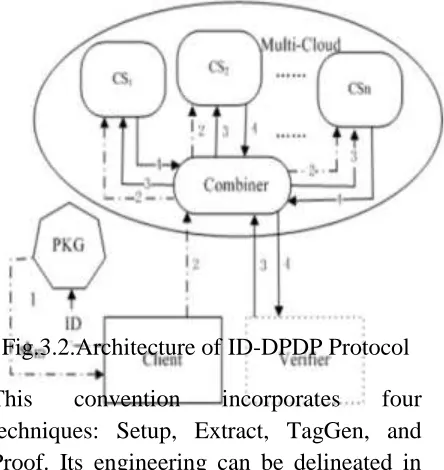
ID-DPDP protocol includes four different entities. Described as below:
a) Client: an entity, which has massive data to be deposited on the multi-cloud for preservation and calculation, can be either individual consumer or corporation.
b) CS (Cloud Server): an entity, which is managed by cloud service provider, has significant storage space and computation resource to maintain the clients’ data[8].
c) Combiner: an entity, which receives the storage request and distributes the block-tag pairs to the corresponding cloud servers. When getting the challenge, it separates the challenge and distributes them to the different cloud servers. When receiving the responses from the cloud servers, it combines them and sends the combined response to the verifier[9].
d)PKG (Private Key Generator): an entity, when receiving the identity, it outputs the private key.
Fig.3.2.Architecture of ID-DPDP Protocol
This convention incorporates four techniques: Setup, Extract, TagGen, and Proof. Its engineering can be delineated in
Figure. The figure can be portrayed as takes after: 1. In the stage Extract, PKG produces the private key for the customer. 2. The customer delivers the piece label combine and transfers it to syndicate. The combiner issues the square label sets to the diverse cloud servers as per the capacity metadata. 3. The verifier guides the test to combiner and the combiner issues the challenge question to the relating cloud servers as per the capacity metadata. 4. The cloud servers answer the test and the combiner aggregates these reactions from the cloud servers. The combiner sends the totaled reaction to the verifier. At long last, the verifier checks whether the amassed answer is viable.
The solid ID-DPDP development
predominantly originates from the signature, provable information ownership and disseminated processing. The mark portrays the customer's personality with his private key. Conveyed registering is utilized to store the customer's information on multi-cloud servers. In the meantime, conveyed figuring is additionally used to syndicate the multi-cloud servers' answers to restore the verifier's test. In light of the provable information ownership convention, the ID-DPDP convention is built by making utilization of the signature and dispersed registering.
is the record of the comparing CS. (Ni , CSli , I) will be utilized to create the tag for the square Fi.
IV. CONCLUSION
This paper proposes the novel security thought of ID-PUIC publically cloud. The paper formalizes ID-PUIC's framework model and security display. At that point, the essential solid ID-PUIC convention is implied by exploitation the straight pairings method. The solid ID-PUIC convention is undeniably secure and prudent by exploitation the formal security confirmation and power investigation. On the inverse hand, the anticipated ID-PUIC convention additionally can comprehend non-open remote information respectability checking, designated remote learning uprightness checking and open remote learning honesty checking upheld the principal customer's approval.
References
[1] B. Chen, H. Yeh, “Secure proxy signature schemes from the weil pairing”, Journal of Supercomputing, vol. 65, no. 2, pp. 496-506, 2013.
[2] X. Liu, J. Ma, J. Xiong, T. Zhang, Q. Li, “Personal health records integrity verification using attribute based proxy signature in cloud computing”, Internet and Distributed Computing Systems, LNCS 8223,pp. 238-251, 2013.
[3] H. Guo, Z. Zhang, J. Zhang, “Proxy re-encryption with unforgeable reencryption
keys”, Cryptology and Network Security, LNCS 8813, pp. 20-33, 2014.
[4] E. Kirshanova, “Proxy re-encryption from lattices”, PKC 2014, LNCS 8383, pp. 77-94, 2014.
[5] P. Xu, H. Chen, D. Zou, H. Jin, “Fine-grained and heterogeneous proxy re-encryption for secure cloud storage”, Chinese Science Bulletin, vol.59, no.32, pp. 4201-4209, 2014.
[6] S. Ohata, Y. Kawai, T. Matsuda, G. Hanaoka, K. Matsuura, “Reencryption
Verifiability: how to detect malicious activities of a proxy
in proxy re-encryption”, CT-RSA 2015, LNCS 9048, pp. 410-428, 2015.
[7] G. Ateniese, R. Burns, R. Curtmola, J. Herring, L. Kissner, Z. Peterson, D. Song, “Provable data possession at untrusted stores”, CCS’07, pp.598-609, 2007.
[8] G. Ateniese, R. DiPietro, L. V. Mancini, G. Tsudik, “Scalable and efficient provable data possession”, SecureComm 2008, 2008.
[9] H. Wang, “Proxy provable data possession in public clouds,” IEEE Transactions on Services Computing, vol. 6, no. 4, pp. 551-559, 2013.
Journal of Biomedical Informatics, vol. 50, pp. 226-233, 2014.
[12] H. Wang, “Anonymous multi-receiver remote data retrieval for pay-tv in public clouds”, IET Information Security, vol. 9, no. 2, pp. 108-118, 2015.
Author’s Profile:
A.SIVAKRISHNA
Completed B.Tech In 2014
Skr Engineering College
Perusing M.Tech In
Malineni Lakshmaiah
Engineering College, Singarayakonda,
Prakasam(Dt), AP, India.
Mr.P.Srinivasulu has
received his B. Tech in CSE in Mother Therissa Institute of
Science and Technology,