MeshHash2
Submitter’s Name: Björn Fay E-Mail: [email protected]
Tel.: +49 6404 661672 Mobile: +49 177 6179340 Fax: +49 721 151-465799
Postal address: Licher Pforte 27
35423 Lich Germany
Name(s) of auxiliary submitter(s): None
Name of the algorithm inventor/developer: Björn Fay Name of the owner of the algorithm: Björn Fay
Contents
1 Introduction and History 2
2 Algorithm specification 3
2.1 Notation . . . 3
2.2 Overview . . . 4
2.3 Details . . . 5
2.3.1 Parameters . . . 5
2.3.2 The internal state . . . 5
2.3.3 Preprocessing . . . 6
2.3.4 Normal round and SBox . . . 7
2.3.5 Final block round . . . 8
2.3.6 Final rounds . . . 8
2.3.7 Compute the hash value by squeezing the sponge . . . 9
2.3.8 Usage as PRG . . . 9
2.3.9 The whole algorithm . . . 9
3 Design rationale 10 4 Special Features 12 5 Security 12 5.1 Sponge . . . 12
5.2 Merkle-Damgård . . . 13
5.3 Attacks . . . 13
5.4 Expected strength . . . 14
6 Tunable security parameter for testing 15 7 Efficiency and memory requirements 16 7.1 Memory . . . 16
7.2 Efficiency . . . 16
7.2.1 64 Bit . . . 16
7.2.2 32 Bit . . . 18
7.2.3 8 Bit . . . 20
1 Introduction and History
by 0 bit.
But since the flaw can be easily fixed, which was already implemented in a preliminary version, it seems to be a good idea to publish MeshHash2 as a patch and see if it might be useful for further research or even usage. The patch uses a feedback, which increases the memory usage, but doesn’t give more security against a straight forward collision attack, which was the reason it has been dropped from the preliminary version of MeshHash.
The following specification is the patched version of MeshHash, named MashHash2. It is a very flexible but conservative design with primarily security in mind and only secondarily speed. But it achieves about the same speed as the SHA-2 family and security up to 16320 bit. It can also be used in a keyed version as PRF or PRG and hence build a stream-cipher of it.
2 Algorithm specification
2.1 Notation
This specification uses the following terms, notations and operations:
Bit is a binary digit having a value of 0 or 1.
Byte is a group of eight bits having values from 0 to 255.
Word is a group of 64 bits or 8 bytes having values from 0 to 264−1.
PRF is the abbreviation of pseudo random function.
PRG is the abbreviation of pseudo random generator.
0r is a group, string or array of r bits with value 0.
h is used as an index for hexadecimal numbers. For example1ah is the number 26.
b is used as an index for binary numbers. For example 0101b is the number 5.
mod,% is the modulo operator, which finds the remainder of division of one number by another. For example:
8 mod 3 = 8 % 3 = 2.
⊕ is bitwise XOR of words or bytes. For example:
0fh⊕55h =00001111b⊕01010101b =01011010b =5ah.
: is bitwise OR of words or bytes. For example:
? is bitwise AND of words or bytes. For example:
0fh?55h =00001111b?01010101b =00000101b =05h.
RotRi(w) is a rotation of a word wto the right by imod 64 bits. For example:
RotR76(123456789abcdefh) =def123456789abch.
w << b is a shift of a word w to the left by b bits. For example:
ffffffff00000000h <<5 = ffffffe000000000h.
w >> b is a shift of a word w to the right by b bits. For example:
ffffffff00000000h >>5 = 07fffffff8000000h.
is addition modulo 264, that is x
y= (x+y) mod 264. For example:
8765432112345678h9876543287654321h =1fdb975399999999h.
is multiplication modulo 2
64, that isx
y= (x·y) mod 2
64. For example:
4000000320000001h7000000000000007h
=c0000015e0000007h7000000000000000h =30000015e0000007h.
| concatenates two groups, strings, or arrays of bits, bytes, or words.
Throughout this specification, the “big-endian” convention is used when expressing words or bytes, so that the most significant byte or bit is stored in the left-most position.
2.2 Overview
The MeshHash2-Algorithm is a mixture of the Merkle-Damgård model and the sponge model [BDPA07, BDPA08]. The algorithm has an internal state, which primarily con-sists of some so called pipes. The number of these pipes (we call it P) depends on the length of the hash value. The algorithm works in blocks and each block consists of P
rounds. In each round one message word is processed and the internal state is updated. At the end of each block there is a special final round to update the internal state in-cluding the processing of a block counter and processing a given key if applicable. Before starting the processing the key is inserted at the beginning of the message.
init internal state
data_stream = key | message | pad while data left do
{
normal round with next data word after P rounds do final block round }
do some final rounds
while hash value is shorter than hash length do {
normal round with 0 as data
compute and append next byte to hash value after P rounds do final block round
}
Figure 1: Overview in pseudocode
2.3 Details
2.3.1 ParametersThe algorithm works for messages of length up to 2256 bit. A key as array of bytes can be
given whose length in bytes must be a multiple of 8 and smaller than 215= 32768. But
normal keys should have a length in the range up to 2048 byte (16384 bit). The output is a hash value as array of bytes whose length in bits must be a multiple of 8 and shorter than 215 = 32768, but should be shorter than or equal to 16320 bit, because there is no
security gain for longer hash values. In addition MeshHash2 can be used as PRG (and create a stream-cipher) and hence a pseudo-random byte sequence of indefinite length can be produced. In this case a key should be given as seed, a message can be given as further input, and the number of pipesP has to be chosen according to security needs.
2.3.2 The internal state
The internal state consists of the following components:
number of pipes namedP, which stores the number of pipes.
P pipes namedpipe[i], fori= 0, . . . , P −1, each containing a word.
2P feedback-words named feedback[i][j], for i = 0,1 and j = 0, . . . , P −1, repre-senting the feedback of the actual block and the last block.
key length named key_length, which is the length of the key in words. If no key is used then this value is 0.
key named key, which is an array of words key[i] for i = 0, . . . ,key_length − 1 containing the key.
key counter namedkey_counter, which counts the uses of the key and is also an offset in the key.
bit counter namedbit_counter, which counts the message bits. It consists of 4 words
bit_counter[i] for i = 0, . . . ,3, where the value of bit_counter is P3
i=02 64i ·
bit_counter[i].
block counter named block_counter, which counts the number of processed blocks. It consists of 4 words block_counter[i] for i = 0, . . . ,3, where the value of
block_counteris P3
i=02
64i·block_counter[i].
hash length named hashbitlen, which is the length of the hash value in bits.
The counters and length for which nothing is said about the type have to be integers which can handle numbers between 0 and 215−1 and can be easily converted to words
(or are words). At the beginning the components of the internal state are set as follows:
• The number of pipes P is computed as the smallest integer greater than or equal tohashbitlen/64 + 1. But at least 4 and at most 256.
• Every pipe and feedback-word is set to 0.
• The value of bit_counteris set to the number of bits in the given message. The counter can also be updated while processing the message, if the message length is not known at the beginning.
• Every other counter is set to 0.
• The given key as array of bytes is transformed to an array of words, where the first of eight bytes is the most significant one and the last is the least significant one (big-endian) and is stored inkey.
• The given key length in bytes is divided by 8 to give the key length in words and is stored in key_length.
2.3.3 Preprocessing
After setting the internal state and before processing the message the input data for the rounds is prepared as
i0101010101010101h
data
pipe’[i] //⊕ //⊕ //RotR37i //SBox // //pipe[i]
pipe’[i+1]
GF
BCOO
. . . . . . . . . . . . . . . pipe[i+1]
Figure 2: Normal Round
where r is the least integer so that key_length·64 +bit_counter+r+ 64·P is a multiple of 64·P. Note that neither the length of the key nor “r+ 64·P” are counted bybit_counter.
The key can already be processed directly after the initialization (this can also be seen as part of the initialization). The concatenation of 0r+64·P and its processing can be done just before doing the final rounds, if the length of the message is not known at the beginning (this can also bee seen as part of the final rounds).
2.3.4 Normal round and SBox
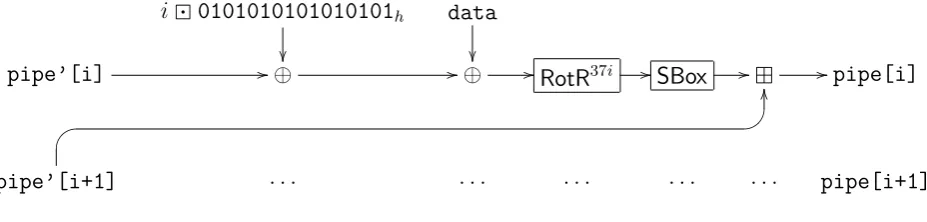
A normal round processes one word (of data_stream, which consists of the key, the message, and 0r+64·P), named data, and the internal state as follows. Let pipe’[i] be
pipe[i] at the beginning of the round. Then at the end of the round it is (see also figure 2)
pipe[i]=SBox(RotR37i(pipe’[i]⊕(i0101010101010101h)⊕data))pipe’[(i+1)%P]
whereSBox(w) is computed according to the pseudocode: SBox(w)
{
w = w9e3779b97f4a7bb9h
w = w5e2d58d8b3bcdef7h
w = RotR37(w)
w = w9e3779b97f4a7bb9h
w = w5e2d58d8b3bcdef7h
w = RotR37(w) return w }
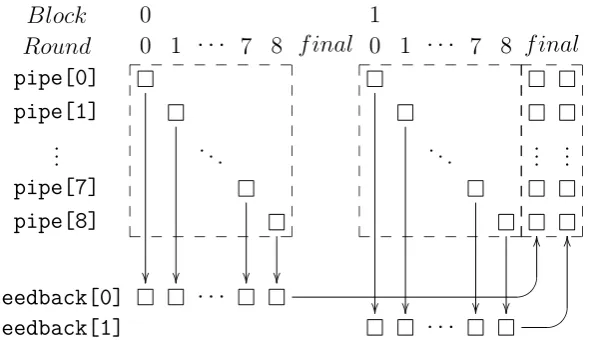
In round j (= block_round_counter) of the block the result pipe[j] is stored in a feedback-word, depending onblock_counter (see also figure 3):
feedback[block_counter[0]?0000000000000001h][j]=pipe[j].
2.3.5 Final block round
AfterP normal rounds a final block round is done as follows.
Reset block round counter: Set block_round_counter to 0 for the next block.
Process block counter: The pipes are updated with block_counterby
pipe[i]=SBox(pipe[i]⊕block_counter[i%4])
fori= 0, . . . , P −1. Increase block_counter by 1.
Process key: Letkbe the least multiple ofP that is greater than or equal tokey_length. Fori= 0, . . . , k−1 do
pipe[i%P]=SBox(pipe[i%P]⊕key[(i + key_counter)%key_length]).
After that set key_counter to (key_counter+ 1) modkey_length and for i = 0, . . . , P −1 do
pipe[i]=SBox(pipe[i]⊕key_length⊕(i0101010101010101h)),
wherekey_length is interpreted as a word.
If no key is given and key_length is 0, then this whole step is skipped.
Process feedback: Letb∈ {0,1}be the least significant bit ofblock_counter(which is
already updated for the next block), that isb =block_counter[0]?0000000000000001h. The pipes are updated withfeedback by
pipe[i]=SBox(pipe[i]⊕feedback[b][i])
pipe[i]=SBox(pipe[i]⊕feedback[1-b][i])
fori= 0, . . . , P −1 (see also figure 3).
2.3.6 Final rounds
After all bits (words) ofdata_streamare processed some final rounds are done as follows:
• Fori= 0, . . . ,3 andj = 0, . . . , P −1 do
pipe[j]=SBox(pipe[j]⊕bit_counter[i]⊕(j0101010101010101h)).
• Fori= 0, . . . , P −1 do
pipe[i]=SBox(pipe[i]⊕hashbitlen⊕(i0101010101010101h)),
Block 0 1
Round 0 1 · · · 7 8 f inal 0 1 · · · 7 8
pipe[0] pipe[1] .. . . .. . .. ... ... pipe[7] pipe[8]
feedback[0] · · ·
BC
O
O
feedback[1] · · ·
BC O O _ _ _ _ _ _ _ _ _ _ _ _ _ _ _ _ _ _ _ _ _ _ _ _ _ _ _ _ _ _ _ _ _ _ _ _ _ _ f inal
Figure 3: Feedback for P = 9
2.3.7 Compute the hash value by squeezing the sponge
The hash value hashval (as array of bytes) is computed byte by byte, similar to the processing of the message. Fori= 0, . . . ,hashbitlen/8−1 do:
• Process a normal round with data= 0 (as in 2.3.4).
• Letk be the greatest even integer smaller than P and compute
hashval[i] = (pipe[0]⊕pipe[2]⊕. . .⊕pipe[k])?00000000000000ffh,
where the result is interpreted as byte (there are only values between 0 and 255).
• IfimodP =P −1 then process a final block round (as in 2.3.5).
2.3.8 Usage as PRG
If MeshHash2 is used as PRG, then hashbitlen is set to 0 and the number of pipes P
is explicitly given. The computation of the “hash value” (as in 2.3.7) has to be repeated as many times as desired and not justhashbitlen/8 times.
2.3.9 The whole algorithm
MeshHash2 computes a hash value of hashbitlen bits for messagewith given_key as follows (pseudocode):
if hashbitlen is no multiple of 8 or >= 215 then exit with error
if length of given_key in bytes is no multiple of 8 or >= 215
then exit with error
data_stream = key | message | 0r+64·P (as in 2.3.3)
while data_stream is not completely processed do {
data = next word in data_stream normal_round(data) (as in 2.3.4)
if block_round_counter = P
then final_block_round (as in 2.3.5)
}
final_rounds (as in 2.3.6)
compute_hash_value (as in 2.3.7)
3 Design rationale
The first design criterion (not necessarily the most important) was to allow parallel execution of MeshHash2. Therefore the algorithm is working in different pipes. But to prevent multi-collision-attacks [Jou04], which would make the whole construction just a little bit stronger than one pipe, these pipes have to be connected in some way. This is why there is an addition of the next pipe at the end of a round. Because this inter-pipe-communication may be slower than in-pipe-computation, the value to add is taken from the beginning of the round (end of previous round). This should give enough time for communication. In particular if there are 4 threads each with 2 pipes, then the value of the next thread (previous round but first pipe in that thread) is not needed until the second pipe in the actual thread is computed.
Each pipe has to compute different values otherwise we would not need more than one. So in each pipe the computation is altered slightly with operations that are easy to compute. This makes implementation in hardware easier since the greatest part of the pipes is identical and may be reused (highly optimized) or the circuits may simply be copied.
Each message-bit should influence each hash-bit or here every bit in each pipe. We easily see that every data-word influence every pipe, but for the diffusion of the message-bits a sbox (SBox) is used. Since many servers use a 64-bit operating system and more and more 64-bit workstations are in use the choice was to use a 64-bit sbox with simple operations that are typical for 64-bit systems but do a fair amount of diffusion. The choice for the operations was to use a multiplication, an addition, and a rotation. The integer for multiplication is the largest prime smaller than 2ϕ64, where ϕ = 1+
√
5
2 is the
golden ratio. That way the multiplication is invertible modulo 264. The number for
addition is the largest prime smaller than 264e . The number by which the word is rotated is the largest prime smaller than 64ϕ. That way rotations can be repeated 64 times before the same word emerges and the rotation is very asymmetric. Since the highest bit would only influence itself, this procedure is done two times so that every bit can influence 37 to 64 bits, depending on its position.
hash value plus one extra pipe since the value of one pipe can be easily controlled with the message.
To avoid extension attacks or a permutation of blocks, a counter for the message bits is processed after the message and a block counter is processed after each block. The size of the counter was chosen to be large enough to nearly take the number of atoms of the universe, which makes even theoretical attacks with counter overflows meaningless. So the final block rounds for each block are different as are the final rounds for different message lengths. The length of a block in words is equal to the number of pipes, so that for an “optimal round function” there would be as many pipe states as message blocks and no one-block collision could be found (but this does probably not hold for the real world).
The usage of the feedback is needed to prevent a second preimage attack as in [Tho08]. The feedback was chosen to be from two blocks to have an interleaving of blocks. This way a change in a message-word changes the result in the pipe and hence the feedback, which is used two times, at the end of the actual block and the next block. The message-words can be easily computed to produce a certain feedback word, so it does not help against simple search for collisions (in the pipes), but it should make “Inversion of the round-function” very difficult, because of the three points of influence of one message-word (two of them exactly one block apart).
Since in theory hash functions should be keyed, it should also be done in practice. Earlier implementations have taught us that it may be weak to use the key only at the beginning of a hash function. So it is processed after each block together with its length. To influence the normal rounds in the first block the key is also processed before the first block. Since the internal state has essentially 64·P (or hashbitlen for ease) bits, the key should not be longer than that. It would only slow down the algorithm and pretend to give more security than the algorithm actually could give. Only if used as a PRG or key generator it could be adequate to use more than 64·P bits for a key.
The hash values of different length but for the same message should not have some easy detectable relation. So the length of the hash value is processed after the message in the final rounds. Similar things hold for the key length, but it is processed after each block since the key is processed there.
4 Special Features
There are three features that make MeshHash2 very flexible to use:
Key The algorithm is designed with key usage in mind. So there is no need for extra workarounds as in HMAC. Supported key lengths are from 0 to 64·P (a little bit more than hashbitlen) bits (with 64-bit steps). Technically even values up to 215−1 = 32767 bytes are possible, but there is no or just little gain in security
above 64·P bits for use as hash function.
Hash length The possible length of the hash value vary from 8 bits to 16320 bits (in 8-bit steps). Technically even values up to 215−8 = 32760 bits are possible, but there is no or just little gain in security above 16320 bits.
PRG MeshHash2 might be used as a PRG (and for key derivation or for building a stream-cipher), where the key length might be even larger than 64·P bits to gain more entropy. The sequence of pseudo-random-bytes can be P ·2256 bytes long
before a repetition of the inner state occurs and hence a repetition of the sequence before positionP ·2256 is very unlikely.
5 Security
5.1 Sponge
MeshHash2 can be seen as sponge [BDPA07, BDPA08] with an adequate mappingp or padding pad, which maps any input word (or block, which ever fits best) to an input character unequal to 0. And/or the sponge model could be slightly altered. Hence the security proof of [BDPA08] or a slightly adapted version should hold for MeshHash2. As capacity we take the size of the internal state, but only the pipes since the others are just counters and feedback-words, which are not very randomly transformed. We even take onlyP−1 pipes, because one pipe can be easily controlled by selecting the message suitably. That gives us a security parameter of 64·(P −1) bits for usage as normal hash function (with hashbitlen = 64·(P −1) for this security proof), which means that you have to compute about 232·(P−1) hash values to find a collision and 264·(P−1) to find
a 2nd preimage. Further more we have that if an attacker computes at most 216·(P−1)
rounds he can distinguish MeshHash2 with a maximal probability of about 2−32·(P−1)
5.2 Merkle-Damgård
MeshHash2 can also be seen as a Merkle-Damgård construction, at least the processing of a whole block. The only difference to MD is the computation of the hash value from the pipes round by round. But at least we can use statements about MD for the internal state.
It may be easy to find a collision of the compression function (with different internal states as input). This is not as bad as it sounds, it just means that we can not use the conclusion, that a collision resistant compression function leads to a collision resistant hash function.
One security feature is a kind of NMAC construction for MeshHash2, since before the computation of the hash value there are some special rounds and a totally different computation of the hash value than simply outputting the internal state. Also the computation of the hash value can be seen as a kind of extreme truncation (or chop solution as it is called in [CDMP05]). And if we treat the block counter as part of the message (at the end of each block), as well as the bit counter (at the end of the message, after a block with a “different encoding”), then we have a prefix-free input for MD. All three mentioned points would make MeshHash2 indifferentiable from a random oracle, if the compression function would be a random oracle as is shown in [CDMP05].
The usage of a block counter can also be seen as dithering [Riv05] and gives no fix-points. It also leads to a protection against message expansion (see [BD06])
5.3 Attacks
The following attacks have been considered:
Finding fix-points: Since there are no fix-points due to the block counter, no fix-points can be found.
Expandable messages: The block counter and bit counter make sure that every block is processed differently depending on its position and that messages with different length are processed differently at the end, so there are no expandable messages.
Second preimage: Since there are no expandable messages, the attacks [KS05, ABF+08]
to find 2nd preimages faster than 2n can not be applied anymore. Also the attack of Thomsen [Tho08] can not be applied due to the feedback.
Differential cryptanalysis: Since each bit in a data word is processed in each pipe and different data words lead to different pipe states for each pipe after one round, the changing of one bit (or more) in a data word leads to a change in at least one bit per pipe, that are at least P bits but with high probability more than P bits. And one feedback-word has at least one bit changed, which is used again after the actual and the next block.
Multi-Collision [Jou04]: Since there is no “wide-range-feedback”, finding a collision (for the internal state) can still be “amplified” to a multi-collision. But since finding collisions should be hard, this attack remains a theoretical one. It should be mentioned that these multi-collisions are for the whole internal state and not for each pipe as considered in the design.
Herding [KK06]: Still possible for the same reason as above.
5.4 Expected strength
After the considerations in the previous sections the expected strength of MeshHash2 is as follows:
Hash function If MeshHash2 is used as hash function with a hash value of lengthnbits where 8≤n ≤ 16320 and n is a multiple of 8, then it has the following expected strength against
• finding a preimage: 2n,
• finding a 2nd preimage: 2n,
• finding a collision: 2n2.
This includes the truncation of longer hash values ton bits. For the four required lengths the expected strength is (in bits):
hash length preimage 2nd preimage collision
224 224 224 112
256 256 256 128
384 384 384 192
512 512 512 256
HMAC/PRF If MeshHash2 is used as HMAC/PRF like in FIPS 198-1 the block size and hence the key size is 64·P bits. But since MeshHash2 has native support for keys, this could also be used. It supports keys from 64 to 64·P bits (in 64-bit steps). The expected strength of this native HMAC/PRF (as for the approach in FIPS 198-1) depends on the goal to achieve. For n-bit hash values and k-bit keys this is:
• If finding a collision for a given key is sufficient (or a valid HMAC for another message, which could be achieved by guessing the key) then it is the minimum of 2n2 and 2k
• If finding a preimage or 2nd preimage for a given key is sufficient (or a valid HMAC for another message, which could be achieved by guessing the key) then it is the minimum of 2n and 2k
• If only finding a valid HMAC for another message is sufficient (which could be achieved by guessing the key or the HMAC) then it is the minimum of 2n and 2k.
Randomized hashing for digital signatures If MeshHash2 is used for randomized hash-ing it can be done as in SP 800-106, but also the native support of MeshHash2 can be used, where the random value is used as key. As also stated in SP 800-107 the expected strength for this is the minimum of 2n and 2n2 + 2k, where the length
of the hash value is n bits and a k-bit random value is used. This is because for a valid collision you have to guess also the right random value, which changes in every signature computation without influence of an attacker.
PRG If MeshHash2 is used as PRG the key is used as seed and additional input such as personalization string or nonce can be given as message. The expected strength is 2k, wherekis the length of the seed or the key in bits. The key can be up to 16320 bits long (technically even longer, up to 215 −8 = 32760 bytes, with unknown
security gain, but the entropy of the sequence should still increase). That means that you should not be able to distinguish the generated bit sequence from a real random sequence with a workload less than 2k and the produced sequence (if long enough) should have an entropy ofkbits. The number of pipesP needed to achieve this strength is the same as for a k-bit hash value. It may be smaller, but further research is needed here.
Key derivation This can be seen as a special use case of PRG. But even if you could derive a 2048-bit key out of a 512-bit seed, the derived key would only have an entropy of 512 bits and hence should not be used as a 2048-bit key. On the other hand you can derive numerous 2048-bit keys (as concatenated byte string) out of a 2048-bit seed for use in different applications or different time slices, where the system of all these applications together has a security level of 2048 bits. That means instead of breaking one part of the system one can guess the seed and hence break all parts. On the other hand if one part is broken due to some weakness and the attacker is able to derive one key with less than a 2k-workload, he is not able to derive the other keys.
6 Tunable security parameter for testing
7 Efficiency and memory requirements
7.1 Memory
The amount of memory that MeshHash2 needs can be easily derived from the design of the internal state (in bytes):
P pipes P ·8
2P feedback-words 2P ·8
block round counter 2
key length 2
key key_length·8 (if unkeyed) 0
key counter 2
bit counter 4·8 32
block counter 4·8 32
hash length 2
one temporary pipe per thread 8
actual data word 8
total key + 3P ·8 + 88
Depending on the implementation another 3 counters (each of 2 bytes) and 2 words could be needed (another 22 bytes). Without a key, but plus these extra 22 bytes, we get the following memory usage for the required lengths of the hash value:
hash length memory 224 bits 230 bytes 256 bits 230 bytes 384 bits 278 bytes 512 bits 326 bytes
7.2 Efficiency
Since the efficiency depends on the system, we look at 64-bit, 32-bit and 8-bit systems in different sections.
7.2.1 64 Bit
Because the trend is to use 64-bit systems MeshHash2 is designed with these systems in mind. Probably the best way to say something about efficiency is to do some tests. Therefore a comparison of the SHA family is done with some variants of MeshHash2.
For this tests (64 bit only) a slightly optimized version is used, where assembler code is used for the rotation (can be switched in the source code). Without this optimization it would take about 9 – 20 % more time.
Operating system: Ubuntu 9.04-amd64 with kernel 2.6.28-11-generic Processor: Intel(R) Core(TM)2 Duo T5600 @ 1.83GHz
Memory: 2 GB
Compiler: gcc version 4.3.3 (Ubuntu 4.3.3-5ubuntu4) Compiler options: -std=c99 -pedantic -O2 -march=native Used libraries: crypto (libssl 0.9.8g-15ubuntu3)
mhash (libmhash2 0.9.9-1)
And the results for processing 100 MiB (100·220 byte) in 1 KiB (210 byte) blocks are
(in ms and cycles per byte):
SHA1 (crypto) 560 ms 9.8 cpb SHA1 (mhash) 630 ms 11.0 cpb SHA256 (mhash) 1280 ms 22.3 cpb SHA512 (mhash) 890 ms 15.5 cpb MeshHash2 (160 bits) 790 ms 13.8 cpb MeshHash2 (160 bits + key) 970 ms 16.9 cpb MeshHash2 (224 bits) 830 ms 14.5 cpb MeshHash2 (224 bits + key) 1020 ms 17.8 cpb MeshHash2 (256 bits) 840 ms 14.7 cpb MeshHash2 (256 bits + key) 1010 ms 17.6 cpb MeshHash2 (384 bits) 950 ms 16.6 cpb MeshHash2 (384 bits + key) 1110 ms 19.4 cpb MeshHash2 (512 bits) 1060 ms 18.5 cpb MeshHash2 (512 bits + key) 1230 ms 21.5 cpb MeshHash2 (1024 bits) 1580 ms 27.6 cpb MeshHash2 (1024 bits + key) 1730 ms 30.2 cpb MeshHash2 (2048 bits) 2600 ms 45.4 cpb MeshHash2 (2048 bits + key) 2790 ms 48.7 cpb
plain write 110 ms 1.9 cpb
The used keys have the length of (P −1)·64 bits, that is the smallest multiple of 64 that is greater than or equal to the hash length. The “plain write” is the time to write the 100 MiB in one-byte steps without processing by a hash function.
For the computation of 100000 = 105 hash values of a one-block message we get the
following times and hence clock cycles per hash value:
To set up the algorithm all counters, pipes, and the feedback-words have to be set to zero. Additionally the key has to be copied and processed if given. A test with 10000000 = 107 calls of the init procedure has been done and the following times (total)
and clock cycles (per init) were needed:
224 bits 1840 ms 337 clock cycles 224 bits + key 4180 ms 765 clock cycles 256 bits 1840 ms 337 clock cycles 256 bits + key 4180 ms 765 clock cycles 384 bits 1890 ms 346 clock cycles 384 bits + key 5740 ms 1050 clock cycles 512 bits 2040 ms 373 clock cycles 512 bits + key 7710 ms 1411 clock cycles
There are no significant tradeoffs between speed and memory.
7.2.2 32 Bit
As with the 64-bit system the same tests were done on the same machine, but this time without any assembler-optimization.
The testing system was:
Operating system: Ubuntu 9.04-i386 with kernel 2.6.28-11-generic Processor: Intel(R) Core(TM)2 Duo T5600 @ 1.83GHz
Memory: 2 GB
Compiler: gcc version 4.3.3 (Ubuntu 4.3.3-5ubuntu4) Compiler options: -std=c99 -pedantic -O2 -march=native Used libraries: crypto (libssl 0.9.8g-15ubuntu3)
mhash (libmhash2 0.9.9-1)
And the results for processing 100 MiB (100·220 byte) in 1 KiB (210 byte) blocks are
SHA1 (crypto) 480 ms 8.4 cpb
SHA1 (mhash) 940 ms 16.4 cpb
SHA256 (mhash) 1830 ms 31.9 cpb SHA512 (mhash) 4370 ms 76.3 cpb MeshHash2 (160 bits) 2520 ms 44.0 cpb MeshHash2 (160 bits + key) 3140 ms 54.8 cpb MeshHash2 (224 bits) 2860 ms 49.9 cpb MeshHash2 (224 bits + key) 3450 ms 60.2 cpb MeshHash2 (256 bits) 2860 ms 49.9 cpb MeshHash2 (256 bits + key) 3450 ms 60.2 cpb MeshHash2 (384 bits) 3500 ms 61.1 cpb MeshHash2 (384 bits + key) 4100 ms 71.6 cpb MeshHash2 (512 bits) 4140 ms 72.3 cpb MeshHash2 (512 bits + key) 4740 ms 82.7 cpb MeshHash2 (1024 bits) 6990 ms 122.0 cpb MeshHash2 (1024 bits + key) 7590 ms 132.5 cpb MeshHash2 (2048 bits) 12530 ms 218.7 cpb MeshHash2 (2048 bits + key) 13130 ms 229.1 cpb
plain write 50 ms 0.9 cpb
The used keys have the length of (P −1)·64 bits, that is the smallest multiple of 64 that is greater than or equal to the hash length. The “plain write” is the time to write the 100 MiB in one-byte steps without processing by a hash function.
For the computation of 100000 = 105 hash values of a one-block message we get the
following times and hence clock cycles per hash value:
224 bits 1010 ms 18483 clock cycles 224 bits + key 1330 ms 24339 clock cycles 256 bits 1090 ms 19947 clock cycles 256 bits + key 1450 ms 26535 clock cycles 384 bits 1890 ms 34587 clock cycles 384 bits + key 2210 ms 40443 clock cycles 512 bits 2720 ms 49776 clock cycles 512 bits + key 3450 ms 63135 clock cycles
To set up the algorithm all counters, pipes, and the feedback-words have to be set to zero. Additionally the key has to be copied and processed if given. A test with 10000000 = 107 calls of the init procedure has been done and the following times (total)
224 bits 3380 ms 619 clock cycles 224 bits + key 11100 ms 2031 clock cycles 256 bits 3380 ms 619 clock cycles 256 bits + key 11560 ms 2115 clock cycles 384 bits 3440 ms 630 clock cycles 384 bits + key 17900 ms 3276 clock cycles 512 bits 4760 ms 871 clock cycles 512 bits + key 27860 ms 5098 clock cycles
There are no significant tradeoffs between speed and memory.
7.2.3 8 Bit
As there has neither been announced a reference platform nor does the author has an 8-bit system to do some tests, the estimates for 8-bit systems are only very rough.
As a raw estimate you need for all operations without the multiplication in the sbox 8-times as many steps on an 8-bit system than on a 64-bit system. For some extra logic we should perhaps blow up the factor to 16-times. But on the other side most of these operations can be done in parallel, so if you can afford to implement these steps in a parallel manner, you are not so much slower. The bottleneck is the multiplication in the sbox. Since there are many possibilities for optimization (one factor is constant) and the possibilities of 8-bit processors vary, there could only be a rough estimate. Since it is sufficient to shift the factor 26 times and add it to or subtract it from a temporary value which has to be done for a decreasing number of bytes this gives about 26·8·3/2 = 312 byte-operations. The 8 is for the 8 bytes in a word, the 3 is for the addition or subtraction, another one for a carry bit and a shift and the 2 is for the decreasing number of bytes. But this also could be done in parallel and there is still much room for optimization. Perhaps if optimized and parallelized it could be done with the same speed as the other operations, namely 8 to 16 times slower than on a 64-bit system (with the same clock-speed). Since multiplication is an old and well known problem there are presumably some very tricky and efficient solutions.
The overall estimation then is somewhere between 8-times and about 300-times slower than on a 64-bit system (with the same clock-speed). For exact estimates it seems one has to implement it on different platforms.
References
[ABF+08] Elena Andreeva, Charles Bouillaguet, Pierre-Alain Fouque, Jonathan J. Hoch, John Kelsey, Adi Shamir, and Sébastien Zimmer. Second preimage attacks on dithered hash functions. In Smart [Sma08], pages 270–288.
[BDPA07] Guido Bertoni, Joan Daemen, Michael Peeters, and Gilles Van Assche. Sponge functions, 2007. ECRYPT Hash Workshop 2007.
[BDPA08] Guido Bertoni, Joan Daemen, Michael Peeters, and Gilles Van Assche. On the indifferentiability of the sponge construction. In Smart [Sma08], pages 181–197.
[CDMP05] Jean-Sébastien Coron, Yevgeniy Dodis, Cécile Malinaud, and Prashant Puniya. Merkle-damgård revisited: How to construct a hash function. In Victor Shoup, editor,CRYPTO, volume 3621 of Lecture Notes in Computer Science, pages 430–448. Springer, 2005.
[Gol03] Oded Goldreich. Foundations of Cryptography, volume I, Basic Tools. Cam-bridge University Press, reprinted and corrected edition, 2003.
[Jou04] Antoine Joux. Multicollisions in iterated hash functions. application to cas-caded constructions. In Matthew K. Franklin, editor, CRYPTO, volume 3152 of Lecture Notes in Computer Science, pages 306–316. Springer, 2004.
[KK06] John Kelsey and Tadayoshi Kohno. Herding hash functions and the nos-tradamus attack. In Serge Vaudenay, editor,EUROCRYPT, volume 4004 of Lecture Notes in Computer Science, pages 183–200. Springer, 2006.
[KS05] John Kelsey and Bruce Schneier. Second preimages on n-bit hash functions for much less than 2n work. In Ronald Cramer, editor, EUROCRYPT, volume 3494 ofLecture Notes in Computer Science, pages 474–490. Springer, 2005.
[Riv05] Ronald L. Rivest. Abelian square-free dithering for iterated hash functions, 2005. ECRYPT Hash Function Workshop 2005.
[Sma08] Nigel P. Smart, editor. Advances in Cryptology - EUROCRYPT 2008, 27th Annual International Conference on the Theory and Applications of Cryp-tographic Techniques, Istanbul, Turkey, April 13–17, 2008. Proceedings, vol-ume 4965 of Lecture Notes in Computer Science. Springer, 2008.