Comparative Study on Rcc Industrial Chimneys by Using Existing
(Is 4998 Part 1:1992) and Draft Code (Ced 38(7892) Wc
Shaik Karim Saida& M.Venkata Narasaiah
1 P.G Student, Structural Engineering
2 Assistant Professor, Department Of Civil Engineering, Velaga Nageswara Rao College Of Engineering, Ponnur.
Abstract— This paper is aimed at knowing
the differences between existing code (IS 4998 part 1:1992) and the draft code CED
38(7892) with respect to its codal
parameters and final design based on geometric parameters and various wind speeds. This study considers various height to base diameter ratios such as 23, 25, 29 (the most preferable ratios as per IS 6533 (Part 1): 1989. Structural performance under lateral dynamic loading will be subjective by the geometry of the structure. This is because geometry will influence the stiffness parameters first and foremost. Based on related environmental conditions basic dimensions such as height, diameter at exit etc are there in case of chimneys. 54 cases of RCC chimneys are analyzed using existing code IS 4998 of heights 220m and 250m were studied and also 54 cases of RCC chimneys were analyzed using Draft Code CED 38(7892):2013 of same heights. Major difference after studying the draft code and existing code is draft code is based on Limit state design and existing code is based on working stress method. After
analysis the design results are in
accordance with the existing principle “limit state design is economical”.
Index Terms—RCC,INDUSTRIAL
CHIMNEYS, CED.
I INTRODUCTION:
Chimneys are generally used for emission of harmful gases to a higher altitude such that the harmful gases do not contaminate surrounding atmosphere. These type of structures are usually tall, lean and with circular in cross section. Generally chimneys are constructed with different type of materials i.e., masonry, concrete, steel. The industrial chimney was initial built in middle 17thcentury which became recognizable in 18th century. In steam boiler is a main part of chimney. Increase in power capacity of steam engine is closely connected to estimation of chimney.
In 19th century, the rapid growth of free standing industrial chimneys take place
which are closely related to the
improvements in boiler design which are related with Watt’s double powered engines[1].
RCC: RCC chimneys, no boundaries on
geometry like steel chimneys. RCC
chimneys are low preliminary and
maintenance cost and also good resistance to weather action when compared to steel chimneys.RCC chimneys are very spirited with steel chimneys in between 45 to 65m. RCC chimneys are preferable whenever the height of the chimney larger than 65m.
II. LITERATURE REVIEW
This division helps in meeting essential information regarding the project and throws light on topic which was not enclosed yet for better perceptive. Reddy, Jaiswal and P.N.Godbole (2011) “combined design
moments of tall reinforced concrete
chimneys”. Combined design moments along and across wind response of chimneys are measured for the design as wind load governs the design of RC chimneys. The methods used for estimated are IS 4998, ACI 307, AS/NZS11702,Menon & Rao [23]. Reddy, Jaiswal and P.N.Godbole (2011) “wind and earthquake analysis of tall RC chimneys”.In this paper, two RC chimneys(heights = 217m and 220m) are analysed for earthquake and wind loads. Earthquake analysis is done as per IS 1893 (Part 4): 2005 and wind analysis is performed as per IS 4998 (Part 1): 1992. In wind response, he considered combined along and across loads. In earthquake, he calculate shear force and bending moments for zones 2,3,4,5 and when zone factor is increases the S.F and B.M are increases. Finally he compare the wind and earthquake results and concluded that wind is governing the design of chimney. And the most critical earthquake zone 5 almost match the wind
response but it never cross the wind.
III. PROPOSED METHOD
The main objective of the present paper to comparative study on RCC industrial chimneys by using existing(IS 4998 part
1:1992) and draft code (CED
38(7892)WCfor considered various height to diameter ratios such as 23, 25 and 29 this are most preferable ratios as per the IS 6533 (Part 1): 1989 and for various loads 1989
and for various loads such as Dead load, Temperature effects, Wind load (basic wind speeds 39m/s, 47 m/s, and 55m/s) as per IS 875 (Part 3): 1987 were studied and finding out the governing load for the design. And comparison between the static and dynamic design loads with different to diameter ratios considered.
Methodology:
The following methodology was adopted during this present study:
1. Collection of data from various journals and standard textbooks and other sources 2. Design and analysis of RCC industrial chimney using procedure given in textbooks for obtained static moments and shear forces.
3. For dynamic analysis, understanding the procedure given in the draft code and the existing code.
4. For obtaining the mode shapes for dynamic analysis STAAD Pro software is used to verify the accuracy of the model. Two models were generated using 8 noded solid plate element and linear(tapered) element.
5. Once mode shapes were obtained from STAAD, these will used to calculate the bending moments and shear forces and they are finally compared with the static moments to obtain the design moments and shear forces.
6. Same work will be carried for draft code to compare and derive the conclusions from it.
Generating chimney model in STAAD, two types of models were considered, i.e., 8 noded solid plate elements for RCC chimney, and other one with line or tapered tube element for RCC chimney. These models were analysed and deflectionwas calculated. It is found that the deflection value for the 8 noded solid plate element model and the linear or tapered tube model are same, so for making the model generation easy linear element was chosen. Mode shapes and frequenciesare calculated using STAAD. A factor of 1.2 was multiplied to take in to account of accessories of chimney to its self-weight.
Fig 4.1 STAAD model of RCC Chimney using 8 node solid elements
In the above figure STAAD model of chimney using 8 node solid plate elements, shows 220m chimney having fixed supports assigned to base elements and the topmost elements are left 21 free to make sure cantilever action. Under the designed horizontal forces the displacement of this chimney was noted to evaluate it with
chimney model generated using linear/ beam element.
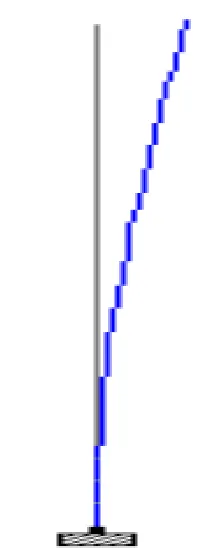
Fig 4.2STAAD model of Chimney using Line/Beam elements
In the above figure STAAD model of chimney using Line/Beam elements, shows 220m chimney having fixed support assigned to base node of the bottom most element. Cross sections were assigned using tapered tube element. For the same horizontal load mentioned above this model was analysed for deflection. It is found that both the deflection values are same. Hence, for modal analysis linear element model was
adopted for easier evaluation and
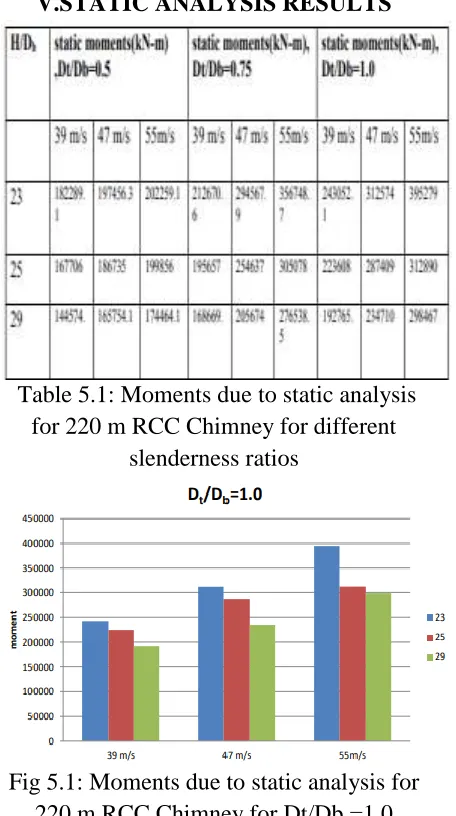
V.STATIC ANALYSIS RESULTS
Table 5.1: Moments due to static analysis for 220 m RCC Chimney for different
slenderness ratios
Fig 5.1: Moments due to static analysis for 220 m RCC Chimney for Dt/Db =1.0
Table 5.2: Moments due to static analysis for 250 m RCC Chimney for different
slenderness ratios
Fig 5.2: Moments due to static analysis for 250 m RCC Chimney for Dt/Db =1.0
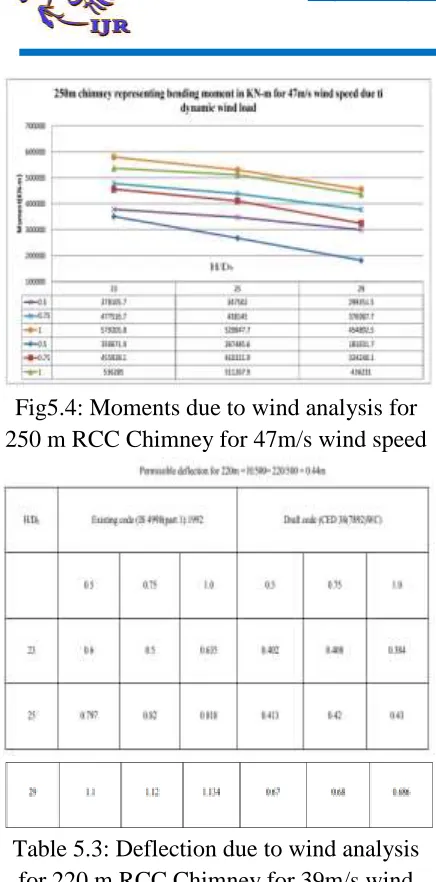
Fig5.4: Moments due to wind analysis for 250 m RCC Chimney for 47m/s wind speed
Table 5.3: Deflection due to wind analysis for 220 m RCC Chimney for 39m/s wind
speed
Table 5.4: Deflection due to wind analysis for 250 m RCC Chimney for 39m/s wind
speed
Conclusion: In case of static loads as H/Db
ratio increases, moment decreases and base shear decreases. All the sections for wind speeds 39 m/s, 47m/s and 55m/s and Slenderness ratio’s 23, 25 and 29 found to be safe in strength criteria. Draft code gives economical sections than compare to existing code. Main difference between draft code and the existing code is the design philosophies i.e. LSM and WSM Existing code deals only with the load aspects only. Empirical formulas were suggested for calculation of natural frequency in draft code. Whereas in existing code no account of it was given. Design interaction diagrams were given for different breach openings were given in appendix for quick reference. Stresses due to temperature effects were formulated in the draft code.As per deflection criteria, the draft code is with in permissible limit but existing code exceeds for slenderness ratios 23,25 and 29. For 250m, both code books exceeds the permissible limits of deflection criteria for slenderness ratios 23,25 and 29. For 250m, the deflections obtained from the draft code are with in permissible limits for slenderness ratios 15. The static and dynamic moments increases from the Dt/Db ratio 0.5 to 1.0 for
all wind speeds. Considerations for
reinforcement detailing were clearly
mentioned in the draft code. In draft code, hourly mean wind speed equation is completely modified for calculation of across wind moments.
[1]DorisMehta, Nishant, Gandhi,J.,“Time response study of tall chimneys, under the effect of soil structure Interaction and Long period earthquake Impulse”, in proceedings of 14thWorld Conference/on Earthquake Engineering,2008.
[2]Dr.KrishnaRaju, N., “Advanced
Reinforced Concrete Design”,CBS
Publishers, Delhi.
[3] Draft copy CED 38(7892):2 13, “Criteria for design of reinforced concrete chimneys”, Bureau of Indian standards, New Delhi, 2 14.
[4] Flaga, A. and Lipecki, T., “Code approaches to shedding and own model”, Engineering Structures, 2 1 , pp.153 -1536. [5] IS 4998 (Part 1): 1992, “Criteria for design of reinforced concrete chimneys”, Bureau of Indian standards, New Delhi, 1992.
[6] Kareem, A., and Cheng, C. M., (1992), “Across wind response of reinforced concrete chimneys”, Journal of wind engineering and aerodynamics,1992, pp 2141-2151.
[7] Kareem, A. and Hseih, J., “Reliability analysis of Concrete chimneys under windloading”, Journal of Wind Engineering andIndustrial Aerodynamics, 1996, pp. 93-112.
[8] Manohar, S. N., “Tall Chimneys- Design
and construction”, Tata McGrawHill
publishers, Banglore.
[9] Menon, D., and Rao, P. S.,
“Uncertainties in incodal recommendations for across-windload analysis of RCC chimneys”, Journal of Wind Engineering and Industrial Aerodynamics, 1997, pp. 455-468.
[10] Shaikh, M. G., Khan, H. A. M. I., “Governing loads for design of a tall RCC chimney”, Journal of mechanical and civil engineering (IOSRJMCE), 2 9, PP: 12-19. [11]STAAD.Pro28(Version11.), “Integrated Software for 3D model generation, analysis and multi-material design”, Inc. Bentley solution centers, USA (28). 95
[12] Verboom, G. K and Van Koten, H, “Vortex excitation: Three design rules tested on 13industrial chimneys”, Journal of Wind Engineering and Industrial Aerodynamics,2 1 , pp.145-154.
[13] Woszczyna, Kaminski, Maj, Ubysz, “Analysis of the influence of the reinforced concretechimney geometry changes in the chimney shaft”, in proceedings of17th
International Conference on the