A Chosen IV Attack Using Phase Shifting
Equivalent Keys against DECIM v2
Hidehiko Nakagami, Ryoichi Teramura, Toshihiro Ohigashi, Hidenori Kuwakado, and Masakatu Morii
Kobe University, 1-1 Rokkodai, Kobe 657-8501, Japan
{nakagami, teramura}@stu.kobe-u.ac.jp, [email protected],
{kuwakado, mmorii}@kobe-u.ac.jp
Abstract. DECIM v2 is a stream cipher submitted to the ECRYPT stream cipher project (eSTREAM) and ISO/IEC 18033-4. No attack against DECIM v2 has been proposed yet. In this paper, we propose a chosen IV attack against DECIM v2 using a new equivalent key class. Our attack can recover an 80-bit key with a time complexity of 279.90 when all bits of the IV are zero. This result is the best one on DECIM v2.
Keywords: cryptanalysis, equivalent keys, stream cipher, DECIM v2, eSTREAM
1
Introduction
Keys are called equivalent keys if ciphertexts generated from these keys have equivalence. In general, equivalent keys generate same ciphertexts. In the stream ciphers, keys that generate pseudo-random sequences (called keystreams) of dif-ferent phase are also called equivalent keys since the ciphertext is made by XORing a plaintext to a keystream. We call such equivalent keysphase shifting equivalent keys.
In 2006, phase shifting equivalent keys on Grain v1 [1] are discussed by ¨
O. K¨u¸c¨uk [2]. Recently, key recovery attacks using phase shifting equivalent keys have been proposed. These attacks search an key and phase shifting equivalent keys in parallel for speeding up an exhaustive key search. Two key recovery attacks against Grain v1 using phase shifting equivalent keys were independently proposed by T. Isobe et al. [3] in September 2007 and by C. De Canni`ere et al. [4] in February 2008 1. When all bits of an initialization vector (IV) are one, the attack of T. Isobe et al. can recover an 80-bit key with a time complexity of 278.4 or 278.7, and the attack of C. De Canni`ere et al. can recover the key with a time complexity of 279. The IV is a public value, and is changed in each encryption session. Moreover, T. Isobe et al. have given a lot of IVs for the attack [5].
1
Although key recovery attacks against Grain v1 using phase shifting equivalent keys have been discussed, applying the attack to other stream ciphers has not been discussed yet.
In this paper, we discuss a key recovery attack against DECIM v2 [6] using phase shifting equivalent keys. DECIM v2 is a hardware oriented stream cipher, which was designed by C. Berbain et al. It uses an 80-bit keyKand a 64-bit IV
IV, and has submitted to the ECRYPT stream cipher project (eSTREAM) [7] and ISO/IEC 18033-4. Now, no efficient attack against DECIM v2 has been proposed yet. First, we show that any (K, IV) pair has a 2-bit phase shifting equivalent key ( ˆK, ˆIV) with a probability of 1/128 on DECIM v2. Next, we propose a key recovery attack against DECIM v2 using these equivalent keys. When IV = (0,0, . . . ,0) is used, our attack can recover an 80-bit key with a time complexity of 279.90. Our attack is a first one against DECIM v2.
This paper is organized as follows: DECIM v2 is described in Sect. 2. In Sect. 3. we define phase shifting equivalent keys, and show that conditions for such equivalent keys. Sect. 4. we give conditions for phase shifting equivalent keys of DECIM v2, and calculate the probability that any (K,IV) has a phase shifting equivalent key. Sect. 5. we propose a key recovery attack against DECIM v2 using phase shifting equivalent keys.
2
Description of DECIM v2
DECIM v2 uses an 80-bit key K = (K0, . . . , K79) and a 64-bit IV IV = (IV0, . . . , IV63), where Ki and IVi are 1-bit variables. An internal stateS
con-sists of a 192-bit linear feedback shift register (LFSR) S = (x0, x1, . . . , x191), wherexi is a 1-bit variable. In addition, DECIM v2 has a nonlinear filter
func-tionf and an irregular decimation mechanism (called the ABSG) and a Buffer. The algorithm of DECIM v2 is split into a key-scheduling algorithm (KSA) and a pseudo-random generation algorithm (PRGA). The KSA initializes the internal state usingKandIV. The PRGA generates a pseudo-random sequence (called a keystream)Z = (z0, z1, . . .) from an initial state of the PRGA, which is an internal state when the KSA was completed, wherezi is a 1-bit variable.
A ciphertext/plaintext is obtained by XORing a plaintext/ciphertext to the keystream.
We describe the KSA and the PRGA. In order to distinguish between the KSA and the PRGA, we use different symbols. The internal state of the KSA is denoted byS∗, and that of the PRGA is denoted byS.
2.1 Pseudo-Random Generation Algorithm
The internal state of the PRGA at time t denotes St = (x0,t, x1,t, . . . , x191,t).
The PRGA has an update functionP RGA N extstate( ) and an output function
Output( ). P RGA N extstate( ) at time t updates St−1 to St, and Output( )
We describe the process ofP RGA N extstate( ). The internal state St−1 is updated as follows:
xi,t=
{
xi+1,t−1 if i= 0, . . . , 190,
lvt−1 if i= 191,
(1)
where
lvt−1=x189,t−1⊕x188,t−1⊕x169,t−1⊕x156,t−1⊕x155,t−1⊕x132,t−1 ⊕x131,t−1⊕x94,t−1⊕x77,t−1⊕x46,t−1⊕x17,t−1
⊕x16,t−1⊕x5,t−1⊕x0,t−1. (2)
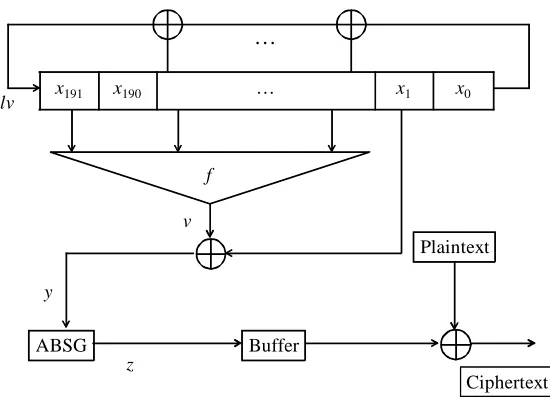
We describe the process ofOutput( ). First, the nonlinear filter function f
outputs a 1-bit variablevt−1 using the internal stateSt−1as follows 2 :
vt−1= {
0 if X= 0,3,
1 if X= 1,2, (3)
whereX = (x191,t−1+x186,t−1+x178,t−1+x172,t−1+x162,t−1+x144,t−1+x111,t−1+
x104,t−1+x65,t−1+x54,t−1+x45,t−1+x28,t−1+x13,t−1) mod 4. Second, a 1-bit
variableyt−1 is obtained fromvt−1 andSt−1as follows:
yt−1=vt−1⊕x1,t−1. (4)
Third, the ABSG outputs the keystream (z0, z1, . . .) from the sequence Y = (y0, y1, . . .). The algorithm of the ABSG is given as follows:
Input: (y0, y1, . . .) Set:i←0; j←0;
Repeat the following steps: 1.e←yi, zj←yi+1;
2.i←i+ 1;
3. while (yi=e)i←i+ 1;
4.i←i+ 1; 5. outputzj;
6.j←j+ 1;
The keystream (z0, z1, . . .) are stored in the buffer. Since the Buffer is a mech-anism for the implementation, we omit its detail. Figure 1 shows the processes of the PRGA of DECIM v2.
2 Note that Eq. (3) andv
t−1=f(a1, . . . , a13) =
L
1≤i<j≤13aiaj L
1≤i≤13aiare
equiv-alent, where (a1, . . . , a13) = (x191,t−1, x186,t−1, x178,t−1, x172,t−1, x162,t−1, x144,t−1,
x191 x190 … x1 x0
f
…
ABSG
lv
v
y
Buffer
Plaintext
Ciphertext
z
Fig. 1.PRGA of DECIM v2.
2.2 Key Scheduling Algorithm
The internal state of the KSA at timetdenotesSt∗= (x∗0,t, x∗1,t, . . . , x∗191,t). First,
S∗ is initialized byKand IV as follows:
x∗i,0=
Ki if i= 0, . . . ,79,
Ki−80⊕IVi−80 if i= 80, . . . ,143,
Ki−80⊕IVi−144⊕IVi−128⊕IVi−112⊕IVi−96 if i= 144, . . . ,159,
IVi−160⊕IVi−128⊕1 if i= 160, . . . ,191. (5)
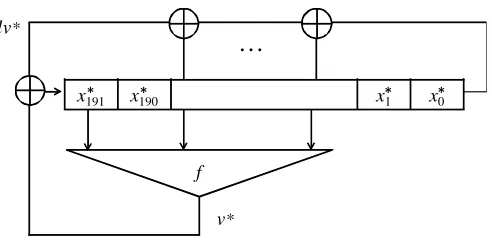
Next,St∗−1is updated by KSA N extstate( ).KSA N extstate( ) is defined as
x∗i,t = {
x∗i+1,t−1 if i= 0, . . . ,190,
lvt∗−1⊕vt∗−1 if i= 191. (6)
lvt∗−1 andvt∗−1 are obtained fromSt∗−1 by using Eqs. (2), and (3).
AfterKSA N extstate( ) is executed fort= 1,2, . . . ,768, an obtainedS768∗
is set toS0, which is an initial state of the PRGA. Figure 2 shows the processes of the KSA of DECIM v2.
3
Phase Shifting Equivalent Keys
3.1 Description
f lv*
v*
…
x191* x190* x*1 x0*
Fig. 2.KSA of DECIM v2.
(K, IV) is expressed asZ = (z0, z1, . . .), whereziis aw-bit variable. We consider
the case that the internal stateSn, which is generated from (K, IV), is equal to
the initial state of the PRGA ˆS0, which is generated from the different key and IV pair ( ˆK,IVˆ ), wherenis a positive integer. This case is expressed as follows:
Sn= ˆS0. (7)
If Eq. (7) holds, the keystream ˆZ, which is generated from ( ˆK,IVˆ ), is ˆ
Z= (ˆz0,zˆ1, . . .) = (zn, zn+1, . . .). (8) ˆ
Z is thenw-bit shifted keystream fromZ. Then, (K, IV) and ( ˆK,IVˆ ) are called phase shifting equivalent keys.
3.2 Conditions for Phase Shifting Equivalent Keys
First, we present conditions for obtaining phase shifting equivalent keys of a stream cipher that has similar update functions of the KSA and the PRGA. We give the following theorem for phase shifting equivalent keys.
Theorem 1 If (K, IV)and( ˆK,IVˆ )satisfy following conditions, thenSn= ˆS0
holds.
Condition 1:Sˆ0∗ andS∗n are identical.
Condition 2: The functionP RGA N extstate( )of(K, IV)at timet= 1,2, . . . , n
and the functionKSA N extstate( )are identical.
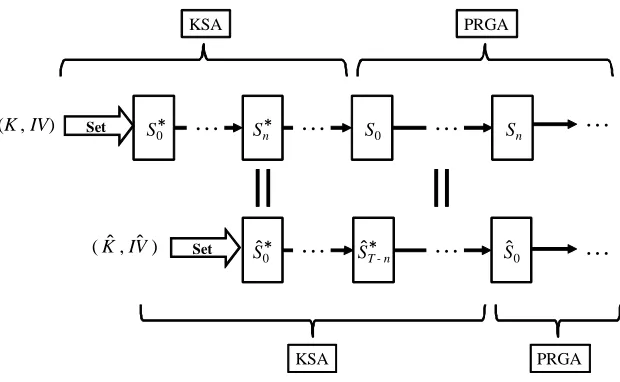
Proof. From Condition 1, ˆS0∗ = Sn∗ holds. Let T be the number of calling
KSA N extstate( ) in the KSA. Since identical update function is used in the KSA for all t = 1,2, . . . , T −n, the initial state of the PRGA S0 satisfies
ˆ
ST∗−n = ST∗ = S0. When Condition 2 holds, P RGA N extstate( ) of (K, IV) at time t= 1,2, . . . , nand the function KSA N extstate( ) of ( ˆK,IVˆ ) at time
(K , IV)
( K , IV )^ ^
KSA PRGA
KSA
…
…
PRGA
S0* Sn* S0 Sn
S^0* S^T - n* S^0
…
…
…
…
…
Set
Set
Fig. 3.Conditions of the phase shifting equivalent keys.
Figure 3 shows that Condition 1 and Condition 2 of Theorem 1.
Next, we calculate a probability that any (K, IV) pair has a phase shifting equivalent key ( ˆK,IVˆ ). LetP1 be a probability that Condition 1 holds, andP2 be a probability that Condition 2 holds. Suppose that Condition 1 and Condition 2 are independent. Then,Pf, which is the probability that any (K, IV) pair has
a phase shifting equivalent key, is given as
Pf=P1·P2. (9)
4
Phase Shifting Equivalent Keys of DECIM v2
4.1 Conditions for 2-bit Phase Shifting Equivalent Keys
We discuss conditions for 2-bit phase shifting equivalent keys of DECIM v2. In DECIM v2, Condition 1 of Theorem 1 for 2 -bit phase shifting equivalent keys is written as follows:
S∗2= ˆS0∗. (10)
In addition, Condition 2 of that is written as follows:
P RGA nextstate(S0) =KSA nextstate( ˆS766∗ ), (11)
We consider conditions for satisfying Eq. (10). From Eqs. (5), and (6),S2∗ is given as follows:
x∗i,2=
Ki+2 if i= 0, . . . ,77,
Ki−79⊕IVi−79 if i= 78, . . . ,141,
Ki−79⊕IVi−143⊕IVi−127⊕IVi−111⊕IVi−95 if i= 142, . . . ,157,
IVi−159⊕IVi−127⊕1 if i= 158, . . . ,189,
lv0∗⊕v0∗ if i= 190,
lv1∗⊕v1∗ if i= 191.
(13)
A 2-bit phase shifting equivalent key ( ˆK,IVˆ ) is defined as
ˆ
Ki=
Ki+2 if i= 0, . . . ,77,
K0⊕IV0 if i= 78,
K1⊕IV1 if i= 79,
(14)
ˆ
IVi=
IVi+2 if i= 0, . . . ,61,
IV0⊕IV16⊕IV32⊕IV48 if i= 62,
IV1⊕IV17⊕IV33⊕IV49 if i= 63.
(15)
Then, from Eqs. (5) and (13)–(15), four conditions for satisfying Eq. (10) are given as follows:
IV0⊕IV32⊕K0= 1, (16)
IV1⊕IV33⊕K1= 1, (17)
IV0⊕IV16⊕IV48⊕1 =lv0∗⊕v∗0, (18)
IV1⊕IV17⊕IV49⊕1 =lv1∗⊕v∗1. (19)
We consider a condition for satisfying Eqs. (11), and (12). From Eqs. (1), and (6), KSA N extstate( ) and P RGA N extstate( ) are identical ifv∗t−1 = 0 holds in the KSA. Thus, the condition for satisfying Eqs. (11), and (12)is as follows:
ˆ
v∗766= 0 ∧ ˆv∗767= 0. (20)
If Eqs. (16)–(20) hold, then ˆY is 2-bit shifted sequence fromY, that is ˆY = (ˆy0,yˆ1,yˆ2, . . .) = (y2, y3, y4, . . .) holds. Note thatY and ˆY are not keystreams but inputs of the ABSG. Keystreams Z and ˆZ are obtained fromY and ˆY by the ABSG. If y0 = y1, that is (y0, y1) = (0,0) or (y0, y1) = (1,1), then ˆZ is 1-bit shifted keystreams from Z. In addition, though we consider about only 2-bit phase shifting equivalent keys in this paper, more than 3-bit phase shifting equivalent keys can also apply3.
3 Using 3-bit phase shifting equivalent keys, ˆZis 1-bit shifted keystreams fromZwhen
y0=y2 ∧ y1̸=y0. Similarly, using 3-bit phase shifting equivalent keys, ˆZ get the
4.2 Rate of 2-bit Phase Shifting Equivalent Keys
We calculate a rate that any (K,IV) pair has a 2-bit phase shifting equivalent key ( ˆK, ˆIV) by using Eq. (9).
Suppose that (K,IV) is selected randomly. Then, a probability that Eqs. (16), and (17) hold is 1/4. Moreover, sincev0∗andv∗1are 1-bit pseudo- random variable, a probability that Eqs. (18), and (19) hold is 1/4. Therefore, the probability that Eq. (10) holds, which isP1, is given as follows:
P1= 1 4 ·
1 4 =
1
16. (21)
Since ˆv∗766 and ˆv767∗ are 1-bit pseudo-random variables, a probability that Eq. (20) holds is 1/4. Therefore, the probability that Eqs. (11), and (12) hold, which isP2, is given as follows:
P2= 1
4. (22)
In addition, ˆZis 1-bit shifted keystreams fromZwheny0=y1. Therefore, the probability that (K, IV) pair has a 2-bit phase shifting equivalent key ( ˆK,IVˆ ) on DECIM v2, which isPf d, is given as follows:
Pf d=Pf·
1 2, =P1·P2·
1 2 =
1
128. (23)
5
A Key Recovery Attack against DECIM v2 using 2-bit
Phase Shifting Equivalent Keys
In this section, we propose a key recovery attack against DECIM v2 using 2-bit phase shifting equivalent keys. We focus on 2-bit phase shifting equivalent keys with same IV, namely,IV = ˆIV holds. WhenIV = ˆIV holds, we can searchK
and ˆK in parallel. It means that a key can be found faster than an exhaustive key search when such an IV is used.
5.1 Phase shifting equivalent keys with same IV
We discuss 2-bit phase shifting equivalent keys that IV = IVˆ holds. From Eq. (15), the condition forIV = ˆIV is given as follows:
IVi=
IVi+2 if i= 0, . . . ,61,
IV0⊕IV16⊕IV32⊕IV48 if i= 62,
IV1⊕IV17⊕IV33⊕IV49 if i= 63.
(24)
First, we disscuss conditions for 2-bit phase shifting equivalent keys ˆKunder the condition that IV = (0,0, . . . ,0). When IV = (0,0, . . . ,0) is used, two conditions for ˆKis given from Eqs. (14) , (16), and (17) as follows:
ˆ
K78=K0= 1, (25) ˆ
K79=K1= 1. (26) Moreover, two conditions for ˆKis given from Eqs. (18), and (19) as follows:
lv0∗⊕v0∗= 1, (27)
lv∗1⊕v∗1= 1. (28) In order to satisfy Eq. (27), it is necessary to satisfy lv0∗ = 1 ∧ v0∗ = 0 or
lv0∗ = 0 ∧ v0∗ = 1. We consider a case of lv0∗ = 1 ∧ v0∗ = 0. When lv0∗ = 1 ∧ v0∗= 0, the following conditions forK is given from Eqs. (2), (3), and (5) andIV = (0,0, . . . ,0).
K77⊕K76⊕K75⊕K52⊕K51⊕K46⊕K17⊕K16⊕K14⊕K5= 1, (29) (K65+K64+K54+K45+K31+K28+K24+K13) mod 4 = 2 or 3.(30) By using Eq. (14), Eqs. (29), and (30) are rewritten as follows:
ˆ
K75⊕Kˆ74⊕Kˆ73⊕Kˆ50⊕Kˆ49⊕Kˆ44⊕Kˆ15⊕Kˆ14⊕Kˆ12⊕Kˆ3= 1, (31) ( ˆK63+ ˆK62+ ˆK52+ ˆK43+ ˆK29+ ˆK26+ ˆK22+ ˆK11) mod 4 = 2 or 3.(32) In addition, we consider a case oflv0∗= 0 ∧ v∗0 = 1. Whenlv∗0 = 0 ∧ v0∗= 1, the following conditions for ˆK is given in a manner similar to the case oflv∗0= 1 ∧ v0∗= 0.
ˆ
K75⊕Kˆ74⊕Kˆ73⊕Kˆ50⊕Kˆ49⊕Kˆ44⊕Kˆ15⊕Kˆ14⊕Kˆ12⊕Kˆ3= 0, (33) ( ˆK63+ ˆK62+ ˆK52+ ˆK43+ ˆK29+ ˆK26+ ˆK22+ ˆK11) mod 4 = 0 or 1.(34) Similarly, in order to satisfy Eq. (28), it is necessary to satisfylv1∗= 1 ∧ v1∗= 0 or lv∗1 = 0 ∧ v∗1 = 1. We consider a case of lv1∗ = 1 ∧ v∗1 = 0. When
lv1∗ = 1 ∧ v∗1 = 0, the following conditions forK is given from Eqs. (2), (3), and (5) andIV = (0,0, . . . ,0).
K77⊕K76⊕K53⊕K52⊕K47⊕K18⊕K17⊕K15⊕K6= 0, (35) (K66+K65+K55+K46+K32+K29+K25+K14) mod 4 = 2 or 3.(36) By using Eq. (14), Eqs. (35), and (36) are rewritten as follows:
ˆ
K75⊕Kˆ74⊕Kˆ51⊕Kˆ50⊕Kˆ45⊕Kˆ16⊕Kˆ15⊕Kˆ13⊕Kˆ4= 0, (37) ( ˆK64+ ˆK63+ ˆK53+ ˆK44+ ˆK30+ ˆK27+ ˆK23+ ˆK12) mod 4 = 2 or 3.(38) In addition, we consider a case oflv1∗= 0 ∧ v∗1 = 1. Whenlv∗1 = 0 ∧ v1∗= 1, the following conditions for ˆK is given in a manner similar to the case oflv∗1= 1 ∧ v1∗= 0.
ˆ
Table 1.Events when our attack searches 276candidates and probabilities that each event occurs.
Event Probability that the event occurs Recoverable keys E1 Ps·Pf d= 1/2048 K and ˆK
E2 Ps·(1−Pf d) = 127/2048 K
E3 (1−Ps)·Pf d= 15/2048 Kˆ
E4 (1−Ps)·(1−Pf d) = 1905/2048 —
Next, we show a method to recoverK from ˆK. From Eqs. (14), (25), and (26), a following relation of betweenK and ˆKis given as
K(i+2) mod 80= ˆKi for∀i∈ {0,1, . . . ,79}. (41)
Therefore, an original key K can be recovered from the equivalent key ˆK by Eq. (41).
5.2 Proposed Attack and its Time Complexity
We propose a chosen IV key recovery attack using 2-bit phase shifting equivalent keys. Our attack searches ˆK using Eqs. (25), (26), (31)–(34), and (37)–(40) whenIV = (0,0, . . . ,0) is used. Specifically, our attack searches 276 candidates. To search the candidates, We use following four conditions: i) Eqs. (25), (26), (31), (32), (37), and (38) are satisfied, ii) Eqs. (25), (26), (31), (32), (39), and (40) are satisfied, iii) Eqs. (25), (26), (33), (34), (37), and (38) are satisfied, iv) Eqs. (25), (26), (33), (34), (39), and (40) are satisfied. If K has ˆK with a probability ofPf d= 1/128, ˆK can be found with a probability of one from the
276candidates. Then,Kis recovered from ˆKby Eq. (41). On the other hand,K
is found from 276 candidates with a probability ofP
s = 276/280 = 1/16. Since
our attack can search K and ˆK in parallel,K can be recovered more efficient than an exhaustive key search.
We calculate the time complexity of our attack. When our attack searches for 276candidates, the following four events occur:E
1(Kand ˆKcan be found),E2 (onlyKcan be found),E3(only ˆKcan be found), andE4(not found). Suppose thatKand ˆKare found independently. Then, probability that each event occurs is given as Table 1.
WhenE1 occurs, a key K can be recovered if either K or ˆK is found. In this case, a time complexity for recovering the key is 275. When E
4 occurs, a key K cannot be recovered from 276 candidates. In this case, K is found from other (280−276) candidates. Thus, a time complexity for recovering the key is 280 when E4 occurs. Then, the total time complexity for recovering the key is obtained as follows:
Pr(E1)·275+ Pr(E2)·276+ Pr(E3)·276+ Pr(E4)·280
= 1
2048·2
75+ 127 2048·2
76+ 15 2048·2
76+1905 2048·2
Therefore, our attack can recover an 80-bit key with a time complexity of 279.90.
6
Conclusion
This paper has presented the key recovery attack against DECIM v2 using phase shifting equivalent keys. Our attack can recover an 80-bit key with a time com-plexity of 279.90 when IV = (0,0, . . . ,0) is used. It means that DECIM v2 is not necessarily secure against the key recovery attack. In addition, we consider about only 2-bit phase shifting equivalent keys, but more than 3-bit phase shift-ing equivalent keys can apply DECIM v2. Moreover, our attack can easily apply to DECIM-128 [8]. Applying our attack to other IVs is future work.
References
1. M. Hell, T. Johansson, and W. Meier, “Grain - a stream cipher for con-strained environments,” eSTREAM, available at http://www.ecrypt.eu.org/ stream/p3ciphers/grain/Grain p3.pdf
2. ¨O. K¨u¸c¨uk, “Slide resynchronization attack on the initialization of Grain 1.0,” eSTREAM, Report 2006/044, 2006, available at http://www.ecrypt.eu.org/ stream/papersdir/2006/044.ps
3. T. Isobe, T. Ohigashi, H. Kuwakado, and M. Morii, “A chosen-IV attack against Grain,” Proc. Information and Communication System Security, ICSS2007-3, pp.15–20, Sep. 2007.
4. C. De Canni`ere, ¨O. K¨u¸c¨uk, and B. Preneel “Analysis of Grain’s initialization al-gorithm,” Workshop Record of SASC 2008, pp.43–56, Feb. 2008.
5. T. Isobe, T. Ohigashi, H. Kuwakado, and M. Morii, “A key recovery attack with equivalent keys of stream cipher,” Technical Report of IEICE, ISEC2007-110, pp.69–74, Nov. 2007.
6. C. Berbain, O. Billet, A. Canteaut, N. Courtois, B. Debraize, H. Gilbert, L. Goubin, A. Gouget, L. Granboulan, C. Lauradoux, M. Minier, T. Pornin, and H. Sib-ert, “DECIM v2,” eSTREAM, available at http://www.ecrypt.eu.org/stream/ p3ciphers/decim/decim p3.pdf
7. eSTREAM, ECRYPT Stream Cipher Project, IST-2002-507932, available athttp: //www.ecrypt.eu.org/stream/