Evaluation of Wolf Control to Reduce Cattle Preda-
tion in Alberta
RONALD R. RJORGE AND JOHN R. GUNSON
Abstract
Results of wolf (Canis @I.@ control to reduce predation of cattle in northwestern Alberta are reported. Numbers of wolves declined from about 40 prior to control to 3 following the strych- nine poisoning of 26 wolves during 2 winters, 197PsO and 1980-81. Additional losses of wolf pack members occurred from natural mortality and dispersal following the removal of the majority of their packmates. In 3 of 6 instances where packs took baits, entire packs of 2,4, and 6 wolves were killed. Ingress of wolves occurred within 1-2 years. Total mortality of cattle declined from a mean of 64 (3.4%) during 4 years prior to control to 36 (Xg$@during 2 years following control. Selectivity of strychnine poisoning was renson- ably good although more emphasis on preventive management is recommended.
Wolf (Cam3 lupus) depredations of livestock and subsequent wolf removal have occurred throughout the settlement of North America (Young 1944, Lopez 1978) and currently occur in western Canada (Gunson 1983a), Ontario (Kolenosky 1983), and Minne- sota (Fritts 1982). Despite controversy and costs associated with these control programs, evaluations have been limited.
In Alberta, wolves occur in the northern and western two-thirds of the province, with current numbers estimated at about 4-5,000 (Gunson 1983b). Wolf-livestock complaints are most common near the forest-agricultural fringe in Alberta and other isolated areas of the province. The Alberta Fish and Wildlife Division (AFW) initiated annual livestock-related wolf control in 1972, consisting of complaint investigation and removal of wolves if predation or mauling was confirmed. During 9 years (1972-8 l), 729 wolves were known to have been removed.
Results of wolf control conducted during studies of wolf preda- tion of cattle in northwestern Alberta during 1975-81 are evalu- ated. This paper reports details of wolf removal, nontarget kill, response of wolves to vacant territories, and the impact of wolf removal on cattle. Results are discussed in relation to management of wolf-livestock conflicts.
Study Area
The study area, located adjacent to or near the Simonette River (54“ SS’N, 117O 5O’W) in northwestern Alberta, encompassed 7 adjacent grazing leases ranging in size from 5 to 59 km*. All leases were located on crown lands in the vicinity of the forest- agricultural fringe. Total numbers of cattle pastured on all leases during the May through October grazing season varied from 1,558 (1979) to 2,288 (1976).
The area is within the boreal forest (Strong and Leggat 1981); trembling aspen (Populus tremuloides)is the dominant tree species with balsam poplar (Populus balsamifera), willow (Salix ssp.), and alder (Alnus spp.) also occurring. The topography is generally flat, but interrupted by the banks (to 120 m) of numerous creeks and the Ronald R. Bjorge is Regional Habitat Biologist, Alberta Fish and Wildlife Div- ision, Bag 900-26, Provincial Building, Peace River, Alberta. John R. Gunson is Carnivore Management Unit Leader, Alberta Fish and Wildlife Division, OS. Longman Building, 6909 - 116 Street, Edmonton, Alberta.
The authors acknowledge W. Johnson for capable assistance throughout most of the project. Additional field assistance was provided by C. Dobson, K Schmidt, D. Wig, and W. Wynnyk. Predator control staff, Alberta Fish and Wildlife Division, provided details of their wolf control. Cattlemen on the study area a~ thanked for their cooperation and assistance.
Manuscript accepted April 25, 1985.
Simonette and Latornell Rivers. During the grazing period aver- age water depth in the rivers varied up to 1 m, but increased occasionally by several meters following periods of heavy rainfall. Moose (Alces alces)were common; and wapiti (Cervus elaphus), white-tailed deer (Odocoileus virginianus), and mule deer (0. hemionus) occurred in some areas. Black bear (Ursus americanus) and coyotes (Canis latrans) were abundant throughout the area.
Methods
We counted and examined cattle entering and leaving grazing leases for signs of attacks by predators. Carcasses discovered by cattlemen were investigated by study personnel rapidly, usually within 24 hours of receiving a report, partly because of require- ments of a compensation program. Cattlemen checked their stock approximately every 2 weeks, while study personnel, travelling by horse and fixed-wing aircraft, occasionally inspected herds. Dead animals were examined to determine cause of death; only those cattle with definite signs of attack including subcutaneous hemor- rhages, blood trails, and/ or teeth and claw marks, were classified as predator kills. Wolf kills were easily distinguished from those of bear; bites were evident on wolf kills and maulings, while wounds from claws or heavy blows were evident on cattle killed by bears. Tracks and sometimes scats were observed at kills, supporting other data used to determine the predator responsible.
Most of the wolves were captured in #48 and #114 Newhouse traps. One wolf was captured in a neck snare similar to those utilized by Nellis (1968) for coyotes. Captured wolves were res- trained with a modified hay fork or forked stick, examined for sex, reproductive status and general condition, radio-collared (AVM Instrument Company; Champaign, Illinois), and released. Radio- collared wolves were aerially located, usually twice/week during May through October, and weekly during other months.
We travelled by fixed-wing aircraft, horse, and all terrain vehicle during summer and by fixed-wing aircraft and snowmobile during winter. Histories of wolf packs and individuals (and thus popula- tion estimates) were constructed from analyses of relocations of radioed wolves, aerial and ground observation of radioed and other wolves, pelage colour, carcasses, and tracks. Because this variety of data sources was used to estimate populations and our study area was relatively small (1,340 km*), we believe our esti- mates are reliable. Removal of 26 wolves through wolf control near the termination of the study revealed no surprises; all these wolves had been included in earlier population estimates.
AFW predator control personnel conducted wolfcontrolduring the winters of 1979-80 and 1980-8 1. The placement of the 12 poison bait stations was determined entirely by predator control person- nel with no consultation with us. Control consisted of unpoisoned draw baits surrounded by several bite-sized portions of poisoned meat, each with 2 cubes of 280 mg strychnine. These were buried in the snow lo-30 m from the larger bait. This is the usual technique used for wolf control during winter in Alberta.
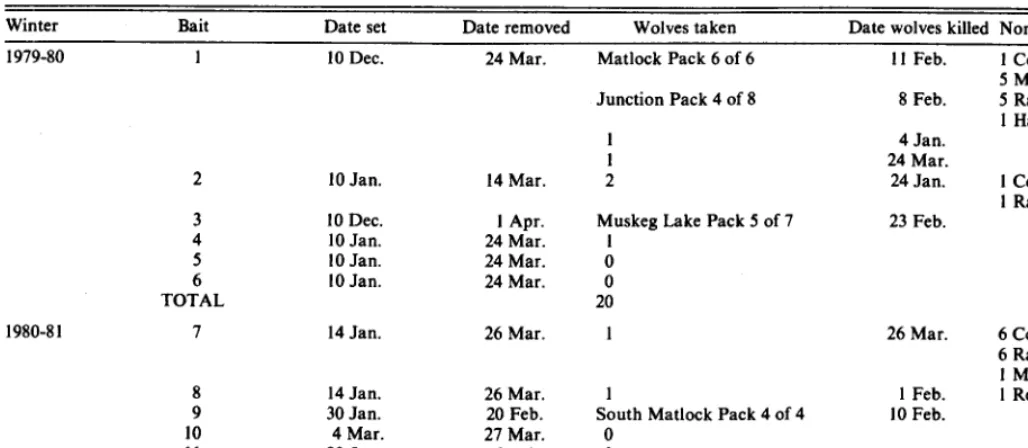
Table 1. Results of wolf control on the Simonette cattle leases in northwestern Alberta during 1979-80 and 1980-81.
Winter Bait Date set Date removed Wolves taken Date wolves killed Non-tare& species
1979-80 1 10 Dec. 24 Mar. Matlock Pack 6 of 6
2
3 4 5 6 TOTAL
1980-8 1 7 14 Jan. 26 Mar. 1 26 Mar.
8 9 10 I1 12 TOTAL
10 Jan. 14 Mar.
10 Dec. 10 Jan. 10 Jan. 10 Jan.
1 Apr. 24 Mar. 24 Mar. 24 Mar.
14 Jan. 26 Mar. 30 Jan. 20 Feb. 4 Mar. 27 Mar. 23 Jan. 5 Feb. 5 Feb. 25 Feb.
Junction Pack 4 of 8
1 1 2
Muskeg Lake Pack 5 of 7 1
0 0 20
1
South Matlock Pack 4 of 4 0
0 0 6
11 Feb.
8 Feb.
4 Jan. 24 Mar. 24 Jan.
23 Feb.
1 Feb. IO Feb.
1 Coyote 5 Magpies 5 Ravens
1 Hairy Woodpecker
1 Coyote 1 Raven
6 Coyotes 6 Ravens 1 Magpie 1 Red Fox
1 Coyote
fall. This compensation was available only in our study area through a special program of the Alberta Predator Indemnity Program and resulted in rapid reporting of dead or missing cattle.
The 2 X 2 ch&test was used to determine if the incidences of mortality and mauling (attempted predation) among cattle dif- fered significantly before and after wolf control.
Results and Discussion Removal of Wolves
Seven of the 12 baits established during 1979-81 (Table 1) resulted in killing 26 wolves. Numbers of wolves on the study area dropped from 39 or 40 during fall 1979 to 3 during summer 1981 (Table 2). The control program required 56 man-days and cost $8,325.00 or $320 per wolf.
Mean number of days from bait establishment until wolves were killed was 48 (range 1 l-94). Wolves radio-monitored during the control program did not always consume bait at first encounter.
For example, the Muskeg Lake Pack visited bait stations within its territory every week between first baiting on 10 December 1979 and 25 February 1980, when 5 of the 7 wplves were poisoned. The Colony Pack spent at least 15 days within 1 km of a bait station during January 1980. Tracks indicated these wolves had fre- quented the site often, but bait was not consumed during that winter. The Matlock and Junction Packs consumed baits on the first known encounter. These data indicate that considerable time may be required to effect wolf removal, especially if baits are placed out in early winter.
All 26 wolves killed at bait stations died within 150 m of the bait. However tracks in the snow indicated that 3 additional wolves staggered up to 1 km from bait sites. They were still travelling and apparently affected by poisoning but their eventual fate was unknown. Elsewhere in wolf control in northwestern Alberta most wolves killed at bait stations died near the baits but several wolves have travelled up to 1 km before dying (G. Craig, person. com-
Table 2. Number of wolves in the vicinity of the Simonette cattle leases in northwestern Alberta before and after wolf control during winters 1979-80 and 1980-81.
Wolves
Number (Fall)
Poisoned at Bait
Shot or TrauDed
Poisoned-
Related Other
Estimated Remaining (Soring)
_- . .
1979-80 Muskeg Lake Pack 7 5 0 0 0 2
Matlock Pack 6 6 0 0 0 0
Colony Pack 6 0 2 0 0 4
Junction Pack 10 4 3 1’ 0 2
South Matlock Pack 4 0 0 0 0 4
Long Lake Pair 2 2 0 0 0 0
Swan Lake Pair 2 0 1 0 0 12
Lone wolves 2-3 3 0 0 0 0
TOTAL 3940 20 6 1 0 12-13
1980-8 1 South Matlock Pack 4 4 0 0 0 0
Colony Pack 9 5’ 2 0 0 2
Lone wolves 3-4 2 0 0 24 I
TOTAL 16-17 11 2 0 2 3
I-Wolf 18 died after separation from all but one member of the Junction Pack. Z-This wolf could have been poisoned and classified as a single wolf. J-These 5 wolves were illegally poisoned.
‘-Two radio-collared lone wolves paired during February and dispersed during March 1981.
Table 3. Mortality of cattle and numbers of wolves on summer grazing leases in the vicinity of tbe Simonette River, northwestern Alberta.
Cattle Mauled Cattle Mortality Loss
Year
Predators’
Cattle on Causes Other Cattle wolves*
Study Area Wolves Bears Wolves Bears than predation Unknown Missing Total % Present
Before Wolf Control
1976 2288
1977 2023
1978 1784
1979 1558
After Wolf Control
1980 1772
1981 1804
6 3 I 1 123 1 50 65 2.9 23-25
5 3 I 0 1 3 65 70 3.5 29-33
13 2 3 1 1 1 58 64 3.6 28-3 1‘
19 1 8 1 2 3 43 57 3.7 39-40
8 1 3 1 2 0 38 44 2.5 1617
0 1 1 0 2 0 24 27 1.6 34
I-These include only known predator kills. Other kills by wolvesand bears occurred but were not detected due to remoteness, large pasture size, dense tree cover, and completecon- sumption.
*-Wolves present during early winter.
J-Seven cattle died from bloat following escape from a grazing lease. ‘-Six wolves were illegally removed during 1977-78 and 5 during 1980-8 1.
mun.). Fuller and Novakowski (1955) also indicated that most wolves died near strychnine baits, although they reported one dying about 400 m away.
Survivors of packs depleted by wolf control demonstrated vari- able behavior including emigration, death from starvation, and increased dependence on livestock. One of 2 members that sur- vived wolf control in the Muskeg Lake Pack during winter 1979-80 left the area the following May. During December 1981 this wolf #20, an adult male, was killed with another at a government poison bait 248 km from the last radio-location. These wolves had been killing cattle in this area, indicating wolf 20 became more depend- ent upon cattle following removal of the majority of his pack and his dispersal. Prior to wolf control on our study area, his pack was primarily dependent on wild prey, although they did kill 1 yearling heifer and wounded 2 other heifers.
Wolf 17, a black female pup, and a small grey wolf of unknown sex and age travelled together following the deaths of at least 4 of the 8 members of the Junction Pack on 8 February 1980. Following a radio-location on 26 March, wolf 17 was found dead. Tracks in the snow indicated she had been walking up a relatively steep bank, collapsed, slid downhill and died. Numerous porcupine (Erethizon dorsatum) quills were located on her mouth and face, one rib was broken and she was emaciated with an empty stomach. Several days earlier a small grey female wolf, likely 17’s companion, was shot near a farmyard about 1 km from where wolf 17 died, and within the general area where these 2 wolves had been living following control.
Age and experience of wolves surviving control appeared to be important factors in their continued survival. For example, wolf 13, a large adult wolf, survived the illegal poisoning of most of the remainder of the Colony Pack in 1980-81. However, wolf reduc- tions may be greater than indicated by the number of wolves at bait stations as suggested above.
Nontarget Kill
In the control reported here, relatively few nontarget animals were taken (Table 1). Although quantitative data relative to densi- ties of fur-bearers are unavailable, coyote densities appeared greater than those of wolf. While capturing wolves for radio- collaring, we made 39 coyote captures versus 28 wolf captures in leg-hold traps. Only 9 coyotes were taken on poison baits com- pared to 26 wolves, suggesting greater selectivity for wolves although some coyotes may have left the area during winter. Other furbearers relatively common and regularly harvested by regis- tered trappers in the region include fisher (Martespennanti), lynx (Felix lynx), and short-tailed weasel (Mustela erminea). None of these were taken on poison baits, although 1 red fox (Vulpes vulpes) was killed. The few nontarget animals taken during 694
bait-nights were largely due to experienced control personnel and the technique of burying small drop baits in the snow. Animals other than wolves apparently did not readily retrieve these baits from beneath the snow.
Wolf Response to Vacant Territories
Ingress of wolves to vacant territory following control was noted. After illegal poisoning of 6 black wolves on the study area during early winter of 1977-78, the resultant vacant territory was occupied by another pack of 8-10 wolves during summer of 1979. Because only 1 wolf survived the illegal control and the new pack was composed of many grey animals, we concluded this was a different group of wolves.
A range shift was evident for wolf 13 following removal of adjacent packs (Junction, Muskeg Lake, and Matlock) during winter of 1979-80. This wolf separated from the Colony Pack and travelled with a small black wolf throughout portions of the former territory of these 3 packs. Ingress of lone wolves into territories vacated through wolf control was suspected during 1980. Three of 5 wolves captured that year were lone, compared to 0 of 9 and 1 of 6 in 1979 and 1978, respectively. During September 198 1 a pack of at least 7 wolves appeared in portions of the territories formerly occupied by the Colony and Junction Packs. By 1982 local cattle- men and hunters were reporting that wolves were again common in the area.
Wolves commonly disperse from established packs (W.B. Bal- lard, R.O. Stephenson and T.H. Spraken 1981, unpublished final report, Nelchina Basin Wolf Studies, Alaska Dept. of Fish and Game; Fritts and Mech 1981) to search for a mate and vacant territory (Mech 1973, Rothman and Mech 1979). Movements of lone wolves and newly formed pairs are largely influenced by the activities of packs. Normally these wolves tend to avoid territories of packs (Fritts and Mech 1981, Van Ballenberghe et al. 1975) although lone wolves have occasionally been known to join estab- lished packs (Fritts and Mech 1981). An absence of howling (Har- rington and Mech 1979, Joslin 1967) and a scarcity of recent scent marks (Peters and Mech 1975) may encourage dispersing wolves to remain in vacant territories. Thus repopulation of vacant territo- ries created through wolf control may occur relatively quickly through immigration of wolves from other areas.
Impact of Wolf Removal on Cattle Mortality
control was initiated (Table 3). We believe that wolf control, and thus less wolf predation of cattle in 1980 and 1981, was primarily responsible for the observed lower mortality during those years.
Elsewhere, wolf control has reduced subsequent prevalence of predations (Fritts 1982, Tompa 1983). In Minnesota, wolf removal reduced losses in most cases, but some depredations stopped even though control was unsuccessful, while in other cases depredations continued despite wolf removal. Fritts (1982) attributed such vari- ation to differential behavior of specific wolf packs, changes in farm management practices, pack versus lone wolves, and wolf densities. In British Columbia, Tompa (1983) reported 34% of 104 cases of control were highly effective whereas in 28% of the cases control was not effective.
A major disadvantage of wolf control is the fairly rapid repopu- lation from surrounding areas. To reduce costs of repetitious con- trol, annual harvests by hunters and trappers should be encour- aged. During the 6 years of our study only 4 wolves were harvested by trappers. Special programs to train trappers in wolf capture are needed.
In our area, total mortality was relatively high during 1976 (65 losses-2.9%) and 1977 (70 losses-3.5%) despite only modest numbers of wolves during those years (compared to 1979) and fewer observed maulings and kills. We did not observe higher levels of bear predation (Table 3) or disease during those years, and because of the remoteness of the pastures, we do not believe theft occurred. These somewhat greater-than-expected losses during the 1st 2 years of study were likely related to 2 factors.
Perhaps most importantly, preventive techniques should be emphasized in wolf-livestock management. Such measures include sending only healthy and non-pregnant animals to pasture (Bjorge 1983), checking cattle regularly, rounding up cattle in early fall, and removing carcasses to discourage scavenging. Techniques cur- rently under evaluation include use of surveyors’ flagging on fen- ces, installation of bright lights, and taste aversion conditioning (Fritts 1982). However, in remote pastures it is unrealistic to expect prevention of all depredations by wolves. Techniques utilized to prevent sheep depredation by coyotes (Robe1 et al. 1981, Boggess et al. 1978) such as corralling at night or use of guard dogs are not feasible to prevent wolf depredations on large, remote cattle pas- tures. Grazing leases should be located as close to agricultural development as possible in order to afford more protection from predation.
First, losses to flooding were probably higher during these years when very high water levels occurred on the Simonette River following 2-3 day rains. On several occasions the level of this river rose rapidly causing extensive bank erosion and loss of vegetation (including large trees). During intervening periods of low water levels, we often observed cattle crossing the river and 6 of 7 pas- tures included portions of the river. Precipitation data from Envir- onment Canada at Grande Prairie, 70 km to the west, indicated May-September rainfall exceeded the 40-year mean of 256 mm during 3 of the 6 years: 1976-394 mm, 1977-341 mm, and 1980-305 mm. It should also be noted that losses were the lowest during 1981, the year of least wolves and lowest rainfall-156 mm.
Literature Cited
Bjorp, R.R. 1983. Mortality of cattle on two types of grazing areas in northwestern Alberta. J. Range Manage. 36:20-21.
Bjorge, R.R., and J.R. Gunson. 1983. Wolf predation of cattle on the Simonette River pastures in northwestern Alberta. p. 106-l Il. In: L.N. Carbyn (Ed.) Wolves in Canada and Alaska: their status, biology and management. Can. Wildl. Serv. Rep. 45.
Boggess, E.K., R.D. Andrews, and R.A. Bishop. 1978. Domestic animal losses to coyotes and dogs in Iowa. J. Wildl. Manage. 42362-372. Fritts, S.H. 1982. Wolf depredation of livestock in Minnesota. U.S. Dep.
Int. Fish and Wildl. Serv. Pub. 145.
Second, but of lesser importance, cattlemen may have removed a few stock and reported them as missing during the initial period of study when we were less familiar with the area and their operations. We did not, however, determine that this occurred.
Another factor tending to obscure the direct relationship between numbers of wolves and total cattle losses is that some of the increases in wolf numbers occurred in areas only peripheral to the pastures. Only the Junction Pack was located primarily within cattle leases.
Fritts, S.H., and L.D. Me&. 1981. Dynamics, movements and feeding ecology of a newly protected wolf population in northwestern Minne- sota. Wildl. Monogr. 80.
Fuller, W.A., and N.S. Novakowski. 1955. Wolf control operations, Wood Buffalo National Park, 1951-52. Wildl. Manage. Bull. (II). Can. Wildl.
Serv.
Predation by wolves was an important source of cattle mortality, because 17 (41%) of 41 animals found dead of known causes were killed by wolves. However, of 327 dead or missing cattle only 49 carcasses were located (Table 3). We have previously (Bjorge 1983, Bjorge and Gunson 1983) pointed out that cattle dying from preda- tors are more difficult to discover than cattle dying from other causes because they are often completely consumed, especially by wolves. Wolves, in all probability, killed greater than 41% of the missing cattle. Because of complete consumption by wolves, large pastures, and tree cover, more intensive searches would not have improved our sample significantly. These results are in contrast to
those of sheep pastured on open range (Klebenow and McAdoo 1976) and cattle managed more intensively (Gee 1979), where most dead animals are found.
Gasaway, W.C., R.O. Stephenson, J.L. Davis, P.E. Shepherd, and O.E. Burris. 1983. Interrelationshius of wolves, orev, and man in interior Alaska. Wildl. Monogr. 84. _
._ _-
Gee, C.K. 1979. Cattle and calf losses to predators-feeder cattle enterprises in the United States. J. Range Manage. 32152-154.
Gunson, J.R. 1983a. Wolf predation of livestock in western Canada. p.
102-105. In: L.N. Carbyn (Ed). Wolves in Canda and Alaska: their status, biology and management. Can. Wildl. Serv. Rep. 45.
Gunson, J.R. 1983). Status and management of wolves in Alberta. p. 25-29. In: L.N. Carbyn (Ed). Wolves in Canada and Alaska: their status, biology, and management. Can. Wild]. Serv. Rep. 45.
Harrington, F.H., and L.D. Mech. 1979. Wolf howling and its role in territorial maintenance. Behavior LXVII: 207-249.
Joslin, P.W.B. 1967. Movements and homesites of timber wolves in Algon- quin Park. Amer. Zoo. 7279-288.
Management Implications
In this study strychnine poisoning was effective in reducing numbers of wolves and subsequent mortality of cattle. Where depredations occur, wolves can be removed quickly and relatively cheaply during mid- to late-winter using this method. A variety of other techniques have been used in wolf control, including aerial shooting (Gasaway et al. 1983), other toxicants (Tompa 1983), and mechanical devices (Young 1944, Lopez 1978, Fritts 1982), but these methods are either less effective in forested areas or are considerably more expensive and time consuming. Although the use of strychnine to remove predators remains controversial, data in this report may assist agencies in selecting control methods.
Klebenow, D.A., and K. MeAdoo. 1976. Predation on domestic sheep in northeastern Nevada. J. Range Manage. 2996-100.
Kolenosky, G.B. 1983. Status and management of wolves in Ontario. p. 35-40. In: L.N. Carbyn(Ed). Wolves in Canada and Alaska, their status, biology, and management. Can. Wild]. Serv. Rep. 45.
Lopez, k. 1978. Of wolves and men. Charles Scribner’s Sons. New York. Mech. L.D. 1973. Wolf numbers in the Suoerior National Forest of Minne-
sota. USDA Forest Serv. Res. Pap. NC-97.
Nellis, C.H. 1968. Some methods for capturing coyotes. J. Wildl. Manage. 30402-405.
Peters, R.P., and L.D. Me&. 1975. Scent marking in wolves. Amer. Sci. 63:628-637.
Robel, R.J., A.D. Dayton, F.R. Henderson, R.L. Meduna, and C.W. Spaeth. 1981. Relationships between husbandry methods and sheep l&es to canine predators. J. Wildl. Manage. 45:894-909.
Rothman. R.J.. and L.D. Meeh. 1979. Scent marking in lone wolves and newly formed pairs. Anim. Behav. 27:750-760. -
Strong, W.L., and K.R. Legpt. 1981. Ecoregions of Alberta. Alberta Energy and Natural Resources Tech. Rep. Number T/4.
Tompa, F.S. 1983. Problem wolf management in British Columbia: con- Van Ballenberghc, V., A.W. Erickaon,and D. Byman. 1975. Ecology of the flict and program evaluation. p. I 12-I 19. In: L.N. Carbyn (Ed). Wolves timber wolf in northeastern Minnesota. Wildl. Monogr. 27.