Point Obfuscation and 3-round Zero-Knowledge
∗Nir Bitansky and Omer Paneth
Tel Aviv University and Boston University
September 21, 2011
Abstract
We construct 3-round proofs and arguments with negligible soundness error satisfying two re-laxed notions ofzero-knowledge: Weak ZKandwitness hiding(WH). At the heart of our construc-tions lie new techniques based onpoint obfuscation with auxiliary input(AIPO).
It is known that such protocols cannot be proven secure using black-box reductions (or simu-lation). Our constructions circumvent these lower bounds, utilizing AIPO (and extensions) as the “non-black-box component” in the security reduction. We also investigate the relation between AIPO and the assumptions previously used to achieve 3-round ZK.
∗
Contents
1 Introduction 1
1.1 Our Contribution . . . 2
1.2 Reflections on the Use of Point Obfuscation . . . 4
2 Definitions and Tools 6 2.1 Weak Zero-Knowledge and Witness Hiding . . . 6
2.2 2-Message Delegation . . . 7
2.2.1 Remarks on Definition 2.4. . . 8
2.3 Point Obfuscation with Auxiliary Input . . . 9
2.4 Digital Lockers and Circular Digital Lockers . . . 11
3 3-round WH 13 3.1 Overview of the Protocol . . . 13
3.2 Soundness . . . 14
3.2.1 Overview of the proof. . . 14
3.2.2 Proof of Theorem 3.1 - soundness. . . 14
3.3 Witness Hiding . . . 15
3.3.1 Overview of the proof. . . 15
3.3.2 Proof of Theorem 3.1 - witness hiding. . . 16
3.4 From an Argument to a Proof . . . 18
4 3-round WZK 18 4.1 Overview of the Protocol . . . 18
4.2 Soundness . . . 19
4.2.1 Overview of the proof. . . 19
4.2.2 Proof of Theorem 4.1 - soundness. . . 20
4.3 Weak Zero-Knowledge . . . 21
4.3.1 Overview of the proof. . . 21
4.3.2 Proof of Theorem 4.1 - weak zero-knowledge. . . 21
Acknowledgements 23
1
Introduction
Interactive proofs (IP’s) and arguments (IA’s) [GMR85, BCC88] are fundamental notions in the the-ory of computation. In cryptography, these are typically used to prove NP-statements, and the proof is required to maintain the prover’s privacy. Different notions of privacy were considered, the most com-prehensive one being zero-knowledge (ZK). ZK protocols allow proving an assertion without revealing anything but its validity. That is, the information on a valid statement learned by the verifier from the interaction can be simulated only from the statement itself.
Since ZK was introduced [GMR85], questions regarding the round complexity of ZK protocols were studied extensively. While it is known that 2-round ZK protocols (with auxiliary input) for languages outside BPP do not exist [GO94], a classical open question is whether there exist 3-round ZK protocols for NP with negligible soundness error. The difficulty of this problem is exemplified by the lower bound of [GK96]: There do not exist 3-round black-box ZK (BBZK) protocols with negligible soundness for languages outside BPP (in BBZK the simulator only has black-box access to the verifier). Namely, to prove that a 3-round protocol is ZK, one must demonstrate a non-black-box simulator.
The work of [Bar01] shows that using non-black-box simulation it is possible to go beyond existing black-box bounds. However, so far we do not know how to use similar techniques to obtain 3-round ZK protocols. Nevertheless, 3-round ZK protocols have been constructed based on non-standard “knowl-edge assumptions”. [HT98, BP04] show a 3-round ZK argument based on theknowledge of exponent assumption(KEA) and variants of it. A different “knowledge assumption” was used to show the exis-tence of 3-round ZK proofs for NP [LM01]. (See further discussion in Section 1.2.)
In light of the difficulties in achieving 3-round ZK, it is natural to examine relaxations of ZK that might enable the construction of such protocols. We discuss several previously studied relaxations.
Witness indistinguishability (WI). A protocol is WI [FS90] if any two proofs for the same statement that use two different witnesses are indistinguishable. [FS90] show that, while the parallel repetition of basic (3-round) ZK protocols is not BBZK, it is WI. Furthermore, the soundness error decreases exponentially in the number of repetitions. However, WI protocols do not always guarantee witness secrecy; in particular, for statements with a unique NP-witness WI is meaningless. Nevertheless, [FS90] show how to use WI to achieve other notions of secrecy such as ZK andwitness-hiding(WH).
Witness hiding. Roughly speaking, a protocol is WH [FS90] w.r.t a distributionDon an NP-language Lif no verifier can extract a witness from its interaction with the honest prover on a common instance
x ← D. For WH to be meaningful, it should be restricted tohard distributions; namely distributions D for which poly-size circuits cannot find a witnessw ∈ RL(x) for instancesx ← D. WH is in a
sense a “minimal” notion of privacy; indeed, leaking the entire witness does not leave much room for imagination.
[FS90] present a 3-round protocol with negligible soundness error that is only WH w.r.t a specific type of (hard) distributions on languages where every instance has two witnesses. In contrast, extending the lower bounds of [GK96], [HRS09] show that for distributions with unique witnesses, 3-round WH can not be ”black-box reduced” to any ”standard cryptographic assumption” (e.g. existence of OWFs), under some natural limitations on the reduction.
Weak zero-knowledge.The standard notion of ZK requires that for any (potentially adversarial) verifier there exist a simulator that simulates its view in an interaction with the honest prover. The simulated view should be indistinguishable from the real one by any (efficient) distinguisher. The notion of WZK [DNRS99] weakens ZK by changing the order of quantifiers. Specifically, it allows the ZK simulator to depend on the particular distinguisher in question.
While ZK is often used as a sub-protocol in larger systems, WZK is not always suitable for this purpose due to its weaker simulation guarantee. In particular, WZK is not known to be closed under sequential repetition. Nevertheless, WZK is useful in settings where the verifier tries to learn a specific type of information, and we can present a distinguisher that can test whether the verifier succeeded in learning it. Examples include verifiers that try to lean a specific predicate of the witness, or any function of the witness that is efficiently verifiable. In particular, WZK implies WH (by considering a distinguisher which tests if the verifier’s view contains a valid witness). We note that for black-box simulation, WZK and (standard) ZK coincide; hence, by [GK96], a 3-round protocol with negligible soundness error can not be shown to even be WZK with a black-box simulator.
To sum up the above discussion, 3-round arguments with negligible soundness error, that are ZK, WH or WZK cannot be constructed using black-box techniques (from this point on, we only consider proofs arguments with negligible soundness error). In light of the existing non-black-box constructions, it is interesting to investigate which techniques and assumptions could suffice for constructing such protocols. Another interesting related question is understanding whether the relaxed notions of WH and WZK require simpler techniques than for full-fledged ZK; indeed, all existing WH constructions are based on the stronger notion of ZK as a building block. The question of finding “more direct” constructions of WH was already raised by [FS90]. This work sheds new light on both questions, introducing techniques based onpoint obfuscation.
Point obfuscation (PO) and extensions.We briefly review the concept of PO. Informally, an obfuscator is a randomized algorithm Owhich gets as input a programC (given by a circuit) and outputs a new program O(C) that has the same functionality as the original one, but does not leak any additional information onC[BGI+01]. A stronger variant isobfuscation with auxiliary input, in whichO(C)does not leak any information even given a related auxiliary inputzC [GK05].
In this work we consider obfuscation ofpoint circuitsand their extensions. A point circuitIsoutputs
1onsand⊥on all other inputs. Amultibit point circuitIs→toutputstonsand⊥otherwise. We also
consider a new extension of point circuits which we call circular point circuits. These are circuits
Istwhich outputton inputs,son inputt, and⊥otherwise. Obfuscators for multibit point circuits
are calledDigital Lockers (DL). We introduce the new notion of circular digital lockers(CDL) that are obfuscators for circular point circuits. Point circuits and their extensions are among the very few functionalities for which obfuscators have been shown; in particular there are several constructions that realize PO (and variants), under a number of strong hardness assumptions. So far, however, PO’s have found only a handful of applications in cryptographic theory, mostly to strong forms of encryption [Can97, Wee05, CD08, CKVW10, BC10].
1.1 Our Contribution
We construct 3-round WH and WZK protocols based on two different variants of point obfuscation:
• 3-round negligible soundness WH IP for NP given auxiliary input point obfuscators that satisfy a relatively mild distributive security requirement. The protocol is WH w.r.t general hard distribu-tions (including the unique witness case).
We next give an overview of our constructions, followed by a discussion on the nature of our obfuscation assumptions and how they relate to previous assumptions used for 3-round ZK protocols.
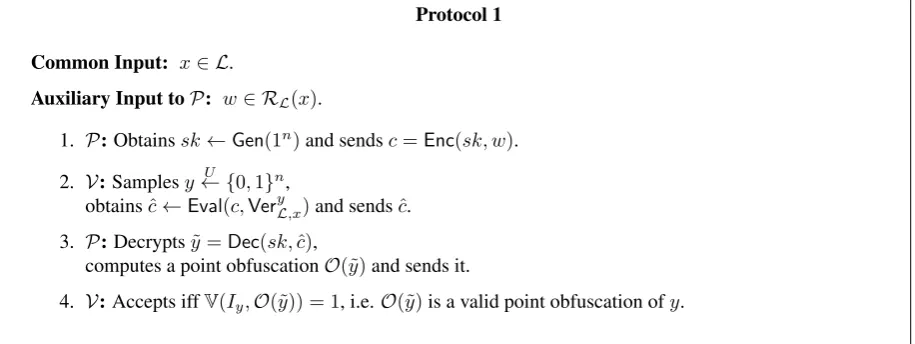
3-round witness-hiding. The high level idea behind our WH protocol is as follows. Given an NP statementx ∈ L, have the verifierV construct a modified NP verification circuitVeryL,xthat on a valid witnessw ∈ RL(x) outputs a secret random pointy and outputs ⊥otherwise. V then “garbles” this
circuit using Yao’s technique and both parties execute a 2-message oblivious-transfer protocol, at the end of which the proverP possesses the garbled circuit and the corresponding labels for the witnessw. Next,Pevaluates the circuit (onw) and obtains the pointy. (This is essentially aconditional disclosure of secrets protocol, as termed by [GIKM00, AIR01], where P learns the output y only if it inputs a valid witness.) In the third message,P sends back toV a point obfuscation ofy. V accepts only after verifying it got a valid obfuscation ofy.
Informally, soundness follows from the secrecy of the garbled circuit that prevents a dishonest prover from obtaining the randomyin case there is no valid witness. In fact, we show that our protocol is a
proof of knowledge.
The witness-hiding property is based on the security of the underlying obfuscator. To exemplify, consider a version of the protocol where P sends backy in the clear. Following is an attack on this simple version of the protocol. Consider a cheating verifierV∗ that instead of garblingVery
L,x, garbles
the identity circuit. P now evaluates the garbled circuit onw and obtains the pointy = w. IfP was to simply send backy in the clear, V∗ would have learned w and the protocol would be completely insecure. Instead, P sends back an obfuscation O(y). The security of the obfuscator O should then assure thatV∗can not obtainw, unless “it was already known” toV∗in advance.
The security reduction and required obfuscation assumptions.As we have seen, the WH guarantee of our protocol depends on the security of the underlying point obfuscatorO. We now discuss the prop-erties of the obfuscation used to show WH. Concretely, our underlying obfuscator should satisfy a distri-butional indistinguishability requirement w.r.t to points and related auxiliary information that are jointly sampled from anunpredictable distribution. We say that a distribution ensembleD ={(Zn, Yn)}n∈N
on pairs of strings is unpredictable (UPD) if poly-size circuits cannot predict (with noticeable chance) the pointYn, given the potentially related auxiliary inputZn. We say that Ois a distributional
auxil-iary input point obfuscator (AIPO) if for any UPD D = {(Zn, Yn)}, no poly-size circuit family can
distinguish, givenZn, an obfuscation ofO(Yn)from an obfuscation of a random pointO(Un).
In our setting, Zn represents the common input x and the prover’s first message (during the OT
protocol). Ynis the obfuscated point (returned by the honest prover). That is,Znis explicitly known
to the verifier, while Yn is obfuscated. A malicious V∗ might choose its (garbled) circuit to output
illegitimate information on the witness (i.e. information it could not predict on its own only fromZn);
the obfuscation, however, should prevent it from doing so.
3-round weak zero-knowledge. The WH protocol described above is not ZK and in fact enables a cheating verifierV∗ to learn arbitrary predicates of the witness. For example, to learnw1, the first bit
ofw,V∗can maliciously choose its garbled circuit to map any witnesswto one of two arbitrary points y0, y1 according tow1. In this case, the honest prover sends an obfuscationO(yw1), andV
∗learnsw1
by simply running the obfuscation on each of the two pointsy0, y1. This attack can be generalized to
any function ofwwith output lengthO(logn)(using a poly-size set of strings{yi}).
Towards making the protocol ZK, we try to cope with the above attack by requiring that the verifier “proves” it “fully knows” the secret pointy(rather than just a poly-size set containingy). To achieve this without adding rounds, we ask that the verifier itself includes an obfuscation ofyin its message. The prover then checks the obfuscation’s consistency with the point extracted from the circuit evaluation. In case of inconsistency, the prover aborts. This modification, however, still does not prevent the above attack. The verifierV∗ can learnw
1 by sending an obfuscation of the stringy0 and observing whether
the verifier’s obfuscation to create an obfuscation of the same pointywithout “knowing”y.
We resolve these issues as follows: (a) To regain soundness, we use an obfuscation scheme with non-malleability properties, based on an obfuscated circular point circuit (CDL). (b) To achieve WZK, we require that instead of a plain point obfuscation, the verifier sends an obfuscated multibit point circuit (DL) that on the secret inputyoutputs the coins used by the verifier to garble the circuit. Now the prover can verify that the garbled circuit is indeedVeryL,x(for somey).
In order to show that the protocol is WZK, we use stronger notions of obfuscation. Since WZK requires worst-case simulation (i.e. simulation for anyx), we require that our obfuscators also satisfy a worst-case simulation guarantee (rather than the weaker distributive definition used for WH). To simulate any verifierV∗, our simulator must make use of the obfuscation simulator forV∗. However, an obfuscation simulator for general adversaries with long output could not exist (see [BGI+01]); in fact, in known constructions of PO only address simulation of adversaries with a single output bit. To overcome this, we use the fact that the WZK simulator is given a specific distinguisher and it only needs to simulate the output of this distinguisher onV∗. SinceV∗and the distinguisher together can be viewed
as an adversary for the obfuscation that outputs a single bit, there exists an obfuscation simulator for this adversary. We show how to use this simulator to construct a WZK simulator. Indeed, this limitation on simulating adversaries with long output is the reason we do not achieve full-fledged ZK.
We note that while we do not know whether our WZK protocol remains secure under sequential composition, we show that if the DL and CDL used are “composable obfuscators” the protocol remains WZK under parallel composition.
1.2 Reflections on the Use of Point Obfuscation
The results of [GK96, HRS09] imply that our 3-round protocols can not be shown secure using reduc-tions that only make black-box use of the adversary. This is not surprising: indeed, neither auxiliary input nor standard point obfuscators can be shown to be secure using black-box reductions [Wee05]. Hence, our use of obfuscation inherently implies that the verifier is not used as a black-box.
To demonstrate the non-black-box nature of POs, we briefly review the techniques used in existing constructions [Can97, Wee05]. We can view POs as a special case of AIPOs where the auxiliary inputZn
is empty. In this case, the distributionYnis unpredictable if it iswell-spread(i.e., has super-logarithmic
min-entropy) and the security requirement is thatO(Yn)≈cO(Un)for any well-spreadYn.
The hardness assumptions made in [Can97, Wee05] are shown to imply that the strategy of any dis-tinguisher essentially consists of a poly-size set of “distinguishing elements”. That is, only obfuscations of points within this set are distinguishable from an obfuscation of a random point. However, these elements can not be extracted using black-box access to the adversary. Hence, they are given to the reduction (or simulator) as non-uniform advice.
These techniques allow achieving the stronger worst-case simulation definition, thus showing that the distributive and worst-case definitions are in fact equivalent in the case of no auxiliary input. When considering auxiliary input, we can no longer apply these techniques. Indeed, the set of distinguishing elements can now depend on the auxiliary input in an arbitrary way. That is, no short advice suffices for the reduction to go through. In general, we do not know whether the distributive AIPO definition implies the worst-case simulation definition in the auxiliary input case (the converse still holds).
Concrete constructions. There exist very few constructions that were shown to be secure w.r.t aux-iliary input. [GK05] show that any point obfuscator is also secure w.r.t auxaux-iliary input that is chosen independently of the obfuscated point. [DKL09] suggest a construction that, under a variant of theLWE
assumption, satisfies a restricted definition, where the distribution Dis “highly unpredictable”. Both results are insufficient for our needs.
strong variant of DDH. Informally, the assumption states that there exists an ensemble of prime order groupsG ={Gn:|Gn|=pn}such that for any unpredictable distributionD= (Zn, Yn)with support
{0,1}poly(n)×
Zpn: (z, r, r
y) ≈
c (z, r, ru), where(z, y) ← (Zn, Yn), u U
← Zpn andr is a random generator ofGn1.
For the second construction, we suggest a new assumption that is stated in terms of uninvertibility rather than indistinguishability. The assumption strengthens the assumption made by Wee [Wee05] to account for auxiliary inputs. Roughly, to construct (non auxiliary input) POs, Wee assumes a strong one-way permutationf that is “uninvertible” w.r.t to all well-spread distributions. A natural extension of the latter to the auxiliary input setting is to assume that the permutation is hard to invert, even given side information Z on the pre-image Y, from which Y cannot be predicted. An additional fact used by Wee is that permutations inherently preserve (information-theoretic) entropy; in particular, ifY is well-spread, so isf(Y). In the (computational) auxiliary input setting, this might not be true; namely, it might be thatY is unpredictable fromZ, while f(Y) is predictable from Z. One possible way to deal with this issue is to assume a trapdoor permutation family (with the above strong uninvertibility). In Section 2.3, we show a more general (or weaker) assumption and a corresponding construction of AIPOs.
We remark that both the assumptions we consider (or any assumption that states that a specific obfuscation candidate is an AIPO satisfying either a the worst-case or the distributive security definition) are considered to be non-standard. In particular, any such assumption is non-falsifiable in the terms of Naor [Nao03]. For example, to falsify the the distributive AIPO definition, one has to come up not only with a distinguisher but also with an unpredictable distribution and a proof of its unpredictability.
Comparison with previous work on 3-round ZK. As already mentioned, it is known how to con-struct 3-round ZK arguments and proofs using non-falsifiable “knowledge assumptions,” such as KEA [HT98, BP04], the POK assumption [LM01], or the existence of “extractable perfect one-way functions” (EPOWF)[CD09].
The KEA assumption [Dam91], essentially asserts that any algorithm that produces a DDH tuple, must “know” the corresponding exponents.Upon the formulation of KEA, [Dam91] raised a more gen-eral question regarding the existence of “sparse range one way functions”, such that any algorithm that can sample an element within the function’s range, must also “know” a primage (KEA indeed yields such a OWF). The EPOWF primitive of [CD09] formalizes this generalization. All in all, all the above assumptions essentially fall under the abstract notion of EPOWF. (Indeed, [CD09] show that either one of the KEA or the POK assumptions imply the EPOWF primitive, when combined with a hardness assumption such as DDH.)
In this work we show how to circumvent the black-box impossibility results for 3-round WZK and WH based on adifferentset of primitives; namely (variants of) point obfuscation with auxiliary input. At this point, we do not know of any formal relation between the AIPO and EPOWF primitives, beyond the relation established in this work (through 3-round ZK). We find that formalizing such a relation is an interesting question on its own (going beyond the scope of 3-round ZK).
Coming up with different assumptions (even non falsifiable ones) that can be used to overcome known black-box bounds opens up new directions for overcoming these bounds. In this case, we show that the research of AIPO can also be instrumental for the attempts to overcome black-box impossibility results for 3-round WZK and WH.
Finally, we consider the techniques in use. Unlike previous works, our work demonstrates a direct WH construction that is not based on a ZK protocol. We then strengthen it to a limited form of ZK. Our WH to WZK transformation is specifically tailored for our construction. An interesting open question is whether a general transformation of this type exists.
1
On the efficiency of the construction.We note that basing our constructions on 2-party secure function evaluation (using Yao’s garbled circuit technique) results in efficient protocols with a practical imple-mentation (similarly to [IKOS07]). By working directly with the verification circuitVerL, we avoid the
overhead of Karp reducions most existing 3-round ZK IA. Specifically, using existing constructions for the relevant primitives, we can achieve communication complexityO(ns), wherenis the security parameter andsis the size ofVerL. This is not optimal as there exist ZK argument with polylog
commu-nication complexity [Kil92]. However, these require usingPCPtechniques, making them impractical.
2
Definitions and Tools
2.1 Weak Zero-Knowledge and Witness Hiding
We consider interactive argument systems for NP languages L with a corresponding witness relation RL. Each system consists of a pair of PPT prover and verifier algorithms(P,V). We require that all our
protocols satisfy:
• Perfect completeness.For any(x, w)∈ RL:
Pr[(P(w),V)(x) = 1] = 1.
• Negligible soundness error. For any poly-size prover strategyP∗, any large enoughn, and any
x∈ {0,1}n\ L:
Pr[(P∗,V)(x) = 1]≤negl(n).
We say that the system is aproof(rather than an argument) if it is also sound against provers of unbounded size.
We also consider the following notion ofproof of knowledge: an interactive proof(P,V)is a proof of knowledge (POK) if there exist an oracle machineE s.t. for every prover strategyP∗, for every long enoughx ∈ Land every polynomialp, ifPr[(P∗,V)(x) = 1]≥p(|x|)thenEP(x)∈ R
L(x)and the
expected running time ofEP(x)is polynomial in1/p(|x|).
In this work we discuss two relaxations of ZK which are formalized next.
Weak zero-knowledge. In ZK we require that the view of any verifier V∗ in an interaction with the
honest proverP can be simulated by an efficient simulatorS. The simulated view should be indistin-guishable from the view ofV∗for any poly-size distinguisher. In weak ZK (WZK), the simulator is only required to output a view that is indistinguishable from that ofV∗ for a specific distinguisher. This is
modeled by supplying the simulator with the distinguisher circuit as additional auxiliary input.
Definition 2.1(Weak zero-knowledge). The argument system(P,V)is WZK if for every PPT verifierV∗
there exist a PPT simulatorSsuch that for every poly-size circuit family of distinguishersD={Dn}n∈N
and anyx∈ L ∩ {0,1}n,w∈ R
L(x),z∈ {0,1}poly(n)it holds that:
|Pr[Dn((P(w),V∗(z))(x)) = 1]−Pr[Dn(S(Dn, x, z)) = 1]| ≤negl(n).
Witness-hiding. A protocol is WH if the verifier cannot fully learn a witness from its interaction with P. This requirement is restricted to instances and witnesses(x, w)sampled from “hard distributions”.
Definition 2.2(Hard distribution). LetD={Dn}n∈Nbe an efficiently samplable distribution ensemble
on RL, i.e. Supp(Dn) = {(x, w) :x∈ L ∩ {0,1}n, w∈ RL(x)}. We say that Dis hard if for any
poly-size circuit family{Cn}and sufficiently largenit holds that:
Pr
(x,w)Dn← RL
Definition 2.3(D-witness-hiding). An argument system(P,V)for an NP languageLis WH w.r.t to a hard distributionD={Dn}n∈N, if for any poly-size verifierV
∗and all large enoughn∈ N:
Pr
(x,w)←Dn
[(P(w),V∗)(x)∈ RL(x)]≤negl(n).
We say that(P,V)is WH if it is WH w.r.t to a every hard distribution.
As discussed in the introduction, in this work we will be interested in WH protocols (w.r.t to a every hard distribution), and not with protocols that are WH w.r.t to a specific hard distribution.
2.2 2-Message Delegation
A central tool used in our constructions is a 2-message delegation protocol in which the prover and verifier jointly evaluate the NP verification circuit of the language on the common instance and the prover’s witness. We use this primitive (following the formulation in [IP07]) to abstract the use of Yao’s garbled circuit construction.
A 2-message delegation protocol is executed by parties(A, B), whereAhas an inputx, andB has as input a functionf (given by a boolean circuit). The protocol should allowAto obtainf(x)using two messages: A →B → A, and without compromising the input secrecy of either party. We additionally require that, givenB’s message and secret randomness, one can reconstructf. The protocol is defined by a tuple of algorithms(Gen,Enc,Eval,Dec,Open)and proceeds as follows:
A: Obtains a keysk←Gen(1n), computes an encryption of its inputc←Enc(sk, x), and sendsc.
B: Computes an encrypted outputcˆ←Eval(c, f)using randomnessr, and sends backˆc.
A: Outputsy=Dec(sk,ˆc).
Definition 2.4 (Secure 2-message delegation). a protocol (Gen,Enc,Eval,Dec,Open) is a secure 2-message delegation protocol if for every ensembleC ={Cn}n∈Nof poly-size circuits, where eachC ∈
Cnhas input lengthn, the following requirements hold:
• Correctness:For alln∈N, x∈ {0,1}nandC∈ C
n, the following procedure outputsC(x)with probability1:
– Obtainsk ←Gen(1n).
– Computec←Enc(sk, x).
– Computeˆc←Eval(c, C).
– OutputDec(sk,cˆ).
• Input Hiding: For any poly-size D, the probability thatD wins the following game is at most
1/2 + negl(n):
– On1n,Dsubmits a pair of stringsx
0, x1 ∈ {0,1}n.
– Samplesk←Gen(1n).
– For a random bitb∈R{0,1}, computec←Enc(sk, xb)and givectoD.
• Function Hiding: A randomized evaluation should not leak information on the input circuitC. This should hold even whenAis malicious and sends an arbitrary first message. Formally, let
E(x) =Supp(Enc(·, x))be the set of all legal encryptions ofx, and letEn = ∪x∈{0,1}nE(x)be
the set legal encryptions for strings of lengthn. Then there exist a PPT simulatorS such that:
{C,Eval(c, C)} n∈N,C∈Cn
x∈{0,1}n,c∈E(x)
≈c{C,S(c, C(x))} n∈N,C∈Cn
x∈{0,1}n,c∈E(x)
(1)
{C,Eval(c, C)} n∈N
C∈Cn,c /∈En
≈c{C,S(c,⊥)} n∈N
C∈Cn,c /∈En
. (2)
• Function Binding: We require that, given the result ˆc of evaluating C on an encrypted input and the randomnessrused byEval, one can efficiently reconstructC. The bind should also hold against a malicious evaluatorB:
1. For alln∈N, x∈ {0,1}n,C ∈ C
n, the following procedure outputsCwith probability1:
– Obtainsk←Gen(1n).
– Computec←Enc(sk, x).
– Computeˆc←Eval(c, C)using randomnessrtoEval.
– OutputOpen(ˆc, r).
2. For anyˆc∈ {0,1}∗there is at most one value ofrs.t.Open(ˆc, r)6=⊥.
2.2.1 Remarks on Definition 2.4.
1. The function-binding property is required in our construction of WZK IA. While function-binding is not required in common formulations of delegation protocols, we show that a Yao-based con-struction (when instantiated with natural forms encryption) has this property.
2. To get WH proofs (rather than arguments), we use a slightly stronger variant where the function-hiding is information-theoretic (and not computational). In this case, we no longer require the delegation protocol to be function-binding (as in standard commitments, the two properties cannot coexist).
3. The security definition presented is weaker than the standard definition ofsecure function evalua-tion. Specifically, if the evaluating partyB is malicious we can not fully simulate.
4. The definition of function-hiding does not require that the simulator knows whether the encryption
ˆ
cis valid or not. In our case, this will be sufficient; specifically, we shall utilize the simulator for circuits the output⊥on all inputs andS(c,⊥)will correctly simulate the garbled circuit whether
cis a valid encryption or not.
Instantiating the 2-message delegation scheme. We describe how to implement a 2-message dele-gation scheme usingYao’s garbled circuittechnique and 2-message OT. We require a 2-message OT scheme, with the following security guarantee:
1. Computational security for the receiver: for every two inputs, the receiver’s messages are compu-tationally indistinguishable.
We will use the OT scheme of [NP01] that satisfy this security requirement under the DDH assumption. A description of Yao’s garbled circuit construction can be found in [LP09].
Gen: Simply outputs asskrandom coins for the OT receiver.
Enc: Use the randomness stringskto generate and output the receiver’s message of the OT, where the choice bits correspond to the bits of the input valuex.
Eval: Generate a garbleduniversal circuitUˆ taking as input a description of the circuitC and another input x for C and outputs C(x). Output the garbled circuit Uˆ, the labels of the input wires describing the input circuitC, and the OT sender’s message encoding the labels of the input wires received fromA.
Dec. Useskto obtain the labels for the input wires corresponding tox(from the OT sender-message); evaluate the garbled circuit and obtain the result.
Open. Given the randomness used to garble the circuitUˆ, open all the gates of the garble circuit; reveal and output the values of the inputs wires encodingC. For this we require that the underlying encryption scheme for Yao’s protocol is committing; namely, any cipher should information-theoretically determine the plaintext (even without the secret key).
The details of the security proof for the function hiding property of the scheme in the semi-honest case are similar to [CCKM00]. By using an OT scheme that is secure against malicious senders, we can show that the function hiding property of the construction holds also in the malicious case. Informally, if a maliciousAsends a malformed first message, the security of the OT guaranties that it will learn nothing about the values of the input wires to the garbled circuit. Together with the security of the garbled circuit it follows that the message sent byBcan be simulated independently ofA’s first message. The function binding property follows directly from the fact that the underlying encryption scheme for the garbled circuit is committing.
Instantiating the 2-message delegation protocol with perfect function hiding. We showed how to construct a 2-message delegation protocol using Yao’s garbled circuit. Note that the OT scheme used ([NP01]) is also secure against unbounded receivers. We can use an information-theoretic variant of Yao’s garbled circuit in a similar way to get a 2-message delegation protocol with perfect function-hiding forNC1 circuits. A description of an information-theoretic variant can be found in [IK02]. As mentioned above, this variant will be used in order to construct IP rather than IA.
2.3 Point Obfuscation with Auxiliary Input
We start by recalling the standard definition for circuit obfuscation with auxiliary input. The definition is a worst-case definitions in the sense that simulation must hold for any circuit in the family and any related auxiliary input.
Definition 2.5(Worst-case obfuscator with auxiliary input [BGI+01, GK05]). A PPTOis an obfuscator with auxiliary input for an ensembleC={Cn}n∈
Nof families of poly-size circuits if it satisfies:
• Functionality.For anyn∈N,C∈ Cn,O(C)is a circuit which computes the same function asC.
• Polynomial slowdown.For anyn∈N,C∈ Cn,|O(C)| ≤poly(|C|).
• Virtual black box.For any PPT adversaryAthere is a PPT simulatorSsuch that for all sufficiently largen∈N, C ∈ Cnandz∈ {0,1}poly(n):
Pr[A(z,O(C)) = 1]−Pr[S
C(z,1|C|) = 1]
An obfuscatorOis recognizable if given a programCand an alleged obfuscation ofC,C˜, it is easy to verify thatCandC˜compute the same function.
• Recognizability.There exist a polynomial time recognition algorithmVsuch that for anyC∈ Cn:
• PrO[V(C,O(C)) = 1] = 1
• For anyC˜∈ {0,1}poly(n)if
V(C,C˜) = 1thenC˜ andCcompute the same function.
Point obfuscation. We consider obfuscation of point circuitsand their extensions. A point circuitIs
outputs1on stringsand⊥on all other inputs.
Definition 2.6(Worst-Case auxiliary-input point obfuscation (AIPO)). A PPT algorithmOis a worst-case AIPO if it is a recognizable obfuscator (according to Definition 2.5) for the following circuit en-semble:C={Cn={Is|s∈ {0,1}n}}n∈N
Remark2.1. The notion of recognizable obfuscation was not explicitly defined in previous works. We only consider this property in the context of point obfuscation. While, in general, point obfuscators are not required to be recognizable, previously constructed obfuscators [Can97, Wee05] are trivially recognizable. This is due to the fact that they use public randomness, i.e. the randomness used by the obfuscator appears in the clear as part of the obfuscated circuit. The recognition algorithm, given a program and its obfuscation, can simply rerun the obfuscation algorithm with the public randomness and compare the result to the obfuscation in hand.
We next present a weaker distributional definition for point obfuscation with auxiliary input that pre-viously appeared in [Can97] (in a slightly different formulation). We first give a preliminary definition of unpredictable distributions (generalizing Definition 2.2) and then present the obfuscation definition.
Definition 2.7 (Unpredictable distribution). A distribution ensemble D = {Dn= (Zn, Yn)}n∈N, on
pairs of strings is unpredictable if no poly-size circuit family can predictYnfromZn. That is, for every poly-size circuit family{Cn}n∈Nand for all large enoughn:
Pr
(z,y)←Dn
[Cn(z) =y]≤negl(n).
Definition 2.8(Auxiliary input point obfuscation for unpredictable distributions (AIPO)). A PPT algo-rithmOis a point obfuscator for unpredictable distributions if it satisfies the functionality and polyno-mial slowdown requirements as in Definition 2.5, and the following secrecy property. For any unpre-dictable distributionD={Dn= (Zn, Yn)}over{0,1}poly(n)× {0,1}nit holds that:
{z,O(y) : (z, y)←Dn}n∈N≈c n
z,O(u) :z←Zn, u U
← {0,1}no
n∈N .
Remark2.2. Using this definition in our WH construction, we can settle for a slightly relaxed definition with bounded auxiliary input; namely |Yn| = ω(|Zn|). We do not know if such a bounded form of
auxiliary-input indeed weakens the requirement. However, it does seem to withstand certain “diagonal-ization attacks” that can be performed for the non-restrictive.
AIPO constructions. Following are two constructions of AIPOs based on two different assumptions. We recall the construction of[Can97]. Then, we describe a modification of the construction in [?] that yields AIPOs given a new assumption that strengthens Wee’s original assumption.
Construction 2.1(Ther, rxpoint obfuscator [Can97]). LetG={Gn}n∈Nbe a group ensemble, where
eachGnis a group of prime orderpn∈(2n−1,2n). We define an obfuscator,O, for points in the domain
Zpn as follows:Ix
O
7−→ C(r, rx), wherer ←U G∗
[Can97] considers a strong variant of the DDH assumption implying that the(r, rx)obfuscator is an AIPO satisfying Definition 2.8. The assumption essentially states there exist an ensemble of prime order groupsG = {Gn:|Gn|=pn} such that for any unpredictable distributionD = (Zn, Xn) with
support{0,1}poly(n)×
Zpn, it holds that that(z, r, rx)≈c(z, r, ru)where(z, x)←(Zn, Xn), u
U
←Zpn andr is a random generator ofGn. Candidate group ensembles include any ensemble where standard DDH is assumed to hold, e.g. quadratic residues modulo a prime, or elliptic curves groups. We note that Construction 2.1 also satisfies the recognizability requirement given in Definition 2.5. Indeed, the recognition algorithmV(Ix,C˜), simply checks whetherC˜is of the formC(g, h), and thatgx=h(here
gis the public randomness used in the obfuscation).
The second construction is based on a new assumption that strengthens the assumption of Wee [Wee05] to account for auxiliary inputs. As explained in the introduction the natural extension of Wee’s assump-tion to auxiliary input is insufficient as is. Instead, we make the following assumpassump-tion and augment Wee’s original construction.
Assumption 2.1. There exists an ensemble of permutation familiesF ={Fn={f}}such that for any unpredictable distribution ensembleD = {Dn = (Zn, Yn)}, the following two distribution ensembles are also unpredictable:
• ((Zn, f(Yn), f);Yn)
• ((Zn, f);f(Yn)),
where in bothf ← FU n(independently ofDn).
We remark that the first property naturally generalizes Wee’s assumption regarding strong uninvertibil-ity; in particular, whenZ is empty andY is simply well-spread the assumption coincides with Wee’s. The second property essentially guarantees that f(Y) is unpredictable fromZ just asY is; In Wee’s assumption (whereZ is empty andY is well-spread) this is inherently guaranteed by the fact that per-mutations preserve information-theoretic entropy.
We note that the second part of the assumption has a flavor of weak extractability; still, it appears to be significantly weaker than the sparse-range extractability discussed in the introduction. We also note that any trapdoor permutation family would inherently imply the second part of the assumption; hence, it suffices to have trapdoor permutations that satisfy the strong uninvertibility (first part of the assumption).
Construction 2.2. Let F be a family of permutations given by Assumption 2.1. The obfuscator O
works as follows: given a pointy ∈ {0,1}n,O samples3npermutations {f
i}i∈[3n] fromFn, and3n strings{ri}i∈[3n] from {0,1}n. For every i ∈ [3n], letfi = fi ◦fi−1 ◦ · · · ◦f1 (where ◦ denotes
composition).Ooutputs a circuitCy that has hardcoded into it the randomness ofO,{fi, ri}i∈[3n]and
the bitsbi =hri, fi(y)i i∈[3n], whereh., .idenotes the inner product inF2. Cy outputs1on a pointx if∀i∈[3n] :bi=hri, fi(x)i; otherwise,Cyoutputs0.
The proof of security follows similar ideas to the proof in Wee, we defer the details to a later extended version of this work.
2.4 Digital Lockers and Circular Digital Lockers
We also consider obfuscation of several extensions of point circuits. Specifically,multibit point circuits
andcircular point circuits. A multibit point circuitIs→toutputstonsand⊥otherwise. A circular Point
circuitIstoutputston inputs,son inputt, and⊥otherwise. Obfuscators satisfying the worst-case
Definition 2.9(Digital locker (DL)). A PPT algorithm is a DL if it is a recognizable obfuscator (ac-cording to Definition 2.5) for the following circuit ensemble:C={Cn={Is→t|s, t∈ {0,1}n}}n∈N
Definition 2.10(Circular digital locker (CDL)). A PPT algorithm is a CDL if it a recognizable obfusca-tor (according to Definition 2.5) for the following circuit ensemble:C={Cn={Ist|s, t∈ {0,1}n}}n∈N Remark2.3. We note that the “security under circularity” feature is inherently provided by the strong obfuscation guarantees, was already considered in previous work for constructing strong encryption schemes which withstandkey dependent messagesandrelated keys attacks[CKVW10, BC10].
While AIPOs are sufficient for our WH protocol, our WZK protocol requires DLs and CDLs. We now explain how these can be constructed based on a worst-caseAIP Othat satisfy the additional property ofcomposability.
Definition 2.11(Composable obfuscation [LPS04]). A PPTOis at-composable obfuscatorfor a circuit ensembleC={Cn}if for any PPT adversaryA, there is a PPT simulatorS, such that for any sufficiently large n, any sequence of circuits C1, . . . , Ct ∈ Cn (where t = poly(n)) and auxiliary input z ∈
{0,1}poly(n):
Pr[A(z,O(C
1), . . . ,O(Ct)) = 1]−Pr[SC1,...,Ct
(z,1|C1|, . . . ,1|Ct|) = 1]
≤negl(n), whereC1, . . . , Ctgets as input(x, i)and returnsCi(x).
Composable point obfuscators yield a natural construction of DLs[CD08].
Construction 2.3(Digital lockers). LetO be a point obfuscator. Define a PPTDLfor point circuits withn-bit output as follows. For a pointx ∈ {0,1}n and outputy = y
1y2. . . yn ∈ {0,1}n, choose a randomu ∈ {0,1}n− {x}and define¯a = (a
0, a1, . . . , an)as follows. a0 = x, and for anyi ∈ [n] ai=xifyi = 1andai=uotherwise. The output of the obfuscator is:
DL(Ix→y) =C(O(Ca0), . . . ,O(Can)),
whereC is a circuit which performs as follows. On inputz, it first checks whetherz = a0 = x(using
the first point circuit). If it does not, it returns⊥. Otherwise, it finds all other coordinates such that
ai=z=xand outputsy1. . . yn, whereyi= 1ifai=z=xand0otherwise.
Proposition 2.1 ([CD08]). IfO is an(n+ 1)-composable worst-case AIPO thenDL(given by Con-struction 2.3) is a digital locker.
Proof. The proof of the functionality, polynomial slow down, and virtual black box properties ofDL, appears in [CD08]. It is left to prove thatDLis recognizable. LetVO be the recognition algorithm for
(the single-bit output)O. We construct a recognition algorithmVDLforDL.VDLis given a programIs→t
and an obfuscated circuitC. First,VDLverifies that the format ofCis correct; i.e., thatCcontainsn+ 1 circuits O˜0, . . . ,O˜n and performs according to Construction 2.3 (we assume that a legal obfuscation always have the same canonical form). If this is the case, it checks whether VO(Is,O˜0) = 1, if so it
checks thatC(s) =t. In case any of the above checks fails, it outputs⊥; otherwise, it outputs1. Note that whileVDLmight output1on circuits that are not a proper obfuscation (for example the circuitsO˜i
corresponding to ”0” might encode different points, rather than the sameu, or even not be point circuits). However, it is guaranteed thatChas the same functionality asIs→t.
Construction 2.4(Circular digital lockers). GivenDLspecified by Construction 2.3, define a PPTCDL
that on input pointss, t∈ {0,1}noutputs the following circuit:
CDL(Ist) =C(DL(Is→t),DL(It→s)),
Proposition 2.2. IfOis an(2n+2)-composable worst-case AIPO thenCDL(given by Construction 2.4) is a circular digital locker.
Proof. It follows directly from the construction thatCDLsatisfies the functionality and polynomial slow down properties. We show that CDLsatisfies the virtual black box property. Let Abe an adversary that is given a circuitCDL as input. ThisCDL contains a pair ofDLs constructed from Oaccording to Construction 2.3. In [CD08] it is shown that ifO is 2(n+ 1)-composable, the pair ofDLs are2 -composable and therefore there exist a simulator S such that for all sufficiently large n ∈ N, every s, t∈ {0,1}nandz∈ {0,1}poly(n):
Pr[A(z,O(Ist)) = 1]−Pr[SIs→t,It→s(z,1n) = 1]
≤negl(n)
Now we transformSto be the obfuscation simulator forAby answering all queriesSmakes to the pair of oraclesIs→t, It→susing the single oracleIst.
It is left to prove thatCDLis recognizable. LetVDLbe the recognition algorithm for the underlying
DL. Given a programIst and an obfuscated circuit C, the recognition algorithm for the CDLwill
simply verify thatC is correctly composed of twoDLs and useVDL to verify that theseDLs have the same functionality asIs→t, It→s.
3
3-round WH
3.1 Overview of the Protocol
As a warmup consider first the following unsound protocol: To prove an NP statementx ∈ L, the proverP and verifierV first engage in a 2-message delegation protocol whereP’s (secret) input is the witnesswandV’s input function is the NP verification circuitVerL,x. P obtains the resultVerL,x(w)
and sends it toV. This is unsound since a cheating prover can always send1as it’s last message. To make the protocol sound, we augment it as follows. LetVeryL,xbe a circuit which outputsy on valid witnesses and⊥otherwise. Now,V will choose a secret stringy ∈R {0,1}n, and use the circuit
VeryL,xas its secret input in the delegation protocol. In order to convinceV of the statement,P should send backy. Indeed, in casex /∈ Lwe haveVeryL,x ≡ ⊥, and hence the “function hiding” property of the delegation protocol assures thatPdoes not learn the randomy.
However, this protocol is not witness hiding. Indeed, a cheating verifier can try to obtain w by maliciously choosing its input function. For instance, choosing the function to be the identity results in the prover sending backw.
A natural approach towards fixing the latter problem would be to have the verifier “prove” it behaved honestly, without revealing its secret. In other words, it should give a round-efficient witness-hiding proof, which is what we set out to do to begin with. Thus, we take a different approach. We note that an honest verifier that “knows”yshould only be able to verify that the prover “knows” it as well; hence, it suffices to have the prover send apoint obfuscationofy, instead of sendingyin the clear. The security of the obfuscation would then guarantee that any information that the verifier learns onwcould also be learned (with noticeable probability) without the obfuscation.
The protocol. LetDEL = (Gen,Enc,Eval,Dec,Open)be a secure 2-message delegation protocol and letO be a point obfuscator for unpredictable distributions (AIPO) with recognition algorithmV. The
protocol is given by Figure 1.
Protocol 1 Common Input: x∈ L.
Auxiliary Input toP: w∈ RL(x).
1. P:Obtainssk←Gen(1n)and sendsc=Enc(sk, w).
2. V:Samplesy← {U 0,1}n,
obtainsˆc←Eval(c,VeryL,x)and sendsˆc.
3. P:Decryptsy˜=Dec(sk,c)ˆ,
computes a point obfuscationO(˜y)and sends it.
4. V:Accepts iffV(Iy,O(˜y)) = 1, i.e.O(˜y)is a valid point obfuscation ofy.
Figure 1: Protocol 1, 3-round Witness Hiding
3.2 Soundness
3.2.1 Overview of the proof.
The protocol presented is an IA. Later we show how to modify the protocol to get an IP. The sound-ness of Protocol 1 follows from the function hiding of the underlying delegation schemeDELand the recognizability of the point obfuscator. Indeed, in case there is no valid witness the verifier’s message reveals no information regarding the verifier’s secret random pointy. Specifically, the prover’s view can be simulated independently ofy. Since the obfuscation is recognizable, in order to fool the verifier, the prover must send a valid point obfuscation ofyand can only succeed with negligible probability.
3.2.2 Proof of Theorem 3.1 - soundness.
Proof. LetP∗ be any poly-size prover strategy. Let cbe the first message ofP∗, lety be the random
point sampled by V, and let cˆ = Eval(c,VeryL,x) be the corresponding message sent by V. Assume towards contradiction that for infinitely manyx /∈ L ∩ {0,1}n:
Pr
V [(P ∗
,V)(x) = 1]≥(n)
For some non-negligible function. That is,P∗manages to sendVa circuitC˜such that
V(Iy,C˜) = 1,
namely a circuit with the same functionality asIy.
Since x /∈ L, it holds that VeryL,x(w) = ⊥ for all w ∈ {0,1}poly(n). Hence, by the function
hiding of the underlying delegation scheme, there exist a PPT simulator S such that (Iy,S(c,⊥))is
indistinguishable from(Iy,ˆc). We now consider a simulated verifierV0, which given the first messagec
returns a simulated evaluationS(c,⊥). By the simulation guarantee it follows that:
Pr
V
(P∗,V0)(x) = 1≥(n)−negl(n)
Otherwise, it is possible to distinguish between the distributions (Iy,cˆ) and (Iy,S(c,⊥)) as follows.
Given a sample (Iy,ˆc), the distinguisher runs P∗, gives it cˆas the second message and obtains the
circuitC˜returned as the third message. The distinguisher outputsV(Iy,C˜).
To complete the proof, note that when interacting withV0,P∗’s view is completely independent of
the random pointy. Hence,P∗can not produce a circuitC˜with the same functionality asIyw.p. greater
Proof of Knowledge.In fact, we can show that our WH protocol satisfies a stronger soundness property, namely it is aproof of knowledge. For this purpose, we use a similar idea to the one in the “knowledge attack” described in Section 3 to show why the protocol is not ZK. In order to extract a witness, we essentially apply this attack repeatedly “against” the prover, revealing the witness bits one by one. Our extractor only makes black-box use of the prover and extracts the witness bit by bit using rewinding.
Proof. Let P∗ be a prover strategy s.t. Pr[(P∗,V)(x) = 1] ≥ 1/p(n) for some polynomial p and x ∈ L ∩ {0,1}nfor large enough n. We construct an oracle machineE s.t. EP∗
(x) ∈ RL(x). Let cbe a random variable representing the first message sent byP∗(x). LetG(c) be the event that there exist w ∈ RL(x) andsk in the range of Gens.t. c = Enc(sk, w). It follows from the soundness
proof thatPr[(P∗,V)(x) = 1|¬G(c)]<negl(n). But sinceP∗convinceVwith noticeable probability,
Pr[(P∗,V)(x) = 1∧G(c)]≥1/q(n)for some polynomialq. We show how to reconstructwbit by bit. For everyi∈[n]and every two pointsy0, y1 ∈ {0,1}nletBi,y0,y1(w)be a circuit that outputsybwhere
bis thei’th bit ofw. IfG(c)holds, Consider the messagescˆ=Eval(c,Veryb
L,x)andˆb=Eval(c, Bi,y0,y1) for randomly selected pointsy0, y1. SinceG(c)holds, it follows from the function hiding property of the
delegation scheme that(yb,ˆc)and(yb,ˆb)are both indistinguishable from(yb,S(c, yb)). We denote by
Pm∗ the obfuscation sent byP∗as the third message when givenmas the verifier’s message. Sinceybis
a random point,P∗ ˆ
c is distributed the same as the obfuscation sent byP∗in a real interaction withV. On
one hand, sincePr[(P∗,V)(x) = 1∧G(c)]≥1/q(n)then alsoPr[V(Iyb,P
∗ ˆ
c) = 1∧G(c)]≥1/q(n)
and thereforePr[V(Iyb,P
∗
ˆb) = 1∧G(c)]≥1/q(n). On the other hand,Pr[V(Iy1−b,P
∗ ˆ
c) = 1]≤negl(n)
since the view ofP∗ is independent ofy1−b and therefore alsoPr[V(Iy1−b,P
∗ ˆ
b) = 1] ≤negl(n). Give
thatG(c) holds, EP∗ can sample y0, y1 andPˆ∗
b enough times and learn b for everyi ∈ [n]. Since
Pr[G(c)]≥1/q(n), the expected running time ofEis polynomial inp.
3.3 Witness Hiding
3.3.1 Overview of the proof.
The WH property is based on the input hiding of the delegation scheme,DELand the indistinguishability w.r.t unpredictable distributions guarantee of the AIPO, O. Concretely, we show how any V∗ which manages to extract a witnesswfrom its interaction withP, can be used to break the input hiding property ofDEL. The reduction samples(x, w)from the hard distribution, and submitsc0 =w, c1 = 1|w|to the
challenger. Upon receiving a challengec =Enc(sk, cb)it simulatesV∗(x)withcas the first message.
V∗ then generates its own messageˆc, and it is left to simulate the last obfuscation message. To do so, we treat two cases, corresponding to whether the secret pointy(induced byV∗’s choice of input circuit
toDEL) is (a) unpredictable from(x, c)or (b) is predictable by some poly size predictorΠ. Intuitively, the first corresponds to a verifier which chooses its input circuit maliciously to gain information onw. The second, corresponds to a verifier which chooses its circuit honestly. To simulate the obfuscation in the second case, we apply the a prediction circuity←Π(x, c)and feedV∗withO(y). In the case thaty
is unpredictable, we obfuscate a random pointO(u). Finally, whenV∗ outputsw˜, we check whether it is a valid witness, and if so answer the challenger withb= 0. Otherwise, we guessbat random. Indeed, by the indistinguishability guarantee of the AIPO, in caseb = 0(i.e. the simulation is done with an encryption ofw) the simulatedV∗ will manage to extract a witness with noticeable probability (related to the the prediction probability ofΠand the success probability ofV∗in a true interaction). In the case, b = 1, the reduction is unlike to produce a valid witness, as its view is completely independent of w
and the underlying distribution is hard. We stress that the reduction is indeed, not black box inV∗, in particular it applies the predictorΠimplied by the AIPO guarantee, which is not black-box inV∗.
auxiliary input distribution in Protocol 1 is essentially restricted to a very “benign” form, namely the first delegation message (ciphertext) and the hard instancex; in particular, the auxiliary input is of fixed polynomial size and can be made much shorter than the obfuscated random point.
Why isn’t Protocol 1 ZK?Protocol 1 is not ZK and in fact enables a cheating verifierV∗to learn
arbi-trary predicates on the witness. Specifically,V∗ can deviate from the protocol by maliciously selecting its input circuitC for the delegation protocol as follows. LetB : {0,1}∗ → {0,1}tbe a polynomial
time computable function witht =O(log(n))output bits. To learnB(w),V∗ fixes an arbitrary set of
stringsY ={yj}j∈{0,1}t and sets its input circuitC =CBto map the witnesswtoyB(w). Indeed, given
an obfuscation ofCB(w),V∗ can simply run the obfuscation on all points in{yj}and learnB(w). In
the following section we explain how to transform Protocol 1 to a WZK protocol.
3.3.2 Proof of Theorem 3.1 - witness hiding.
Proof. Assume towards contradiction there exist a poly-size adversaryV∗ and a hard distributionDon L, such that for a non-negligibleand infinitely manyn∈N:
Pr
(x,w)Dn← RL
[(P(w),V∗)(x)∈ RL(x)]≥(n) (1)
We construct a poly-size adversary that breaks the input hiding property of the delegation scheme. De-note byV1∗ the circuit which on inputz = (x, c), outputsV∗’s message after it is givenx as input and
cas the prover’s first message. Denote byV2∗the circuit which on input(z,O(y)), outputsV∗’s output, after it is givenx as input,cas the first prover message andO(y) as the second prover message. We define the following distribution ensemble.
Sn= (Zn, Yn) :
(x, w)Dn
← RL, sk ←Gen(1n)c←Enc(sk, x),
ˆ
c=V1∗(x, c),s˜=Dec(sk,cˆ)
Zn= (x, c), Yn= ˜s
n∈N
Intuitively, any instance ofSncorresponds to an execution of(P,V∗)on inputxsampled fromD, where
Z = (x, c)are the input and first message, andY is the point obfuscated in the last message. LetI⊆N
be the infinite set of indicesn∈Nfor which (1) holds. By the definition ofSn, for alln∈I:
Pr
Zn,Yn,O
[V2∗(Zn,O(Yn))∈ RL(x)]≥(n) (1)
LetG(z, y)be the event thatPrO[V2∗(z,O(y))∈ RL(x)]≥ (2n). By (1) follows that:
Claim 3.1. For alln∈I,PrZn,Yn[G(Zn, Yn)]≥
(n) 2 .
Consider the distribution ensemble SG = SnG= (ZnG, YnG) n∈
IwhereS
G
n is the distributionSn
conditioned on the occurrence ofG. We distinguish between the case that the distribution ensembleSG
is unpredictable, and the case that it is not.
Case 1 -SGis predictable.In this case there exist an efficient predictorΠ, a non-negligible functionδ
and an infinite setIG ⊆Isuch that for alln∈IG:
Pr
(z,y)←SG n
[Π(z) =y]≥δ(n) (1)
V∗
2((x, c),O(Π(x, c))). In case the output ofV2∗is inRL(x),A1will guessb= 1otherwise it will guess bat random. Indeed, for alln∈IG, in case thatb= 1:
Pr
(x,w)←Dn,O
Gen,Enc
[sk=Gen(1n), z= (x,Enc(sk, w)),V2∗(z,O(Π(z)))∈ RL(x)] = (1)
Pr
Zn,O
[V2∗(Zn,O(Π(Zn)))∈ RL(x)]≥ (2) (n)
2 ·ZPrG n,O
V2∗(ZnG,O(Π(ZnG)))∈ RL(x)≥ (3) (n)δ(n)
2 ·ZGPr n,YnG,O
[V2∗(Zn,O(Yn))∈ RL(x)]≥
2(n)δ(n) 4 (4)
Where (1) follows from the definition ofZn, (2) follows from the definition ofZnG and Claim 3.1, (3)
follows from (1), and (4) is due to the way we defined the eventG. It follows that wheneverb= 1,A1
guessesbwith non-negligible advantage.
On the other hand, we show that whenb= 0,A1guessesbonly with a negligible advantage. Indeed,
sinceDis hard forL, for all large enoughn:
Pr
(x,w)←Dn,O
Gen,Enc
h
sk =Gen(1n), z= (x,Enc(sk,0|w|)),V2∗(z,O(Π(z)))∈ RL(x) i
≤negl(n)
Overall,A1breaks the input hiding property ofDELwith a non-negligible advantage.
Case 2 -SGis unpredictable.By the definition ofSGit holds that for alln∈
IG.
Pr
ZG n,YnG,O
V2∗(ZnG,O(YnG))∈ RL(x)≥ (n)
2
Since Ois a secure point obfuscator for unpredictable distributions, it holds that for all large enough
n∈IG:
Pr
ZG n,O
y∈R{0,1}n
V2∗(ZnG,O(y))∈ RL(x)≥ (n)
2 −negl(n) (1)
Otherwise,V∗
2 can be used to break the security ofO. Similarly to case 1, we describe an adversaryA2
that breaks the input hiding property ofDEL.A2(1n)samples(x, w)← Dn, outputs the two messages
m0 = 0|w|, m1 = w, and receives back a challenge c. It then samples y
U
← {0,1}n and invokes
V2∗((x, c),O(y)). In case the output ofV2∗ is inRL(x),A2 guessesb = 1. Otherwise, it guessesbat
random. In caseb= 1, it holds forn∈I:
Pr
(x,w)←Dn,O
Gen,Enc
y∈R{0,1}n
[sk=Gen(1n), z= (x,Enc(sk, w)),V2∗(z,O(y))∈ RL(x)] = (1)
Pr
Zn,O,y∈R{0,1}n
[V2∗(Zn,O(y))∈ RL(x)]≥ (2) (n)
2 ·ZG Pr n,O,y∈R{0,1}n
V2∗(ZnG,O(y))∈ RL(x)
≥
2(n)
4 −negl(n) (3)
Where (1) follows from the definition ofZn, (2) follows from the definition ofZnGand Claim 3.1,
On the other hand, we show that whenb= 0A2guessesbonly with negligible advantage. Indeed, since Dis hard forL, then for all large enoughn:
Pr
(x,w)←Dn,O
y∈R{0,1}n ,Gen,Enc
h
sk=Gen(1n),V2∗((x,Enc(sk,0|w|),O(y))∈ RL(x) i
≤negl(n)
Overall,A2breaks the input hiding property ofDELwith non-negligible advantage.
3.4 From an Argument to a Proof
We modify Protocol 1 and obtain a WH IP. Note that the computational soundness proof relies only an the function hiding property ofDEL. To obtain IP, we use a 2-massage delegation protocol with information-theoretic function-hiding (see Section 2.2.1). We would like to use the construction of a 2-message delegation protocol with information-theoretic function-hiding that is described in Section 2.2. However, this construction only allows to evaluate circuits of logarithmic depth while the circuitVeryL,x
might not be such. To solve this we use a techniques similar to [AIR01]. Note that except for the pointy
selected by the verifier, all of the circuitVeryL,xis public. to construct a new circuitVer˜ yL,xof logarithmic depth that has the same functionality asVeryL,x. The input wires ofVer˜ yL,xcorrespond to all the wires
including internal wires) of the circuitVerL,x. For every gateGofVerL,x that takes two input wires
w1, w2and outputs the wirew3we check inVer˜
y
L,xthe conditionw03=G(w10, w02)wherew01, w20, w30 are
the corresponding inputs ofVer˜ yL,x. LetwO0 be input wire ofVer˜ y
L,xcorresponding to the output wire of
VerL,x. The output ofVer˜ y
L,xwill beyifw0O= 1and all of conditions hold. Otherwise,Ver˜ y
L,xoutputs
⊥. We modify Protocol 1 as follows. Instead of the executing a 2-message delegation protocol where the prover inputs a witnesswand the verifier inputs the circuitVeryL,x, execute a 2-message delegation protocol with information-theoretic function-hiding where the prover inputs the values of all wires of the circuitVerL,xevaluated onwand the verifier inputs the circuitVer˜
y
L,x.
Theorem 3.2. LetDELbe a secure 2-message delegation protocol with information-theoretic function hiding, and letObe an AIPO. The modified Protocol is a WH IP.
Proof. In the soundness proof of Theorem 3.1 we only rely on the function hiding property of the the 2-message delegation protocol and on the recognizability property of the obfuscation. If the 2-massage delegation protocol has information-theoretic function hiding, even an unbounded prover will not be able to distinguish a real verifier message from a simulated one. Since the recognizability property holds for every obfuscated circuit, we have that the same arguments used in the soundness proof of Theorem 3.1 hold also in this case. Similarly, The proof of the WH property remains unchanged since the circuits
˜
VeryL,xandVeryL,xcompute the same function.
4
3-round WZK
4.1 Overview of the Protocol
To make Protocol 1 WZK, we try to cope with verifiers executing the “malicious circuit choice attack” described in the previous section. As explained in the introduction, this involves two main modifications:
1. We require that the verifier’s message also includes a digital locker DL(Iy→rV), which on the
secret inputy“unlocks” the secret coinsrV used by the verifier in the delegation protocol. Upon receiving this message, the honest proverPappliesDecas in the previous protocol, obtainsy, and then retrieves the coinsrV. NowP can apply theOpenalgorithm of the delegation to verify that the input circuit ofV∗was honestly chosen (to beVery
2. The prover is required to send back an obfuscation ofy(as in the previous protocol). However, to maintain soundness we should prevent a malicious prover from using (or mauling) the verifier’s messageDL(Iy→rV)to get the required obfuscation. For this purpose we apply a “non-malleable
obfuscation scheme”2, implemented as follows. In its first message, the prover commits to a randomr ∈ {0,1}n(by sending the image ofrunder some injective OWFf). Then in the last
message, it sends acircular digital lockerCDL(Iyr)that “binds”rand the secret pointy. The
honest verifier then runs the CDL on y, retrieves r and uses the CDL recognition algorithm to validate theCDL.
We now fully describe the protocol and further explain the role of the above modifications.
The protocol. LetDEL= (Gen,Enc,Eval,Dec,Open)be a secure 2-message delegation protocol. Let
DL, CDLbe a digital locker and a circular digital locker. Let Vbe the recognition algorithm for the
CDL. Letf be aninjective one way function. The protocol is presented in Figure 2.
Protocol 2 Common Input: x∈ L.
Auxiliary Input toP: w∈ RL(x).
1. P:Obtainssk←Gen(1n)andc←Enc(sk, w),
samplesr← {U 0,1}n,
sendscandf(r).
2. V:Samplesy← {U 0,1}n,
obtainsˆc←Eval(c,VeryL,x)using random coinsrV, sendsˆcandDLV =DL(Iy→rV).
3. P:Decryptsy˜=Dec(sk,c)ˆ, obtainsr˜V=DLV(˜y),
verifies thatV(Iy˜→rV,DLV) = 1andOpen(ˆc,r˜V) =Ver
˜
y
L,x.
If so, sends backCDLP =CDL(I˜yr).
Otherwise, samplesu← {U 0,1}nand sends backCDL
P =CDL(Iuu).
4. V:Obtainsr˜=CDLP(y),
accepts ifff(˜r) =f(r)andV(Iyr˜,CDLP) = 1.
Figure 2: Protocol 2, 3-round WZK
Theorem 4.1. Let DEL be a 2-message delegation protocol, let DL be a digital locker and CDL a circular digital locker and letfbe an injective one way function, then Protocol 2 is a WZK IA.
4.2 Soundness
4.2.1 Overview of the proof.
Soundness is shown in two stages. First, we argue that givenV’s message(ˆc,DLV), it is hard to recover
the underlying secret point y. I.e, no poly-size circuit family can recover y, except with negligible chance. Indeed, the auxiliary input obfuscation guarantee implies that ifycan be recovered fromDLV
and the related auxiliary information ascˆ, it can also be recovered solely fromcˆ. However, sincex /∈ L andDELis function hiding,ycan not be recovered fromˆc(similarly to the WH protocol).
Second, we show that any cheating proverP∗can be used to recoveryfromV’s message. Assume
WLOG thatP∗ is deterministic, and note that in its first message, P∗ sends some (fixed)f(r). Since f is injective,P∗ is in fact “committed” to the corresponding fixedr. We can then feedP∗ with V’s message and get backCDLP. Noting that wheneverP convincesV,CDLP(r) =y, we can runCDLP
onr(given as non-uniform advice) and obtainywith noticeable probability.
4.2.2 Proof of Theorem 4.1 - soundness.
Proof. LetP∗ be a cheating prover, and assume WLOG that P∗ is deterministic Assume that for
in-finitely many x /∈ L, P∗ manages to fool V with non-negligible probabilityδ. Let (c, f(r)) be the (fixed) first message sent byP∗. We first show that it is hard to recover V’s secret pointy from V’s message(ˆc,DLV).
Claim 4.1. For any poly-sizeA:
Pr
V [A(ˆc,DLV) =y]≤negl(n)
Whereyis the secret point selected byV,ˆc← Eval(c,VeryL,x)is the result ofEvalapplied byV using random coinsrV, andDLV =DL(Iy→rV)is theDLsent byV.
Proof. Assume towards contradiction there exist a poly-sizeA which recovers y with non-negligible probability. We first consider an adversary A0 which predicts the first bit ofy,y1,. A0(ˆc,DLV) runs
A(ˆc,DLV)and obtains its outputy˜. Ify˜“unlocks”DLV (i.e.y˜=y),A0outputsy˜1, otherwise it outputs
a random bit. By our assumption onA:
Pr
V [A 0
(ˆc,DLV) =y1]≥ 1
2+(n)
Now, letSA0 be the obfuscation simulator forA0. By the obfuscation guarantee it holds that:
Pr
SA0,V[S
DLV
A0 (ˆc) =y1]≥
1
2 +−negl(n)) (1)
Since x /∈ L, VeryL,x(w) ≡ ⊥ and hence by the function hiding property of Eval there exist a PPT simulatorSsuch that:
ˆ
c=. nEval(c,VeryL,x)o,(ˆc,DLV)≈c{(S(c,⊥),DLV)} (2)
We now claim thatSA0does not query its oracle on the pointyexcept with negligible chance. Otherwise,
SA0 can be used to predictyfromˆcwith noticeable probability. (2) implies thatSA0 can also predicty
fromS(c,⊥)which is in turn independent ofy, resulting in a contradiction. Putting this together with (1) implies:
Pr
SA0,V[S ⊥
A0(ˆc) =y1]≥
1
2 +−negl(n)
where⊥is the oracle that answers⊥on all queries. It follows thatS⊥
A0 can be used to predicty1 from
ˆ
cwith noticeable advantage. In addition, by (2),S⊥
A0 will also be able to recoveryby applyingS(c,⊥)
which is independent ofy, leading once again to a contradiction. Completing the proof of Claim 4.1.
To complete the proof, we use the cheating proverP∗to construct a poly-sizeAwhich recoversy
from(ˆc,DLV). Awill have the pointrhardwired in to it. It will runP∗and feed it with(ˆc,DLV). P∗
then outputsCDLP∗, andAoutputsCDLP∗(r). By our assumption onP∗, with probability at leastδ,V
acceptsCDLP∗, implying thatCDLP∗is an obfuscation ofIy˜rsuch thatf(˜r) =f(r)or equivalently,
˜