Cryptography Using Captcha Puzzles
Abishek Kumarasubramanian1, Rafail Ostrovsky1 ?, Omkant Pandey2, and Akshay Wadia1
1
University of California, Los Angeles
[email protected],[email protected],[email protected] 2
University of Texas at Austin [email protected]
Abstract. A Captcha is a puzzle that is easy for humans but hard to solve for computers. A formal framework, modellingCaptcha puz-zles (as hard AI problems), was introduced by Ahn, Blum, Hopper, and Langford ([ABHL03], Eurocrypt 2003). Despite their attractive features and wide adoption in practice, the use of Captchapuzzles for general cryptographic applications has been limited.
In this work, we explore various ways to formally modelCaptchapuzzles and their human component and explore new applications forCaptcha. We show that by definingCaptchawith additional (strong but realistic) properties, it is possible to broadenCaptchaapplicability, including us-ing it to learnus-ing a machine’s “secret internal state.” To facilitate this, we introduce the notion of an human-extractableCaptcha, which we be-lieve may be of independent interest. We show that this type ofCaptcha yields aconstant roundprotocol forfullyconcurrent non-malleable zero-knowledge. To enable this we also define and construct a Captcha -based commitment scheme which admits “straight line” extraction. We also explore Captcha definitions in the setting of Universal Compos-ability (UC). We show that there are two (incomparable) ways to model Captcha within the UC framework that lead to different results. In particular, we show that in the so calledindirect access model, for every polynomial time functionalityF there exists a protocol that UC-realizes F using human-extractableCaptcha, while for the so-calleddirect ac-cess model, UC is impossible, even with the help of human-extractable Captcha.
The security of our constructions using human-extractableCaptchais proven against the (standard) class of all polynomial time adversaries.
?Department of Computer Science and Mathematics, UCLA, Email:
In contrast, most previous works guarantee security only against a very limited class of adversaries, called theconservative adversaries.
Keywords:Captcha, concurrent non-malleable zero-knowledge, universal composability, human-extractableCaptcha.
1
Introduction
Captcha is an acronym for Completely Automated Public Turing test to tell Computers and Humans Apart. These are puzzles that are easy for humans but hard to solve for automated computer programs. They are used to confirm the “presence of a human” in a communication channel. As an illustration of a scenario where such a confirmation is very important, consider the problem of spam. To carry out their nefarious activities, spammers need to create a large number of fake email accounts. Creating a new email account usually requires the filling-in of an online form. If the spammers were to manually fill-in all these forms, then the process would be too slow, and they would not be able to generate a number of fake addresses. However, it is relatively simple to write a script (or an automated bot) to quickly fill-in the forms automatically without human intervention. Thus, it is crucial for the email service provider to ensure that the party filling-in the form is an actual human, and not an automated script. This is achieved by asking the party to solve aCaptcha, which can only be sovled by a human3. A common example of aCaptcha puzzle involves the distorted image of a word, and the party is asked to identify the word in the image.
The definition of Captcha stipulates certain limitations on the power of machines, in particular, that they cannot solve Captcha puzzles efficiently. This gives rise to two distinct questions which are interesting from a crypto-graphic point of view. Firstly, what are the underlying hard problems upon which Captcha puzzles can be based? Von Ahn, Blum, Hopper and Lang-ford [ABHL03] study this question formally, and provide constructions based on the conjectured hardness of certain Artificial Intelligence problems.
The second direction of investigation, and the one which we are concerned with in this paper, is to use Captchas as a tool for achieving general cryp-tographic tasks. There have been only a few examples of use of Captchas in this regard. Von Ahn, Blum, Hopper and Langford [ABHL03] use Captchas for image-based steganography. Canetti, Halevi and Steiner[CHS06] construct a scheme to thwart off-line dictionary attacks on encrypted data usingCaptchas. [DSC12] present an encryption protocol using Captcha that is secure against non-human profiling adversaries. And recently, Dziembowski [Dzi10] constructs a “human” key agreement protocol using only Captchas. We continue this line of work in the current paper, and investigate the use of Captchas in zero-knowledge and UC secure protocols. On the face of it, it is unclear how
3
Captchas may be used for constructing such protocols, or even for
construct-ing buildconstruct-ing blocks for these protocols, like commitment schemes. However, mo-tivated by current Captcha theory, we define a new extraction property of
Captchas that allows us to use them for designing these protocols.
We now give an overview of our contributions. We formally defineCaptchas in Section 3, but give an informal overview of the model here to make the fol-lowing discussion cogent. Firstly, modellingCaptchapuzzles invariably involves modelling humans who are the key tenets in distinguishingCaptchas from just another one-way function. Following [CHS06] we model the presence of a human entity as an oracleH that is capable of solvingCaptchapuzzles. A party gen-erates a Captcha puzzle by running a (standard) PPT generation algorithm denoted by G. This algorithm outputs a puzzle-solution pair (z, a). All parties have access to a “human” oracle denoted byH. To “solve” a Captchapuzzle, a party simply queries its oracle with the puzzle and obtains the solution in re-sponse. This allows us to distinguish between two classes of machines. Standard PPT machines for which solving Captchas is a hard problem and oracle PPT machines with oracle access toH which may solveCaptchas efficiently.
The starting point of our work is the observation that if a machine must solve a givenCaptchapuzzle (calledchallenge), itmust send one or moreCaptcha -queries to a human. These -queries are likely to be correlated to the challenge puzzle since otherwise they would be of no help in solving the challenge puzzle. Access to these queries, with the help of another human, may therefore provide us with some knowledge about the internal state of a (potentially) malicious machine! This is formulated in our definition of an human extractableCaptcha (Definition 32). Informally, we make the following assumption about Captcha
puzzles. Consider two randomly chosen Captcha puzzles (p0, p1) of which an adversary obtains only one to solve, saypb, where the value ofbis not known to the challenger. Then by merely looking at his queries to a human oracleH, and with the help of ahuman, a challenger must be able to identify the value ofb. More precisely, we augment the human oracleH to possess this added ability. We then model adversaries in our protocols as oracle PPT machines with access to a Captcha solving oracle, but whose internal state can be “extracted” by another oracle PPT machine.
It is clear that this idea, i.e.—the idea of learning something non-trivial about a machine’s secret by looking at itsCaptcha-queries—connectsCaptcha puz-zles with main-stream questions in cryptography much more than ever. This work uses this feature present in Captchas to construct building blocks for zero-knowledge protocols which admit “straight-line” simulation. It is then nat-ural to investigate that if we can get “straight-line” simulation, then perhaps we can answer the following questions as well: construction ofplain-text aware
encryption schemes [BR94], “straight-line” extractable commitment schemes, constant-round fully concurrent zero-knowledge for NP[DNS98], fully concur-rent two/multi-party computation [Lin03a,PR03,Pas04], universal composition
Our Contribution. In section 4 (theorem 42), as the first main result of this work, we construct a commitment scheme which admits “straight-line” extrac-tion. That is, the committed value can be extracted by looking at theCaptcha -queries made by the committer to a human oracle.
The starting point (ignoring for a moment an important difficulty) behind our commitment protocol is the following. The receiver Rchooses two independent
Captchapuzzles (z0, z1). To commit to a bitb, the senderCwill selectzbusing the 1-2-OT protocol and commit to its solutionab using an ordinary (perfectly-binding) commitment scheme. Since the committer cannot solve the puzzle itself, it must query a human to obtain the solution. By looking at the puzzlesCqueries to the human, an extractor (with the help of another human oracle) can detect the bit being committed. Since the other puzzlez1−bis computationally hidden fromC, this should indeed be possible.
As alluded above, the main difficulty with this approach is that a cheating sender may not query the human on any of the two puzzles, but might still be able to commit to a correct value by obtaining solutions to some related puzzles. This is the issue of malleability that we discuss shortly, and also in section 3.
We then use this commitment scheme as a tool to obtain new results in protocol composition. First off, it is straightforward to see that given such a scheme, one can obtain a constant-round concurrent zero-knowledge protocol for all ofNP. In fact, by using our commitment scheme in place of the “PRS-preamble” [PRS02] in the protocol of Barak, Prabhakaran, and Sahai [BPS06], we obtain a constant-round protocol forconcurrent non-malleable zero-knowledge
[BPS06] (see appendix D ).4
As a natural extension, we investigate the issue of incorporating Captcha puzzles in the UC framework introduced by Canetti [Can01]. The situation turns out to be very sensitive to the modelling of Captchapuzzles in the UC frame-work. We discuss two different ways of incorporating Captcha puzzles in the UC framework:5
– Indirect Access Model:In this model, the environment Z is not given direct access to a human H. Instead, the environment is given access to H only through the adversary A. This model was proposed in the work of Canetti et. al. [CHS06], who constructed a UC-secure protocol for password-based key-generation functionality. We call this model the indirect access model.
– Direct Access Model: In this model, the environment is given a direct access to H. In particular, the queries made byZ to H are not visible to the adversaryA, in this model.
4 For readers familiar with concurrent non-malleability, our protocol admits
“straight-line” simulation, but the extraction of witnesses from a man-in-the-middle is not straight-line. Also, another modification is needed to the protocol of [BPS06]: we need to use a constant round non-malleable commitment scheme and not that of [DDN00]. We can use any of the schemes presented in [PR05,PPV08,LP11,Goy11]. 5
In the indirect access model, we show how to construct UC-secure proto-cols for all functionalities. In section 5, as the second main result of this work, we construct a constant-roundUC-puzzle protocol as defined by Lin, Pass, and Venkitasubramaniam [LPV09]. By the results of [LPV09], UC-puzzles are suffi-cient to obtain UC-secure protocols for general functionalities. Our protocol for UC-puzzles is obtained by combining our commitment scheme with a “cut-and-choose” protocol and (standard) zero-knowledge proofs forNP[GMW86,Blu87]. In contrast, in the direct access model, it is easy to show that UC-secure computation is impossible for most functionalities. A formal statement is ob-tained by essentially reproducing the Canetti-Fischlin impossibility result for UC-commitments [CF01] (details reproduced in appendix E.1 ). The situation turns out to be the same for concurrent self-composition of two-party proto-cols: by reproducing the steps of Lindell’s impossibility results [Lin03b,Lin08], concurrent self-composition in this model can be shown equivalent to universal composition. This means that secure computation of (most) functionalities in the concurrent self-composition model is impossible even with Captchapuzzles.
On modellingCaptchapuzzles in the UC framework. The fact that UC-computation is possible in the indirect access model but concurrent self-composition is im-possible raises the question whether indirect access model is the “right” model. What does a positive result in this model mean? To understand this, let us compare the indirect access model to the other “trusted setup” models such as the Common-Random-String (CRS) model [BSMP91]. In the CRS-model, the simulatorS is in control of generating the CRS in the ideal world—this enables
S to have a “trapdoor” to continue its actions without having to “rewind” the environment. We can view the indirect access model as some sort of a setup (i.e., access toH) controlled by the simulator in the ideal world. The fact that
S can see the queries made byZtoH in the indirect-access-model, is then anal-ogous toS controlling the CRS in the CRS-model. The only difference between these two settings is that the indirect-access-model doesnot require any trusted third party. viewed this way, the indirect-access-model can be seen as a “hybrid” model that stands somewhere between a trusted setup (such as the CRS model) and the plain model.
Beyond Conservative Adversaries. An inherent difficulty when dealing with
Captcha puzzles, is that of malleability. Informally, this means that given a challenge puzzle z, it might be possible for an algorithm Ato efficiently gener-ate a new puzzle z0 such that given the solution ofz0,Acan efficiently solvez. Such a malleability attack makes it difficult to reduce the security of a crypto-graphic scheme to the “hardness” of solving Captchapuzzles.
But both works consider only restricted adversaries which are prohibited from querying H with such a mauled puzzle z0. As noted in [CHS06,Dzi10], this an unreasonable restriction, especially knowing that Captchapuzzles are in fact easily malleable.
In contrast, in this work, we prove the security of our schemes against the standard class of all probabilistic polynomial time (ppt) adversaries. The key-idea that enables us to go beyond the class of conservative adversaries is the formulation of the notion of anhuman-extractable Captchapuzzle. Informally speaking, an human-extractable Captcha puzzle, has the following property: suppose that a ppt algorithm A can solve a challenge puzzle z, and makes queries ¯q to the human H during this process; then there is a ppt algorithm which on input the queries ¯q, can distinguish with the help of the human that ¯q are correlated toz and not to some other randomly generated puzzle, sayz00.
We discuss this notion at length in section 3, and many other issues related to formalizing Captcha puzzles. This section essentially builds and improves upon previous works of [ABHL03,CHS06,Dzi10] to give a unified framework for working with Captcha puzzles. We view the notion of human-extractable
Captcha puzzles as an important contribution to prove security beyond the
class of conservative adversaries.
2
Preliminaries
In this work, to model “access to a human”, we will provide some parties (mod-eled as interactive Turing machines–ITM)oracleaccess to a functionH. An ITM M with oracle access to H is an ordinary ITM except that it has two special tapes: a write-only query tape and a read-onlyanswer tape. When M writes a string q on its query tape, the valueH(q) is written on its answer tape. If q is not a valid query (i.e., not in the domain of H), a special symbol⊥is written on the output tape. Such a query and answer step is counted as one step in the running time ofM. We use the notationMH to mean thatM has oracle access to H. The reader is referred to [Gol01,AB09] for a detailed treatment of this notion.
Notation. The output of an oracle ITMMH is denoted by a triplet (out,q,¯ ¯a) whereout,q, and ¯¯ adenote the contents of M’s output tape, a vector of strings written to the query tape in the current execution, and the answer to the queries present in ¯qrespectively.
Let k ∈ N denote the security parameter, where N is the set of natural numbers. All parties are assumed to receive 1k as an implicit input (even if not mentioned explicitly). When we say that an (I)TMM (perhaps with access to an oracle H) runs in polynomial time, we mean that there exists a polynomial T(·) such that for every input, the total number of steps taken by M are at mostT(k). For two stringsaandb, their concatenation is denoted bya◦b. The statistical distance between two distributionsX, Y is denoted∆(X, Y).
so on. We assume familiarity with standard concepts such as computational indistinguishability, negligible functions, and so on (see [Gol01]).
Statistically Secure Oblivious Transfer We now recall the notion of a statistically secure, two message oblivious transfer (OT) protocol, as defined by Halevi and Kalai [HK10].
Definition 21 (Statistically Secure Oblivious Transfer), [HK10]Let`(·)
be a polynomial and k ∈ N the security parameter. A two-message, two-party
protocolhSot, Rotiis said to be a statistically secure oblivious transferprotocol for bit-strings of length`(k)such that both the senderSot and the receiverRot
are ppt ITMs receiving 1k as common input; in addition, Sot gets as input two strings (m0, m1)∈ {0,1}
`(k)
× {0,1}`(k) andRot gets as input a choice bit
b∈ {0,1}. We require that the following conditions are satisfied:
– Functionality: If the sender and the receiver follow the protocol then for every k∈ N, every (m0, m1)∈ {0,1}
`(k)
× {0,1}`(k), and every b∈ {0,1}, the receiver outputsmb.
– Receiver security:The ensembles{Rot(1k,0)}
k∈N and{Rot(1k,1)}k∈N are
computationally indistinguishable, where{Rot(1k, b)}
k∈N denotes the (first
and only) message sent byRot on input (1k, b). That is,
{Rot(1k,0)}k∈N c
≡{Rot(1k,1)}k∈N
– Sender security:There exists a negligible functionnegl(·)such that for every
(m0, m1)∈ {0,1} `(k)
× {0,1}`(k), every first message α∈ {0,1}∗ (from an arbitrary and possibly unbounded malicious receiver), and every sufficiently largek∈N, it holds that either
∆0(k) :=∆(Sot(1k, m0, m1, α), Sot(1k, m0,0`(k), α))or,
∆1(k) :=∆(Sot(1k, m0, m1, α), Sot(1k,0`(k), m1, α))
is negligible, where Sot(1k, m
0, m1, α) denotes the (only) response of the
honest senderSot with input (1k, m0, m1)when the receiver’s first message
isα.
3
Modeling Captcha Puzzles
As said earlier,Captcha puzzles are problem instances that are easy for “hu-mans” but hard for computers to solve. Let us first consider the “hardness” of such puzzles for computers. To model “hardness,” one approach is to consider an asymptotic formulation. That is, we envision a randomized generation algorithm Gwhich on input a security parameter 1k, outputs a puzzle from a (discrete and finite) set Pk called the puzzle-space. Indeed, this is the formulation that previ-ous works [ABHL03,Dzi10,CHS06] as well as our work here follow. assume that there is a fixed polynomial `(·) such that every puzzle instancez ∈ Pk is a bit string of length at most`(k).
Of course, not allCaptcha puzzle systems satisfy such an asymptotic for-mulation. It is possible to have a (natural) non-asymptotic formulation to define
Captcha puzzles which takes into consideration this issue and defines
hard-ness in terms of a “human population” [ABHL03]. However, a non-asymptotic formulation will be insufficient for cryptographic purposes. For many puzzles, typically hardness can be amplified by sequential or parallel repetition[CHS04]. Usually,Captchapuzzles have a unique and well defined solution associated with every puzzle instance. We capture this by introducing a discrete and finite set Sk, called the solution-space, and a corresponding solution function Hk :
Pk → Sk which maps a puzzle instance z ∈ Pk to its corresponding solution. Without loss of generality we assume that every element ofSk is a bit string of lengthk. We will require thatGgenerates puzzles together with their solutions. This restriction is also required in previous works [ABHL03,Dzi10]. To facilitate the idea that the puzzle-generation is a completely automated process, G will not be given “access to a human.”
With this formulation, we can view “humans” as computational devices which can “efficiently” compute the solution functionHk. Therefore, to capture “access to a human”, the algorithms can simply be provided with oracle access to the family of solution functions H := {Hk}k∈N. Recall that by definition, oracle-access toH means that algorithms can only provide an inputzto some function Hk0 in the familyH, and then read its outputHk0(z); ifz is not in the domain
Pk0, the response to the query is set to a special symbol, denoted⊥. Every query
toHk0 will be assumed to contribute one step to the running time of the querying
algorithm. The discussion so far leads to the following definition for Captcha puzzles.
Definition 31 (Captcha Puzzles)Let`(·)be a polynomial, andS :={Sk}k∈N
and P :={Pk}k∈N be such that Pk ⊆ {0,1} `(k)
and Sk ⊆ {0,1} k
. A Captcha puzzle system C := (G, H) over (P,S) is a pair such that G is a randomized polynomial time turing machine, called the generation algorithm, and H :=
{Hk}k∈Nis a collection of solution functionssuch thatHk :Pk → Sk. Algorithm G, on input a security parameter k∈N, outputs a tuple (z, a)∈ Pk× Sk such
that Hk(z) = a. We require that there exists a negligible function negl(·) such
that for every pptalgorithmA, and every sufficiently largek∈N, we have that:
p
inv(k) := Pr
(z, a)←G(1k);A(1k, z) =a
where the probability is taken over the randomness of bothGandA.
Turing Machines vs Oracle Turing Machines. We emphasize that theCaptcha puzzle generation algorithm Gis an ordinary turing machine with no access to any oracles. Furthermore, the security of aCaptchasystem holdsonly against
ppt adversaries A who are turing machines. It does not hold against oracle turing machines with oracle access to H. However, we use Captcha systems defined as above in protocols which guarantee security against adversaries who may even have access to the oracleH. This distinction between machines which have access to an (human) oracle and machines which don’t occurs throughout the text.
The Issue of Malleability. As noted earlier,Captchapuzzles are usually easily
malleable [DDN00]. That is, given a challenge puzzlez, it might be possible for an algorithm A to efficiently generate a new puzzlez0 6=z such that given the solution of z0, Acan efficiently solvez. It turns out that in all previous works this creates several difficulties in the security proofs. In particular, in reducing the “security” of a cryptographic scheme to the “hardness” of the Captcha
puzzle, it becomes unclear how to handle such an adversary.
Due to this, previous works [Dzi10,CHS06] only prove security against a very restricted class of adversaries called the conservative adversaries. Such adver-saries are essentially those who do not query Hk on any Captcha instances other than the ones that are provided to them by the system. To facilitate a proof against all ppt adversaries, we develop the notion of human-extractable
Captchapuzzles below.
Human-ExtractableCaptchaPuzzles. The notion of human-extractableCaptcha
puzzles stems from the intuition that if a pptalgorithm Acan solve a random instance z produced by G, then it must make queries ¯q= (q1, q2, . . .) to (func-tions in)H that contain sufficient information aboutz. More formally, suppose that z1 andz2 are generated by two random and independent executions ofG. IfAis givenz1as input and it produces the correct solution, then the queries ¯q will contain sufficient information aboutz1 and no information about z2 (since z2 is independent of z1 and never seen by A). Therefore, by looking at the queries ¯q, it should be possible with the help of the human to deduce which of the two instances is solved by A. We say that aCaptcha puzzle system is human-extractable if there exists apptalgorithmExtrwhich, by looking at the queries ¯q, can tell with the help of the human which of the two instances was solved byA. The formal definition follows; recall the convention that output of oracle Turing machines includes the queries ¯qthey make toH and corresponding answers ¯areceived.
for every oracle pptalgorithm AH, and every sufficiently largek∈
N, we have
that:
p
fail(k) := Pr
(z0, s0)←G(1k); (z1, s1)←G(1k);b $
← {0,1}; (s,q,¯a)¯ ← AH(1k, z
b);b0←ExtrH(1k,(z0, z1),q);¯ s=sb∧b06=b
≤negl(k)
where the probability is taken over the randomness of G,A, andExtr.
Observe that except with negligible probability,s06=s1, since otherwise one can break the hardness ofC(definition 31).
We believe that the notion of human-extractableCaptchapuzzles is a very natural notion; it may be of independent interest and find applications elsewhere. We note that while assuming the existence of human-extractableCaptcha puz-zles may be a strong assumption, it is very different from the usual extractability assumptions in the literature such as the Knowledge-Of-Exponent (koe) assump-tion [HT98,BP04]. In particular, often it might be possible to empirically test whether a given Captcha system is human-extractable. For example, one ap-proach for such a test is to just ask sufficiently many humans to correlate the queries ¯qto one of the puzzlesz0orz1. If sufficiently many humans can correctly correlate ¯q to zb with probability noticeably better than 1/2, one can already conclude some form of weak extraction. Such weak extractability can then be amplified by using techniques from parallel repetition. In contrast, there is no such hope forkoeassumption (and other problems with similar “non-black-box” flavor) since they are not falsifiable [Nao03].
In this work, we only concern ourselves with human-extractable Captcha puzzles. Thus we drop the adjective human-extractable as convenient.
Drawbacks of Our Approach and Other Considerations. While our framework significantly improves upon previous works [Dzi10,CHS06], it still has certain drawbacks which are impossible to eliminate in an asymptotic formulation such as ours.
The first drawback is that as the value ofk increases, the solution becomes larger. It is not clear if the humans can consistently answer such a long solution. Therefore, such a formulation can become unsuitable for even very small values ofk. The second drawback is that the current formulation enforces strict “rules” on how a human and a Turing machine communicate via oracle access to H. This does not capture “malicious” humans who can communicate with their computers in arbitrary ways. It is not even clear how to formally define such “malicious” humans for our purpose.
be negligible, we can consider it to be a small constant. Likewise, we can also consider weakening the extractability condition by in definition 32 by requiring
p
fail to be only noticeably better than 1/2.A subtle point to observe here is that while it might be possible toindividually
amplify
p
inv andp
fail by using parallel or sequential repetitions, it may notbe possible to amplify both at the same time. Indeed, when |Sk| is small, the adversary A can simply ask one Captcha puzzle for every solution a ∈ Sk multiple times and “hide” the challenge puzzle zb (in some mauled form zb0) somewhere in this large list of queries. Such a list of queries might have sufficient correlation withboth z0 and z1 simply because the solutions of these both are in Sk and Ahas asked at least one puzzle for each solution in the whole space. In this case, even though parallel repetition may amplify
p
inv, extraction might completely fail because the correlation corresponding to the challenge puzzle is not easy to observe in A’s queries and answers.As a consequence of this, our formulation essentially rules out the possibility of using such “weak” Captcha puzzles for which both
p
inv andp
fail are notsuitable. This is admittedly a strong limitation, which seems to come at the cost of proving security beyond the class of conservative adversaries.
4
A Straight-line Extractable Commitment Scheme
In this section we present a straight-line extractable commitment scheme which uses human-extractableCaptchapuzzles. The hiding and binding properties of this commitment scheme rely on standard cryptographic assumptions, and the straight-line extraction property relies on the extraction property of Captcha puzzles.
We briefly recall the notion of secure commitment schemes, with emphasis on the changes from the standard definition and then define the notion of straight-line extractable commitments.
Commitment Schemes. First, we present a definition of commitment schemes augmented withCaptcha puzzles. LetC:= (G, H) be aCaptchapuzzle sys-tem, and let ComC :=hCH,Ribe a two-party interactive protocol where (only)
Chas oracle access to the solution function familyH6. We say that Com C is a commitment scheme if: bothCandRare ppt(interactive) TM receiving 1k as the common input; in addition,Creceives a stringm∈ {0,1}k. Further, we re-quireCtoprivately output adecommitment stringd, andRtoprivately output an auxiliary string aux. The transcript of the interaction is called the commit-ment string, denoted byc. During the course of the interaction, let ¯q and ¯a be the queries and answers obtained by C via queries to the Captcha oracle H.
6
To denote the sampling of an honest execution of ComC, we use the following notation: (c,(d,q,¯ ¯a),aux)← hCH(1k, m),R(1k)i.
Notice that (d,q,¯ ¯a) is the output of oracle ITMCH as defined in section 2. For convenience, we associate a polynomial time algorithmDComwhich on input (c, d,aux) either outputs a message m, or ⊥. It is required that for all honest executions whereCcommits tom,DComalways outputsm. We say that ComC is anordinary commitment scheme if ¯q(and hence ¯a) is an empty string.
Furthermore, our definition of a commitment scheme allows for stateful com-mitments. In particular the output auxmight be necessary for a successful de-commitment of the committed message.
We assume that the reader is familiar with perfect/statistical binding and computational hiding properties of a commitment scheme. Informally, straight-line extraction property means that there exists an extractor ComExtrH which on input the commitment stringc(possibly from an interaction with a malicious committer),aux(from an honest receiver), and ¯q, outputs the committed message m(if one exists), except with negligible probability. Ifmis not well defined, there is no guarantee about the output ofComExtr.
For any commitment, we useM=M(c,aux) to denote a possible decommit-ment message defined by the commitdecommit-ment stringc and the receiver stateaux. If such a message is not well defined (say there could be multiple such messages or none at all) for a particular (c,aux), then defineM(c,aux) =⊥.
Definition 41 (Straight-line Extractable Commitment) A statistically-binding computationally-hiding commitment scheme ComC := hCH,Ri defined
over a human-extractable Captcha puzzle systemC:= (G, H)is said to admit
straight-line extraction if there exists a ppt algorithm ComExtrH (the extrac-tor) and a negligible function negl(·), such that for every ppt algorithm Cb (a
maliciouscommitter whose input could be arbitrary), and every sufficiently large
k∈N, we have that:
Pr
(c∗,(d∗,q,¯ ¯a),aux)← hbCH(1k,·),R(1k)i;M=M(c∗, aux);
m←ComExtrH(1k,q,¯ (c∗,aux)) : (M 6=⊥)∧(m6=M)
≤negl(k)
where the probability is taken over the randomness of bC,R, andComExtr.
The Commitment Protocol. At a high level, the receiver Rof our protocol will choose two Captcha puzzles (z0, z1) (along with their solutions s0, s1). To commit to bit b, the sender C will select zb using the OT protocol and com-mit to its solutionsb using an ordinary (perfectly-binding) commitment scheme
hCpb, Rpbi. The solution to the puzzle is obtained by querying H on zb. To decommit, first decommit tosbwhich the receiver verifies; and then the receiver accepts b as the decommitted bit if the solution it received is equal to sb. To facilitate this task, the receiver outputs an auxiliary stringaux which contains (z0, z1, s0, s1). To commit to ak-bit stringm∈ {0,1}k
, this atomic protocol is repeated inparallel k-times (with some minor modifications as in Figure 1)
string then consists of the committed messages and the randomness ofCpb. The formal description of our protocol appears in figure 1.
Letk be the security parameter,C:= (G, H) a human-extractableCaptcha puzzle system, hCpb, Rpbi a non-interactive perfectly-binding commitment scheme for strings of lengthk2, andhSot, Rotia two-message two-party OT protocol.
Commitment.Let m= (m1, . . . , mk)∈ {0,1}k be the message to be com-mitted.
1. Captcha Generation:For everyi∈[k],Rgenerates a pair of indepen-dent Captchapuzzles: (zi0, s
0
i)←G(1 k
) and (zi1, s
1
i)←G(1 k
).
2. Parallel OT: CandRperformkparallel executions of OT, where the
ith execution proceeds as follows. PartyRacts as the OT-senderSot on input (z0
i, zi1) and partyCacts the OT-receiverRot on input the bitmi.
At the end of the execution, let the puzzle instances obtained by C be
zm1
1 , . . . , z
mk k .
3. Commit to Captcha Solutions:For everyi∈[k],CqueriesHkonzmi i
to obtain the solutionsmi
i . Let ¯s:=s m1
1 ◦. . .◦s
mk
k , which is of lengthk
2 . Ccommits to ¯susing protocolhCpb, Rpbi. Letrbe the randomness used andcbe the message sent byCin this step.
4. Outputs:Rsetsaux={(z0
i, zi1, s0i, s1i)}ki=1, andCsetsd= (¯s, r).
Decommitment.On input the commitment transcript, and stringsd= (¯s, r) andaux={(zi0, z1i, s0i, s1i)}ki=1do the following: parse the transcript to obtain stringcfrom the last step, and verify that (¯s, r) is a valid decommitment for
c. If yes, parse ¯s=a1◦. . .◦ak and test that for every i∈[k], there exists a
uniquebitbisuch thatai=sbi
i . If any test fails, output⊥; otherwise output m= (b1, . . . , bk).
Fig. 1.Straightline Extractable Commitment ProtocolhCH,Ri
Theorem 42 Assume thathCpb, Rpbiis an ordinary, non-interactive, perfectly-binding and computationally-hiding commitment scheme,C= (G, H)is a human-extractableCaptchapuzzle system, andhSot, Rotiis a two-round statistically-secure oblivious transfer protocol. Then, protocol ComC =hCH,Ri described in
figure 1 is a 3-round perfectly-binding and computationally-hiding commitment scheme which admits straight-line extraction.
Proof. [Sketch] Statistical binding of our scheme follows from perfect binding ofhCpb, Rpbiand the fact that except with negligible probability over the ran-domness of G, s0
i 6= s1i for every i ∈ [k] (since otherwise
p
inv(k) will not benegligible).
property ofhSot, Roti, and computational-hiding ofhCpb, Rpbi. The proof of this part is standard, and omitted.
We now show that the scheme admits straight-line extraction. Suppose that string (c∗,(d∗,q,¯¯a),aux) represents the output of an execution of our commit-ment protocol; then by statistical binding of our commitcommit-ment scheme, except with negligible probability there is a unique message defined by this string. In fact, this unique message is completely defined by only the strings (c∗,{z0
i, zi1}ki=1), where{z0
i, zi1}ki=1 areCaptchapuzzles of the honest receiver (included inaux). Recall that to refer to this message, we use the variableM, and writeM(c∗,aux) to explicitly mention a transcript.
Now suppose that for a commitment scheme, it holds that Pr[M 6= ⊥] is negligible, then straight-line extraction property as in Definition 41 holds triv-ially. Therefore, in our analysis, it suffices to analyze malicious committers who satisfy the condition that the eventM 6=⊥happens with non-negligible prob-ability. The formal description of our commitment-extractor, ComExtr, follows. It uses the (extractor-)machineExtrguaranteed for theCaptchasystemC(by definition 32), to extractmbit-by-bit.
AlgorithmComExtrH(1k,q,¯ (c∗,aux)): 1. Parseauxto obtain the puzzles{zi0, zi1}k
i=1. 2. For everyi∈[k], setbi←ExtrH(1k,(zi0, z
1
i),q). If¯ Extr H
outputs⊥, then setbi=⊥.
3. Output the stringb1◦. . .◦bk.
Observe that the extraction algorithmdoes not use the solutions{s0 i, s1i}ki=1 included in the stringaux, and this information is redundant. Also, the output of the algorithm above, may include the⊥symbols in some places.
We say thatComExtrH(1k,q,¯ (c∗,aux))fails at stepiifb
i=⊥or ifbi6=Mi, whereMi denotes theith bit of the unique messageMif it exists. Further, let pi(k) denote the probability that this happens. Define the following probability pi(k) over the randomness ofbCandRandExtr:
pi(k) := Pr
(c∗,(d∗,q,¯ ¯a),aux)← hCbH(1k,·),R(1k)i;M:=M(c∗,aux);
bi=ExtrH(1k,(z0i, z1i),q) :¯ Mi6=⊥ ∧bi6=Mi
(4.1)
We remark again, thatpi(k) is not affected by the actual solutions{s0i, s1i}ki=1 included inauxin the equation above. This is becauseMis completely defined by c∗ and the puzzles {z0
i, zi1}ki=1, and every other expression in the equation does not depend onaux.
Informally, the proof follows from the fact that when the commitment ad-versary solves a particularCaptchapuzzle, sayzb
i, and commits to its solution sb
i, the “other” Captchapuzzle z 1−b
i is statistically hidden from his view due to the statistical security of the OT protocol. Thus, this commitment adversary can be converted to aCaptcha extraction adversary by settingzi
b = ˜z, where ˜
z is the Captcha puzzle that the Captcha extraction adversary gets to see in the extraction game (Definition 32). Due to space limitations, we defer the formal proof to Appendix A.
5
Constructing UC-Puzzles using Captcha
We provided a basic background in the section 1 to our results on protocol composition, and mentioned that there are two ways in which we can incorporate
Captchapuzzles in the UC-framework: the indirect access model, and the direct
access model. This section is about constructing UC puzzles [LPV09] in the indirect access model. Recall that in the indirect access model, the environment
Z is not given direct access to a human (or the solution function family of the Captcha system) H; instead, Z must access H exclusively through the adversary A. This allows the simulator to look at the queries of Z, which in turn allows for a positive result. Due to space constraints, we shall assume basic familiarity with the UC-framework [Can01], and directly work with the notion of UC-puzzles. A more detailed review of the UC framework, and concurrent composition, is given in appendix C .
Lin, Pass and Venkitasubramaniam [LPV09] defined the notion of aUC puz-zle, and demonstrated that to obtain universal-composition in a particular model (e.g., the CRS model), it suffices to construct a UC puzzle in that model. We will adopt this approach, and construct a UC puzzle usingCaptcha. We recall the notion of a UC-puzzle with necessary details, and refer the reader to [LPV09] for an extensive exposition. Our formulation directly incorporates Captcha puz-zles in the definition and hence does not refer to any setup T; other than this semantic change, the description here is essentially identical to that of [LPV09]. The UC-puzzle is a protocol which consists of two parties—a senderS, and a receiver R, and a PPT-relation R. Let C := (G, H) be a Captcha puzzle system. Only the sender will be given oracle access to H, and the resulting protocol will be denoted by hSH, Ri. Informally, we want that the protocol be
Formally, we consider a concurrent execution of the protocol hSH, Ri for an adversary A. In the concurrent execution, A exchanges messages with a puzzle-environmentZ and participates as a sender concurrently inm= poly(k) (puzzle)-protocols with honest receiversR1, . . . , Rm. At the onset of a execution,
Z outputs a session identifiersid that all receivers receive as input. Thereafter,
Z is allowed to exchange messages only with the adversaryA. In particular, for any queries to theCaptcha solving oracle,Z cannot queryH; instead, it can send its queries to A, who in turn, can queryH forZ, and report the answer back toZ. We compare a real and an ideal execution.
Real Execution. The real execution consists of the adversary A, which
in-teracts with Z, and participates as a sender in m concurrent interactions of
hSH, Ri. Further, the adversary and the honest receivers have access toH which they can query and receive the solutions over secure channels. The environment
Z does not have access toH; it can queryH, by sending its queries toA, who queries H with the query and reports the answers back to Z. Without loss of generality, we assume that after every interaction,A honestly sendsTRANSto
Z, whereTRANSis the transcript of execution. LetrealH
A,Z(k) be the random variable that describes the output ofZ in the real execution.
Ideal Execution.The ideal execution consists of a pptmachine (the simula-tor) with oracle access toH, denoted SimH. On input 1k, SimH interacts with the environment Z. At the end of the execution, the environment produces an output. We denote the output ofZin the ideal execution by the random variable
idealSimH,Z(k).
Definition 51 (UC-Puzzle, adapted from [LPV09]) Let C := (G, H) be a Captcha puzzle system. A pair(hSH, Ri,R)is called UC-puzzle for a
poly-nomial time computable relation R and the Captcha puzzle system C, if the following conditions hold:
– Soundness. There exists a negligible function negl(·) such that for every
pptreceiver A, and every sufficiently large k, the probability that A, after
an execution with the senderSH on common input 1k, outputs y such that y∈ R(TRANS)whereTRANSis the transcript of the message exchanged in the interaction, is at mostnegl(k).
– Statistical Simulation. For every ppt adversary A participating in a
concurrent puzzle execution, there exists an oracle ppt machine called the
simulator, SimH, such that for every ppt environment Z and every suf-ficiently largek, the random variables realH
A,Z(k) andidealSimH,Z(k) are statistically close overk∈N, and wheneverSimsends a message of the form
TRANStoZ, it outputsy in its special output tape such thaty∈ R(TRANS).
following issues: it is possible for a cheating committer to commit to an invalid string ⊥ (simply by committing incorrect solutions toCaptcha puzzles), and this event cannot be detected by the receiver. We would like to ensure that if the receiver accepts the transcript, then except with negligible probability, there be a unique and valid string fixed by the transcript of the communication. However, since the Captcha solutions cannot be verified by a pptTuring machine, we cannot use zero-knowledge proofs right-away to guarantee this.
Therefore, we resort to using our extractable commitment scheme along with an ordinary commitment scheme, and then use simple “cut-and-choose” tech-niques to ensure that the two commitment schemes commit to same values. Once this is ensured, the ordinary commitment scheme will provide us with NP-relations which we can work with.
Formally, lethCpb, Rpbibe a non-interactive perfectly-binding and computationally-hiding commitment scheme; and let ComC :=hCH,Ribe our extractable-commitment scheme in figure 1 defined over an human-extractable Captchapuzzle system
C:= (G, H). Then, define the following commitment scheme:
SchemeComd(v):
To commit to a valuev, the sender commits tovtwice: first commit tovusing the protocolhCpb, Rpbi, then commit tov using the protocolhCH,Ri. The Receiver accepts the commitment if both,RpbandR, accept their respective commitments.
To open to a valuev, the sender executes the opening phases of both Cpb and ComC; and if both opening phases accept v as the decommitted value, the receiver of Comd also accepts v as the decommitted value. That fact that
d
Comis statistically-binding and computationally-hiding follows directly from the corresponding properties ofhCpb, RpbiandhCH,Ri. Now define the following 3-round “cut-and-choose” protocol for committing to a strings, which is essentially taken from [Ros04,PRS02], except that it uses the schemeComd:
SchemePRSCom(s):
1. Sender selects 2k strings {si
0}ki=1,{si1}i=1k such thats=si0⊕s11. Now the sender commits to strings, as well as all 2kstrings{si
0}ki=1,{si1}ki=1 using the special commitment schemeComd.
2. Receiver sends a uniformly selected challengeσ=σ1◦. . .◦σk ∈ {0,1}k. 3. Sender opens to si
σi for each 1 ≤i ≤k by sending the decommitment
information for Comd. Receiver accepts the commitment phase, if these
are valid openings.
To open the committed string saccording to the scheme PRSCom, the sender simply opens the rest of commitment values as well, i.e., decommitment tosas well as to the remainingk unopened strings. The fact thatPRSCom is actually a statistically-binding and computationally-hiding commitment scheme follows (only) from the fact that Comd is a statistically-binding and
For convenience, we define the notion ofwell-formedness ofPRSCom. Infor-mally, we say that a PRS commitment is well formed if each pair of commitments in the first step is indeed to valid shares of s.
Definition 52 (Partial Transcripts)Lethρ,(ρ10, ρ11), . . . ,(ρk0, ρk1)ibe the
tran-scripts of the commit phases of the2k+ 1executions ofComd in Step 1 of a
suc-cessfully completed execution ofPRSCom. For each(i, b)∈ {1, . . . , k} × {0,1}, parseρib as a pair of transcripts(τbi, θib), whereτbiis the transcript of the commit phase ofhCpb, Rpbi, andθib is the transcript of the commit phase ofhCH,Ri, in the (i, b)-execution of Com. Similarly, letd ρ= (τ, θ). Define thepartial transcript
to be the tuple hτ,(τ01, τ11), . . . ,(τ0k, τ1k)i.
Definition 53 (Well-formed PRS) Let Ψ =hτ,(τ1
0, τ11), . . . ,(τ0k, τ1k)i be the
partial transcript of the commitment phase ofPRSCom. Then, we say Ψ is well-formed if for every 1 ≤ i ≤ k: si0⊕si1 = s where sib and s denote the strings committed inτbi andτ respectively and b∈ {0,1}.
For a partial transcript Ψ = hτ,(τ1
0, τ11), . . . ,(τ0k, τ1k)i we define the string
committed inΨ,sΨ, as follows: ifΨ is well-formed, thensΨ :=s, wheresis the string committed inτ. Else,sΨ :=⊥.
Note that ashCpb, Rpbiis a perfectly-binding commitment scheme, givenΨ, the statement that “Ψ is well-formed” is an NP-statement where the witness consists of all the committed strings along with the correct openings (which, in turn, is just the randomness used by algorithmCpb).
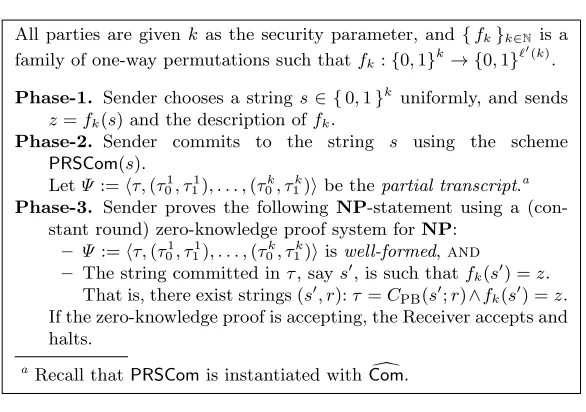
The UC-puzzle System. The construction of our UC-puzzle over an human-extractableCaptchapuzzle systemC:= (G, H), denoted hSH, Ri,R
appears in figure 2. The construction uses a family of one-way permutations {fk}k∈N such that fk : {0,1}
k
→ {0,1}`0(k) where `0 :
N → N is a polynomial. Let `1(·) be a polynomial such that the length of the transcripts of the UC-puzzle is`1(k). Then, the relationRassociated with our puzzle system is defined over the transcripts of executions TRANSas follows:
R(TRANS, s) = 1 if and only if: 1.TRANS:= ((z, fk), τ2, τ3)∈ {0,1}
`1(k), ands∈ {0,1}k.
2.z=fk(s), where (z, fk) represents sender’s Phase-1 message 3.τ3, representing the transcript of ZK-proof in Phase-3, is accepting. The stringsis defined to be thetrapdoor of the accepting executionTRANS.
Theorem 54 Assume that {fk}k∈N is a family of one-way permutations, and
that C := (G, H) is an human-extractable Captcha puzzle system. Then, the protocol hSH, Riin figure 2 is a UC puzzle.
All parties are givenk as the security parameter, and{fk}k∈N is a
family of one-way permutations such thatfk:{0,1}k→ {0,1}`0(k).
Phase-1. Sender chooses a string s∈ {0,1}k uniformly, and sends z=fk(s) and the description offk.
Phase-2. Sender commits to the string s using the scheme PRSCom(s).
LetΨ :=hτ,(τ01, τ11), . . . ,(τ0k, τ1k)ibe thepartial transcript.a Phase-3. Sender proves the following NP-statement using a
(con-stant round) zero-knowledge proof system forNP: – Ψ :=hτ,(τ1
0, τ11), . . . ,(τ0k, τ1k)iiswell-formed,and
– The string committed inτ, says0, is such thatfk(s0) =z. That is, there exist strings (s0, r):τ =Cpb(s0;r)∧fk(s0) =z. If the zero-knowledge proof is accepting, the Receiver accepts and halts.
a
Recall thatPRSComis instantiated withCom.d
Fig. 2.UC PuzzlehSH, Riusing a
Captchapuzzle systemC:= (G, H)
ensures that the corresponding components of two commitment schemes (in-cluded in Comd), are indeed equal with high probability. Then, the ZK-proof
guarantees that for one of them that the XOR of the majority of pairs commit-ted to yield a unique and well defined value, say sΨ and that it is equal to the desired trapdoor s, with high probability. Then,sΨ can be recovered from the extractable-commitment part to prove the statistical simulation. Soundness is proven using a standard hybrid argument.
6
Conclusion
Open Questions and Future Work. Our work presents a basic technique us-ing human-extractable Captchapuzzles to enable straight-line extraction and shows how to incorporate it into the framework of protocol composition to obtain new and interesting feasibility results. However, many other important questions remain to be answered. For examples, can we obtain zero-knowledge proofs forNPin 3 or less rounds?7 Can we obtain plain-text aware encryption-schemes? What aboutnon-interactivenon-malleable commitmentswithoutsetup [DDN00,CIO98,CKOS01,PPV08]?
One interesting direction is to consider improving upon the recent work of Goyal, Jain, and Ostrovsky on generating a password-based session-keys in the concurrent setting [GJO10]. One of the main difficulties in [GJO10] is to get a
7 By using standard techniques, e.g., coin-tossing using our commitment scheme along
control on the number of times the simulator rewinds any given session. They accomplish this by using the technique of precise-simulation [MP06,PPS+08]. However, since we obtain straight-line simulation, it seems likely that our tech-niques could be used to improve the results in [GJO10]. The reason we are not able to do this is that our techniques are limited to only simulation—they do
not yield both straight-line simulation and extraction, whereas [GJO10] needs a control over both.
Another interesting direction is to explore the design of extractableCaptcha puzzles. In general, investigating the feasibility and drawbacks of the asymptotic formulation forCaptchapuzzles presented here and in [ABHL03,CHS06,Dzi10] is an interesting question in its own right. We presented a discussion of these details in section 3, however they still present numerous questions for future work.
References
[AB09] Sanjeev Arora and Boaz Barak. Computational Complexity: A Modern Ap-proach. Cambridge University Press, 2009.
[ABHL03] Luis Von Ahn, Manuel Blum, Nicholas J. Hopper, and John Langford. Captcha: Using hard AI problems for security. InEUROCRYPT, pages 294–311, 2003.
[Blu87] Manual Blum. How to prove a theorem so no one else can claim it. In
International Congress of Mathematicians, pages 1444–1451, 1987.
[BP04] Mihir Bellare and Adriana Palacio. The knowledge-of-exponent assumptions and 3-round zero-knowledge protocols. InCRYPTO, pages 273–289, 2004. [BPS06] Boaz Barak, Manoj Prabhakaran, and Amit Sahai. Concurrent
non-malleable zero knowledge. InFOCS, pages 345–354. IEEE Computer Soci-ety, 2006.
[BR94] Mihir Bellare and Phillip Rogaway. Optimal asymmetric encryption. In
EUROCRYPT, pages 92–111, 1994.
[BSMP91] Manuel Blum, Alfredo De Santis, Silvio Micali, and Giuseppe Persiano. Noninteractive zero-knowledge. SIAM J. Comput., 20(6):1084–1118, 1991. [Can01] Ran Canetti. Universally composable security: A new paradigm for
crypto-graphic protocols. InFOCS, pages 136–145, 2001.
[CF01] Ran Canetti and Marc Fischlin. Universally composable commitments. In
CRYPTO, pages 19–40, 2001.
[CHS04] Ran Canetti, Shai Halevi, and Michael Steiner. Hardness amplification of weakly verifiable puzzles. InTCC, pages 17–33. Springer-Verlag, 2004. [CHS06] Ran Canetti, Shai Halevi, and Michael Steiner. Mitigating dictionary attacks
on password-protected local storage. InADVANCES IN CRYPTOLOGY, CRYPTO. Springer-Verlag, 2006.
[CIO98] Giovanni Di Crescenzo, Yuval Ishai, and Rafail Ostrovsky. Non-interactive and non-malleable commitment. InSTOC, pages 141–150, 1998.
[CKOS01] Giovanni Di Crescenzo, Jonathan Katz, Rafail Ostrovsky, and Adam Smith. Efficient and non-interactive non-malleable commitment. InEUROCRYPT, pages 40–59, 2001.
[DDN00] Danny Dolev, Cynthia Dwork, and Moni Naor. Non-Malleable Cryptogra-phy. SIAM J. on Computing, 30(2):391–437, 2000.
[DNS98] Cynthia Dwork, Moni Naor, and Amit Sahai. Concurrent zero-knowledge. InSTOC, pages 409–418, 1998.
[DSC12] Sandra Diaz-Santiago and Debrup Chakraborty. On securing communica-tion from profilers. InSECRYPT, pages 154–162, 2012.
[Dzi10] Stefan Dziembowski. How to pair with a human. InSCN, pages 200–218, 2010.
[GJO10] Vipul Goyal, Abhishek Jain, and Rafail Ostrovsky. Password-authenticated session-key generation on the internet in the plain model. In CRYPTO, pages 277–294, 2010.
[GK96] Oded Goldreich and Ariel Kahan. How to construct constant-round zero-knowledge proof systems for NP. J. Cryptology, 9(3):167–190, 1996. [GMW86] Oded Goldreich, Silvio Micali, and Avi Wigderson. Proofs that yield
noth-ing but their validity and a methodology of cryptographic protocol design (extended abstract). InFOCS, pages 174–187, 1986.
[Gol01] Oded Goldreich. Foundations of Cryptography: Basic Tools. Cambridge University Press, 2001.
[Goy11] Vipul Goyal. Constant round non-malleable protocols using one way func-tions. InSTOC, pages 695–704, 2011.
[HK10] Shai Halevi and Yael Kalai. Smooth projective hashing and two-message oblivious transfer.Journal of Cryptology, pages 1–36, 2010. 10.1007/s00145-010-9092-8.
[HO09] Brett Hemenway and Rafail Ostrovsky. Lossy trapdoor functions from smooth homomorphic hash proof systems. Electronic Colloquium on Com-putational Complexity (ECCC), 16:127, 2009.
[HT98] Satoshi Hada and Toshiaki Tanaka. On the existence of 3-round zero-knowledge protocols. InCRYPTO, pages 408–423, 1998.
[Lin03a] Yehuda Lindell. Bounded-concurrent secure two-party computation without setup assumptions. InSTOC, pages 683–692, 2003.
[Lin03b] Yehuda Lindell. General composition and universal composability in secure multi-party computation. InIn 44th FOCS, pages 394–403, 2003.
[Lin04] Yehuda Lindell. Lower bounds for concurrent self composition. In Moni Naor, editor,Theory of Cryptography, volume 2951 ofLecture Notes in Com-puter Science, pages 203–222. Springer Berlin / Heidelberg, 2004.
[Lin08] Yehuda Lindell. Lower bounds and impossibility results for concurrent self composition. Journal of Cryptology, 21:200–249, 2008. 10.1007/s00145-007-9015-5.
[LP11] Huijia Lin and Rafael Pass. Constant-round non-malleable commitments from any one-way function. InSTOC, pages 705–714, 2011.
[LPV09] Huijia Lin, Rafael Pass, and Muthuramakrishnan Venkitasubramaniam. A unified framework for concurrent security: universal composability from stand-alone non-malleability. InSTOC, pages 179–188, 2009.
[MP06] Silvio Micali and Rafael Pass. Local zero knowledge. InSTOC, pages 306– 315, 2006.
[Nao03] Moni Naor. On cryptographic assumptions and challenges. InCRYPTO, pages 96–109, 2003.
[Off] The Official CAPTCHA Site. www.captcha.net.
[PPS+08] Omkant Pandey, Rafael Pass, Amit Sahai, Wei-Lung Dustin Tseng, and Muthuramakrishnan Venkitasubramaniam. Precise concurrent zero knowl-edge. InEUROCRYPT, pages 397–414, 2008.
[PPV08] Omkant Pandey, Rafael Pass, and Vinod Vaikuntanathan. Adaptive one-way functions and applications. InCRYPTO, pages 57–74, 2008.
[PR03] Rafael Pass and Alon Rosen. Bounded-concurrent secure two-party compu-tation in a constant number of rounds. InFOCS, 2003.
[PR05] Rafael Pass and Alon Rosen. New and improved constructions of non-malleable cryptographic protocols. InSTOC, pages 533–542, 2005. [PRS02] Manoj Prabhakaran, Alon Rosen, and Amit Sahai. Concurrent zero
knowl-edge with logarithmic round-complexity. InFOCS, pages 366–375, 2002. [Ros04] Alon Rosen. A note on constant-round zero-knowledge proofs for NP. In
TCC, pages 191–202, 2004.
A
Proof of Theorem 42
In this section we present the complete proof of security of our extractable com-mitment scheme.
Theorem A1 (Restated) Assume thathCpb, Rpbiis an ordinary, non-interactive, perfectly-binding and computationally-hiding commitment scheme, C = (G, H)
is a human-extractable Captcha puzzle system, andhSot, Rotiis a two-round statistically-secure oblivious transfer protocol. Then, protocol ComC = hCH,Ri
described in figure 1 is a 3-round perfectly-binding and computationally-hiding commitment scheme which admits straight-line extraction.
Proof. Statistical binding of our scheme follows from perfect binding ofhCpb, Rpbi
and the fact that except with negligible probability over the randomness of G, s0
i 6=s1i for every i∈[k] (since otherwise
p
inv(k) will not be negligible).In addition, the computational-hiding of this scheme follows by a standard hybrid argument which uses the following two conditions: thereceiver security
property ofhSot, Roti, and computational-hiding ofhCpb, Rpbi. The proof of this part is standard, and omitted.
We now show that the scheme admits straight-line extraction. Suppose that string (c∗,(d∗,q,¯¯a),aux) represents the output of an execution of our commit-ment protocol; then by statistical binding of our commitcommit-ment scheme, except with negligible probability there is a unique message defined by this string. In fact, this unique message is completely defined by only the strings (c∗,{zi0, zi1}k
i=1), where{zi0, zi1}k
i=1 areCaptchapuzzles of the honest receiver (included inaux). Recall that to refer to this message, we use the variableM, and writeM(c∗,aux) to explicitly mention a transcript.
AlgorithmComExtrH(1k,q,¯ (c∗,aux)):
1. Parseauxto obtain the puzzles{z0
i, zi1}ki=1.
2. For everyi∈[k], setbi←ExtrH(1k,(zi0, zi1),q). If¯ Extr
H outputs⊥, then setbi=⊥.
3. Output the stringb1◦. . .◦bk.
Observe that the extraction algorithmdoes not use the solutions{s0 i, s1i}ki=1 included in the stringaux, and this information is redundant. Also, the output of the algorithm above, may include the⊥symbols in some places.
We say thatComExtrH(1k,q,¯ (c∗,aux))fails at stepiifb
i=⊥or ifbi6=Mi, whereMi denotes theith bit of the unique messageMif it exists. Further, let pi(k) denote the probability that this happens. Define the following probability pi(k) over the randomness ofbCandRandExtr:
pi(k) := Pr
(c∗,(d∗,q,¯a),¯ aux)← hCbH(1k,·),R(1k)i;M:=M(c∗,aux);
bi=ExtrH(1k,(zi0, zi1),q) :¯ Mi6=⊥ ∧bi6=Mi
(A.1) We remark again, thatpi(k) is not affected by the actual solutions{s0i, s1i}ki=1 included inauxin the equation above. This is becauseMis completely defined by c∗ and the puzzles {z0
i, zi1}ki=1, and every other expression in the equation does not depend onaux.
If we prove thatpi(k) is negligible for everyi∈[k], then by union bound, it follows that, except with negligible probability, the output ofComExtris always equal to M(or Mequals ⊥). This will complete the proof of the theorem. To show pi(k) is negligible, we construct an adversary for the extraction game in Definition 32(we will call such an adversary anCaptchaextraction adversary), and then show thatpi(k) and
p
fail are negligibly close.Informally, the proof follows from the fact that when the commitment ad-versary solves a particularCaptchapuzzle, sayzbi, and commits to its solution sbi, the “other” Captchapuzzle z1i−b is statistically hidden from his view due to the statistical security of the OT protocol. Thus, this commitment adversary can be converted to aCaptcha extraction adversary by settingzi
b = ˜z, where ˜
zis theCaptchapuzzle that theCaptchaextraction adversary gets to see in the extraction game (Definition 32).
To prove the above statement formally, we analyze the following hybrid games.
Hybrid H1. In this hybrid experiment, we consider the interaction of bC with
the following simulator S. Simulator S interacts with bC on common input 1k
exactly like an honest receiver R of our commitment protocol except that in session i, the messages corresponding to the OT protocol are forwarded to an external (honest) OT-sender Sot. The OT-sender Sot is given inputs (x0, x1) where (xb, sb)←G(1k) forb∈ {0,1}byS. At the end of the experiment, denote by let (d0,q¯0,a¯0) denote the contents of output tape of Cb, and c0 denote the
as follows: z0
i =x0, zi1 =x1, s0i =⊥, s1i =⊥. By defining these values, we have completely defined aux0 (which includes puzzles and solutions for all sessions). Define (c0,(d0,q¯0,¯a0),aux0) to be the output ofH1.
Letq1(k) denote the probability that the event in equation (A.1) occurs, when we replace the string (c∗,(d∗,q,¯ ¯a),aux) by the output ofH1—i.e., (c0,(d0,q¯0,¯a0),aux0).
Observe that except for the solutions (s0
i, s1i), all components of the string (c0,(d0,q¯0,¯a0),aux0), are distributed identically to the corresponding components of string (c∗,(d∗,q,¯a),¯ aux). Further, as noted earlier, the event in equation (A.1) is independent of (s0i, s1i). Therefore, ComExtr fails at step i with probability pi(k) even if we use the strings (c0,(d0,q¯0,¯a0),aux0) sampled according to Hybrid 1, in equation A.1. Therefore, we have thatq1(k) =pi(k). Note that experiment
H1is a polynomial time process.
Before going to the next set of hybrid experiments, we make some obser-vations. Recall that our protocol consists of k parallel OT-executions; let us denote them by OT1, . . . ,OTk. Each OT-execution has exactly 2-rounds, and the message corresponding to executionOTi, sayαi is forwarded toSot(inH1). To computeαi, our simulator S, selects a random-taper which is independent from the randomness used to samplex0andx1of experimentH1. LetRbe the domain from whichr is sampled.
Consider an exponential number of experimentsHr, defined below, one for each r ∈ R. We show that in each one of them, qr(k), defined analogous to q1(k), is negligible. We note that unlike “standard” hybrid arguments which use indistinguishability of consecutive hybrids, we have thatq1(k) is related toqr(k) via equation A.2.
Hybrid Hr. This experiment is identical to H1 except that the randomness sampled by S apart from that used to sample (x0, x1) of is fixed to the string r. The output of this experiment is defined exactly as in Hr. Letqr(k) denote the probability that event in equation (A.1) occurs when we replace the string (c∗,(d∗,q,¯ a),¯ aux) by the output ofH1. By definition, we have that for allk∈N:
q1(k) =
X
r∈R
qr(k)·Pr[ris the randomness sampled byS]≤max
r qr(k) (A.2)
We consider the hybridsHrto enable us to use the statistical security prop-erty of the OT protocol. Consider any r(one that makes the valueqr(k) maxi-mum is most convenient). To measureqr, we will make use of definition 21 and get rid of one of the puzzles (x0, x1). Note that, every stringr∈ Rresults in our simulatorSsending a stringαitoSot. Sincergeneratesαi, andris hardwired in
Hr, this experiment always sends the same stringαitoSot, who responds with some reply, sayβ ←Sot((x0, x1), αi). By definition 21, it holds that random-variableβ is statistically-close to one of the following: eitherSot((x0,0`(k)), αi) orSot((0`(k), x
HybridH1
r. This hybrid is identical toHr, except that it non-uniformly receives the value of the bitγ(r). The output of this experiment is therefore distributed identically to that ofHr.
Hybrid H2
r. This hybrid is identical to Hr except for the following difference: instead of computing β ←Sot((x0, x1), αi) it computes the output of Sot on either (x0,0`(k)) or (0`(k), x1) depending upon the value ofγ(r). Ifγ(r) = 0,Sot is given ((x0,0`(k)), αi) as input; else, ifγ(r) = 1, it is given ((0`(k), x1), αi).
By construction, and by definition 21, it holds that the output of this distri-bution is statistically-close to that of H1
r, with distance ∆γ(r)(k). Therefore, if q0r(k) denotes the probability that the event in equation (A.1) occurs, when we replace the string (c∗,(d∗,q,¯ ¯a) by the output ofH2
r, then
qr0(k)≤qr(k) +∆γ(r)(k) (A.3)
Next, we show thatqr0 is at most
p
fail(k) as defined in definition 32. To seethis, consider the following adversary for breaking the extractability property of theCaptchasystemC.
Adversary AH
C . The adversary incorporates the entire hybrid experiment H2r, including the values of r and γ(r) . The adversary receives a challenge puzzle z as input. The execution of the adversary, on inputz, internally simulatesH2 r (including the honest senderSot), except for the following difference: ifγ(r) = 0, it setsx0=z, and otherwise it setsx1=z. Note thatAC must use its oracleH to correctly simulateH2
r since the hybrid includes a cheating committer bCwho
requires access toH.
When the execution ofHr
2 halts, let the contents of the tapes of the cheating committerCb, corresponding to theith-execution be (d∗i,q,¯a). The decommitment¯
information d∗i includes a value s∗i, supposedly a solution for xγ(r) = z. The adversary outputss∗i as its solution to the challengez.
First off, note that ifM 6=⊥, it holds that except with negligible probability s∗i is a unique and well-defined value, which is indeed the solution ofz. Next, observe that the internal execution ofAC, on inputz sampled honestly usingG, is in fact identical to that ofH2
r. Finally, observe that the queries made byA, are independent of the “other” Captcha puzzle. That is, ifγ(r) = 0, the queries made byA are independent ofx1 or any other puzzle. The case forγ(r) = 1 is symmetric.
Therefore, if the event in equation (A.1) occurs on outputs ofHr
2with prob-abilityq0
B
Proof of UC Puzzle Construction
We now prove that (hSH, Ri,R), as defined in Section 5, is a UC puzzle, and begin with the soundness property. Recall that the soundness property requires that no malicious receiver can output the trapdoors. In our case, the trapdoor is the pre-image (under the one-way permutation family {fk}k∈N) of the first message of the protocol, z. We will show that if there exists a malicious re-ceiver that succeeds in outputting the trapdoor with non-negligible probability, then there exists an adversary that inverts the one-way permutation with some non-negligible probability. Informally, it will follow from the hiding property of
PRSCom, and the zero-knowledge property of the proof in Phase 3, that the re-ceiver does not learnsfrom Phases 2 and 3 of the protocol. Thus, if it succesfully outputs the trapdoor, it must do so by inverting the one-way permutation. As a technical point, note that when we are constructing the adversary for fk(·), we are no longer inside the UC framework, and in particular, we are allowed to rewind the adversary. Details follow.
Lemma B1 For any malicious receiver R∗H, the probability that it outputs s
such thatR(TRANS, s) = 1, whereTRANSis an accepting transcript, is negligi-ble inn.
Proof. LetR∗H be a malicious receiver that outputs the correct pre-image for the first message of an accepting execution with probability. We construct an adversaryAthat invertsfk(·) with probability negligibly close to. We construct
Athrough a series of hybrid adversaries, wherein we maintain the invariant that each intermediate adversary outputs the pre-image with probability negligibly close to . As observed before, we are no longer in the UC framwork and are thus allowed to rewind the adversary.
HybridA0: AdversaryA0 starts an internal execution ofhSH, R∗Hialong with the environment. In particular, A0 starts by setting the random tapes of the environment and R∗H, and starts simulating the execution ofhSH, R∗Hi, con-veying messages between the various parties. The adversary A0 simulates an honestSH itself. In the end,A
0 outputs whateverR∗H outputs. It is clear that this internal simulation is identical to the real execution, and A0 outputs the correct pre-image of the first message with probability .
HybridA1: AdversaryA1 is the same asA0 except that in Phase 3, instead of giving the zero-knowledge proof from SH to R∗H, it uses the simulator. More precisely, let SimZK be the simulator for the zero-knowledge proof in Phaes 3.
AdversaryA1runs the execution of the puzzle similar toA0, except that it con-veys all Phase 3 messages fromR∗H toSim
ZK, and allSimZK messages back to
R∗H. If Sim