Fully Secure Functional Encryption with General
Relations from the Decisional Linear Assumption
∗Tatsuaki Okamoto NTT
Katsuyuki Takashima Mitsubishi Electric
December 22, 2011
Abstract
This paper presents a fully secure functional encryption scheme for a wide class of re-lations, that are specified by non-monotone access structures combined with inner-product relations. The security is proven under a standard assumption, the decisional linear (DLIN) assumption, in the standard model. The proposed functional encryption scheme covers, as special cases, (1) key-policy, ciphertext-policy and unified-policy (of key and ciphertext poli-cies) attribute-based encryption with non-monotone access structures, and (2) (hierarchical) predicate encryption with inner-product relations and functional encryption with non-zero inner-product relations.
Contents
1 Introduction 3
1.1 Background . . . 3
1.2 Our Result . . . 4
1.3 Notations . . . 6
2 Dual Pairing Vector Spaces by Direct Product of Symmetric Pairing Groups 6 3 Functional Encryption with General Relations 8 3.1 Span Programs and Non-Monotone Access Structures . . . 8
3.2 Key-Policy Functional Encryption with General Relations . . . 9
3.3 Ciphertext-Policy Functional Encryption with General Relations . . . 10
3.4 Unified-Policy Functional Encryption with General Relations . . . 11
4 Decisional Linear (DLIN) Assumption 11 5 Lemmas for the Proofs of Main Theorems 12 6 KP-FE Scheme 13 6.1 Construction . . . 13
6.2 Security . . . 14
7 CP-FE Scheme 21 7.1 Construction . . . 21
7.2 Security . . . 23
8 UP-FE Scheme 28 8.1 Construction . . . 28
8.2 Security . . . 31
9 Fully Secure (CCA Secure) CP-FE Scheme 31 9.1 Strongly Unforgeable One-Time Signatures . . . 31
9.2 Construction . . . 32
9.3 Security . . . 33
Appendices 37 A Dual Pairing Vector Spaces (DPVS) 37 A.1 Summary . . . 37
A.2 Dual Pairing Vector Spaces by Direct Product of Asymmetric Pairing Groups . . 38
B Proofs of Lemmas 1 and 2 39 B.1 Outline . . . 39
B.2 Preliminary Lemmas . . . 40
B.3 Proof of Lemma 1 . . . 42
B.4 Proof of Lemma 2 . . . 45
C Proof of Lemma 3 47
E Generalized Version of Lemma 3 50
F How to Relax the Restriction that ρIs Injective 51
F.1 The Modified CP-FE Scheme . . . 51
F.2 Security . . . 51
G Special Cases 52 G.1 KP-ABE with Non-Monotone Access Structures . . . 52
G.2 CP-ABE with Non-Monotone Access Structures . . . 53
G.3 PE for Inner Products . . . 53
G.3.1 Construction . . . 54
G.3.2 (Weakly) Attribute-Hiding Security . . . 54
H HIPE Schemes 58 H.1 Key Idea in Constructing the Proposed HIPEs . . . 58
H.2 Special Notations for the Proposed HIPEs . . . 58
H.3 Efficient Payload-Hiding HIPE Scheme . . . 59
H.3.1 Construction . . . 59
H.3.2 Security . . . 59
H.4 Attribute-Hiding HIPE Scheme . . . 61
H.4.1 Construction . . . 61
H.4.2 Equivalence of Delegated and Freshly-Generated Keys . . . 62
H.4.3 Security . . . 63
1
Introduction
1.1 Background
Although numerous encryption systems have been developed over several thousand years, any traditional encryption system before the 1970’s had a great restriction on the relation between a ciphertext encrypted by an encryption-key and the decryption-key such that these keys should be equivalent. The innovative notion of public-key cryptosystems in the 1970’s relaxed this restriction, where these keys differ and the encryption-key can be published.
Recently, a new innovative class of encryption systems, functional encryption (FE), has been extensively studied. FE provides more sophisticated and flexible relations between the keys where a secret key, skΨ, is associated with a parameter, Ψ, and message m is encrypted to a ciphertext Enc(m,pk,Υ) using system public key pk along with another parameter Υ. CiphertextEnc(m,pk,Υ) can be decrypted by secretskΨ if and only if a relationR(Ψ,Υ) holds. FE has various applications in the areas of access control for databases, mail services, and contents distribution [3, 8, 10, 17, 18, 23, 24, 25, 26, 28].
When R is the simplest relation or equality relation, i.e., R(Ψ,Υ) holds iff Ψ = Υ, it is
identity-based encryption(IBE) [4, 5, 6, 7, 11, 13, 14, 16].
true, and T(ψ) := 0 if ψ is false (For example, T(x =v) := 1 if x =v, and T(x = v) := 0 if
x=v).
If parameter Ψ for a secret key is access structure (policy) ( ˆM ,(v1, . . . , vi)), it is called key-policy ABE (KP-ABE). If parameter Υ for encryption is ( ˆM ,(v1, . . . , vi)), it is ciphertext-policy ABE (CP-ABE).
Inner-product encryption (IPE) [18] is also a class of FE, where each parameter for en-cryption and secret key is a vector over a field or ring (e.g., −→x := (x1, . . . , xn) ∈ Fqn and
− →v := (v
1, . . . , vn) ∈ Fqn for encryption and secret key, respectively), and R(−→v ,−→x) holds iff
−
→x · −→v = 0, where −→x · −→v is the inner-product of −→x and −→v. The inner-product relation
repre-sents a wide class of relations including equality, conjunction and disjunction (more generally, CNF and DNF) of equality relations and polynomial relations.
There are two types of secrecy in FE, attribute-hiding and payload-hiding [18]. Roughly speaking, attribute-hiding requires that a ciphertext conceal the associated attribute as well as the plaintext, while payload-hiding only requires that a ciphertext conceal the plaintext. Attribute-hiding FE is called predicate encryption (PE) [18]. Anonymous IBE and hidden-vector encryption (HVE) [10] are a class of PE and covered by predicate IPE, or PE with inner-product relations.
Although many ABE and IPE schemes have been presented over the last several years, no adaptively-secure (or fully-secure) scheme has been proposed in the standard model except [19]. The ABE scheme in [19] supports monotone access structures with equality relations and is secure under non-standard assumptions over composite order pairing groups. The IPE scheme in [19] supports inner-product relations and is secure under a non-standard assumption, whose size depends on some parameter that is not the security parameter.
No adaptively-secure (or fully-secure) ABE (even for monotone access structures) or IPE scheme has been proposed under a standard assumption in the standard model, and no adaptively-secure (or fully-adaptively-secure) ABE scheme with non-monotone access structures has been proposed (even under non-standard assumptions) in the standard model. In addition, to the best of our knowledge, no FE scheme (even with selective security) has been presented that supports more general relations than those for ABE, i.e., access structures with equality relations, and those for IPE, i.e., inner-product relations.
1.2 Our Result
• This paper proposes an adaptively secure functional encryption (FE) scheme for a wide class of relations, that are specified by non-monotone access structures combined with inner-product relations. More precisely, either one of the parameters for encryption and a secret key is a tuple of attribute vectors and the other is a non-monotone ac-cess structure or span program ˆM := (M, ρ) along with a tuple of attribute vectors, e.g., Υ := (−→x1, . . . ,−→xi)∈Fn1+···+ni
q for encryption, and Ψ := ( ˆM ,(−→v1, . . . ,−→vi)∈Fqn1+···+ni)
for a secret key. The component-wise inner-product relations for attribute vector compo-nents, e.g., {−→xt· −→vt = 0 or not }t∈{1,...,i}, are input to span program ˆM, and R(Ψ,Υ) holds iff the truth-value vector of (T(−→x1·−→v1 = 0), . . . ,T(−→xi·−→vi = 0)) is accepted by span program ˆM. Note that in this paper (e.g., Section 6), parameter (−→x1, . . . ,−→xi) above is ex-pressed by Γ :={(t,−→xt)|1≤t≤d}, where 1≤t≤dmeans thattis an element of some subset of{1, . . . , d}, and parameter ( ˆM ,(−→v1, . . . ,−→vi)) above is expressed by S:= (M, ρ), whereρ inS is abused asρ in ˆM combined with (−→v1, . . . ,−→vi) (see Definition 4),
Similarly to ABE, we propose two types of FE schemes, the KP-FE and CP-FE schemes (in Sections 6 and 7), where parameter Ψ for a secret key is access structure (policy)
In addition, we show a generalized notion of KP-FE and CP-FE, unified-policy FE (UP-FE) in Section 8, where a parameter for a secret key or encryption is a combination of access structure (policy)Sand attributes Γ, and a ciphertext can be decrypted by a secret key when the both policies for the secret key and encryption are satisfied simultaneously. (The notion of UP-ABE and the first UP-ABE scheme were proposed by Attrapadung and Imai [1].)
Since the class of relations supported by the proposed FE scheme is more general than that for ABE and IPE, the proposed FE scheme includes the following schemes as special cases:
1. The (KP, CP and UP)-ABE schemes for non-monotone access structures with equal-ity relations. Here, the underlying attribute vectors of the FE scheme,{−→xt}t∈{1,...,d}
and {−→vt}t∈{1,...,d}, are specialized to two-dimensional vectors for the equality rela-tion, e.g., −→xt := (1, xt) and −→vt := (vt,−1), where −→xt · −→vt = 0 iff xt = vt (see Appendices G.1 and G.2 for KP-ABE and CP-ABE).
2. The (zero-)IPE and non-zero-IPE schemes, where a non-zero-IPE scheme is a class of FE with R(−→v ,−→x) iff −→x · −→v = 0. Here, the underlying access structure S of the FE scheme is specialized to the 1-out-of-1 secret sharing. The IPE scheme, is attribute-hiding,’ where a type of key queries are not allowed in ‘weakly-attribute-hiding’ (see the definition in [19]), while there is no such restriction in ‘fully-attribute-hiding’ ([18]). See Appendix G.3 for our (weakly-attribute-hiding) IPE scheme, which is slightly modified from a straightforward IPE-specialization of our FE scheme for improving efficiency.
3. If the underlying access structure is specialized to the d-out-of-dsecret sharing, our FE scheme can be specialized to ahierarchicalzero/non-zero-IPE scheme by adding delegation and rerandomization mechanisms. We show two hierarchical (zero-)IPE (HIPE) schemes in Appendix H, where one is payload-hiding and the other (weakly) attribute-hiding.
• The proposed FE scheme with such a wide class of relations is proven to be adaptively secure (adaptively payload-hiding against CPA) under a standard assumption, the de-cisional linear (DLIN) assumption (over prime order pairing groups), in the standard model.
Note that even for FE with the simplest relations or the equality relations, i.e., IBE, only a few IBE schemes are known to be adaptively secure under standard assumptions; the Waters IBE scheme [27] under the DBDH assumption, and the Waters IBE scheme [29] under the DBDH and DLIN assumptions.
• To prove the security, this paper elaborately combines the dual system encryption method-ology proposed by Waters [29] and the concept of dual pairing vector spaces (DPVS) proposed by Okamoto and Takashima [21, 22], in a manner similar to that in [19]. See Section 2 for the concept and actual construction of DPVS.
This paper also develops a new technique to prove the security based on the DLIN as-sumption. This provides a new methodology of employing a simple assumption defined on primitive groups to prove a complicated scheme that is designed on a higher level concept, DPVS.
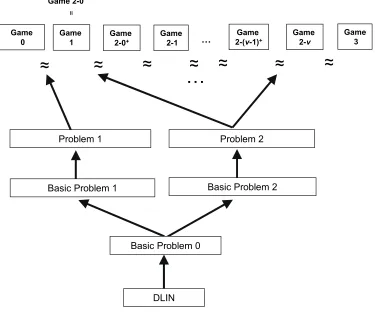
1 and 2), that are defined on DPVS. The methodology bridges the top level assumptions and the primitive one, the DLIN assumption, in a hierarchical manner, where several levels of assumptions are constructed hierarchically. Such a modular way of proof greatly clarifies the logic of a complicated security proof.
• The efficiency of the proposed FE scheme is comparable to that of the existing ABE and IPE schemes. For example, if the proposed FE scheme is specialized to IPE, the key and ciphertext sizes of our IPE scheme (Appendix G.3) are (3n+ 2)· |G|, while they are (2n+ 3)· |G|for the IPE scheme in [19], wherenis the dimension of the attribute vectors, and |G|denotes the size of an element of prime order pairing groupG, e.g., 256 bits.
• It is easy to convert the (CPA-secure) proposed FE scheme to a CCA-secure FE scheme by employing an existing general conversion such as that by Canetti, Halevi and Katz [12] or that by Boneh and Katz [9] (using additional 7-dimensional dual spaces (Bd+1,B∗d+1) withnd+1:= 2 on the proposed FE scheme, and a strongly unforgeable one-time signature scheme or message authentication code with encapsulation). That is, we can present afully secure(adaptively payload-hiding against CCA) FE scheme for the same class of relations in thestandard modelunder the DLIN assumption as well as a strongly unforgeable one-time signature scheme or message authentication code with encapsulation (see Section 9).
1.3 Notations
When A is a random variable or distribution, y←R A denotes that y is randomly selected from
A according to its distribution. When A is a set, y ←U A denotes that y is uniformly selected from A. y := z denotes that y is set, defined or substituted by z. When a is a fixed value,
A(x) → a (e.g., A(x) → 1) denotes the event that machine (algorithm) A outputs aon input
x. A function f :N→Ris negligible inλ, if for every constant c >0, there exists an integern
such thatf(λ)< λ−c for all λ > n.
We denote the finite field of order q by Fq, and Fq\ {0} by Fq×. A vector symbol denotes a vector representation over Fq, e.g., −→x denotes (x1, . . . , xn) ∈ Fqn. For two vectors −→x = (x1, . . . , xn) and −→v = (v1, . . . , vn), −→x · −→v denotes the inner-product ni=1xivi. The vector
−
→0 is abused as the zero vector in Fn
q for any n. XT denotes the transpose of matrix X. I and 0 denote the × identity matrix and the × zero matrix, respectively. A bold face letter denotes an element of vector space V, e.g., x ∈ V. When bi ∈ V (i = 1, . . . , n),
spanb1, . . . ,bn ⊆ V (resp. span−→x1, . . . ,−→xn ) denotes the subspace generated by b1, . . . ,bn
(resp. −→x1, . . . ,−→xn). For vectors −→x := (x1, . . . , xN),−→y := (y1, . . . , yN) ∈ FqN and bases B := (b1, . . . ,bN),B∗:= (b∗1, . . . ,b∗N), (→−x)B (= (x1, . . . , xN)B) denotes linear combinationNi=1xibi, and (−→y)B∗ (= (y1, . . . , yN)B∗) denotes Ni=1yib∗i. For a format of attribute vectors −→n := (d;n1, . . . , nd) that indicates dimensions of vector spaces,−→et,j denotes the canonical basis vector
(
j−1
0· · ·0,1, nt−j
0· · ·0)∈Fnt
q fort= 1, . . . , d andj = 1, . . . , nt.
2
Dual Pairing Vector Spaces by Direct Product of Symmetric
Pairing Groups
polynomial-time computable nondegenerate bilinear pairing e:G×G→GT i.e.,e(sG, tG) =e(G, G)st and
e(G, G)= 1.
Let Gbpg be an algorithm that takes input 1λ and outputs a description of bilinear pairing
groups (q,G,GT, G, e) with security parameterλ.
In this paper, we concentrate on the symmetric version of dual pairing vector spaces [21, 22] constructed using symmetric bilinear pairing groups given in Definition 1.
Definition 2 “Dual pairing vector spaces (DPVS)” (q,V,GT,A, e) by a direct product of sym-metric pairing groups (q,G,GT, G, e) are a tuple of prime q, N-dimensional vector space V:=
N
G× · · · ×Gover Fq, cyclic groupGT of orderq, canonical basisA:= (a1, . . . ,aN) of V, where
ai := (
i−1
0, . . . ,0, G, N−i
0, . . . ,0), and pairing e:V×V→GT.
The pairing is defined by e(x,y) := Ni=1e(Gi, Hi) ∈ GT where x := (G1, . . . , GN) ∈ V
and y := (H1, . . . , HN) ∈ V. This is nondegenerate bilinear i.e., e(sx, ty) = e(x,y)st and if
e(x,y) = 1 for all y∈V, then x=0. For alli and j, e(ai,aj) =e(G, G)δi,j where δ
i,j = 1 if i=j, and 0 otherwise, ande(G, G)= 1∈GT.
DPVS also has linear transformations φi,j onVs.t.φi,j(aj) =ai andφi,j(ak) =0 ifk=j,
which can be easily achieved by φi,j(x) := (
i−1
0, . . . ,0, Gj, N−i
0, . . . ,0) where x:= (G1, . . . , GN). We call φi,j “distortion maps”.
DPVS generation algorithmGdpvs takes input1λ (λ∈N) andN ∈N, and outputs a
descrip-tion of paramV := (q,V,GT,A, e) with security parameter λ and N-dimensional V. It can be constructed using Gbpg.
For the asymmetric version of DPVS, (q,V,V∗,GT,A,A∗, e), see Appendix A.2. The above symmetric version is obtained by identifyingV=V∗ and A=A∗ in the asymmetric version.
We describe random dual orthonormal basis generator Gob below, which is used as a
sub-routine in the proposed FE scheme.
Gob(1λ,−→n := (d;n1, . . . , nd)) :paramG := (q,G,GT, G, e)
R
← Gbpg(1λ), ψ U ←F×
q , N0 := 5, Nt:= 3nt+ 1 for t= 1, . . . , d,
fort= 0, . . . , d,
paramVt := (q,Vt,GT,At, e) :=Gdpvs(1λ, Nt,paramG),
Xt:=
⎛ ⎜ ⎝
− →χ
t,1
.. .
− →χ
t,Nt
⎞ ⎟
⎠:= (χt,i,j)i,j ←U GL(Nt,Fq),
⎛ ⎜ ⎝
− →
ϑt,1
.. .
− →
ϑt,Nt
⎞ ⎟
⎠:= (ϑt,i,j)i,j :=ψ·(XtT)−1,
bt,i := (−→χt,i)At =Nt
j=1χt,i,jat,j fori= 1, . . . , Nt, Bt:= (bt,1, . . . ,bt,Nt),
b∗t,i := (−→ϑt,i)At =Nt
j=1ϑt,i,jat,j fori= 1, . . . , Nt, B∗t := (b∗t,1, . . . ,b∗t,Nt),
gT :=e(G, G)ψ, param−→n := ({paramVt}t=0,...,d, gT),
return (param−→n,{Bt,B∗t}t=0,...,d).
3
Functional Encryption with General Relations
3.1 Span Programs and Non-Monotone Access Structures
Definition 3 (Span Programs [2]) Let {p1, . . . , pn} be a set of variables. A span program over Fq is a labeled matrixMˆ := (M, ρ) where M is a (×r) matrix overFq and ρis a labeling of the rows ofM by literals from{p1, . . . , pn,¬p1, . . . ,¬pn}(every row is labeled by one literal), i.e.,ρ:{1, . . . , } → {p1, . . . , pn,¬p1, . . . ,¬pn}.
A span program accepts or rejects an input by the following criterion. For every input sequenceδ ∈ {0,1}n define the submatrix Mδ of M consisting of those rows whose labels are set to 1 by the input δ, i.e., either rows labeled by some pi such thatδi = 1 or rows labeled by some ¬pi such that δi = 0. (i.e., γ :{1, . . . , } → {0,1} is defined by γ(j) = 1 if [ρ(j) =pi]∧[δi = 1]
or [ρ(j) =¬pi]∧[δi= 0], and γ(j) = 0otherwise. Mδ := (Mj)γ(j)=1, where Mj is thej-th row of M.)
The span programMˆ acceptsδ if and only if−→1 ∈spanMδ , i.e., some linear combination of the rows ofMδgives the all one vector−→1. (The row vector has the value 1 in each coordinate.) A span program computes a Boolean functionf if it accepts exactly those inputsδ where f(δ) = 1. A span program is called monotone if the labels of the rows are only the positive literals
{p1, . . . , pn}. Monotone span programs compute monotone functions. (So, a span program in
general is “non”-monotone.)
We assume that the matrix M satisfies the condition: Mi=−→0 fori= 1, . . . , .
We now introduce a non-monotone access structure with evaluating map γ by using the inner-product of attribute vectors, that is employed in the proposed functional encryption schemes.
Definition 4 (Inner-Products of Attribute Vectors and Access Structures) Ut(t= 1,
. . . , d and Ut ⊂ {0,1}∗) is a sub-universe, a set of attributes, each of which is expressed by
a pair of sub-universe id and nt-dimensional vector, i.e., (t,−→v), where t ∈ {1, . . . , d} and −
→v ∈Fnt
q \ {−
→
0}.
We now define such an attribute to be a variable p of a span program Mˆ := (M, ρ), i.e., p := (t,−→v). An access structure S is span program Mˆ := (M, ρ) along with variables
p := (t,−→v), p := (t,−→v), . . ., i.e., S := (M, ρ) such that ρ : {1, . . . , } → {(t,−→v),(t,−→v), . . ., ¬(t,−→v),¬(t,−→v), . . .}.
Let Γbe a set of attributes, i.e., Γ :={(t,−→xt)| −→xt∈Fnt
q \{−→0},1≤t≤d}, where1≤t≤d
means that tis an element of some subset of {1, . . . , d}.
When Γ is given to access structure S, map γ :{1, . . . , } → {0,1} for span program Mˆ := (M, ρ) is defined as follows: For i = 1, . . . , , set γ(i) = 1 if [ρ(i) = (t,−→vi)] ∧[(t,−→xt) ∈ Γ]
∧[−→vi· −→xt= 0] or [ρ(i) =¬(t,−→vi)] ∧[(t,−→xt)∈Γ]∧[−→vi· −→xt= 0]. Set γ(i) = 0 otherwise. Access structure S:= (M, ρ) accepts Γ iff −→1 ∈span(Mi)γ(i)=1 .
We now construct a secret-sharing scheme for a non-monotone access structure or span program.
Definition 5 A secret-sharing scheme for span program Mˆ := (M, ρ) is:
1. Let M be ×r matrix. Let column vector −→fT := (f1, . . . , fr)T ←U Fqr. Then, s0 :=
− →
2. If span program Mˆ := (M, ρ) accept δ, or access structure S := (M, ρ) accepts Γ, i.e., −
→1 ∈ span(M
i)γ(i)=1 with γ : {1, . . . , } → {0,1}, then there exist constants {αi ∈ Fq | i∈I} such that I ⊆ {i ∈ {1, . . . , } | γ(i) = 1} and i∈Iαisi =s0. Furthermore, these constants {αi} can be computed in time polynomial in the size of matrixM.
3.2 Key-Policy Functional Encryption with General Relations
Definition 6 (Key-Policy Functional Encryption : KP-FE) A key-policy functional en-cryption scheme consists of four algorithms.
Setup This is a randomized algorithm that takes as input security parameter and format −→n := (d;n1, . . . , nd) of attributes. It outputs public parameters pk and master secret key sk.
KeyGen This is a randomized algorithm that takes as input access structureS:= (M, ρ),pk and
sk. It outputs a decryption key skS.
Enc This is a randomized algorithm that takes as input message m, a set of attributes, Γ :=
{(t,−→xt)|−→xt ∈Fnt
q \ {−
→
0},1 ≤ t ≤d}, and public parameters pk. It outputs a ciphertext
ctΓ.
Dec This takes as input ciphertextctΓ that was encrypted under a set of attributesΓ, decryption key skS for access structure S, and public parameters pk. It outputs either plaintextm or the distinguished symbol ⊥.
A KP-FE scheme should have the following correctness property: for all (pk,sk)←R Setup(1λ,
−
→n), all access structures S, all decryption keys sk
S ←R KeyGen(pk,sk,S), all messages m, all
attribute sets Γ, all ciphertexts ctΓ ←R Enc(pk, m,Γ), it holds that m =Dec(pk,skS,ctΓ) with overwhelming probability, ifS accepts Γ.
Definition 7 The model for proving the adaptively payload-hiding security of KP-FE under chosen plaintext attack is:
Setup The challenger runs the setup algorithm, (pk,sk) ←R Setup(1λ, −→n), and gives public parameters pk to the adversary.
Phase 1 The adversary is allowed to adaptively issue a polynomial number of queries, S, to the challenger or oracle KeyGen(pk,sk,·) for private keys, skS associated with S.
Challenge The adversary submits two messagesm(0), m(1) and a set of attributes,Γ, provided that no S queried to the challenger in Phase 1 accepts Γ. The challenger flips a coin
b← {U 0,1}, and computes ct(Γb)←R Enc(pk, m(b),Γ). It gives ct(Γb) to the adversary.
Phase 2 The adversary is allowed to adaptively issue a polynomial number of queries, S, to the challenger or oracleKeyGen(pk,sk,·) for private keys,skS associated with S, provided thatS does not accept Γ.
Guess The adversary outputs a guess b of b.
The advantage of adversary A in the above game is defined as AdvKPA -FE,PH(λ) := Pr[b =
We note that the model can easily be extended to handle chosen-ciphertext attacks (CCA) by allowing for decryption queries in Phases 1 and 2. The advantage of adversary A in the CCA game is defined as AdvKPA -FE,CCA-PH(λ) := Pr[b=b]−1/2 for any security parameterλ.
3.3 Ciphertext-Policy Functional Encryption with General Relations
Definition 8 (Ciphertext-Policy Functional Encryption : CP-FE) A ciphertext-policy functional encryption scheme consists of four algorithms.
Setup This is a randomized algorithm that takes as input security parameter and format −→n := (d;n1, . . . , nd) of attributes. It outputs the public parameters pk and a master key sk.
KeyGen This is a randomized algorithm that takes as input a set of attributes,Γ :={(t,−→xt)|−→xt
∈Fnt
q ,1≤t≤d}, pk and sk. It outputs a decryption key.
Enc This is a randomized algorithm that takes as input messagem, access structureS:= (M, ρ), and the public parameters pk. It outputs the ciphertext.
Dec This takes as input the ciphertext that was encrypted under access structureS, the decryp-tion key for a set of attributesΓ, and the public parameters pk. It outputs either plaintext
m or the distinguished symbol ⊥.
A CP-FE scheme should have the following correctness property: for all (pk,sk)←R Setup(1λ,
−
→n), all attribute sets Γ, all decryption keys sk
Γ←R KeyGen(pk,sk,Γ), all messagesm, all access structures S, all ciphertexts ctS ←R Enc(pk, m,S), it holds that m = Dec(pk,skΓ,ctS) with overwhelming probability, ifS accepts Γ.
Definition 9 The model for proving the adaptively payload-hiding security of CP-FE under chosen plaintext attack is:
Setup The challenger runs the setup algorithm, (pk,sk) ←R Setup(1λ,−→n), and gives the public
parameters pk to the adversary.
Phase 1 The adversary is allowed to issue a polynomial number of queries, Γ, to the challenger or oracle KeyGen(pk,sk,·) for private keys, skΓ associated with Γ.
Challenge The adversary submits two messages m(0), m(1) and an access structure, S := (M, ρ), provided that the S does not accept any Γ sent to the challenger in Phase 1.
The challenger flips a random coin b← {U 0,1}, and computes ctS(b)←R Enc(pk, m(b),S). It gives ct(Sb) to the adversary.
Phase 2 The adversary is allowed to issue a polynomial number of queries, Γ, to the challenger or oracleKeyGen(pk,sk,·) for private keys, skΓ associated withΓ, provided thatS does not accept Γ.
Guess The adversary outputs a guess b of b.
The advantage of an adversaryA in the above game is defined asAdvCPA -FE,PH(λ) := Pr[b =
b]−1/2 for any security parameter λ. A CP-FE scheme is adaptively payload-hiding secure if all polynomial time adversaries have at most a negligible advantage in the above game.
3.4 Unified-Policy Functional Encryption with General Relations
Definition 10 (Unified-Policy Functional Encryption : UP-FE) A unified-policy func-tional encryption scheme consists of four algorithms.
Setup This is a randomized algorithm that takes as input security parameter and format −→n := ((dKP;nKP1 , . . . , nKPdKP),(dCP;nCP1 , . . . , nCPdCP)) of attributes. It outputs public parameters pk
and master secret key sk.
KeyGen This is a randomized algorithm that takes as input access structureSKP := (MKP, ρKP), a set of attributes, ΓCP := {(t,−→xtCP)|−→xCPt ∈ FnCPt
q \ {−→0},1 ≤ t ≤ dCP}, pk and sk. It
outputs a decryption keysk(SKP,ΓCP).
Enc This is a randomized algorithm that takes as input message m, a set of attributes, ΓKP :=
{(t,−→xKPt )|−→xKPt ∈ FnKPt
q \ {−→0},1 ≤ t ≤ dKP}, access structure SCP := (MCP, ρCP), and
public parameters pk. It outputs a ciphertext ct(ΓKP,SCP).
Dec This takes as input a ciphertext ct(ΓKP,SCP) that was encrypted under a set of attributes
and access structure, (ΓKP,SCP), decryption key sk(SKP,ΓCP) for access structure and a set
of attributes, (SKP,ΓCP), and public parameters pk. It outputs either plaintext m or the distinguished symbol ⊥.
A UP-FE scheme should have the following correctness property: for all (pk,sk)←R Setup(1λ,
−
→n), all access structuresSKP, all attribute sets ΓCP, all decryption keyssk
(SKP,ΓCP)
R
←KeyGen(pk,
sk,SKP,ΓCP), all messages m, all attribute sets ΓKP, all access structures SCP, all ciphertexts
ct(ΓKP,SCP)
R
← Enc(pk, m,ΓKP,SCP), it holds that m = Dec(pk,sk(SKP,ΓCP),ct(ΓKP,SCP)) with over-whelming probability, if SKP accepts ΓKP and SCP accepts ΓCP.
The adaptively payload-hiding security of UP-FE under chosen plaintext attack (and chosen ciphertext attack) are defined similarly as those of KP-FE and CP-FE. (See Definition 7 and 9.)
4
Decisional Linear (DLIN) Assumption
Definition 11 (DLIN: Decisional Linear Assumption) The DLIN problem is to guessβ ∈
{0,1}, given (paramG, G, ξG, κG, δξG, σκG, Yβ)← GR DLIN
β (1λ), where
GDLIN
β (1λ) :paramG := (q,G,GT, G, e)
R
← Gbpg(1λ),
κ, δ, ξ, σ←UFq, Y0 := (δ+σ)G, Y1 ←UG,
return (paramG, G, ξG, κG, δξG, σκG, Yβ),
for β ← {U 0,1}. For a probabilistic machine E, we define the advantage of E for the DLIN problem as:
AdvDLINE (λ) := Pr
E(1λ, )→1 ←GR 0DLIN(1λ)
−Pr
E(1λ, )→1 ←GR 1DLIN(1λ).
The DLIN assumption is: For any probabilistic polynomial-time adversary E, the advantage
5
Lemmas for the Proofs of Main Theorems
We will show three lemmas for the proof of Theorems 1 and 2.
Definition 12 (Problem 1) Problem 1 is to guessβ, given(param−→n,B0,B∗0,eβ,0,{Bt,B∗t,eβ,t,1,
et,i}t=1,...,d;i=2,...,nt)← GR βP1(1λ,−→n), where
GP1
β (1λ,−→n) : (param−→n,{Bt,B∗t}t=0,...,d)
R
← Gob(1λ,−→n),
B∗0:= (b∗0,1,b∗0,3, ..,b∗0,5), B∗t := (b∗t,1, ..,b∗t,nt,b∗t,2nt+1, ..,b∗t,3nt+1) fort= 1, .., d,
ω, z0, γ0 ←UFq, e0,0 := (ω,0,0,0, γ0)B0, e1,0 := (ω, z0,0,0, γ0)B0,
fort= 1, . . . , d;
− →e
t,1 := (1,0nt−1)∈Fqnt, −→zt
U ←Fnt
q , γt
U ←Fq, nt
nt nt 1
e0,t,1 := ( ω−→et,1, 0nt, 0nt, γ
t )Bt,
e1,t,1 := ( ω−→et,1, −→zt, 0nt, γ
t )Bt,
et,i :=ωbt,i fori= 2, . . . , nt,
return (param−→n,B0,B0∗,eβ,0,{Bt,B∗t,eβ,t,1,et,i}t=1,...,d;i=2,...,nt),
for β ← {U 0,1}. For a probabilistic machineB, we define the advantage ofB as the quantity
AdvP1B (λ) :=Pr
B(1λ, )→1←GR 0P1(1λ,−→n)
−Pr
B(1λ, )→1←GR 1P1(1λ,−→n).
Lemma 1 For any adversary B, there exist probabilistic machines E, whose running times are essentially the same as that of B, such that for any security parameter λ, AdvP1B (λ) ≤
AdvDLINE (λ) + (d+ 6)/q.
Definition 13 (Problem 2) Problem 2 is to guessβ, given (param−→n,B0,B∗0,h∗β,0,e0,{Bt,B∗t,
h∗β,t,i,et,i}t=1,...,d;i=1,...,nt)← GR P2
β (1λ,−→n), where
GP2
β (1λ,−→n) : (param−→n,{Bt,B∗t}t=0,...,d)
R
← Gob(1λ,−→n),
B0:= (b0,1,b0,3, ..,b0,5), Bt := (bt,1, ..,bt,nt,bt,2nt+1, ..,bt,3nt+1) fort= 1, .., d, δ, δ0, ω ←UFq, τ, u0 ←UFq×, z0:=u−01,
⎛ ⎜ ⎝ − →z t,1 .. . − →z t,nt ⎞ ⎟
⎠:=Zt←U GL(nt,Fq),
⎛ ⎜ ⎝ − →u t,1 .. . − →u t,nt ⎞ ⎟
⎠:= (Zt−1)T for t= 1, .., d,
h∗0,0 := (δ,0,0, δ0,0)B∗
0, h∗1,0:= (δ, u0,0, δ0,0)B∗0, e0:= (ω, τ z0,0,0,0)B0,
fort= 1, . . . , d; i= 1, . . . , nt;
− →e
t,i:= (0i−1,1,0nt−i)∈Fqnt,
− →
δt,i ←UFnt
q , nt
nt nt 1
h∗0,t,i:= ( δ−→et,i, 0nt, −→δ
t,i, 0 )B∗t
h∗1,t,i:= ( δ−→et,i, →−ut,i, −→δt,i, 0 )B∗
t
et,i := ( ω−→et,i, τ−→zt,i, 0nt, 0 )
Bt,
for β← {U 0,1}. For a probabilistic adversaryB, the advantage ofB for Problem 2,AdvP2B (λ), is similarly defined as in Definition 12.
Lemma 2 For any adversary B, there exists a probabilistic machine E, whose running time is essentially the same as that of B, such that for any security parameter λ, AdvP2B (λ) ≤
AdvDLINE (λ) + 5/q.
Lemma 3 Forp∈Fq, letCp:={(−→x ,−→v)|−→x·−→v =p} ⊂V×V∗ whereV isn-dimensional vector spaceFn
q, andV∗ its dual. For all(−→x ,→−v)∈Cp, for all(−→r ,→−w)∈Cp,Pr [−→x U =−→r ∧ −→v Z=−→w]
= Pr [−→x Z=−→r ∧ −→v U =−→w] = 1 Cp, where Z ←UGL(n,Fq), U := (Z−1)T.
6
KP-FE Scheme
6.1 Construction
We define function ρ:{1, . . . , } → {1, . . . , d} by ρ(i) := t if ρ(i) = (t,−→v) or ρ(i) = ¬(t,−→v), where ρ is given in access structureS:= (M, ρ). In the proposed scheme, we assume that ρis injective for S:= (M, ρ) with decryption key skS. We will show how to relax the restriction in Appendix F.
In the description of the scheme, we assume that input vector, −→xt := (xt,1, . . . , xt,nt), is normalized such that xt,1 := 1. (If −→xt is not normalized, change it to a normalized one by (1/xt,1)· −→xt, assuming that xt,1 is non-zero).
Random dual basis generator Gob(1λ,−→n) is defined at the end of Section 2. We refer to
Section 1.3 for notations on DPVS.
Setup(1λ, −→n := (d;n1, . . . , nd)) : (param−→n,{Bt,B∗t}t=0,...,d)← GR ob(1λ,−→n),
B0 := (b0,1,b0,3,b0,5), Bt:= (bt,1, ..,bt,nt,bt,3nt+1) fort= 1, .., d,
B∗0 := (b∗0,1,b∗0,3,b∗0,4), B∗t := (b∗t,1, ..,b∗t,nt,b∗t,2nt+1, ..,b∗t,3nt) fort= 1, .., d,
pk:= (1λ,param−→n,{Bt}t=0,...,d), sk:={B∗t}t=0,...,d,
return pk, sk.
KeyGen(pk, sk, S:= (M, ρ)) :
− →
f ←UFqr, −→sT := (s1, . . . , s)T:=M·−→fT, s0 :=−→1 ·−→fT, η0 ←U Fq,
k∗0 := (−s0, 0, 1, η0, 0)B∗
0,
fori= 1, . . . , ,
if ρ(i) = (t,−→vi:= (vi,1, . . . , vi,nt)∈Fnt
q \ {−→0}), θi
U
←Fq, −→ηi
U ←Fnt
q , nt
nt nt 1
k∗i := ( si−→et,1+θi−→vi, 0nt, −→η
i, 0 )B∗t,
if ρ(i) =¬(t,−→vi), −→ηi ←U Fnt
q , nt
nt nt 1
k∗i := ( si−→vi, 0nt, −→η
i, 0 )B∗t,
return skS:= (S,k0∗,k∗1, . . . ,k∗).
Enc(pk, m, Γ :={(t,−→xt:= (xt,1, .., xt,nt)∈Fnt
q \ {−→0})|1≤t≤d, xt,1 := 1}) : ω, ϕ0, ϕt, ζ ←U Fq for (t,−→xt)∈Γ,
nt
nt nt 1
ct:= ( ω−→xt, 0nt, 0nt, ϕ
t )Bt for (t,−→xt)∈Γ,
cd+1:=gTζm, ctΓ:= (Γ,c0,{ct}(t,−→xt)∈Γ, cd+1),
return ctΓ.
Dec(pk, skS:= (S,k0∗,k∗1, . . . ,k∗), ctΓ:= (Γ,c0,{ct}(t,−→xt)∈Γ, cd+1)) :
If S:= (M, ρ) accepts Γ :={(t,−→xt)}, then computeI and {αi}i∈I such that
− →
1 =i∈IαiMi, whereMi is thei-th row ofM, and
I ⊆ {i∈ {1, . . . , } | [ρ(i) = (t,−→vi) ∧ (t,−→xt)∈Γ ∧ −→vi· −→xt= 0]
∨ [ρ(i) =¬(t,−→vi) ∧ (t,→−xt)∈Γ ∧ −→vi· −→xt= 0] },
K :=e(c0,k0∗)
i∈I∧ ρ(i)=(t,−→vi)
e(ct,k∗i)αi
i∈I ∧ ρ(i)=¬(t,−→vi)
e(ct,k∗i)αi/(−→vi·−→xt),
return m :=cd+1/K.
[Correctness] IfS:= (M, ρ) accepts Γ :={(t,−→xt)},
e(c0,k∗0)i∈I ∧ ρ(i)=(t,−→vi)e(ct,k∗i)αi·
i∈I ∧ ρ(i)=¬(t,−→vi)e(ct,k
∗
i)αi/(
− →vi·−→xt)
=gT−δs0+ζi∈I ∧ ρ(i)=(t,−→vi)gδαisi
T
i∈I ∧ ρ(i)=¬(t,−→vi)g
δαisi(−→vi·−→xt)/(−→vi·−→xt)
T
=gδ(−s0+
P
i∈Iαisi)+ζ
T =gTζ.
6.2 Security
Theorem 1 The proposed KP-FE scheme is adaptively payload-hiding against chosen plaintext attacks under the DLIN assumption.
For any adversaryA, there exist probabilistic machinesE1,E2+, andE2, whose running times are essentially the same as that of A, such that for any security parameter λ,
AdvKPA -FE,PH(λ)≤AdvDLINE1 (λ) +
ν−1
h=0
AdvDLINE+ 2,h
(λ) +AdvDLINE2
,h+1(λ)
+,
where E2+,h(·) := E2+(h,·),E2,h+1(·) := E2(h,·) (h = 0, . . . , ν −1), ν is the maximum number of A’s key queries and := (2dν+ 16ν+d+ 7)/q.
Proof Outline of Theorem 1: At the top level of strategy of the security proof, we follow the dual system encryption methodology proposed by Waters [29]. In the methodology, ciphertexts and secret keys have two forms, normal and semi-functional. In the proof herein, we also introduce another form calledpre-semi-functional. The real system uses only normal ciphertexts and normal secret keys, and semi-functional/pre-semi-functional ciphertexts and keys are used only in a sequence of security games for the security proof.
To prove this theorem, we employ Game 0 (original adaptive-security game) through Game 3. In Game 1, the challenge ciphertext is changed to semi-functional. When at most ν secret key queries are issued by an adversary, there are 2ν game changes from Game 1 (Game 2-0), Game 2-0+, Game 2-1 through Game 2-(ν −1)+ and Game 2-ν. In Game 2-h, the first h
keys are semi-functional while the remaining keys are normal, and the challenge ciphertext is semi-functional. In Game 2-h+, the first h keys are semi-functional and the (h+ 1)-th key is
For skS := (S,k0∗,k1∗, . . . ,k∗) and ctΓ := (Γ,c0, {ct}(t,−→xt)∈Γ, cd+1), we focus on −→k∗S := (k0∗,k∗1, . . . ,k∗) and−→cΓ := (c0,{ct}(t,−→xt)∈Γ), and ignore the other part of skS andctΓ(and call them secret key and ciphertext, respectively) in this proof outline. In addition, we ignore a negligible factor in the (informal) descriptions of this proof outline. For example, we say “A is bounded by B” whenA≤B+(λ) where(λ) is negligible in security parameterλ.
A normal secret key, −→k∗Snorm (with access structure S), is the correct form of the secret key of the proposed FE scheme, and is expressed by Eq. (1). Similarly, a normal ciphertext (with attribute set Γ), −→cnormΓ , is expressed by Eq. (2). A semi-functional secret key, −→k∗Ssemi, is expressed by Eq. (8), and a semi-functional ciphertext, −→csemiΓ , is expressed by Eqs. (3)-(5). A pre-semi-functional secret key, −→k∗Spre-semi, andpre-semi-functional ciphertext,−→cpreΓ -semi, are expressed by Eq. (6) and Eqs. (3), (7) and (5), respectively.
To prove that the advantage gap between Games 0 and 1 is bounded by the advantage of Problem 1 (to guess β ∈ {0,1}), we construct a simulator of the challenger of Game 0 (or 1) (against an adversary A) by using an instance with β ← {U 0,1} of Problem 1. We then show that the distribution of the secret keys and challenge ciphertext replied by the simulator is equivalent to those of Game 0 when β = 0 and those of Game 1 when β = 1. That is, the advantage of Problem 1 is equivalent to the advantage gap between Games 0 and 1 (Lemma 4). The advantage of Problem 1 is proven to be equivalent to that of the DLIN assumption (Lemma 1).
The advantage gap between Games 2-h and 2-h+ is similarly shown to be bounded by the advantage of Problem 2 (i.e., advantage of the DLIN assumption) (Lemmas 5 and 2). Here, we introduce special forms of pre-semi-functional keys and ciphertexts, −→k∗Sspec.pre-semi
and −→cspecΓ .pre-semi, respectively, such that they are equivalent to pre-semi-functional keys and ciphertexts, −→k∗Spre-semi and−→cpreΓ -semi, respectively, except thatw0r0 =a0:=kr=1gk and r0 ←U Fq (note that r0, w0
U
← Fq for −→kS∗ pre-semi and −→cpreΓ -semi). These forms of keys and ciphertexts,
− →
k∗Sspec.pre-semiand→−cspecΓ .pre-semi, are simulated using Problem 2 withβ = 1. From the definition of these forms, −→k∗Sspec.pre-semi can decrypt −→cspecΓ .pre-semi for any Γ when S accepts Γ, i.e., it is hard for simulator B+2 to tell (−→k∗Sspec.pre-semi, →−cspecΓ .pre-semi) for Game 2-h+ from (−→k∗ norm
S ,
− →csemi
Γ ) for Game 2-h under the assumption of Problem 2. On the other hand, a0(= w0r0) is independently distributed from the other variables when S does not accept Γ (shown in Proof of Claim 1 by using Lemma 3). That is, the joint distribution of −→k∗Spre-semi and −→cpreΓ -semi is equivalent to that of −→k∗Sspec.pre-semi and −→cspecΓ .pre-semi, when S does not accept Γ (i.e., B+2’s simulation using Problem 2 with β = 1 is the same distribution as that of Game 2-h+ from the adversary’s view). In other words, w0 and r0 in −→kS∗ spec.pre-semi and −→cspecΓ .pre-semi (given by
B+2’s simulation using Problem 2 with β = 1) are correlated for the case that S accepts Γ or for simulatorB2+’s view, but adversaryAcannot notice the correlation sinceA’s queries should satisfy the condition that Sdoes not accept Γ.
The advantage gap between Games 2-h+ and 2-(h+ 1) is similarly shown to be bounded by the advantage of Problem 2, i.e., advantage of the DLIN assumption (Lemmas 6 and 2).
Finally we show that Game 2-ν can be conceptually changed to Game 3 (Lemma 7).
Proof of Theorem 1 : To prove Theorem 1, we consider the following (2ν+ 3) games. In Game 0, a part framed by a box indicates coefficients to be changed in a subsequent game. In the other games, a part framed by a box indicates coefficients which were changed in a game from the previous game.
M is:
k0∗:= (−s0, 0, 1, η0, 0)B∗
0,
fori= 1, . . . , ,
if ρ(i) = (t,−→vi), k∗i := (si→−et,1+θi−→vi, 0nt , −→η
i, 0)B∗
t,
if ρ(i) =¬(t,−→vi), ki∗:= (si−→vi, 0nt , −→η
i, 0)B∗t,
⎫ ⎪ ⎪ ⎪ ⎪ ⎪ ⎬ ⎪ ⎪ ⎪ ⎪ ⎪ ⎭ (1)
where −→f ←U Fqr,−→sT:= (s1, . . . , s)T :=M·−→fT, s0 :=−→1 ·−→f T, θi, η0 ←UFq,−→ηi ←U Fnt
q ,−→et,1 =
(1,0, . . . ,0) ∈ Fnt
q , and −→vi ∈ Fqnt \ {−→0}. The challenge ciphertext for challenge plaintexts
(m(0), m(1)) and Γ :={(t,−→xt)|1≤t≤d} is:
c0 := (δ, 0, ζ , 0, ϕ0)B0,
ct:= (δ−→xt, 0nt , 0nt, ϕ
t)Bt for (t,−→xt)∈Γ,
cd+1 :=gζTm(b),
⎫ ⎪ ⎪ ⎬ ⎪ ⎪ ⎭ (2)
whereb← {U 0,1};δ, ζ, ϕ0, ϕt←U Fq, and −→xt∈Fnt
q \ {−→0}.
Game 1 : Same as Game 0 except that the challenge ciphertext is:
c0:= (δ, r0 , ζ, 0, ϕ0)B0, (3)
ct:= (δ−→xt, −→rt , 0nt, ϕ
t)Bt for (t,−→xt)∈Γ, (4)
cd+1:=gTζm(b), (5)
wherer0←UFq,−→rt←U Fnt
q , and all the other variables are generated as in Game 0.
Game 2-h+(h= 0, . . . , ν−1) : Game 2-0 is Game 1. Game 2-h+ is the same as Game 2-h
except the reply to the (h+ 1)-th key query forS:= (M, ρ) with ×r matrixM, and ct of the challenge ciphertext are:
k0∗:= (−s0, w0 , 1, η0, 0)B∗
0,
fori= 1, . . . , ,
if ρ(i) = (t,−→vi),
k∗i := (si−→et,1+θi−→vi, (ai→−et,1+πi−→vi)·Zt , −→ηi, 0)B∗
t,
if ρ(i) =¬(t,−→vi),
k∗i := (si−→vi, ai−→vi·Zt , −→ηi, 0)B∗
t, ⎫ ⎪ ⎪ ⎪ ⎪ ⎪ ⎪ ⎪ ⎪ ⎪ ⎪ ⎬ ⎪ ⎪ ⎪ ⎪ ⎪ ⎪ ⎪ ⎪ ⎪ ⎪ ⎭ (6)
ct:= (δ−→xt, →−xt·Ut, 0nt, ϕ
t)Bt for (t,−→xt)∈Γ, (7)
where w0 ←U Fq, −→g ←U Fqr, −→aT := (a1, . . . , a)T := M · −→gT, πi ←U Fq (i = 1, . . . , ), Zt ←U GL(nt,Fq), Ut:= (Zt−1)T fort= 1, . . . , d, and all the other variables are generated as in Game 2-h.
Game 2-(h+ 1) (h= 0, . . . , ν−1) : Game 2-(h+ 1) is the same as Game 2-h+ except the reply to the (h+ 1)-th key query for S:= (M, ρ) with ×r matrix M, andct of the challenge ciphertext are:
k0∗:= (−s0, w0, 1, η0, 0)B∗
0,
fori= 1, . . . , ,
ifρ(i) = (t,−→vi), k∗i := (si→−et,1+θi−→vi, 0nt , −→η
i, 0)B∗t,
ifρ(i) =¬(t,−→vi), ki∗ := (si−→vi, 0nt , −→η
i, 0)B∗