Emerging Science Journal
Vol. 1, No. 4, December, 2017
Comparison and Evaluation of the Performance of Various Types of
Neural Networks for Planning Issues Related to Optimal Management of
Charging and Discharging Electric Cars in Intelligent Power Grids
Arash Moradzadeh
a, Kamran Khaffafi
b*a Department of Electrical-Power Engineering, Faculty of Electrical and Computer Engineering, Tabriz Branch, Islamic Azad
University, Tabriz, Iran
b Assistant Professor of Electrical-Power Engineering Department, Islamic Azad University, Tabriz, Iran
Abstract
The use of electric vehicles in addition to reducing environmental concerns can play a significant role in reducing the peak and filling the characteristic valleys of the daily network load. In other words, in the context of smart grids, it is possible to improve the battery of electric vehicles by scheduling charging and discharging processes. In this research, the issue of controlling the charge and discharge of electric vehicles was evaluated using a variety of neural models, until the by examining the effect of the growth rate of the penetration level of electric vehicles of the hybrid type that can be connected to the distribution network, the results of the charge management and discharge model of the proposed response are examined. The results indicate that due to increased penetration of these cars is increased the amount of responses to charge and discharge management. In this research, a variety of neural network methods, a) neural network method using Multilayer Perceptron Training (MLP), b) neural network method using Jordan Education (RNN), c) neural network method using training (RBF ) Was evaluated based on parameters such as reduction of training error, reduction of network testing error, duration of run and number of replications for each one. The final results indicate that electric vehicles can be used as scattered power plants, and can be useful for regulating the frequency and regulation of network voltages and the supply of peak traffic. This also reduces peak charges and incidental costs, which ultimately helps to further network stability. Finally, the charge and discharge management response reflects the fact that intelligent network-based models have the ability to manage the charge and discharge of electric vehicles, and among the models the amount of error reduction training and testing is very favourable for both RNN, MLP.
Keywords:
Smart Grid;
Optimized Charge and Discharge Management;
Neural Networks; Electric Vehicles.
Article History:
Received: 20 September 2017
Accepted: 12 December 2017
1-
Introduction
In recent years, the global demand for electricity has grown more than other energy sources. Therefore, the rate of increase of power in the country is very important. On the other hand, due to the need for existing technologies in large dimensions, it is not possible to store electrical energy. Therefore, accurate prediction of load consumption in a particular period can play an important role in the economic use of electrical energy. Optimal charging and discharging management, in addition to saving investment costs, provides better planning opportunities for the development of power plants and transmission and distribution networks [1]. But inefficiency of the power grid in manage maximum response to manage charge and discharge, as well as the inability of the network to exchange reliable information and the use of renewable energy resources, has caused some problems in the grid, which ultimately the power of smart grid in the planning discussion as well as the use of energy resources led to the emergence of a suitable alternative method for the fundamental and basic structure of the power grids [2].
The Smart Grids of distribution of electrical energy is one of the newest technologies in the world and is the result of the efforts of experts to modernize digital distribution networks and enter the digital age. The main goal is to provide reliable electricity and meet the growing needs of customers with the least damage to the environment. Another feature of the smart grid, in addition to monitoring the transmission and distribution network, is the ability of the smart
*CONTACT: [email protected]
DOI: http://dx.doi.org/10.28991/ijse-01123
distribution network to monitor the charge and discharge of electric vehicles connected to the network. While in elementary and primary electricity networks.
Using electric cars produces negative effects on the transmission and distribution network. The effect of electric vehicles' penetration on the distribution network is different. These effects have affected the charging pattern, charging speed, and charge characteristics, power losses in the distribution network, vehicle driving patterns, response and demand, strategy for reducing load, driving distance, battery size and tariffs. Therefore, researchers follow these issues and plans to reduce these effects [3, 4].
There are several ways to answer and manage the charge and discharge of electric cars, which can be pointed to: a) final consumption method, b) time methods, c) land use method, and d) new methods such as neural network, which are the most important Accountability and charging and discharging management of electric vehicles. Indeed, neural networks are new systems and computational methods for machine learning, knowledge representation, and, finally, the application of knowledge to predict outcomes of complex systems [5].
In this research, we try to investigate different methods of accountability and optimal management of electric vehicle charging and discharge using neural network methods. The smart methods based on the neural network used in this research are: a) Neural network method using Multilayer Perceptron Training (MLP); b) Neural Network Method using Jordan Education (RNN); c) Neural Network Method Using RBF tutorials, Also, in this research, issues such as the amount of training error reduction, the amount of network test error reduction, runtime, and the number of replications for each one were evaluated. The results show that electric vehicles can be used as scattered power plants. They can also be used to regulate the frequency and voltage of the network and provide peak traffic. This also reduces peak charges and incidental costs, which ultimately helps to further network stability.
2-
Materials and Methods
The structure of the neural network plays an important role in achieving the desired performance. Depending on the pattern of connections that the neural network uses to spread the data among the neurons, it can be classified into two basic categories. 1) Neural Networks
(Feed-Forward), which in these networks,
The data is entered into the input and passed through the network, layer-to-layer, to the output. 2) Returning networks that include the feedback connections that are from the output of the neurons to the input of the neurons in the previous layers or in the same layer. 1) Neural Networks (Feed-Forward), which in these networks, the data is entered into the input and passed through the network, layer-to-layer, to the output. 2) Returning networks that include the feedback connections that are from the output of the neurons to the input of the neurons in the previous layers or in the same layer. The only difference between the recurrent neural network and the neural network (Feed-Forward) is the presence and absence of feedback connections. The only difference between the recurrent neural network and the neural network (Feed-Forward) is the presence and absence of feedback connections, which connects the output of the neurons to the previous layer's input neurons. The recursive neural networks are potentially more potent in the form of feed-forwarding. A recursive neural network is able to recognize and recall temporary patterns. The recursive neural networks are potentially more powerful than the Feed-Forward networks. A recursive neural network is able to recognize and recall temporary patterns.
In this research, a variety of recurrent neural networks has been used to investigate the optimal response of the charge and discharge of electric vehicles. The model of the neural network used in this study is: 1. Layered Perceptron Neural Network (MLP), 2. Neural Network (RBF) and 3. Neural Network (RNN). In the following discussion, a brief explanation is given of the performance of these models. Also, input data including the rate of power consumption and the rate of demand generation and output parameters are also the answer to the management of charging and discharging electric vehicles in the standard network [6, 7].
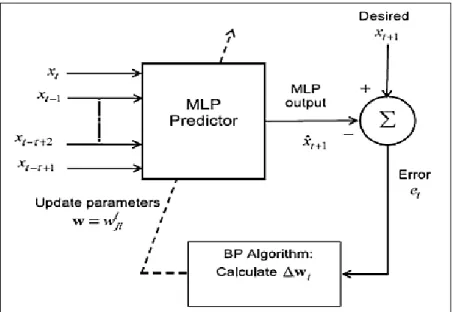
2-1- Multilayer Perceptron Neural Network (MLP)
process (MLP) is shown in Figure 1 [7].
Figure 1. Network Learning (MLP) used to simulate the response of charge and discharge management of electric vehicles
2-2- Introduction of the Neural Network (RBF)
The structure of the neural networks (RBFs) used in this study has different neurons in the peripheral multilayer forward neural networks. This type of structure only contains neuron (RBF) in the first active layer or the middle layer and the second active layer is considered linear. Mostly this network conforms to the behavior of the biological networks of living organisms. As mentioned, in the neural network (RBF), the response of the first active layer neurons, the intermediate layer, is localized, which is a function of the input differential of the receiver units of each unit (RBF). Often the output of this linear neural network is network training based on center parameters and standard deviation of the function (RBF). Figure 2 shows the neural network (RBF) used in this research [7].
Figure 2. Neural network (RBF) with radial functions in the middle layer and linear output used to simulate the charge
management and discharge control of electric vehicles
2-3- Neural Network Jordan (RNN)
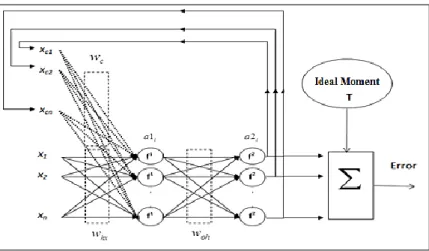
Jordan's recurring neural network has a structure very similar to Allman's neural network, but with the difference that the feeder operation is performed from the output layer to the input layer, which is shown in Figure 3 of the neural network (RNN) used in this research and display. The special features of this structure are the use of full feedbacks of the neural network, which results in the use of the final output of the network, and we will have a complete process in feedstock [7].
Figure 3. Jordan's Recurrent Irradiance Network (RNN) structure used to simulate the charge and discharge response of electric vehicles
3-
Results
3-1- Neural Network (MLP)
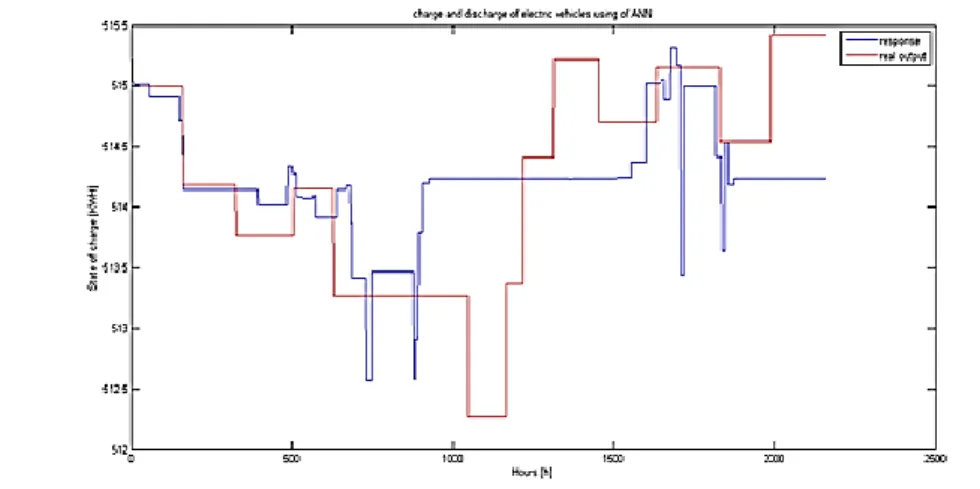
The results of the Multilayer Perceptron Neural Network (MLP) have been studied in this section. Two-layer neural network (MLP) with the number of hidden neurons in the first layer and 10 neurons in the second layer with a learning rate of 0.005 and a correction factor of 0.9 with a number of 250 repetitions. After setting the parameters and training the network results are presented in Figure 4.
Also, in this structure, the number of defined weights and biases is equal to 3, which is calculated during the learning of the new correction parameters for the multi-layer network structure. In this study, 75%, 23% and 2% of the data were allocated for teaching multi-layer perceptron neural network and training, network testing and checking and evaluation respectively. The results of the use of the Neural Network Model (MLP) are presented in Figure 4.
As can be seen, the value of the network behavior after the application of the algorithm was observed, which ultimately led to a decrease in the error value. Also, the red-outlet of the main waveform displays the optimized final charge and discharge management response, the blue-field output of the neural network (MLP), which results in the predictability of the predicted waveform.
Figure 4. Distribution of final optimized charge and discharge of the multi-layer perceptron neural network, the red model
is related to the actual output, and the blue model by the neural network model (MLP)
3-2- Neural Network (RBF)
limitations. In order to implement the neural network (RBF) has been used from the Tobacco (Matlab), which is implied to simulate the order (newrb). The results of the algorithm for implementing this network are presented in Fig. 5. As can be seen, the model in this case is not able to cover in the optimal finalized charge and discharge distribution in a satisfactory manner. It is also observed that the error in this mode is much higher than the previous one.
Figure 5. Distribution of final optimized charge and discharge of the multi-layer perceptron neural network, the red model
is related to the actual output, and the blue model by the neural network model (RBF)
3-3- Neural Network (RNN) Jordan
The neural network (RNN) used in this study consists of two layers with 20 hidden neurons in the first layer and 10 neurons in the second secret layer with a learning rate of 0.003 and an overreaching learning rate of 0.005 with a correction coefficient of 0.9 and a number of repetitions of 200. It should also be noted that the execution time of this algorithm is very low compared to other algorithms.
In this structure, in addition to the initial weights and biases, which is equal to 3, the weights and bias of the internal network control is used to prevent more fitting the network, which the use of this method will lead to a better performance model in the learning section. Also, in Jordan's Neural Network training, 75% of the data was allocated to the education sector, 20% of the data for testing the network and 5% of the data for checking and evaluation. The neural network (RNN) has been used by the Tollbacks (Matlab).
The structure is very similar to the Elman neural network, but with the difference, the feeder operation is performed from the output layer to the input layer. The special features of this structure are the use of full feed back to the neural network, which will Couse to use the final output of the network and there will be a complete process in the feeder. There is a feedback signal for the number of neurons in the output layer of the feedback signal. It can increase the number of delays, but in this figure only a delay is considered. The results of the neural network model (RNN) are shown in Fig. 6. As we can see, the model in this case has the ability to cover in the final optimized charge and discharge distribution in a satisfactory manner. It is also observed that the error in this case has been reduced to an acceptable level compared to previous methods.
Figure 6. Distribution of final optimized charge and discharge of the multi-layer perceptron neural network, the red model
4-
Discussion and Conclusion
In this research, it have been described a model of an electric vehicle system with a standardized power system. A decision strategy is created to develop the energy stored in the battery, considering the charge, charging time, and discharge of the car. In the grid distribution network, the distribution results are normal, which makes the grid error in terms of the final optimized charge and discharge distribution very high. [8]
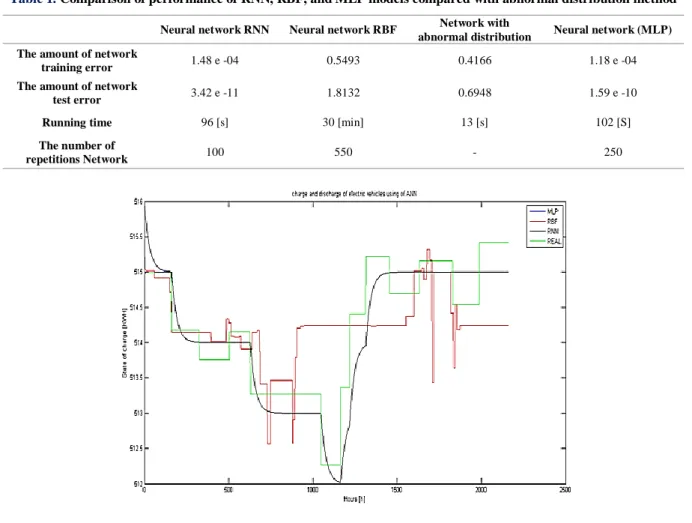
For this purpose, RNN, RBF, and MLP models were introduced based on the neural network to investigate and reduce the amount of charge and discharge discharging error. At first, the results of each of the networks were obtained in relation to the best distribution. In Fig. 7, the optimized final charge and discharge distribution was compared by the three proposed methods with the actual amount of optimized charge and discharge distribution, and then in the table (1) the magnitude of the error reduction is compared to that in which the grid uses an abnormal distribution. As can be seen, the error reduction value for both RNN and MLP methods is very favorable. All the results obtained in this study were achieved in the computer system with the Core i5 processor with RAM 8.
Table 1. Comparison of performance of RNN, RBF, and MLP models compared with abnormal distribution method
Neural network (MLP) Network with
abnormal distribution Neural network RBF
Neural network RNN
1.18 e -04 0.4166
0.5493 1.48 e -04
The amount of network training error
1.59 e -10 0.6948
1.8132 3.42 e -11
The amount of network test error
102 [S] 13 [s]
30 [min] 96 [s]
Running time
250 -
550 100
The number of repetitions Network
Figure 7. Finalized optimized charge and discharge distribution and comparison of performance of RNN, RBF, MLP
models
As can be seen in Fig. 7, the reduction of the error of training and testing for the two RNN methods is MLP. In contrast, the RBF method has a high degree of training and testing error. It should be noted that the implementation time of this model is also very high compared to previous methods. Using the technology of electric vehicles by combining the RNN-based neural network, MLP, has led the network to be analyzed in terms of load balancing and energy savings and energy savings available to car owners. Obstacles and Challenges are examined. The results indicate that electric vehicles can be used as scattered power plants. They can also be used to regulate the frequency and regulation of network voltages and provide peak traffic. This makes it more responsive to better charging and discharge, along with lowering the cost of skidding, which ultimately contributes to network stability.
5-
References
[2] Liu, Ryan, Luther Dow, and Edwin Liu. “A Survey of PEV Impacts on Electric Utilities.” ISGT 2011 (January 2011). doi:10.1109/isgt.2011.5759171.
[3] Chen, Changsong, and Shanxu Duan. “Optimal Integration of Plug-In Hybrid Electric Vehicles in Microgrids.” IEEE Transactions on Industrial Informatics 10, no. 3 (August 2014): 1917–1926. doi:10.1109/tii.2014.2322822.
[4] Sekyung Han, Soohee Han, and Kaoru Sezaki. “Development of an Optimal Vehicle-to-Grid Aggregator for Frequency Regulation.” IEEE Transactions on Smart Grid 1, no. 1 (June 2010): 65–72. doi:10.1109/tsg.2010.2045163.
[5] Li, Zhang Xueqing Liang Jun Zhang, Yu Dayang Han Xueshan Zhang Feng, and Zhang Xi. "Approach for plug-in electric vehicles charging scheduling considering wind and photovoltaic power in Chinese regional power grids [J]." Transactions of China Electrotechnical Society 2 (2013): 003.
[6] O’Connell, Niamh, Qiuwei Wu, Jacob Østergaard, Arne Hejde Nielsen, Seung Tae Cha, and Yi Ding. “Day-Ahead Tariffs for the Alleviation of Distribution Grid Congestion from Electric Vehicles.” Electric Power Systems Research 92 (November 2012): 106– 114. doi:10.1016/j.epsr.2012.05.018.
[7] Branch, Mary Ann, and Andrew Grace. MATLAB: optimization toolbox: user's guide version 1.5. The MathWorks, 1996.