Donor polymer
fl
uorination doubles the e
ffi
ciency
in non-fullerene organic photovoltaics
†
Nicole Bauer, aQianqian Zhang, aJingshuai Zhu,bZhengxing Peng,c
Liang Yan, aChenhui Zhu,dHarald Ade,cXiaowei Zhan band Wei You *a
Donor polymer fluorination has proven to be an effective method to improve the power conversion efficiency of fullerene-based polymer solar cells (PSCs). However, thisfluorine effect has not been well-studied in systems containing new, non-fullerene acceptors (NFAs). Here, we investigate the impact of donor polymer fluorination in NFA-based solar cells by fabricating devices with either a fluorinated conjugated polymer (FTAZ) or its non-fluorinated counterpart (HTAZ) as the donor polymer and a small molecule NFA (ITIC) as the acceptor. We found that, similar to fullerene-based devices,fluorination leads to an increased open circuit voltage (Voc) from the lowered HOMO level and improvedfill factor (FF) from the higher charge carrier mobility. More importantly, donor polymerfluorination in this NFA-based system also led to a large increase in short circuit current (Jsc), which stems from the improved charge transport and extraction in the fluorinated device. This study demonstrates that fluorination is also advantageous in NFA-based PSCs and may improve performance to a higher extent than in fullerene-based PSCs. In the context of other recent reports on demonstrating higher photovoltaic device efficiencies withfluorinated materials,fluorination appears to be a valuable strategy in the design and synthesis of future donors and acceptors for PSCs.
Introduction
A popular and effective method to improve the power conver-sion efficiency (PCE) of polymer solar cells (PSCs) isuorination of the donor polymer.1–4One successful, well-studied example
of donor uorination is the copolymer of benzodithiophene (BnDT) anduorinated benzotriazole (FTAZ), which was intro-duced in 2011 by Priceet al.5In that study, the performance of
FTAZ in bulk heterojunction (BHJ) devices was compared with that of its non-uorinated counterpart, HTAZ (Chart 1). Price
et al.found thatuorination increased the short circuit current (Jsc), open circuit voltage (Voc), andll factor (FF) of the solar cells, leading to an overall improvement in PCE from 4.3% to 7.1% for HTAZ and FTAZ, respectively. Later, Liet al.optimized the molecular weight of FTAZ6and designed a series of BnDT–
(X)TAZ polymers with varying amounts ofuorination (from
0 to 100% F) to further investigate the impact ofuorine in this system.7 The authors found that PCE increased as amount of uorine increased, due mainly to an increase in FF. Through a comprehensive study of device properties, this increase in FF was attributed solely to an increase in hole mobility with increaseduorination.7
Recently, non-fullerene acceptors (NFAs) have become more popular as electron acceptors than traditional fullerene deriv-atives in PSCs.8–10 Compared with fullerene derivatives, NFAs
benet from improved light absorption and easier tuning of optoelectronic properties, allowing for complementary
Chart 1 Chemical structures of FTAZ, HTAZ, and ITIC. aDepartment of Chemistry, University of North Carolina at Chapel Hill, Chapel Hill,
North Carolina 27599, USA. E-mail: [email protected]
bDepartment of Materials Science and Engineering, College of Engineering, Key Laboratory of Polymer Chemistry and Physics of Ministry Education, Peking University, Beijing 100871, China
cDepartment of Physics and ORaCEL, North Carolina State University, Raleigh, North Carolina 27695, USA
dAdvanced Light Source, Lawrence Berkeley National Laboratory, Berkeley, California 94720, USA
†Electronic supplementary information (ESI) available. See DOI: 10.1039/c7ta07882j
Received 7th September 2017 Accepted 9th October 2017
DOI: 10.1039/c7ta07882j
Device performance
To determine the effect ofuorination on photovoltaic perfor-mance, bulk heterojunction devices were prepared with a device structure of ITO/ZnO/polymer:ITIC/MoO3/Al, a polymer : ITIC
ratio of 1 : 1.5 and an active layer thickness of90 nm. The photovoltaic characteristics are given in Table 1, with repre-sentativeJ–Vcurves displayed in Fig. 2a. As expected, addition ofuorine substituents led to an increase inVocdue to the lower HOMO level of FTAZ, asVocis largely correlated to the difference between the HOMO level of the donor and LUMO of the acceptor. Fluorination also led to a 40% improvement in FF, which is similar to that observed in the fullerene-based devices for these polymers.5 Additionally, the FTAZ:ITIC device also
displayed a large increase inJsc, with aJsc30% higher than that
of the HTAZ:ITIC device. Notably, this improvement inJschas
not been observed in previously published studies of PCBM-based devices with these TAZ polymers. Overall, the power conversion efficiency of FTAZ:ITIC (8.37%) was nearly double that of HTAZ:ITIC (4.26%), due mainly to the increase in bothJsc
and FF. This efficiency of8% for FTAZ:ITIC is similar to those obtained when the donor polymer FTAZ was paired with other high-performing, non-uorinated ITIC derivatives.12,15
Fig. 1 (a) Normalized absorption and (b) energy levels of FTAZ, HTAZ, and ITIC.
Table 1 Photovoltaic characteristics of FTAZ:ITIC- and HTAZ:ITIC-based solar cells
Blend Voc(V) Jsc(mA cm2) FF (%) PCE (%)
FTAZ:ITIC 0.9110.001 16.250.46 56.51.5 8.370.40
HTAZ:ITIC 0.8510.001 12.540.49 39.90.9 4.260.24
Fig. 2 (a) RepresentativeJ–V curves and (b) EQE spectra of FTA-Z:ITIC- and HTAFTA-Z:ITIC-based BHJ devices.
absorption and energy level matching with those of donor polymerstoimproveJscandVoc.AmongallNFAs,ITIC(Chart1)
anditsderivativesarethemoststudiedandhaveshowngreat potentialinadvancingtheefficiencyofpolymersolarcells.ITIC hasanindacenodithieno[3,2-b]thiophenecoreand 2-(3-oxo-2,3-dihydroinden-1-ylidene)malononitrileendgroups,andwasrst introduced asa NFA byLin et al. in 2015.11 When ITIC was
pairedwith PTB7-Th, apopular donor polymer,in BHJ solar cells, a PCE of 6.80% was obtained, which was the highest efficiencyforNFA-baseddevicesatthattime.Sincethen,ITIC and its derivatives have become commonly used acceptor moleculestoreachhigherPCEsforPSCs.12–23Justrecently,Zhao etal.foundthatuorinationoftheacceptormoleculecanalso leadtoimprovedPSCperformance.Theydesignedauorinated ITIC derivative which, when paired with the FTAZ polymer, achieveda PCE of 13.1%, the highest reported efficiency for PSCstodate.24
Whilethereareafewreportsofdonorpolymeruorination improvingefficiencyinNFA-basedsolarcells,25,26themajority
of work on the so-called “F effect” has been focused on fullerene-basedsystems(e.g., PCBM, phenyl-C61-butyricacid
methylester).Inthisstudy,weaimtoinvestigatetheimpact of donorpolymer uorination in these NFA-based systems, anddetermineifuorinationhasapositive effect ondevice performance similar to that in fullerene-based devices. To accomplishthis, wehavefabricatedBHJdevices witheither non-uorinated TAZ (i.e., HTAZ) or its uorinated version (i.e., FTAZ) as the donor polymer and ITIC as the non-fullereneacceptor,as FTAZhas proven tobe a good match forITICanditsderivativesinpreviousreports.12,15Bystudying
the photovoltaic and morphological properties of the FTA-Z:ITICandHTAZ:ITICdevices,wefoundthatuorinationalso ledtoanincreasedPCEinthisNFA-basedsystemdueinpart to an improved Voc and FF. This result is similar to these polymers with PCBM;5 however, unlike the PCBM-based
devices, the increase in efficiencyfortheITIC-baseddevices was also in large part due to an increase in Jsc with
uorination.
Results
and
discussion
Opticalandelectrochemicalproperties
We rst considered the optical and electronic properties of FTAZ,HTAZ,andITIC.AsdisplayedinFig.1a,theabsorptionof bothFTAZandHTAZiscomplementarytothatofITIC,which wouldallow foranimprovedJsccompared tofullerene-based
In addition to theJ–Vcharacteristics, the external quantum efficiency (EQE) of the devices was measured. As shown in Fig. 2b, both FTAZ:ITIC and HTAZ:ITIC display a broad EQE response with contributions from both the donor and acceptor; however, FTAZ:ITIC has a higher response across the entire spectrum, reaching a maximum of 70% compared to only 60% for HTAZ:ITIC. This increase in EQE for FTAZ:ITIC is consistent with the improved Jsc observed in the FTAZ-based
device.
Device physics
To further understand the effect of donor polymeruorination in these devices, werst investigated the cause of the largeJsc
increase in the FTAZ:ITIC device. We chose to focus on the increase inJscrst rather than the similarly large increase in FF, because the Jsc improvement was not previously observed in PCBM-based devices with HTAZ and FTAZ. In order to under-stand this enhancement in Jsc, we needed to consider the various processes involved in current generation in PSCs. To generate current, an exciton needs to rst be formed and subsequently dissociated into free charge carriers at the donor– acceptor (D–A) interface. Then, these free charge carriers need to be transported through the device and extracted at the elec-trodes before recombination occurs.
Werst studied the exciton dissociation by measuring the photoluminescence (PL) quenching in these blends (Fig. 3). As shown in Fig. 3a, ITIC is able to quench the PL of both FTAZ and HTAZ nearly completely, with a similar quenching efficiency of 99% for both blends. Similarly, both polymers are able to efficiently quench the PL of ITIC, as displayed in Fig. 3b. The high PL quenching efficiency for all materials suggests efficient exciton dissociation in both the FTAZ- and HTAZ-based devices, likely due to a morphology with small and/or mixed enough domains.
We then considered the recombination mechanisms occur-ring in the devices, as recombination will compete with charge extraction and lower the current generation. To gain insight into the recombination mechanisms in the FTAZ:ITIC- and HTAZ:ITIC-based devices, we measured the light intensity dependence of bothJscandVoc(Fig. 4). Jscis known to have
a power law dependence on light intensity, and the slope of the
Jsc vs. intensity log plot will equal one if there is minimal bimolecular recombination in the device.27 From the log–log
plot ofJscvs.light intensity shown in Fig. 4a, it is clear that the
FTAZ:ITIC and HTAZ:ITIC devices have the same slope, indi-cating a similar degree of bimolecular recombination in these devices at short circuit condition. The slope for both the FTAZ-and HTAZ-based device is 0.88, which signies there is a small amount of bimolecular recombination for both devices. In a previous study,28 the light intensity dependence of the
FTAZ:PCBM-based device was also studied. The slope of the log– log plot was determined to be 0.93, indicating a slightly lower degree of bimolecular recombination in the PCBM-based device than the ITIC-based device studied here.
TheVocdependence on light intensity is displayed in Fig. 4b.
When bimolecular recombination is the sole loss mechanism, a plot ofVocvs.the natural log of light intensity will have a slope
equal to kT/q.27 Similar to Jsc, the Voc dependence on light
intensity shows comparable slopes for both the FTAZ- and HTAZ-based device, with a slope of 0.91kT/qand 0.85kT/qfor FTAZ:ITIC and HTAZ:ITIC, respectively. This again indicates a similar degree of recombination in these devices, which decreases the overall current generation for both blends. Additionally, these values suggest that bimolecular recombi-nation is the dominant mechanism in these devices as opposed to monomolecular, as monomolecular recombination will lead to a slope of 2kT/qin the Vocvs.intensity plot.29The results
obtained from the light intensity study are similar to those obtained by Liet al.in their earlier study,7where they found that
all devices had nearly identical bimolecular recombination coefficients, regardless of uorination amount. Here, we demonstrate that replacing PCBM with ITIC as the acceptor again leads to a comparable degree of recombination in both theuorinated (FTAZ) and non-uorinated (HTAZ) polymer.
Aer exciton dissociation, the newly generated free charge carriers need to be transported through the device and extracted at the electrodes to generate current. To study the charge transport in these solar cells, we rst measured the charge mobilityviathe space charge limited current (SCLC) method. The electron and hole mobility values are given in Table 2. The device based onuorinated FTAZ displays a higher electron and hole mobility than that of the device based on non-uorinated HTAZ. This higher charge mobility would lead to improved charge transport in the FTAZ:ITIC-based device, contributing to the improvement inJscand also in FF. Although the
FTAZ:ITIC-based device has higher mobility values than that of the HTAZ:ITIC-based device, the mobility observed in both blends is still low, on the order of only 105 cm2 V1 s1 for hole mobility and 106 for electron mobility. These low mobility
Fig. 3 Photoluminescence of (a) neat FTAZ and HTAZ (excitation at 530 nm) and (b) neat ITIC (excitation at 650 nm)films and both BHJ blendfilms.
values, along with the imbalance in the hole and electron mobility, could be a contributing factor to the lowerll factors observed in these devices, due to the potential for a build-up of space charge that would increase the bimolecular recombina-tion and be detrimental to charge transport.30
To further understand the charge transport and extraction in these PSCs, we measured the photocurrent and charge collec-tion probability (Fig. 5). The photocurrent (Jph) is calculated by
subtracting the dark current density (JD) from the current
density under illumination (JL). This value can then be plotted
against the effective voltage,Veff, which is found by subtracting
the applied voltage (V) from the compensation voltage (V0) at whichJphis equal to zero.31The plot ofJphvs. Ve
ffgives insight to
the saturated photocurrent,Jph,sat, which is the point at which all free carriers are extracted to the electrodes with minimal recombination. The saturated photocurrent is independent of the electriceld, and affected by botheld-independent losses and the optical absorption of thelm.32Fig. 5a demonstrates
that the FTAZ:ITIC-base device has a higherJph,satthan that of
the HTAZ:ITIC-based device, which agrees with the higherJscof
this device. This increase in photocurrent could be due in part to the higher absorption of the FTAZ-based blend compared to that of the HTAZ-based one (Fig. S2†). Additionally, by normalizing the photocurrent with respect toJph,sat, we are able
to calculate the charge collection probability (Pc) of the devices
(Fig. 5b).32The FTAZ:ITIC-based device displays a higherPcthan
that of the HTAZ:ITIC-based one, indicating more efficient charge extraction in the FTAZ-based device, which would lead to a higher current compared to the HTAZ-based device.
Morphology
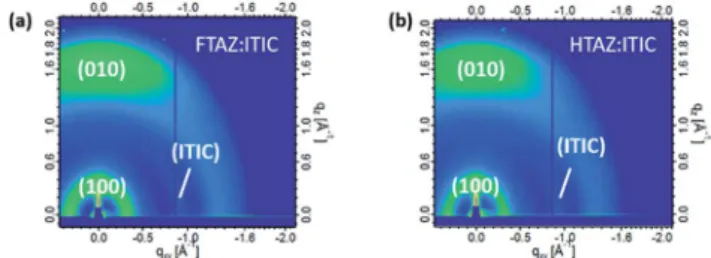
We also studied the morphology of the BHJ blend lms, as morphology can have a large effect on photovoltaic properties. Grazing incidence wide angle X-ray scattering (GIWAXS) was used to determine the molecular packing within thelm. As
displayed in the 2D GIWAXS patterns for these blend lms (Fig. 6), both the FTAZ:ITIC blendlm and the HTAZ:ITIC blend
lm display similar, mostly amorphous packing. The disorder in theselms could play a large role in the low charge mobility values discussed previously. It is possible that improving the crystallinity in these blends would lead to improved charge transport and further increase the performance for these poly-mer systems. In addition to the GIWAXS data, resonant so X-ray scattering (RSoXS) was utilized to measure the domain spacing and relative composition variations of the BHJ lms. The RSoXS data have been corrected using the Lorentz correc-tion (Fig. S6†) with the assumption of a globally isotropic 3-dimensional morphology and that long periods of Lorentz-corrected proles give a good agreement to real-space domain spacing, which has already been justied.33,34 The relative
composition variations, related to domain purities, are 1 and 0.9 for FTAZ:ITIC and HTAZ:ITIC, respectively (Table 3). The more pure domains for the FTAZ:ITIC blend trends with the higher FF observed for its device, as impure domains can lead to increased bimolecular recombination and reduce the FF. Additionally, the FTAZ:ITIC blend has a smaller domain spacing of 50 nm compared to 60 nm for the HTAZ:ITIC one, which is benecial for charge transport and agrees with the higherJscfor the FTAZ:ITIC-based photovoltaic device.
Conclusions
In summary, with FTAZ/HTAZ as the exemplary conjugated polymers, we show thatuorination of the donor polymer also leads to much improved device performance in solar cells with ITIC as the non-fullerene acceptor, similar to our previous discovery of uorination-induced-efficiency enhancement in fullerene (e.g., PCBM)-based devices. The observed increase in
Vocwithuorination–in both PCBM-based devices and
ITIC-based ones–can be ascribed to the lower HOMO level of the
uorinated FTAZ compared to its non-uorinated counterpart
Blend
Hole mobility
(105cm2V1s1)
Electron mobility
(105cm2V1s1)
FTAZ:ITIC 9.31.4 0.590.17
HTAZ:ITIC 1.90.6 0.150.06
Fig. 5 (a) Photocurrent and (b) charge collection probability of the FTAZ:ITIC- and HTAZ:ITIC-based devices.
Fig. 6 2D GIWAXS patterns for (a) FTAZ:ITIC and (b) HTAZ:ITICfilms.
Table 3 Domain spacing and relative purity for FTAZ:ITIC and HTA-Z:ITIC blends from RSoXS data
Blend
Domain spacing (nm)
Relative composition variations
FTAZ:ITIC 50.2 1
HTAZ:ITIC 59.8 0.9
HTAZ. Furthermore, the increase of FF by 40% from HTAZ to FTAZ in their ITIC-based devices – also similar to the FF enhancement observed in their PCBM-based devices– can be largely explained by the increased hole mobility with uorina-tion, as well as the increase in electron mobility. However, a large improvement of 30% was observed for theJsc, which was
not seen in previous studies of these two polymers in their PCBM-based BHJ solar cells. By studying the various processes involved in current generation in PSCs, we determined that the increase inJsc for the ITIC-based devices is due to improved
charge transport and extraction in the FTAZ:ITIC-based device compared to HTAZ:ITIC-based one, stemming from the higher electron and hole mobility, as well as a higher saturated photocurrent and charge collection probability for the FTAZ:ITIC-based device.
The results of this study demonstrate that donor polymer
uorination is also a viable method to further increase effi -ciency in NFA-based PSCs, and may improve performance through different mechanisms than those observed in fullerene-based PSCs. To fully understand the“F effect”in NFA-based solar cells, further study is required utilizing other effi -cient,uorinated donor polymers, such as those recently re-ported by Zhang et al.35 Additionally, there have been a few
reports demonstrating that uorination of the non-fullerene acceptor leads to improved device performance,15,24 which
should also be considered in future studies of the“F effect.”
Experimental
Device fabrication
Solar cells were fabricated on glass substrates with patterned indium doped tin oxide (ITO). ITO substrates were cleanedvia
sonication in deionized water, acetone and isopropyl alcohol for
een minutes each, followed by UV-ozone treatment for 15 minutes. The ZnO precursor solution was prepared by dissolv-ing 1 g zinc acetate dihydrate and 0.28 g ethanolamine in 10 mL of 2-methoxyethanol. The solution was stirred overnight, and then spun cast onto the cleaned ITO at 6000 rpm for 60 s, then baked at 200C for 30 minutes in air. The substrates were then transferred into a nitrogenlled glovebox. Polymer:ITIC solu-tions (D : A¼1 : 1.5, 6 mg mL1polymer) in chloroform were prepared for both polymers and spun cast at 5000 rpm for 60 s. The solar cells werenished by evaporation of 10 nm MoO3and
50 nm of aluminum, with a device area of 13 mm2, and tested under AM 1.5G irradiation calibrated with an NREL certied standard silicon solar cell. Current density–voltage curves were measuredviaa Keithley 2400 digital source meter.
SCLC measurements
Electron and hole mobilities were measured via the space-charge limited current (SCLC) method. Electron-only devices were fabricated with the conguration ITO/ZnO/Polymer:ITIC/ Ca/Al, and hole-only devices were also prepared with the conguration ITO/PEDOT:PSS/Polymer:ITIC/MoO3/Al. The dark
current densities were measured with an applied voltage from 0 to 6 V using a Keithley 2400 digital source meter. The applied
voltage was corrected from the voltage drop due to series and contact resistance. The Mott–Gurneys law was utilized to extract mobility values:
J¼ 983r30mhV 2
L3
where 3r is the dielectric constant of the tetramer, 30 is the permittivity of free space,mhis the hole mobility,Vis the voltage drop across the device, andLis the thickness of the active layer.
Morphology
GIWAXS, R-SoXS and NEXAFS reference spectra measurements were respectively performed at the beamline 7.3.3 (ref. 36) and beamline 11.0.1.2,37beamline 5.3.2.2,38Advanced Light Source
(ALS), Lawrence Berkeley National Laboratory, following the previously established protocols. GIWAXS data were acquired just above the critical angle (0.13) of thelms with a hard X-ray energy of 10 keV, and Silver Behenate (AgB) was used for geometry calibration. R-SoXS was performed in a transmission geometry with linearly polarized photons under high vacuum (1 107torr) and a cooled (45C) CCD (Princeton PI-MTE, 2048 pixels 2048 pixels) was used to capture the soX-ray scat-tering 2D maps and PS300 was used for geometry calibration. The raw 2D X-ray data was processed with a modied version of NIKA into 1D scattering prolesI(q).39
Con
fl
icts of interest
There are no conicts to declare.
Acknowledgements
N. B., Q. Z., and W. Y. were supported by the Office of Naval Research (Grant No. N000141410221), and a NSF grant (DMR-1507249). W. Y. and L. Y. were supported by a NSF grant (CBET-1639429). Work by NCSU was supported by ONR grant N00141512322. X-ray data was acquired at beamlines 11.0.1.2, and 7.3.3 at the Advanced Light Source, which is supported by the Director, Office of Science, Office of Basic Energy Sciences, of the U.S. Department of Energy under Contract No. DE-AC02-05CH11231. A. L. D. Kilcoyne, E. Schaible, A. Hexemer, and C. Wang, of the ALS (DOE) assisted with the measurements and/or provided instrument maintenance. We also thank Wesley Swords and Professor Gerald Meyer (University of North Caro-lina at Chapel Hill) for assistance with PL measurements.
Notes and references
1 Q. Zhang, M. A. Kelly, N. Bauer and W. You,Acc. Chem. Res., 2017,50(9), 2401–2409.
2 N. Leclerc, P. Ch´avez, O. Ibraikulov, T. Heiser and P. L´evˆeque,Polymers, 2016,8(1), 11.
3 X.-P. Xu, Y. Li, M.-M. Luo and Q. Peng, Chin. Chem. Lett., 2016,27(8), 1241–1249.
4 F. Meyer,Prog. Polym. Sci., 2015,47, 70–91.
6 W. Li, L. Yang, J. R. Tumbleston, L. Yan, H. Ade and W. You,
Adv. Mater., 2014,26(26), 4456–4462.
7 W. Li, S. Albrecht, L. Yang, S. Roland, J. R. Tumbleston, T. McAfee, L. Yan, M. A. Kelly, H. Ade, D. Neher and W. You,J. Am. Chem. Soc., 2014,136(44), 15566–15576. 8 Y. Lin and X. Zhan,Adv. Energy Mater., 2015,5(20), 1501063. 9 C. B. Nielsen, S. Holliday, H. Chen, S. J. Cryer and
I. Mcculloch,Acc. Chem. Res., 2015,48(11), 2803–2812. 10 Y. Lin and X. Zhan,Acc. Chem. Res., 2016,49(2), 175–183. 11 Y. Lin, J. Wang, Z. Zhang, H. Bai, Y. Li, D. Zhu and X. Zhan,
Adv. Mater., 2015,27(7), 1170–1174.
12 S. Dai, F. Zhao, Q. Zhang, T.-K. Lau, T. Li, K. Liu, Q. Ling, C. Wang, X. Lu, W. You and X. Zhan, J. Am. Chem. Soc., 2017,139(3), 1336–1343.
13 Y. Lin, F. Zhao, Q. He, L. Huo, Y. Wu, T. C. Parker, W. Ma, Y. Sun, C. Wang, D. Zhu, A. J. Heeger, S. R. Marder and X. Zhan,J. Am. Chem. Soc., 2016,138(14), 4955–4961. 14 S. Li, L. Ye, W. Zhao, S. Zhang, S. Mukherjee, H. Ade and
J. Hou,Adv. Mater., 2016,28(42), 9423–9429.
15 F. Zhao, S. Dai, Y. Wu, Q. Zhang, J. Wang, L. Jiang, Q. Ling, Z. Wei, W. Ma, W. You, C. Wang and X. Zhan,Adv. Mater., 2017,29(18), 1700144.
16 J. Wang, W. Wang, X. Wang, Y. Wu, Q. Zhang, C. Yan, W. Ma, W. You and X. Zhan,Adv. Mater., 2017,29(35), 1702125. 17 H. Yao, L. Ye, J. Hou, B. Jang, G. Han, Y. Cui, G. M. Su,
C. Wang, B. Gao, R. Yu, H. Zhang, Y. Yi, H. Y. Woo, H. Ade and J. Hou,Adv. Mater., 2017,29(21), 1700254.
18 Y.-Q.-Q. Yi, H. Feng, M. Chang, H. Zhang, X. Wan, C. Li, Y. Chen, H. Zhang, C. Li, J. Hou, Y. Chen, S. R. Marder, X. Zhan, A. Amassian, A. Salleo, T. Kirchartz, J. R. Durrant and I. McCulloch, J. Mater. Chem. A, 2017, 5(33), 17204– 17210.
19 B. Guo, W. Li, X. Guo, X. Meng, W. Ma, M. Zhang and Y. Li,
Adv. Mater., 2017,29(36), 1702291.
20 F. Lin, W. Huang, H. Sun, J. Xin, H. Zeng, T. Yang, M. Li, X. Zhang, W. Ma and Y. Liang,Chem. Mater., 2017,29(13), 5636–5645.
21 W. Wang, C. Yan, T.-K. Lau, J. Wang, K. Liu, Y. Fan, X. Lu and X. Zhan,Adv. Mater., 2017,29(31), 1701308.
22 X. Bao, Y. Zhang, J. Wang, D. Zhu, C. Yang, Y. Li, C. Yang, J. Xu and R. Yang,Chem. Mater., 2017,29(16), 6766–6771. 23 T. Yu, X. Xu, G. Zhang, J. Wan, Y. Li and Q. Peng,Adv. Funct.
Mater., 2017,27(28), 1701491.
24 W. Zhao, S. Li, H. Yao, S. Zhang, Y. Zhang, B. Yang and J. Hou,J. Am. Chem. Soc., 2017,139(21), 7148–7151. 25 Z. Li, K. Jiang, G. Yang, J. Y. L. Lai, T. Ma, J. Zhao, W. Ma and
H. Yan,Nat. Commun., 2016,7, 13094.
26 L. Gao, Z. Zhang, H. Bin, L. Xue, Y. Yang, C. Wang, F. Liu, T. P. Russell and Y. Li,Adv. Mater., 2016,28(37), 8288–8295. 27 A. K. K. Kyaw, D. H. Wang, V. Gupta, W. L. Leong, L. Ke, G. C. Bazan and A. J. Heeger,ACS Nano, 2013,7(5), 4569– 4577.
28 N. Bauer, Q. Zhang, J. Zhao, L. Ye, J.-H. Kim, I. Constantinou, L. Yan, F. So, H. Ade, H. Yan and W. You,J. Mater. Chem. A, 2017,5(10), 4886–4893.
29 S. R. Cowan, A. Roy and A. J. Heeger,Phys. Rev. B: Condens. Matter Mater. Phys., 2010,82(24), 245207.
30 C. M. Proctor, J. A. Love and T.-Q. Nguyen,Adv. Mater., 2014,
26(34), 5957–5961.
31 P. W. M. Blom, V. D. Mihailetchi, L. J. A. Koster and D. E. Markov,Adv. Mater., 2007,19(12), 1551–1566. 32 L. Yang, J. Tumbleston, H. Zhou, H. Ade and W. You,Energy
Environ. Sci., 2013,6, 316–326.
33 L. Ye, Y. Xiong, S. Li, M. Ghasemi, N. Balar, J. Turner, A. Gadisa, J. Hou, B. T. O'Connor and H. Ade,Adv. Funct. Mater., 2017,27(33), 1702016.
34 S. Mukherjee, A. Herzing, D. Zhao, Q. Wu, L. Yu, H. Ade, D. M. DeLongchamp and L. J. Richter,J. Mater. Res., 2017,
32(10), 1921–1934.
35 Q. Zhang, L. Yan, X. Jiao, Z. Peng, S. Liu, J. J. Rech, E. Klump, H. Ade, F. So and W. You,Chem. Mater., 2017,29(14), 5990– 6002.
36 A. Hexemer, W. Bras, J. Gossinger, E. Schaible, E. Gann, R. Kirian, A. MacDowell, M. Church, B. Rude and H. Padmore,J. Phys.: Conf. Ser., 2010,247(1), 12007. 37 E. Gann, A. T. Young, B. A. Collins, H. Yan, J. Nasiatka,
H. A. Padmore, H. Ade, A. Hexemer and C. Wang,Rev. Sci. Instrum., 2012,83(4), 45110.
38 A. L. D. Kilcoyne, T. Tyliszczak, W. F. Steele, S. Fakra, P. Hitchcock, K. Franck, E. Anderson, B. Harteneck, E. G. Rightor, G. E. Mitchell, A. P. Hitchcock, L. Yang, T. Warwick and H. Ade, J. Synchrotron Radiat., 2003, 10, 125–136.