TECHNICAL UNIVERSITY OF CLUJ-NAPOCA
ACTA TECHNICA NAPOCENSIS
Series: Applied Mathematics, Mechanics, and Engineering Vol. 62, Issue IV, November, 2019
RESEARCH ON THE SURFACE OF THE DENTAL ALLOYS WITH
COBALT-CROM BASE
Willi Andrei URICIUC, Horatiu VERMESAN, Adrian-Ioan BOTEAN, Liviu NISTOR, Catalin POPA
Abstract: Removable parts assemblies are key that ensure the resistance of combined dental prosthetic works.The main problem regarding these dental prosthetic works in combining the two components as parts of the assembly. Dental alloys are considered biomaterials due to the fact, that they develop on their surface a passive oxide film that blocks the interaction with the environment in which they are immersed, thus, having an anticorrosive behaviour. In this study we assessed three Co-Cr base alloys: Co-Cr-Mo, Co-Cr-W and Co-Cr-Mo-W alloy. The surface of the samples was polished to the mirror texture, by mechanical processing using specific tools and another surface was sandblasted. The surfaces was heat treated at high temperature (HTO) and continues (CTO). The pieces were prepared for the electrochemical behaviour testes (OCP- open circuit potential, Tafel diagrams and EIS–electro impedance spectroscopy) using the Electrochemical Laboratory Voltalab PGZ100 and the results were processed with a special Voltamaster 4 soft. The samples were layered with ceramic and mechanically loaded for simple bending through universal testing machine Instron 3366 and analysed by the digital image correlation method with Q400 system. According to the differences between the values obtained by electrochemical testes, Co-Cr-W alloy had the highest thermodynamic stability. These differences highlighted the tendencies of materials to passivation in saliva. This is a self-protection ability of the material that is active from the design stage. The oxide on the surface of Co-Cr base alloy is an elastic buffer between alloy’s structure and the environment where functions as a biomaterial.
Key words: Co-Cr base alloy, electrochemical behaviour, mechanically loaded, digital image correlation method, heat treatment oxidation
1.INTRODUCTION
Removable parts assemblies are
components of the combined dental prosthetic works resistance. The realization of these prosthetic assemblies is done by casting in refractory moulding of the dental alloys for each component part and then they are realized by mechanical processing at the surface of the coupling surfaces of the assembly. [1]
The problem with these dental prosthetic works is the precision of the combination between the two components of the parts assembly [2]. The surface of the joint of the main part is transferred to the surface of the joint of the secondary part with a considerable deviation due to the transfer process by duplication in the refractory mass of the first part. [3]
We tried to optimize the method of transferring the shape of the joint surface by
applying a burning out resin at the level of the main part and creating a pattern for the secondary part with the help of this resin model, but due to the shrinkage and expansion of both the refractory mass of the form and the molten alloy and cast, also got a piece that requires mechanical adaptation to join the main piece. [1, 2, 3]
The idea of casting the molten alloy directly on to the joint surface of the main part was advanced, the part which represented an insert structure in the refractory mould, but the result was a set of non-detachable pieces welded together.
The dental alloys used in the realization of the combined prosthetic works are alloys with Co-Cr base. In the current practice of dental medicine, the removable assembly of moulded structures is made of 2 different alloys. Due to the fact that there is friction at the fitting adapted between two pieces made of different alloys, which work in the salivary corrosive environment of the oral cavity, the tribocorrosion process may be present. [7, 8, 9] The idea of the unique alloy was advanced, which represents the casting of the two component parts of the assembly from the same alloy with Co-Cr base. [10] The possibility was to develop a passive separation oxides film on the surface of the main part so that it could be used as an insert piece in the refractory mold prepared for casting the secondary part. It was also pursued after the casting and cooling of the secondary part of a set of detachable parts that do not require mechanical stress in decoupling step. [11]
2.MATERIALS
In this study the alloys are from Heraeus Holding Gmbh Germany (alloy HPW: Co-Cr-W alloy, Surface NYD Kft. Brand-Hungary (alloy SC: Co-Cr-Mo alloy) and Mediloy S-Co
from Bego Bremer Goldschlegerei
Gmbh&Co.KG (alloy M: Co-Cr-W-Mo alloy) in conformity with the standards: EN ISO 9693 and 22674. From the point of view of the facts exposed, this alloys elected are the optimum alloys for the construction of combined dentures resistance structures. In the Table 1 are exposed the Ceramic Bonding Alloys (CBA) and the elements weight percent composition, and properties in Table 2 and Table 3.
Table 1 Heraenium PW alloy vs SuperC alloy (weight
percent).
CBA Co Cr Mo Fe W Si,C,N,M n HPW 55.2 24 - 4 15 ˂ 1
SC 62 30 5.5 1.5 - ˂ 1 M 63.9 24.7 5 - 5.4 ˂ 1
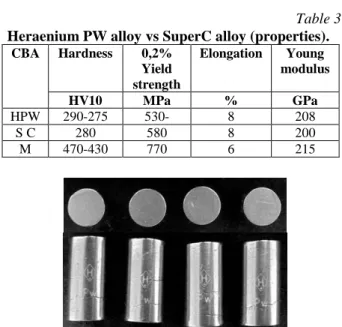
The alloys are in 6.2 g cylindrical shape with 0.502 cm² base surface area that is reveal in
Figure 1. The pieces are in stage 1 (HPW and SC).
Table 2 Heraenium PW alloy vs SuperC alloy (melting range,
density and casting temperature).
CBA Melting range solidus-liquidus
Casting temperature
Density
˚C ˚C g/cm³ HPW 1320-1400 1550 8.2
S C 1300-1380 1450 8.7 M 1380-1420 - 8.6
Table 3 Heraenium PW alloy vs SuperC alloy (properties).
CBA Hardness 0,2% Yield strength
Elongation Young modulus
HV10 MPa % GPa HPW 290-275 530- 8 208
S C 280 580 8 200 M 470-430 770 6 215
Fig. 1. HPW-alloy ingots (vertical) and SC-alloy ingots (horizontal).
The horizontal surface of the samples was polished to the mirror texture, by mechanical processing using tools specific to the procedure (Figure 2).
Fig. 2. The beam produced with SLM technology (two surfaces prepared: mirror texture and sandblasted with aluminium oxides 120µ granulation,
at 4 atm. pressure).
Table 4 Heat treatment parameters for oxidation
B (°C)
C (min)
t(°C/min) V1 (°C)
V2 (°C)
T (°C)
O1 650 06:00 55 600 979 980
O2 650 06:00 55 600 979 980
O3 650 06:00 55 - - 980
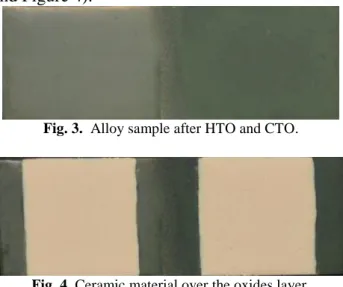
The thermal treatment for O1 and O2 is under vacuum and is finalized with oxidation at the final temperature T, so we can define it as high temperature oxidation (HTO). The thermal treatment for O3 is with oxidation the sample throughout all heating process and we can define it as continuous thermal oxidation (CTO). On the surface is layered ceramic material (Figure 3 and Figure 4).
Fig. 3. Alloy sample after HTO and CTO.
Fig. 4. Ceramic material over the oxides layer.
3.METHODS
The HPW and SC in described shape are prepared for the analyses. The pieces with 0,502 cm² surface area are mechanical polished (MP) until the mirror effect appear and cleaned with acetone. The pieces are prepared for the electrochemical behaviour testes as a working electrode (WE) in an electrochemical cell. The analyses is made with the help of Electrochemical Laboratory Voltalab PGZ100 and the results had been processed with a special soft Voltamaster 4.
Voltalab PGZ100 is a complex
electrochemical laboratory and one all in one potentiostat with a multitude of function: voltammetry and electrochemical impedance spectroscopy.
The electrochemical cell (Figure 5) is compound from: the working electrode (the analysed alloy surface), the reference electrode
(RE- Ag/AgCl), counter electrode (CE- Pt) and one electrolytic liquid (H2SO4 0,1N) at 23˚C.
The cell is connected at the VoltalabPGZ 100.
Fig. 5. The electrochemical cell.
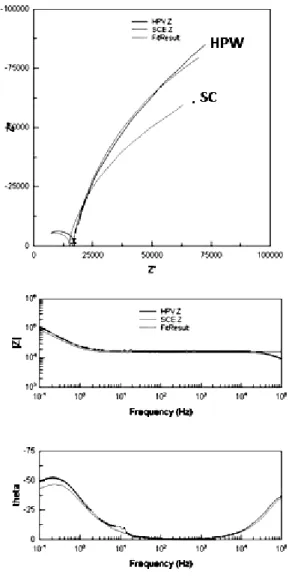
The analyses of the electrochemical impedance spectroscopy (EIS) measurement, showed the resistance at polarisation (Rp) of two type of alloy. The representation of EIS is a Nyquist diagram and one equivalent electric circuit that reveal the electrochemical behaviour of alloys at polarisation.
The measurement of linear polarisation for corrosion is interpreted in diagram. The corrosion current density expressed in loss of alloy thickness per year is determinate from the Tafel equation. The thermodynamic βa and βc parameters of the Butler Volmer equation are also obtained. The test are focus on the applying of continue current potential at the analysed surface and obtain a feet back. Because in this case is about a pitting corrosion and not a general one, is not correct to analyse the corrosion speed, but remain to talk about the value of Icorr. The linear polarisation had performed with scanning of potential in ±300 mV interval with 1 mV/sec speed.
The measurement in open circuit potential (OCP) showed the tendencies of the materials to create a passive layer at the surface in electrolytic liquid, as anticorrosion response.
4. RESULTS
The results of electrochemical tests over the dental alloys presented in Chapter 2, reveal the quality and the thermodynamic characteristics of this materials.
(-0.12 mV). The potential difference registered
(Δpotential= +138.88 mV) highlighting the
differences thermodynamic behaviour of this alloys.
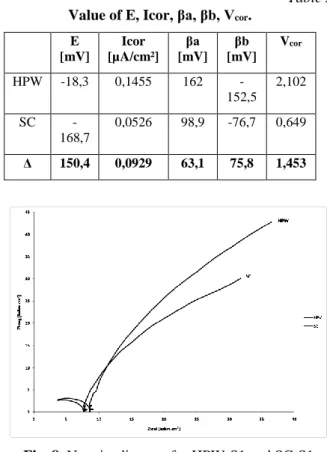
Graphic from Fig.7 is Tafel diagram and it is obtain after linear polarisation, with potential sweeping in the field ± 300 mV up and down in front of OCP value, with a speed (v= 1mV/sec). The results and values obtain are showed in the Table 5.
From the representation of the values registered it is possible to see the oscillation of the graphic, can be interpreted as behaviour of alloys.
The representation of (EIS) electrochemical
impedance spectroscopy in Nyquist
interpretation is showed in Fig.8, the values: working electrode polarisation resistance (Rp), electrical resistance of the electrolyte (Re) and constant phase element (CPE) represented in Table 6.
Fig. 6. (OCP) open potential circuit diagram for HPW and SC (Source: laboratory tests).
Fig. 7. Tafel diagram for HPW and SC (Source: laboratory tests).
Table 5 Value of E, Icor, βa, βb, Vcor.
E [mV]
Icor [µA/cm²]
βa [mV]
βb [mV]
Vcor
HPW -18,3 0,1455 162 -152,5
2,102
SC -168,7
0,0526 98,9 -76,7 0,649
Δ 150,4 0,0929 63,1 75,8 1,453
Fig. 8. Nyquist diagram for HPW-S1 and SC-S1
Table 6 Value of Re, Rp and CPE.
Re [Ωcm²]
Rp [Ωcm²]
CPE-T [F/cm²]
CPE-P [F/cm²]
HPW 16296 232660 1.3204 ∙ 10 -5 0.88785 SC 14553 146120 1.6131∙ 10-5 0.87704
According with Nyquist diagram the equivalent circuit is made for understanding the way that the alloys are behave in electrolyte. The best fitting of the curve describe is transposed begin from Randles equivalent electric circuit, replacing the capacitive element (capacitor type) with constant phase element (CPE). The fitting of the diagram curve is show in Fig.9.
Fig. 9. Photo of PC screen.
The three layers will be loaded mechanically for simple bending through universal testing machine Instron 3366 and analysed by digital image correlation method with Q400 system, according to Fig.10. It will be followed if the layer of ceramic material is exfoliated after mechanical loading.
The mechanical loading is carried out progressively, static, in steps of 0.1kN, the maximum load being 0.5kN.
Using the digital image correlation method, the total displacement of the 4 nodes (according to the Figure 10) is followed. Figure 11 shows the total displacements of the 4 points, mentioning the fact that a number of seven sets of tests were performed.
From the analysis of this diagram it is shown that the oxide layer has a good mechanical behaviour, it does not exfoliate from the base surface.
Fig. 10. Model is loaded mechanically through universal testing machine Instron 3366 and analysed by digital image correlation method
with Q400 system.
Fig. 11. Force vs total displacement.
5. CONCLUSIONS
According with the values differences revealed in OCP diagram, HPW (Co-Cr-W) alloy had a thermodynamic stability in front of SC (Co-Cr-Mo) alloy. This differences highlighting the tendencies of materials to passivation in electrolyte. That is a self-protection action of the material that is active from the design stage.
corrosion, the pitting corrosion is what we discuss. The Co-Cr-W alloy is affected with high corrosion speed but it reached to lose the passive layer very hard.
The Nyquist diagram showed that at the surface of working electrode (HPW, SC) had happened some modification of roughness, porosity or developed and deposited at the surface the corrosion products that can be the type of oxides.
6. REFERENCES
[1] Wulfes, H., Kombitechnik und Modellguss: Ein Leitfaden, Moderne Konstruktion, Ratinelle Anfertigung, Bremen ISBN 3-9809111-0-1, 2003
[2] Ortorp A. et al., The fitt of cobalt-chromium three-unit fixed dental prostheses fabricated with four different techniques: A comparation in vitro study, Dental Materiales, doi: 10.1016/j.dental.2010.11.015, 2010 [3] Liu R., Xi S.Q., Kapoor S., Wu X.J., Investigation of
solidification behavior and associate microstructures of Co-Cr-W and Co-Cr-Mo alloy system using DSC technique J. Of Materials Science, 45:6225-6234, 2010
[4] Aihara, H Surface and biocompatibility study of electropolished Co-Cr alloy L605, San Jose State
University, UMI Nr. 1478595, ProQuest LLC, 2010
[5] Espevik S., Rapp R.A., Daniel P.L., Hirth J.P.,
Oxidation of ternary Co-Cr-W alloys, Oxidation of Metals, 20:37-65, 1983
[6] McGinley E.L., Moran G.P., Fleming, G.J.P., Base-metal dental casting alloy biocompatibility assessment using a human-derived 3D oral mucosal model, Acta Biomaterialia, doi:10.1016/j.actbio.2011.08.017, 2011
[7] Werner, G., Biocompatibility of dental casting alloys, Crit. Rev.Oral Biol. Med., 13(1):71-84, 2002 [8] Wataha J.C., Lockwood P.E., Khajotia S.S., Turner
R., Effect of pH on element release from dental casting alloys. J.Prosthet.Dent. 8:691-698, 1998 [9] Wataha J.C., Biocompatibility of dental casting
alloys: a review, J.Prosthet. Dent., 83(2):223-234, 2000
[10] Cunat, P-J., Alloyng Elements in Stainless Steel and Other Chromium-Containing Alloys, Euro Inox, www.euroinox.org: 6, 2004
[11] Botean, A.I., State of stresses in 2D osteoporotic models according to human proximal femoral bone area in unipodal support, Acta Technica Napocensis, Series: Applied Mathematics, Mechanics, and Engineering, Vol. 60, Issue II,
June, 2017
CERCETĂRI LA SUPRAFAŢA ALIAJELOR DENTARE CU BAZA COBALT-CROM
Rezumat: Ansamblurile de piese detasabile sunt componente de rezistența a protezelor dentare. Aliajele dentare sunt considerate biomateriale datorită faptului că dezvoltă pe suprafața lor o peliculă de oxid pasiv care blocheaza interacțiunea cu mediul în care sunt introduse, având un comportament anticoroziv. În acest studiu sunt utilizate 3 aliaje cu bază Co-Cr: Co-Cr-Mo, Co-Cr-W și Co-Cr-Mo-W. Suprafața orizontală a eșantioanelor a fost lustruită până la textura oglinzii, prin prelucrare mecanică folosind instrumente specifice procedurii și o suprafață a fost sablata. Suprafețele au fost tratate termic și oxidează la temperatură ridicată (HTO) și continu (CTO). Piesele sunt pregătite pentru testele electrochimice ( potențial de circuit deschis OCP, diagrame Tafel și spectroscopie de impedanță electrică EIS) cu ajutorul Laboratorului Electrochimic Voltalab PGZ100, iar rezultatele au fost procesate cu un soft Voltamaster 4. Eșantionul a fost stratificat cu ceramică și încărcat mecanic pentru compresiune prin mașina de testare universală Instron 3366 și analizată prin metoda de corelare a imaginilor digitale cu sistemul Q400. Conform diferențelor de valori relevate în testele electrochimice, aliajul Co-Cr-W a avut stabilitate termodinamică mai mare. Aceste diferențe evidențiază tendințele materialelor de pasivizare în salivă. Aceasta este o acțiune de auto-protecție a materialului.Oxidul de la suprafața aliajului de bază Co-Cr este un tampon elastic între structura aliajului și mediul în care este făcut să fie funcțional ca biomaterial.
Willi Andrei URICIUC, University of Medicine and Pharmacy Cluj-Napoca, Department of Oral Rehabilitation, Oral Health and Dental Office Management, [email protected], 076 88 22 618.
Horaţiu VERMEŞAN, Corrosion and Anticorrosion Protection Laboratory, Technical University Cluj-Napoca.
Adrian Ioan BOTEAN, Lecturer, Ph.D., Technical University of Cluj-Napoca, Department of Mechanical Engineering, 103-105 Muncii Blvd., 400641, Cluj-Napoca, +40-264-401751, [email protected].
Liviu NISTOR, Tehnical University of Cluj-Napoca, Department of Materials Science and Engineering, 103-105, Muncii Blvd., 400641, Cluj Napoca