TECHNICAL UNIVERSITY OF CLUJ-NAPOCA
ACTA TECHNICA NAPOCENSIS
Series: Applied Mathematics, Mechanics, and Engineering Vol. 61, Issue Special, September, 2018
CONTRIBUTIONS TO IMPROVE THE QUALITY OF A SPECIAL
MILITARY TRANSPORT SYSTEM BETWEEN TWO EUROPEAN UNION
MEMBER STATES
Ştefan ŢÎŢU, Alina-Bianca POP, Constantin OPREAN, Mihai AurelŢÎŢU
Abstract: This original research aim is to highlight the military transport process by addressing the legislation, the involved special characteristics and the analysis of the global situation of operations with military equipment and materials at the European Union level. It was identified the potential danger that military assets have on the various elements of the road transport system and the response in case of accidents, for blurring them, highlighting their place and role in the quality domain. The personal and original contribution also refers to the improvement of the quality of a real situation involved in such a particular military transports. In the military mission case the transport systems are vital, for any country, to carry out missions both in peacetime and in military operations theatre. On this basis it was chosen to analyze those specific quality characteristics and how they influence positively or negatively, the entire situation, which makes it more or less difficult to obtain satisfaction for the well-done work in such transport. A real situation has also been developed in terms to improve the quality of a special military transport system, taking into account all the quality and quality management means in the military field in European Union.
Key words: Quality, quality management, military transport, legislation.
1. INTRODUCTION
In addition to the important role they play in the national economy, transport has a great military importance as well.
Transport activity is indispensable in this area even in peacetime, because the training and technical - military assurance activities cannot be conceived without this.
Their role and importance are obviously increasing during the war, when it represents a material support, as links between the troops involved in the military operations theatres and the deep of the national territory.
In the military field, the displacements of military units are predominant in time of war and two components of the movement notion are distinguished: march and transport [1].
The march is the walking or military equipment, trucks, armored military convoys, tanks, while transport is the transport of the means made available to the army by the public park [2].
Thus, military transports are displacements of large units, formations, groups of soldiers or combat techniques and military materials of all categories under execution, in time of peace or war [1].
The communication lines and their development play a very important role for the military needs, quoting Napoleon's maximum "the secret of military art lies in mastering communications", taking into account that large offensive operations were planned, and are still doing the same, depending on the possibilities of the communication networks and their transport volume [2].
with a diversity in volume and nature of cargo on many divergent and even crossed transport directions; carrying out very short and high-speed transport; ensuring the traffic continuity; ease of need [2].
The military transport potential depends most on the transport possibilities of all transport categories that can be used to meet the needs of armed conflicts and the efficiency of the complex of protection, security and defense measures, technical assistance and restoration of transport capacities designed to ensure the transport continuity [3].
This research attempts to identify the need for such transport.
Considering the fact that explosives and ammunition are military-grade materials, handling and loading for shipment, transport as well as handling and unloading at the recipient are assigned for the same entity (military units, military subunits, military formations, etc.), they find themselves unique manufacturer, transporter and beneficiary, and the duties, regime and mode of action on them are normalized by their own regulations, orders and instructions.
And the transport of explosives and ammunition from producers to the Ministry of National Defense deposits is executed according to the contractual clauses concluded between the parties [4].
2. CONTRIBUTIONS CONCERNING THE ANALYSIS OF OPERATIONS IN THE APPROACHED FIELD
In order to be able to carry out the actual transport of the military materials, a thorough research was identified in advance on exports and imports from and to Romania, through the evidence that SIPRI - Stockholm International Peace Research Institution has achieved from the start of its work in 1950 to the present [5].
The own research focused on the 2000-2016 period and has generated 3 categories of results.
A first category of results provided a top 50 of most important importers and top 50 exporters countries of the world of military goods, depending on the amounts recorded by each country, and below is a top 3 of the largest
exporters, identified as a result of own documentation.
The United States ranks first in the ranking of exporting countries, maintaining its position every year [5].
The advance is ahead of Russia with a total of 102.270 billions of dollars and, starting to 2014, it is overtaking it considerably and in third place is Germany with a total of 31.227 billions of dollars but it has been oscillating over the years, showing progress between 2005-2010 and recent year 2016 [5].
These three countries are the leaders of the ranking and the force considerations they have chosen because of the pseudonym of "great powers of the world."
The US has a total of 131.047 billions of dollars in the export of military materials during the period 2000-2016.
Romania is ranked among the top exporters in position 37, just after India, which has fluctuations over the years.
Until 2003, significant exports are not being made, to emerge in the years 2012 and 2013 an export figure of more than 100 billions of dollars will be generated, representing also the vast majority of exports in the analyzed period [5].
Romania has made exports of military equipment, registering a total of 289 billions of dollars in 2000-2016.
About the total exports, the sums raised by the top 50 countries made by SIPRI, exceed 400.000 billions of dollars, and the amounts collected by the rest of the exporting countries have a steady increase.
The amount received by the 50 countries over the period under review has as expected, the net majority, with a value of 415.951 billions of dollars representing 98% of the cumulative total, plus the amount made by the rest of the non-top countries, with a total of 764 billions of dollars, show a total of 416.713 billions of dollars in total exports of military equipment.
On the other hand, the top of the largest importers, is quite different, during the analyzed period show some fluctuation.
which in 2009 took the lead and reached, in 2013 to 5170 billions of dollars.
Since 2014, both China and India have started to regress, and Saudi Arabia, has a significant increase in imports over the last two years, respectively, 2015 and 2016 [5].
Following a tumultuous run for the three countries that have split their ranking position over the analyzed period, India remains a leader, with imports of 42.912 billions of dollars over the entire period, 58% more than the third position and 21% more than the second position.
The second category of results refers to military materials, imports and exports of armament systems, divided by country during the period 2000 - 2016.
Exported military technique refers mainly to means of transport such as airplanes, motor vehicles and ships, and propulsion elements.
The military technique is expressed in billions of dollars, and the best-selling are the aircraft, followed by artillery and missiles.
The years 2011 and 2015 are with the most exports.
Aircraft exports are worth 15.000 billion of dollar in 2011 and 12.000 billions of dollars in 2015.
The next category of exports are the armored vehicles, that make a total close to 4000 billions of dollars in 2011 and a little over 2000 billions of dollars in 2015.
Total military exports from 2000 to 2016, has been growing steadily due to the increase in the number of exports.
In the first part of the period under review, the exports are relatively low, rising substantially in 2007, followed by a decrease over the next 3 years and reaching 30.000 billions of dollars in 2011, followed again by 4 years with low exports, so that in 2016 are the maximum exports, more than 31.000 billion of dollars.
About the Romania’s position in terms of military materials exports during the analyzed period, this has a difficult start.
The years 2000 - 2003, Romania has an export of up to 285 billions of dollars in 2004 and 437 billions of dollars in 2005. 2005 is also the year with the largest percentage of export,
followed by a decrease, but still with a retention in the next period covers the years 2006 -2011 and a promising increase in 2016 [5].
The value recorded in 2014 is less than half a billions dollars.
The imported military technique is the same as that exported, largely to means of transport (aircraft, motor vehicles and ships).
Aircraft is the best military technique imported each year, with values ranging from 8.000 billions of dollars in the years 2000, 2002 and 2005 to nearly 16.000 billion dollars in 2011.
Regarding imports of military equipment made by the Romanian state, these are not so homogeneous.
The years 2012 and 2013 when Romania imported military equipment worth 108 billions of dollars each year, while the last 3 years were with imports 0.
In the first part of the analyzed period, it is quite clear that there are years of significant imports alternating with no imports.
During the last part of the analyzed period, corresponding to the years 2014-2016, no imports are made.
In conclusion, by comparing the imports and exports made by Romania, the imports are relatively low, a total of about 289 billion dollars, and exports were net higher in the amount of 1519 billions of dollars, which is beneficial for the national economy.
The third category, over which were specifically targeted the research, refers to the information about each transaction included in the database: suppliers and recipients, the type and number of weapon systems ordered and delivered, delivery data and financial value affairs of the business.
The searches had the following criteria: the suppliers were the European countries and as the recipient Romania and also vice versa.
The purpose of this last quest was to choose the country from which the transport will be made, while presenting viable, real and not fictive contracts.
and correlated with the countries that carried out the transfer activities with Romania reached the next result.
The transport of explosive materials and military materials will be carried out from Rheinmetall factory in Germany to Romania, at Mihail Kogălniceanu Military Base in
Constanţa [6].
Next, an actual transport of explosive materials [7] was carried out, taking into account all the planning of such transport, starting with identifying the points of dispatch and destination and the possible dangers [8] that may occur, identifying the optimum route by analyzing several possible routes [9], the choice of the strategic route for entering the national territory [10], the choice of the means of transport [11] and, last but not least, the calculation of the traffic speeds on the different road sections, and the economic side.
3. TECHNICAL STUDY RELATED TO THE RESEARCH
3.1. Traffic speeds calculation
Taking into account the fact that the transport vehicle achieves a maximum speed of 100 km/ h, the route from Romania is analyzed as follows:
● Table 1 - which is author's own
contribution - shows traffic values by hours. Vehicle intensity differs both by hours and by road category;
● Table 2 - which is author's own
contribution - shows the distances between major cities on the chosen route and the road categories on different portions.
Using the speed calculation formula, (1) and the table 1 data, the travel speeds and travel times between the cities mentioned in table 2, are obtained.
V = ∙ ± ∙∙ ∙ ∙ ∙ (1)
Where:
● Vmax – represent the maximum speed
allowed on the road category;
● Dmax – maximum density;
● Imax - The intensity of road vehicles by
time and category of road.
The density was determined to be 133 vehicles / km. These calculations were carried out to determine the legal speeds of movement on the Romanian territory, taking into account the fact that the route traveled on the national territory is not homogeneous, alternating between communal, national, county roads and highways.
As a result of these calculations it was determined that two drivers were needed to carry out the transport, and so the driving and resting program was determined as shown in the table 3 [12].
Table 3 - which is author's own contribution - shows both the driving and resting schedule for the two drivers and the speeds to be respected on the different sections of the road.
There are also the points where the legal breaks of the two drivers will be made, the exchanges between the drivers and the truck's places.
The driving periods are marked in green and the rest in red, so as to be as visible as possible the crew work of the two drivers.
Departure time from Deva is 23.30 and the time when they arrive at Mihail Kogalniceanu is 10.11.
The route was completed in 10 hours and 41 minutes, cumulated with legal breaks.
The border, which has been chosen to enter Romania, is Salonta, it has been strategically chosen to provide more secure points for stationing the truck.
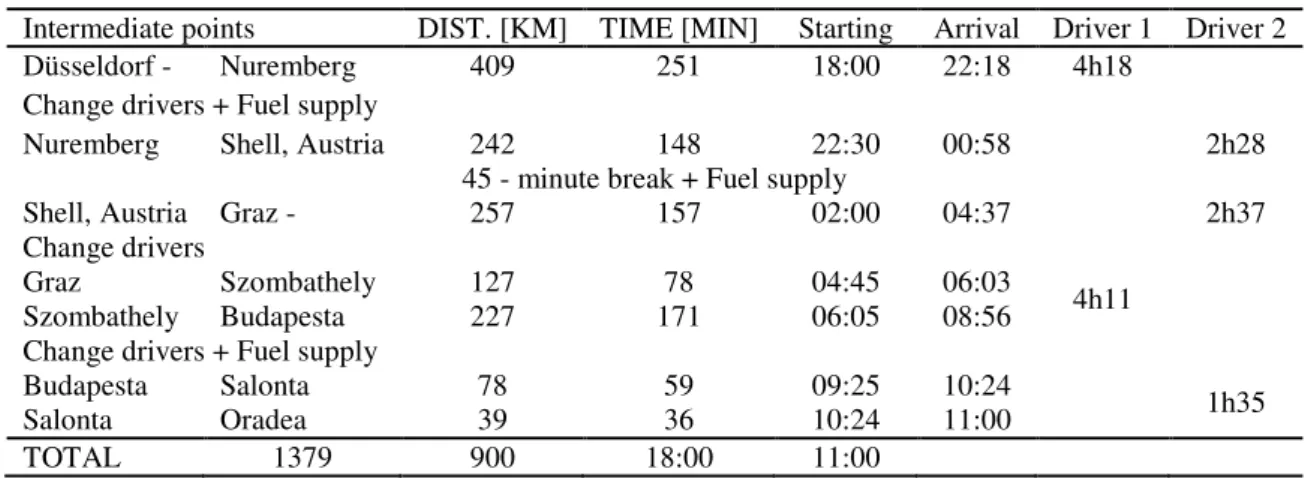
Table 4 - which is author's own contribution - shows the same information as table 3, only that here is the first part of the route, the one outside Romania territory.
Thus, adding the first part of the transport, from Düsseldorf to Salonta, shows that the total time required to carry out the transport is 27 hours and 41 minutes, cumulated with breaks.
4. CONCLUSIONS
cannot achieve the whole transport chain alone, the superiority of all other modes of transport and rapid adaptability to any field conditions, special mobility without the need for special investments for commissioning, have led to a progressive evolution of this transport system, both in terms of volume of cargo and weight, in the total volume of transport.
For military missions, current transport systems are vital, vital for any country, to carry out missions, which is why it was chosen to analyze those specific characteristics and how they influence positively or negatively, which makes it difficult or simpler to achieve of such a transport and tried to identify the importance of such transport for society.
So, in the scientific paper, it was debated the study of the quality of a transport of dangerous materials, which are part of the 1st class of hazardous material, transport carried out under military regime.
Considering that, for the most part, the military and defense elements are not easily accessible and most of the time the access is forbidden to the civilians, it was tried, within the limits of the materials available, to shape and to analyze this branch.
This paper also presents the overall situation of operations with military products and equipment, with an emphasis on actual transport.
The safety conditions for carrying out the transport are related to the normative norms in the field.
By identifying the truck's speeds for the safe transport of cargo and taking into account its nature, a gang crew with gendarmes was assured, according to the national legislation in force, Law 333 of 2003, regarding the guarding of the objects, the goods, values and people's protection.
For military missions, current transport systems are vital, vital for any country, to carry out missions.
Military transports are and will be among the most complex types of transport, both in terms of their purpose and their size and importance for national security, territorial integrity, and the sense of security of civilians and beyond.
Also on the basis of a transfer of dangerous material and good military and military deployment is the European Agreement concerning the International Carriage of Dangerous Goods by Road, (ADR), which specifies the strict conditions under which a shipment should be carried out in such a way that ensure the safety of the load, the vehicle, the environment and the crew and last but not least the other road users.
Good planning of the transport of hazardous materials must take into account, first of all, the risk to which the environment is to be subjected and, in particular, the mode of intervention in the event of an accident.
The need for legal protection of military transport systems and, at the same time, the imperative need to achieve them is obvious because the subject matter involves national security.
Consequently, concluding that the military transport is constituted by the national laws, regimes, regulations and norms, own transport systems, of particular importance at national and international level, whereby technical efficiencies are concentrated in order to protect the territorial integrity.
The limitations of the subject are due to the lack of information available to civilians on this subject.
Future objectives for further study are related to the detailed access to information (accessible to civilians) on how military transports are carried out by the different European countries.
Table 1. Traffic values by hours
Hour 5.00-7.00 7.00-11.30 11.30-18.30 18.30-21.30 21.30-23.30 23.30-5.00 Highway
[veh/h]
800 1400 1600 1200 700 200
European road [veh/h]
National road [veh/h]
500 840 1100 780 400 100
Table 2. Travel speed in Romania
No. Starting Arrival Distance [Km]
V
[km/h] Road Category
1 Salonta Oradea 39 73 European road E671
2 Oradea Deva 191 86 European road E79
3 Deva Sibiu 137 98 European road E81 Highway A1
4 Sibiu Râmnicu
Vâlcea 108
89 National road DN7
5 Râmnicu Vâlcea Pitești 61 89 National road DN7
6 Pitesti București 118 94 Highway A1
7 București KogMihail
ălniceanu 206
88
Highway A2
Total 860
Table 3. Planning of driving and rest time on the territory of Romania [13]
Starting– Arrival Average speed [Km/h] Driving time [min] Starting Time arrival Time Driver 1 Driver 2
Oradea – Deva 86 133 23:30 1:43
3h37
Deva – Sibiu 98 84 1:43 3:07
Change drivers + Fuel supply 3:07 4:00
Sibiu - Râmnicu Vâlcea 89 73 4:00 5:13
3h10
Râmnicu Vâlcea – Pitești 89 42 5:13 5:55
Pitesti – București 94 75 5:55 7:10
Change drivers + Fuel supply 7:10 8:00
București - Mihail
Kogălniceanu 88 131 8:00 10:11 2h11
Total 84 538
Table 4. Planning the driving and rest times to the border with Romania
Intermediate points DIST. [KM] TIME [MIN] Starting Arrival Driver 1 Driver 2 Düsseldorf - Nuremberg 409 251 18:00 22:18 4h18
Change drivers + Fuel supply
Nuremberg Shell, Austria 242 148 22:30 00:58 2h28
45 - minute break + Fuel supply
Shell, Austria Graz - 257 157 02:00 04:37 2h37
Change drivers
Graz Szombathely 127 78 04:45 06:03
4h11 Szombathely Budapesta 227 171 06:05 08:56
Change drivers + Fuel supply
Budapesta Salonta 78 59 09:25 10:24
1h35
Salonta Oradea 39 36 10:24 11:00
TOTAL 1379 900 18:00 11:00
Its purpose is to identify an optimal system for achieving a massive dismantling of military
Another direction on which future studies will focus is the analysis of the subject from the point of view of intellectual property.
This will identify both the categories of transport information that need to be protected and the means and rules by which protection is achieved.
5. REFERENCES
[1] Nicolescu, C., Transport and communications in the Romanian
Armed Forces (in Romanian),
(Bucharest, Romania, 1992)
[2] Posea C., Turcu, M., Assistant Professor colonel, Military transport course – (in Romanian) (Dry Troops Academy Publishing House, Sibiu,1998)
[3] Lepădatu, M., Road transport of hazardous goods ADR, course - vol. I and II, (in Romanian) (PROFESSIONAL TRAINING INSTITUTE IN ROAD TRANSPORT Publishing house, 2013)
[4] European Agreement concerning the
International Carriage of
Dangerous Goods by Road, (ADR) – Volume I / Volume II, (2017) [5] https://www.sipri.org/databases (accessed
on 24.03.2017) [6]
https://earth.google.com/web/@51. 25681954,6.82672778,56.02855986 a,20208.28706762d,35y,0h,0t,0r/da ta=ClEaTxJJCiUweDQ3YjhjOWVi NDEwN2U3NTc6MHg5ZTQ3MT VjYTc4MmE0NWRmGZMa2gBso ElAITANw0fEJBtAKg5SaGVpbm 1ldGFsbCBBRxgCIAE (accessed on 22.03.2017)
[7] Government Emergency Ordinance no. 158/1999 on the control regime for exports, imports and other operations with military products, republished in the Official Gazette of Romania, Part I, no. 601 of September 26, (2013)
[8] Crinu, I., Prevention of accidents in amunitions work (in Romanian) (MILITARY publishing house, 1977)
[9]
http://distanta.ro/dusseldorf/47.070 256,15.438572/47.249407,16.3696 29/47.498382,19.040471/46.80555 5,21.646262 (accessed on 25.03.2017)
[10].
https://www.politiadefrontiera.ro/ro /main/pg-puncte-de-trecere-a- frontierei-situate-in-judetele-arad-si-bihor-304.html - (accessed on 25.03.2017)
[11].
http://www.roman.ro/index.php?lan g=ro&showlang=&cat=PRODUSE &subcat=Autovehicule%20militare &subid=32&main=produse (accessed on 23.03.2017)
[12] Sbora, T., Tănase, G., Șerban, D.,
Transportation Organization and Planning, (in Romania) (Didactic and Pedagogical Publishing House, Bucharest)
[13] Order no. 14/1982, for the approval of the normative consumption of fuel and motor oil, published in the Official Bulletin no. 2 of January 7, (1982).
CONTRIBUŢII PENTRU ÎMBUNĂTĂŢIREA CALITĂŢII UNUI SISTEM SPECIAL DE TRANSPORT
MILITAR ÎNTRE DOUĂ STATE MEMBRE ALE UNIUNII EUROPENE
Rezumat: Acestă lucrare de cercetare original dorește să evidențieze procesul de transport militar prin abordarea
militare la nivelul Uniunii Europene. A fost identificat potențialul pericol pe care îl au activele militare asupra diferitelor elemente ale sistemului de transport rutier și răspunsul în caz de accidente, subliniind locul și rolul lor în
domeniul calității. Contribuția personalăși originală se referă, de asemenea, la îmbunătățirea calității unei situații reale
într-un astfel de transport militar special. În cazul misiunii militare, sistemele de transport sunt vitale, pentru orice țară,
de a îndeplini misiuni atât pe timp de pace, cât și în timpul unor operațiuni militare. Pe această bază a fost aleasă
analiza acelor caracteristici de calitate specifice și modul în care ele influențează pozitiv sau negativ întreaga situație,
ceea ce face mai mult sau mai puțin dificilă obținerea satisfacției pentru munca bine făcută în astfel de transporturi. O
situație reală a fost luată în calcul pentru a putea stabili metode de îmbunătățirea calității unui sistem special de
transport militar, luând în considerare toate mijloacele de management al calității în domeniul militar din Uniunea
Europeană.
Ștefan ȚÎȚU, The Oncology Institute "Prof. Dr. Ion Chiricuta" Cluj-Napoca, 34-36 Republicii Street, code 400015, Cluj-Napoca, Romania, [email protected]
Alina-Bianca POP, SC Tehnocad SA Baia Mare, 72 Vasile Alecsandri Street, code 430351, Baia Mare, Romania, [email protected]
Constantin OPREAN, Lucian Blaga University of Sibiu, 10 Victoriei Street, code 550024, Sibiu, România, [email protected]