
COVER 16/12/05 9:16 AM Page 1
C M Y CM MY CY CMY K
J u l y 2 0 0 5
G u i d e l i n e s f o r P r o f e s s i o n a l P r a c t i c e
P r o f e s s i o n a l S t a n d a r d s f o r T e a c h e r s
Queensland the Smart State
© The State of Queensland (Department of Education) 2005
Copyright protects this publication. Except for purposes permitted by the Copyright Act, reproduction by whatever means is prohibited. Education Queensland schools are permitted to make multiple copies of the material in this book without infringing copyright, provided the number of copies does not exceed the number of copies required in any one school.
Any inquiries should be addressed to the Copyright Officer, Education Queensland, PO Box 15033, City East, Brisbane 4002.
C o n t e n t s
Statement by the Director-General of Education iv
Introduction 1
Purpose of the standards 2
Teachers’ work and the standards 3
Using the standards 4
A developmental view of teaching 5
Format of the standards 7
Overview of the standards 8
The standards in detail 10
1. Structure flexible and innovative learning experiences for individuals and groups
10
2. Contribute to language, literacy and numeracy development
12
3. Construct intellectually challenging learning experiences
14
4. Construct relevant learning experiences that connect with the world beyond school
16
5. Construct inclusive and participatory learning experiences
18
6. Integrate information and communication technologies to enhance student learning
20
7. Assess and report on student learning
22
8. Support the social development and participation of young people
24
9. Create safe and supportive learning environments
26
10. Build relationships with the wider community
28
11. Contribute to professional teams
29
12. Commit to professional practice
30
Education Queensland has long acknowledged and
celebrated that the relationship between our teachers
and students and their families is the point at which
we can make a real difference to students’ learning
and social development.
As we consider the Education and Training Reforms
for the Future (ETRF), we know that ‘ ... the future
of every young Queenslander depends very much on
their ability to adapt to change, achieve high-level
qualifications and continue learning throughout their
lives’.
1As they design and manage learning experiences for
students, teachers also need to be knowledge workers
modelling the same skills they seek to develop in
students. As lifelong learners, teachers construct
and reconstruct professional knowledge, skills and
behaviours as they reflect on pedagogy and share
professional practice in a range of settings.
Education Queensland’s
Professional Standards for
Teachers
provides a strong definition of and a key
reference point for the work of teachers towards
achieving the learning and social outcomes articulated
in Queensland State Education – 2010 and the
Education and Training Reforms for the Future.
The standards, which are generic in nature, also
provide the context to recognise and celebrate the
complex and varied nature of a teacher’s work. They
provide a platform for reflection on professional
practice, along with opportunities to examine
learning culture and showcase the responsibility of
professionals prioritising and driving their individual
and collective learning in a framework aligned to key
systemic initiatives.
The standards were developed using a professional
learning approach, with the ongoing involvement
of practitioners across all sectors and other key
stakeholders including the Queensland Teachers’
Union, Board of Teacher Registration, Principals’
Associations and Deans of Education. A joint
Education Queensland–Queensland Teachers’ Union
taskforce now steers the standards program.
The Pilot in 2002 provided strong validation of
the standards as a definition of teachers’ work
and a framework for professional learning and
further recommended a shift in focus to learning in
community
2.
I would like to acknowledge and pay tribute to the
role that teachers play in leading peers,
whole-school communities and their various curriculum
and pedagogical networks and its contribution to the
effectiveness of our schools. When a school workforce
operates as a community of learners, it makes
decisions and solves problems related to teaching
and student learning. This ongoing learning process
enables the reflection necessary to strengthen personal
and team professional practice and the overall quality
of education.
I commend the
Professional Standards for Teachers
for use as a framework to review teaching practice,
to formulate goals to strengthen teaching practice, to
establish personal and team professional learning and
development plans, and to monitor the achievement of
professional development goals.
I refer teachers to the first Joint Statement on Teacher
Professionalism issued by Education Queensland and
the Queensland Teachers’ Union. I encourage teachers
in teams, school communities and networks to adopt
this resource as a platform to take responsibility for
their continued learning and growth as professionals.
KEN SMITH
Director-General of Education
S t a t e m e n t b y t h e D i r e c t o r - G e n e r a l o f E d u c a t i o n
1 The State of Queensland, Education and Training Reforms for the Future – A White Paper, 2003
2 Mayer, Mitchell, Macdonald, Land & Luke, From personal reflection to professional community: Education Queensland Professional Standards for Teachers Evaluation of the 2002 Pilot, State of Queensland (Department of Education), 2003
Education Queensland is committed to providing a
quality system of public education that prepares young
people for entering, and participating in, Australian
society. This objective is becoming increasingly
complex as social, economic and technological
changes are transforming the knowledge base of our
society, the structure of the family, the role of social
institutions, the nature of community relations, and
the world of work.
Students’ school experiences must help them develop
the attitudes and abilities required for functioning
effectively in this new environment. Students should
emerge from schooling with optimistic visions of
the future, capabilities to adapt to rapid social and
economic change, a commitment to lifelong learning,
and skills and knowledge that enable them to
participate in social and community decision-making.
These requirements acknowledge the pivotal role that
teachers and others involved in public education play
in embracing:
• new content and models of curriculum organisation
• student-centred approaches to learning, teaching
and assessment specific to the Early, Middle and
Senior phases of learning
• learning partnerships that link the school, the
community and the workplace
• technology-based approaches to learning that
emphasise self-directed and independent learning.
The move towards a knowledge society is transforming
the work of teachers. Increasingly, their work focuses
on structuring learning experiences that promote
outcomes specified in system-wide curriculum
frameworks. Teachers are, therefore, responsible for
designing and implementing learning experiences that
not only achieve common curriculum outcomes but
also cater for the learning needs, styles and preferences
of their students. This involves teachers working in
team situations with other teachers, paraprofessionals
and community members. It also involves teachers
in organising learning in a variety of individual and
group situations, in settings both within and outside
the school and in online and virtual environments.
Education Queensland supports teachers in
transforming their roles to meet these needs through:
• introducing new curriculum frameworks that
coordinate curriculum, pedagogy and assessment
• establishing professional standards for teachers
• renewing its commitment to teacher learning and
development.
Major stakeholders and practitioners from all sectors of
schooling have contributed to the development of the
Professional Standards for Teachers
through steering
committee and reference group structures as well as
extensive consultation with teachers at key junctures.
A joint Education Queensland–Queensland Teachers’
Union taskforce now sets directions for the standards
program as well as exploring and testing further
applications for its use. The taskforce is supported by
a Reference Group of practising teachers charged with
the responsibility of analysing and recommending
revisions to keep the point-in-time definition of
teachers’ work through the standards accurate,
relevant and contemporary.
The standards have been developed using a deliberate
professional learning and development perspective, not
as part of the performance management arrangements
of Education Queensland. They do, however, provide an
appropriate framework for collaborative performance
development with colleagues and a key reference point
for the induction and mentoring of teachers.
The Professional Standards for Teachers are generic
in nature, defining knowledge, skills and abilities to
apply to all teachers (across all sectors, developmental
levels and sites) in state education in Queensland. The
standards celebrate, articulate and support the complex
and varied nature of a teacher’s work. They describe
what teachers need to know and do to provide relevant
and worthwhile learning experiences for individuals
and groups of students in Queensland state schools,
and so ‘equip young people for the future to enable
them to contribute to a socially, economically and
culturally vibrant society.’
3As such, the standards:
• provide a platform for teachers to identify their
professional development needs and drive their
continuing learning and development
• inform program development for pre-service
education
• represent the aspirations of the teaching profession.
Teachers employed by Education Queensland use
the standards to devise and implement learning and
development plans. In doing so, it is envisaged that
they will ‘dip in and out of’ individual standards
and combinations of standards as they consider
their strengths and areas for further learning and
development. Learning in one area may lead to the
identification of a learning need in another area. So
teachers, either individually or in collaboration with
colleagues and mentors, will use selected standards for
reflection when:
• reviewing student learning and teaching practice
• formulating goals to strengthen teaching practice
• establishing personal learning and development
plans
• monitoring their achievement of personal learning
and development goals.
Education Queensland is committed to making the
standards as valuable and useful as possible for
teachers. In working with the standards, teachers
are encouraged to collectively examine the culture
active in their profession, system and work sites.
The standards may support and empower teachers to
identify and exert influence within their profession,
system and schools by pursuing personal and team
professional learning and strengthened practice.
Increasingly, the standards are being acknowledged
as an ‘umbrella’ that encompasses all aspects of
teachers’ work. This means that no matter what the
policy, curriculum or initiative, the standards support
reflection and development for individuals and teams
of teachers.
As well, new applications of the standards are
considered and trialled as the framework is embedded
in systemic processes.
The standards will also serve as an important guide for
those seeking to enter the teaching service. Providers
of pre-service teacher education are therefore
encouraged to establish programs that enable their
graduates to demonstrate the skills and professional
capabilities outlined in the standards.
P u r p o s e o f t h e s t a n d a r d s
3 The State of Queensland (Department of Education and the Arts),
As the following diagram shows, the
Professional
Standards for Teachers
consist of twelve interrelated
standards.
Taken together, these standards represent the skills
and knowledge teachers need to create relevant and
worthwhile learning experiences for individuals and
groups of students. When referring to the standards,
teachers will of course need to take account of their
professional circumstances including the context,
resources, structures and processes of the school or
centre where they are working.
Teachers will recognise that there are some overlaps
between the standards. This reflects the interrelated
nature of the standards and the complexity of teachers’
work. For example, drawing on and valuing students’
knowledge, experience and preferred learning styles
are integral aspects of each of the standards.
Applying the standards will enable teachers to
structure flexible and innovative learning experiences
that:
• foster language, literacy and numeracy
development
Te a c h e r s ’ w o r k a n d t h e s t a n d a r d s
• are intellectually challenging
• connect with the world beyond the school
• are inclusive, participatory and socially critical
• incorporate the use of information and
communication technologies
• are underpinned by valid and reliable assessment
processes.
It is envisaged that these learning experiences will
be designed within curriculum frameworks and be
provided by teachers who have the skills, knowledge
and commitment to:
• support the social development and participation of
young people
• create safe and secure learning environments
• build relationships with families, community and
business
• contribute to professional work teams
• engage in professional practice.
Support the social development and participation of young people. Contribute to professional teams.
Create safe and supportive
learning environments.
Build relationships with the wider
community. Construct intellectually challenging learning experiences. Construct relevant learning experiences that connect with the world beyond school. Contribute to language, literacy and numeracy development. Construct inclusive and participatory learning experiences. Assess and
report on student learning. Integrate information and communication technologies to enhance student learning. Commit to professional practice. Structure flexible and innovative learning experiences for individuals and
The Professional Standards for Teachers
provide a
platform for teachers to reflect on their professional
practice. The standards are intended to help teachers to
recognise their professional strengths, identify learning
and development goals and devise plans to meet those
goals. In establishing such plans teachers, individually
or in teams, reflect on an entire standard, a component
of a standard or a group of standards depending on
their needs and the priorities they are pursuing at
their sites. They may also decide to revisit individual
standards as their professional circumstances change.
In examining their practice relative to selected
standards, individual teachers follow a process of
reflecting on their current practice, comparing current
practice with the descriptor and considering questions
such as:
• In what context do I apply these standards?
• How do I function in professional teams on matters
related to the standards?
• Do I understand the knowledge and skills
underpinning the standards?
• What do I contribute to learning and development
related to these standards?
• How do I know that I apply the standards in this
manner?
• Which aspects of my professional practice require
further development?
• What actions can I take to improve these aspects of
my professional practice?
• How will I know that I have strengthened my
practice?
For example, teachers wishing to review their use of
information technology may refer to the standard on
this topic
(Integrate information and communication
technologies to enhance student learning)
. This may
lead them to ask questions such as:
• How do I determine student learning needs
in relation to the use of information and
communication technologies?
• Do I select or adapt information technology
resources to meet the learning needs and styles of
individual students?
• How can the learning experiences I design make
better use of information technology resources?
• What criteria do I use to evaluate information
technology resources?
• How could I use information technology tools
to manage the information I collect on student
learning?
• How can I further develop my practice in the
integration of information and communication
technologies?
• How do I know that the action I am taking
in relation to the use of information and
communication technologies is strengthening my
practice?
Reflecting on these questions helps teachers to identify
areas for professional growth. For example, they may
decide to obtain advice on how to select or adapt
technology-based resources to suit students’ learning
needs. Having identified the issue, they then formulate
a plan for strengthening this aspect of their practice.
This could involve:
• consulting a colleague
• observing another teacher’s practice
• professional reading
• attending a training program.
As teachers use the standards to review aspects of their
professional practice, they may choose from a range
of strategies to monitor and document their progress
against the standards and their learning plans — for
example:
• reflective journals
• learning and development plans annotated with
ongoing reflective comments
• working with a critical friend or mentor
• reflecting, planning and taking action
collaboratively in a range of team situations, such
as a group of teachers who are team teaching,
those teaching in the same year level or department
or with colleagues who have identified common
learning needs.
Individual teachers or groups of teachers will examine
aspects of their practice for a variety of reasons.
For example, they may be motivated by a desire for
affirmation, by a problem requiring a new solution or
by a wish to explore shared beliefs about teaching and
learning.
The standards assume that teachers develop their
knowledge, skills and teaching practices throughout
their professional careers. By working with students
and their families, collaborating with colleagues,
reflecting on their practice and participating in
learning and development activities, teachers develop
and extend their skills and capacities.
In this context, teacher development is not necessarily
viewed as a linear process. It is recognised that
teachers enter the profession with varying levels of
prior learning, work experience and professional
preparation, and that they work in different contexts
and have varying access to professional learning and
development. A teacher’s personal and professional
circumstances may also lead them to identify new
learning needs. As a consequence, individual teachers
acquire and apply the skills and capacities identified in
the standards in different ways, in different contexts
and with varying levels of sophistication.
For example, a teacher may be able to demonstrate
elements of standard 11,
Contribute to professional
teams
, by contributing to a range of school-based
teams. After working in a range of team situations
and participating in learning and development, the
same teacher may also be able to apply the skills and
capacities identified in the standard through mentoring
team members or leading school-based teams.
Scope of professional practice
As indicated in the preceding example, individual
teachers apply the standards within a particular scope
of professional practice. This may be influenced by a
range of factors including the context in which they
are working, their personal experience and expertise,
and their access to learning and development. As
teachers develop their knowledge and skills they are
able to extend the scope of their professional practice.
In the context of the standards, teachers may identify
the scope of their professional practice by reflecting
on:
•
the context in which they apply the standards
. For
example, are the standards applied in the context
of a designated learning group, a year level or a
whole-school approach?
•
their involvement in professional teams on matters
related to the standards
. For example, is the teacher
actively involved in professional teams, providing
mentor support for others or leading teams on
matters related to the standards?
•
their involvement in planning, organising,
implementing and evaluating learning experiences.
For example, is the teacher involved in initiating
and constructing learning experiences for use
within his or her own learning group, within key
areas at the school or beyond the school?
•
their understanding of the knowledge and skills
underpinning professional practice
. For example,
does the teacher have a breadth and depth of the
knowledge and skills that underpin professional
practice?
•
their involvement in learning and development
. For
example, does the teacher reflect on his or her own
learning and development needs or the needs of
colleagues both within and beyond the school?
It is envisaged that teachers will be able to use these
criteria to determine the scope of professional practice
in which they apply the standards. Through reflecting
on their application of the standards, teachers will be
able to identify their strengths as well as the areas in
which they can enhance their professional practice.
It is acknowledged that teachers will not necessarily
apply all of the standards within the same scope of
professional practice. For example, a teacher with
particular experience and expertise in language
and literacy development may apply the skills
and capacities associated with standard 2 within a
broader scope of professional practice than, say, the
skills and capacities of standard 6, which deals with
the application of information and communication
technologies in teaching and learning. Such
differences in the application of the standards are
not simply attributable to the length of time that an
individual has been teaching but rather reflect that
person’s range of teaching experience, learning and
development, and willingness to engage in critical
self-reflection.
As teachers’ personal and professional circumstances
change, they apply the standards within a broader or
narrower scope of professional practice. For example,
a teacher moving from a small regional school to a
larger metropolitan school may find that the context
within which he or she applies the standards shifts in
focus from the whole school to a year level or class.
Similarly, a teacher who takes on a particular task
within the school (for example, mentoring others
in a particular aspect) may find that he or she has
opportunities to apply some or all of the standards
within a broader scope of professional practice. The
critical factor to note here is that teachers who achieve
the standards are effectively performing their diverse
and complex roles. It is also important to acknowledge
that the scope of professional practice within which
these standards are applied for an individual teacher
may vary over a teacher’s career.
Teacher as leader
As well as considering the detailed description
articulated through the indicators for the standards,
teachers are encouraged to reflect on the scope of
professional practice within which they apply each of
the standards. This will help them identify their skill
development needs and plan appropriate learning and
development.
For example, in reviewing classroom management
practices, a teacher may consult standard 9,
Create
safe and supportive learning environments
. Reflection
might indicate that the teacher competently applies
the standard in the context of his or her own class,
contributes to professional teams on matters associated
with classroom management and has a grasp of the
critical concepts and understandings that underpin
effective classroom management.
Having reflected on this aspect of professional
practice, the teacher may decide to establish a personal
professional learning and development plan that will
provide the skills needed to apply the standard in a
more complex manner. This may involve undertaking
professional reading to improve understanding of
the principles of effective classroom management or
acquiring mentoring skills to assist colleagues with
classroom management issues. These actions may
assist the teacher to extend the scope of his or her
professional practice and represent an example of peer
leadership.
Through such applications of specialised mastery,
teachers lead their peers and contribute to shared
practice and collective actions within and across their
school and professional communities. Harnessed with
a shared purpose aligned to site and systemic priorities
and supported by mutual respect, teacher leadership
combines with and complements principal leadership
to create opportunities to maximise outcomes for
students.
7
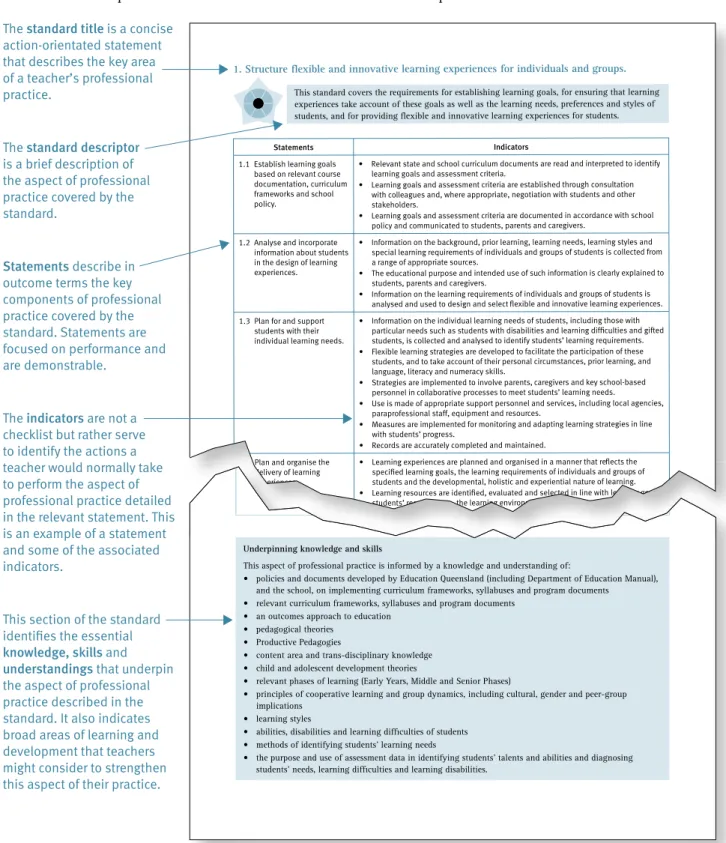
The standards are presented in a common format. Each standard comprises the elements shown below.
F o r m a t o f t h e s t a n d a r d s
The standard title is a concise action-orientated statement that describes the key area of a teacher’s professional practice.
The standard descriptor
is a brief description of the aspect of professional practice covered by the standard.
Statements describe in outcome terms the key components of professional practice covered by the standard. Statements are focused on performance and are demonstrable.
The indicators are not a checklist but rather serve to identify the actions a teacher would normally take to perform the aspect of professional practice detailed in the relevant statement. This is an example of a statement and some of the associated indicators.
This section of the standard identifi es the essential
knowledge, skills and
understandings that underpin the aspect of professional practice described in the standard. It also indicates broad areas of learning and development that teachers might consider to strengthen this aspect of their practice.
Diagram to go here
Statements Indicators
• Relevant paraprofessional staff and other contributors to student learning are involved in planning and implementing learning experiences.
• Relevant support and direction are provided based on students’ confi dence and familiarity with ideas, concepts and problems being investigated. • Relevant documentation is accurately completed and maintained. 1.5 Review and evaluate
learning experiences.
• Valid, reliable and relevant information on student progress is obtained from a range of sources and used in evaluating learning experiences.
• Feedback from students, parents, paraprofessionals and other contributors is used in evaluating learning experiences.
• Evaluation data are analysed and used to inform the review and adaptation of teaching and learning strategies, assessment practices and learning resources. • Information and insights gained through the evaluation of learning experiences are
documented and shared with colleagues and other relevant personnel.
Underpinning knowledge and skills
This aspect of professional practice is informed by a knowledge and understanding of:
• policies and documents developed by Education Queensland (including Department of Education Manual), and the school, on implementing curriculum frameworks, syllabuses and program documents • relevant curriculum frameworks, syllabuses and program documents
• an outcomes approach to education • pedagogical theories
• Productive Pedagogies
• content area and trans-disciplinary knowledge • child and adolescent development theories
• relevant phases of learning (Early Years, Middle and Senior Phases)
• principles of cooperative learning and group dynamics, including cultural, gender and peer-group implications
• learning styles
• abilities, disabilities and learning diffi culties of students • methods of identifying students’ learning needs
• the purpose and use of assessment data in identifying students’ talents and abilities and diagnosing students’ needs, learning diffi culties and learning disabilities.
Diagram to go here
10
Statements Indicators
1.1 Establish learning goals based on relevant course documentation, curriculum frameworks and school policy.
• Relevant state and school curriculum documents are read and interpreted to identify learning goals and assessment criteria.
• Learning goals and assessment criteria are established through consultation with colleagues and, where appropriate, negotiation with students and other stakeholders.
• Learning goals and assessment criteria are documented in accordance with school policy and communicated to students, parents and caregivers.
1.2 Analyse and incorporate information about students in the design of learning experiences.
• Information on the background, prior learning, learning needs, learning styles and special learning requirements of individuals and groups of students is collected from a range of appropriate sources.
• The educational purpose and intended use of such information is clearly explained to students, parents and caregivers.
• Information on the learning requirements of individuals and groups of students is analysed and used to design and select fl exible and innovative learning experiences. 1.3 Plan for and support
students with their individual learning needs.
• Information on the individual learning needs of students, including those with particular needs such as students with disabilities and learning diffi culties and gifted students, is collected and analysed to identify students’ learning requirements. • Flexible learning strategies are developed to facilitate the participation of these students, and to take account of their personal circumstances, prior learning, and language, literacy and numeracy skills.
• Strategies are implemented to involve parents, caregivers and key school-based personnel in collaborative processes to meet students’ learning needs. • Use is made of appropriate support personnel and services, including local agencies,
paraprofessional staff, equipment and resources.
• Measures are implemented for monitoring and adapting learning strategies in line with students’ progress.
• Records are accurately completed and maintained. 1.4 Plan and organise the
delivery of learning experiences.
• Learning experiences are planned and organised in a manner that refl ects the specifi ed learning goals, the learning requirements of individuals and groups of students and the developmental, holistic and experiential nature of learning. • Learning resources are identifi ed, evaluated and selected in line with learning goals,
students’ requirements, the learning environment, available expertise and support and constraints such as budget and time.
• Learning experiences incorporate a variety of individual and group learning, teaching and assessment strategies designed to engage students in self-initiated, independent and collaborative learning.
• Learning experiences are implemented in accordance with Education Queensland’s and the school’s policies and procedures and take into account teachers’ legal responsibilities and duty of care obligations.
• A range of individual and group management strategies is implemented to achieve learning goals, to ensure all students actively participate in learning experiences, and to manage inappropriate behaviour.
1. Structure fl exible and innovative learning experiences for individuals and groups. This standard covers the requirements for establishing learning goals, for ensuring that learning experiences take account of these goals as well as the learning needs, preferences and styles of students, and for providing fl exible and innovative learning experiences for students. T h e s t a n d a r d s i n d e t a i l
1. Structure flexible and innovative learning experiences for individuals and groups.
1.1 Establish learning goals based on relevant course documentation, curriculum frameworks and school policy. 1.2 Analyse and incorporate information about students in the design of learning experiences.
1.3 Plan for and support students with their individual learning needs. 1.4 Plan and organise the delivery of learning experiences.
1.5 Review and evaluate learning experiences.
2. Contribute to language, literacy and numeracy development.
2.1 Determine students’ learning needs in language, literacy and numeracy development to inform the planning and implementation of learning experiences.
2.2 Integrate language and literacy development across all curriculum areas. 2.3 Integrate numeracy development across all curriculum areas.
2.4 Monitor and evaluate students’ language, literacy and numeracy development.
3. Construct intellectually challenging learning experiences.
3.1 Provide learning experiences in which students examine the central ideas of a topic, problem or issue. 3.2 Provide learning experiences in which students question and share ideas and knowledge.
3.3 Provide learning experiences in which students use higher-order and critical-thinking skills to solve problems and construct new meanings and understandings.
4. Construct relevant learning experiences that connect with the world beyond school.
4.1 Devise learning goals and learning experiences that build on students’ prior knowledge, life experiences, and interests.
4.2 Engage students in learning experiences that integrate ideas, concepts and information across curriculum areas. 4.3 Provide learning experiences that establish connections with the world beyond the classroom.
4.4 Develop learning experiences that involve students in examining study, work and leisure in the future. 4.5 Design learning experiences that foster personal initiative and enterprise.
5. Construct inclusive and participatory learning experiences.
5.1 Design and implement learning experiences that acknowledge, and cater for, individual learning differences. 5.2 Design and implement learning experiences that are inclusive and that recognise and celebrate difference. 5.3 Design and implement learning experiences in which students participate in decision making and active
citizenship.
6. Integrate information and communication technologies to enhance student learning.
6.1 Determine students’ learning needs in relation to the use of available information and communication technologies.
6.2 Select learning strategies and resources based on the use of information and communication technologies to cater for students’ learning needs and styles.
6.3 Create learning experiences in which students actively use information and communication technologies to organise, research, interpret, analyse, communicate and represent knowledge.
6.4 Evaluate the effectiveness of teaching and learning approaches based on the use of information and communication technologies.
6.5 Use information and communication technologies to access and manage information on student learning.
7. Assess and report on student learning.
7.1 Establish and communicate learning goals and assessment criteria. 7.2 Plan for assessing student learning.
7.3 Collect and use multiple sources of valid evidence to make judgments about student learning. 7.4 Communicate with students, families, caregivers and other authorities about student progress. 7.5 Use assessment results to guide program planning, delivery and assessment.
8. Support the social development and participation of young people.
8.1 Actively support students in developing personal identity, self-esteem and a positive self-image. 8.2 Assist students to develop sound relations and empathy with others.
8.3 Construct learning experiences in which students assess and plan their personal futures. 8.4 Support students by providing appropriate pastoral care* across a range of activities.
9. Create safe and supportive learning environments.
9.1 Create safe learning environments that are based on mutual trust and respect and that provide social support for student achievement.
9.2 Provide learning environments in which students have responsibility for their own learning.
9.3 Implement student management strategies that enable students to learn to take responsibility for their own behaviour.
10. Build relationships with the wider community.
10.1 Establish and maintain relationships with families, caregivers, business, industry, and community agencies. 10.2 Establish learning environments that acknowledge the concerns, values and priorities of students’ families,
cultures and communities.
10.3 Promote the school and public education in the community.
11. Contribute to professional teams.
11.1 Establish and effectively implement procedures to meet personal work-related goals and priorities. 11.2 Contribute to the effective functioning of professional teams.
11.3 Work with professionals, paraprofessionals, teacher aides and other community-based personnel.
12. Commit to professional practice.
12.1 Reflect critically on professional practice.
12.2 Contribute to learning communities and other professional networks. 12.3 Participate in school governance.
12.4 Meet ethical, accountability and professional requirements.
Statements Indicators 1.1 Establish learning goals
based on relevant course documentation, curriculum frameworks and school policy.
• Relevant state and school curriculum documents are read and interpreted to identify learning goals and assessment criteria.
• Learning goals and assessment criteria are established through consultation with colleagues and, where appropriate, negotiation with students and other stakeholders.
• Learning goals and assessment criteria are documented in accordance with school policy and communicated to students, parents and caregivers.
1.2 Analyse and incorporate information about students in the design of learning experiences.
• Information on the background, prior learning, learning needs, learning styles and special learning requirements of individuals and groups of students is collected from a range of appropriate sources.
• The educational purpose and intended use of such information is clearly explained to students, parents and caregivers.
• Information on the learning requirements of individuals and groups of students is analysed and used to design and select flexible and innovative learning experiences. 1.3 Plan for and support
students with their individual learning needs.
• Information on the individual learning needs of students, including those with particular needs such as students with disabilities and learning difficulties and gifted students, is collected and analysed to identify students’ learning requirements. • Flexible learning strategies are developed to facilitate the participation of these students, and to take account of their personal circumstances, prior learning, and language, literacy and numeracy skills.
• Strategies are implemented to involve parents, caregivers and key school-based personnel in collaborative processes to meet students’ learning needs.
• Use is made of appropriate support personnel and services, including local agencies, paraprofessional staff, equipment and resources.
• Measures are implemented for monitoring and adapting learning strategies in line with students’ progress.
• Records are accurately completed and maintained. 1.4 Plan and organise the
delivery of learning experiences.
• Learning experiences are planned and organised in a manner that reflects the specified learning goals, the learning requirements of individuals and groups of students and the developmental, holistic and experiential nature of learning. • Learning resources are identified, evaluated and selected in line with learning goals,
students’ requirements, the learning environment, available expertise and support and constraints such as budget and time.
• Learning experiences incorporate a variety of individual and group learning, teaching and assessment strategies designed to engage students in self-initiated, independent and collaborative learning.
• Learning experiences are implemented in accordance with Education Queensland’s and the school’s policies and procedures and take into account teachers’ legal responsibilities and duty of care obligations.
• A range of individual and group management strategies is implemented to achieve learning goals, to ensure all students actively participate in learning experiences, and to manage inappropriate behaviour.
1. Structure flexible and innovative learning experiences for individuals and groups.
This standard covers the requirements for establishing learning goals, for ensuring that learning
experiences take account of these goals as well as the learning needs, preferences and styles of
students, and for providing flexible and innovative learning experiences for students.
Statements Indicators
• Relevant paraprofessional staff and other contributors to student learning are involved in planning and implementing learning experiences.
• Relevant support and direction are provided based on students’ confidence and familiarity with ideas, concepts and problems being investigated.
• Relevant documentation is accurately completed and maintained. 1.5 Review and evaluate
learning experiences.
• Valid, reliable and relevant information on student progress is obtained from a range of sources and used in evaluating learning experiences.
• Feedback from students, parents, paraprofessionals and other contributors is used in evaluating learning experiences.
• Evaluation data are analysed and used to inform the review and adaptation of teaching and learning strategies, assessment practices and learning resources. • Information and insights gained through the evaluation of learning experiences are
documented and shared with colleagues and other relevant personnel.
Underpinning knowledge and skills
This aspect of professional practice is informed by a knowledge and understanding of:
• policies and documents developed by Education Queensland (including Department of Education Manual),
and the school, on implementing curriculum frameworks, syllabuses and program documents
• relevant curriculum frameworks, syllabuses and program documents
• an outcomes approach to education
• pedagogical theories
• Productive Pedagogies
• content area and trans-disciplinary knowledge
• child and adolescent development theories
• relevant phases of learning (Early Years, Middle and Senior Phases)
• principles of cooperative learning and group dynamics, including cultural, gender and peer-group
implications
• learning styles
• abilities, disabilities and learning difficulties of students
• methods of identifying students’ learning needs
• the purpose and use of assessment data in identifying students’ talents and abilities and diagnosing
students’ needs, learning difficulties and learning disabilities.
2. Contribute to language, literacy and numeracy development.
This standard covers the requirements for facilitating, monitoring and assessing the
development of students’ language, literacy and numeracy skills through the use of a broad
range of teaching and learning activities and across all curriculum areas.
Statements Indicators
2.1 Determine students’ learning needs in language, literacy and numeracy development to inform the planning and implementation of learning experiences.
• Students’ background, characteristics and learning needs are considered in selecting strategies for assessing language, literacy and numeracy requirements. • Strategies for assessing students’ language, literacy and numeracy requirements
incorporate clear assessment criteria and are non-discriminatory in terms of gender, culture, language background, disability and socioeconomic circumstances.
• The outcomes of assessment processes are documented and explained to parents, caregivers, relevant colleagues and specialist personnel.
• Learning plans are developed for students at risk of not achieving the required progress in language, literacy and numeracy development.
2.2 Integrate language and literacy development across all curriculum areas.
• Learning goals and plans articulate the language and literacy skills required in the relevant curriculum area.
• Language and literacy knowledge and skills required in the relevant curriculum area are identified and discussed with students.
• Teaching and learning strategies and resources are selected that build on and consolidate students’ prior knowledge and experiences, and support the delivery of learning in the relevant curriculum area as well as students’ language and literacy development.
• Teaching and learning strategies and resources are selected that reflect an understanding of:
– the developmental stages of reading, writing and oracy
– the role of language and literacy in students’ educational and social development
– the ways in which different means of communication influence language choice and literacy practices.
• Learning experiences include explicit teaching of the language and literacy skills necessary for achieving identified learning outcomes.
• Students’ language use is connected to literacy and subject area knowledge through a range of speaking, listening, viewing, reading and writing activities. • Learning experiences are planned and implemented that engage students in
developing knowledge and skills in language and literacy for a range of meaningful purposes and use in a variety of contexts.
• Learning experiences examine how language is used to construct knowledge in the curriculum area through the use of strategies such as modelling, discussions and guided practice.
• Learning experiences explicitly take account of the language demands of texts in the relevant curriculum area through the joint construction of written, spoken and visual texts.
• Learning experiences foster and promote students’ first and second languages and reflect an awareness of how different cultural knowledge and values influence language use and related literacy practices.
2.3 Integrate numeracy development across all curriculum areas.
• Learning goals and plans articulate the numeracy skills required in the relevant curriculum area.
• Numeracy knowledge and skills required in the relevant curriculum area are identified and discussed with students.
• Teaching and learning strategies and resources are selected that support the delivery of learning in the relevant curriculum area as well as numeracy development.
Statements Indicators
• Teaching and learning strategies and resources are selected that reflect an understanding of:
– the development of mathematical language and symbols;
– the role of numeracy in students’ educational and social development; – the range of learning contexts for the development of numeracy. • Learning strategies build on and consolidate students’ prior knowledge and
experiences and explicitly link the development of numeracy skills across curriculum areas.
• Learning experiences provide students with opportunities to develop numeracy in relevant curriculum areas through a range of activities and in different contexts. 2.4 Monitor and evaluate
students’ language, literacy and numeracy development.
• Strategies, including self-assessment, peer assessment and teacher assessment, are implemented to regularly monitor the development of students’ language, literacy and numeracy skills.
• Information on students’ language, literacy and numeracy development is analysed and incorporated in the review of teaching, learning and assessment strategies and resources.
Underpinning knowledge and skills
This aspect of professional practice is informed by a knowledge and understanding of:
• policies and documents developed by Education Queensland (including Department of Education Manual),
and the school, on literacy and numeracy
• relevant curriculum frameworks, syllabuses and program documents
• an outcomes approach to education
• the English language and the way in which it functions, in particular a detailed knowledge of the way
language is used in particular contexts
• pedagogy and practices that support effective language, literacy and numeracy learning
• effects of pedagogical choices on particular children and in particular community groups
• language, literacy and numeracy demands of the curriculum areas
• the range of literacy strategies that can be used for different purposes in a range of contexts
• the range of numeracy strategies that can be used to understand and apply numerical concepts
• factors that can cause reading, writing and numerical concepts to be difficult for some students
• methods of identifying students’ language, literacy and numeracy needs
• multiliteracies and forms of language
• language, literacy and numeracy development — theories, developmental stages including Early Years,
Middle and Senior Phases, intervention strategies and integration across curriculum areas
• the learning needs of students for whom English is a second language
• support services and learning resources provided by professionals and paraprofessionals
• learning experiences that make explicit the way language constructs the knowledge of curriculum areas
• programs and units of work that teach students the language, literacy and numeracy knowledge and skills
needed to achieve learning outcomes across curriculum areas
• teaching and learning strategies that help students to develop knowledge of and control over literacy and
numeracy skills
• content area and trans-disciplinary knowledge
3. Construct intellectually challenging learning experiences.
This standard covers the requirements for planning and implementing intellectually challenging
learning experiences. This involves constructing experiences in which students examine the
key ideas underpinning major issues and problems, formulate and justify opinions and apply
higher-order thinking skills to analyse issues, develop understandings and solve problems.
Statements Indicators
3.1 Provide learning experiences in which students examine the central ideas of a topic, problem or issue.
• Topics, problems and issues that are relevant to students and provide opportunities for examining significant ideas and concepts are selected for investigation.
• Teaching and learning strategies are planned and implemented that help students identify, refine and extend their understandings and examine the relationships between the key ideas and concepts underpinning the selected topic, problem or issue.
• Opportunities are created for students to reflect on the learning experience and apply their understandings to new topics, problems and issues.
3.2 Provide learning experiences in which students question and share ideas and knowledge.
• Topics, problems and issues that are relevant to students and stimulate student discussion are selected for investigation.
• Teaching and learning strategies that involve students in examining the construction of ideas, concepts and theories are planned and implemented. • A learning environment is established in which ideas and opinions are valued,
and students are encouraged to express ideas, ask questions and exchange and challenge points of view.
• Opportunities are created for students to examine and discuss alternative
viewpoints and perspectives, form ideas and justify opinions, and present these to different audiences using a range of formal and informal means of communication. • Teaching strategies are planned and implemented that involve students in logical
disputation and in exploring new ideas and examining different perspectives, interpretations and meanings.
• Opportunities are provided for students to reflect on the outcomes of discussions, develop their own ideas, viewpoints and meanings and apply these to new situations.
3.3 Provide learning experiences in which students use higher-order and critical-thinking skills to solve problems and construct new meanings and understandings.
• Issues, topics or problems that are relevant to students and provide opportunities for the use of higher-order thinking skills, intellectual risk taking, and problem- solving are selected for investigation.
• Learning experiences are conducted in a supportive learning environment in which students’ ideas, beliefs and opinions are valued and shared.
• Teaching and learning strategies are planned and implemented that focus on identifying, refining and extending students’ understandings of the key ideas or concepts underpinning the selected issue, problem or topic.
• Individual and small-group activities are planned and implemented that enable students to identify problems, collect and exchange information, manipulate data and objects, test ideas and opinions, form and justify conclusions, make predictions and solve problems.
• Learning experiences are underpinned by a model of student inquiry that involves establishing what is known, refining and extending student knowledge and reflecting on the learning process.
• Support and direction are provided in proportion to students’ confidence and familiarity with ideas, concepts and problems being investigated.
• Opportunities are provided for students to reflect on learning experiences, examine the reasoning behind their conclusions and opinions, share their understandings and apply their learnings to new problems and situations.
Underpinning knowledge and skills
This aspect of professional practice is informed by a knowledge and understanding of:
• policies and documents developed by Education Queensland (including Department of Education Manual),
and the school, on the education of gifted and talented students and the implementation of curriculum
frameworks, syllabuses and program documents
• relevant curriculum frameworks, syllabuses and program documents
• an outcomes approach to education
• principles of effective learning and teaching
• principles of inclusive curriculum
• Productive Pedagogies
• child and adolescent development theories relevant to appropriate phase of learning (Early Years, Middle
and Senior Phases)
• group dynamics
• facilitation skills
• learning styles
• disabilities
• conflict resolution
• methods of identifying students’ learning needs
• values analysis and clarification
• the purpose and use of assessment data in identifying students’ talents and abilities and diagnosing their
particular needs, learning difficulties and learning disabilities
• construction and deconstruction of knowledge
• the impact of political, social and cultural influences on construction of knowledge
• a range of thinking skills — for example, Multiple Intelligences, Bloom’s Taxonomy and Edward de Bono’s
CoRT and Six Hats
• metacognitive processes
• processes for transferring knowledge
• content area and trans-disciplinary knowledge
• the unique nature of relevant disciplines/key learning areas
• a range of research skills
• reflective processes
• teaching and learning strategies
• the design, planning, implementation, documentation and review of learning experiences
• the selection and use of appropriate resources.
4. Construct relevant learning experiences that connect with the world beyond school.
This standard covers the requirements for planning and implementing learning experiences that
build on students’ prior knowledge, life experiences, and interests; establish linkages between
key curriculum areas; and make connections between school programs and the world beyond
the school.
Statements Indicators
4.1 Devise learning goals and learning experiences that build on students’ prior knowledge, life experiences, and interests.
• Accurate and relevant information on students’ prior knowledge, life experiences, and interests is obtained from a variety of appropriate sources.
• Information on students’ prior knowledge, life experiences, and interests is analysed and used to set learning goals, design learning experiences and select teaching and learning strategies and resources.
4.2 Engage students in learning experiences that integrate ideas, concepts and information across curriculum areas.
• Learning experiences are focused on the examination of significant ideas and concepts that have the potential to develop student’s understandings of themselves and their world.
• Learning experiences are planned and implemented in a way that integrates different disciplinary perspectives on key ideas, concepts and information. • Learning experiences are planned and implemented that involve students in
examining an idea or concept, refining and extending their understandings and reflecting on what they have learned.
• Learning experiences are planned collaboratively to maximise opportunities for coordinating subject content, sharing resources and team teaching.
4.3 Provide learning
experiences that establish connections with the world beyond the classroom.
• Learning experiences are planned and implemented that focus on topics, problems and issues relevant to local, national and global communities.
• Community-based learning resources are identified, evaluated and, where appropriate, incorporated in school programs.
• Opportunities are created for students to undertake learning experiences in situations and locations beyond the immediate school environment. • Learning partnerships involving the school, business, and community
organisations are identified, evaluated and where appropriate incorporated in school programs.
4.4 Develop learning experiences that involve students in examining study, work and leisure in the future.
• Opportunities are created for students to assess their personal interests and competencies and to use this information in setting and evaluating personal goals in relation to study, work and leisure.
• Learning experiences are planned and implemented that involve students in examining the nature of work and leisure, work/career options and changes in the Australian workforce.
• Learning experiences are planned and implemented that involve students in critically assessing training, education and work options.
• Learning experiences are planned and implemented that establish linkages between school and the world of work.
4.5 Design learning experiences that foster personal initiative and enterprise.
• Learning experiences are planned and implemented that facilitate enterprising behaviours in students, including taking intellectual risks, testing ideas and using initiative.
• Opportunities are created for students to demonstrate enterprising behaviours in contexts both within and beyond the school.
• Opportunities are created for students to assess the relationships between personal enterprise and work, lifestyle and career options.
Underpinning knowledge and skills
This aspect of professional practice is informed by a knowledge and understanding of:
• policies and documents developed by Education Queensland (including Department of Education Manual),
and the school, on vocational education and training, pathways for students, enterprise education, full
service schools
• relevant curriculum frameworks, syllabuses and program documents
• an outcomes approach to education
• Productive Pedagogies
• child and adolescent development theories
• relevant phases of learning (Early Years, Middle Phase, Senior Phase)
• strategies for identifying students’ learning styles, interests, prior learning, and life experiences
• strategies for locating community resources and incorporating them in school programs
• content area and trans-disciplinary knowledge
• strategies for integrating concepts across key curriculum areas
• the changing nature of work, workforce patterns and leisure
• practices and processes of lifelong learning
• processes for transferring knowledge
• concepts and strategies relevant to enterprise education
• strategies for incorporating current local, national and global issues in school programs
• the design, planning, implementation, documentation and review of learning experiences.
5. Construct inclusive and participatory learning experiences.
This standard covers the requirements for designing and implementing learning experiences
that are inclusive, acknowledge and value difference, and enable students to demonstrate
personal, group and community responsibility.
Statements Indicators
5.1 Design and implement learning experiences that acknowledge, and cater for, individual learning differences.
• Education Queensland’s and the school’s policies related to equal educational opportunity are analysed and used to plan learning experiences that cater for the diversity of students’ needs.
• Learning experiences are planned and implemented that provide opportunities for both boys and girls, including those with particular learning needs, to access learning and achieve the learning goals established for the relevant curriculum area(s).
• Learning experiences are planned and implemented that enhance students’ experiences, interests and strengths and enable them to develop self-esteem, and confidence in their ability to learn.
• A broad range of teaching and learning strategies is employed to cater for the diversity of learning styles, to motivate students and to enhance their learning. • Teaching and learning strategies and resources are selected that are
non-discriminatory and inclusive in terms of gender, culture and socioeconomic circumstances.
• Use is made of support personnel and services (including appropriate
paraprofessionals and agencies) and other resources to overcome any potential barriers to student learning, including advice and support to address particular needs for students with disabilities, learning difficulties and gifted students. • The level of complexity of students’ work, as well as the form and pace of its
presentation to students, is monitored to cater for individual differences and to ensure that all students have equal access to learning.
• A variety of assessment approaches is planned and implemented to give all students opportunities to demonstrate their achievement of learning goals. 5.2 Design and implement
learning experiences that are inclusive and that recognise and celebrate difference.
• Accurate and reliable information about students and their families (including gender, ethnicity, cultural background, religious beliefs, disability and
socioeconomic circumstances) is gathered from a range of sources and used to establish learning goals, identify students’ needs and design learning experiences. • A learning environment is established in which diversity is valued and student–
teacher relationships are based on trust and mutual respect.
• Teaching, learning and assessment resources are evaluated to ensure that they focus on learning goals, accurately represent different cultures, are not discriminatory and do not reinforce stereotypes.
• Learning experiences that build on the diverse backgrounds of students and their families are planned and implemented.
• Learning experiences that focus on events, customs and beliefs relevant to specific communities are planned and implemented.
• Community resources are assessed and, where appropriate, used to support the delivery of learning experiences that focus on events, customs and beliefs relevant to specific communities.
5.3 Design and implement learning experiences in which students participate in decision making and active citizenship.
• Learning experiences are planned and implemented that involve students in examining the rights and responsibilities of individuals and groups within the school and broader community.
• Learning experiences are planned and implemented that assist students to develop the skills required for participating in school and community decision making.
• Classroom practices model and reinforce students’ knowledge and understanding of their rights and responsibilities and enhance their capacity to participate in decision-making processes.
• Opportunities are provided for students to contribute to the school and broader community by participating in a range of school and community projects.
![6 Bromo 1,3 bis[(1,3 dioxolan 2 yl)methyl] 1H imidazo[4,5 b]pyridin 2(3H) one](data:image/gif;base64,R0lGODlhAQABAIAAAP///wAAACH5BAEAAAAALAAAAAABAAEAAAICRAEAOw==)