Int J BioMed Public Health. 2019;2(1):20-26 10.22631/ijbmph.2018.125835.1047
International Journal
of
BioMedicine and Public Health
http://www.ijbmph.com
Original Article
Open Access
Application of job safety analysis and inspecting the changes in identification of
hazards in a cement industry in Fars province in 2017
Zeinab Sadat Nezamodini1, Sedigheh Ahmadabadi2, Zeinab Mosavianasl3*
ARTICLE INFO
Article History:
Received 27 March 2018 Revised 3 July 2018 Accepted 5 July 2018
Keywords:
Change analysis Job safety analysis Cement industry
1 Department of Occupational Health Engineering, School of Public Health, Ahvaz JundiShapur University of Medical Sciences, Ahvaz, Iran;
2 Department of Occupational Health Engineering, School of Public Health, Ahvaz JundiShapur University of Medical Sciences, Ahvaz, Iran;
3 Department of Occupational Health and Safety Engineering, School of Health, Larestan University of Medical Sciences, Larestan, Iran. Correspondence:
Zeinab Mosavianasl. Department of Occupational Health and Safety Engineering, School of Health, Larestan University of Medical Sciences, Larestan, Iran. [email protected]
ABSTRACT
Introduction: Every year, many workers lose their lives or suffer serious injuries due to various workplace accidents, and it is essential to investigate and identify hazards to prevent accidents. Therefore, the purpose of the current study was to investigate occupational hazards using job safety analysis and inspecting the changes in identification of hazards in a cement industry.
Methods: This cross-sectional study was conducted in 2017. Fifteen critical job positions that bear potential health threats were identified in a cement factory in Fars province. The hazards of each position were investigated using job safety analysis and inspecting the changes.
Results: The highest scored cause of accidents among the evaluated hazards was human error with the score of 37.1%. Economic outcomes (56.1%) was rated higher compared to human and environmental outcomes and human causes (58.9%) was rated higher compared to management, design, and structural reasons. Furthermore, management changes (55.3%) prioritized design and structural changes.
Conclusion: The change analysis is a powerful way to reveal the contemporary defects in an organization or system, and can be used to identify deficiencies and hazards, ways to fix the defects and the scope of the problem. Executing the specified changes, remarkably improves the safety of the organization and controls the existing hazards.
Introduction
A
long with the advancement of technology in the industry, we annually face irreparable events and incidents in different industries. The main causes of incidents and diseases, regardless of the degree of the development of countries, include human errors, inse-cure facilities, inadequate design, lack of emergency preparedness, lack of safety, health and environmental standards (1). The incidence of occupational accidents is increasing, especially in the industrial sector, in var-ious countries. According to the World Labor Organi-zation, annually, 250 million occupational incidents happen in the world which result in the death rates of 14 per 100,000 workers (2, 3). Occupational accidents in developing countries are 3 to 4 times more prevalent than in developed countries, such that today,occupa-tional accidents are one of the most important problems in developing countries (4). One way to prevent work related accidents and illnesses is to identify and assess potential hazards (5). Today, more than 100 scientif-ic and practscientif-ical approaches are available to assess and improve various aspects of safety, health and preven-tion of accidents. One of these methods is job safety analysis (JSA). Job safety analysis is an important el-ement in the risk managel-ement system. This technique involves the analysis of the main tasks in the job and identifying the risks and determining the safe ways to perform those tasks. Based on JSA, risk assessment is considered as the process of estimating the likelihood of an event and the importance or severity of its harm-ful effects. In addition to risk assessment, this process allows the team to understand the minimum risks in the system and propose appropriate control measures.
The proper implementation of JSA can be in prevent-ing injuries, identifyprevent-ing the need for worker trainprevent-ing and more significantly, in developing safety guidelines for any activity and safety management system (6). Change based analysis is a technique to assess changes, and can be used to determine the components that need to be addressed along with previous changes in order to maintain system equilibrium. Change based analysis is used both in accident prevention and investigation. Cement manufacturing industry among the industries with the heaviest labor load in the country. Several fi-nancial damages and morbidity and mortality are annu-ally reported in cement industry that which puts a great financial burden on this industry (7). The cement fac-tory in this study has also had several accident reports in different parts each year. Despite the measures taken by the factory Health and Safety Sector, a number of these accidents are being repeated annually. Therefore, a combination of change based analysis, which is an descriptive method, and JSA method were performed to investigate the conditions that lead to the occurrence of these accidents and therefore to reduce and prevent the rate of these accidents in the factory. The aims of the present study was to control the identified hazards in each sub-unit, reduce the number of accidents in the factory and to determine the applied changes in order to increase the level of safety in a central cement factory in the country.
Methods
The current cross-sectional study was carried out in one of the cement factories of Fars province in 2017. The JSA is the most important managerial tool that helps to eliminate the risks and reduce injuries and workplace accidents. The JSA technique helps increase productiv-ity by identifying errors in the production process (8). In accordance with the instructions of the JSA meth-od, a worksheet in three columns was designed in four steps. Before the implementation a team of experts (workshop supervisor, occupational safety officer, oc-cupational health professional, production manager and skilled workers) was assembled to collect data. The JSA steps were as follows: Step 1: Selecting the job to be analyzed. Basically, jobs should not be randomly selected for analysis. But they are prioritized by taking into account factors including the history of accidents or the risks of the job. In the present study, the expert team identified 15 sensitive positions with high poten-tial damage to individuals and equipment by examining all job responsibilities and job positions in the cement industry. Then, the expert team performed an initial as-sessment focused on those 15 determined positions to continue the research process. Step 2: Dividing of the jobs into their constituent duties. Tasks are parts of a
job that their fulfilment in the right sequence results in the completion of a job. To identify the successive stages of each job, the workers in that job were ap-proached in order not to miss any task. Furthermore, in order to increase the precision, each job was observed several times. This step was used to complete the first column of the worksheet. Step 3: Identification of haz-ards in selected tasks. At this stage, the hazhaz-ards of each task were highlighted by focusing on unsafe actions and conditions. This step was used to complete the sec-ond column of the JSA worksheet. Step 4: Determin-ing preventive measures to control identified risks. At this stage, the controlling measures were presented us-ing danger controllus-ing strategies to complete the third column of the worksheet (9). In this study, the change based analysis technique was carried out after the JSA technique, in order to find the necessary changes need-ed to improve working conditions and safety in the workplace. In this technique, the contemporary con-ditions are compared to the ideal concon-ditions, and the changes that must be made to achieve the ideal state are determined. The contemporary conditions are ex-isting conditions that have some defects and can lead to an accident. But in ideal conditions, solutions have been made to overcome these defects so that those ac-cidents are prevented. To implement this technique, a worksheet consisting of 6 columns had to be complet-ed. In the first column, sub-tasks are assigncomplet-ed. In the second column, the risks associated with job tasks are specified. In the third column, the current job descrip-tion is expressed in order to reveal the existing defects in the workplace. In the fourth column the ideal condi-tions, in which solutions are performed for defects are identified. The fifth column of the worksheet is com-pleted using words named applied terms for change. These words questions include who, what, when and where they were. These words are used to specify the type of change necessary to achieve ideal conditions. In fact, these words determine the type of necessary change for a person or place or time or method. In the last column of the analysis worksheet, the changes ap-propriate to the applied terms are listed, and sugges-tions are given (10). After completing the worksheets for each technique of the assigned tasks, information was entered into Excel 2010 software and the results were reported.
Results
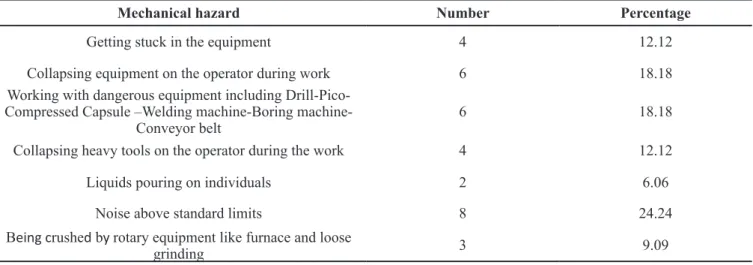
Completion of JSA tables and change based analysis revealed the total number of identified hazards in the plant to be 90, with mechanical hazards of 35.55% pri-or to other hazards (Figure 1). Table 1 shows the num-ber and percentage of mechanical hazards. As the table shows that the exposure to high levels of noise (25%)
Application of job safety analysis Nezamodini et al.
was the highest mechanical hazard and thus was rated as the first priority (Table 1). Overall, 197 outcomes were reported as a result of actual exposure, of which 102 (51.77%) were financial outcomes, with 45.68% impact on human health and 2.53% on environmental issues (Table 2). The causes of potential hazards in the factory were observed in a total of 239 cases, which were classified in four categories; human, manage-ment, structural and design hazards (Figure 2). Among the human causes, fatigue (12.03%) had the highest rate (Table 3). A total of 188 cases required changes to the factory to achieve the ideal conditions. These
changes were grouped into three categories included management, design and structural changes. Manage-rial changes (77.65%) comprised the majority of re-quired changes in the factory (Figure 3).
Discussion
The purpose of this study was to analyze job safety and to inspect the changes in one of the central ce-ment factories in Iran. Among the identified hazards, mechanical hazards (35.55%) were the most frequent hazards. In the study by Dastgerdi, mechanical hazards Table 1. Number and percentage of mechanical hazards identified in the cement factory
Mechanical hazard Number Percentage
Getting stuck in the equipment 4 12.12
Collapsing equipment on the operator during work 6 18.18
Working with dangerous equipment including Drill-Pico- Compressed Capsule –Welding machine-Boring machine-
Conveyor belt 6 18.18
Collapsing heavy tools on the operator during the work 4 12.12
Liquids pouring on individuals 2 6.06
Noise above standard limits 8 24.24
Being crushed by rotary equipment like furnace and loose
grinding 3 9.09
Application of job safety analysis Nezamodini et al.
were also found to be contributed to the risks (11). In the study by Ebrahimzadih et al., 11% of the identified risks were related to the collision with moving equip-ment in mines (12). One of the reasons for the high per-centage of mechanical risks is the lack of automation in sectors including bag loading, which resulted in the use of excessive man power in these sectors. Another reason is the lack of manpower in the factory, which makes the current forces have more workload and each person has the same responsibility as several other peo-ple, which causes excessive fatigue, rush, and inaccu-racy, and can result in accidents. Automating the parts that can be automated is therefore helpful in reducing the number of these hazards. Additionally, increasing the number of manpower to the required level can prevent the pressure on the current staff. In the study by Dastgerdi, automation of some parts and use of Table 2. Number and percentage of each outcome
Outcome definition Number Percentage
Financial 102 51.77
Human causalities 90 45.68
Environmental 5 2.53
trained and experienced forces were presented as mea-surements to reduce and prevent mechanical hazards (11). The second important hazard after mechanical hazards was the risk of contact with chemicals (20%). This was due to lack of personal protective equipment, especially gloves and masks when working with chem-icals including oil and grease. Heydari et al. evaluated the health risks of contact with chemicals and use of personal protective equipment and identified contact with chemicals, and lack of management emphasis on the use of personal protective equipment as the most important parameters (13). However, according to the current study, the affective factors including the inap-propriateness and inefficiency of personal protective equipment, the appearance of a protective device and the lack of knowledge chemicals complications. There-fore, exposing workers to long-term and short-term Figure 2. Percentage of causes identified hazards in the cement factory
Application of job safety analysis Nezamodini et al.
Table 3. Number and percentage of human causes of identified hazards in the cement factory
Human causes Number Percentage
Fatigue 16 12.03
Distraction 15 11.27
Not using safety equipments 13 9.77
Figure 3. Number and percentage of changes in the cement factory contact with chemicals and providing appropriate PPE can help reduce the risks of hazards. Ardeshir et al. also reported the need to use personal protective equipment as a means of identifying and prioritizing risks (14). Electrical injury was ranked third with 14.44% preva-lence. In a study by Kouhnavard et al. who assessed the safety and health risks in the Affiliated Agency to Iran Khodro Company, it was shown that the risk of electri-cal injury is one of the identified risk priorities (15). In the study by Mohammadi et al. the risks were assessed in the school equipment manufacturing factory and the highest risk was found to be related to electrical injury at workstations (16). According to the studies conduct-ed in this factory, the risk of electrical injury was more noticeable to the factory employees due to the high work load and insufficient number of manpower in the unit, as well as lack of alternate work force for super-vision of sectors at the time of personnel leave. The
findings of this study also identified a worsening prob-ability of electrical injury among employees. Thus, an increase in the number of forces and allocation of al-ternative forces for the absence of sector managers can help reduce the risk of these hazards. According to the mechanical risk results, the exposure to high levels of noise (25%) was higher than the other mechanical haz-ards. Dehghan et al. reported that the exposure to noise in a petrochemical complex was reported by 63% of the employees (17). One of the reasons for high mechanical risk of noise is abandoning earplugs due to rush and the need to clean the plugs every time they were used. It is therefore necessary to make workers aware of the haz-ards of long-exposure to loud noise and provide work-ers with ear muffs rather than earplugs. A total of 239 causes of potential hazards in the factory were reported in 4 categories of human, management, structural and design hazards. Human causes (55.64%) were the most
Application of job safety analysis Nezamodini et al.
References
1. Azrah K, Jamali Z, Jari A. Identification and assessment of hazard in the Refractory Brick Production Company of Gonabad, Iran, using the hazard and operability technique. J Occup Health Epidemiol. 2014;3(1):7-16.
2. Halvani G, Fallah H, Barkhordari A, Khoshk Daman R, Behjati M, Koohi F. A survey of causes of occupational accidents at working place under protection of Yazd Social Security Organization in 2005. Iran Occup Health. 2010;7(3):22-9.
3. Concha-Barrientos M, Nelson DI, Fingerhut M, Driscoll T, Leigh J. The global burden due to occupational injury.
Am J Indust Med. 2005;48(6):470-81. doi:10.1002/
ajim.20226
4. Snashall D. Occupational health in the construction industry. Scand J Work Environ Health. 2005;31(suppl
2):5-10. PMID:16363441
5. Christian MS, Bradley JC, Wallace JC, Burke MJ. Workplace safety: A meta-analysis of the roles of person and situation factors. J Appl Psychol. 2009;94(5):1103-27.
doi:10.1037/a0016172
6. Mohammadfam A. Safety Techniques, Occupational Safety Analysis (JSA). First Edition. Tehran: Fanavaran Publications; 2003.
7. Lotfolahzadeh A, Lavasani M, Dehghani A. Risk Assessment and determination of insurance rate by FMEA method-Case study in a cement factory. J Occup Environ Health. 2017;2(4):311-22.
8. Gholi Pour M, Feyzi V, Khammar A. Identification and Assessment of dangers’ risk in production hall of radiator parts a Metal Industry with JSA Method . Occup Hygin Health Promot J. 2017;1(1):42-51.
9. Yousefi Aghkand M, Farshad A, Arghami S. Evaluation & Identification of hazards for employees in oil exploration seismic operations with Job Safety Analysis Method. Iran Occup Health J. 2006;3(3-4):39-45.
10. Halvani GH, Zare M. Engineering Safety Systems and Risk Management. First Edition. Tehran: Sobhan Publishing Institute; 2009.
11. Abbasalipour Dastgerdi Z. Risk assessment of loading/ unloading of bulk cargo by using of JSA technique risk assessment. J Maritime Transport Industry. 2017;3(2):48-51.
12. Ebrahimzadih M, Halvani G, Darvishi E, Froghinasab F. Application of Job Safety Analysis and William Fine Methods to identify and control hazards in a uranium Mine in Central Area of Iran. J Health. 2015;6(3):313-24.
frequent and important hazards. The lack of automa-tion of the various parts of the plant and, consequently, the exploitation of a large number of manpower are the causes high probability of potential human casualties. Among the human causes, fatigue had the highest rate (12.03%). The cause of fatigue can be the lack of man-power in various sectors of the factory, because each worker had enormous responsibilities. In many stud-ies, occupational fatigue has been reported as a major contributor to human error and occupational accidents (18-21). The changes implemented in the factory were designed to fulfill the ideal conditions of 188 cases and were divided into three categories of management, structure and design. Management changes with em-phasis on securing and preventing incidents require im-mediate measures. In the study by Cheng, management support for proper safety practices was identified as one of the factors to minimize occupational accidents (22). In the second place, structural changes (13.29%) were the most prevalent indicating the importance and quality of personal protective equipment in preventing accidents. Cheng also stated that appropriate selection of workers in accordance with working conditions and the provision of suitable and standard personal protec-tive equipment would be effecprotec-tive in reducing the in-cidence of accidents (22). In the study by Malakouti et al., inspection and maintenance of equipment was reported as an effective ingredient in reducing the risk level (23).
Conclusion
According to the results of this study, mechanical haz-ards are of major safety and health hazhaz-ards in jobs in the cement factory based on the two assessment tech-niques. Therefore, use of control measures including the provision of appropriate personal protective equip-ment, automation of units with small manpower and implementation of the desired changes can reduce the level of identified hazards.
Ethical disclosure
Not applicable.
Acknowledgements
The authors of this article would like to express their gratitude to the management and personnel of the ce-ment industry of Fars province.
Author contributions
All the authors have accepted responsibility for the en-tire content of this submitted manuscript and approved
submission.
Conflict of interest
The authors declare there is no conflict of interest.
Funding/Support
Application of job safety analysis Nezamodini et al.
13. Heydari M, Omidvari M, Fam IM. Presenting of a material exposure health risk assessment model in Oil and Gas Industries (case study: Pars Economic and Energy Region). J Health Saf Work. 2014;3(4):11-22.
14. Ardeshir A, Maknoon R, Rekab Islami Zadeh M, Jahantab Z. Health Risk Management which are effective on Human Health in High-rise Building construction projects with Fuzzy Approach. J Health Saf Work. 2013;3(1):69-80.
15. Kouhnavard B, Aghanasab M, Safayee R, Fazli Z. Risk identification and assessment, using Job Safety Analysis, in an affiliated agency to Iran Khodro Company, 2014. Beyhagh. 2015; 19(2): 40-50.
16. Pourang N, Esmaeili F, Ranjbarian M. Assessment of potential safety hazards of three fisheries research centers laboratories staff by Failure Modes and Effect Analysis (FMEA) and the relevant statistical methods. Iran J Health Environ. 2017;10(1):87-102.
17. Farhang Dehghan S, Monazzam MR, Nassiri P, Haghighi Kafash Z, Jahangiri M. The assessment of noise exposure and noise annoyance at a Petrochemical Company. J Health Saf Work. 2013;3(3):11-24.
18. Babaeipouya A, Mosavianasl Z, Amani S, Moazez Ardebili N. Human error analysis in neonatal intensive care unit by predictive analysis of cognitive errors. Occup Envir Health. 2017;3(1):38-47.
19. Azad P, Halvani GH, Najimi MR, Kouhnavard B. Investigating the role of behavioral factors in non-fatal accidents of urban and suburban driver. J Health Saf Work. 2015;5(3):13-20.
20. Kouhnavard B, Mahgoli H, Bolghanabadi S, Yazdan Aval M, Rostami Aghdam Shendi M, Kolahdouzi M. The relationship between fatigue, stress and job performance with some demographic variables in dental prosthesis technicians. J Dent Med. 2018;31(2):91-7.
21. Nezamodini ZS, Abasi M, Mosavianasl Z, Kouhnavard B. Application of Human Hazop Technique for identifying human error in a Flour Company. Arch Occup Health. 2018;2(3):170-7.
22. Cheng CW, Lin CC, Leu SS. Use of association rules to explore cause–effect relationships in occupational accidents in the Taiwan construction industry. Saf Sci.
2010;48(4):436-44. doi:10.1016/j.ssci.2009.12.005
23. Malakouti J, Gharibi V. Risk analysis of automated excavation operations by Energy Trace & Barrier Analysis Method. Iran Occupational Health. 2013;10(2):87-98.