···
Journal of Civil Engineering and Materials Application
http://jcema.com :
Journal home page Received: 13 February 2019 • Accepted: 15 May 2019
JCEMA.2019.93622 /
10.22034 :
doi
Investigating Durability Behavior and Compressive Strength
of Lightweight Concrete Containing the Nano-Silica and
Nano Lime Additives In the Acid Environment
Pejman Sekhavati
1, Mahyar Jafarkazemi
2, Özgür kaya
3*
1 Department of Earthquake Engineering, Islamic Azad University, South Tehran Branch, Tehran, Iran. 2 Department of Civil Engineering, Islamic Azad University, West Tehran Branch, Tehran, Iran. 3 Department of Civil Engineering, Cucas University, Shanghai, China.
*Correspondence should be addressed to Özgür kaya, Department of Civil Engineering, Cucas University, Shanghai, China.Tel: 86-10-89388301; Fax:+908899024531 Email:[email protected]
Copyright © 2019 Özgür kaya This is an open access paper distributed under the Creative Commons Attribution License. Journal of Civil Engineering and Materials Applicationis published by Pendar pub; Journal p-ISSN 2676-232X; Journal e-ISSN 2588-2880.
1. INTRODUCTION
oday the widespread use of concrete in executing various types of structures is a clear reason for preferring it over other types of construction materials. Also, accuracy in the production and execution of reinforced concrete structures is essential. Although, in an overall view, concrete seems to be a durable material but focusing on its history one could realize that in acid environments, the concrete durability faces serious problems. Various researchers have attempted to investigate the concrete and its durability in acid environments. For example, Yasar et al. (2003) have researched the compressive strength and durability of lightweight concrete made of Basalt and fly ash and reported the compressive, tensile and flexural strength of
lightweight concrete specimens [1]. In their research, two lightweight concrete specimens; SLWC35 and SLWC50 with strengths of 35 and 50 MPa made of coarse aggregates and ordinary gravel and sand were cured for 7 and 28 days in the water. Then they were subjected to the hot and humid environmental conditions containing the salts of sea bank, and their durability was investigated [2]. Fattuhi et al. (1986) investigated the effect of various coating of the concrete specimens against the acid attack. The examined coatings included styrene-butadiene latex, silica fume and naphthalene. In that research, the loss in concrete weight after remaining in the acid solution for 30 to 50 days was reported. The loss in the weight of the concrete specimens was about
T
ABSTRACT
Lightweight concrete has been used in the construction industry for many years, and by introduction of modern technologies in the construction industry, this type of concrete has been accounted as one of the powerful and reliable materials in the construction industry. The density of lightweight concrete is about 0.56 that of the ordinary concrete. This type of concrete is commonly used as a flooring material in buildings. Thus there is possibility of its corrosion in different climatic conditions. In the present research, we would investigate the compressive strength and durability of the lightweight concrete in the acid environment, so that by specifying the corrosion rate one could have a better understanding of the behavior of these concretes. For making the lightweight concrete in the present research use has been made of pumice aggregate in the mix design, and the acid used is 1M sulfuric acid. Also, the effect of adding two types of Nanomaterials i.e., Nano-silica and Nano clay on the concrete behavior is assessed. The results have shown that in case of keeping the specimens of lightweight concrete in the acid environment for 90 days, their weight reaches 0.56 that of the ordinary specimens. The results of the current research have shown that the use of Nano-silica and Nano lime per 10 wt% of cement could result in the increased compressive strength of the lightweight concrete. So that the concrete compressive strength per 10 wt% of Nano lime increases by 1.43%. On the other hand, the concrete durability in the acid solutions reaches the maximum value per addition of 5% Nano-silica and 5% Nano lime, and has lost a lower percentage of its weight.
··· 50% [3]. Araghi et al. (2015) investigated the
experimental research on the strength of specimens containing PET against the attack of sulfuric acid. All the specimens were cured for 30 and 60 days, and the results of weight change and ultrasonic tests after being kept in acid for specimens with 0, 5, 10 and 15% PET were reported [4]. Alzeebaree et al. (2019) investigated the specimens reinforced with fibers in geopolymeric concretes in the acid environment. In that research, after keeping the geopolymeric specimens and geopolymeric specimens made of nano-silica, the change in the specimens weight against the acid attack was investigated [5]. Pham in 2016 investigated the durability of lightweight concrete specimens containing asphalt with 30% rubber powder, and the results showed that the rubber containing concrete absorbs more water with respect to the ordinary concrete, and by absorbing rubber, the water absorption rate also increases. Thus, the rubberized concrete is much more susceptible to water, chloride and chemical compounds attacks. The carbonation of rubberized concrete was also higher than the ordinary concrete and increased with the rubber content increase, which shows a higher sensitivity to corrosion [6]. Research and investigation of lightweight concrete with various types of additives has also been performed in the past, and researchers have investigated the compressive and tensile strength behavior of these types of concretes. For example, Rumsys et al. (2017) have examined the use of clay and polyethylene in lightweight concrete. Use of polyethylene in the lightweight concrete specimens resulted in the loss of weight of specimens and also loss in their water absorption rate. Also, due to expansion of clay, the hydration rate of cement paste increased [7]. Sara et al. (2019) also investigated the simultaneous use of nano-silica and slag powder on the lightweight concrete, and the rate of tensile and compressive strength of these concretes had increased in long time [8]. Naniz et al. (2018) investigated the use of nano-silica in the lightweight concrete. In that research, nano-silica was added at., 1, 3 and 5 wt% of cement to the concrete. Various destructive tests (such as the compressive strength, splitting tensile strength, flexural strength) and nondestructive tests (such as the electrical resistivity and ultrasonic pulse velocity) were performed on the lightweight concrete. Also, the wt% of water to cement
in the tests was variable ranging from 0.35-0.4 wt% of cement [9]. Considering the significant effect of nano-silica and nano lime additives on the compressive strength, and durability of concrete, these additives could be used in the retrofitting of reinforced masonry walls and also RC frames [10]. Du et al. (2019) investigated the use of nano-silica in ultra lightweight concrete. Use of glass particles as the additive together with nano-silica was examined in investigating the 28-day strength of the concrete, and the obtained strength was 20 MPa. Also in that study the effects of water and chloride-ion penetration were investigated and the concrete durability was examined [11]. Mosaberpanah et al. (2019) investigated the use of nano-silica in the ultra lightweight concrete. In that research, both the glass powder and nano-silica were used to increase the concrete strength, and the results showed that addition of nano-silica glass powder and wastes and especially their interaction causes improvement of UHPC properties [12]. Du et al. (2015) used nano-silica in the lightweight concrete. In that research, various durability tests were performed on the concrete specimens in the vicinity of chloride-ion and the rate of water absorption was examined. The results showed that the use of nano-silica in the lightweight concrete results in increased durability of concrete [13]. Afzali-Naniz (2019) investigated the effect of adding micro silica and nano colloid to the self-compacting lightweight concrete. The results showed that simultaneous addition of micro silica and nano colloid to the concrete increases the durability of concrete specimens [14]. Zhang et al. (2018) used a low percentage of nano-silica in the lightweight concrete and the results showed that even application of a low percentage of nano-silica could improve the performance of lightweight concrete [15]. In the present research two types of nano materials (lime and silica) were simultaneously used in the mix design of lightweight concrete, and its compressive strength and durability were investigated. The previous research had investigated the effect of both of these materials separately in the mix design of the concrete, but investigating the simultaneous use of both materials and also durability behavior of the specimens in the acid environment has not been performed yet in the research works. Therefore in this research, the complete behavior of these concretes is investigated.
2. MATERIALS AND METHODS
The used materials in this research include nano lime, nano-silica and pumice which are used in making the lightweight concrete. Table 1 shows the mix design of specimens made in the laboratory.Sand: According to ASTM classification, the aggregates finer than 4.75mm and coarser than 0.075mm are called sand. According to the unified soil classification system, sand is classified into three groups of fine, medium and coarse aggregates. Cement: Tehran cement type II is used for making the specimens Pumice: is a rock with white to light gray color but sometimes appears in pink, light yellow or brown colors, too. This type of rock is produced when lava with a high content of water and gases, cools slowly together with expansion of the bubbles present in it, which results in a very light rock material. The lightweight concrete containing pumice has many applications such as for sound-proofing and heat-proofing purposes, or is used for resisting fire in concrete parts of the roofs, prefabricated panels and
construction blocks. Nano-silica: Silicon dioxide nano particles also known by names of silica nano particles or nano-silica has widespread use, due to its high stability, insignificant toxicity and capability of being incorporated along with a large number of molecules and polymers. These properties have turned it into a basis for a large number of biomedical studies [16]. Nano lime: Calcium carbonate is among the most applicable materials known to mankind which constitutes more than 4% of the earth's crust and is found all over the world. This material could be produced in artificial form, and its important industrial source is limestone containing gypsum, marble and travertine. Pure calcium carbonate also is produced from marble stone or could be generated by passing carbon dioxide through the solution of calcium hydroxide [17].
···
2.1. MIXING
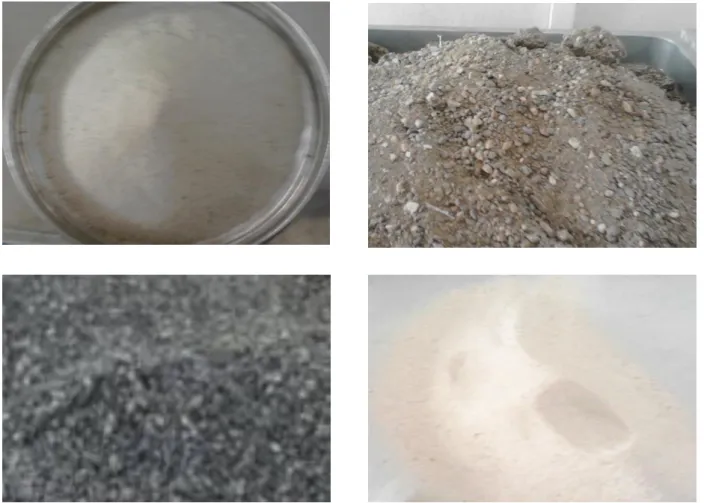
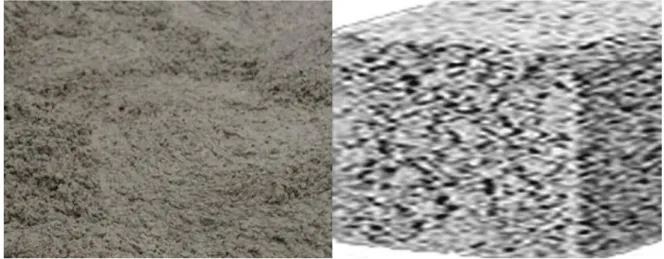
After moisturizing the pumice grains and mixing them with sand in mixer for 2 minutes, cement and water are added to the mix design and mixed for two minutes. After that, other additives are added together with water and mixed for further two minutes and after vibration are placed in the mold. The specimens are removed from the molds after one day and kept in the water basin for 7 and 28 days. Figure 1 shows the used materials in making concrete and Figure 2 also presents the made lightweight concrete. Adding nanomaterial to the concrete mix design is according to the previous research works. So that after two minutes of mixing, the nanomaterial is added to the mix, stage by stage, and is mixed in a way that it is distributed uniformly in the concrete [18-20]. In the normal state, slumps ranging 5-8 cm are desirable for
non-pumpable lightweight concrete and slumps ranging 7-10cm are regarded desirable for pumpable lightweight concrete. In the present research, the concrete slump for all the specimens is taken constant about 8-8.5 cm. Considering the minimum and maximum temperatures for the structural and durable lightweight concrete is essential and is not different from the ordinary concrete in this respect. The minimum allowable temperature in the previous studies has been +5℃ and the minimum desirable temperature has been +10℃. In this research, the curing and placing temperature in the concrete molds have been 20℃.
Figure 1. Used materials in making the lightweight concrete
Table 1. Mix design of lightweight concrete in the laboratory
Nano Lime Nano-Silica
Pumice Cement
sand materials
0 0
1000 450
800 Group1
0 5
1000 450
800 Group2
0 10
1000 450
800 Group3
0 15
1000 450
800 Group4
5 0
1000 450
800 Group5
10 0
1000 450
800 Group6
15 0
1000 450
800 Group7
5 5
1000 450
800 Group8
10 10
1000 450
800 Group9
10 5
1000 450
800 Group10
···
Figure 2. Surface and mixing of the specimen made of pumice
2.2. PERFORMED TESTS
2.2.1. COMPRESSIVE STRENGTH TEST
This test is performed on the standard cubical specimens in this research. The amount of load exerted on the specimen at ages of 7 and 28 days at the moment of
specimen breakage is obtained, and the effect of adding Nano-silica and nano lime is also investigated.
Figure 3. Specimen made of nano-silica, nano lime
2.2.2. SPECIMEN STRENGTH TEST IN THE ACID SOLUTION
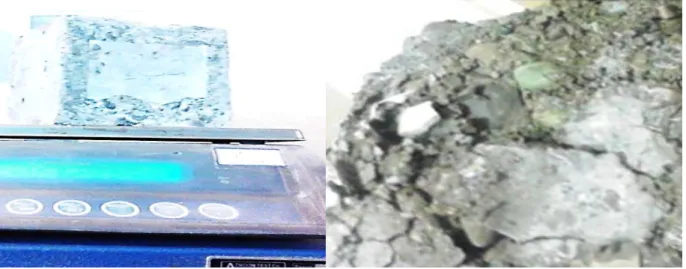
The test of change in the weight of concrete specimen in the acid environment has been performed and investigated weekly. The test was performed in this way that after making the specimens they remained for 7, 14, 28 and 90 days in the acid environment and the weight change has been reported. The percentages of concrete corrosion in the acid environment are given in diagrams 6 and 7. Fig.7shows the concrete specimen after being kept for 28 days in the container of 1M sulfuric acid. As is seen, the surface of 28-day concrete specimen indicates that keeping the specimen in the acid
environment has caused damage to the concrete, and the surface of the specimen has been cracked and somehow corroded. The weight of specimen after being kept in the acid environment after 28 days has reached 57% of its initial value in the control specimen. This shows that the specimen durability in the acid environment reduces with increase in days. Figure 4 also shows the weighing of specimen prior to its placing in the acid environment, which is without cracks on the surface, but placing it in the acid solution causes corrosion of the specimen.
···
Figure 4. Corrosion on the surface of concrete specimen in the acid environment
3. RESULTS AND DISCUSSION
Figure 5shows the compressive strength for 8 specimens made in the laboratory. The results of using pumice in concrete give the 7-day and 28-day compressive strength values equal to 20 and 30 MPa, respectively, which are lower than those specimens where 1% to 2% nano-silica or nano lime are used in them. But using 3% nano-silica reduces the compressive strength of the specimens. Simultaneous use of nano-silica and nano lime at 1% causes increase in the compressive strength up to its maximum value. After that, the compressive strength of concrete reduces for both ages. Figures 5and 6 present the 7-day and 28-day compressive strength values.
Figure 5 shows the compressive strength values for 10 groups of made specimens. According to the mix design table, use of nano-silica and nano lime has increased the compressive strength of specimens. So that the compressive strength of the made specimens when using nano at 1 and 2 wt% of cement, has increased by 1.15
times that of the control specimen at 28-day age (per optimal percentage of nano-silica) and 1.44 times that of the control specimen at 28-day age (per optimal percentage of nano lime). Simultaneous use of these two materials has resulted in increased compressive strength up to 1.55 times that of the control specimen at the age of 28 days which is a considerable value. This value at the age of 7 days is equal to 1.37 times that of the control specimen. Also, this value per use of nano-silica at the age of 7 days is 1.24 times that of the control specimen, and for nano lime is 1.28 times that of the control specimen. Using too much nanomaterial in the concrete reduces the compressive strength of the combined specimens at both 7-day and 28-day ages. According to Figure 5, Specimens no. 3, 4 and 8 had the maximum compressive strength values.
Figure 5. 7-day and 28-day compressive strength values for the lightweight concrete specimens 0
5 10 15 20 25 30 35 40 45
Goup 1 Goup 2 Goup 3 Goup 4 Goup 5 Goup 6 Goup 7 Goup 8 Goup 9 Goup 10
Co
m
p
re
ssi
ve
st
re
an
gh
(
M
Pa)
Specimens 7 days
··· Adding nano-silica causes accelerated hydration process.
And also increases the compressive strength of the specimens. Nano-silica fills the pores and thus increases the strength, but for higher amounts of nanomaterials, the amount of water and superplasticizer should be adjusted to ensure prevention of too much drying and cracking. In the performed study, the amount of used water has remained constant; thus, addition of too much nanomaterials has resulted in drying up of the cement paste. Therefore in those specimens where a high percentage of nanomaterial is used the compressive strength has reduced per all the ages. One of the problems associated with voluminous mortars is the
issue of cracking due to the hydration heat. For this reason, in many cases, to reach a proper mix design, the amount of cement is reduced. This, in turn, causes reduced amount of water and increase in the aggregate size. This type of mortar is faced with many executive problems and reduction in strength. Therefore use of nano-silica as replacement for a portion of cementitious materials could be effective. In this research the1 and 2 wt% replacements with cement paste were economic.
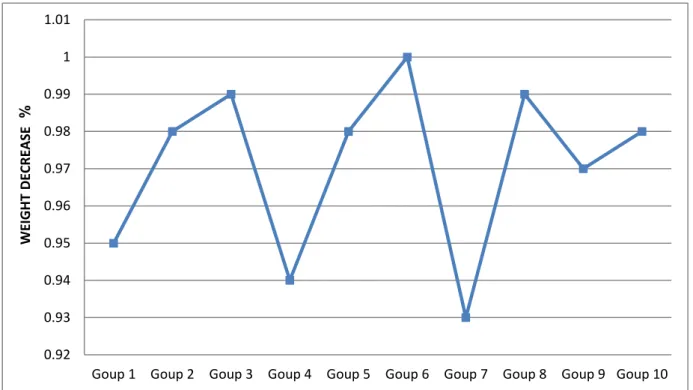
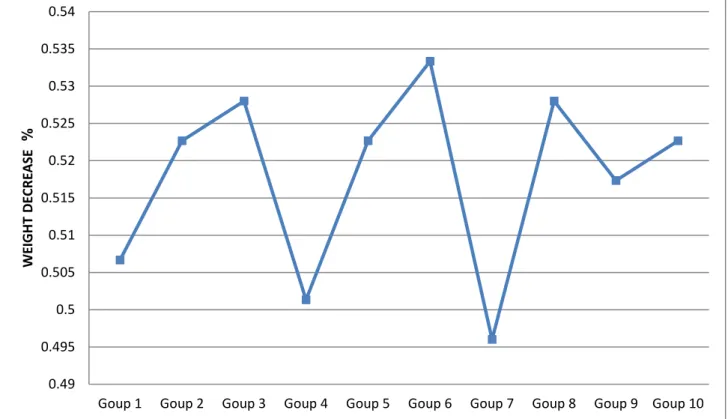
Figures 6-8 show the percentages of reduced weight of specimens after 7, 28 and 90 days remaining in the acid solution.
Figure 6. Percentage of reduced weight of lightweight concrete specimens after keeping 7 days in the acid solution
Figure 7. Percentage of reduced weight of lightweight concrete specimens after keeping 28 days in the acid 0.92
0.93 0.94 0.95 0.96 0.97 0.98 0.99 1 1.01
Goup 1 Goup 2 Goup 3 Goup 4 Goup 5 Goup 6 Goup 7 Goup 8 Goup 9 Goup 10
%
WE
IGH
T
D
ECR
EA
SE
0.74 0.75 0.76 0.77 0.78 0.79 0.8
Goup 1 Goup 2 Goup 3 Goup 4 Goup 5 Goup 6 Goup 7 Goup 8 Goup 9 Goup 10
%
WE
IGH
T
D
ECR
EA
···
Figure 8. Percentage of reduced weight of lightweight concrete specimens after keeping 90 days in the acid solution
The precise amount of used Nano Sio2 should be determined using various tests per each mix design. So it is recommended to add Nano Sio2 at 1-4 wt% of cement to the concrete (considering that it increases the concrete strength it could replace the same amount of cement). It is Considering that nano-silica is a water reducing material so it should always be used together with a super plasticizer. Otherwise, it causes cracking of the concrete and reduces the efficiency and compaction of concrete. But in the present research no superplasticizer is used in the mix design. Therefore use of nanomaterial independently and at high percentages results in crack formation on the concrete surface, and in the acid environment the concrete corrosion is increased, too. According to Figure 6, the control specimen in the acid solution lost its weight by 93 to 100% after 7 days. The maximum value corresponds to the specimens where a large amount of nanomaterial is used in their making. Placing concrete in the acid solutions for 28 days, as shown in Figure 7, indicates that the corrosion range of the concrete specimens greatly increases so that concrete reaches 74 to 79% of its initial weight. As seen in Figure 7, the specimens that had lower compressive strength had experienced higher losses in weight. Figure 8 also shows loss in the weight of concrete specimens per 90 days remaining in the acid environment. As seen in the figure, the concrete specimens have reached 50 to 55% of their weight, which is the maximum loss in weight.
4. CONCLUSION
In the present research, the lightweight concrete specimens made of nano lime and nano-silica have been investigated and their durability behavior in the acid environments is studied. The results showed that the use of nano-silica and nano clay could improve the strength behavior of lightweight concrete specimens. The following are the results obtained from the concrete durability and compressive strength tests:
Lightweight concretes could retain their weight in the acid solutions for 7 days and a severe corrosion does not occur on the concrete surface. But passage of time resulted in concrete corrosion in the acid environments.
Using nano-silica at amounts higher than 2% results in increased corrosion of concrete and reduced compressive strength of the concrete. So that the concretes with higher than 3 wt% of nano-silica when kept in the acid solutions for more than 28 days have experienced greatest loss in the weight and corrosion and have reached 73 wt% of the control specimen
Using nano lime at amounts higher than 2% results in increased corrosion of concrete and reduced compressive strength of the concrete. So that the
concretes with higher than 3 wt% of nano lime when kept in the acid solutions for more than 28 days have experienced greatest loss in the weight and corrosion and have reached 74 wt% of the control specimen
Simultaneous use of nano-silica and nano lime results in increased compressive strength of the concrete and also concrete durability in the acid environments. So that all the made specimens using both nanomaterials had higher compressive strength and durability with respect to their respective (using just one nanomaterial) specimens.
Maximum corrosion of the lightweight concrete specimens per addition of 3% nano-silica occurred in the specimens where concrete had reached 49% of its initial weight. This shows that the lightweight concretes are highly damaged when subjected to the acid attack and loss more than half of their weight.
Use of pumice in the making of the lightweight concrete yields a concrete with appropriate strength and 0.49
0.495 0.5 0.505 0.51 0.515 0.52 0.525 0.53 0.535 0.54
Goup 1 Goup 2 Goup 3 Goup 4 Goup 5 Goup 6 Goup 7 Goup 8 Goup 9 Goup 10
%
WE
IGH
T
D
ECR
EA
··· lower weight than the weight of ordinary concrete
specimens. So that the range of concrete compressive
strength for a 7-day concrete is equal to 18-23 MPa and for a 28-day concrete is equal to 25-38 MPa.
FUNDING/SUPPORT
Not mentioned any Funding/Support by authors.
ACKNOWLEDGMENT
Not mentioned by authors.
AUTHORS CONTRIBUTION
This work was carried out in collaboration
among all authors.CONFLICT OF INTEREST
The author (s) declared no potential conflicts of
interests with respect to the authorship and/or
publication of this paper.
5. REFERENCES
[1] Yasar E, Atis CD, Kilic A, Gulsen H. Strength properties of lightweight concrete made with basaltic pumice and fly ash. Materials
Letters. 2003 Apr 1;57(15):2267-2270.[View at Google Scholar] ;
[View at Publisher].
[2] Haque MN, Al-Khaiat H, Kayali O. Strength and durability of lightweight concrete. Cement and Concrete Composites. 2004 May 1;26(4):307-314.[View at Google Scholar] ; [View at Publisher].
[3] Fattuhi NI, Hughes BP. Resistance to acid attack of concrete with different admixtures or coatings. International Journal of Cement Composites and Lightweight Concrete. 1986 Nov 1; 8(4):223-230.
[View at Google Scholar] ; [View at Publisher].
[4] Araghi HJ, Nikbin IM, Reskati SR, Rahmani E, Allahyari H. An experimental investigation on the erosion resistance of concrete containing various PET particles percentages against sulfuric acid attack. Construction and Building Materials. 2015 Feb 15;77:461-471.
[View at Google Scholar] ; [View at Publisher].
[5] Alzeebaree R, Çevik A, Nematollahi B, Sanjayan J, Mohammedameen A, Gülşan ME. Mechanical properties and
durability of unconfined and confined geopolymer concrete with fiber reinforced polymers exposed to sulfuric acid. Construction and Building Materials. 2019 Aug 10;215:1015-1032. [View at Google Scholar] ; [View at Publisher].
[6] Pham TM, Elchalakani M, Hao H, Lai J, Ameduri S, Tran TM. Durability characteristics of lightweight rubberized concrete. Construction and Building Materials. 2019 Nov 10;224:584-599.
[View at Google Scholar] ; [View at Publisher].
[7] Rumšys D, Bačinskas D, Spudulis E, Meškėnas A. Comparison of material properties of lightweight concrete with recycled polyethylene and expanded clay aggregates. Procedia Engineering. 2017 Jan 1;172:937-944. [View at Google Scholar] ; [View at Publisher].
[8] Allalou S, Kheribet R, Benmounah A. Effects of calcined halloysite nano-clay on the mechanical properties and microstructure of low-clinker cement mortar. Case Studies in Construction Materials. 2019 Jun 1;10:e00213. [View at Google Scholar] ; [View at Publisher].
[9] Naniz, O. A., & Mazloom, M. (2018). Effects of colloidal nano-silica on fresh and hardened properties of self-compacting lightweight concrete. Journal of Building
Engineering, 2014 Nov 1; 20: 400-410.[View at Google Scholar] ; [View at Publisher].
[10] Massumi A, Mahboubi B, Ameri MR. Seismic response of RC
frame structures strengthened by reinforced masonry infill panels. Earthquakes and structures. 2015;8(6):1435-1452. [View at Google Scholar] ; [View at Publisher].
[11] Du H. Properties of ultra-lightweight cement composites with
nano-silica. Construction and Building Materials. 2019 Feb 28;199:696-704. [View at Google Scholar] ; [View at Publisher].
[12] Mosaberpanah MA, Eren O, Tarassoly AR. The effect of
nano-silica and waste glass powder on mechanical, rheological, and shrinkage properties of UHPC using response surface methodology. Journal of Materials Research and Technology. 2019 Jan 1;8(1):804-811.[View at Google Scholar] ; [View at Publisher].
[13] Du H, Du S, Liu X. Effect of nano-silica on the mechanical and
transport properties of lightweight concrete. Construction and Building Materials. 2015 May 1;82:114-122. [View at Google Scholar] ; [View at Publisher].
[14] Afzali-Naniz O, Mazloom M. Assessment of the influence of
micro-and nano-silica on the behavior of self-compacting lightweight concrete using full factorial design. Asian Journal of Civil Engineering. 2019 Jan 23;20(1):57-70. [View at Google Scholar] ; [View at Publisher].
[15] Zhang P, Xie N, Cheng X, Feng L, Hou P, Wu Y. Low dosage
nano-silica modification on lightweight aggregate concrete. Nanomaterials and Nanotechnology. 2018 Feb 28; 8(1): 1-8.[View at Google Scholar] ; [View at Publisher].
[16] Li W, Huang Z, Cao F, Sun Z, Shah SP. Effects of nano-silica and
nano-limestone on flowability and mechanical properties of ultra-high-performance concrete matrix. Construction and Building Materials. 2015 Oct 1;95:366-374. [View at Google Scholar] ; [View at Publisher].
[17] Yang H, Che Y. Effects of nano-CaCO3/limestone composite
particles on the hydration products and pore structure of cementitious materials. Advances in Materials Science and Engineering. 2018 Feb 11;2018(1): 1-8. [View at Google Scholar] ; [View at Publisher].
[18] Khotbehsara MM, Miyandehi BM, Naseri F, Ozbakkaloglu T,
Jafari F, Mohseni E. Effect of SnO2, ZrO2, and CaCO3 nanoparticles on water transport and durability properties of self-compacting mortar containing fly ash: Experimental observations and ANFIS predictions. Construction and Building Materials. 2018 Jan 15;158:823-834. [View at Google Scholar] ; [View at Publisher].
[19] Naseri F, Jafari F, Mohseni E, Tang W, Feizbakhsh A, Khatibinia
M. Experimental observations and SVM-based prediction of properties of polypropylene fibres reinforced self-compacting composites incorporating nano-CuO. Construction and Building Materials. 2017 Jul 15;143:589-598. [View at Google Scholar] ; [View at Publisher].
···
[20] Ghanei A, Jafari F, Khotbehsara MM, Mohseni E, Tang W, Cui
H. Effect of nano-CuO on engineering and microstructure properties of fibre-reinforced mortars incorporating metakaolin: Experimental and
numerical studies. Materials. 2017; 10(10):1215. [View at Google Scholar] ; [View at Publisher].