1
Morphological Study of PDLC Films with Refractive Index
Using Catalyst
Mujtaba Ellahi*1,Muhammad Nawaz2, and M. Yasir Rafique3
1, 2. Department of Chemistry, Faculty of Arts & Basic Sciences, Balochistan University of Information Technology, Engineering and Management Sciences, Quetta Pakistan.
3. Beijing University of Chemical Technology, Beijing 100029, People’s Republic of China4 * Corresponding Author: Email: [email protected]
Abstract
In present study the smart glass films whose feed ratio based on Nemetic liquid crystal (LC) and epoxy resins through the polymerization induced phase separation (PIPS) technique. Study the applications in display technology to inspect the morphological activities and refractive indices of epoxy resins based PDLC films (Smart Glass) using Tris(hydroxymethyl)amine as catalyst. In this study, best possible preparation condition was 20% LC, curing time 5 hrs at 90°C temperature. In this research, the refractive index of the domain size of PDLC films was studied using Abbe Refractometer at ambient temperature. The Tris(hydroxymethyl)amine have distorted the difference between the refractive indices of the polymer and the LC, and the aggregation increases the light scattering that could develop the morphological characteristics of the composites. In addition, PDLC films were prepared with different amounts of Tris(hydroxymethyl)amine to investigate the best ratio of the catalyst. It is revealed that when the weight feed ratio of LC was 20% in PDLC and 2% of Tris(hydroxymethyl)amine catalyst, then dispersed state of LC were well proportioned, and the variation of transmittance reached the highest value which noticeably affect the morphological characteristics of the composites. The refractive index of polymer matrix varied in the series due to the composition difference .Concurrently, these result lengthen the possible applications of epoxy resins smart glass thin films by choosing accurate compositions ratio, heating time, and catalyst reaction used for fabrications of smart films.
Key Words:
PDLC films,Smart glass, Tris (hydroxymethyl) amine, Refractive Index.1.
Introduction
Liquid crystal (LC) is a fascinating stage of matter and has an exceptionally big impact on electronic displays. However, the ever growing market of polymer liquid crystals (PDLC) films requires high quality liquid crystal materials. Recently, it is observed that the polymer liquid crystals smart glass have been regularly investigated and successfully considered by the different scientific and technical methods as the suitable model system. A smart glass thin films system having droplet size micron-sized LC domains, detached consistently in an E-O characteristics activity and transparent film, having spatially changeable refractive indices and well-organized glow dispersion characteristics. In this context, the economical power is one of the most significant points connected by worldwide, and glass is frequently regarded
as a lesser amount of energy capable
component. A new mode o f glass, the so-called ‘smart glass’, is predictable to be a elucidation for buildings and moving vehicles to decrease curing and cooling power. PDLC films (smart glasses) are a industrially significant set of resources that ascertain a lot of applications as electrically switchable visual instruments [1-4]. Smart glass are
shaped through smectic LC micro d o m a i n dimension entrenched in a domain size. Smart glass can be utilized not only for elegant doors,
nevertheless for displays and visual
technology [5]. Turn off state, no electric filed is applied between ITO electrodes, the orientation (i.e. director) of liquid crystal molecules inside each droplet are different in different d o m a i n size.When the incident light of electromagnetic
wave having a specific polarization [6]
perpendicularly enters into PDLC, the refractive index [7] within every domain (the incident light) determined director. For this reason, the directors in the droplets are arbitrarily distributed, so most of refractive indice inside droplets different from refractive indices polymer surrounding droplets. According to Snell Law, the incident light will be refracted at the interface between liquid crystal and polymer. There are thousands of micron d o m a i n size distributed in 10 μm volume of PDLC, so thousands time of refraction occur when the Incident light passing through PDLC, the light is sprinkled, and an opaque milky white state observed in other side. Generally, most suitable technique for preparation of smart glass thin film PIPS technique [8-10]. It also has benefit above U.V. thermo tropic PIPS techniques because it avoids together changes in LC characteristics
2 shaped by U.V. irradiation and consequential infectivity of fundamental maker reagents [11]. Along with different families of crosslinking agents, epoxy resins are extensively utilize owing to outstanding progress, convention techniques and cheap charge. Before, we considered two groups with influence of the multi-functional epoxy monomers structure and characterization on the E-O characteristics of thin PDLC films [12, 13]. In this regard, the present work concern with research of epoxy resins system with Tris(hydroxymethyl) amine (THMA) as catalyst to investigate briefly study the E-O characteristics of PDLC films. This paper, we have been studied the morphology as well as refractive indices of s m a r t g l a s s with LC concentrations, thicknesses, and curing times; comprehensively. In the meantime, this paper will exemplify refractive index of the domain size decreased with increasing the chain length of curable resins.
Study devoted to examine an instance of manufacture technique by using Nematic liquid crystal (LC) with epoxy resins structure. Furthermore, in this paper in both systems, we have tried to show the Tris(hydroxymethyl)amine (THMA) as catalyst with variable mol% and different composition feed proportion.
2.
Experimental Setup
2.1
Materials
In this research, the smart glass thin films have fabricated through PIPS heat curing process. The Nematic liquid crystal used Sigma-Aldrich Company Co. Ltd.). The curable epoxy resins used were Trimethylol propane triglycidyl ether tri-funtional (TMPTGE, Merck Chemical Industry).
Its refractive index is 1.477. Ethylene glycol
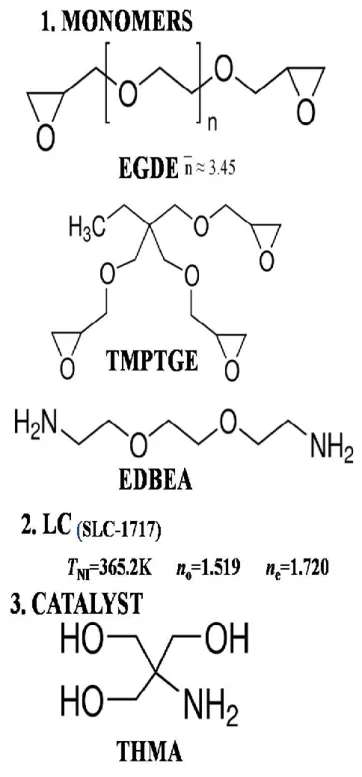
diglycidyl ether (EGDE) resin (Sigma-Aldrich Company).It is a di-fucntional viscous fluid liquid having yellowish color epoxy monomer containing short flexible chain length. Its refractive index is 1.463. Catalyst used Tris(hydroxymethyl)amine (THMA) (Sigma-Aldrich Company), and 2, 2’-(ethylene di oxy)bis (ethylamine) (EDBEA, Sigma-Aldrich Company). The compound structures of these materials exposed in Figure 1. The
compositions of curable epoxy
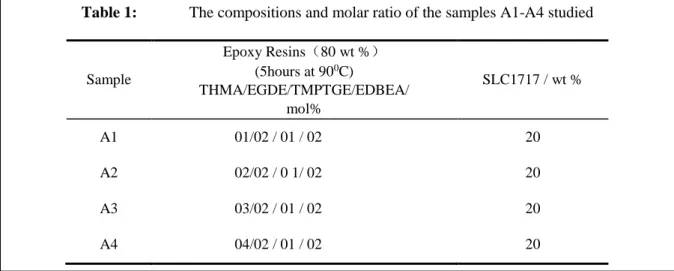
monomers/hardener/LC mixtures are listed in Table 1 for 5.0 hrs at 90°C time and temperature respectively. It’s intended by Fav=∑Фi fi, where Fav is the average functionality of composite resin, Фi and fi stand for the relation amount and functionality correspondingly [14].
Figure 1: Chemical structures and physical
properties of the materials used without further purifications.
2.2 Sample Preparation
Samples were arranged consisting of changed amount of 20% of liquid crystal (LC). Initially, the chemicals are mix in various %ages and then, moved for 5 hrs until they had been homogenized.
3
2.3 Analysis Technique
The morphology of PDLC samples was observed by scanning electron microscopy (SEM) (ZEISS, EVO18, Germany). The refractive index of the polymer matrix was measured using Abbe Refractometer (WYA-2WAJ, Hangzhou Kebo Instrument Co., Ltd.) at ambient condition. The polymer matrices were prepared with the molar ratio according to the samples A1-A4, but LC was absent.
3.
Experimental
Results
and
Discussion
3.1 Morphology of Polymer Network
at 5.0 hours at 90°C with Nematic
Liquid Crystal (LC).
In order to measure the domain size, Figure 2 shows the morphology of SEM micrographs of the polymer network of the samples A1-A4. The morphological characteristics of PDLC systems is dependent on the mol% ratio, curing conditions, time, temperature, chemical structures materials, and details of the film formation technique [15, 16].
Figure 2: SEM micrographs of the polymer
network of the samples A1-A4
Progressively, the composition feed ratio of samples A1-A4 with 20% LC content and similar curing temperatures is listed in Table 1. Figure 2 shows the domain size morphology of the polymer network of PDLC system for samples A1-A4. Tris(hydroxymethyl)amine (THMA) catalyst reacts with the epoxy resins to form polymeric network with the ring opening addition polymerization reaction process. To begin with the hydroxyl group (-OH) opened and adds a new epoxy ring to form polymer network chain of the PDLC systems. In addition, the THMA hydroxyl group (-OH) then capable to form a link with one more epoxy group to form continue polymer network chain. It can be seen that the LC domain size of the polymer network increasing with constant mol% of hardener. The effects of the structure of alkoxy chain length, flexible di-functional curable epoxy monomer EGDE, and tri-functional TMPTGE on PDLC films were showed the microstructures of the PDLC films as shown in Figure 2. When polymerization was initiated, the molecular weight and cross-linking density of the polymer network decrease and hence the solubility of the LC increase leading to the formation of domain size. This was related to the relative content of the curable epoxy monomers composition and the 20% of LC content. The average LC domains sizes have been observed of all samples approximately 1.8 μm, 2.1 μm, 3.1 μm, and 4.3 μm for samples A1-A4 respectively. It can be clearly seen that the LC domain size have different variations with increasing the mol% of THMA catalyst shown in Figure 2. In this paper, the LC domain size and cross-linking density were mainly influenced by the relative ratio of the EGDE and TMPTGE. Epoxy monomers mostly influences to form cross-linking density with alkoxy group chain length with increasing PPGDE which increases the cross-linking density of PDLC films. For a ideal system, the relative content of the heat
Table 1: The compositions and molar ratio of the samples A1-A4 studied
Sample
Epoxy Resins(80 wt %) (5hours at 900C)
SLC1717 / wt % THMA/EGDE/TMPTGE/EDBEA/
mol%
A1 01/02 / 01 / 02 20
A2 02/02 / 0 1/ 02 20
A3 03/02 / 01 / 02 20
4 curable monomers and LC have a great effect on the
microstructure of the polymer matrix.
Subsequently, the size of the LC domains mol 2% THMA catalyst is ideal and smooth with a curing time 5.0 hours at 90°C temperature.
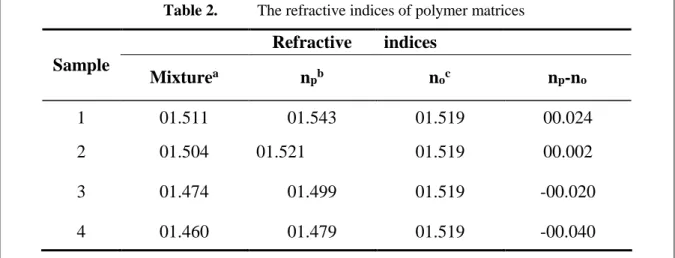
As shown Table 2 the refractive indices (np) of the
smart glass domain size. While, it is to note down that the amount of mismatching of the refractive indices improved at first, and then decreased from all samples. Well-built mismatching amount of the refractive indices of smectic liquid crystal domain size and the droplets shows, the lesser is the Toff in smart films glass [17]; as shown in Figure 2.
4. Conclusions
In this study, the optimized condition for fabricating smart glass thin PDLC films containing liquid crystal (LC) was found to be the weight% of LC 20%.We have been investigated two PDLC film system. At 5.0 hrs at 90°C using curable epoxy resins with heat curing processes mol%, composition ratio, various molecular structures and
at different mol feed ratio catalyst
Tris(hydroxymethyl)amine (THMA), which effects the morphology of the PDLC systems. Moreover, the effect on microstructures of the PDLC systems was strongly influenced by the hydroxyl group (-OH), which in turn influenced the morphology of PDLC system. Moreover, using different mol% THMA variable driving voltages were optimized. Moreover, using different mol% THMA variable driving voltages were optimized. In the intervening time, the refractive index of the thin films droplets lesser with growing sequence distance end to end of epoxy resins di-functional EGDE and tri-functional TMPTGE have an effect on the abridged mismatching among np and no; therefore, turn on condition the transmittance is simplified. As a result, smart glass thin PDLC films will assist
further to know the scope of epoxy resins and nematic LCs for additional developments in the smart glass thin films technology.
Acknowledgment
This work was supported by the HEC fund for distinguished Young Scholars and the research fund of the State Key Laboratory for Advanced Metals and Materials. The authors wish to express appreciation to the State Key Laboratory of Chemical Resource Engineering (BUST) and QUA University for laboratory experiment support and technical assistance.
References
[1] Doane, J. W., Vaz, N. A., Wu, B. G., & Žumer, S. (1986). Field controlled light scattering from nematic microdroplets. Applied Physics Letters, 48(4), 269-271.
[2] Bahadur, B. (Ed.). (1992). Liquid Crystals -
Applications and Uses, Singapore: World Scientific.
[3] Kitzerow, H. S. (1994). Polymer-dispersed
liquid crystals from the nematic curvilinear aligned phase to ferroelectric films. Liquid Crystals, 16(1), 1-31.
[4] Kim, Y. B., Park, S., & Hong, J. W. (2009).
Fabrication of flexible polymer dispersed liquid crystal films using conducting
polymer thin films as the driving
electrodes. Thin Solid Films, 517(10), 3066-3069.
[5] Park, S., & Hong, J. W. (2009). Polymer dispersed liquid crystal film for
variable-transparency glazing. Thin Solid
Films, 517(10), 3183-3186.
Table 2. The refractive indices of polymer matrices
Sample
Refractive
indices
Mixture
an
pbn
ocn
p-n
o1
01.511
01.543
01.519
00.024
2
01.504
01.521
01.519
00.002
3
01.474
01.499
01.519
-00.020
5 [6] Ellahi, M., Gao, Y., & Rafique, M. Y. (2013).
Influence of enhanced curing temperature of epoxy monomers structure on the electro-optical properties and morphology of polymer-dispersed liquid crystal films. American Journal of Engineering Research, 2(3), 01-06.
[7] Lee, S. H., Lee, S. L., & Kim, H. Y. (1998). Electro-optic characteristics and switching principle of a nematic liquid crystal cell controlled by fringe-field switching. Applied physics letters, 73(20), 2881-2883.
[8] Ellahi, M., Gao, Y., & Yang, H. (2013). Effects of di and tetra functional epoxy monomers structure on the morphology and the electro-optical properties of polymer-dispersed liquid crystal films. International
Journal of Science and Technology
Research, 2(3), 127-131.
[9] Yun, H. J., Jo, M.H., Jang, I. W., Lee, S.H.,
Ahn, S. H., Hur, H.J. (2012). Achieving high light efficiency and fast response time in fringe field switching mode using a liquid crystal with negative dielectric anisotropy. Journal of Liquid Crystals, 39, 1141-1148. [10] Ahmad, F., Jamil, M., Woo, L. J., & Jeon, Y.
J. (2012). The investigation of molecular affinity involved in poly (ethylene glycol)-based polymer-dispersed liquid crystal display. Colloid and Polymer Science, 290(7), 599-606
[11] Ahmad, F., Jamil, M., Lee, J. W., Ri, Y. H.,
& Jeon, Y. J. (2014). Characteristics of di-and tri-block copolymers: polymer disperse liquid crystal display. Journal of Modern Optics, 61(12), 1027-1032.
[12] Murai, H., & Gotoh, T. (1993). Stabilization of epoxy-based polymer-dispersed liquid crystal films by addition of excess hardener. Molecular Crystals and Liquid Crystals, 226(1), 13-23.
[13] Ellahi, M., Liu, F., Song, P., Gao, Y., Cao, H., Rafique, M. Y., Khaskheli, M. A., Iqbal, M. Z., Yang, H. (2013). Influence of the multi-functional epoxy monomers structure
on the electro-opticalproperties and
morphology of polymer-dispersed liquid crystal films, Journal of Polymer Bulletin,70 (11), 2967-2980.
[14] Ellahi, M., Liu, F., Song, P., Gao, Y.,
Rafique, M. Y., Khan, D. F., Cao, H., Yang,
H., (2014). Characterization and
Morphology of Polymer-Dispersed Liquid
Crystal Films. Journal of Soft
Materials,12(3),339-345.
[15] Sarkar, M. D., Gill, N. L., Whitehead, J. B.,
& Crawford, G. P. (2003). Effect of monomer functionality on the morphology and performance of the holographic transmission gratings recorded on polymer dispersed liquid crystals. Macromolecules, 36(3), 630-638.
[16] Song, P., Yu, L., Cao, H., Wang, F., Liu, F.,
Zhang, C., Yang, H. (2012). Studies on
electro-optical properties of polymer
dispersed liquid crystal films based on epoxy resins prepared by UV-initiated cationic polymerisation. Liquid Crystals, 39(3), 313-321.
[17] Song, P., Cao, H., Wang, F., Liu, F., Wang,
J., Ellahi, M., Yang, H. (2012). The UV polymerisation temperature dependence of polymer-dispersed liquid crystals based on epoxies/acrylates hybrid polymer matrix components. Liquid Crystals, 39(9), 1131-1140.