Sharif University of Technology
Scientia IranicaTransactions E: Industrial Engineering www.scientiairanica.com
Analysis of network trust dynamics based on the
evolutionary game
F. Liu
a;, L. Wang
a, H. Johnson
band H. Zhao
ca. School of Management Science and Engineering, Shandong Normal University, Ji'nan 250014, China. b. Faculty of Computer Sciences, Blekinge Institute of Technology, 371 41, Karlskrona, Sweden.
c. Department of Computer Science, University of California Davis, One Shields Ave., Davis, CA, 95616, USA. Received 6 December 2012; received in revised form 26 August 2014; accepted 15 November 2014
KEYWORDS Trust;
Trust dynamics; Game theory; Evolutionary game.
Abstract. Trust, as a multi-disciplinary research domain, is of high importance in the area of network security and it has increasingly become an important mechanism to solve the issues of distributed network security. Trust is also an eective mechanism to simplify complex society, and is the source to promote personal or social cooperation. From the perspective of network ecological evolution, we propose the model of the P2P Social Ecological Network. Based on game theory, we also put forward network trust dynamics and network eco-evolution by analysis of network trust and the development of the dynamics model. In this article, we further analyze the dynamic equation, and the evolutionary trend of the trust relationship between nodes using the replicator dynamics principle. Finally, we reveal the law of trust evolution dynamics, and the simulation results clearly describe that the dynamics of trust can be eective in promoting the stability and evolution of networks.
© 2015 Sharif University of Technology. All rights reserved.
1. Introduction
The P2P network is composed of nodes with dierent functions, structure and service. These nodes not only involve cooperation but also competition that aggravates the instability and disorder of the network because of the existence of free riders and malicious nodes. How to promote cooperation between nodes is very important in P2P. As known, emergence and maintenance of cooperation are the most interesting and baing problems in social and ecological net-works [1-7]. One way to approach the problem is the possibility of using evolutionary game theory [8-12], in which the game is an interaction model in the competition between micro-individuals. As long
*. Corresponding author. Tel.: 86-531-86180509; Fax: 86-531-86180510
E-mail addresses: [email protected]; and [email protected] (F. Liu)
as contradiction, competition and cooperation exist between micro-individuals, the micro-dynamics evolu-tionary mechanism can be described by a game theory model. P2P networks, social networks and ecolog-ical networks have striking similarities. Therefore, analyzing the dynamic characteristics of cooperation between the nodes in the P2P network is a chal-lenging subject and also the focus of the proposed research.
In 1961, Lewontin rst applied the thought of game theory to biological science [13], describing the interaction between species and the natural environ-ment. In 1973, Smith and Price completed their famous paper \The logic of animal conict" [14]. With the perspective of individual choice and the application of game theory, this paper further explains why ghts between animals are always of limited aggression, and never cause serious damage. This is the rst time that game theory has formally been applied to evolution. Game theory is developed based on the understanding
that all involved individuals are rational. Therefore, the idea of game theory is applied to biological sciences with three key changes:
1. Change of strategy connotation: In evolutionary game theory, \survival of the ttest" becomes the basis of strategy selection for players;
2. Change of Equalization: The Evolutionary Stable Strategy (ESS) [14] proposed by Smith and Price is the \Nash Equilibrium" of the evolutionary game. That is, if all individuals in a population have adopted a certain strategy and, at this time, a handful of any other mutation strategies cannot invade this population, this strategy is called evo-lutionary stable. This specic strategy is called the evolutionary stable strategy. Each evolutionary stable strategy must be the Nash equilibrium, but only strict Nash equilibrium is an evolutionary stable strategy [15];
3. Changes in connotation of individual interaction: In evolutionary game theory, the game individual interacts by random matching [16], and this interac-tion of the evoluinterac-tionary game has been thoroughly studied [1,17-19] in a complex network.
Due to the connotative change of the above three important concepts, evolutionary game theory en-dows dynamic evolutional ideas with a static decision-making process. This process not only enriches and promotes the development of the theory of biological evolution, but also makes evolutionary game theory into an important theoretical technology in ecological stability analysis and micro-economic analysis. Since then it has been widely applied to economic, social and behavioral sciences [20-22].
The classic game theory is based on players with the assumption of \perfect rationality", demanding that actors should have sound judgment and forecast-ing capabilities, and always pursue their own interests to the maximum. But, Alchian [23] believes that in the real world, the future is uncertain and information is also incomplete. Therefore, perfect rationality is not common under those constraint conditions. He originally proposed a system evolution model based on the thought of \natural selection", which is a biological evolution. In this model, people adapt to the changing environment and survive through imi-tative and trial-and-error behavior. In addition, the \replicated dynamic" [14] mechanism assumes that the players are bounded rationally, and decides the be-havior strategy through imitation and trial-and-error. The adjustments of the dynamic strategy and evolu-tionary stability are obtained through the repeated game. Moreover, Smith introduced the concept of the evolutionary stable strategy in [13], and noted that in biological populations, all individuals use a strategy.
Trust is a subject of strong theoretical signi-cance and realistic meaning. It is related to human behavior, which changes due to the uncertainty of the environment. Accurately understanding the change of human behavior in a variety of situations is important to dene trust. Trust involves interpersonal interaction strategies, dependent relationships, and game theory. Game theory studies strategy interaction and oers an alternative perspective to profoundly reveal the important role and production mechanism of trust. Therefore, research on trust based on game theory is quite common in sociology, economics, politics, and other disciplines [24-31].
Trust is further an important topic in the area of Online Social Networks (OSNs) in which a number of uncovered and potential problems occurs [32-35]. Several of these issues are highly related to the area of trust in P2P networks and the evolution of future networks in which OSN and the introduction of social interaction has created a way to mimic real human communication using the Internet. For example, by services like Facebook, Twitter and Google+ it is now possible to interact and share feelings and images by ooding your social network with information related to your daily activities in a way not possible before the era of OSNs.
In computer science, game theory mainly con-centrates on applied research of the resource sharing incentive mechanism; typically, trust and cooperation. Namely, it is how to make nodes cooperate with each other by taking eective strategies. Previous research is based on the simple pure strategy game and there is little research involving the dynamic, uncertainty trust game [36]. In [37], a model of the \prisoners' dilemma" in the P2P le sharing network is proposed. However, it only proposes some feasible methods of establishing the incentive mechanism, and has not been able to adapt to the self-organization management model. Non-cooperative repeated game theory is applied to the study of incentives in packet routing forwarding by Blanc et al. [38]. The distributed algorithm to adapt to a self-organization management model is also not given. In addition, Buragohain et al. [39] gave a non-cooperative game model in the P2P network resource sharing. Also, a majority of the current research projects are concentrated on Ad Hoc Networks [26-28] and not on P2P networks.
Trust is the vital basis of cooperation. So, this paper is based on evolutionary game theory to analyze the dynamics characteristics of trust and its trends of evolution and evolutionary stability. Moreover, it demonstrates that trust is an important mechanism to reduce network security risks and maintain network stability. First, based on social and ecological networks, we propose the model of the P2P Social Ecological Network. Then, we analyze the strategy choice of the
populations, and get the Evolutionary Stable Strategy in the P2P Social Ecological Network.
The rest of the paper is organized as follows. The dynamics model of trust and its analysis is presented in Section 2. Section 3 shows the simulation experiments and also presents the evaluation of the results. Finally, our work is concluded in Section 4.
2. Dynamics model of network trust 2.1. P2P social ecological network
Ecology is a subject studying the relationships be-tween biology, people and the environment, and the functional structure of natural ecological and human ecology systems. The basic principles of ecology can be applied to not only biology but also production activities in which human beings are engaged. From social ecology, network speeding development will lead to a series of questions between various factors within the network, as well as the network and other related social environments. All other social systems that aect network development constitute the ecological environment of network development, i.e. interaction and mutual inuence between the ecological environ-ments is analyzed with an eye towards connections and development, which are then formed as a network ecosystem.
In complex and dynamically changing environ-ments, such as P2P networks, the interactions and transfer of information between services are sometimes uncertain and continuously changing, which makes the network system more dynamic. In addition, evolu-tional results of these long-term processes will make development of the dynamic and organic system much more self-organizing. Eventually, the whole system achieves stability and evolution through interaction and collaboration between nodes.
In our proposed work, we are inspired by mech-anisms in ecological and social networks in order to analyze the evolutionary stability of P2P networks. In P2P networks, we put node groups of dierent types, such as normal, malicious, and free-rider class node groups, as dierent populations in the ecological network. We can also place a virus as an invasion population, as part of the P2P network social ecology. The following section describes several denitions. Denition 1. P2P networks are social-ecological net-works, expressed as PSEnet < G; R >. Among them,
G represents the set of the population in the network, R represents the relationships between the ecological nodes in the population, and the relationships between the populations will emerge by the relationships of the nodes.
Denition 2. The population set is dened as G =
(G1; G2; ; Gn), where Gi(i = 1; ; n) denotes one
population in the ecological network. Viruses or Trojan horses constitute one or more populations.
Denition 3. The same types of ecological node are dened as a population, Gi = (g1; g2; ; gm), and
among them, gj(j = 1; ; m) is an ecological node
in the P2P networks.
Denition 4. Relationship sets are dened as R = (r11; r12 ; rij; ; rmn) among ecological nodes
where rij(i = 1; ; m; j = 1; ; n) represents the
relation between ecological nodes within one or two populations.
The ecological node in the network with people in social networks has limited rationality because of understanding limitations and network knowledge limi-tation regarding the information of other nodes. At the same time, it is selsh, has opportunistic tendencies, and is determined, by its nature, to pursue its own long-term optimization outcome (such as the degree of safety). The ecological nodes interact with each other according to their strategies, which provide the ecological power for network evolution. As a result, we can consider the behavior of this interaction between nodes as game behavior, and the behaviors of an ecological node occur in order to help it survive in the network and pursue its own interests. The interactive process is the game process driven by the dierent strategies adopted by the nodes.
Denition 5. PSEnet is a nite set, S = (s1; s2;
:::; sw), in the network eco-node behavior policy set.
It is called strategy space in which the nodes randomly select strategy sy(y = 1; ; w) in order to interact in
the games.
A complex social ecological network, such as the P2P network system, is made up of a variety of relationships produced by dierent species and their interaction. Nodes in multiple or single populations follow dynamic and self-adjustment evolutionary game theory to compete for limited network resources, such as storage resources, computing resources and network bandwidth, which provide the power for the network ecological evolution.
2.2. Trust dynamics model
A social network is formed by interaction between people and organizations. It is their behavior that forces the social development and evolution of the ecological network. Therefore, we use abstract force models and principles to explain and analyze the cooperative evolution and network stability. Both the relationship formed between nodes and the inuence from the context nodes are inuential properties.
Figure 1. Dynamics model of network trust.
they must consider their safety. Cooperation, the core of P2P, means taking risks. It cannot guarantee the stability of the network. We propose to use the Trust of the Dynamics between the nodes to study the evolution stability and the evolution rule of network ecology. Figure 1 depicts the network trust calculation dynamic model proposed in this article.
The trust dynamics process can be described as follows:
1. Collection and storage of trust evidence;
2. Calculation of trust (taking into account the con-text);
3. Choice of trust strategy;
4. Evaluation of interaction behavior, namely feed-back.
Denition 6. Trust dynamics in the P2P service environment is concerned with network stability and evolution based on node trust strategy, interaction and feedback.
2.3. Trust dynamics analysis
To simplify the discussion on the above model, the evolution game is studied between the nodes in a single population (that is, the same type of node population), where nodes provide or consume services (such as le sharing).
Denition 7. The probability distribution function of interactive strategies adopted by players (Network Ecosystem node) is P = (p1; p2; ; pw) where py
is the probability of the node selection strategy, sy,
Pw
y=1py= 1 (y = 1; ; w).
Denition 8. A game is an interaction of two rational nodes. The benet function of a game is u whose value is related to the strategy used by both sides.
The probability of selecting interactive game strategy, pi, changes over time, which can be expressed
as a function of time pi(t). For simplicity, it can still
be expressed as pi.
The expected probability of a node, y, to choose pure strategy, sy, is:
uy = py u(sy): (1)
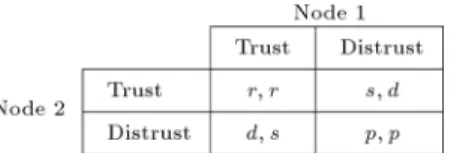
Figure 2. The Benet matrix of node 1 and node 2 in game.
The earnings of the px selected mix strategy, sx, as:
ux= w
X
x=1;x6=y
(px u(sx)): (2)
By Eqs. (1) and (2), we understand that the replicated dynamic equation of the node game is:
dpy
dt = py 0
@py u(sy) w
X
x=1;x6=y
(px u(sx))
1 A : (3) There are various strategies and dierent types of relationship between nodes. The core of the whole network stability depends on the cooperation during the interaction process. In order to discuss the trend and stability of the evolution, we focus on the trust relationship and assign two values to it; trust and distrust. Figure 2 shows the benet matrix of both sides in a game. Among them, r denotes the benet when both parts choose trust strategy in a game. If only one party's strategy is dened by trust, s denotes the benet of the trusting party and d denotes the benet of the distrusting party. p denotes the benet of both parts when they choose the distrust strategy.
In the famous \prisoners' dilemma", the only case, where Nash equilibrium exists, is when both parts choose the distrust strategy. However, when the nodes consider long-term survival in the network, they adopt the mutual trust strategy to continue the game. This is called `Game Rened Nash equilibrium' in non-cooperative game theory. We introduce non-cooperative game theory to the P2P network and use it to analyze and solve the trust evolution among nodes. The theory guarantees the strategy equilibrium and the stability of the network evolution.
We also use the \replicated dynamic" mechanism to solve the game model with two nodes. Among them, the nodes choose a strategy with transcendental behav-ior probability to each game, correct the transcendental probability through imitation, trial and error, and evolve to the posteriori probability.
We assume that the probability of choosing a trust strategy probability at the rst stage is x, and the probability of using the distrust strategy is 1 x.
Therefore, the node's benet, u1, to choose the
trust strategy is:
u1= x r + (1 x) s: (4)
is then:
u2= x d + (1 x) p: (5)
Thus, the node average benet, u, is:
u = x u1+ (1 x) u2: (6)
Here, if we assume r = 1, and s, d, and p are zero, the benet of nodes with the trust strategy is higher than nodes with the distrust strategy. It is also higher than the average benet, based on the above formula, unless all nodes choose the distrust strategy (the reason is 0 < x < 1, so u1 = x >
x2 = u > 0). This will be discovered by the distrust
node, in which it will change its strategy in order to get higher benet. Therefore, the proportion of nodes with dierent strategy is changing with time, i.e. the changing rate can then be expressed by the following dynamic dierential equation:
dx
dt = x (u1 u): (7)
This dierential equation is called the replicated dy-namic equation. The reason is that it is consistent with the equation that describes the natural selection process of frequency changing of an individual's specic traits in biological evolution.
F (x) denotesdx
dt, and we obtain the next equation
from Eqs. (4) to (7): dx
dt = F (x) = x (1 x) (x (r d) + (1 x)
(s p)): (8)
We rst obtain the stable solution of the replicated dynamic equation, if we consider the Evolutional Stable Strategy (ESS) of the game. That is, the proportion of nodes with trust or distrust strategies remain un-changed in the calculation process of the replicated dynamic equation. Then, we can analyze the stability of these steady-state elds, i.e. it will maintain the equilibrium state, even with small deviation distur-bance. In Figure 3, we can see the evolution rule for two kinds of proportion nodes.
To set F (x) = 0, we can obtain the three following solutions:
x1= 0; (9)
x2= 1; (10)
x3= r d + p sp s : (11)
According to the stability principle of dierential equa-tions, we know that the derivative of a function must be less than 0 at the steady state, that is F (x) < 0, and
x is the ESS. Therefore, to make the trust strategy
become an ESS in the network evolution, we further need to discuss the value of r, s, d, and p.
Figure 3. State diagram of trust dynamics equation (assuming r = 1, and s, d and p are zero).
2.4. Trust strategy stability analysis
Thus, if the trust strategy becomes an ESS, it should meet the following conditions:
1. F0(x
1= 0) < 0,
2. F0(x
2= 1) < 0,
3. 0 < x3= r d+p sp s <12.
Next, we discuss the parameters, r, s, d, and p, and analyze the trust strategy of how to obtain the ESS in the network evolution:
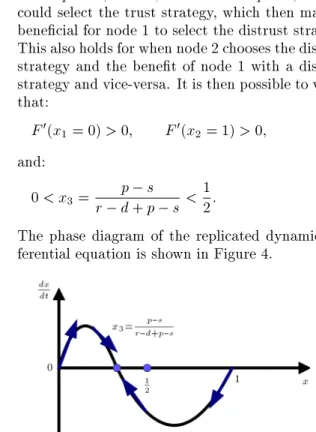
1. When p < s, r < d, and r d > p s, node 2 could select the trust strategy, which then make it benecial for node 1 to select the distrust strategy. This also holds for when node 2 chooses the distrust strategy and the benet of node 1 with a distrust strategy and vice-versa. It is then possible to verify that:
F0(x
1= 0) > 0; F0(x2= 1) > 0;
and:
0 < x3= r d + p sp s < 12:
The phase diagram of the replicated dynamic dif-ferential equation is shown in Figure 4.
Figure 4. Partial phase diagram of the replicated dynamic equation.
It can be seen from Figure 4 that the tangent slope at x = x3 is lower than 0, and the tangent
slope at x1 = 0 and x2 = 1 is greater than 0. It
can also be seen from Figure 4 that the number of nodes with trust strategy will eventually stabilize around x3, and the number of nodes with distrust
strategy is 1 x3, following that 1 x3> x3.
2. When p < s, r < d, and r d < p s, it is similar as for case 1. It is then also possible to verify that:
F0(x
1= 0) > 0; F0(x2= 1) > 0;
and: 1
2 < x3=
p s
r d + p s < 1:
The phase diagram of the replicated dynamic dif-ferential equation is then shown in Figure 5.
It is further possible to verify (in Figure 5) that a similar tangent slope evaluation is obtained as for case 1 and Figure 4.
3. When p > s, r > d, and r d > p s, a trust strategy for node 2 is benecial, which also makes the trust strategy more benecial for node 1 compared to a distrust strategy. This also holds for the distrust strategy for both nodes. This is then veried by:
F0(x
1= 0) < 0; F0(x2= 1) < 0;
and:
0 < x3=r d + p sp s < 12;
with a phase diagram presented in Figure 6.
Figure 5. Partial phase diagram of the replicated dynamic equation.
Figure 6. Partial phase diagram of the replicated dynamic equation.
It can be seen from Figure 6 that the tangent slope at x3is greater than 0, and the tangent slope
at x1 and x2 is lower than 0. Therefore, x3 is not
an evolutionary stable strategy, and x1 and x2 are.
The two strategies of trust and distrust are likely to be used by both sides of the game node, but because:
0 < x3=r d + p sp s < 12;
it can be seen that the probability of using a trust strategy is greater than the probability of using a distrust strategy.
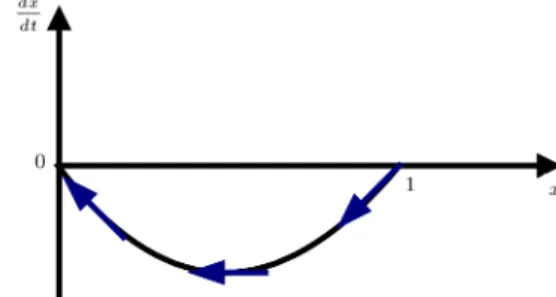
4. When p > s, r > d and r d < p s, it is similar as for case 3. At this time, there are also:
F0(x
1= 0) < 0; F0(x2= 1) < 0;
and: 1
2 < x3=
p s
r d + p s < 1;
and the phase diagram is shown in Figure 7. The probability of using a trust strategy is then lower than the probability of using a distrust strategy;
5. When p > s and r < d, it does not matter if node 1 chooses the trust or distrust strategy. The benet of node 2 with a distrust strategy is always more than the benet with a trust strategy. That is, when F0(x1 = 0) < 0 and F0(x2 = 1) > 0 (the phase
diagram is shown as in Figure 8), it can be seen that x1is the stability strategy, while x2is not. So,
Figure 7. Partial phase diagram of the replicated dynamic equation.
Figure 8. Partial phase diagram of the replicated dynamic equation.
Figure 9. Partial phase diagram of the replicated dynamic equation.
all the players in the game tend to use the distrust strategy;
6. When p < s and r > d, it does not matter if node 1 chooses the trust or distrust strategy. The benet of node 2 with a trust strategy is always more than the benet of choosing a distrust strategy. That is, when F0(x
1 = 0) > 0 and F0(x2 = 1) < 0 (the
phase diagram is shown in Figure 9), it can be seen that x2is the stability strategy, while x1is not. So,
all the players in the game tend to use the trust strategy.
By the above analysis, trust is an evolutionary stable strategy in an ideal situation, when F0(x2=
1) < 0. In general, it is normal for players in a game to adopt the two strategies. However, making the trust strategy evolve to ESS, by regulating certain mechanisms, is important, while maintaining net-work stability and security. Therefore, the players will tend to select the trust strategy as long as p < s and r > d. In addition, r d >>> p s (the meaning of the symbol >>> is much larger than >), even though F0(x
1= 0) < 0, in which a stable
strategy exists.
With x3 = r d+p sp s ! 0, the proportion of nodes
with a distrust strategy will gradually decrease through continuous imitation, and trial and error. Finally, it will achieve a stable small scale level, as depicted in Figure 7, developed from the state of Figure 4. It can also be observed that it will ultimately tend to the stability of the trust strategy. Even though a small number of nodes occasionally deviate, wherein they choose a distrust strategy, the replicated dynamic mechanism will make it back to a stable level. In this way, trust is the only evolutionary stable strategy.
After analyzing two dierent strategies of the trust evolution game, from their motivation to punish-ment mechanism regulations, which change the game matrix parameters, it can be seen that the convergence speed to a stable state of trust strategy is faster than that of a distrust strategy. In the evolutional process of a trust game, the new game strategy depends on the current strategy, and the process also meets the property of a Markov chain. This Markov chain
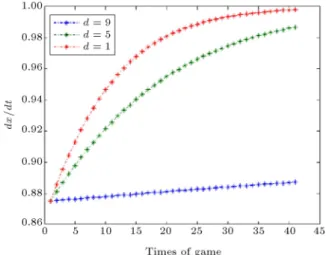
Figure 10. Dierent dx
dt with d when r = 10, s = 1, and p = 1.
is homogeneous, because the evolutional transition probability does not depend on time in the evolutionary process. Instead, it shows that the evolution of the strategy can converge. It also conrms that the trust strategy will eventually become an evolutionary stable strategy in a network evolution.
3. Experimental simulation analysis
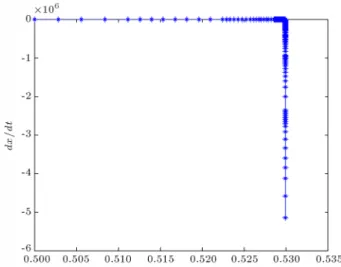
1. If we assume that r = 10, s = 1, p = 1, and p s = 2 for d = 9, d = 5, and d = 1, the changing curve of dx
dt is then shown in Figure 10.
It is observed in Figure 10 that when the gap between r d and p s is bigger and bigger, the change of dx
dt is quite obvious. That is, the relative
change between the proportion of nodes with a trust strategy is possible to detect, as the adjustment mechanism obviously works. Similarly, as long as p < s, r > d, and r d >>> p s, the players constantly adjust their strategy through trial and error, and imitation. Similarly, adjusting the other parameter values, as long as the above conditions are met, will lead to the same results.
2. If we assume that:
(1) r = 10, s = 1, p = 1, and d = 1,
(2) r = 10, s = 1, p = 1, and d = 1,
(3) r = 1, s = 1, p = 1, and d = 10,
(4) r = 1, s = 1, p = 1, and d = 10,
we can get four dierent curves, respectively, as shown in Figures 11-14.
In the rst case, the trust meets the conditions of the evolutionary stable strategy. So, when x is small, the curve also changes more quickly. In addition, when x is of a bigger number, the curve changes more slowly.
In the second case, when a node chooses the distrust strategy, the best choice of another node is
Figure 11. Function picture when r = 10, s = 1, p = 1, and d = 1.
Figure 12. Function picture when r = 10, s = 1, p = 1, and d = 1.
Figure 13. Function picture when r = 1, s = 1, p = 1, and d = 10.
then to select the distrust strategy. It can then be seen, from Figure 12, that the change of the curve is relatively smooth.
Figure 14. Function picture when r = 1, s = 1, p = 1, and d = 10.
In the third case, when the other side chooses the trust strategy, our own strategy is to choose the distrust strategy. Then, when the other side selects the distrust strategy, our own strategy will be the choice of trust, which is completely tit-for-tat.
And in the fourth case, when the other side chooses the trust strategy, our own strategy is to choose the distrust strategy. Then, when the other side selects the distrust strategy, our own strategy will also be the choice of distrust. In Figure 14, the choice of this strategy can be seen. Moreover, before x reaches a certain threshold, the changes of dx
dt cannot be seen.
However, when the threshold is reached (although the function value does not change much), the value of x does not make any signicant changes.
From the above simulation, it can be concluded that for the node selection of a trust strategy in the network, and as long as eective control measures are taken, it can make trust the stable strategy of evolu-tion. This will then provide an eective mechanism for network security and stability. Thus, the realization of trust depends on the adjustment of parameters, that is, for the network node to take corresponding incentive measures related to reward or punishment behaviors.
4. Conclusion
This paper is based on the ecological evolution mech-anism, and its major contribution is a proposed P2P social ecological network using the evolution game and replicated dynamic mechanism. It analyzes the dy-namic evolution tendency and simulates the evolution of a single type of service network. It is further noticed that in order to make the network evolution stable and the service performance optimized for a reliable and trustworthy environment, the network should adjust
the income of an interaction strategy in the game and set up a corresponding incentive and punishment mechanism. Thus, nodes in the network could achieve eective cooperation and the trust strategy will become the stable strategy of the interactive nodes. The network will then obtain a service of higher security and trust between the cooperating nodes.
This paper also discusses the maneuverability and feasibility of network trust and security through simplied and proposed trust game model. In future re-search, multi-group (multi-services) and multi-strategy matching will be further elaborated upon to randomly undertake the feasibility and operability of trust game evolution and provide a reference model for network service optimization and for the stability of the whole network. This will, hopefully, create a perfect trust mechanism of network security and oer more powerful tools for a further stability evolution and optimization service related to P2P networks.
Acknowledgement
This work was supported in part by the National Natural Science Foundation of China (No. 61170038, 61472231), the National Social Science Foundation of China (No. 14BTQ049), the Natural Science Foun-dation of Shandong Province (ZR2012FM013), and a project of International Cooperation in the Training of Excellent Backbone Teachers for Advanced University in Shandong Province.
References
1. Szab, G. and Fath, G., \Evolutionary games on graphs", Physics Reports, 446, pp. 97-216 (2007).
2. Ohtsuki, H., Hauert, C., Lieberman, E. and Nowak, M.A. \A simple rule for the evolution of cooperation on graphs and social networks", Nature, 441, p. 502 (2006).
3. Nowak, M.A. and Sigmund, K. \Evolution of indirect reciprocity", Nature, 437, p. 1291 (2006).
4. Nowak, M.A. \Five rules for the evolution", Science, 314, p. 1560 (2006).
5. Bowles, S. \Group competition, reproductive leveling, and the evolution of human altruism", Science, 314, p. 1569 (2006).
6. Boyd, R. \The puzzle of human sociality", Science, 314, p. 1555 (2006).
7. Traulsen, A. and Nowak, M.A. \Evolution of cooper-ation by multilevel selection", PANS, 103, pp. 10952-10955 (2006).
8. Axelrod, R. and Hamilton, W.D. \The evolution of cooperation", Science, 211, p. 1390 (1981).
9. Allen, B., Traulsen, A., Tarnita, C.E. and Nowak, M.A. \How mutation aects evolutionary games on
graphs", Journal of Theoretical Biology, 299, pp. 97-105 (2012).
10. Rand, D.G. and Nowak, M.A. \Evolutionary dynam-ics in nite populations can explain the full range of cooperative behaviors observed in the centipede game", Journal of Theoretical Biology, 300, pp. 212-221 (2012).
11. Shakarian, P., Roos, P. and Johnson, A. \A review of evolutionary graph theory with applications to game theory", Biosystems, 107, pp. 66-80 (2012).
12. Szab, G. and Szolnoki A. \Selshness, fraternity, and other-regarding preference in spatial evolutionary games", Journal of Theoretical Biology, 299, pp. 81-87 (2012).
13. Smith, J.M., Evolution and the Theory of Games, Cambridge University Press, Cambridge (1982).
14. Smith, J.M. and Price, G.R. \The logic of animal conict", Nature, 246, p. 15 (1973).
15. Hofbauer, J. and Sigmund, K., Evolutionary Games and Population Dynamics, Cambridge University Press, Cambridge (1998).
16. Want, R., Hopper, A., Falcao, V. and Gibbons, J. \The active badge location system", ACM Transactions on Information Systems, 1, pp. 91-102 (1992).
17. Nowak, M.A. and May, R.M. \The Spatial dilemmas of evolution", International Journal of Bifurcation and Chaos, 3, pp. 35-78 (1993).
18. Nowak, M.A., Bonnhoefer, S. and May, R.M. \More spatial games", International Journal of Bifurcation and Chaos, 4(1), pp. 33-56 (1993).
19. Herz, A.V.M. \Collective phenomena in spatially ex-tended evolutionary games", Journal of Theoretical Biology, 169, pp. 65-87 (1994).
20. Turner, P.E. and Chao, L. \Prisoner's dilemma in an RNA virus", Nature, 398, p. 441 (1999).
21. Nowak, M.A., Sasaki, A., Taylor, C. and Fudenberg, D. \Emergence of cooperation and evolutionary stability in nite populations", Nature, 428, p. 646 (2004).
22. Nowak, M.A. and Sigmund, K. \Evolutionary dynam-ics of biological games", Science, 303, p. 793 (2004).
23. Alchian, A. \Uncertainty, evolution, and the economic theory", The Journal of Political Economy, 58, pp. 211-221 (1995).
24. Berg, J., Dickhaut, J. and McCabe, K. \Trust, reci-procity, and social history", Games and Economic Behavior, 10, pp. 122-142 (1995).
25. McCabe, K., Rigdon, M. and Smith, V.L. \Positive reciprocity and intentions in the trust game", Journal of Economic Behavior and Organization, 52, pp. 267-275 (2003).
26. Boyd, R. and Lorberbaum, J. \No pure strategy is evo-lutionarily stable in the repeated prisoner's dilemma game", Nature, 327, pp. 58-59 (1987).
27. Keller, L. and Reeve, H.K. \Familiarity breeds coop-eration", Nature, 394, pp. 121-122 (1998).
28. Lotem, A., Fishman, M.A. and Stone, L. \Evolution of cooperation between individuals", Nature, 440, pp. 226-227 (1999).
29. Ding, Y., Liu, F. and Tang, B. \Context-sensitive trust computing in distributed environments", Knowledge-Based Systems, 28, pp. 105-114 (2012).
30. Liu, F., Li, X., Ding, Y., Zhao, H., Liu, X., Ma, Y. and Tang, B. \A social network-based trust-aware propagation model for P2P systems", Knowledge-Based Systems, 41, pp. 8-15 (2013).
31. Bohnet, I. and Kubler, D. \Compensating the coop-erators: is sorting possible in the prisoner's dilemma game?", Journal of Economic Behavior and Organiza-tion, 56, pp. 61-67 (2005).
32. Erlandsson, F., Johnson, H. and Boldt, M. \Privacy threats related to user proling in online social net-works", Proceedings of the Third International Work-shop on Security and Privacy in Social Networks 2012 (SPSN-2012) in Conjunction with IEEE SocialCom (2012).
33. Liu, F., Wang, L., Gao, L., Li, H., Zhao, H. and Sok Khim Men \A web service trust evaluation model based on small-world networks", Knowledge-Based Systems, 57, pp. 161-167 (2014).
34. Johnson, H., Lavesson, N., Zhao, H. and Wu, S.F. \On the concept of trust in online social networks", Trustworthy Internet, Part 3, Springer, pp. 143-157 (2011).
35. Bhattacharyya, P., Wu, S.F., Haigh, K., Lavesson, N. and Johnson, H. \Your best might not be good enough: ranking in collaborative social search engines", Pro-ceedings of Seventh International Conference on Col-laborative Computing: Networking, Applications and Worksharing (CollaborateCom), IEEE Press (2011).
36. Osborne, M.J. and Rubenstein, A., A Course in Game Theory, Cambridge, Massachusetts: The MIT Press (1994).
37. Ranganathan, K., Ripeanu, M., Sarin, A. and Foster, I. \To share or not to share: an analysis of incentives to contribute in le sharing environments", Proceedings of the First International Workshop on Economics of Peer to Peer Systems, Cambridge, MA, USA, pp. 1-6 (2003).
38. Blanc, A., Liu, Y.K. and Vahdat, A. \Designing incentives for peer-to-peer routing", Proceedings of the 2nd Workshop on Economics of Peer to Peer Systems, MA, USA, pp. 374-385 (2004).
39. Buragohain, C., Agrawal, D. and Suri, S. \A game theoretic framework for incentives in P2P systems", Proceedings of the 3rd International Conference Peer-to-Peer Computing, Linkoping Sweden, pp. 48-56 (2003).
Biographies
Fengming Liu obtained his PhD degree in Computer Science at Donghua University, China, in 2008, and is currently Associate Professor in the School of Man-agement Science and Engineering at Shandong Normal University, China. His research interests include trust and social computing, p2p computing and game theory, and network behavior dynamics, in which elds he has more than thirty scientic publications.
Li Wang graduated from the School of Manage-ment Science and Engineering at Shandong Normal University, China, and is currently a Postgraduate recommended for admission without exam. She served as a volunteer of the 15th Teaching Assistance Group of Graduates to teach Mathematics at a high school in Chongqing for one year. Her research interests include social computing, trust management and network ru-mors.
Henric Johnson is Pro Chancellor of Blekinge In-stitute of Technology (BTH) in Sweden, where he is Assistant Professor and Faculty Member in the School of Computing. His research focuses on the relationship between social informatics and trustworthy computing through a combination of network security, internet analysis and social computing. In the past year, he has received several grants from European Union and Swedish foundations. He is a member of twelve conference program committees, including the very prestigious ASONAM, ICCN, CPSCOM, and Social-Com; and he serves as a reviewer for the Journal of Software: Practice and Experience, IEEE Journal of Transactions on Services Computing, IEEE Journal on Selected Areas in Communications, IEEE Global Communications, IEEE Journal of Communications and Networks, among others, while being on the Editorial Board of the Journal of Advanced Computer Science and Technology.
Haifeng Zhao obtained his PhD degree in Computer Science at the University of California, Davis, in 2013. His research interests include data mining, trust and knowledge representation in social media, in which elds he has more than ten scientic publications. He has served on program committees, as well as invited reviewer for many international conferences and journals. He has also worked on big data and mobile projects at several companies, including Google, eBay and Oracle. He currently works at Bloomreach Inc., providing big data platforms and personalized rec-ommendation services to well-known online shopping merchants.