Evaluating the Impact of Distance Learning Support
Systems on the Learning Experience of MBA Students in a
Global Context
Yongmei Bentley, Anjali Shegunshi and Mike Scannell
University of Bedfordshire, Luton, UK
[email protected] [email protected] [email protected]
Abstract: This paper reports the findings from an investigation into the distance learning support systems of a UK University’s overseas MBA programme. This programme is provided to several countries around the world in alliance with the overseas’ local higher educational institutions (HEIs), and is delivered primarily via online courses, but also with periods of face-to-face teaching by both UK and local staff. The aim of the research was to evaluate the learning support mechanisms that are used to deliver this programme overseas, and to determine their impact on the learning experience of the MBA students. The primary research method was questionnaire surveys which were conducted over two periods: April - July 2008, and January - March 2009. The first survey showed a high level of satisfaction with the MBA programme as delivered, but also indicated areas that could see further improvement. The impacts of programme changes were examined in the second survey which revealed students’ improved satisfaction with the programme after the implementation of the changes in the programme support systems. The outcomes of this research have not only helped improve the learning support systems and enhanced the quality of this particular programme, but could also help provide guidelines for other HEIs that offer, or intend to offer, blended learning courses globally.
Keywords: distance learning, support systems, MBA, questionnaire survey, learning experience
1. Introduction
This paper reports the findings from an investigation into the distance learning support mechanisms of a UK University’s overseas MBA programme. The aim was, through the evaluation of the learning support systems that were used to deliver this programme, to determine the impact of such systems on the learning experience of the MBA students. Questionnaire surveys were used and the MBA students who were taking the course were encouraged to complete the evaluation form. The following sections give an overview of the MBA programme; a review of specific literature relevant to this distance learning programme; and sets out the investigation process, the findings from the data analysis, and the implications of the research.
2. Overview of the MBA programme
This University has developed an MBA programme which is being delivered to students in a number of countries around the world. Currently it has centres running MBA courses in the UK, Zurich, Hamburg, Poland, Oman, India, and South Africa. Up to the summer of 2008, the programmes’ total MBA student numbers were 362. Figure 1 gives the percentage of the MBA students from each of the centres.
Figure 1: Student percentages by centre (data updated: June 2008)
ISSN 1479-4403 51 ©Academic Conferences Ltd
Reference this paper as:
Bentley, Y, Shegunshi, A and Scannell, M (2010) “Evaluating the Impact of Distance Learning Support Systems on the Learning Experience of MBA Students in a Global Context” Electronic Journal of e-Learning Volume 8 Issue 2 2010, (pp51 - 62), available online at www.ejel.org
The course structure of the part time MBA programme is illustrated in Table 1. As indicated, the students on this programme are required to take four taught modules plus an applied management project each year, and normally it takes two years (part time) for the students to complete the whole programme.
Table 1: The course structure of this MBA programme
Academic Year/semester Modules
(15 credits each)
Applied Management Projects (30 credits each) Semester 1 Strategic Finance
Marketing Management Year 1
Semester 2 Leading and Management People Operations Management
Executive Development Project
Semester 1 E-Business Management Strategy
Year 2
Semester 2 Entrepreneurship Financial Markets
Leadership Project
The main course contents are delivered to the students primarily online via the University’s virtual learning system ‘BREO’ which provides interactive online and downloadable learning materials specifically written for this MBA programme. This programme also includes periods of face-to-face teaching by both the University’s lecturers and by lecturers from the collaborative higher education institutions. In addition, all MBA students have full online access to the University’s digital library which is accessible twenty-four hours a day and seven days a week. An overview of the approach taken to deliver the programme is given in Figure 2.
Figure 2: Overview of the MBA course delivery approach
As indicated on the left side of the diagram, at the start of each semester the ‘flying faculty’ (lecturers from the Business School of the UK University), with the support of the local institution, conducts an induction to the students of each cohort at the various overseas centres followed by two full days’ face-to-face teaching. The main purpose of doing so is to give the students an overview of each module run in the semester. In addition, the UK lecturers are also in charge of delivering the online course materials such as readings, PowerPoint slides, audio and video clips, podcasting clips, assignment instructions, and so on. In addition, scheduled online audio visual synchronous teaching slots are pre-set for each module using ‘WIMBA live classroom’ which is accessible via BREO. In addition, the local institution (as indicated on the right side of the diagram), with their supporting lecturers and teaching resources, provide six days of face-to-face teaching each semester at the local Business School. The local institution also provides the basic services to fulfil the requirements of the students.
As illustrated in the lower part of Figure 2, the assignments for each module are delivered to students and submitted to the UK lecturers via BREO. They are also marked by these lecturers. The examinations are taken and invigilated at the local institutions, but the scripts are posted to the UK and marked by the UK lecturers. The components and weights of the assessments of this MBA programme are: assignments - 68%, examination - 21%, presentation - 6% and portfolio development - 5%.
½ Day Induction & 2 Days Direct Teaching at Local Institution
6 Days of Direct Teaching
Local support in Co-Ordination with the UK
University Online Course Materials &
WIMBA Live Classroom Discussions
End of the semester Examinations U K U n iv e rs ity
AAsssseessssmmeenntt &&GGrraaddiinngg Assignments &
Marking T
Teeaacchhiinngg
L o c a l U n iv e rs ity
Yongmei Bentley et al.
3. Literature review
3.1 e-Learning and distance learning
The delivery of this MBA programme has elements of both e-learning and distance learning. Therefore, the discussion below will cover features from both.
Compared with conventional face-to-face teaching, e-learning and distance learning have many positive features. A number of points that are seen as relevant to this MBA programme are presented below.
a. Lave and Wenger (1991) state that online learning must not be seen as a stand-alone activity, but has to be regarded as one part of the blended learning context. Mestre (2007) calls for a diversity of learning approaches in online environments so that students can choose those approaches that suit their own learning style best. Therefore, learning styles have to be taken into account both for the conceptual framework and for the design of e-learning systems that are appropriate for a multicultural learner group. Salmon’s (2004) five-stage model of teaching and learning online discusses issues such as access to the e-learning environment and how to motivate learners to participate. Salmon argues that learners are usually capable of handling cross-cultural differences successfully themselves.
b. Instructionally designed online learning materials could create good impact on the online learning experience. Bowyer (2003) carried out a case study based research on multimedia rich distance learning environment and found that students rate the value of this type of educational highly while at the same time they gained a significantly increased depth of understanding of the materials.
c. As online learners are more diverse in nature in terms of culture and learning skills blended learning would prove more beneficial to them as opposed to total online learning. Molphy and Pocknee (2005) report that as students joining online course come from diverse and disparate backgrounds, they often have issues with their learning environment, and require skills and need support that is a combination of face-to-face and online, for example, by using video recorded lectures.
d. In the view of Barbara and Consuelo (2008), group work in online learning could better hold the learner’s interest in learning as it is not just sharing academic knowledge but to share practical knowledge and experience from the fellow students. The analysis of the above authors illustrate that e-learning teams and their efforts to value adult learners in their e-learning solutions are influenced by factors such as team size, team talent, company size, and technology.
e-Learning and distance learning are approached in various ways, and the typical formats are computers and the Internet supported by audio, video and so on. This type of learning often involve the use of some, or all, of the technologies such as desktop and laptop computers, software, interactive whiteboards, digital cameras and videos, mobile and wireless tools, electronic communication tools, including email, discussion boards, chat facilities, virtual classroom and video conferencing, virtual learning environments and managed learning environments, and learning activity management systems (Unknown Author 2009). This MBA programme has used the available technologies in place to facilitate the smooth delivery of the programme.
3.2 Technology Enhanced Learning Environments
As described above, the delivery of this MBA programme to its students of various countries is largely by means of the distance learning support system online, and enhanced by periods of face-to-face teaching by both UK and local lecturers. This type of learning, according to the Joint Information Systems Committee in the UK (JISC 2007), is called ‘technology enhanced learning environments’ (TELE). According to JISC, TELE refers to the specialist area that encompasses both virtual and physical technology-enhanced learning environments which incorporate the four learning elements - physical learning spaces, institutional (virtual) learning environments, personalised learning environments, and mobile and immersive learning environments.
Physical learning spaces: According to JISC (2007), ‘physical learning spaces’ contain many of the traditional learning interactions and activities of learning at HEIs. However, with the emergence of
virtual and online learning opportunities these spaces are being ‘re-conceptualized and re-designed, partly to facilitate more effective use of flexible spaces for learning to improve the learners experience with traditional learning but also to improve the opportunities for informal and mobile learning’. Such spaces may include traditional learning exchanges and uses, blended learning approaches (using mobile and virtual as well as face-to-face learning experiences). They can also include technology-enhanced social spaces and libraries.
Virtual learning environments: Based on Stiles (2000), virtual learning environments (VLE) are designed to focus on learners’ learning activities and their management and facilitation, along with the provision of content and resources required to help make the activities successful. These systems allow students and tutors to interact locally or remotely, and to collaboratively share and generate knowledge in the virtual environment without having to travel out of their local setting.
Personalised learning environments: The term ‘personal learning environments’ (PLE), which was introduced by Wilson et al. (2006), refers to the environments in which individuals can access personal learning resources, tools and services (JISC 2007) that support learners’ individual needs. The drive behind this is to create a more enriched and personalised learning experience for individual and groups of learners.
Mobile and immersive learning environments: ‘Mobile and immersive learning environments’ are, as the name indicates, environments which have mobile or immersive (e.g. 3D) components. These environments may include integrated social software tools, mobile learning, game-based learning, simulation-based learning, producing 'seamless' learning experiences and often place an emphasis upon collaborative learning. The linked areas of such learning environments bring together more experience-based learning that often blends physical and virtual learning to support enriched blended learning experiences (e.g. Kukulska-Hulme and Traxler 2005; de Freitas 2006). The main purpose of such technology-enhanced learning environments is to “explore and develop effective practice in the delivery of flexible, seamless and personalised services to learners, focussing on the technological interface between the learner and their learning environment” (JISC 2007).
According to Goold, Craig, et al (2007), online learning environments can enable a greater number of students of diverse educational and cultural backgrounds as well as modes of study to come together within the one virtual classroom. However, many of the clues that could help enable staff and students to be culturally sensitive in physical classrooms are missing in the online world. Overall, for this and other reasons, it has been suggested that students need better preparation for learning in an online environment than in a traditional classroom. With this in mind, the University’s overseas MBA programme has paid particular attention to support mechanisms, as reported in this paper.
3.3 Quality assurance
A key area that this MBA programme needs to address is quality assurance. In the UK the proliferation of distance learning has required the Quality Assurance Agency (QAA) for Higher Education to develop guidelines for quality assurance within its code of practice (QAA 2007). Within the guidelines, QAA acknowledge four dimensions of distance learning – materials-based learning, programme components delivered by travelling teachers, learning supported locally, and learning supported from the providing institution remotely from the student. In line with these four dimensions, the following is a summary of the current approaches adopted by this University in delivery of its MBA programme to its overseas students:
Materials-based learning refers to the learning materials made available by the University to its students studying at a distance, including paper-based, audio/visual, and web-based materials, and other computer-based resources. Materials distributed this way form the main basis of study for the students on this MBA course.
Programme components delivered by visiting lecturers. This dimension refers to the teaching staff of the University travelling on a periodic basis to the location of the distance learners to deliver parts of the programme. In this MBA, this delivery is concentrated into a period of intensive classroom-based study for a group of students. The functions carried out by the travelling lecturers include initial orientation, intensive teaching of sections of the programme, tutorial support, and gathering of feedback. The operations of these lecturers are strongly supported by staff from the collaborating institutions.
Yongmei Bentley et al.
Learning supported locally. This MBA programme has close collaborations with each of the local institutions which provide counterpart lecturers to undertake the defined functions and to provide necessary support to the local students.
Learning supported from the providing institution remotely from the student. This dimension refers to the provision of different forms of communication to support individual learners or groups of learners by a tutor from the providing institution. The forms of communication between the tutor and the students on this MBA programme have primarily been e-mails and by means of the discussion board via BREO and other computer-based conferencing (Voice Café and WIMBA Live Classroom discussions), but there has also been postal correspondence and communications by telephone.
4. Research method
As mentioned above, this research investigated the impact of distance learning support systems on the learning experience of the MBA students at a number of the University’s global sites. The primary research method used was by two questionnaire surveys. The first survey covered the period between April and July 2008, and had both online and off-line components. The second covered the period between January and March 2009, and was conducted online.
The topics covered in the surveys included learning and teaching strategies, the quality of online learning delivery, the means of assessment, and the support mechanisms that were already in place. Comments were also invited where appropriate in order to seek for new solutions. There were 26 questions in the questionnaire which covered seven areas: registration, induction, Business School days (face-to-face teaching), other teaching support (including textbooks, CD-ROMs, blackboard - BREO, website links, Voice Café, module queries and responses), assessment design, social networking, and overall learning experience. In principle, both surveys had the same type of questions. However, based on the findings from the first survey, some changes were made to the MBA programme, and therefore, these changes were incorporated in the second questionnaire survey. For example new module handbooks and ICT guides were introduced after first survey and thus questions related to such changes were added. In order to minimise personal and sampling bias, for the second survey stratified sampling strategy (Teddlie and Yu 2007) was used for the selection of the samples. For both surveys, the questionnaires were completed voluntarily by MBA students with the clear understanding that the data gathered would be for research purposes only, and anonymity of participants would be protected.
5. Research findings
5.1 Findings from the first questionnaire survey
For the first survey, a total of 48 completed questionnaires were received from the MBA students from two countries - Oman and India, out of a possible number of 184 respondents. An overview of the questionnaire response rate is given in Table 2. Note that students from Oman and India took the survey online.
Table 2: Overview of the questionnaire response rates (N=48)
Country
Total no. of students
Total no. of respondents
% as total students no.
% as total responses no.
Oman 143 30 20.98% 62.5%
India 41 18 43.90% 37.5%
Total 184 48 N/A 100.00%
As mentioned earlier, the areas covered in the questionnaires included the various elements of the MBA programme delivery - registration, induction; face to face teaching, other teaching support, assessment design, social networking, and overall learning experience. Table 3 below gives an overview of the findings from the first survey with the focus on the distance learning support systems offered by the programme provider.
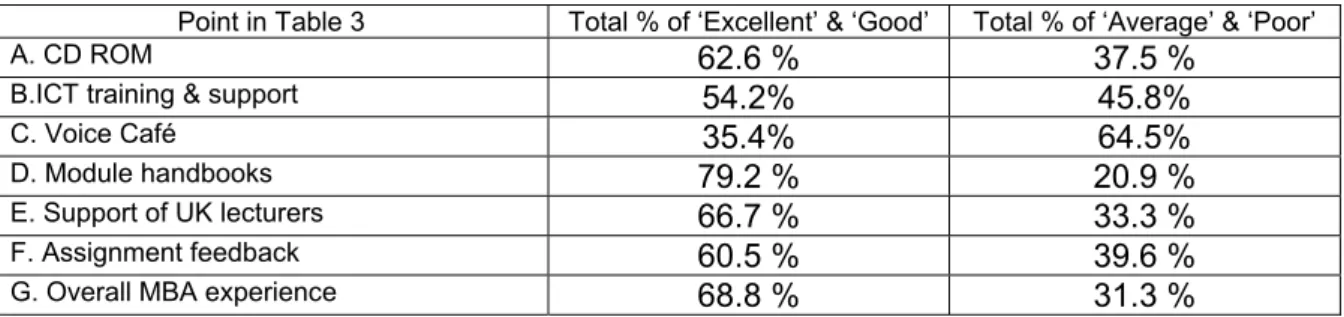
Overall, the survey results showed a high level of satisfaction with the MBA programme. In terms of the distance learning support systems, as shown in Table 3, five out of the seven areas showed that the total percentage of ‘excellent’ and ’good’ was greater than the total of ‘average’ and ’poor’ (points A, D, E, F and G); one result had these total close to each other (point B -54.2% vs. 45.8%), and one
result had the total percentage of ‘excellent’ and ’good’ significantly lower than the total of ‘average’ and ’poor’ (point C - 35.4% vs. 64.5%). A summary of these is illustrated in Table 4.
Table 3: Overview of the students on the distance learning support systems A. CD ROMs (with the main teaching contents of each module):
Excellent: 18.8% 9
Good: 43.8% 21
Average: 22.9% 11
Poor: 14.6% 7
B. ICT training/ support for using BREO, Netmail and Digital Library, etc.
Excellent: 12.5% 6
Good: 41.7% 20
Average: 33.3% 16
Poor: 12.5% 6
C. Voice Café:
Excellent: 14.6% 7
Good: 20.8% 10
Average: 31.2% 15
Poor: 33.3% 16
D. Module Handbooks
Excellent: 29.2% 14
Good: 50.0% 24
Average: 18.8% 9
Poor: 2.1% 1
E. Support of the UK Lecturers:
Yes: 16.7% 8
Varies tutor to tutor: 50.0% 24
Somewhat: 31.2% 15
No: 2.1% 1
F. Assignment feedback:
Excellent: 16.7% 8
Good: 43.8% 21
Average: 29.2% 14
Poor: 10.4% 5
G. Overall experience of undertaking supported learning MBA with the UK university:
Very satisfied: 25.0% 12
Somewhat satisfied: 43.8% 21
Varies module to module: 29.2% 14
Yongmei Bentley et al.
Table 4: Comparison of students’ perceptions of the e-learning support systems
Point in Table 3 Total % of ‘Excellent’ & ‘Good’ Total % of ‘Average’ & ‘Poor’
A. CD ROM 62.6 % 37.5 %
B.ICT training & support 54.2% 45.8%
C. Voice Café 35.4% 64.5%
D. Module handbooks 79.2 % 20.9 %
E. Support of UK lecturers 66.7 % 33.3 %
F. Assignment feedback 60.5 % 39.6 %
G. Overall MBA experience 68.8 % 31.3 %
For this survey, the respondents’ were also invited to offer comments on the areas investigated. On the positive side, we received comments such as:
‘It was a pleasure and enjoyable experience taking the MBA with this UK University ’. ‘Fast and active response is one of the University’s strengths, as we feel attended to’.
‘I was impressed with the idea of free wireless internet facility and the ever helpful nature of the faculty office and administration team’.
‘Voice Cafe, blackboard, and the student records system are excellent facilities for remote students like us. I found this course very balanced and suitable for working candidates’.
‘It has been really a correct decision for me to enrol onto the MBA programme. The wisdom derived from e-MBA is tremendous’.
There were, of course, also negative comments. To help improve the delivery of this MBA programme, these negative comments were important to the University and its collaborative partners. These can be summarized as follows:
Improve customer services - Bear in mind that they are part time students and most of them are at company manager level. They need more support to their independent learning. They would like to have all essential information at the induction, and would appreciate quick responses to their requests. Some students felt that BREO had been under-used as it was not used as effective discussion forums or for submitting assignments at a post graduate level.
Improve communication and collaboration between the education partners, and provide better and more effective on-line support.
They would like to have consistent and comprehensive module information and guidance, clear assignment instructions and the formats of examinations. They hate using different assignment submission systems which were often time-consuming and confusing. It was strongly suggested that the assignments be evaluated based on the criteria given in module handbooks.
Some feel that insufficient time was spent with UK tutors, and expressed a wish for another round of face to face interaction in the middle of a semester. Some respondents would like to have opportunity for the classroom experience at the UK University.
Students felt that immediate confirmation of the receipt of their assignment is very important to reduce their unnecessary worries. They also felt very dissatisfied if they failed to receive their assignment feedback within the specified time. In addition, they appreciated more detailed and customized feedback rather than a brief and general one as they wanted to understand what went wrong in their work.
Ineffective use of Voice Café – the students felt that Voice Café was not very useful and not well utilized. Some say it was tedious; very often there were auditory troubles, a lot of interruptions, and the Voice Café sound was very poor as so many students were talking at the same time. This might have been the main reason for poor attendance of the Voice Café session. A student said that he conducted a survey with his group and found that only 20% of his peers attended such sessions. In addition, some students said that half of the session time was spent fixing technical difficulties.
Inadequate teaching facilities at local college/University - the computing equipment at one of the collaborative institutions was described as ‘really poor’ and the class rooms were either not well equipped with proper facilities, or if any of such facilities were in place, they were not functioning properly.
5.2 Findings from the second questionnaire survey
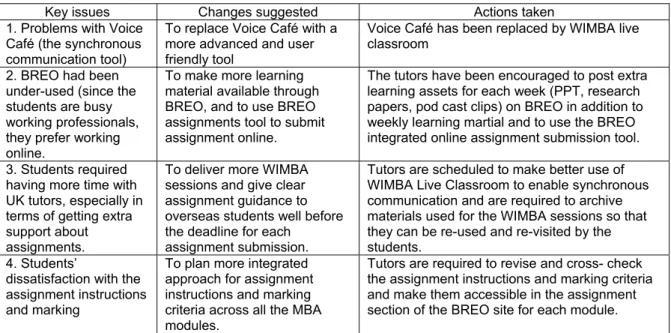
The findings from the first survey discussed in the section above showed that there was a lot of room in some areas for the University to focus on for further improvement. Table 5 below summarises the key issues identified, the changes suggested, and the actions taken after the first questionnaire survey.
Table 5: Key issues identified from the 1st survey, suggestions and actions
Key issues Changes suggested Actions taken
1. Problems with Voice Café (the synchronous communication tool)
To replace Voice Café with a more advanced and user friendly tool
Voice Café has been replaced by WIMBA live classroom
2. BREO had been under-used (since the students are busy working professionals, they prefer working online.
To make more learning material available through BREO, and to use BREO assignments tool to submit assignment online.
The tutors have been encouraged to post extra learning assets for each week (PPT, research papers, pod cast clips) on BREO in addition to weekly learning martial and to use the BREO integrated online assignment submission tool.
3. Students required having more time with UK tutors, especially in terms of getting extra support about assignments.
To deliver more WIMBA sessions and give clear assignment guidance to overseas students well before the deadline for each
assignment submission.
Tutors are scheduled to make better use of WIMBA Live Classroom to enable synchronous communication and are required to archive materials used for the WIMBA sessions so that they can be re-used and re-visited by the students.
4. Students’
dissatisfaction with the assignment instructions and marking
To plan more integrated approach for assignment instructions and marking criteria across all the MBA modules.
Tutors are required to revise and cross- check the assignment instructions and marking criteria and make them accessible in the assignment section of the BREO site for each module.
In order to see if the changes made to the e-learning support systems had produced any useful results on the e-learning experience of the MBA students, a second survey was conducted about six months after the first survey was completed. An analysis of the second survey and a comparison of the results of the two surveys indicate that the changes incorporated in the e-learning support systems have brought about, in most cases, positive impact. This has confirmed that the necessity and suitability of the changes implemented for this distance learning support systems. The section below gives details on this.
5.3 Comparative analysis of the findings
The results from both surveys are presented below, mostly in table format, to facilitate the comparison and contrast of the findings.
5.3.1 E-Learning materials
One of the changes made in the distance learning support systems was the restructuring of the online learning contents. These are now presented on BREO in a standard format and made available online weekly, consistent with the study schedule as opposed to provided on a CD ROM with all the reading materials for each module. As shown in Table 6, in comparing the two elements listed, the percentage of the students’ view as ‘excellent’ and ‘good’ has increased (from 62.6 to 73%).
Table 6: Provision of learning materials on CD ROMs vs. weekly online Students’
perception
First survey Second survey % in ‘excellent’ and ‘good’ (1st survey vs. 2nd survey)
Excellent 18.8% 21.6%
Good 43.8% 51.4%
Average 22.9% 16.2%
Poor 14.6% 10.8%
62.6% vs. 73%
In the first survey, one respondent commented that ‘BREO has been the most under-used tool’. The current BREO statistical tracking shows that there is very good hit rate for the weekly online materials for all the modules. For example, a total of 182 students from four randomly selected modules for Oman (semester 2 2008-9 batch) showed a total of 8047 hits. These included the weekly online course materials (6566 hits), WIMBA live classroom (657 hits), and ICT training guidelines (824 hits).
Yongmei Bentley et al.
5.3.2 E-Learning systems training
Subsequent to the first survey, quite a few training materials on e-learning systems including ICT handbooks and audio/video clips, had been developed and made available on BREO to the students. In the first survey, students commented that they did not get proper training on the use of the University’s Digital Library and thought that it is very difficult to make it work. In the second survey, students rated the ICT handbooks and ‘Harvard Referencing’ guidelines as most useful followed by Net-mail and WIMBA Live Classroom guides. In addition, based on BREO statistical tracking, as mentioned above, there was a good hit rate for the ICT guides in all the BREO sites. Statistics of the results of the two surveys on this area are illustrated in Table 7.
Table 7: Training materials for e-learning systems
Students’ perception First survey Second survey % in ‘excellent’ & ‘good’ (1st survey vs. 2nd survey)
Excellent 12.5% 13.5%
Good 41.7% 54.1%
Average 33.3% 29.7%
Poor 12.5% 2.7%
54.2% vs. 67.6%
5.3.3 VLE system – Voice Café vs. WIMBA
Tool for online communication (Tele-conferencing) between the lecturers and the students was changed from Voice Café to WIMBA. In one of the respondents’ words, Voice Café was ‘tedious’, often there were ‘auditory troubles’ and ‘interruptions’, and it was difficult to hear clearly while many people tried to talk simultaneously. Because of all sorts of problems, WIMBA, which is considered by many as a better VLE supporting system, has been adopted to replace the Voice Café system in August 2008. It can be seen from Table 8 that the students’ perception of WIMBA is significantly more positive compared with that of Voice Café (62% vs. 35%). One student commented on this after a WIMBA online classroom session, saying that ‘it is the best teaching session after the induction’. The students also like the idea of archiving the session for those students who missed live WIMBA sessions. The BREO tracking statistics show that for the seven WIMBA archives made available till March 2009, there were 107 hits which indicated that the students have made use of the archives and they do appreciate the effort the University has made.
Table 8: Voice Café vs. WIMBA Students’
perception
First survey Second survey % in ‘excellent’ & ‘good’ (1st survey vs. 2nd survey)
Excellent 14.6% 16.2%
Good 20.8% 45.9%
Average 31.2% 18.9%
Poor 33.3% 18.9%
35.4% vs. 62.1%
5.3.4 Tutor support
For each module, UK lecturers on the programmes have been assigned online synchronous and asynchronous contact hours to provide better support to the students on the course including the WIMBA sessions as discussed above. Table 9 shows that the students’ satisfaction of the online tutor support has been improved from 67% in the first survey to 81% in the second.
Table 9: Online support from UK tutors Students’
perception
First survey Second survey % in ‘excellent’ & ‘good’ (1st survey vs. 2nd survey)
Excellent 16.7% 48.6%
Good 50.0% 32.4%
Average 31.2% 16.2%
Poor 2.1% 0.0%
66.7% vs. 81%
5.3.5 Module handbooks
Regarding module handbooks, in the first survey, the students expressed their wish that each module handbook should provide all the information about the module, in particular, details about the exams and assignments so that the students are well informed of all the module information. The format of all the module handbooks are standardized at the outset, and the students feel that they are more clear
about what is required for each module they take, but, as shown in Table 10, their satisfaction in this has not changed much (from 79% to 81%). It is also suggested that they have more focused content for exams and assignments.
Table 10: The format of module handbooks Students’
perception
First survey Second survey % in ‘excellent’ & ‘good’ (1st survey vs. 2nd survey)
Excellent 29.2% 13.5%
Good 50.0% 67.6%
Average 18.8% 18.9%
Poor 2.1% 0.0%
79.2 vs. 81.1%
5.3.6 Assignment feedback
In terms of providing students with their assignment feedback, both surveys show that about 60% of the respondents graded it as either ‘excellent’ or ‘good’ (see Table 11). They felt that for some assignments the feedback was very general - not enough to help them improve their future assignments. Some were not happy about delayed release of the assignment feedback. Students also asked to see examples of good assignments. However, they also acknowledged that some lecturers gave very good feedback.
Table 11: Assignment feedback Students’
perception
First survey Second survey % in ‘excellent’ & ‘good’ (1st survey vs. 2nd survey)
Excellent 16.2% 16.7%
Good 45.9% 43.8%
Average 18.9% 29.2%
Poor 18.9% 10.4%
62.1% vs. 60.5%
5.3.7 Students’ overall experience
Both surveys showed that that the students had a high percentage of satisfaction (68.8% vs. 78.3%) with their experience in taking the MBA programme (see Table 12). Some said that it was a pleasure and a very nice experience taking the MBA course. Another student from Oman commented that ‘I really enjoyed each and every step - the very friendly behaviour of UK tutors has a good impact here because in Oman there are lot of traditional and cultural thinking in students but to take them to an international level the UK University is doing what is required. I believe that I have learned a lot and can now come up with new ideas as I wish’. But students also expressed their dissatisfaction, one of the respondents wrote: ‘The overall problem for this programme was the lack of communication and the varied versions of guidance from local and UK sides which sometimes lead to confusion in some assignments’. It was suggested that more interaction is required between the education partners. Table 12: Students’ overall experience of taking MBA programme
Students’ perception First survey Second survey % in ‘excellent’ & ‘good’ (1st survey vs. 2nd survey)
Very satisfied 25.0% 29.7%
Somewhat satisfied 43.8% 48.6%
Varies from module to module 29.2% 16.2%
Not satisfied 2.1% 5.4%
68.8% vs. 78.3%
5.4 Issues identified from the second survey
As was discussed above, a number of changes were implemented to address the problems identified from the first survey. However, nothing can be perfect, and the second survey also helped identify areas for improvement. The main issue identified was again related to the assignments. Most of the respondents were still not very satisfied with the overall assignment instructions, marking criteria and feedback. So it is suggested that the programme provider plan to adopt a more integrated approach to assignment guidelines and the tutors provide more meaningful assignment feedback to students across all the MBA modules. At the time of writing this paper, a handbook is being drafted that will include detailed instructions for the assignments of all modules of this MBA programme. Sample assignments of different grades will be made available to the students in order to give them better understanding of the marking criteria and level of feedback for their assignment. It is hoped that, once the handbook is published, the student should be very clear as to what they are expected to do for
Yongmei Bentley et al.
each assignment, and the tutors should be able to follow the guidelines and provide students with more constructive feedback to help them improve their future academic work.
6. Conclusion
We haven’t compared the impact of level of increased satisfaction on the results/ grades of MBA students due to time limitations but we are planning to do this after the exam board this year and will be in a better position to justify if learning satisfaction causes any impact on the actual learning that would reflect through pass rate and good grades. At this point it is one of the major limitations to this research. The implications of such a study can be measured over a period of at least 2-3 years to be able to come up with some tangible conclusions in terms of the relationship between learning satisfaction and actual learning outcome.
If we compare the two surveys there is a significant increase in the satisfaction level and a decrease in the non satisfactory comments in the second survey, indicating that the changes incorporated following the first survey have made a very positive impact on the learning experience and satisfaction of the students whilst maintaining and, in fact, increasing the quality of the MBA programme.
The second survey showed a higher level of satisfaction with the MBA programme, but again indicated areas that could see further improvement. The surveys have indicated the value of student feedback. Comments made by students have to be analysed. Changes to the programme will only be made on the basis that they help improve the quality of the programme as well as the learning experience of the MBA students. The surveys confirmed that the success in delivering the programme involves a joint contribution of all three parties involved - the programme provider (the UK University), the local collaborator, and the students on the programme, covering all aspects of the programme including the design of the programme, the e-learning technologies, the choice of learning materials as well as the overall delivery methodology.
The findings from the questionnaire surveys described in this paper have already confirmed that this research has created a positive impact on the students learning experience of this particular MBA programme and helped enhance the quality of the programme delivery. As a result, it is believed that this research has practical implications such as: reduced anxiety and improved confidence and increased interest of the MBA students in the programme; and improved image of the programme provider.
In conclusion, learning is a co-operative and social endeavour with learners gaining significant benefit from being part of a cohort and interacting with staff and other students on a daily basis. However, for distance learning, emphasis should be focused on how such a co-operative experience can be replicated without the standard face-to-face interactive processes taking place in classrooms, tutorials and social occasions. Distance learning should not let the distance learners feel that they are learning in isolation. Distance learning support systems should always be designed with this concern in mind. This should be a prime objective which can help reduce the risk of students becoming demotivated and, therefore, more likely to withdraw from the programme.
Finally, it is hoped that the outcomes of this research can not only help enhance this particular MBA programme, but also provide guidelines to other HEIs that offer, or intend to offer, distance learning courses globally.
References
Barbara, S and Consuelo, W (2008) ‘E-learning teams and their adult learning efforts in corporate settings: a cross analysis of four case studies, International Journal on E-Learning, Vol. 7, pp. 293-309.
Bowyer, P. (2003) ‘Multimedia based enhancement of the science of Oenology in the distance education learning environment’, Australian Journal of Educational Technology, Vol. 19 (3), pp. 323-338.
de Freitas, S. (2007) Learning in immersive worlds – a review of game-based learning [online]. Available from: <http://www.jisc.ac.uk/media/documents/programmes/elearninginnovation/gamingreport_v3.pdf> [accessed 23 May 2009].
Goold,A., Craig, A and Coldwell, J. (2007) ‘Accommodating culture and cultural diversity in online teaching’, Australasian Journal of Educational Technology, 2007, 23(4), pp. 490-507.
Jeffrey,F.(2003) ‘Additional components of the still-face effect: commentary on Adamson and Frick’, Infancy, Vol. 4(4) , pp. 493 – 497.
JISC (2007) Technology enhanced learning environments, JISC e-Learning Programme [online]. Available from: <http://www.jisc.ac.uk/whatwedo/themes/elearning/tele.aspx > [accessed 2 May 2009].
Kukulska-Hulme, A. and Traxler, J. (Eds) (2005) Mobile Learning: A Handbook for Educators and Trainers. London. Routledge Falmer.
Lave, J. and Wenger, E. (1991) Situated Learning: Legitimate Peripheral Participation, Cambridge University Press, Cambridge.
Mestre, L. (2007) ‘Accommodating diverse learning styles in an online environment’, Reference & User Services Quarterly, Vol. 46, No. 2, pp 27-32.
Molphy, M. & Pocknee, C. (2005) ‘Chemistry online in a constructivist environment’, Proceedings of the 22nd Annual Conference of the Australasian Society for Computers in Learning in Tertiary Education (ASCITE 2005: Balance, Fidelity, Mobility: Maintaining the Momentum? Brisbane, Queensland, Australia, 4–7 December 2005, Queensland University of Technology, Vol. 1, pp. 493-501.
QAA (2007) ‘Distance learning guidelines’, Quality Assurance Agency Publication [online]. Available from: <http://www.qaa.ac.uk/academicinfrastructure/codeOfPractice/distanceLearning> [accessed 24 May 2009]. Salmon, G. (2004) ‘Cultural and pedagogical implications of a global e-learning programme’, Cambridge Journal
of Education, Vol.34, No. 2, pp 223-239.
Stiles, M. J. (2000) ‘Effective learning and the virtual learning environment’, Keynote at the 2000 European Universities Information Systems Congress (EUNIS 2000) - Towards Virtual Universities. Poznan, Poland, April 2000.
Teddlie, C. and Yu, F. (2007) Mixed methods sampling’, Journal of Mixed Methods Research [online]. Available from: <http://mmr.sagepub.com>, Vol. 1, 77-100 [accessed 24 May 2009].
Unknown Author (2009) About e-learning, a block using new information and communication technologies, open source, Web2.0, social software, e-learning, and online distance learning [online]. Available from:
<http://about-elearning.blogspot.com/2007/10/open-vs-distance-learning-is-there.html > [accessed 8 July 2009].
Wilson, S., Liber, O. et al. (2006) Personal learning environments: challenging the dominant design of educational systems [online]. Available from: <http://dspace.ou.nl/bitstream/1820/727/1/sw_ectel.pdf> [accessed 23 May 2009].
ISSN 1479-4403 1 ©Academic Conferences Ltd Reference this paper as:
Brown, M, Paewai, S and Suddaby, G. (2010) “The VLE as a Trojan Mouse: Policy, Politics and Pragmatism” Electronic Journal of e-Learning Volume 8 Issue 2 2010, (pp63 - 72), available online at www.ejel.org
The VLE as a Trojan Mouse: Policy, Politics and
Pragmatism
Mark Brown, Shelley Paewai and Gordon Suddaby
Massey University, Palmerston North, New Zealand
[email protected][email protected] [email protected]
Abstract: This paper argues that selecting a new Learning Management System (LMS) is a strategic decision about the future direction of your institution. However, the development of a robust methodology for the selection of a new LMS is particularly challenging given the fluidity of the elearning environment. This is especially so when both quantitative and qualitative factors are overlaid by institutional requirements involving political considerations. Selecting the technology is only part of the process and the least problematic aspect. The real challenges are embedded in institutional culture. The paper reflects on the tactics, strategies and approval process involved in the decision to adopt Moodle to replace a proprietary system for the delivery of learning in New Zealand’s largest university-level distance education provider. Critical to the process was the explication of guiding principles, pedagogical criteria and identification of institutional requirements, along with politically astute alliances and allegiances to inform and endorse the selection process. Those centrally involved in the decision process draw on their experiences and reflect on the type of questions that senior managers need to ask when considering new strategic initiatives in open and distance learning.
Keywords: Moodle, learning management system, policy, leadership, institutional culture
1. Introduction
The choice of a ‘next generation’ Learning Management System (LMS) or Virtual Learning Environment (VLE) is a critical decision for any university and one which may have a major impact over many years. However, developing a robust methodology for the selection of a new LMS is particularly challenging and both quantitative and qualitative factors need to inform such decisions. This is especially the case when specific organisational requirements are deeply rooted in institutional politics.
In this paper, we reflect on the political tactics, pedagogical strategies and approval processes involved in the decision to select Moodle to replace a proprietary system in New Zealand’s largest university-level distance education provider. Critical to the process was the explication of guiding principles, pedagogical criteria and identification of university requirements, along with politically astute alliances and consultations to endorse the selection process.
Selecting the technology was only part of the process; indeed, it was the least problematic aspect of the challenge. The real challenges lay embedded in institutional culture. The need to shift institutional thinking in the absence of formal policies and strategies related to elearning, and the lack of a governance structure and policy framework to mandate the replacement LMS complicated, and at times convoluted, the review process.
This paper draws on the experiences from those centrally involved in the process and discusses the lessons learned and types of strategic questions that senior executives need to ask about the deployment of e-learning. In reflecting on the ‘Massey experience’, we identify the importance of perseverance, delegated authority and strong leadership and conclude with a number of additional questions that build on a recent framework to help scaffold strategic decisions about open, flexible and distance learning.
2. Institutional context
Massey University is New Zealand’s largest university-level distance education provider. Currently the University has over 18,000 distance learners in addition to an equal number of campus-based students. In 2010, Massey University will celebrate 50 years of delivering courses by distance. Distance education and blended learning are defining features of Massey University. In 1998, for example, Massey piloted and later adopted WebCT as one of the first commercially produced LMS. Massey was the first New Zealand university to do so.
A decade or so later the LMS has become a mission critical application that supports a high proportion of the course offerings at the University. In 2008, an online environment supported or was used to enhance over 2200 courses. The LMS has become a key front-of-house point of engagement with many distance students and consequently has a major impact on student retention, achievement and satisfaction. For example, student retention was significantly higher in courses across all disciplines with a strong online presence. However, due to budget constraints and the lack of an academic owner the University’s current LMS (WebCT CE4) was nearing obsolescence; and the adoption of a replacement system was essential. Despite the number of course offerings, the selection and implementation of a replacement LMS was also seen as key opportunity to address the patchy and uncoordinated uptake of online learning throughout the University.
3. Strategic drivers
Although the need to invest in new infrastructure and better support staff in the use of new learning technology was widely acknowledged, there was no strong sponsor for change. For historical reasons the LMS was the domain of the central Information Technology Services (ITS) and was largely just another technical service. The first challenge was to wrestle the ‘ownership’ of the LMS from ITS to the Academic portfolio. Essentially the argument was that pedagogy rather than technology should be the central business driver. In this sense, the selection and implementation of the LMS was not simply about procuring a new platform. It was a strategic opportunity for the University to redefine its delivery modes to support a more engaging and flexible learning environment. Thus, the key strategic drivers were:
To respond to the challenge of the so-called Google Generation;
To enhance the quality of teaching and thereby maintain Massey’s University pre-eminent status as a flexible learning and distance education provider;
To introduce a new blended model of teaching that increases the level of student engagement and provides a learning experience relevant to the requirements of today’s Knowledge Society.
4. Growing the vision
From an academic perspective, the selection of the LMS was a foundation upon which Massey could define itself as New Zealand’s most accessible, engaging and flexible university. It provided the chance to align and operationalise our aspirations with a platform for the University to be a future-maker through new flexible, technology-enabled, learning-centred education delivery. The overall vision was to build a new blended learning environment providing a more flexible, collaborative, interactive and personalised student learning experience. This vision was cultivated in the backdrop of a major new government funding model, which required universities to identify their priority investments for the future (i.e., our Investment Plan). Importantly, as part of this process the University had already identified the following two strategic priorities:
Improved educational outcomes for learners from strengthening Massey University’s elearning capability
Improved educational success for learners from the continuous improvement of Massey’s university-level distance education provision
5. Navigating the political minefield
In many respects, setting these high level priorities with related key performance indicators (KPIs) was relatively easy. There was little or no disagreement over the priorities. The first lesson to take from this aspect of the initiative is that because university funding was tied to achieving the KPIs for elearning and distance education, the money provided a crucial lever for change. Without this type of policy alignment, it would have been much harder to redefine the political landscape. In essence, the LMS was now for the first time part of a much bigger picture aligned with strategic priorities and there was an institutional mandate for the academic portfolio to take a stronger leadership role. Arguably, without the strategic drivers it would have been extremely difficult to remove many of the pre-existing roadblocks.
Having said that, the process that followed was fraught at almost every step of the way. Considerable work and political cunning was required to navigate the political minefield of generating a strong support base from key stakeholders, including the major academic colleges, the Library, the Student Learning Centre and ITS. For this reason, the selection process for a replacement LMS required a
Mark Brown et al.
multi-pronged approach. We recognized from the outset the danger of the perception of a centrally driven process and the limitations of applying an overly rigid set of quantitative criteria for the selection of a new system (Uys, 2007). As Weller (2007) points out:
‘The important thing to recognize about choosing a VLE is that it is the making of the decision that is the most significant part of the process, not the actual decision itself’ (p.43).
To address this point, and to ensure strategic drivers rather than technical considerations drove the process, the selection criteria for the new LMS were based upon clear principles, pedagogical considerations and university-specific requirements. Criteria were made available to all staff and the selection process involved extensive consultation through a variety of mechanisms. Although the process did not strictly follow the six stages proposed by Weller, as there was no authority or mandate to initiate the first stage of the selection process, stakeholder consultation occurred over almost 18 months and involved:
Working parties, staff surveys, and in-house evaluations Meetings with representatives from the Students’ Federation
National and international benchmarking with other institutions and organisations Meetings with senior staff from different LMS suppliers
In early 2008, a formal pilot was conducted with two of the preferred options (Moodle and WebCT CE6). A set of guiding principles was developed to firmly anchor and align the evaluation and selection process within strategic priorities. The value of a principled approach is consistent with the advice given by Weller. The principles provided a framework that played a key role in shaping and determining the decisions that would follow. For example, the principle of supporting indigenous M ori and Pasifika students eliminated a number of potential LMS solutions, as they did not contain the relevant language packs.
6. Guiding principles
The full set of principles is listed below:
New initiatives must align and be consistent with the key priorities of Massey University’s Investment Plan.
The selection of a new electronic toolset is a critical strategic decision about the future direction of Massey University.
A new core electronic toolset is required to support Massey University’s aspirations to become a leader in Australasia in the design of elearning, flexible delivery and leading-edge distance education.
New initiatives in elearning and distance education must support and be consistent with the concept of a one-university identity. There is no benefit in a fragmented approach.
A new electronic toolset must enhance the ‘Massey experience’ and more specifically student retention and learning outcomes.
A blended and more flexible elearning environment is essential to meet the unique needs of all Massey students with a particular emphasis on the needs of distance learners.
The new core electronic toolset must work and there must be adequate technical support and infrastructure to ensure that the toolset is stable for widespread implementation.
The success of new initiatives will rely heavily on appropriate training and professional development to ensure a high level of pedagogical uptake by academic staff and students.
New initiatives must support Massey University in building a stronger network of provision with other education providers and key stakeholders, including M ori and Pasifika students.
The selection of any new electronic toolset must be driven by contemporary theory and research and related pedagogical criteria aimed at enhancing the quality of teaching and learning at Massey University.
7. Pedagogical criteria
The next step was to establish a Pedagogical Reference Group. The Group served a dual purpose. Firstly, it provided a means to ensure staff with contemporary pedagogical knowledge was centrally involved in the process. Importantly, group members were selected carefully to ensure university-wide representation. The second purpose of the Pedagogical Reference Group was to mitigate and weaken the historical influence of ITS in making decisions about technology provision. Those on the group had a high level of academic credibility, which helped to ensure the trust and support of senior management.
A set of pedagogical criteria was developed to scaffold the selection process and legitimatise the importance of pedagogy driving the outcome. In this regard, the language of pedagogy was a solid defence against those who ‘pushed’ a technical orientation to the selection process, as they were ill equipped to argue on this front. After a brief synthesis of the literature (e.g., Garrison & Vaughan, 2008; McCombs & Vakili, 2005; Milne & Suddaby, 2006) the following ten pedagogical criteria were adopted:
Communities of Inquiry - Learning is a social experience where generative knowledge is embedded within and distributed across communities of practice.
Learning-centredness - The focus is on ‘learning’ where different instructional designs can be employed to support the needs and experiences, and pre-existing knowledge of the learner. Interactive - Deep and durable learning occurs when there is regular and structured interactivity
with blended content and fellow students.
Collaboration - Active and meaningful learning is promoted by collaboration and a strong sense of social presence between students and the teacher.
Personalisation - Teaching needs to be responsive to individual needs and the learner must be able to customise the learning experience to their unique requirements.
Rich Tasks - Understanding is enhanced by rich tasks and productive pedagogies that engage students in critical reflection within authentic contexts.
Flexibility - Learning designs need to support adaptive and flexible learning spaces where students can learn anytime, anywhere and any place.
Assessment for Learning - Learning activities must promote feedback and feed-forward assessment, which helps students to reflect on and improve their learning outcomes.
Diverse Learners - Learning designs need to respect the diverse needs of learners and support learning in socially and culturally appropriate contexts.
Innovation and Excellence - Good teaching occurs in a culture of innovation where teachers are encouraged to continually push boundaries and strive for excellence.
Importantly, the criteria were based on the assumption that there is no one single pedagogy or metaphor of learning (Sfard, 1998). This point is reflected in the concept of learning-centredness as opposed to the traditional binary distinction between learner-centred and teacher-centred approaches. Learning-centredness conveys the view that learning is at the centre of the process and that both acquisition and participation metaphors have an important role to play in the educative process. The key point is that each metaphor has something to offer; they are not mutually exclusive as neither metaphor fully explains the complexity of learning. By analogy, Roblyer et al. (2003) note:
Like the blind person [sic] trying to describe the elephant each focuses on a different part of the problem and each is correct in limited observations (p. 54).
8. University requirements
Building on the above principles and pedagogical criteria, the third layer to the selection framework was a number of university specific requirements. For example, it was determined that the replacement LMS would:
Allow a customised Massey “skin” or appearance with consistent institutional branding across all papers and programmes.
Mark Brown et al.
Integrate with existing systems and teaching applications and enable the electronic submission, tracking and return of assignments.
Promote explicit models of instructional design which support differing needs of learners and subject discipline requirements.
Allow the integration of static and dynamic content within a common template and explicit instructional framework.
Offer the latest social networking tools to promote collaboration, social presence and a scholarly culture of knowledge production.
Support a robust system of quality assurance for electronic content that aligns with existing print-based materials submission processes.
Support Te Reo M ori and initiatives for Pasifika consistent with key university priorities and outcomes in these areas.
Integrate with an ePortfolio system to provide a more connected life-long and life-wide learning experience.
Support and easily integrate additional ‘plug-ins’ and ‘mash-ups’ within a single overarching framework.
Have a high level of local support and be a proven solution used by other major tertiary and distance education providers.
Although a weakness of the approach was the failure to establish a separate learner stakeholder group, the student voice was represented within the Pedagogical Reference Group by both learning support and student union representatives.
9. Recommendation
Moodle was the recommendation of the Pedagogical Reference Group. The decision was unanimous. However, this was not surprising as the three-tier framework of principles, criteria and requirements heavily steered the selection process in this direction. Herein lies the second major lesson from this experience. The selection process is not neutral and it is possible to capture the process for certain political and institutional ends—for better and worse.
Opposing political forces, nevertheless, were still at work and those in ITS favouring an ‘off the shelf’ commercial solution continued to advocate for a different outcome. To provide a definitive recommendation a formal LMS Project Board, with strategically selected university-wide representation, reviewed the options and endorsed the Moodle decision. Ideally, this Board would have been established at the outset of the selection process but there was no recognition by senior management of the need for such a board at the time. Importantly, the Board representation was endorsed by the Vice Chancellor’s Executive Committee to ensure the selection process would stand up to close scrutiny by the wider university community. The Moodle recommendation was then further endorsed by:
The Teaching & Learning Committee Distance Students’ Association University’s Senior Leadership Team Academic Board
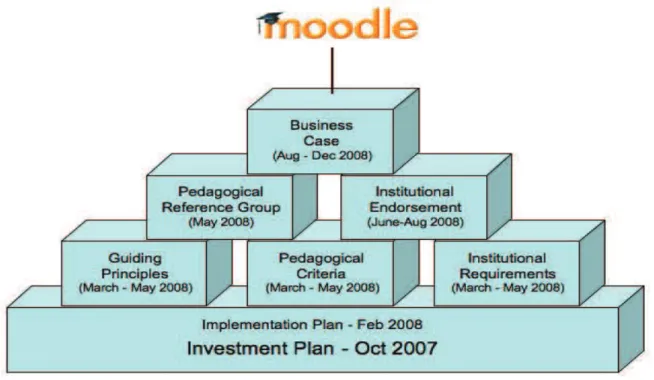
This was the first time for over a decade that discussion around a key teaching platform had occurred at the University’s Senate/Academic Board. The importance of Academic Board raises the third major lesson, as this level of discussion was crucial to finally ending outlying debate so the issue could finally move forward. Importantly, the engagement of Academic Board meant that this body had a sense of ownership of the decision which proved to be important in the implementation process. Figure 1 illustrates the key ‘bricks in the wall’ that contributed to the decision to select Moodle as the new LMS.
In short, Moodle was the preferred LMS for some of the following reasons:
It clearly signalled the University’s intention to move from a more formally structured, content and teacher-centred approach to a blended and flexible learning environment where ‘communities of learners’ could be supported.
Figure 1: Key ‘bricks in the wall’ in the LMS selection process
It provided a consistent style and institutional branding across all courses and programmes, with the flexibility for staff to teach, and students to learn, in different ways.
It offered instructional design features that could blend together print and electronic content, and a capacity to integrate new electronic tools as they become available.
It was used by some of the world’s leading distance education providers and large multi-national corporations; it also supported the University’s aspirations for international delivery.
Finally, as previously mentioned, Moodle had the capability to support Te Reo Måori and other Pasifika languages.
10. Developing the business case
Having identified our preferred LMS, the next step was to develop a full business case to unlock the financial resources required to implement the recommendation and operationalise the wider strategic vision. This was not an easy step. Those involved needed to learn the language of writing business cases and four drafts were required over six months before the final version of the business case eventually worked its way through internal university decision-making processes. Some of the key questions raised during this process included:
Is the timeline realistic? How it will be phased in?
What are the workload implications? Is there enough money for staff support? Is there sufficient time to teach the teachers? Have we addressed the pedagogical challenges? Have we defined the new media technical roles? Is the NPV (depreciation) rate accurate?
After much discussion of these questions and preparation of a supplementary paper, the Senior Leadership Team eventually approved the Business Case with a sizeable budget ($4.5M NZ). Notably, the budget went well beyond infrastructure and allowed for a fivefold increase in the existing level of pedagogical support. Never before had such a level of resourcing been available to support technology enhanced learning within the University. Approval of the Business Case meant that at the
Mark Brown et al.
start of 2009 Massey was ready to embark on a major three-year project of implementing Moodle (rebranded Stream) across the University.
However, one more vital piece needs to be added to the story of the selection and business case process. Approval of the Business Case was not solely the result of a compelling argument for Moodle and the related action points. Indeed, the critical tipping point was when our new Vice Chancellor began formal responsibilities. The Vice Chancellor Designate, previously Minister of Education and number three ranked in Government, was kept informed from an early stage but it was his formal commencement of duties on October 2008 that cut through the doubts and lingering opposition from a handful of senior management. It is fair to say that financial concerns and competing bids for funding by some members of the Senior Membership Team could have derailed any further progress. Without high level intervention and political astuteness of those leading the process, further iterations of the business case would have been evitable with an uncertain outcome. The need for this type of leadership from the highest level of the University is the third major lesson to emerge from the process.
11. Key questions for senior managers
This final section reflects on our experience in the backdrop of a recent framework and planning guide developed by Higgins and Prebble (2008) for senior managers of higher education institutions. Derived from a study of senior managers, the authors identify the following key questions that need to be considered when investing in new learning technology. Under each section, we add some key questions to those already proposed which help to extend the utility of the framework.
11.1 Strategy
What are the medium and long-term strategic goals and objectives of your institution? How are these strategic goals reflected in your institution’s Learning and Teaching Plan? How are these strategic goals reflected in your institution’s more specific plans for e-learning? What is the problem that this technology will solve or help us with?
What sort of priority is it?
Do our teachers/students wish to teach/study in this way? Will we suffer if we simply don’t adopt it?
In our experience, the additional questions that need to be asked are: how do you know what you do not know? How much is enough to know before you can make a decision? In today’s globally enmeshed digital world, how do you set your own strategic direction? To what extent should you be following what other institutions are doing as opposed to going your way?
11.2 Decision making
Who makes the decisions about which courses and programmes will use e-learning and how they will do so?
In our experience, the additional questions that need to be asked are: How do you manage the politics? What is the right balance between the competing and coexisting pedagogical, technical and student-focused interest groups? Which group should have the greatest weight in the selection process?
11.3 Structure
How should you organise and manage for e-learning?
More specifically, who should be responsible for what and how should their various efforts be integrated and led?
In our experience, the additional questions that need to be asked are: Whose interests do the current structures serve? Where are the tensions and pressure points in our structures and what can we do about them? How do you go about making strategic decisions with immature structures?