9
Developing an Academic Essay
2
2
Developing an Academic Essay
In Chapter 1: Writing an academic essay, you were introduced to the concepts of essay prompt, thesis statement and outline. In this chapter, using these
concepts and looking at examples, you will obtain an idea of how to develop your essay in an organised and logical way. You may have the best ideas in the world but if you do not know how to connect them together, it may be
diffi cult to convince your readers to accept your views.
There are four important things to remember when you develop ideas in your essay. These are:
● Construct your thesis statement ● Organise your paragraphs ● Make your writing coherent
● Combine your ideas in correct sentences
2.1 Construct Your Thesis Statement
An essay will generally be based on an all encompassing idea developed throughout the whole text. This idea, expressed in a sentence or two, is a summary answer to your assigned question and is known as the thesis statement. This thesis statement will form the main focus of your essay. You can construct an effective thesis statement by understanding the requirements of an essay question or prompt. The key words in the prompt, or question, below are indicated in bold:
10
Developing an Academic Essay
A topic sentence is important
to convey the focus of each paragraph.
Is this a good thesis statement? The invention of the Internet has revolutionised and benefi tted society a great deal. The Internet exercises both a positive and negative infl uence on young people.
Although young people today have greatly benefi tted from the use of the Internet, it has its drawbacks.
Yes
✓
✓
No
✗
Comment
While the thesis statement makes sense on its own, its focus is on the effects of the Internet on society in general, while the question requires the focus to be on young people. Addresses the key words in the question and tells the reader that both negative and positive infl uences of the Internet will be covered in the essay.
Addresses the key words in the question. It can be seen that this thesis statement is more sophisticated in the way it is phrased. The
although clause summarises one aspect of the
writer’s view of the topic and the main clause indicates the position he/she will argue in the essay. Both positive and negative impacts of the Internet will be discussed in the essay. Read the three thesis statements below and the comments against each of them to get
an idea of how thesis statements can be constructed.
2.2 Organise Your Paragraphs
Now that you have an idea of what constitutes a thesis statement, the next step is to develop and elaborate your thesis statement, which you will do over several paragraphs in the body of your essay.
Each paragraph needs to be well developed with a topic sentence and an organisational pattern that is easy for the reader to follow.
2.2.1 Construct a topic sentence
Just as a thesis statement is important to convey the focus of an essay, a topic sentence is important to convey the focus of each paragraph. A topic sentence is a single, well defi ned idea which is supported by specifi c details in the rest of the paragraph.
Read the following paragraphs and the comments against each of them to get an idea of how important topic sentences are.
11
Developing an Academic Essay
Paragraph
Research around the world has found that the use of local languages as medium of instruction is the most effective way to teach young
children. Children taught in their own languages
learn their lessons faster than when they are taught in a foreign language. They also show more confi dence in class when they speak in the language that they are most comfortable in. There is also transfer of skills — that is, the skills children learn in their mother tongues also help them make the transition to learning in other languages in the future.
Topic sentence?
✓
Supporting details?
✓
Comments
The topic sentence provides the main focus or the controlling idea, which is elaborated by the supporting details.
You can see that in developing your essay, merely providing details as in the fi rst paragraph is insuffi cient. Instead, you need to state the focus of each paragraph clearly in a topic sentence, as in the second one.
2.2.2 Use diff erent organisational patterns
Based on the topic sentence, you need to develop each paragraph using a clear organisa-tional pattern. Remember each paragraph must support your thesis. Some common organisational patterns are discussed below.
2.2.2.1 Exemplifi cation
You would commonly use exemplifi cation in academic writing to illustrate your ideas in an essay. See the analysis of the following paragraph for its information organisation and the signal words (see underlined phrases) used to indicate exemplifi cation.
Paragraph without a topic sentence
Paragraph
Children taught in their own languages learn their lessons faster than when they are taught in a foreign language. They also show more confi dence in class when they speak in the language that they are most comfortable in. There is also transfer of skills — that is, the skills children learn in their mother tongues also help them make the transition to learning in other languages in the future.
Topic sentence?
✗
Supporting details?
✓
Comments The main focus of the paragraph is not clear because there is no topic sentence. The paragraph only has what look like supporting details.
12
Developing an Academic Essay
Some other signal words and phrases you can use to represent exemplifi cation are especially, particularly, notably, chiefl y, mainly, to illustrate and that is.
2.2.2.2 Cause and eff ect
In your academic essays, you are bound to write about actions and events. These are generally discussed in the context of their causes and results. You can see this organisa-tional pattern and the accompanying signal words used to indicate cause and effect in the analysis below.
Paragraph
(1) Face to face communication with people of
different cultures can be quite tricky because of
different communication styles. (2) For example, rules
of conversation such as turn-taking and the use of silence differ across cultures. Turn-taking or waiting for someone to fi nish speaking before one says anything is a sign of politeness in many cultures. However, in some cultures, frequently interrupting someone when speaking may indicate that one has one’s heart in the subject matter, rather than rudeness. Silence may express disagreement or dislike in one culture but agreement or consent in another culture. A lack of awareness of these different rules of conversation can sometimes lead to misunderstandings in communication that can be quite costly in business. (3) For instance, in discussing the terms of a business contract for a building project, the interpretation of silence as agreement when it in fact indicates disagreement on the part of the contractor can lead to serious complications later, causing unnecessary delays and work stoppages which can cost the company hundreds or thousands of dollars.
Signal words
For example, such as
For instance, Analysis
(1) Topic sentence (2) Supporting details — examples
(3) Exemplifi cation to illustrate how lack of awareness of different rules of conversation can be costly
Paragraph
(1) Many people are worried about the effects of
television on young children. (2) Teachers are concerned
that the visual images on the screen can stifl e children’s creativity as they may lose the ability to form their own visual pictures in their heads. (3) Secondly, children may lose the ability to make rational judgments about things by becoming passive observers, taking in all the information that they see without questioning. (4) However, what worries parents the most is the violence children watch on television. This is because some children have been known to imitate violent characters and violent acts which they see on television, sometimes causing fatal accidents.
Signal words effects as by This is because Analysis (1) Topic
sentence — Cause (2) Effect 1 + Reason (3) Effect 2 + Explanation
(4) Effect 3 + Reason
13
Developing an Academic Essay
Some other signal words and phrases associated with this pattern of organisation are due to, because of, as a consequence of, effect of, resulted from, was the result of, consequently, therefore, thus, accordingly and resulted in.
2.2.2.3 Problem-solution
The problem-solution pattern of organisation is a very common pattern in academic writing as you will frequently be focusing on an issue and ways of solving its problems. You can see this pattern in the following paragraph.
Paragraph
(1) Famine is a serious problem in some under
developed countries and aid agencies have been making suggestions about what governments can do. (2) One suggestion to help solve the problem is that governments can help families set up small farms by providing them with chickens and goats. (3) They can also be given seeds and helped to grow crops and maintain small vegetable gardens. (4) In addition, it is very important to educate them on taking care of farm animals, growing crops and maintaining farming tools.
Signal words serious problem
to help solve the
problem indicates that
a solution is coming
can also signals
another solution
In addition signals
a third solution Analysis
(1) Stating the problem (2) Solution 1
(3) Solution 2 (4) Solution 3
14
Developing an Academic Essay
2.2.2.4 Comparison and contrast
Another pattern you can use to develop your paragraphs is the comparison-contrast pattern. In this pattern of organisation, you will explain the similarities and/or differences between two items. In the example below, the differences are highlighted.
A paragraph of comparison can be similarly organised. However, the signal words and phrases would be different. Listed below are other signal words and phrases associated with both comparison and contrast patterns of organisation.
Comparison: just as, both, not only…but also, similarly, likewise, also, as, like and too Contrast: although, even though, though, but, yet, despite, in spite of, nevertheless, on the
contrary, on the one hand, on the other hand, in contrast, whereas, while, instead, still and otherwise
As well as a paragraph, a whole essay can be developed using one, or combining several, of the patterns of organisation explained in this section, depending on the key words in your question or prompt.
Paragraph
(1) Whether you decide to set up your own business
consultancy or to be employed in a consultancy fi rm
depends very much on your fi nancial status.
(2) If you set up your own business, you need to provide the initial capital outlay to get your business started by using funds from your own savings or borrowing money from a bank or both. (3) In contrast, if you join a consultancy fi rm that is already established, you do not need to provide any cash to get the business up and running. (4) Another consideration is that when your business consultancy is set up, you still need to have suffi cient funds for the day-today running of the business. (5) However, if you are an employee in a company, while you may be responsible in some way to help the company make profi ts, you do not need to provide funds for the day-to-day running of the business. (6) Finally, in the unfortunate event that your business goes bankrupt, you will not only lose your source of income, but you may fi nd yourself in serious debt. (7) On the other hand, if a consultancy fi rm that you work for has to close down, while you will still end up losing your job and source of income, you will not be saddled with debts to pay off. (8) As such, it seems that the decision to set up one’s own business consultancy may be easier to take for those who are fi nancially better off.
Signal words
In contrast,
Another consideration However,
Finally,
On the other hand, Analysis
(1) Topic sentence — two items compared (2,3) First point of contrast
(4,5) Second point of contrast
(6,7) Third, and fi nal, point of contrast
(8) Conclusion — relates to topic sentence
15
Developing an Academic Essay
2.3.2 Repeat nouns and pronouns
Another way to achieve coherence is to repeat key nouns and make consistent use of pronouns. Observe how the underlined repeated nouns and pronouns connect ideas across sentences and make the text coherent.
Paragraph with repeated nouns and pronouns
Inspiring teachers who are highly valued by their students have two outstanding characteristics. Firstly, inspiring teachers have excellent communication skills. Therefore they are able to arouse great interest in whatever they teach. Another important characteristic of inspiring teachers is that they have enormous patience. This means they never appear threatening to their students.
2.3 Make Your Writing Coherent
To achieve coherence in your writing, it is important to guide the reader logically through your ideas. You can do this by using transitions or linking words and/or repeating nouns and pronouns.
2.3.1 Use transitions or linking words
When you read the paragraph below, you will notice that it is just a listing of sentences and that there is no connection between the sentences. While you can understand the sentences, they do not connect to form a meaningful paragraph. In other words, the ideas in the paragraph are not cohesive. This results in the paragraph lacking coherence.
Paragraph without transitions
Inspiring teachers who are highly valued by their students have two outstanding characteristics. Inspiring teachers have excellent communication skills. They are able to arouse great interest in whatever they teach. They have enormous patience. They never appear threatening to their students.
Read the revised paragraph. You will notice that the underlined words connect the different ideas on inspiring teachers and also indicate the relationship between these ideas. Such writing is said to be both cohesive and coherent.
Paragraph with transitions
Paragraph
Inspiring teachers who are highly valued by their students have two outstanding characteristics. Firstly, inspiring teachers have excellent communication skills. Therefore they are able to arouse great interest in whatever they teach. Another important characteristic of inspiring teachers is that they have enormous patience. This means they never appear threatening to their students.
Comments
Firstly, signals the fi rst characteristic.
Therefore indicates result.
Another indicates an additional and
perhaps equally important idea.
16
Developing an Academic Essay
2.4 Combine Your Ideas in Correct Sentences
You should now have some idea of how to organise your ideas at the paragraph level using different organisational patterns, transition words and repeated nouns and pronouns to connect your ideas to show support for the topic sentence.
Of course, you need to combine your ideas at the sentence level too. One way you can do this is by using coordinating and subordinating conjunctions.
2.4.1 Join sentences using coordinating conjunctions
Compound sentences contain two or more independent clauses joined by coordinating conjunctions. Both clauses have equal importance. Example:
The lecturer sat down. The student remained standing.
Simple sentence Simple sentence
These two sentences can be joined by using the coordinating conjunction but and written as:
The lecturer sat down but the student remained standing.
Notice that but not only joins the two sentences but also indicates the relationship between them.
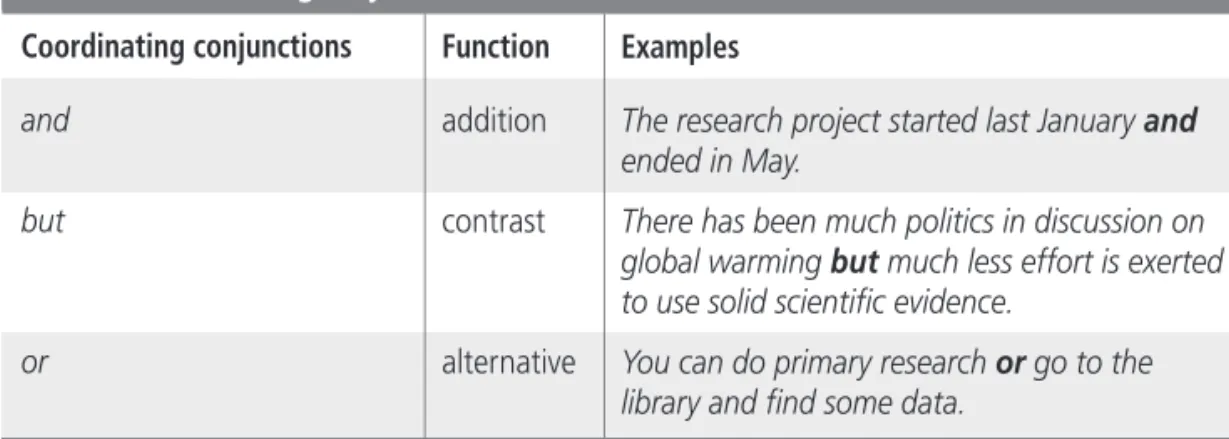
The most common coordinating conjunctions are and, but and or. Some examples of their usage are shown below.
Table 1: Coordinating conjunctions
Coordinating conjunctions and
but
or
Examples
The research project started last January and
ended in May.
There has been much politics in discussion on
global warming but much less effort is exerted
to use solid scientifi c evidence.
You can do primary research or go to the
library and fi nd some data. Function
addition contrast
17
Developing an Academic Essay
2.4.2 Join sentences using subordinating conjunctions
In addition to coordination, you can also use subordinating conjunctions to connect sentences. The only difference is that subordinating conjunctions link a main clause and a dependent or subordinate clause. Example:
Juliana went shopping as soon as she got her monthly salary.
Main clause Subordinate clause
You can see in the above example that the main clause makes complete sense on its own but the subordinate clause does not. Thus, it needs the main clause to make meaning, which is why it is called the subordinate clause.
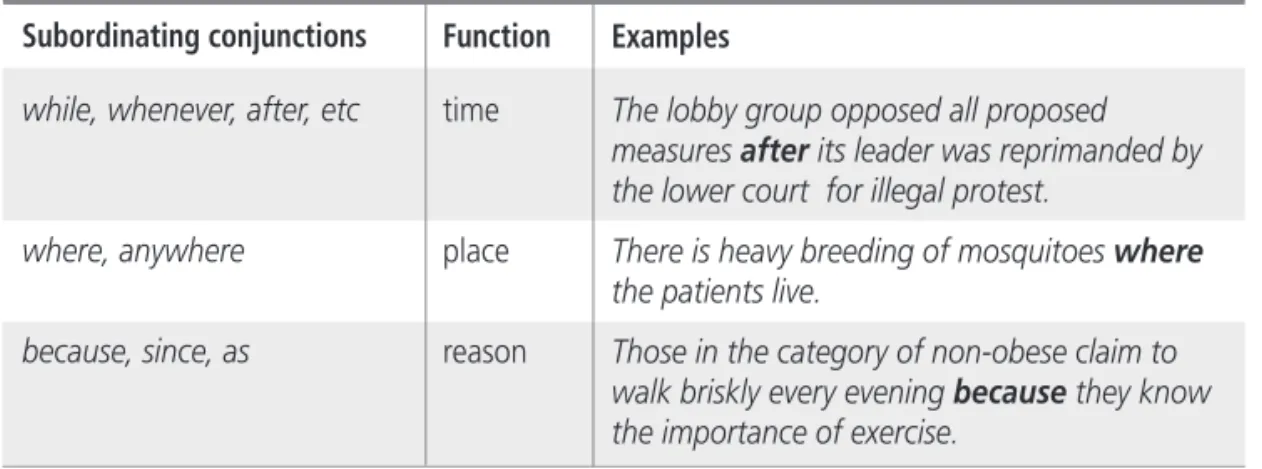
Below is a list of some subordinating conjunctions, their functions and examples of their usage.
Conclusion
Remember that every essay must have a thesis statement, which controls all the ideas in it. Likewise, every paragraph is controlled by a topic sentence, which is supported by ideas arranged in a logical organisational pattern. The connections between these ideas are made clear by transitions and the repetition of nouns and pronouns and, within sentences, by coordinating and subordinating conjunctions. The key thing to remember is that, in developing your academic essay, you must present your ideas in a logical and organised way.
Table 2: Subordinating conjunctions
Subordinating conjunctions while, whenever, after, etc
where, anywhere because, since, as
Examples
The lobby group opposed all proposed
measures after its leader was reprimanded by
the lower court for illegal protest.
There is heavy breeding of mosquitoes where
the patients live.
Those in the category of non-obese claim to
walk briskly every evening because they know
the importance of exercise. Function
time
place reason
18
Developing an Academic Essay
Further reading
Harris, J., & Moseley, A. (2000). Strategies for college writing. USA: Allyn and Bacon.
Jordan, R.R. (1999). Academic writing course. United Kingdom: Pearson.
Oshima, A., & Hogue, A. (2006). Writing academic English. New York: Pearson.
Raimes, A. (2004). Grammar troublespots. New York: Cambridge University Press.
Swales, J.M., & Feak, C.B. (2004). Academic writing for graduate students. Ann Arbor: The University of Michigan Press.