There is no Fork: an Abstraction for Efficient,
Concurrent, and Concise Data Access
Simon Marlow
Facebook [email protected]Louis Brandy
Facebook [email protected]Jonathan Coens
Facebook [email protected]Jon Purdy
Facebook [email protected]Abstract
We describe a new programming idiom for concurrency, based on Applicative Functors, where concurrency is implicit in the Applica-tive<*>operator. The result is that concurrent programs can be written in a natural applicative style, and they retain a high degree of clarity and modularity while executing with maximal concur-rency. This idiom is particularly useful for programming against external data sources, where the application code is written without the use of explicit concurrency constructs, while the implementa-tion is able to batch together multiple requests for data from the same source, and fetch data from multiple sources concurrently. Our abstraction uses a cache to ensure that multiple requests for the same data return the same result, which frees the programmer from having to arrange to fetch data only once, which in turn leads to greater modularity.
While it is generally applicable, our technique was designed with a particular application in mind: an internal service at Face-book that identifies particular types of content and takes actions based on it. Our application has a large body of business logic that fetches data from several different external sources. The framework described in this paper enables the business logic to execute ef-ficiently by automatically fetching data concurrently; we present some preliminary results.
Keywords Haskell; concurrency; applicative; monad; data-fetching; distributed
1.
Introduction
Consider the problem of building a network service that encap-sulates business logic behind an API; a special case of this being a web-based application. Services of this kind often need to effi-ciently obtain and process data from a heterogeneous set of external sources. In the case of a web application, the service usually needs to access at least databases, and possibly other application-specific services that make up the distributed architecture of the system.
Thebusiness logicin this setting is the code that determines, for each request made using this service, what data to deliver as the result. In the case of a web application, the input is an HTTP request, and the output is a web page. Our goal is to have clear and
Permission to make digital or hard copies of part or all of this work for personal or classroom use is granted without fee provided that copies are not made or distributed for profit or commercial advantage and that copies bear this notice and the full citation on the first page. Copyrights for third-party components of this work must be honored. For all other uses, contact the owner/author(s).
ICFP ’14, September 1–6, 2014, Gothenburg, Sweden. Copyright is held by the owner/author(s).
ACM 978-1-4503-2873-9/14/09. http://dx.doi.org/10.1145/2628136.2628144
concise business logic, uncluttered by performance-related details. In particular the programmer should not need to be concerned with accessing external data efficiently. However, one particular problem often arises that creates a tension between conciseness and efficiency in this setting: accessing multiple remote data sources efficiently requiresconcurrency, and that normally requires the programmer to intervene and program the concurrency explicitly.
When the business logic is only concerned with readingdata from external sources and not writing, the programmer doesn’t care about the order in which data accesses happen, since there are no side-effects that could make the result different when the order changes. So in this case the programmer would be entirely happy with not having to specify either ordering or concurrency, and letting the system perform data access in the most efficient way possible. In this paper we present an embedded domain-specific language (EDSL), written in Haskell, that facilitates this style of programming, while automatically extracting and exploiting any concurrency inherent in the program.
Our contributions can be summarised as follows:
• We present anApplicativeabstraction that allows implicit concurrency to be extracted from computations written with a combination ofMonadandApplicative. This is an extension of the idea of concurrency monads [10], using Applicative<*>
as a way to introduce concurrency (Section 4). We then develop the idea into an abstraction that supports concurrent access to remote data (Section 5), and failure (Section 8).
• We show how to add acache to the framework (Section 6). The cache memoises the results of previous data fetches, which provides not only performance benefits, but also consistency in the face of changes to the external data.
• We show that it isn’t necessary for the programmer to use
Applicativeoperators in order to benefit from concurrency in our framework, for two reasons: first, bulk monadic oper-ations such as maps and filters useApplicativeinternally, which provides a lot of the benefit of Applicative concur-rency for almost zero effort (Section 5.5), and secondly we can automatically translate code written using monadic style into
Applicativein certain cases (Section 7).
• We have implemented this system at Facebook in a back-end service that contains over 200,000 lines of business logic. We present some preliminary results showing that our system run-ning with production data efficiently optimises the data ac-cesses. When running without our automatic concurrency, typ-ical latencies were 51% longer (Section 9).
While our work is mostly focused on a setting in which all the operations of the DSL are data reads, we consider how to incorporate side-effecting operations in Section 9.3. Section 10 compares our design with other concurrent programming models.
2.
Motivation
To motivate the design, we will present two use cases. The first is a typical web application, which needs to render a web page based on data fetched from one or more external sources. The second is a real-world use case from Facebook: a rule-engine for detecting certain types of content and taking actions based on it.
2.1 Example: rendering a blog
In this example we’ll look at some code to render a blog, focusing on the part of the application that fetches and processes the data from the external data source (e.g. a database). The blog web page will consist of two panes:
•The main pane shows the most recent posts to the blog in date order.
•The side pane contains two sub-panes:
a list of the posts with the most page views (“popular posts”),
a list of topics and the number of posts in each topic. Assuming a set of operations to fetch the necessary data, and a set of functions to actually render the HTML, the task is to write the code to collect the necessary data and call the rendering functions for each of the separate parts of the page. The goal is to write code that has two properties:
•It should bemodular, so that new sections on the page can be added and removed without disturbing the rest of the code. •It should executeefficiently, but without the programmer having
to implement optimisations manually. In particular, we should be fetching as much data concurrently as possible.
Our framework allows both of these goals to be met; the code will be both maximally modular and maximally efficient (in terms of overlapping and batching external requests for data).
The example requires a bit of setup. First, some types: data PostId -- identifies a post
data Date -- a calendar date data PostContent -- the content of a post data PostInfo = PostInfo
{ postId :: PostId , postDate :: Date , postTopic :: String }
A post on the blog is represented by two types:PostInfoand
PostContent.PostInfocontains the metadata about the post: the date it was created, and its topic. The actual content of the post is represented by the abstractPostContenttype.
Posts have an identifier that allows them to be fetched from the database, namelyPostId. For the purposes of this example we will assume the simplest storage model possible: the storage performs no computation at all, so all sorting, joining, and so forth must be done by the client.
Our computation will be done in a monad calledFetch. The implementation ofFetchwill be given later, but for this example all we need to know is thatFetchhas instances ofMonad,Functor
andApplicative, and has the following operations for fetching data:
getPostIds :: Fetch [PostId]
getPostInfo :: PostId → Fetch PostInfo getPostContent :: PostId → Fetch PostContent getPostViews :: PostId → Fetch Int
getPostIdsreturns the identifiers of all the posts,getPostInfo
retrieves the metadata about a particular post,getPostContent
fetches the content of a post, and finallygetPostViewsreturns a count of the number of page views for a post. Each of these operations needs to retrieve the data from some external source, perhaps one or more databases. Furthermore a database might be highly distributed, so there is no expectation that any two requests will be served by the same machine.
We assume a set of rendering functions, including.
renderPosts :: [(PostInfo,PostContent)] → Html renderPage :: Html → Html → Html
renderPoststakes a set of posts and returns the corresponding HTML. Note that we need both thePostInfoand thePostContent
to render a post. TherenderPagefunction constructs the whole page given the HTML for the side pane and the main pane. We’ll see various other functions beginning withrender; the implemen-tations of these functions aren’t important for the example.
Now that the background is set, we can move on to the actual code of the example. We’ll start at the top and work down; here is the top-level function,blog:
blog :: Fetch Html
blog = renderPage <$> leftPane <*> mainPane
bloggenerates a web page by callingleftPaneandmainPaneto generate the two panes, and then callingrenderPageto put the re-sults together. Note that we’re using theApplicativecombinators
<$>and<*>to construct the expression:leftPaneandmainPane
are bothFetchoperations because they will need to fetch data. To make the main pane, we need to fetch all the information about the posts, sort them into date order, and then take the first few (say 5) to pass torenderPosts:
mainPane :: Fetch Html mainPane = do
posts ← getAllPostsInfo
let ordered = take 5 $
sortBy (flip (comparing postDate)) posts content ← mapM (getPostContent . postId) ordered return $ renderPosts (zip ordered content)
Here getAllPostsInfo is an auxiliary function, defined as follows:
getAllPostsInfo :: Fetch [PostInfo]
getAllPostsInfo = mapM getPostInfo =<< getPostIds
As you might expect, to fetch all the PostInfos we have to first fetch all thePostIds withgetPostIds, and then fetch each
PostInfowithgetPostInfo.
The left pane consists of two sub-panes, so in order to construct the left pane we must render the sub-panes and put the result together by calling another rendering function,renderSidePane:
leftPane :: Fetch Html
leftPane = renderSidePane <$> popularPosts <*> topics
Next we’ll look at the popularPostssub-pane. In order to define this we’ll need an auxiliary function, getPostDetails, which fetches both thePostInfoand thePostContentfor a post:
getPostDetails :: PostId
→ Fetch (PostInfo, PostContent) getPostDetails pid =
Here is the code forpopularPosts:
popularPosts :: Fetch Html popularPosts = do
pids ← getPostIds
views ← mapM getPostViews pids
let ordered =
take 5 $ map fst $
sortBy (flip (comparing snd)) (zip pids views)
content ← mapM getPostDetails ordered return $ renderPostList content
First we get the list ofPostIds, and then the number of page views for each of these. The number of page views are used to sort the list; the valueorderedis a list of the top fivePostIds by page views. We can use this list to fetch the information about the posts that we need to render, by callinggetPostDetailsfor each one, and finally the result is passed torenderPostListto render the list of popular posts.
Next the code for rendering the menu of topics:
topics :: Fetch Html topics = do
posts ← getAllPostsInfo
let topiccounts =
Map.fromListWith (+)
[ (postTopic p, 1) | p ← posts ] return $ renderTopics topiccounts
Creating the list of topics is a matter of calculating a mapping from topic to the number of posts in that topic from the list of
PostInfos, and then passing that torenderTopicsto render it. This completes the code for the example. The code clearly expresses the functionality of the application, with no concession to performance. Yet we want it to execute efficiently too; there are two ways in which our framework will automatically improve the efficiency when this code is executed:
•Concurrency. A lot of the data fetching can be done concur-rently. For example:
every time we use mapM with a data-fetching operation, there is an opportunity for concurrency.
we can computemainPaneandleftPaneat the same time, and withinleftPanewe can computepopularPostsand
topicsat the same time.
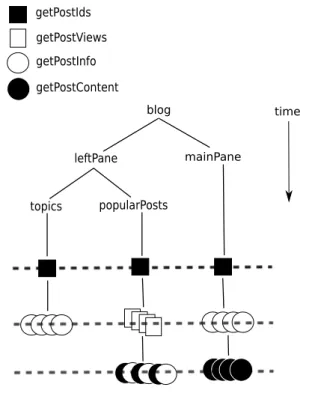
Our goal is to exploit all this inherent concurrency without the programmer having to lift a finger. The framework we will describe in this paper does exactly that: with the code as written, the data will be fetched in the pattern shown in Figure 1. The dotted lines indicate a roundof data-fetching, where all the items in a round are fetched concurrently. There are three rounds:
getPostIds(needed by all three panes)
getPostInfo for all posts (needed by mainPane and
topics), and getPostViews for all posts (needed by
popularPosts).
getPostContent for each of the posts displayed in the main pane, andgetPostInfo and getPostContentfor each of the posts displayed inpopularPosts.
•Caching. We made no explicit attempt to fetch each piece of data only once. For example, we are callinggetPostIdsthree times. Remember the goal is to bemodular: there is no global knowledge about what data is needed by each part of the page.
blog
mainPane
leftPane
topics popularPosts getPostIds
getPostViews getPostInfo getPostContent
time
Figure 1. Data fetching in the blog example
Furthermore, even though we could reasonably predict that we needgetPostIdsin several places and so do it once up front, it is much harder to predict whichgetPostContentcalls will be made: the main pane displays the five most recent posts, and the side pane displays the five most popular posts. There might well be overlap between these two sets, but to write the code to fetch the minimal set ofPostContentwould require destroying the modularity.
Our system uses caching to avoid fetching the same data mul-tiple times, which lets the programmer keep the modularity in their code without worrying about duplicate data fetching. Fur-thermore, as we describe in Section 6, caching has important benefits beyond the obvious performance gains.
2.2 Example: a data-rich DSL
Our second use-case is a service inside the Facebook infrastructure that identifies spam, malware, and other types of undesirable con-tent [11]. Every action that creates an item of concon-tent on the site results in a request to this service, and it is the job of the service to return a result indicating whether the content should be allowed or rejected1. The service runs on many machines, and each instance of the service runs the same set of business logic, which is typically modified many times per day.
As an example of the kind of calculations that our business logic needs to perform, consider this hypothetical expression fragment:
length (intersect (friendsOf x) (friendsOf y))
length is the usual list length operation,intersect takes the intersection of two lists, andfriendsOfis a function that returns the list of friends of a user:
friendsOf :: UserId → [UserId]
The value of this expression is the number of friends thatxand
yhave in common; this value tends to be a useful quantity in our business logic and is often computed.
This code fragment is an example of how we would like the business logic to look: clear, concise, and without any mention of implementation details.
Now, thefriendsOffunction needs to access a remote database in order to return its result. So if we were to implement this directly in Haskell, even if we hide the remote data access behind a pure API likefriendsOf, when we run the program it will make two requests for data in series: first to fetch the friends ofx, and then to fetch the friends ofy. We ought to do far better than this: not only could we do these two requests concurrently, but in fact the database serving these requests (TAO, [14]) supports submitting several requests as a single batch, so we could submit both requests in a single unit.
The question is, how could we modify our language such that it supports an implementation that submits these two requests con-currently? The problem is not just one of exploring simple expres-sions like this; in general we might have to wait for the results of some data accesses before we can evaluate more of the expression. Consider this:
let
numCommonFriends =
length (intersect (friendsOf x) (friendsOf y))
in
if numCommonFriends < 2 && daysRegistered x < 30
then ...
else ...
HeredaysRegisteredreturns the number of days that a user has been registered on the site.
So now, assuming that we want a lazy&&such that if the left side isFalsewe don’t evaluate the right side at all, then we cannot fetch the data fordaysRegistereduntil we have the results of the twofriendsOfcalls.
Scaling this up, when we consider computing the result of a request that involves running a large amount of business logic, in general at any given time there might be many requests for data that could be submitted concurrently. Having fetched the results of those requests, the computation can proceed further, possibly along multiple paths, until it gets blocked again on a new set of data fetches.
Our solution is to build an abstraction usingApplicativeand
Monadto support concurrent data access, which we describe in the next few sections. We will return in Section 5.3 to see how our DSL looks when built on top of the framework.
3.
Concurrency monads
A concurrency monad embodies the fundamental notion of a com-putation that can pause and be resumed. The concurrency monad will be the foundation of the abstractions we develop in this paper. Here is its type:
data Fetch a = Done a | Blocked (Fetch a)
An operation of typeFetch ahas either completed and deliv-ered a valuea, indicated byDone, or it is blocked (or paused), in-dicated byBlocked. The argument toBlockedis the computation to run to continue, of typeFetch a.
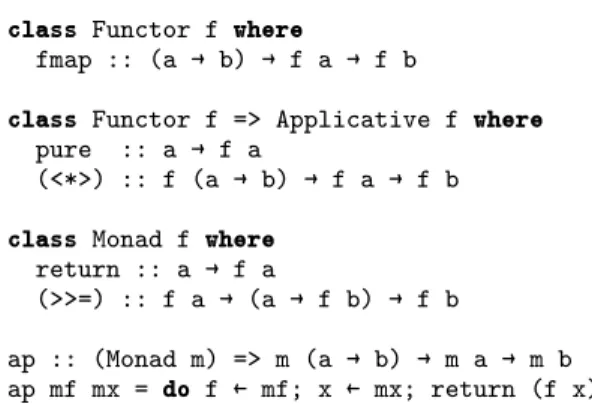
For reference, we give the definitions of the Functor and
Monad type classes in Figure 2. The instances of Functor and
MonadforFetchare as follows:
class Functor f where
fmap :: (a → b) → f a → f b
class Functor f => Applicative f where pure :: a → f a
(<*>) :: f (a → b) → f a → f b
class Monad f where return :: a → f a
(>>=) :: f a → (a → f b) → f b
ap :: (Monad m) => m (a → b) → m a → m b ap mf mx = do f ← mf; x ← mx; return (f x)
Figure 2. Definitions ofFunctor,Applicative,Monad, andap instance Functor Fetch where
fmap f (Done x) = Done (f x)
fmap f (Blocked c) = Blocked (fmap f c)
instance Monad Fetch where return = Done
Done a >>= k = k a
Blocked c >>= k = Blocked (c >>= k)
In general, a computation in this monad will be a sequence of
Blockedconstructors ending in aDonewith the return value. This is the essence of (cooperative) concurrency: for example, one could implement a simple round-robin scheduler to interleave multiple tasks by keeping track of a queue of blocked tasks, running the task at the front of the queue until it blocks again, and then returning it to the end of the queue.
Our monad isn’t very useful yet. There are two key pieces missing: a way to introduce concurrency into a computation, and a way for a computation to say what data it is waiting for when it blocks. We will present these elaborations respectively in the next two sections. Following that, we will return to our motivating examples and show how theFetchframework enables efficient and modular data-fetching.
4.
Applicative concurrency
Concurrency monads have occurred in the literature several times. Scholz [10] originally introduced a concurrency monad based on a continuation monad, and then Claessen [2] used this as the ba-sis for his Poor Man’s Concurrency Monad. This idea was used by Li and Zdancewic [5] to implement scalable network services. A slightly different formulation but with similar functionality was dubbed theresumption monadby Harrison and Procter [4]. The resumption monad formulation was used in describing the seman-tics of concurrency by Swierstra and Altenkirch [12]. OurFetch
monad follows the resumption monad formulation. It is also worth noting that this idea is an instance of afree monad[1].
All these previous formulations of concurrency monads used some kind offorkoperation to explicitly indicate when to create a new thread of control. In contrast, in this paperthere is no fork. The concurrency will be implicit in the structure of the computa-tions we write using this abstraction. To make it possible to build computations that contain implicit concurrency, we need to make
Fetchan Applicative Functor [7]. For reference, the definition of theApplicativeclass is given in Figure 2 (omitting the*>and
<*operators, which are not important for this paper).
Applicative Functors are a class of functors that may have ef-fects that compose using the<*>operator. Morally, the class of
Ap-plicative Functors sits between Functors and Monads: every Monad is an Applicative Functor, but the reverse is not true. For historical reasons,Applicativeis not currently a superclass ofMonadin Haskell, although this is expected to change in the future.
AnApplicativeinstance can be given for anyMonad, simply by makingpure = returnand<*> = ap(Figure 2). However, forFetch we want a custom Applicativeinstance that takes advantage of the fact that the arguments to<*>are independent, and uses this to introduce concurrency:
instance Applicative Fetch where pure = return
Done g <*> Done y = Done (g y) Done g <*> Blocked c = Blocked (g <$> c) Blocked c <*> Done y = Blocked (c <*> Done y) Blocked c <*> Blocked d = Blocked (c <*> d)
This is the key piece of our design: when computations inFetch
are composed using the<*>operator,botharguments of<*>can be explored to search forBlockedcomputations, which creates the possibility that a computation may be blocked on multiple things simultaneously. This is in contrast to the monadic bind operator,
>>=, which does not admit exploration of both arguments, because the right hand side cannot be evaluated without the result from the left.
For comparison, if we used<*> = ap, the standard definition for aMonad, we would get the following (refactored slightly): instance Applicative Fetch where
pure = return
Done f <*> x = f <$> x
Blocked c <*> x = Blocked (c <*> x)
Note how only the first argument of<*>is inspected. The differ-ence between these two will become clear if we consider an ex-ample: Blocked (Done (+1)) <*> Blocked (Done 1). Un-der ourApplicativeinstance this evaluates to:
Blocked (Done (+1) <*> Done 1) ==>
Blocked (Done (1 + 1))
whereas under the standardApplicativeinstance, the same ex-ample would evaluate to:
Blocked (Done (+1) <*> Blocked (Done 1)) ==>
Blocked ((+1) <$> Blocked (Done 1)) ==>
Blocked (Blocked ((+1) <$> Done 1)) ==>
Blocked (Blocked (Done (1 + 1)))
If Blocked indicates a set of remote data fetches that must be performed (we’ll see how this happens in the next section), then with ourApplicativeinstance we only have to stop and fetch data once, whereas the standard instance has two layers ofBlocked, so we would stop twice.
Now that we have established the basic idea, we need to elabo-rate it to do something useful; namely to perform multiple requests for data simultaneously.
5.
Fetching data
In order to fetch some data, we need a primitive that takes a description of the data to fetch, and returns the data itself. We will call this operationdataFetch:
dataFetch :: Request a → Fetch a
whereRequest is an application-specific type that specifies re-quests; a value of typeRequest ais an instruction that the system can use to fetch a value of typea. For now theRequesttype is a concrete but unspecified type; we will show how to instantiate this for our blog example in Section 5.2, and we outline how to abstract the framework over the request type in Section 9.
How can we implementdataFetch? One idea is to elaborate theBlockedconstructor to include a request:
data Fetch a = Done a
| forall r . Blocked (Request r) (r → Fetch a)
This works for a single request, but quickly runs into trouble when we want to block onmultiplerequests because it becomes hard to maintain the connections between multiple result typesr
and their continuations.
We solve this problem by storing results in mutable refer-ences. This requires two changes. First we encapsulate the re-quest and the place to store the result in an existentially quantified
BlockedRequesttype: data BlockedRequest =
forall a . BlockedRequest (Request a)
(IORef (FetchStatus a))
(a foralloutside the constructor definition is Haskell’s syntax for an existentially-quantified type variable).IORef is Haskell’s mutable reference type, which supports the following operations for creation, reading and writing respectively:
newIORef :: a → IO (IORef a) readIORef :: IORef a → IO a writeIORef :: IORef a → a → IO ()
TheFetchStatustype is defined as follows: data FetchStatus a
= NotFetched | FetchSuccess a
Before the result is available, theIORef containsNotFetched. When the result is available, it containsFetchSuccess. As we will see later, using anIORefhere also makes it easier to add caching to the framework.
The use ofIORefrequires that we layer our monad on top of the
IOmonad. In practice this isn’t a drawback, because theIOmonad is necessary in order to perform the actual data fetching, so it will be available when executing a computation in theFetch monad anyway. TheIOmonad will not be exposed to user code.
Considering that we will need computations that can block on multiple requests, our monad now also needs to collect the set of BlockedRequestassociated with a blocked computation. A list would work for this purpose, but it suffers from performance problems due to nested appends, so instead we will use Haskell’s
Seqtype, which supports logarithmic-time append.
With these two modifications (adding IO and attaching Seq BlockedRequestto theBlocked constructor), the monad now looks like this:
data Result a = Done a
| Blocked (Seq BlockedRequest) (Fetch a)
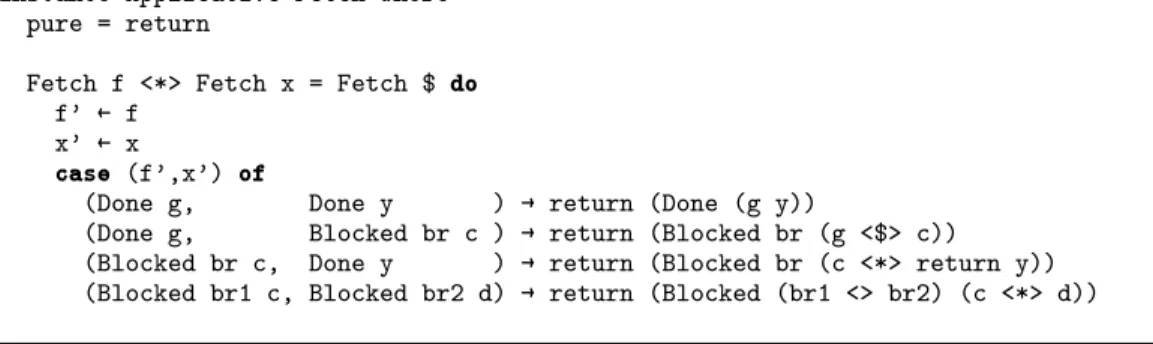
instance Applicative Fetch where pure = return
Fetch f <*> Fetch x = Fetch $ do f’ ← f
x’ ← x
case (f’,x’) of
(Done g, Done y ) → return (Done (g y))
(Done g, Blocked br c ) → return (Blocked br (g <$> c)) (Blocked br c, Done y ) → return (Blocked br (c <*> return y)) (Blocked br1 c, Blocked br2 d) → return (Blocked (br1 <> br2) (c <*> d))
Figure 3. Applicative instance forFetch
instance Monad Fetch where
return a = Fetch $ return (Done a) Fetch m >>= k = Fetch $ do
r ← m
case r of
Done a → unFetch (k a)
Blocked br c → return (Blocked br (c >>= k))
and theApplicativeinstance is given in Figure 3. Note that in the case where both arguments to<*>areBlocked, we must combine the sets of blocked requests from each side.
Finally we are in a position to implementdataFetch:
dataFetch :: Request a → Fetch a dataFetch request = Fetch $ do
box ← newIORef NotFetched -- (1) let br = BlockedRequest request box -- (2) let cont = Fetch $ do -- (3)
FetchSuccess a ← readIORef box -- (4)
return (Done a) -- (5)
return (Blocked (singleton br) cont) -- (6) Where:
•Line 1 creates a newIORefto store the result, initially contain-ingNotFetched.
•Line 2 creates aBlockedRequestfor this request.
•Lines 3–5 define the continuation, which reads the result from theIORefand returns it in the monad. Note that the contents of the IORef is assumed to be FetchSuccess a when the continuation is executed. It is an internal error of the framework if this is not true, so we don’t attempt to handle the error condition here.
•Line 6:dataFetchreturnsBlockedin the monad, including theBlockedRequest.
5.1 Running a computation
We’ve defined theFetch type and itsMonadand Applicative
instances, but we also need a way to runa Fetchcomputation. Clearly the details of how we actually fetch data are application-specific, but there’s a standard pattern for running a computation that works in all settings.
The application-specific data-fetching can be abstracted as a functionfetch:
fetch :: [BlockedRequest] → IO ()
The job offetchis to fill in theIORefin eachBlockedRequest
with the data fetched. Ideally,fetchwill take full advantage of concurrency where possible, and will batch together requests for
data from the same source. For example, multiple HTTP requests could be handled by a pool of connections where each connection processes a pipelined batch of requests. Our actual implementa-tion at Facebook has several data sources, corresponding to various internal services in the Facebook infrastructure. Most have asyn-chronous APIs but some are synasyn-chronous, and several of them sup-port batched requests. We can fetch data from all of them concur-rently.
Givenfetch, the basic scheme for running aFetch computa-tion is as follows:
runFetch :: Fetch a → IO a runFetch (Fetch h) = do
r ← h
case r of
Done a → return a Blocked br cont → do
fetch (toList br) runFetch cont
This works as follows. First, we run theFetch computation. If the result wasDone, then we are finished; return the result. If the result wasBlocked, then fetch the data by callingfetch, and then run the continuation from theBlockedconstructor by recursively invokingrunFetch.
The overall effect is to run the computation in stages that we call rounds. In each roundrunFetchperforms as much computation as possible and then performs all the data fetching concurrently. This process is repeated until the computation returnsDone.
By performing as much computation as possible we maximise the amount of data fetching we can perform concurrently. This makes good use of our network resources, by providing the maxi-mum chance that we can batch multiple requests to the same data source, but it might not be the optimal scheme from a latency per-spective; we consider alternatives in Section 11.
Our design does not impose a particular concurrency strategy on the data sources. The implementation offetchhas complete free-dom to use the most appropriate strategy for executing the requests it is given. Typically that will involve a combination of batching re-quests to individual data sources, and performing rere-quests to mul-tiple data sources concurrently with each other using Haskell’s ex-isting concurrency mechanisms.
5.2 Example: blog
In this section we will instantiate our framework for the blog ex-ample described in Section 2.1, and show how it delivers automatic concurrency.
First, we need to define theRequesttype. Requests are parame-terised by their result type, and since there will be multiple requests with different result types, aRequestmust be a GADT [9]. Here is theRequesttype for our blog example:
data Request a where
FetchPosts :: Request [PostId]
FetchPostInfo :: PostId → Request PostInfo FetchPostContent :: PostId → Request PostContent FetchPostViews :: PostId → Request Int
Next we need to provide implementations for the data-fetching operations (getPostIdsetc.), which are simply calls todataFetch
passing the appropriateRequest:
getPostIds = dataFetch FetchPosts getPostInfo = dataFetch . FetchPostInfo getPostContent = dataFetch . FetchPostContent getPostViews = dataFetch . FetchPostViews
Now, if we provide a dummy implementation of fetchthat simulates a remote data source and prints out requests as they are made2, we do indeed find that the requests are made in three rounds
as described in Section 2.1. A real implementation offetchwould perform the requests in each round concurrently.
5.3 Example: Haxl
In Section 2.2 we introduced our motivation for designing the applicative concurrency abstraction. Our implementation is called
Haxl, and we will describe it in more detail in Section 9.1. Here, we briefly return to the original example to show how to implement it usingFetch.
The example we used was this expression:
length (intersect (friendsOf x) (friendsOf y))
How does this look when used with ourFetchmonad? Any oper-ation that may fetch data must be aFetchoperation, hence
friendsOf :: UserId → Fetch [UserId]
whilelengthandintersectare the usual pure functions. So to write the expression as a whole we need to lift the pure operations into theApplicativeworld, like so:
length <$> intersect’ (friendsOf x) (friendsOf y)
where intersect’ = liftA2 intersect
This is just one way we could write it, there are many other equiv-alent alternatives. As we shall see in Section 7, it is also acceptable to use the plain do-notation, together with a source-to-source trans-formation that turns do-notation intoApplicativeoperations:
do a ← friendsOf x b ← friendsOf y
return (length (intersect a b))
In fact, this is the style we advocate for users of our DSL.
5.4 Semantics ofFetch
It’s worth pondering on the implications of what we have done here. Arguably we broke the rules: while theApplicativelaws do hold forFetch, the documentation forApplicativealso states that if a type is also aMonad, then itsApplicativeinstance should satisfy
pure = returnand<*> = ap. This is clearly not the case for our
Applicativeinstance. But in some sense, our intentions are pure: the goal is for code written usingApplicativeto execute more efficiently, not for it to give a different answer than when written usingMonad.
Our justification for this Applicativeinstance is based on more than its literal definition. We intend dataFetch to have
2Sample code is available at https://github.com/simonmar/ haxl-icfp14-sample-code
certain properties: it should not be observable to the programmer writing code using Fetch whether their dataFetchcalls were performed concurrently or sequentially, or indeed in which order they were performed, the results should be the same. Therefore,
dataFetchshould not have any observable side-effects—all our requests must be read-only. To the user ofFetch it isas if the
Applicativeinstance is the default<*> = ap, except that the code runs more efficiently, and for this to be the case we must restrict ourselves to read-only requests (although we return to this question and consider side-effects again in Section 9.3).
Life is not quite that simple, however, since we are reading data from the outside world, and the data may change between calls to
dataFetch. The programmer might be able to observe a change in the data and hence observe an ordering ofdataFetchoperations. Our approach is to close this loophole as far as we can: in Section 6 we add a cache to the system, which will ensure that identical requests always return the same result within a single run ofFetch. Technically we can argue thatrunFetchis in theIOmonad and therefore we are justified in making a non-deterministic choice for the ordering ofdataFetchoperations, but in practice we find that for the majority of applications this technicality is not important: we just write code as if we are working against a snapshot of the external data.
If we actually did have access to an unchanging snapshot of the remote data, then we could make a strong claim of determinism for the programming model. Of course that’s not generally possible when there are multiple data sources in use, although certain indi-vidual data sources do support access to a fixed snapshot of their data; one example is Datomic3.
5.5 Bulk operations:mapMandsequence
In our example blog code we used the combinators mapM and
sequenceto perform bulk operations. As things stand in Haskell today, these functions are defined using monadic bind, for example
sequenceis defined in the Haskell 2010 Report as
sequence :: Monad m => [m a] → m [a] sequence = foldr mcons (return [])
where mcons p q = do x ← p; y ← q; return (x:y)
Unfortunately, because this uses monadic bind rather than Ap-plicative <*>, in our framework it will serialise the operations rather than perform them concurrently. Fortunately sequence
doesn’t require monadic bind;Applicativeis sufficient [7], and indeed the theData.Traversablemodule provides an equivalent that usesApplicative:sequenceA. Similarly,traverseis the
Applicativeequivalent ofmapM. Nevertheless, Haskell program-mers tend to be less familiar with theApplicativeequivalents, so in our EDSL library we mapsequencetosequenceAandmapMto
traverse, so that client code can use these well-known operations and obtain automatic concurrency.
In due course when Applicative is made a superclass of
Monad, theApplicativeversions of these functions will become the defaults, and our workaround can be removed without changing the client code or its performance.
6.
Adding a cache
In Section 2.1 we identified two ways that the framework can pro-vide automatic performance benefits for the application. So far we have demonstrated the first, namely exploiting implicit concur-rency. In this section we turn our attention to the second: avoiding duplicate requests for data.
The solution is not surprising, namely to add caching. However, as we shall see, the presence of a cache provides some rather nice benefits in addition to the obvious performance improvements.
Recall that data is fetched usingdataFetch:
dataFetch :: Request a → Fetch a
Caching amounts to memoising this operation, such that the second time it is called with a request that has been previously issued, it returns the result from the original request. Not only do we gain performance by not repeating identical data-fetches, as mentioned in Section 5.4 the programmer can rely on identical requests returning the same results, which provides consistency within a singleFetchcomputation in the face of data that might be changing.
We also gain the ability to do some source-to-source transfor-mations. For example, common subexpression elimination:
do x ← N; M ==>
do x ← N; M[return x/N]
WhereMandNstand for arbitraryFetchexpressions, This holds provideddataFetchis the only way to do I/O in our framework, and alldataFetchrequests are cached.
6.1 Implementing the cache
Let’s consider how to add a cache to the system. In order to store a mapping from requests to results, we need the following API: data DataCache
lookup :: Request a → DataCache → Maybe a insert :: Request a → a → DataCache → DataCache
If we want to use an existing efficient map implementation, we cannot implement this API directly because its type-correctness relies on the correctness of the map implementation, and the Eq
and Ord instances for Request. But if we trust these, Haskell provides an unsafe back-door,unsafeCoerce, that lets us convey this promise to the type system. The use of unsafe features to implement a purely functional API is common practice in Haskell; often the motivation is performance, but here it is the need to maintain a link between two types in the type system.
A possible implementation is as follows: newtype DataCache =
DataCache (forall a . HashMap (Request a) a)
The contents of aDataCacheis a mapping that, for all typesa, maps things of typeRequest ato things of typea. The invariant we require is that a key of typeRequest ais either not present in the mapping, or maps to a value of typea. We will enforce the invariant when an element is inserted into theMap, and assume it when an element is extracted. If theMapis correctly implemented, then our assumption is valid.
Note that we use a HashMap rather than a plain Map. This is because Map requires the key type to be an instance of the
Ordclass, butOrdcannot be defined for allRequest abecause it would entail comparing keys of different types. On the other hand, HashMap requires Eq and Hashable, both of which can be straightforwardly defined forRequest a, the former using a standalone deriving declaration:
deriving instance Eq (Request a)
and the latter with a hand-written Hashable instance (see the sample code4).
4https://github.com/simonmar/haxl-icfp14-sample-code
Looking up in the cache is simply alookupin theMap:
lookup :: Request a → DataCache → Maybe a lookup key (DataCache m) = Map.lookup key m
This works because we have already declared that theMapin a
DataCacheworks for all typesa. Theinsertoperation is where we have to make a promise to the type system:
insert :: Request a → a → DataCache → DataCache insert key val (DataCache m) =
DataCache $ unsafeCoerce (Map.insert key val m)
We can insert a key/value pair into theMapwithout any difficulty. However, that results in aMapinstantiated at aparticulartypea
(the type ofval passed to insert), so in order to get back a
Mapthat works for anyawe need to applyunsafeCoerce. The
unsafeCoercefunction has this type:
unsafeCoerce :: forall a b . a → b
Therefore, applying unsafeCoerce to the Map allows it to be generalised to the type required byDataCache.
Now we have a cache that can store a type-safe mapping from requests to results. We will need to plumb this around theMonadto pass it to each call todataFetchso that we can check the cache for a previous result. However, this won’t be enough: consider what happens when we make two identical requests in the sameround: there won’t be a cached result, but nevertheless we want to ensure that we only make a single request and use the same result for bothdataFetchcalls. Indeed, this happens several times in our blog example: the first round issues three calls togetPostIds, for example.
IndataFetchwe need to distinguish three different cases: 1. The request has not been encountered before: we need to create
aBlockedRequest, and block.
2. The request has already been fetched: we can return the cached result and continue.
3. The request has been encountered in the current round but not yet fetched: we need to block, but not create a new
BlockedRequestsince it will already have been added to the set of requests to fetch elsewhere.
The key idea is that in the third case we can share theIORef (FetchStatus a)from theBlockedRequestthat was created the first time the request was encountered. Hence, all calls to
dataFetchfor a given request will automatically share the same result. How can we find theIOReffor a request?We store it in the cache.
So instead of storing only results in ourDataCache, we need to storeIORef (FetchStatus a). This lets us distinguish the three cases above:
1. The request is not in theDataCache.
2. The request is in the DataCache, and the IORef contains
FetchSuccess a.
3. The request is in the DataCache, and the IORef contains
NotFetched.
This implies that we must add an item to the cache as soon as the request is issued; we don’t wait until the result is available. Filling in the details, ourDataCachenow has the following API: data DataCache
lookup :: Request a → DataCache → Maybe (IORef (FetchStatus a))
dataFetch :: Request a → Fetch a dataFetch req = Fetch $ λref → do
cache ← readIORef ref
case lookup req cache of Nothing → do
box ← newIORef NotFetched
writeIORef ref (insert req box cache)
let br = BlockedRequest req box
return (Blocked (singleton br) (cont box)) Just box → do
r ← readIORef box
case r of
FetchSuccess result → return (Done result) NotFetched →
return (Blocked Seq.empty (cont box))
where
cont box = Fetch $ λref → do FetchSuccess a ← readIORef box return (Done a)
Figure 4. dataFetchimplementation with caching
insert :: Request a → IORef (FetchStatus a) → DataCache → DataCache
(the implementation is the same). The cache itself needs to be stored in anIORefand passed around in the monad;Fetchnow has this definition:
newtype Fetch a = Fetch {
unFetch :: IORef DataCache → IO (Result a) }
The alterations to the Monad and Applicative instances are straightforward, so we omit them here.
The definition ofdataFetchis given in Figure 4, The three cases identified earlier are dealt with in that order:
1. If the request is not in the cache, then we create a newIORef
for the result (initially containing NotFetched) and add that to the cache. Then we create aBlockedRequest, and return
Blockedin the monad, with a continuation that will read the result from theIORefwe created.
2. If the request is in the cache, then we check the contents of theIORef. If it containsFetchSuccess result, then we have a cached result, anddataFetchreturnsDoneimmediately (it doesn’t block).
3. If the contents of theIORef isNotFetched, then we return
Blocked, but with an empty set ofBlockedRequests, and a continuation that will read the result from theIORef.
6.2 Cache Persistence and Replaying
Within a singlerunFetch, the cache only accumulates informa-tion, and never discards it. In the use-cases we have described, this is not a problem: requests to a network-based service typically take a short period of time to deliver the result, after which we can dis-card the cache. During a computation we don’t want to disdis-card any cached data, because the programmer might rely on the cache for consistency.
We have found that the cache provides other benefits in addition to the ones already described:
•at the end of a Fetch computation, the cache is a complete record of all the requests that were made, and the data that was
fetched. Re-running the computation with the fully populated cache is guaranteed to give the same result, and will not fetch any data. So by persisting the cache, we can replay computa-tions for the purposes of fault diagnosis or profiling. When the external data is changing rapidly, being able to reliably repro-duce past executions is extremely valuable.
• We can store things in the cache that are not technically re-mote data fetches, but nevertheless we want to have a single deterministic value for. For example, in our implementation we cache the current time: within aFetchcomputation the current time is a constant. We can also memoise wholeFetch compu-tations by storing their results in the cache.
7.
Automatic Applicative
OurFetchabstraction requires the programmer to use the opera-tions ofApplicativein order to benefit from concurrency. While these operations are concise and expressive, many programmers are more comfortable with monadic notation and prefer to use it even whenApplicativeis available. Furthermore, we don’t want to pe-nalise code that uses monadic style: it should be automatically con-current too. Our monad is commutative, so we are free to re-order operations at will, including replacing serial>>=with concurrent
<*>.
In general, the transformation we want to apply is this: do p ← A; q ← B; ...
==> {- if no variable ofpis a free variable ofB-} do (p,q) ← (,) <$> A <*> B
for patternsp and q and expressionsA and B. The transforma-tion can be applied recursively, so that long sequences of indepen-dent statements in do-notation can be automatically replaced by
Applicativenotation.
At the time of writing, the transformation is proposed but not implemented in GHC; it is our intention to implement it as an optional extension (because it is not necessarily valid for every
Applicativeinstance). In ourHaxlimplementation we currently apply this transformation as part of the automatic translation of our existing DSL into Haskell.
8.
Exceptions
Handling failure is an important part of a framework that is de-signed to retrieve data from external sources. We have found that it is important for the application programmer to be able to han-dle failure, particularly transient failures that occur due to network problems or outages in external services. In these cases the pro-grammer typically wants to choose between having the whole com-putation fail, or substituting a conservative default value in place of the data requested.
We need to consider failure in two ways: first, the way in which exceptions propagate in the monad, and second, how failure is handled at the data-fetching layer. We’ll deal with these in order.
8.1 Exceptions inFetch
First, we add explicit exception support to our monad. We need to add one constructor to theResulttype,Throw, which represents a thrown exception:
data Result a = Done a
| Blocked (Seq BlockedRequest) (Fetch a) | Throw SomeException
TheSomeExceptiontype is from Haskell’sControl.Exception
ex-ception we need to convert it to aSomeExceptionand return it withThrow:
throw :: Exception e => e → Fetch a throw e = Fetch $ \_ →
return (Throw (toException e))
TheMonadinstance forFetchwith theThrowconstructor is as follows:
instance Monad Fetch where
return a = Fetch $ λref → return (Done a) Fetch m >>= k = Fetch $ λref → do
r ← m ref
case r of
Done a → unFetch (k a) ref
Blocked br c → return (Blocked br (c >>= k)) Throw e → return (Throw e)
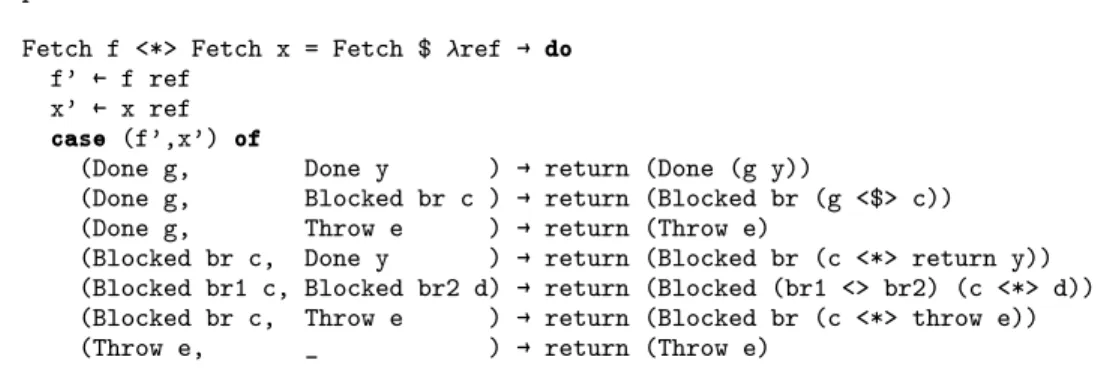
and Figure 5 gives theApplicativeinstance. It is straightforward except for one case: in<*>, where the left side returnsBlocked
and the right side returnsThrow, wemust not propagate the excep-tion yet, and instead we must return aBlockedcomputation. The reason is that we don’t yet know whether the left side will throw an exception when it becomes unblocked; if it does throw an ex-ception, then that is the exception that the computation as a whole should throw, and not the exception from the right argument of<*>. If we were to throw the exception from the right argument of<*>
immediately, the result would be non-determinism: the exception that gets thrown depends on whether the left argument blocks.
We also need acatchfunction:
catch :: Exception e
=> Fetch a → (e → Fetch a) → Fetch a catch (Fetch h) handler = Fetch $ λref → do
r ← h ref
case r of
Done a → return (Done a) Blocked br c →
return (Blocked br (catch c handler)) Throw e → case fromException e of
Just e’ → unFetch (handler e’) ref Nothing → return (Throw e)
As withcatchin theIOmonad, ourcatchcatches only ex-ceptions of the type expected by the handler (the second argument tocatch). The functionfromExceptionreturnsJust e’if the exception can be coerced to the appropriate type, orNothing oth-erwise. The interesting case from our perspective is theBlocked
case, where we construct the continuation by wrapping a call to
catcharound the inner continuation.
8.2 Exceptions indataFetch
When a failure occurs in a data fetching operation, it must be thrown as an exception to the caller ofdataFetch. We need to pro-gram this propagation explicitly, because the data is being fetched in the top-levelrunFetchloop, outside the context of theFetch
computation that calleddataFetch.
We propagate an exception in the same way that we communi-cate the result of the data fetch: via theIORefthat stores the result. So we modify theFetchStatustype to include the possibility that the fetch failed with an exception:
data FetchStatus a = NotFetched
| FetchSuccess a
| FetchFailure SomeException
and we also modifydataFetchto turn aFetchFailureinto a
Throwafter the fetch has executed (these modifications are straight-forward, so we omit the code here).
This is all the support we need for exceptions. There is one pit-fall: we found in our real implementation that some care is needed in the implementation of a data source to ensure that an exception is properly reported as aFetchFailureand not just thrown by the data source; the latter causes the wholeFetchcomputation to be aborted, since the exception is thrown during the call tofetchin
runFetch.
9.
Implementation and evaluation
The basics of our use-case at Facebook were introduced in Sec-tion 2.2. Essentially it is a network-based service that is used to detect and eliminate spam, malware, and other undesirable content on Facebook. There are about 600 different kinds of request, all implemented by a body of Haskell code of approximately 200,000 lines; this was automatically translated into Haskell from our pre-vious in-house DSL, FXL.
The system can be viewed as a rule-engine, where rules are
Fetchcomputations. Each request runs a large set of rules and aggregates the results from all the rules. Rules are often (but not always) short, and most of them fetch some external data. In our system we run all the rules for a request usingsequence; this has the effect of executing all the rules concurrently.
We will give an outline of our implementation in the next sec-tion, and then present some preliminary results.
9.1 Implementation
In the earlier description, the implementation of theFetchmonad depended on theRequesttype, because the monad carries around aDataCachethat storesRequests, and thedataFetchoperation takes aRequestas an argument. This is straightforward but some-what inconvenient, because we want to have the flexibility to add new data sources in a modular way, without modifying a single sharedRequesttype. Furthermore, we want to be able to build and test data sources independently of each other, and to test the framework against “mock” versions of the data sources that don’t fetch data over the wire.
To gain this flexibility, in our implementation we abstracted the core framework over the data sources and request types. Space limitations preclude a full description of this, but the basic idea is to use Haskell’sTypeableclass so that we can store requests of arbitrary type in the cache. ThedataFetchoperation has this type:
dataFetch :: (DataSource req, Request req a) => req a → Fetch a
whereRequestis a package of constraints includingTypeable, andDataSourceis defined like this:
class DataSource req where
fetch :: [BlockedFetch req] → PerformFetch
data PerformFetch = SyncFetch (IO ())
| AsyncFetch (IO () → IO ())
A data source is coupled to the type of requests that it serves, so for each request type there must be an instance ofDataSourcethat defines how those requests are fetched. Thefetchmethod takes a list ofBlockedRequests containing requests that belong to this data source (theBlockedRequesttype is now parameterised by
instance Applicative Fetch where pure = return
Fetch f <*> Fetch x = Fetch $ λref → do f’ ← f ref
x’ ← x ref
case (f’,x’) of
(Done g, Done y ) → return (Done (g y))
(Done g, Blocked br c ) → return (Blocked br (g <$> c)) (Done g, Throw e ) → return (Throw e)
(Blocked br c, Done y ) → return (Blocked br (c <*> return y)) (Blocked br1 c, Blocked br2 d) → return (Blocked (br1 <> br2) (c <*> d)) (Blocked br c, Throw e ) → return (Blocked br (c <*> throw e)) (Throw e, _ ) → return (Throw e)
Figure 5. Applicative instance forFetchwith exceptions
the type of the request that it contains). The job offetchis to fetch the data for those requests; it can do that synchronously or asyn-chronously, indicated by thePerformFetchtype. AnAsyncFetch
is a function that takes as an argument theIOoperation to perform while the data is being fetched. The idea is that when fetching data from multiple sources we wrap all the asynchronous fetches around a sequence of the synchronous fetches:
scheduleFetches :: [PerformFetch] → IO () scheduleFetches fetches = asyncs syncs
where
asyncs = foldr (.) id [f | AsyncFetch f ← fetches] syncs = sequence_ [io | SyncFetch io ← fetches]
In our implementation, most data sources are asynchronous. Maximal concurrency is achieved when at most one data source in a given round is synchronous, which is the case for the vast ma-jority of our fetching rounds. When there are multiple synchronous data sources we could achieve more concurrency by using Haskell’s own concurrency mechanisms; this is something we intend to ex-plore in the future.
9.2 Results
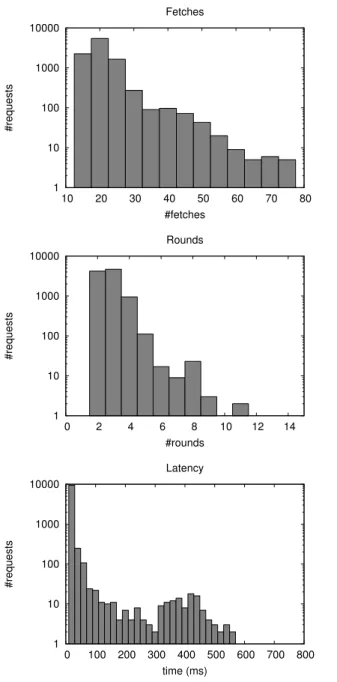
To evaluate how well our system exploits concurrency, we ran a random sample of 10,000 actual requests for a single common re-quest type. We measured the number of data fetches performed by each request (not including those that were served from the cache), the number ofrounds(batches of fetches performed concurrently), and the total end-to-end processing time of each request. Figure 6 gives the results, in the form of histograms of the number of re-quests against fetches, rounds, and total time (latency). Note that the number of requests on the Y-axis is a log scale. In the histogram of fetches, the buckets are 5 wide, so for example the first bar rep-resents the number of requests with 10–15 data fetches (there were no requests that performed fewer than 10 fetches). The histogram of rounds has integral buckets, and the time histogram has buckets of 20ms.
Figure 7 gives the 50th (median), 95th, and 99th percentiles, and the maximum value, for each of fetches, rounds, and time. Note that the figures for each column were calculated by sorting the requests by fetches, rounds, and time respectively. It is not necessarily the case that the request that performed the maximum number of fetches is the same request that took the maximum number of rounds or the longest time.
We can see that 95% of our 10,000 requests require at most 4 rounds of fetching (median 3), 95% perform at most 27 data fetches (median 18), and 95% run in at most 26.3ms (median 9.5ms). There is a long tail, however, with some requests requiring more than
2000 data fetches. A few requests took an inordinately long time to run (the longest was 2.2s), and this turned out to be because one particular data fetch to another service took a long time.
The second table in Figure 7 shows for comparison what hap-pens when we disable concurrency—this was achieved by making
(<*>) = ap, so that<*> no longer batches together the fetches from both of its arguments (caching was still enabled, however). We can see that the number of rounds is equal to the number of fetches, as expected. The experiments were run against production data, so there are minor differences in the number of fetches be-tween the two runs in Figure 7, but we can see that the effect on to-tal runtime is significant, increasing the median time for a request by 51%. One extreme example is the request that required 2793 fetches, which increased from 220ms to 1.3s with concurrency dis-abled. Concurrency had no effect on the pathological data fetches, so the maximum time was unchanged at 2.2s.
9.2.1 Discussion
We have shown that the automatic concurrency provided by our framework has a sizeable impact on latency for requests in our system, but is it enough? Our existing FXL-based system performs similar data-fetching optimisations, but it does so using a special-purpose interpreter, whereas our Haskell version is implemented in libraries without modifying the language implementation.
Our workload is primarily I/O bound, so although Haskell is far faster than FXL at raw compute workloads, this has little ef-fect on comparisons between our two systems. Thus we believe that executing data fetches concurrently is the most important fac-tor affecting performance, and if the Haskell system were less able to exploit concurrency that would hinder its performance in these benchmarks. At the time of writing we have only preliminary mea-surements, but performance of the two systems does appears to be broadly similar, and we have spent very little time optimising the Haskell system so far.
It is also worth noting that the current workload is I/O bound partly because compute-heavy tasks have historically been of-floaded to C++ code rather than written in FXL, because using FXL would have been too slow. In the Haskell version of our sys-tem we have reimplemented some of this functionality natively in Haskell, because its performance is more than adequate for com-pute tasks, and the Haskell code is significantly cleaner and safer. We believe that being able to implement compute tasks directly in Haskell will empower the users of our DSL to solve problems that they couldn’t previously solve without adding C++ primitives to the language implementation.
1 10 100 1000 10000
10 20 30 40 50 60 70 80
#requests
#fetches Fetches
1 10 100 1000 10000
0 2 4 6 8 10 12 14
#requests
#rounds Rounds
1 10 100 1000 10000
0 100 200 300 400 500 600 700 800
#requests
time (ms) Latency
Figure 6. Results
Concurrency Fetches Rounds Time (ms)
50% 18 3 9.5
95% 27 4 26.3
99% 47 5 356.5
Max 2793 11 2200.0
No concurrency Fetches Rounds Time (ms)
50% 17 17 14.4
95% 27 27 36.1
99% 46 46 381.4
Max 2792 2792 2200.0
Figure 7. Summary results, with and without concurrency
9.3 Using Applicative Concurrency with Side-effects
As described, our framework has no side-effects except for reading, for good reason: operations inFetchmay take place in any order (Section 5.4). However, side-effects are important. For example, a web application needs to take actions based on user input, and it might need to generate some statistics that get stored. Our imple-mentation at Facebook has various side effects, including storing values in a separatememcache service, and incrementing shared counters.
One safe way to perform side effects is to return them from
runFetch, and perform them afterwards. Indeed, this is exactly the way that side effects are typically performed when using Software Transactional Memory (STM) in Haskell.
Sometimes it is convenient to allow side-effects as part of the
Fetchcomputation itself. This is fine as long as it isnot possible to observe the side-effect with aFetch operation, which would expose the ordering of operations to the user. But this is quite flexible: we can, for example, have a write-only instance ofFetch
that allows write operations to benefit from concurrency (obviously, the cache is not necessary for this), or we can have side-effects that cannot be observed, such as accumulating statistics.
10.
Comparison and related work
Probably the closest relatives to the Fetch framework are the family of async programming models that have been enjoying popularity recently in several languages: F# [13], C#, OCaml [15], Scala [3], and Clojure5.
A common trait of these programming models is that they are based on a concurrency-monad-like substrate; they behave like lightweight threads with cooperative scheduling. When a compu-tation is suspended, its continuation is saved and re-executed later. These frameworks are typically good for scheduling large numbers of concurrent I/O tasks, because they have lower overhead than the heavyweight threads of their parent languages.
In contrast with theFetchframework, the async style has an explicit fork operation, in the form of an asynchronous method call that returns an object that can later be queried for the result. For example, in C# a typical sequence looks like this:
Task<int> a = getData(); int y = doSomethingElse(); int x = await a;
The goal in this pattern is to performgetData()concurrently with
doSomethingElse(). The effects ofgetData() will be inter-leaved with those ofdoSomethingElse(), although the degree of non-determinism is tempered somewhat by the use of cooperative scheduling.
Ignoring non-determinism, in our system this could be written do [x,y] ← sequence [getData,doSomethingElse]
...
making it clear thatgetDataanddoSomethingElseare executed together.
A similar style is available in F# and C# usingAsync.Parallel
andTask.WhenAllrespectively; so it seems that in practice there are few differences between the asynchronous programming mod-els provided by these languages and ourFetchmonad. However, we believe the differences are important:
• In the asynchronous programming models, concurrency is achieved using special-purpose operations, whereas in our ap-proach existing standard idioms likesequenceandmapM be-come concurrent automatically by virtue of theApplicative 5http://clojure.github.io/core.async/
instance that we are using. Programmers don’t need to learn a new concurrency library; they just use data-fetching operations together with the tools they already know for structuring code, and concurrency comes for free.
•Our system has a built-in cache, which is important for modu-larity, as we described in Section 2.1.
Explicit blocking (as inawaitabove) is often shunned in the asynchronous programming models; instead it is recommended to attach callback methods to the results, like this (in Scala):
val future = getData(); future map(x => x + 1);
This has the advantage that we don’t have to block on the result of the future in order to operate on it, which allows the system to exploit more concurrency. However, the programming style is somewhat indirect; in our system, this would be written
do x ← getData; return (x+1)
Reactive programming models [8] add another dimension to asynchronous programming, where instead of a single result being returned, there is a stream of results. This is a separate problem space from the one we are addressing in this paper.
11.
Further work
The method for taking advantage of concurrency described in Sec-tion 4 is fairly simplistic: we run as much computaSec-tion as possible, and then perform all the data fetching concurrently, repeating these two steps as many times as necessary to complete the computation. There are two ways we could overlap the computation phase with the data-fetching phase:
•As soon as we have the result of any data fetch, we can start running the corresponding blocked part(s) of the computation. •We might want to emit some requests before we have finished
exploring the whole computation. This potentially reduces con-currency but might also reduce latency.
We intend to investigate these in future work.
Acknowledgements
We would like to thank Richard Eisenberg for providing helpful feedback on an early draft of this paper.
References
[1] S. Awodey. Category Theory, volume 49 ofOxford Logic Guides. Oxford University Press, 2006.
[2] K. Claessen. A poor man’s concurrency monad. J. Funct. Program., 9(3):313–323, May 1999.
[3] M. Eriksen. Your server as a function. InProceedings of the Seventh Workshop on Programming Languages and Operating Systems, PLOS ’13, pages 5:1–5:7. ACM, 2013. ISBN 978-1-4503-2460-1. [4] W. Harrison and A. Procter. Cheap (but functional) threads. 44 pages.
Accepted for publication toHigher-Order and Symbolic Computation. [5] P. Li and S. Zdancewic. Combining events and threads for scalable net-work services implementation and evaluation of monadic, application-level concurrency primitives. InProceedings of the 2007 ACM SIG-PLAN Conference on Programming Language Design and Implemen-tation, PLDI ’07, pages 189–199, 2007.
[6] S. Marlow. An extensible dynamically-typed hierarchy of exceptions. InProceedings of the 2006 ACM SIGPLAN Workshop on Haskell, Haskell ’06, pages 96–106, 2006.
[7] C. Mcbride and R. Paterson. Applicative programming with effects.
J. Funct. Program., 18(1):1–13, Jan. 2008. ISSN 0956-7968. [8] E. Meijer. Reactive extensions (Rx): Curing your asynchronous
pro-gramming blues. InACM SIGPLAN Commercial Users of Functional Programming, CUFP ’10, pages 11:1–11:1. ACM, 2010.
[9] S. Peyton Jones, D. Vytiniotis, S. Weirich, and G. Washburn. Sim-ple unification-based type inference for GADTs. InProceedings of the Eleventh ACM SIGPLAN International Conference on Functional Programming, ICFP ’06, pages 50–61. ACM, 2006.
[10] E. Scholz. A concurrency monad based on constructor primitives, or, being first-class is not enough. Technical report, Universit¨at Berlin, 1995.
[11] T. Stein, E. Chen, and K. Mangla. Facebook immune system. In
Proceedings of the 4th Workshop on Social Network Systems, SNS ’11, pages 8:1–8:8. ACM, 2011.
[12] W. Swierstra and T. Altenkirch. Beauty in the beast. InProceedings of the ACM SIGPLAN Workshop on Haskell Workshop, Haskell ’07, pages 25–36, 2007. ISBN 978-1-59593-674-5.
[13] D. Syme, T. Petricek, and D. Lomov. The F# asynchronous program-ming model. InPractical Aspects of Declarative Languages, volume 6539 ofLecture Notes in Computer Science, pages 175–189. Springer Berlin Heidelberg, 2011.
[14] V. Venkataramani, Z. Amsden, N. Bronson, G. Cabrera III, P. Chakka, P. Dimov, H. Ding, J. Ferris, A. Giardullo, J. Hoon, S. Kulkarni, N. Lawrence, M. Marchukov, D. Petrov, and L. Puzar. TAO: How face-book serves the social graph. InProceedings of the 2012 ACM SIG-MOD International Conference on Management of Data, SIGMOD ’12, pages 791–792, 2012.
[15] J. Vouillon. Lwt: A cooperative thread library. InProceedings of the 2008 ACM SIGPLAN Workshop on ML, ML ’08, pages 3–12. ACM, 2008.